Amancio Ortega Turned a Dress Shop Into Zara and a $60 Billion Fortune
Amancio Ortega started with a small dress shop in Galicia and built Inditex, the fast-fashion giant behind Zara, into a global retail empire.
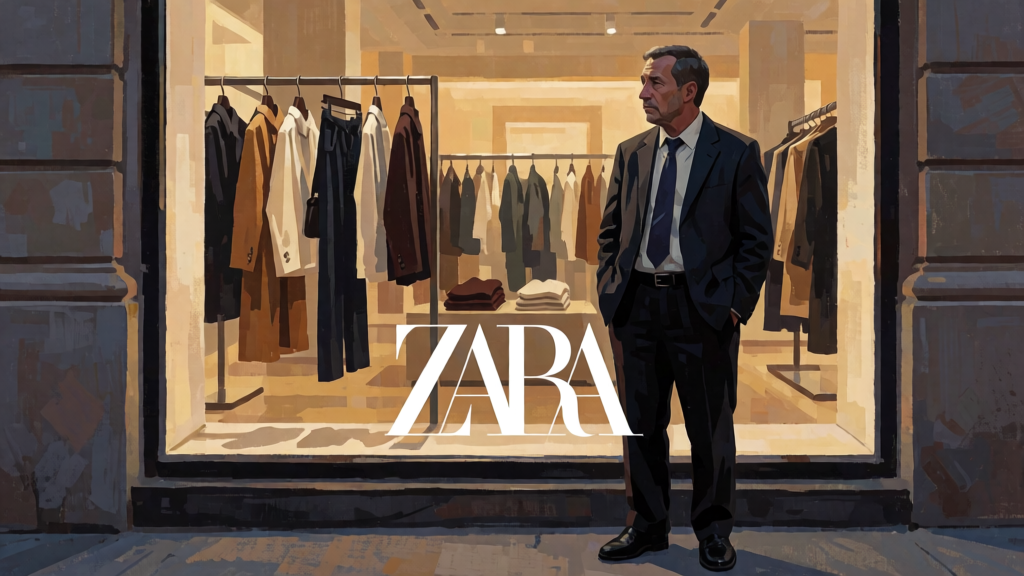
View all stories about this mogul
In 1963, Amancio Ortega opened a small dress shop in A Coruña, Galicia, with his first wife Rosalía Mera. They called it GOA, and it made simple, affordable clothing for local customers. That shop was the seed of Inditex, the company that would eventually own Zara and become one of the world’s largest fashion retailers.
From a Shop to a Factory
Ortega soon moved from retail to manufacturing. He started making garments himself, cutting out middlemen and controlling the supply chain. In 1975, he opened the first Zara store in A Coruña. The name was chosen because it was short and easy to remember. Zara’s model was different: it copied popular designs quickly and produced them in small batches, getting new styles into stores in weeks rather than months.
The move from shopkeeper to manufacturer is the part of the story that tends to get skipped, and it is the part that explains everything that follows. A retailer who buys finished garments from wholesalers is at the mercy of their lead times, their minimum order quantities and their pricing. A retailer who cuts and sews the clothes himself sets those terms. Ortega’s early years in Galicia were spent learning which parts of the chain he could own outright and which he could not, and the answer he arrived at shaped the company’s structure for the next five decades. The first Zara store was not a leap into the unknown so much as the visible tip of a supply chain he had already built behind it.
There is a reason this phase is underreported. Manufacturing is unglamorous next to the opening of a store, and the intermediate steps — sourcing fabric, organising cutting and sewing, arranging transport between workshops — do not photograph well. But they are where the economics of the business were settled. Owning production meant Ortega could decide how much of a given design to make, when to stop making it, and how quickly to replace it, without waiting on a third party’s schedule. Those are precisely the decisions that later became the public face of Zara, and they were only possible because the capability had been assembled quietly, years before anyone outside Galicia was paying attention.
The Fast-Fashion Machine
Ortega’s insight was vertical integration. Inditex controlled design, manufacturing, distribution, and retail. This allowed Zara to respond to trends almost in real time. Stores would receive new shipments twice a week, and unsold items were limited. The result was high turnover and frequent customer visits. By the 1990s, Zara had expanded across Spain and into Portugal, France, and the United States.
It is worth being precise about what vertical integration actually buys a company, because the phrase is often used loosely. Control of design, manufacturing, distribution and retail in one set of hands means decisions can be made and acted on inside a single organisation rather than negotiated across several. A trend spotted in a store can become a garment in production without a supplier renegotiating a contract or a distributor reallocating space. The twice-weekly shipments are not a marketing gimmick; they are the visible output of a system in which the gap between observing demand and meeting it has been compressed. Limiting unsold items does something similar on the other side of the ledger: it keeps inventory from accumulating and forces the assortment to keep moving.
Consider what the alternative looks like, because the contrast is instructive. A conventional retailer working through wholesalers plans a season months in advance, commits to volumes, and then lives with the consequences until the next buying cycle. If a design sells poorly, the inventory sits; if it sells well, reordering takes time and the moment may pass. The twice-weekly cadence and the deliberate scarcity of unsold items attack both failure modes at once. They shorten the interval between a bet and its result, which means mistakes are cheaper and successes can be reinforced faster. That is the operational logic beneath the shopping experience, and it is why the model spread so widely once competitors saw it working.
The Mechanism Behind the Speed
The speed is the headline, but the mechanism is organisational. Inditex built a structure in which the people closest to the customer — the store staff — feed information back into design and production, and in which the production side is close enough to the retail side to act on that information quickly. That is a management achievement as much as a logistical one. It requires a company willing to accept short production runs, to tolerate the risk of getting a trend wrong, and to keep decision rights concentrated enough that a signal from a shop floor can travel to a cutting table without passing through layers of approval.
This is also why the model has been so hard for rivals to copy in full. Competitors can imitate the look of a fast-fashion store, the frequency of deliveries, the low prices. What is harder to imitate is the underlying arrangement: owning enough of the chain to move quickly, and being disciplined enough not to let inventory build up when a bet does not pay off. The twice-weekly shipments that customers see are the end of a process that begins much earlier, in decisions about what to make, how much to make, and where to send it.
There is a human dimension to that arrangement that is easy to overlook. Short production runs and rapid turnaround place demands on the people doing the designing, cutting, sewing and shipping, and they require a workforce and a set of suppliers able to flex with demand rather than settle into a fixed seasonal rhythm. The organisational achievement, in other words, is not only about decision rights at the top; it is about whether the rest of the organisation can absorb frequent change without losing coherence. Companies that adopt the visible tactics without building that capacity tend to find the cadence collapses under its own weight, with deliveries arriving but nothing behind them to make the arrivals meaningful.
Global Expansion and Public Listing
In 2001, Inditex went public, and Ortega’s stake made him one of the richest people in Spain. The company continued to grow, launching brands like Massimo Dutti, Pull&Bear, and Bershka. By 2023, Inditex operated over 5,800 stores in 96 markets. Ortega stepped down as chairman in 2011 but remained a major shareholder.
The multi-brand strategy deserves a moment of its own, because it is often treated as a footnote to Zara. Launching Massimo Dutti, Pull&Bear and Bershka gave Inditex a portfolio aimed at different customers and different price points, sharing the same underlying approach to supply and distribution while presenting distinct identities on the high street. The 2001 listing changed the company’s relationship with capital, and Ortega’s continued position as a major shareholder after stepping down as chairman in 2011 meant the founder’s influence did not end with his executive role. The scale reached by 2023 — over 5,800 stores across 96 markets — is the cumulative result of that expansion, brand by brand and market by market.
The sequencing matters here too. The international push of the 1990s established that the model could travel beyond its home market; the 2001 listing gave the company access to public capital; the multi-brand portfolio widened the range of customers it could reach without diluting any single brand’s identity. Each step built on the infrastructure the previous one had required. A retailer cannot simply decide to operate in 96 markets; it has to have the distribution, the sourcing and the local market knowledge to make each entry work, and those capabilities compound over time rather than arriving all at once. The 2023 figures are best read as the cumulative tally of that compounding, not as a single strategic stroke.
A Low-Profile Billionaire
Despite his wealth, Ortega is famously private. He rarely gives interviews and avoids the spotlight. He owns a stake in a real estate portfolio and has invested in infrastructure. His fortune, estimated at over $60 billion, makes him one of the wealthiest individuals in Europe.
The reticence is not incidental to the business story; it is part of how the story has been told. A founder who rarely gives interviews leaves the company’s results and its stores to speak for him, and that has shaped the public image of Inditex as an organisation that prefers to be judged on operations rather than on pronouncements. The real estate holdings and infrastructure investments point to a pattern familiar among founders who have built operating businesses: diversifying into assets that are slower-moving and less exposed to the rhythms of retail. The fortune estimated at over $60 billion is the balance sheet of that long accumulation, and it sits alongside a public profile that remains deliberately small.
That combination — enormous wealth and near-total public silence — has practical consequences for anyone trying to understand the company. There is comparatively little founder mythology to draw on, few memorable quotations, and no steady stream of pronouncements to interpret. What remains is the record: the store counts, the market entries, the corporate milestones. For a reader, that is a discipline in itself. It forces attention onto what can be verified rather than onto personality, and it is a useful corrective in an industry that often runs on narrative as much as on numbers.
The Legacy of a Retail Pioneer
Ortega’s approach changed the fashion industry. The fast-fashion model he pioneered is now standard, but Inditex remains a leader. The company’s success is built on speed, control, and a deep understanding of local markets. Ortega’s story is a reminder that retail innovation often comes from the ground up, not from boardrooms.
That last point is worth dwelling on. The innovations described here were not conceived in a strategy department and handed down; they emerged from the practical problems of a shopkeeper in Galicia who wanted more control over what he sold and how quickly he could sell it. The lesson generalises beyond fashion: some of the most durable operational advantages in any industry begin as unglamorous solutions to immediate problems, and only later look like strategy in retrospect.
What the Model Does Not Explain
There is a caveat worth holding alongside the celebration, and it is a caveat about evidence rather than about virtue. The fast-fashion model is widely credited with reshaping the industry, and Inditex’s scale is undeniable, but the model’s success does not by itself prove that speed is the only route to retail longevity. Inditex remains a leader in a field where the approach he pioneered is now standard — which means the advantage is no longer the idea alone but the execution, the scale and the accumulated infrastructure behind it. A company that adopts fast-fashion tactics without the vertical integration underneath them gets the look of the model without the mechanism.
It is also worth noting what the numbers in this story can and cannot tell us. Store counts and market reach describe footprint, not profitability or resilience in any particular year. The 2001 listing and the 2011 handover of the chairmanship describe governance milestones, not a verdict on strategy. And the estimate of Ortega’s fortune is just that — an estimate, moving with markets. Reading the Inditex story carefully means separating the durable structural facts, such as vertical integration and the cadence of shipments, from the headline figures that change with the news cycle.
There is a further caution about causation. The company grew through decades in which global retail expanded, supply chains lengthened and emerging markets opened, and some of its success reflects those tailwinds as much as any internal genius. Attributing everything to vertical integration would be too tidy. What can be said with confidence is narrower and more useful: the structure gave Inditex options that competitors lacked, and it exercised them consistently. That is a claim about capability, not about inevitability, and it is the more defensible version of the story.
What This Means for the Reader
The practical lesson is less about fashion than about where control sits in a supply chain. Ortega began with a single shop making simple, affordable clothing for local customers, and the through-line from that shop to a company operating over 5,800 stores in 96 markets is a through-line about ownership: of production, of distribution, of the retail floor, and of the information that flows between them. Whether you run a shop, a brand or something else entirely, the question the Inditex story poses is the same one Ortega answered in Galicia in the 1960s and 1970s — which links in the chain do you need to hold yourself, and which can you afford to leave to someone else?
The answer will differ by business. But the discipline of asking it, and the willingness to build the structure that follows from the answer, is the part of Ortega’s approach that travels furthest beyond fashion. The fast-fashion model he pioneered is now standard; the habit of mind behind it — own what determines your speed, and let the rest follow — is the part that still distinguishes the companies that execute it from those that merely imitate it.
And the habit of mind is not only about acquisition. It is also about restraint: knowing which parts of the chain to leave alone, which risks to accept, and which signals to trust. Ortega’s career, read carefully, is a long argument that control is worth paying for when it determines how fast you can learn and respond, and worth forgoing when it does not. That distinction, more than any single store or shipment schedule, is what the story leaves behind.
💡 Key Insights
- ▸ Vertical integration gave Zara unmatched speed in responding to fashion trends.
- ▸ Ortega's low-profile nature contrasts with the global visibility of his brand.
- ▸ Inditex's public listing in 2001 turned Ortega into one of Europe's richest individuals.
- ▸ The fast-fashion model he pioneered remains a blueprint for retailers worldwide.