Fred Smith Sent Packages Through Memphis to Sell Overnight Certainty
Fred Smith made Memphis the meeting point for overnight packages, then used tracking, larger aircraft and acquisitions to turn a delivery promise into FedEx.
View all stories about this mogul
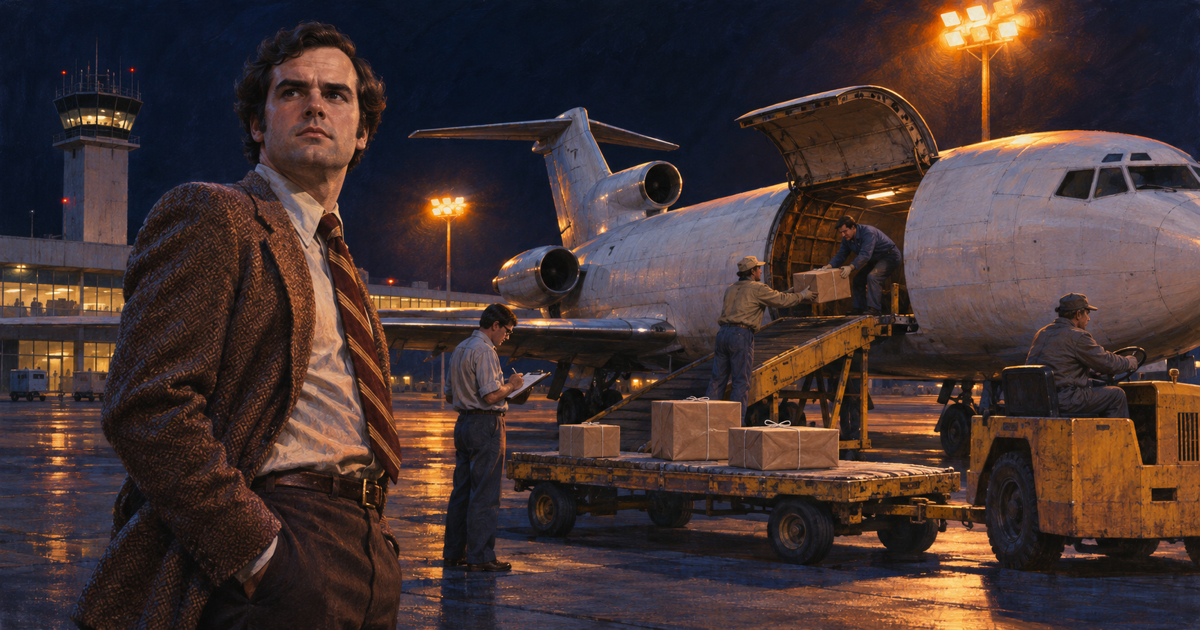
On April 17, 1973, Federal Express began operating from Memphis with 389 employees and 14 aircraft. Its first night’s deliveries amounted to 186 packages across 25 American cities. Those figures, recorded in the company’s history, describe a striking imbalance: Frederick W. Smith had assembled an airline and a delivery organization for a shipment count that could fit inside a modest office. The network had to exist before enough customers arrived to justify it. FedEx history.
Smith’s proposition required customers to accept another apparent imbalance. A package could travel toward Memphis rather than directly toward its recipient, change aircraft during the night, and still arrive the next day. The extra handling was part of a system designed to make delivery more predictable. What mattered commercially was the elapsed time between collection and receipt, rather than the straightness of the route.
That distinction became the foundation of FedEx. Smith organized transportation around a deadline, then added the aircraft, sorting capacity and information systems needed to meet it repeatedly. His achievement can be measured in the distance between those first 186 packages and a durable business. Its limits are visible in an expensive attempt to apply the same delivery logic to electronic documents.
A deadline became the product
Federal Express was founded in Little Rock, Arkansas, in 1971, two years before its Memphis operating launch. The gap matters. Creating the corporation and creating a functioning overnight network were separate undertakings. An airline needed aircraft and crews; a delivery service also needed collections, sorting, local transportation and a reliable way to connect each stage.
FedEx traces Smith’s underlying concept to a Yale term paper in 1965. Its history says the paper received an average grade. The more consequential detail is the proposed integration of air and ground transportation. Smith was considering the shipment as a complete journey, rather than treating the flight as the service and leaving everything around it to chance. FedEx’s account of Smith’s career.
The economic distinction is straightforward. A fast flight cannot rescue a package that misses collection, waits too long for transfer or reaches its destination airport without an onward delivery arrangement. Every handoff consumes part of the available time. An overnight commitment makes those handoffs the carrier’s operating problem, even when the customer never sees them.
Consider a hypothetical manufacturer waiting for a replacement component. The relevant comparison is between the shipping bill and the cost of leaving equipment idle. A document needed for a transaction presents a similar calculation: its weight may be negligible, while the consequences of delay are substantial. These examples explain why some shipments can support a premium for speed and reliability without implying that every parcel needs an aircraft.
Smith’s business therefore depended on identifying demand for a particular service standard. Competing only on transportation cost would have made the expense of dedicated aircraft difficult to defend. A delivery deadline offered a different basis for purchasing. It gave customers something they could incorporate into their own schedules, provided Federal Express could earn their confidence through execution.
The company name reflected the scale of that ambition. According to FedEx, Smith thought “federal” suggested nationwide economic activity and hoped it would appeal to the Federal Reserve Bank as a prospective customer. The name supplied an impression of national reach while the operation was still being assembled. The actual reach would have to come from routes, facilities and repeated departures.
Memphis made the detour useful
Memphis was a practical choice rather than a decorative headquarters address. FedEx lists its central location, an airport rarely closed by bad weather, available hangar space and the airport’s willingness to improve facilities among the reasons for locating there. Each consideration addressed a constraint that could interrupt the nightly movement of packages. FedEx history.
The hub worked by pooling shipments. Aircraft brought packages from different origins into a common sorting point; those packages were regrouped by destination and dispatched outward. A plane serving one city could therefore carry shipments connected to many other cities without requiring a separate direct flight for every possible origin and destination.
A simplified calculation shows the appeal. Twenty-five cities have 300 possible two-city pairings. Connecting 24 outlying cities to one central city requires 24 basic spoke connections. This is an illustration of network geometry, not a reconstruction of Federal Express’s original timetable. Real schedules must account for aircraft capacity, demand, maintenance and departure windows. Even so, the comparison explains why a detour can make a wider service economically possible.
Pooling demand also changes the question asked about a route. A flight into the hub can carry packages destined for the entire connected network. Its commercial usefulness does not depend solely on customers shipping to Memphis. The sorting operation converts traffic arriving from one set of places into traffic leaving for another, allowing separate local markets to support shared transportation capacity.
The arrangement imposes discipline. Inbound flights must arrive early enough for packages to be unloaded and sorted; outbound flights must leave early enough for delivery work at the other end. A delayed arrival can affect more than one destination because its cargo may be distributed among several departing aircraft. The efficiency of concentration comes with exposure to a concentrated point of disruption.
That is why the first night’s small volume is revealing. The basic sequence still required people to collect, move, sort and deliver packages. A sparse network cannot simply omit those functions because revenue is disappointing. Aircraft and facilities create substantial commitments ahead of demand, while the customer’s reason for paying depends on those commitments being maintained.
Smith was taking a risk on the eventual density of the system. More packages moving through existing facilities can spread common costs across a larger revenue base, until capacity needs expansion. Too few packages leave expensive resources underused. Too many can overwhelm the sort and damage the delivery standard. Growth must therefore be matched to capacity with more care than a rising shipment total alone suggests.
Larger aircraft changed the calculation
The next constraint was partly regulatory. FedEx’s history connects its purchase of seven Boeing 727s in 1977 with congressional deregulation of air cargo following company lobbying. The important business consequence was access to larger aircraft. The original network could gain customers, but growth also required permission and equipment to carry their shipments efficiently.
This was a different kind of entrepreneurial work from designing a route map. A founder operating aircraft must deal with the rules governing those aircraft. Commercial demand does not remove a legal limit on available capacity. Smith’s expansion illustrates how a business model can depend on a change outside the company’s own facilities, and why management attention may extend into transportation policy.
Larger planes offer potential savings when sufficient traffic exists to fill them. Their costs can be distributed across more shipments, and an established route can carry additional business without multiplying departures in the same proportion. But capacity alone does not create an advantage. An underfilled large aircraft can compound the financial burden of an underfilled small one.
The sequence mattered: develop demand, obtain suitable capacity, and keep the ground operation able to process what the aircraft deliver. The hub’s usefulness depended on those elements moving together. Faster expansion in one part of the system could create a bottleneck elsewhere. Selling more overnight shipments than the sort could handle would weaken the very promise that supported the price.
Federal Express listed on the New York Stock Exchange in 1978. For a company whose service required expensive physical assets, access to capital was part of the operating story. Investors were financing an organization in which future demand had to justify aircraft and infrastructure acquired in the present. The deadline sold to customers rested on commitments that could not be switched off between individual orders.
The distinction between revenue growth and financial resilience remains essential when assessing this model. High shipment volumes do not by themselves disclose the quality of earnings. Prices, aircraft utilization, labor, fuel, maintenance and capital spending all affect the result. Smith’s network created a way to aggregate demand; management still had to turn that demand into returns after paying for the system.
Tracking became part of delivery
The physical network required a corresponding information network. FedEx dates the introduction of COSMOS, its centralized system for managing operational information, to 1979. Its anniversary history also records a PC-based automated shipping system in 1984, handheld SuperTracker barcode scanners in 1986 and online package-status tracking in 1994. These were successive investments in knowing what the transportation network was doing. FedEx’s technology chronology.
A package can be moving correctly while its sender remains uncertain. Without status information, the customer must either trust the carrier without evidence or ask someone to investigate. Tracking reduces that uncertainty by making events in the shipment’s journey visible. It also creates a record against which the carrier’s delivery commitment can be checked.
For the operator, information has a more immediate use. A package that reaches the wrong location needs intervention; a delay needs to be understood early enough for a response to remain possible. Records of collection, transfer and delivery help distinguish a physical failure from a missing update. The value lies in connecting an observation to a decision, rather than accumulating data for its own sake.
These investments fit Smith’s original proposition. A customer buying a deadline benefits from evidence about progress toward that deadline. Transportation and information therefore support the same transaction. The aircraft moves the goods; the tracking record helps the customer decide whether to keep a production appointment, alert a recipient or investigate an exception.
There is also a useful limit to the claim. A scan is evidence of an event, not proof that every subsequent stage will proceed as planned. Publishing status cannot substitute for sorting capacity or an available aircraft. Information improves the usefulness and management of the service only when the underlying operation can respond to what the information reveals.
Online tracking extended access to that record. Instead of requiring each inquiry to pass through an employee, the carrier could let customers retrieve shipment status themselves. The broader lesson is specific to the transaction: making a service observable can increase its practical value. For FedEx, visibility helped turn an overnight promise from a statement on a sales document into something a customer could monitor.
ZapMail exposed a boundary
Smith’s organization also pursued a service in which the document could travel electronically. FedEx launched ZapMail in 1984, offering delivery of document facsimiles within two hours or less. The proposition compressed the timetable beyond what an overnight aircraft network could provide. Yet the financial result was severe enough to make ZapMail a necessary part of any balanced account of Smith’s expansion. FedEx financial timeline.
The company’s 1987 annual report gives the accounting detail. Federal Express announced the discontinuance of ZapMail on September 29, 1986, and phased out the services by May 31, 1987. It recorded a $357 million pretax loss, or $195 million after tax benefits, associated with the discontinuance. The distinction matters: the smaller figure often repeated in historical timelines is an after-tax amount. 1987 annual report, Note 9.
The report also separates operating losses from the charge associated with ending the business. For fiscal 1986, ZapMail recorded approximately $33 million in revenue and a $131.9 million operating loss. Those figures describe an operation whose expenses were far beyond its sales. They should not be casually added to a disposal figure without considering the periods and accounting categories involved.
ZapMail presents a question about the boundary of a carrier’s advantage. Physical goods need physical movement. Information can sometimes reach the recipient without the transportation organization that carries an original sheet of paper. A business serving urgent documents must therefore consider whether customers need the original object, the information it contains, or both.
That distinction does not, by itself, establish every cause of ZapMail’s failure. The financial statements demonstrate the losses and the decision to withdraw; they do not justify reducing the episode to a single explanation about technology. What the episode clearly establishes is that success in one urgent-delivery service did not guarantee acceptable economics in another.
Stopping the service was consequential too. A founder’s earlier success can make a new initiative seem entitled to more time and capital. The discontinuance placed a limit on that commitment. FedEx retained its transportation business while abandoning an offering whose reported results could not support its costs. Smith’s record includes both the willingness to finance a network ahead of demand and the eventual withdrawal from a costly extension.
International reach required another method
Federal Express expanded internationally through more than the gradual addition of its own flights. Its financial timeline records the $895 million acquisition of Flying Tiger Line in 1989 and the merger of operations on August 7 that year. The acquisition added substantial international routes. Smith was purchasing access and operating reach as well as aircraft. FedEx financial timeline.
This approach addressed a problem that a domestic hub could not solve alone. International service requires a functioning path across jurisdictions, airports and local delivery arrangements. An aircraft capable of crossing an ocean is only one element. Buying an existing carrier can provide capabilities that would take time to assemble separately, although it introduces the cost and difficulty of combining organizations.
The acquisition also complicates a familiar founder narrative. Smith did not rely on a single method of expansion throughout his career. The early Federal Express system was assembled to demonstrate a particular service. Later growth included purchasing an established carrier with routes that strengthened the wider network. Organic development and acquisition served different needs at different stages.
Both methods ultimately faced the same test: whether the enlarged operation could provide a service customers valued at prices that covered its costs. A broader map is commercially useful when its connections work. It can also add complexity, underused assets and operational dependencies. The strategic value of reach must be established through the shipments that use it, rather than inferred from the number of destinations alone.
Smith’s formal operating leadership eventually passed to a successor. FedEx’s March 2022 announcement named Raj Subramaniam as president and chief executive effective June 1, with Smith becoming executive chairman. Smith died in June 2025 at 80. Those dates close the founder’s personal chronology without suggesting that the continuing company’s decisions or results can all be attributed to him. FedEx succession announcement filed with the SEC.
His lasting contribution was an operating design that made a delivery deadline commercially repeatable. Memphis concentrated shipments; aircraft connected the spokes; information helped employees and customers follow the journey. ZapMail showed that the design’s success had boundaries. Together, the network and the failed extension provide a more useful account of Smith than a story in which every ambitious expenditure was destined to work.
Frequently asked questions
Who founded FedEx?
Frederick W. Smith founded Federal Express in 1971. Its Memphis delivery operation launched on April 17, 1973.
Why did Federal Express use Memphis?
FedEx cites its central location, relatively dependable airport weather, available hangar space and airport support for improvements.
What did the ZapMail discontinuance cost?
The 1987 annual report records a $357 million pretax charge, equivalent to $195 million after tax benefits.
💡 Key Insights
- ▸ A delivery deadline required control of the complete shipment journey.
- ▸ Memphis pooled demand that separate direct routes could not efficiently serve.
- ▸ Tracking made the service observable to customers and operators.
- ▸ ZapMail demonstrated the financial limits of extending a successful model.
Sources
- FedEx — Company history ↗
- FedEx — Frederick W. Smith, Visionary Founder of FedEx, Dies at 80 ↗
- FedEx — Financial timeline ↗
- FedEx — 40th anniversary and technology chronology ↗
- Federal Express — 1987 annual report, Note 9: Discontinued Operations ↗
- FedEx — 2022 CEO succession announcement, SEC exhibit ↗