George Lucas Kept Sequel Rights and Sold Lucasfilm for $4 Billion
George Lucas sought sequel rights to protect his filmmaking freedom. Those rights helped turn a film production company into a business Disney valued at $4.05 billion.
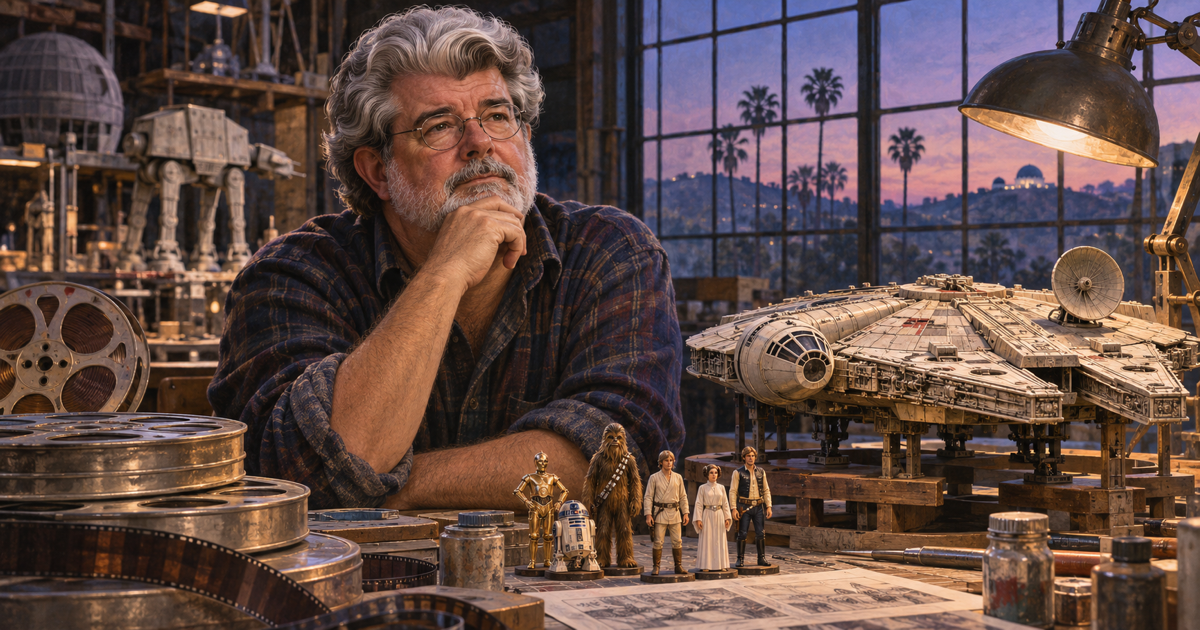
View all stories about this mogul
On October 30, 2012, Disney announced a $4.05 billion agreement to acquire Lucasfilm, a company its announcement identified as wholly owned by George Lucas. The proposed payment was roughly half cash and half Disney shares. Lucas was selling a filmmaking business, technical operations and the rights behind Star Wars—the space adventure whose sequels he had once negotiated to keep within his own control. Disney’s acquisition announcement records the transaction’s original terms.
The ownership mattered as much as the price. A director paid to make a successful picture receives compensation under a contract. A proprietor who controls the continuing property can also decide what happens when the first picture leaves theaters. Lucas had spent decades occupying both positions. By 2012, he could transfer the company that held those continuing opportunities to a buyer equipped to exploit them across several businesses.
The familiar version of this history centers on merchandise: a filmmaker recognized the value of toys while studio executives overlooked it. Lucas’s own account offers a more specific starting point. He wanted protection against a studio deciding that his story should stop. What eventually became a multibillion-dollar acquisition began, in his telling, with the practical problem of obtaining permission to continue making films.
A company formed around the next picture
Lucasfilm began in 1971, following Lucas’s experience with American Zoetrope, the independent filmmaking venture associated with Francis Ford Coppola. Lucas’s first feature, THX 1138, came through Zoetrope; financial trouble there helped push him toward a company of his own. Lucasfilm’s corporate history describes the new entity as initially little more than a legal name established to support his next production. Lucasfilm’s American Graffiti retrospective traces that beginning.
That next production, American Graffiti, drew on Lucas’s adolescence in Modesto, California. Gloria Katz and Willard Huyck worked with him on the screenplay, while Coppola served as executive producer. The film’s success subsequently helped finance a headquarters in San Anselmo and the visual-effects operation that became Industrial Light & Magic.
This sequence gives the company’s early development a concrete financial shape. Lucas needed a legal vehicle to undertake a production. A successful production then supplied money for premises and technical capability. The business acquired substance through work that audiences had already paid to see. Its facilities were an investment of proceeds from filmmaking into the means of making another, more demanding film.
The distinction is important because owning a company provides little independence when that company cannot finance its activities. Incorporation establishes who holds shares and signs agreements; it does not pay a crew. American Graffiti gave Lucas resources that a company name alone could never supply. Those resources made his next negotiation more consequential because he had something to contribute beyond an unproduced idea.
They also connected two apparently different films. A story about teenagers, cars and a single summer evening helped fund the organization needed for a space fantasy. Lucasfilm’s later identity can make that transition look inevitable. At the time, earnings from one kind of entertainment were being committed to an uncertain project in another.
The sequel was an issue of permission
Star Wars still required a studio relationship. The American Film Institute’s production history records Universal’s involvement in Lucas’s earlier work and the project’s eventual move to Twentieth Century-Fox. Fox executive Alan Ladd Jr. supported Lucas after seeing American Graffiti, despite doubts elsewhere within the studio. Star Wars reached American theaters on May 25, 1977. The AFI catalog documents the development and release.
In an interview preserved by the Academy of Achievement, Lucas explained that he secured sequel rights because he wanted to make the continuing story even if the studio declined. He also described merchandising as a possible means of promoting the film through products such as shirts and posters. His retrospective explanation emphasizes survival and continuity, rather than a precisely calculated forecast of future licensing income. Lucas’s account of the rights negotiations is the clearest statement of that motivation.
A sequel right answers a question that a directing fee cannot: who has authority to return to these characters? If the answer is the financing studio alone, the filmmaker’s desire to continue is insufficient. Another investment decision must occur, and the studio may prefer a different project, a different director or no sequel at all. Retaining rights changes the filmmaker’s position in that decision.
It does not remove every dependency. A rights holder still needs production money, people and a route to audiences. A legal entitlement cannot guarantee an affordable shoot or a distributor willing to support it. But it gives the holder an asset to organize those relationships around. The next negotiation begins with someone who controls a necessary permission.
Lucas’s account therefore supports a narrower and more useful conclusion than the idea that he simply predicted the toy market. He understood a specific vulnerability in his working arrangements and sought a contractual remedy. The eventual financial consequences were much larger than the immediate problem he described, but the problem itself was practical: preserving the ability to finish a story.
His remarks about the limited movie-merchandising market should also be read as his recollection of the opportunity he perceived. They do not establish that licensed film products had never existed. The significant point is what he expected the rights to accomplish for his production, rather than a claim that every other filmmaker had ignored merchandise.
Characters became assets beyond the screen
A film ticket and a merchandise license represent different transactions. The ticket purchases access to an exhibition. A license authorizes another business to use specified property under agreed conditions. The licensee then undertakes activities such as manufacturing, distribution and retailing. For the rights holder, this creates a way to earn from characters without performing every task required to put a physical product into a customer’s hands.
That arrangement distributes work and risk across several businesses. A toy company must consider tooling, safety, inventory and retailer demand. The owner of the characters must consider the permission being granted, the payment terms and the effect of the resulting products on the property. Success requires both sides to perform; owning a popular character does not make every licensed product profitable.
By the acquisition announcement, this was a substantial part of Lucasfilm’s business. On Disney’s October 2012 investor call, chief financial officer Jay Rasulo said expected annual consumer-products licensing revenue was comparable to the roughly $215 million Marvel had generated in consumer-products revenue in 2009. He also identified opportunities outside toys and North America. Those were management’s contemporary estimates and ambitions, presented to investors evaluating the deal. Disney’s acquisition-call transcript supplies the comparison.
The revenue terminology matters. Money collected by a licensor is different from the total retail value of goods sold under its licenses. A customer’s payment for a toy is divided among businesses with different costs and obligations. Treating the entire retail sale as revenue belonging to the character owner would overstate the business being acquired.
There is also a timing difference. A theatrical release concentrates attention around a particular date. Licensed goods can remain available between releases, provided customers still want them and partners keep supplying them. This gives an enduring property more ways to maintain commercial activity, although it never guarantees that demand will persist.
The strategic attraction is the possibility of reinforcement. A film introduces characters; products let customers keep encountering them; another film can renew attention. Each activity may support the others. Yet the same relationship creates exposure: an unpopular creative decision or poor product can affect something more durable than a single transaction. Managing the property becomes an ongoing responsibility.
Independence required people and facilities
Lucas also invested in the technical conditions of filmmaking. The Academy of Achievement’s biography describes the development of Skywalker Ranch as a place accommodating creative, technical and administrative work, including post-production and recording. Its account situates those facilities within the growth of Lucas’s companies during the 1980s. The Academy’s biographical record provides this institutional context.
These investments reveal a second meaning of independence. Contractual control determines whether someone is entitled to undertake a project. Operational capability determines whether that person’s organization can execute it. Lucas’s business history involves both: rights over continuing stories and organizations capable of solving difficult production problems.
Neither kind of control substitutes for the other. A company with excellent equipment can remain dependent on clients who own the underlying work. A company with valuable rights can remain dependent on outside suppliers for every stage of production. Combining the two can reduce particular dependencies, but it also creates a more complicated enterprise to manage.
Technical operations bring employees, equipment, schedules and the need to maintain expertise. These commitments continue beyond the moment a film is completed. Owning facilities therefore exchanges some freedom from external suppliers for responsibility toward an internal organization. The proprietor must keep that organization useful and financially sustainable.
This is why the Lucasfilm sale cannot be understood merely as the purchase of a title or a collection of scripts. The announced transaction included Industrial Light & Magic and Skywalker Sound alongside the entertainment properties. Disney was acquiring operating businesses as well as permissions to make and sell entertainment.
There is a limit to what can be inferred from that package. The inclusion of technical businesses does not establish how much of the price Disney assigned to each one. They were part of what changed hands, but their presence alone cannot explain the valuation. For that, the buyer’s stated reasoning is more informative than an inventory of subsidiaries.
Disney priced the work still to come
Rasulo told investors that Disney’s valuation focused almost entirely on Star Wars. The same presentation disclosed $550 million in Lucasfilm operating income for 2005, a year with a new Star Wars theatrical release. That figure described one historical year; it was not presented as an ordinary annual run rate. Disney’s case combined an existing business with expectations about further films, licensing and other uses of the property.
The distinction between historical income and expected income is central to the acquisition. A purchase price pays for control of future cash flows under uncertain conditions. Past results supply evidence, but the buyer must judge whether the business can repeat or improve them. A strong release year may demonstrate earning capacity while also illustrating how uneven film-related income can be.
Disney had particular reasons to see opportunities in the property. A buyer with distribution, consumer-products operations and theme parks can consider uses that would require a smaller owner to negotiate multiple separate relationships. The potential advantage lies in coordinating those activities and retaining more of the resulting economics inside one group.
That potential is still a forecast. A character’s appearance in several businesses does not make each use commercially sound. Additional films require production and marketing expenditure. Products need customers, attractions need investment, and every expansion competes for attention. More opportunities increase the number of decisions available to management; they do not abolish the possibility of poor decisions.
For Lucas, the transaction converted concentrated ownership of one company into a mixture of cash and shares in the purchaser. The announced $4.05 billion valuation depended on a specified Disney share price and was subject to adjustments. It should not be described as a cash payment of that entire amount or treated as an exact statement of his after-tax proceeds.
For Disney, the same consideration purchased the authority to make future decisions about the company and its properties. This is where the early sequel negotiations and the eventual acquisition meet. Rights retained to keep a filmmaking option alive had become part of an enterprise whose next owner was paying for many further options.
The sale transferred the deciding vote
Lucas described the transaction publicly as arranging a transition during his lifetime so that Star Wars could continue under another generation of filmmakers. The announcement named Kathleen Kennedy as the incoming Lucasfilm president within Disney and assigned Lucas a creative-consultant role on new Star Wars films. Those were the succession arrangements presented when the agreement was announced.
A consultant can contribute judgment without possessing the authority of an owner. That difference is substantial for someone whose earlier business decisions had sought to preserve creative discretion. The sale secured a destination for the company and paid for the property, while placing ultimate corporate control with the purchaser.
It would be misleading to explain the transaction as a failure of independence. Ownership includes the capacity to transfer an asset on acceptable terms. Lucas exercised that capacity. Equally, it would be misleading to suggest that a sale preserved his old decision-making position merely because his name remained associated with the company and its work.
The transaction exposes a recurring tension in founder-led businesses. The arrangements that protect a founder’s authority do not automatically answer what should happen when that founder wants to stop exercising it. A company with employees, contracts and valuable properties needs continuing decisions. Succession requires someone else to acquire enough authority to make them.
Lucasfilm’s history also resists a simple instruction that creators should always retain every possible right. Retention can demand concessions elsewhere, and a right to develop something may remain unused without funding or partners. The relevant question is which permissions are essential to the work the creator intends to pursue, and whether the organization can afford to exercise them.
In Lucas’s case, sequel rights addressed an immediate creative concern. Film earnings helped finance capabilities. Characters supported licensing relationships, and those relationships contributed to a company attractive to a much larger buyer. The financial result depended on that sequence holding together across decades, rather than on a contract clause generating money by itself.
The $4.05 billion announcement was the point at which Lucas agreed to sell the institution assembled around those decisions. The filmmaker who had wanted assurance that someone could not prevent his next story was transferring the authority to determine the stories that followed. Disney’s payment purchased that authority along with the business that made it valuable.
Frequently asked questions
Why did George Lucas retain Star Wars sequel rights?
He said he wanted to continue the story even if the financing studio chose not to support further films.
What price did Disney announce for Lucasfilm?
Disney announced a $4.05 billion cash-and-stock agreement on October 30, 2012, subject to adjustments.
Did Disney acquire more than Star Wars?
Yes. The announced acquisition also included Lucasfilm’s operating businesses, including Industrial Light & Magic and Skywalker Sound.
💡 Key Insights
- ▸ Lucas sought sequel rights to preserve the ability to continue his story.
- ▸ American Graffiti earnings helped finance Lucasfilm’s premises and technical capabilities.
- ▸ Licensing revenue belongs to a different accounting category from merchandise retail sales.
- ▸ The Disney sale monetized Lucas’s ownership and transferred corporate control.
Sources
- Disney acquisition announcement filed with the SEC, October 30, 2012 ↗
- Lucasfilm: Our First Movie—The 50th Anniversary of American Graffiti ↗
- American Film Institute Catalog: Star Wars ↗
- Academy of Achievement: George Lucas on Vision ↗
- Disney's Agreement to Acquire Lucasfilm: Investor Conference Call Transcript ↗
- Academy of Achievement: George Lucas Biography and Interview ↗