Ingvar Kamprad Sold Matches as a Boy and Built IKEA Into a Global Retail Machine
From a kitchen table in Småland to flat-pack warehouses worldwide, Ingvar Kamprad turned thrift, frugality and a simple idea into one of the most copied retail systems in history.
View all stories about this mogul
The matchbox start
Ingvar Kamprad was born in 1926 in Pjätteryd, a village in the Småland region of southern Sweden. According to IKEA’s own corporate history, he began selling matches to neighbours as a young boy, buying them in bulk from Stockholm and reselling them at a small mark-up on his bicycle. He later expanded to fish, seeds and Christmas decorations. The habit that stuck was not the product but the arithmetic: buy cheap, sell cheap, keep the margin thin and the volume high.
That arithmetic deserves a closer look, because it is easy to mistake for mere thrift. A boy on a bicycle buying matches in bulk and reselling them at a small mark-up is doing something more interesting than saving money. He is testing whether a low price can create a market that did not previously exist — whether volume, not margin, is where the money is. The bicycle is the supply chain. The neighbours are the customer base. The mark-up is deliberately small enough that they keep coming back. Decades later, the same logic would be applied to bookshelves and coffee tables, but the underlying question was already settled in Småland: can you make the cheap thing reliable, repeatable and available to almost everyone? If you can, you do not need to charge much.
There is a mechanism hidden in that boyhood trade, and it is worth naming because it recurs throughout the later business. Buying in bulk from Stockholm lowered the unit cost; selling at a thin mark-up kept the price within reach of neighbours who might otherwise not have bought at all; and the bicycle kept the distribution cost close to zero because the seller was also the courier. The margin was small, but the capital tied up in inventory was small too, and the turnover was quick. In other words, the model was never about extracting a large profit from each transaction. It was about making the transaction cheap enough that many people would make it, and cheap enough to move that the seller could keep repeating it. That is a supply-chain insight dressed up as a childhood hobby, and it explains why the same person would later be willing to redesign a table so it could fit into a car.
Småland itself matters to the story, though IKEA’s own telling tends to treat it as scenery. It is a sparsely populated, stony region where frugality was less a virtue than a necessity, and where a small trading business could plausibly reach scattered customers only through mail and catalogue. The future company’s obsession with cost discipline was not invented in a boardroom; it grew out of an environment in which waste was simply not affordable.
The geography is not incidental. A region of thin soil and scattered farms produces a particular kind of commerce: small, mobile, dependent on postal networks and on customers who cannot easily come to a shop. Mail-order was not a novelty in that setting; it was the obvious way to reach people. When Kamprad later built a catalogue business, he was not importing a big-city retail idea into the countryside. He was scaling up the only distribution method the countryside had. The frugality that outsiders later read as a personal quirk was, in its origins, an environmental adaptation — and that helps explain why it survived into a global company rather than fading once the founder could afford not to be frugal.
In 1943, at 17, he registered a business called IKEA. The name came from his initials and the farm and parish where he grew up: Ingvar Kamprad, Elmtaryd, Agunnaryd. The company started as a mail-order operation selling pens, wallets, watches and stockings — not furniture. The acronym is a kind of address as much as a brand: a person, a farm, a parish. It is worth noting how unglamorous the founding portfolio was. There was no design manifesto, no flagship product, no category to disrupt. There was a catalogue, a list of small goods people needed anyway, and a postal system that carried them to places without shops.
That unglamorous start is easy to skip past, but it carries a lesson about how systems begin. The founding portfolio was a list of low-value, high-turnover goods — the kind of things a household buys repeatedly and does not think much about. Selling them by post required the same disciplines that furniture later demanded: a reliable catalogue, a supplier who could deliver at a low price, and a distribution method cheap enough that the thin margin still worked. The furniture came later, but the operating logic was already in place. What changed in the late 1940s was the category, not the method.
Furniture enters the catalogue
The pivot to furniture came in the late 1940s, when Kamprad began selling locally made chairs and tables through the catalogue. The early business was mail-order, and the catalogue was the storefront. The decisive move came in 1956, when a designer named Gillis Lundgren reportedly removed the legs from a table so it would fit into a car — the flat-pack idea that would define the company.
The word “reportedly” is doing real work in that sentence, and it is worth being honest about it. The leg-removal story is IKEA’s own origin myth, repeated in its corporate histories and in most accounts of the company, and it has the shape of a founding anecdote: a practical problem, a simple fix, a world-changing consequence. What can be said with more confidence is that flat-pack was not a single eureka moment but a direction the business was already moving in. Mail-order furniture had an obvious problem — bulky objects are expensive to post — and any mail-order seller of chairs and tables was under pressure to make them smaller, lighter and cheaper to move. Lundgren’s table is the story the company chose to tell about a shift that the economics were already demanding.
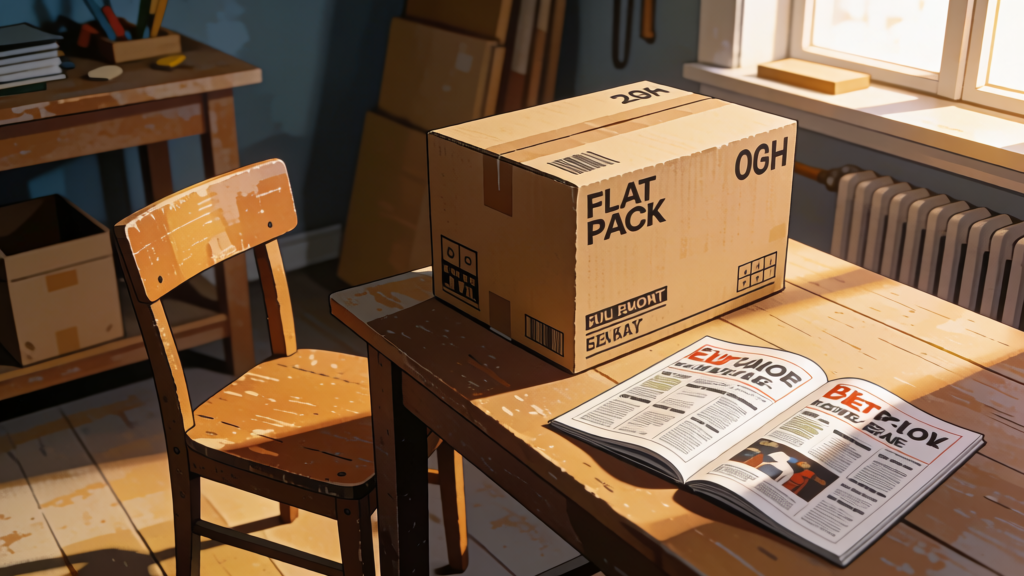
Flat-pack was not just a packaging trick. It cut shipping and storage costs, allowed self-assembly and made the catalogue a promise the customer could carry home. The mechanism is worth spelling out, because it explains why the idea was so durable. A conventional furniture retailer pays to ship air: fully assembled chairs and cabinets occupy volume that earns nothing. Flat-pack converts that air into density. More units fit in a container, more containers fit in a warehouse, and the customer performs the final assembly, which shifts labour out of the cost base and into the home. The saving is not a discount the company chooses to give; it is a structural reduction in what the product costs to move, store and sell. That is why the low price could be repeated rather than run as a promotion.
The same mechanism explains why flat-pack spread beyond IKEA’s own range. Once a product is designed to ship flat, the constraint moves upstream into design: the joints, the fittings and the instructions all have to be standardised so that a customer with a screwdriver can complete what a factory would otherwise do. That standardisation is what makes the catalogue work as a manual, and it is also what makes the range scalable. A company that can ship a table in a flat box can ship ten thousand of them in the same container logic, and the cost per unit falls accordingly. The customer’s labour is the price of that scale, and it is a price many customers have been willing to pay.
IKEA’s first showroom opened in Älmhult, Sweden, in 1953, and the first store opened in 1958. The model was showroom plus warehouse plus catalogue, all under one roof. The sequence matters: the showroom came before the store, and the catalogue came before both. Customers could see and touch the furniture, then collect it flat-packed from the warehouse on the way out. The showroom solved the trust problem that mail-order furniture had always faced — people are reluctant to buy a sofa from a photograph — while the warehouse solved the cost problem. The combination was the innovation, more than any single product.
It is worth pausing on why the trust problem was so acute, because it explains the showroom’s role in the system. Mail-order furniture asked customers to spend a significant sum on an object they had never touched, based on a printed image and a description. That is a hard sell in any era, and it was harder still when the alternative was a local carpenter whose work you could inspect. The showroom answered the objection directly: come and sit on it, then take it home. But the showroom also did something subtler. It made the catalogue credible. A customer who has visited a showroom reads the catalogue differently, because the photographs now refer to things that exist in a place they have been. The showroom was not just a sales floor; it was the proof that the catalogue was telling the truth.
The system, not the store
Kamprad’s real invention was not a store but a system: a catalogue that doubled as a product manual, a supply chain built around low-cost components, and a culture of cost discipline that became almost liturgical. IKEA’s corporate site describes the company’s “test lab” and supplier audits, and the company’s annual reports show a business built on volume and standardisation.
It is worth unpacking what “system” means here, because it is the part of the story that is hardest to copy and easiest to underestimate. A catalogue that doubles as a product manual is a piece of design that removes the need for staff to explain the product, and it also standardises the product itself: if the instructions are printed once, the parts had better be identical every time. Supplier audits and a test lab perform the same function from the other direction, checking that the cheap component is also the reliable one. Cost discipline, meanwhile, is not simply spending less. In IKEA’s telling it is a design constraint applied before the product exists — a target price that the engineers and suppliers must hit, rather than a price calculated after the fact. That is the difference between a company that occasionally has a bargain and a company whose entire range is priced by the same rule.
The target-price method deserves a little more attention, because it inverts the usual sequence of product development. In a conventional process, a product is designed and then priced according to what it cost to make, with a margin added. In the method IKEA describes, the price is set first — by what the customer will pay and by what the volume model requires — and the design must then meet it. That changes the conversation between designer and supplier: instead of asking what a component costs, they ask what it must cost, and then work out how to get there. It is a demanding discipline, and it explains why so much of IKEA’s innovation is invisible. The visible product is a chair; the invisible product is a chair that can be made, shipped and sold at a price the system has already fixed.
The culture that surrounds this discipline is the part that outsiders find hardest to replicate. Cost consciousness in a company of that size is not a policy that can be announced; it has to be practised until it becomes second nature, from the way meetings are run to the way travel is booked. Kamprad’s own habits — the economy flights, the old Volvo — are often cited as evidence of this, and they are, but they are also a signal. A founder who visibly spends little gives the rest of the organisation permission to treat cost as a shared value rather than a constraint imposed from above. That is why the anecdotes survive in the corporate history: they are not merely colour, they are instruction.
The 1970s and 1980s brought international expansion, starting with stores in Norway, Denmark, Switzerland and Germany. The company’s ownership structure — a foundation, INGKA Holding and Inter IKEA Systems — was designed to keep the business independent and to protect it from takeovers. Kamprad stepped back from day-to-day management in 1986 but remained a cultural presence.
That ownership structure is unusual enough to be worth a moment. A foundation at the top, a holding company beneath it and a separate entity owning the concept and franchise mean that IKEA is not a listed company answerable to quarterly shareholders. The stated aim was independence and protection from takeovers; the practical effect is that the company can take a long view that public rivals find harder to sustain. It also means the usual measures of a retailer — revenue, profit, market share — are not published in the way a listed company publishes them, which is why accounts of IKEA’s size tend to rely on franchise figures and annual summaries rather than a single audited global number.
The franchise arrangement is part of the same architecture, and it is often misunderstood. Inter IKEA Systems owns the concept and the franchise, while INGKA Holding operates most stores. That split means the brand and the system can be licensed and extended without the operating company having to own every store, and it also means the concept itself is treated as an asset to be protected rather than a set of shops to be expanded at any cost. For a reader trying to understand why IKEA behaves differently from a listed retailer, this is the key: the structure was built for permanence, and permanence changes what a company is willing to do in any given year.
The numbers and the limits
IKEA does not publish a single global revenue figure in the way a listed company does, but its franchise system and annual summaries give a clear picture. The IKEA Foundation, the philanthropic arm, has reported billions in grants. The company has faced criticism over its tax structure and over labour practices, and it has had to adapt to e-commerce and to the rise of competitors such as Wayfair and local discounters.
The criticism is part of the record and belongs in any honest account. The tax structure — the foundation-and-holding arrangement that protects independence — has also been the subject of scrutiny, on the argument that a structure designed for permanence also has consequences for where profits are recognised. Labour practices have drawn criticism too, as they have across discount retail generally. None of this undoes the system, but it complicates the tidy story of frugality and simplicity: the same architecture that lets IKEA plan decades ahead is the architecture that makes its finances hard to read from outside.
It is worth being precise about what the criticism does and does not establish. The tax structure is lawful and disclosed, but its complexity means that reasonable people can disagree about whether the outcome matches the intent. The labour criticism is similarly a matter of degree rather than kind: discount retail is a low-margin business by design, and low margins put pressure on wages and working conditions wherever they are found. The fair conclusion is not that the system is a facade, but that a system built for low prices will always be judged on whether the low price is shared fairly between customer, worker and supplier. That is a question the company’s own history raises but does not settle.
The competitive pressure is a different kind of limit. E-commerce rewards exactly the things flat-pack made possible — dense shipping, self-assembly, a catalogue that works as a webpage — but it also removes the showroom, which was IKEA’s answer to the trust problem. Competitors such as Wayfair and local discounters have attacked the same territory without the cost of stores. IKEA’s response has been to keep the store as an experience while pushing into online retail, which is a harder balancing act than it sounds: the showroom and the warehouse were designed as a single circuit, and splitting them changes the economics that made the low price repeatable in the first place.
The counter-evidence here is worth stating plainly, because it cuts against the tidy narrative. If flat-pack and cost discipline were sufficient, IKEA would have had e-commerce to itself. It did not. Competitors without a single showroom have been able to sell furniture online at low prices, which suggests that the showroom was a solution to a problem that the internet has partly dissolved. The trust problem that the showroom solved — buying a sofa from a photograph — is now solved differently, by reviews, by returns policies and by the simple fact that a generation of customers has grown used to buying sight unseen. That does not make the showroom obsolete, but it does mean the circuit that once made IKEA unique is no longer the only circuit that works.
Kamprad died in 2018 at 91. By then IKEA had stores in dozens of countries and a catalogue that had become one of the most widely distributed publications in the world. The company’s own history frames the story as one of frugality and simplicity — a founder who flew economy and drove an old Volvo — but the more durable lesson is about a system that made low prices repeatable rather than accidental.
For the reader, that lesson is portable even if the furniture is not. The founder anecdotes — the matches, the economy flights, the old Volvo — are charming, but they describe a temperament, and temperaments are hard to copy. What can be copied is the discipline of designing to a price instead of discounting to one; of treating distribution and packaging as part of the product rather than an afterthought; of building a structure that lets you think in decades. The matchbox arithmetic was never really about matches. It was about asking, every time, whether the cheap version could be made reliable enough that volume would do the work of margin — and then building a system that answered yes.
That is why the story resists the usual moralising about frugality. Frugality is a personal virtue, and personal virtues are fragile: they depend on the person. The system is what survives the person. A company that has designed its products, its packaging, its suppliers and its ownership around a single question can keep answering that question long after the founder has stopped flying economy. The reader who takes one thing from the matchbox start should take that: the arithmetic is portable, but only if you build the machinery that makes it repeatable.
💡 Key Insights
- ▸ Kamprad started with matches and mail order, not furniture; the catalogue was the storefront before the store existed.
- ▸ Flat-pack and self-assembly were cost and logistics innovations, not just design quirks.
- ▸ The ownership structure was built to keep the company independent from public markets.
- ▸ Frugality became a management system, which is why the low-price model was repeatable.