James Dyson Licensed His Vacuum in Japan to Finance His Own Brand
James Dyson's Japanese G-Force licence brought in royalties before the DC01 launch, helping turn a workshop invention into a business selling under his own name.
View all stories about this mogul
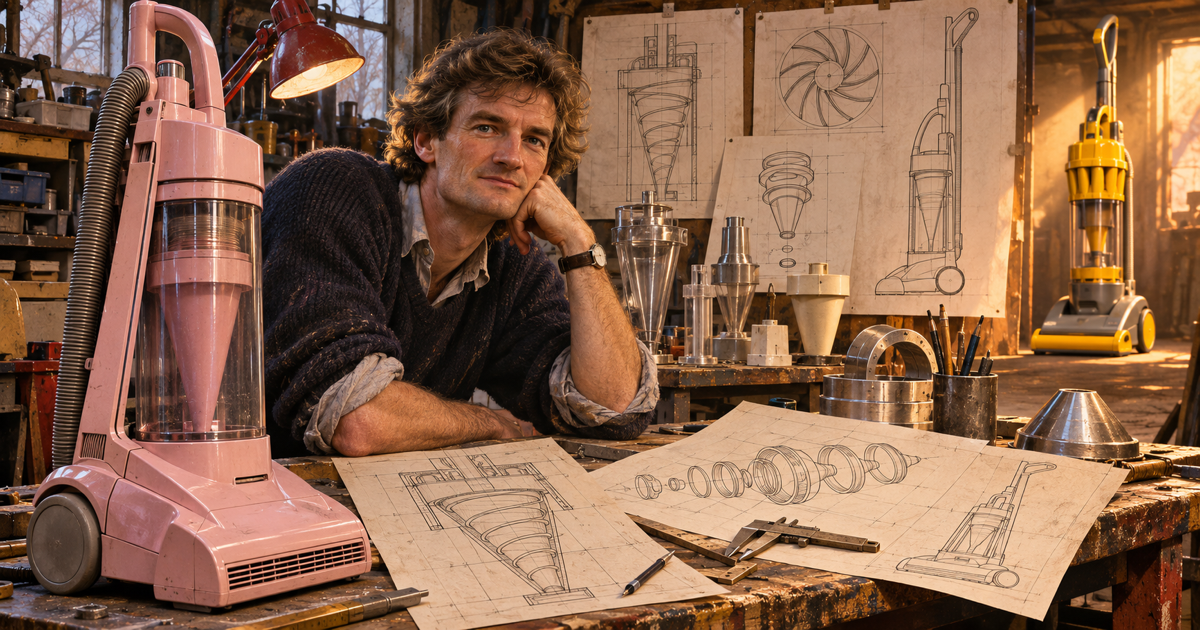
In 1985, James Dyson was in Nishiazabu, Tokyo, redesigning the cleaning head of a vacuum that would enter production as the G-Force. His own photographic archive records the work and credits the Japanese company Apex with putting the pale-pink appliance into production. The vacuum carrying Dyson’s name into British shops would follow in 1993. Between the workshop invention and the recognisable brand stood a licensing agreement overseas. Dyson’s photographic account documents that intermediate step.
The agreement mattered because a working invention still needed a way to pay for its commercial development. Income from Japanese G-Force royalties helped Dyson and a small team continue refining the technology before manufacturing under his own name. The Malaysian Investment Development Authority’s historical account explicitly connects those royalties with the development programme that preceded the DC01. MIDA’s company history supplies the financial link.
This was a change in Dyson’s position as a businessman. Licensing let another company bring his design into production; selling an appliance under his own name would make his business responsible for the finished proposition. The route between those positions was neither immediate nor a straight progression through successful products.
A factory problem supplied the starting point
Before the vacuum, Dyson had worked on the Ballbarrow, a wheelbarrow whose broad ball replaced the conventional narrow wheel. Manufacturing it exposed him to a different problem: powder used to coat its metal components clogged the factory’s filtration system. An industrial cyclone offered a way to separate the powder from the air. Dyson then explored whether the same principle could serve a domestic vacuum cleaner. Robin Roy’s interview-based Open University study traces that transfer between applications. Roy’s research paper provides a contemporary account of the development work.
The business significance lies in the connection between those two settings. A production difficulty in one venture supplied an idea for another product. The vacuum project therefore grew partly from practical exposure to manufacturing, where material that seems incidental to a finished object can determine whether the process works reliably.
A factory separator and a household appliance nevertheless have different jobs to satisfy. A homeowner needs an object that can be moved, stored, emptied and used repeatedly. Making an industrial principle useful in that setting involves decisions about the whole appliance. The cyclone could supply the central mechanism without supplying a finished product.
That distinction explains why the initial experiment could be encouraging while leaving substantial uncertainty. Demonstrating separation establishes that a principle has promise. It does not establish the cost of a production tool, the durability of an assembly or the willingness of a customer to pay. Each requires evidence of a different kind.
For a business assessing such a project, the questions accumulate. Can the mechanism work in the proposed dimensions? Can the components be made consistently? Can the resulting product support a selling price that covers the costs of getting it to the customer? Success at the first question offers a reason to investigate the others, rather than an answer to them.
Dyson’s early work is useful precisely because it keeps invention close to those physical constraints. The opportunity came from recognising a connection across products, but the commercial task required turning that connection into something sufficiently dependable and comprehensible to sell.
The prototype count conceals several different risks
MIDA’s account dates the vacuum project to 1978 and records five years of development and 5,127 prototypes. That number has become the most portable detail in Dyson’s history. It captures the volume of iteration, though it can also compress several distinct stages into an apparently simple sequence: experiment repeatedly, complete the product, achieve success. The same history places the Japanese G-Force launch in 1986 and manufacturing under Dyson’s own name in 1993. MIDA’s chronology separates those milestones.
A prototype count is an incomplete measure of commercial progress. An experimental component can answer a narrow question about performance. A demonstration model can help explain an invention to a prospective licensee. A production design must also withstand the constraints of repeated manufacture. Those objects may all be called prototypes while doing very different work.
There is a corresponding difference in what a failed test means. A result that rules out one configuration may make the next experiment more useful. A product that fails to sell raises questions that another adjustment to the mechanism may never answer. Technical persistence and commercial judgement have to operate together.
The celebrated number also leaves the financing question unresolved. Someone must support the interval between experiments and receipts from customers. Materials, equipment and time are consumed before the finished appliance earns anything. More testing can improve a design while extending that interval.
The relevant business problem was therefore larger than whether Dyson would keep trying. He needed a route through development and into production that would generate income. A licensing contract could potentially provide that route without requiring his small operation to perform every commercial function immediately.
This makes the later Japanese agreement more revealing than the prototype total on its own. The experiments describe effort directed at the product. The agreement describes an arrangement through which the product could begin supporting further work. Both belong in the history, but they explain different parts of it.
A British licence came before the Japanese opening
Dyson’s own archive identifies an earlier appliance, the Kleeneze Rotork Cyclon, produced in 1983 and 1984. He says Rotork had licensed his design and that only 550 units were made. He attributes its commercial failure to the person selected to run the operation; that explanation is his retrospective judgement. The limited production run is the more concrete fact. The Coach House archive records both the model and Dyson’s assessment.
That episode complicates the familiar account of an inventor rejected at home until Japan recognised his work. A British licensing attempt did reach production. Its existence means the obstacle cannot be described solely as an inability to persuade anyone to manufacture the invention. Getting a product made and establishing a sustainable business around it were separate achievements.
A licence combines a technical asset with another organisation’s execution. The inventor contributes a design or rights to use it. The manufacturing partner must turn that contribution into a product customers can obtain. The outcome depends on decisions beyond the mechanism itself, including production, presentation and the handling of the commercial operation.
The arrangement can reduce the inventor’s immediate responsibilities, but it also distributes control. That is the central tradeoff. Access to a partner’s capabilities can bring an appliance closer to sale while making its prospects dependent on that partner’s choices.
The Cyclon’s short run does not establish that licensing was inherently unsuitable. Nor does the subsequent Japanese deal prove that every obstacle had finally disappeared. Together, the episodes show why a founder may have to evaluate the same commercial structure more than once, with different partners and a revised product.
For Dyson, the distinction would later become consequential. Licensing could help move the invention forward. Operating under his own name would offer a different relationship with the customer and with decisions about the finished appliance. The earlier effort belongs in that transition because it demonstrated how little a production launch alone could guarantee.
The G-Force created an income-bearing intermediate product
The G-Force was a substantial appliance in its own right. The Centre Pompidou dates its example to 1986 and records a body made from ABS and polycarbonate, a telescopic tube and Dual Cyclone technology. Its listed dimensions are 102 centimetres high, 34 wide and 47 deep. The museum also records a first prize at Japan’s International Design Fair in 1991. These details anchor the product beyond later corporate storytelling. The museum’s collection record identifies the surviving object.
The object matters because the Japanese episode was more than a contract signed around a speculative drawing. A recognisable consumer appliance emerged from the arrangement. Dyson’s archive places him in Japan working on its cleaner head before production, showing that the passage from concept to sale still involved detailed design work.
A licence can be understood here as a means of staging the venture. Instead of treating a complete manufacturing business as the first necessary outcome, Dyson could participate in commercial production through another company. Royalties then offered income associated with the use of his design.
The financial distinction is straightforward. A founder who finances production directly commits resources before receiving the proceeds of sales. A licensor’s receipts depend on the agreement governing the licensed product. Neither arrangement removes uncertainty, but they place obligations and potential returns in different hands.
MIDA’s account says G-Force royalty income enabled continued development by Dyson and a small team. It does not provide a complete financing statement for the later launch. The supported conclusion is that the Japanese product helped fund the next stage; it would go beyond that evidence to treat its royalties as the sole source of money required. MIDA’s account of the royalties makes the narrower claim.
That narrower claim is still significant. A venture does not need its first commercial arrangement to resemble its eventual operating model. An intermediate product can generate resources while its creator develops a different way to reach customers. The G-Force gave Dyson’s project such an intermediate stage.
It also puts a useful limit on the language of independence. The later Dyson brand rested partly on income earned through another manufacturer’s participation. Building greater control over a business can begin with a contract that shares control over an earlier product.
In 1993, Dyson put his name on the finished proposition
Dyson’s archive places a DC01 production line at Bumpers Farm in Chippenham in 1993. The same chapter preserves an early advertising campaign organised around saying goodbye to the vacuum bag in several languages. A product photograph contrasts the DC01 with a competitor using a cloth bag. These were ways to explain a change in familiar household equipment through a feature customers could recognise. The DC01 archive documents the manufacturing and promotional material.
The advertising choice had a clear commercial logic. A customer does not need to understand every internal component to recognise a recurring task or consumable. Focusing on the bag gave the proposed difference a concrete reference point. It connected the unfamiliar appliance with something already present in the cleaning routine.
Under his own name, Dyson could bring the mechanism, appearance and explanation into one proposition. That does not mean every activity had to be performed personally or inside one building. It means the business presenting the product to the customer would carry the responsibility associated with the Dyson name.
The advantages came with obligations. A brand owner must think beyond whether a single demonstration succeeds. The promise has to survive repeated use, and the company must support the object after the transaction. Manufacturing volume makes consistency more consequential because a recurring fault can reach many customers.
For that reason, the 1993 launch should be read as an expansion of the business task. The technical work had made the product possible. Selling under the inventor’s name required an organisation capable of turning that work into repeatable transactions and a continuing relationship with owners.
The difference from licensing was therefore practical as well as symbolic. The Dyson name could accumulate recognition from each sale. At the same time, problems with the finished appliance would attach to that name. Greater control and greater exposure arrived together.
The clear bin helped make an internal claim visible
Dyson’s technology archive describes the 1993 DC01 as using Dual Cyclone technology in place of a clogging bag. It also says the clear bin was retained contrary to market research, allowing users to see the dirt collected. The same chronology records the DC02 cylinder vacuum in 1995, using the Dual Cyclone technology developed for the DC01 in another configuration. Dyson’s technology chronology documents those design decisions.
The clear container gave the customer something observable. Dirt accumulating inside the appliance could connect a cleaning session with a visible result. It also made the product’s difference easier to demonstrate than a mechanism concealed inside an opaque housing.
That visibility had limits. The amount of dirt in a container does not, by itself, establish comparative cleaning performance or prove a claim about suction. A demonstration can explain what a product does while leaving measurement to testing. Keeping those functions distinct makes the commercial strategy easier to assess.
Dyson’s account of resisting market research also requires careful interpretation. The example concerns a particular feature and a particular decision. It cannot support a general conclusion that customer evidence is useless. Designers still need to understand what people do with an appliance, even when they disagree with a stated preference about its appearance.
The DC02 illustrates another kind of commercial development: adapting an established mechanism to a different product format. Once a business has invested in a technical approach, subsequent designs can explore other ways to package and use it. Each still needs its own engineering and commercial assessment; shared technology reduces neither task to a formality.
The record also contains a restraint on any claim that the method guaranteed success. Dyson’s chronology says production of the later Contrarotator washing machine could not continue because manufacturing costs were too high. Technical distinction did not settle the economics of that product. The same technology archive acknowledges that limit.
Seen through the early vacuum story, Dyson’s achievement was a sequence of different solutions to different problems. Industrial experience supplied a technical connection. Development made it usable in an appliance. Licensing brought it into commercial production and generated income. The DC01 then placed a finished consumer proposition under his own name.
The Japanese agreement is the hinge in that sequence. It helped turn an invention requiring support into a product contributing to further development. The later brand began with that less visible transaction: another company’s production of an earlier vacuum helped finance the work that allowed Dyson to sell his own.
Frequently asked questions
What was the Japanese G-Force?
It was a vacuum using Dyson’s cyclone design, put into production by Apex in Japan in 1986.
Did G-Force royalties help finance Dyson’s business?
Yes. MIDA’s history says the royalties supported continued development before the DC01 launch; it does not identify them as the sole funding source.
When did the Dyson DC01 launch?
The DC01 launched in 1993. Dyson’s archive documents a production line in Chippenham that year.
💡 Key Insights
- ▸ Japanese G-Force royalties helped support development before the DC01 launch.
- ▸ An earlier British licensed vacuum reached production but had a limited run.
- ▸ Selling under the Dyson name combined greater control with responsibility for the finished product.
- ▸ Visible design features helped explain the invention, while manufacturing economics still constrained later products.
Sources
- Dyson — Invention: A Life, Chapter Five: The Coach House ↗
- Malaysian Investment Development Authority — Dyson ↗
- Robin Roy, Open University — Case Studies of Creativity in Innovative Product Development ↗
- Centre Pompidou — James Dyson, Aspirateur G-Force, 1986 ↗
- Dyson — Invention: A Life, Chapter Six: DC01 ↗
- Dyson — Invention: A Life, Chapter Seven: Core Technologies ↗