J.P. Morgan: The Man Who Bailed Out America
Before the Federal Reserve existed, there was one man who could save the United States from financial ruin — and he did it twice. J.P. Morgan was part banker, part power broker, part shadow government. This is the story of the most powerful private citizen in American history.

View all stories about this mogul
🏛️ Chapter 1: The Prince of Hartford
John Pierpont Morgan was born rich. Let’s get that out of the way immediately.
Born on April 17, 1837, in Hartford, Connecticut, he was the son of Junius Spencer Morgan — a successful banker who would become one of the wealthiest Americans of the 19th century. There was no rags-to-riches arc here. No poverty to overcome. No bootstrapping narrative.
J.P. Morgan was born on third base and ran to home plate. But what he did when he got there was extraordinary.
Young Pierpont (as his family called him) was not an easy child. He was sickly, prone to mysterious illnesses and skin conditions that would plague him throughout his life. A condition called rhinophyma eventually gave him the bulbous, disfigured nose that became his most recognized physical feature — and the source of constant embarrassment and social anxiety.
“My nose is part of the American economy. I can’t change it, so I might as well make sure the economy is in good shape.”
He was educated at some of the finest institutions in the world — the English High School of Boston, a school in Switzerland, and the University of Göttingen in Germany, where he studied mathematics. His education was cosmopolitan by design: his father wanted him to be comfortable in the European financial centers where the real money lived.
And the real money did live in Europe. In the mid-19th century, the United States was a developing country — rich in resources and ambition but poor in capital. European banks, particularly British ones, were the primary source of investment capital for American railroads, steel mills, and industrial enterprises.
Junius Morgan had positioned himself at the intersection of European capital and American enterprise, first as a partner at George Peabody & Co. in London and later as head of his own firm, J.S. Morgan & Co. Young Pierpont was being groomed to take over the American end of this transatlantic financial pipeline.
He was, from birth, being prepared to become the most powerful banker in the world.
🚂 Chapter 2: The Railroad Wars
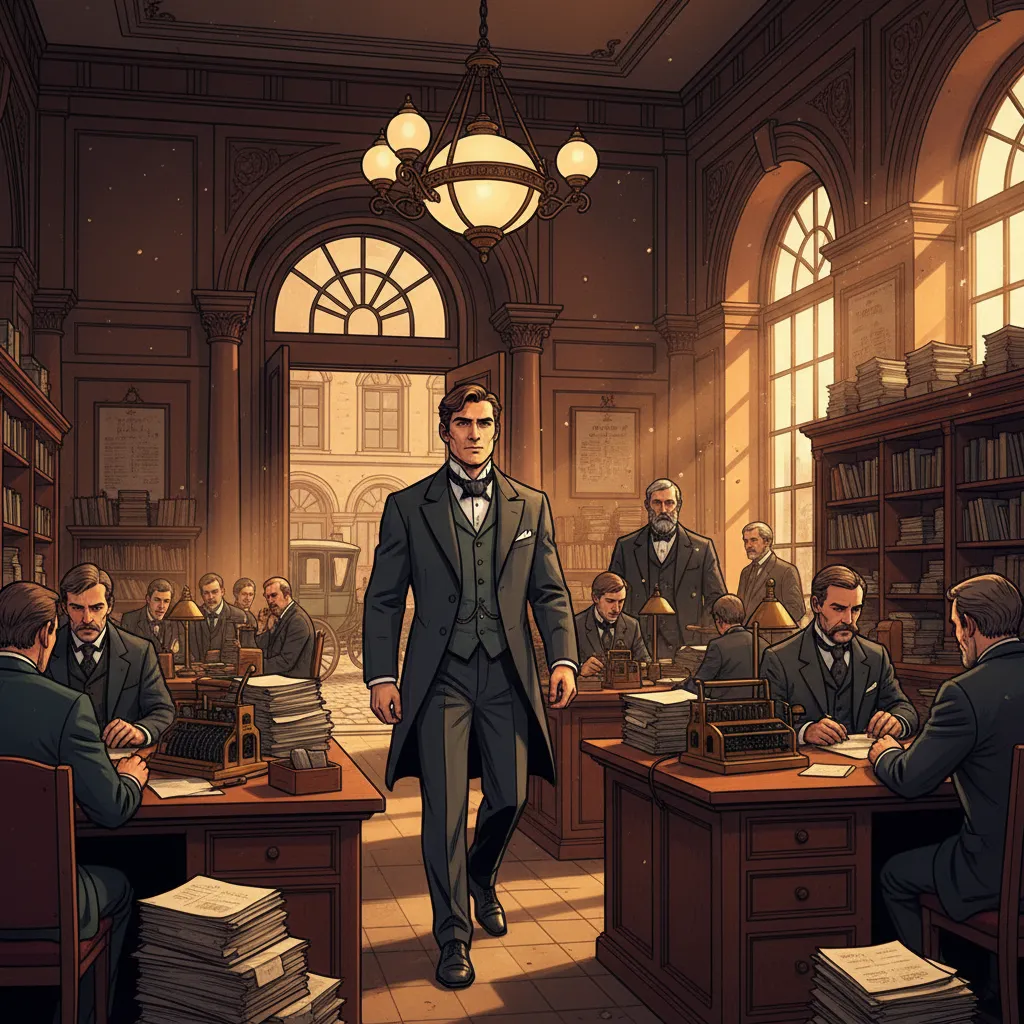
J.P. Morgan entered the banking world in 1857, joining the New York office of Duncan, Sherman & Company, the American representative of George Peabody’s London bank. He was 20 years old, well-educated, well-connected, and possessed of an intensity that both impressed and intimidated everyone around him.
Within a few years, he established his own firm — first J.P. Morgan & Company, later reorganized multiple times — and began the work that would define his career: financing American industry.
The industry that mattered most in the 1860s and 1870s was railroads. The railroad was the technology of the age — the internet, the AI, and the cryptocurrency of the 19th century, all rolled into one. Railroads were transforming the American economy, connecting distant markets, enabling industrial agriculture, and creating fortunes of unprecedented scale.
They were also a complete mess.
The railroad industry was characterized by vicious competition, massive overbuilding, frequent bankruptcies, and chronic instability. Companies built competing lines between the same cities, drove each other into price wars, and then collapsed into insolvency. Investors lost millions. The economy was routinely disrupted by railroad failures.
Morgan saw this chaos and recognized an opportunity: what if, instead of financing individual railroads, he reorganized the entire industry?
“Competition is fine for groceries. It is ruinous for railroads. The nation needs a stable, efficient transportation system, and competition will never produce one. Consolidation will.”
This philosophy — that certain industries were too important for unregulated competition — became the core of Morgan’s worldview. He believed in order. He believed in stability. He believed that capital should be concentrated in the hands of competent managers rather than dispersed among competing incompetents.
Between the 1870s and 1900s, Morgan reorganized dozens of railroad companies. His method was consistent: he would take over bankrupt or failing railroads, eliminate redundant routes, install professional managers, and restructure the finances. The process was called “Morganization” — a term that combined respect and fear in equal measure.
Morganization typically worked. The railroads Morgan reorganized became profitable and stable. But the process also concentrated enormous power in Morgan’s hands. By the 1890s, Morgan-controlled railroads represented roughly a third of America’s total railroad mileage.
⚡ Chapter 3: The Industrial Architect
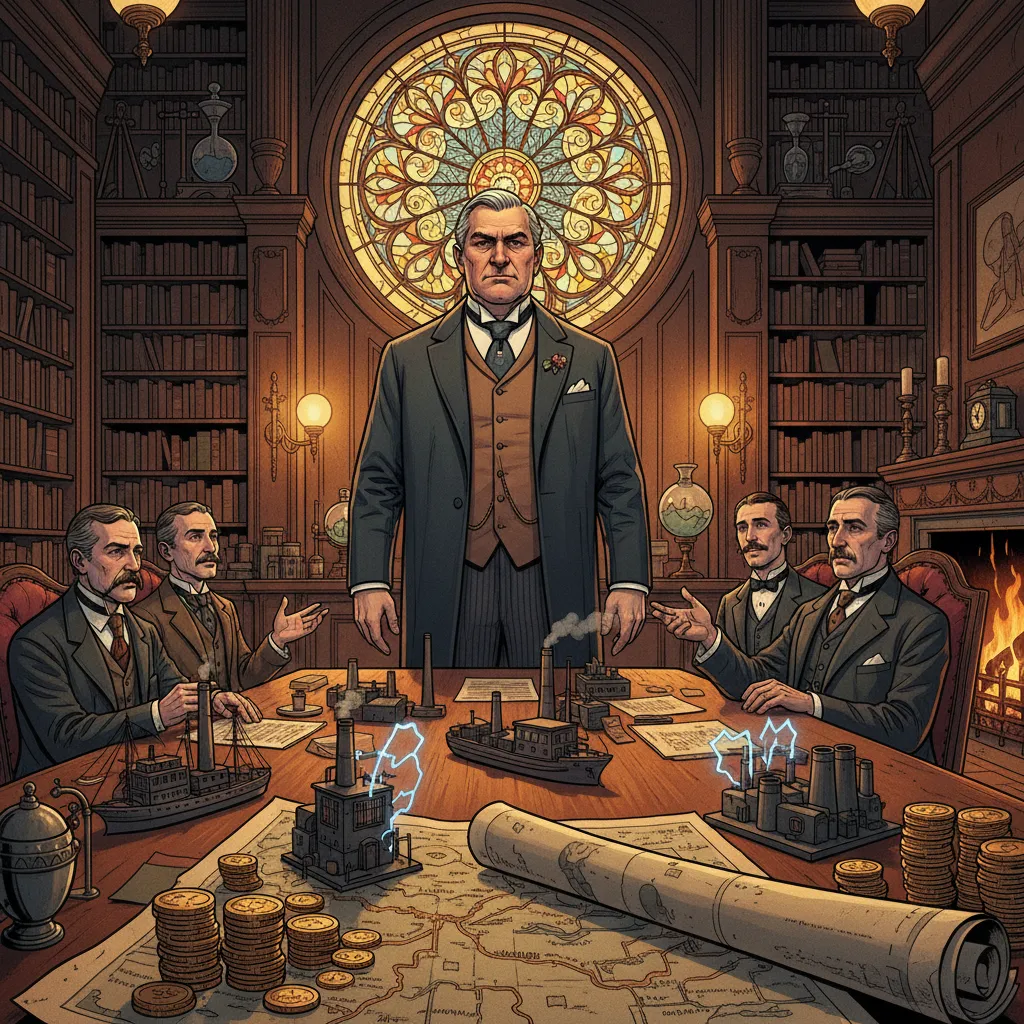
Railroads were just the beginning.
In 1892, Morgan orchestrated the merger of Edison General Electric and Thomson-Houston Electric Company to create General Electric — which would become one of the largest and most enduring companies in American history. Morgan served on GE’s board and his firm financed the company’s growth.
In 1901, he topped even that by creating the largest corporation the world had ever seen: United States Steel Corporation.
The backstory was pure Morgan. Andrew Carnegie, the steel king, had been dominating the industry and terrorizing his competitors. Carnegie was talking about expanding into areas that would directly compete with other Morgan-backed companies. Morgan decided the most efficient solution was to simply buy Carnegie out.
The deal was legendary. Morgan’s intermediary, Charles Schwab (the president of Carnegie Steel, not the modern brokerage founder), approached Carnegie with an offer. Carnegie scribbled a number on a piece of paper: $480 million. Morgan looked at the number and said, “I accept.”
$480 million in 1901 dollars. Roughly $17 billion in today’s money. Paid without negotiation.
When the deal was finalized, Carnegie reportedly told Morgan, “I should have asked for more.” Morgan replied, “You would have gotten it.”
“Morgan didn’t negotiate because negotiation implied doubt. He made decisions. Immediately, definitively, irrevocably. That speed — that certainty — was what made people trust him with their money.”
U.S. Steel combined Carnegie Steel with several other major steel producers to create a corporation capitalized at $1.4 billion — the first billion-dollar corporation in history. It controlled roughly 67% of American steel production.
By 1901, J.P. Morgan was not just a banker. He was the architect of American industry. He had organized railroads, created General Electric, and assembled U.S. Steel. He sat on the boards of dozens of major corporations. His partners and associates served on dozens more. The Morgan network touched virtually every significant industry in the American economy.
A later congressional investigation, the Pujo Committee of 1912, would calculate that Morgan and his associates held 341 directorships in 112 corporations with aggregate resources of over $22 billion — more than the total value of all property in the 22 states west of the Mississippi River.
One man. 341 board seats. Control over more wealth than half the country.
💰 Chapter 4: The Gold Rescue
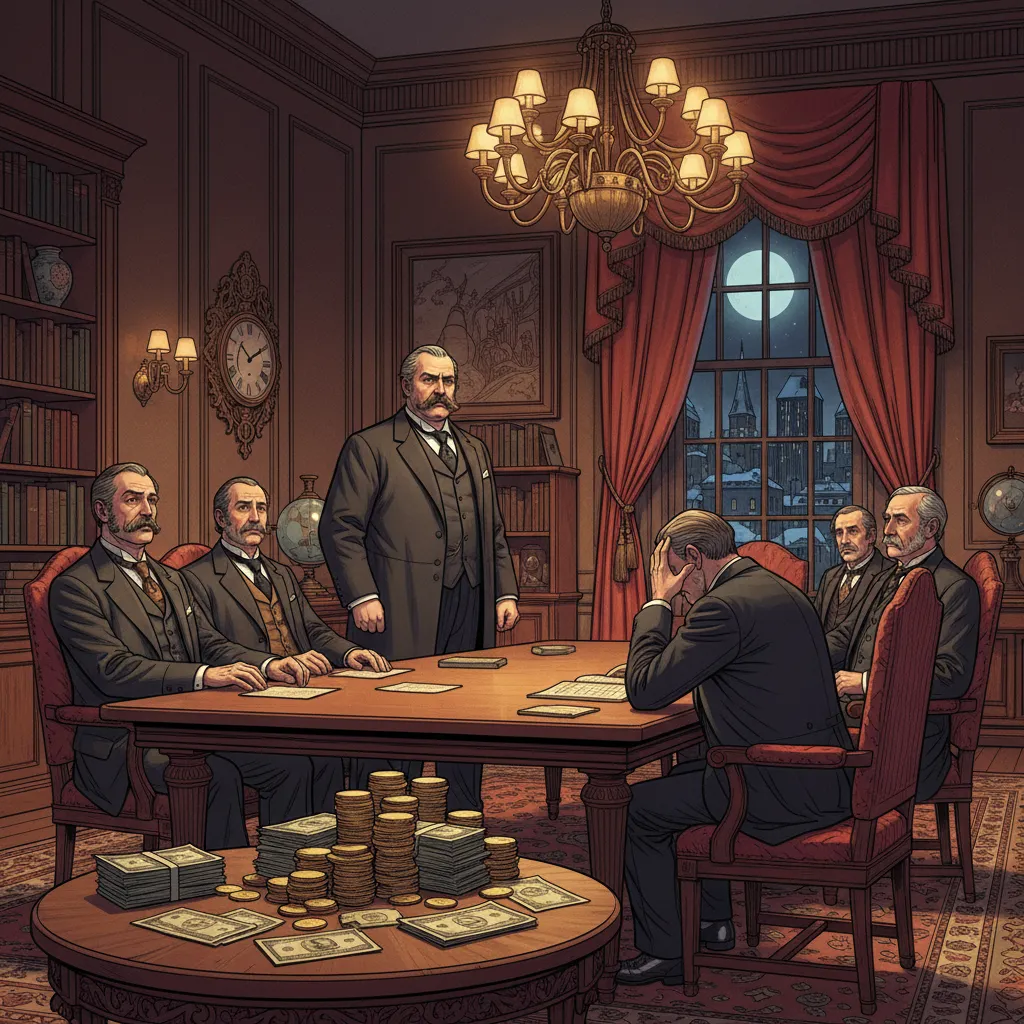
On February 8, 1895, the United States government was about to run out of gold.
The country operated on the gold standard, which meant that the government was legally required to redeem paper currency for gold on demand. By early 1895, the Treasury’s gold reserves had fallen to approximately $9 million — barely enough to cover a single day’s withdrawals. If the gold ran out, the government would default on its obligations, the dollar would collapse, and the American economy would descend into chaos.
President Grover Cleveland was desperate. He had tried to raise money through public bond sales, but the markets were too panicked to buy. Congressional authorization for emergency measures was blocked by political gridlock.
There was only one person who could save the situation: J.P. Morgan.
Morgan traveled to Washington and presented Cleveland with a plan: he and the Rothschild banking family would organize a private syndicate to sell $65 million in gold-backed bonds, replenishing the Treasury’s gold reserves. In exchange, Morgan’s syndicate would receive favorable terms on the bonds.
Cleveland hesitated. The optics of a private banker bailing out the federal government were terrible. It would confirm every populist fear about Wall Street’s power over Washington.
Morgan applied pressure. According to contemporary accounts, he told Cleveland that he was aware of a $10 million draft on the Treasury that, if presented, would exhaust the remaining gold reserves within the hour. “If that draft is presented,” Morgan reportedly said, “the Treasury will be empty before three o’clock.”
Cleveland agreed.
“The government of the United States was saved from default by a private citizen sitting in the White House drawing room. Think about that. The most powerful nation on Earth was rescued by a banker from Hartford. That is either the greatest act of patriotism in American history or the greatest demonstration of private power. Probably both.”
The bond deal worked. Gold reserves were replenished. The crisis passed. Morgan’s syndicate reportedly made a profit of approximately $1.5 million on the transaction — a fact that infuriated populists who saw the deal as proof that Morgan had exploited the government’s desperation.
Morgan’s defenders argued that he had saved the country from financial ruin. His critics argued that he had demonstrated that the country’s financial system was effectively privatized — controlled by a single man whose interests might not always align with the public good.
Both arguments had merit. And both would be reprised, on a larger scale, twelve years later.
🔥 Chapter 5: The Panic of 1907
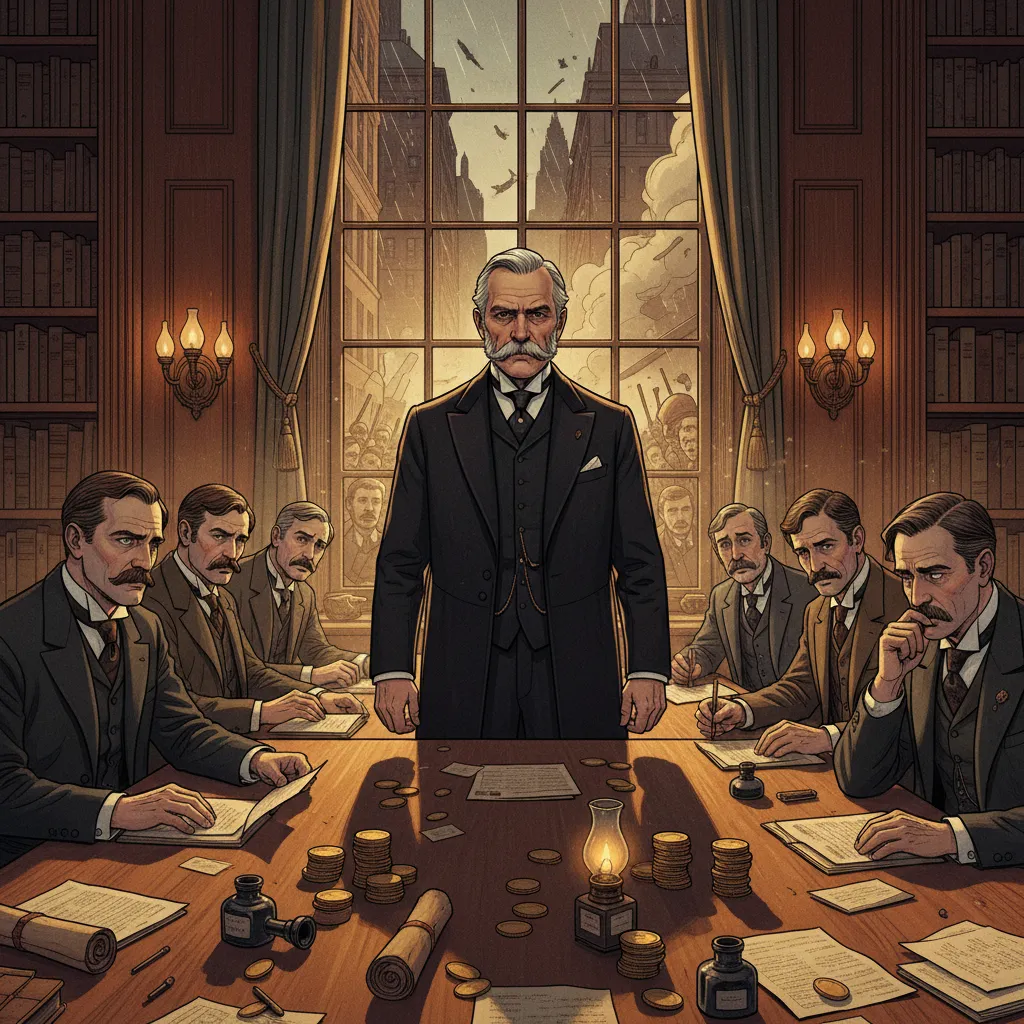
October 1907. The American financial system was collapsing.
A failed attempt to corner the stock of United Copper Company triggered a chain reaction of bank runs and trust company failures. The Knickerbocker Trust Company — one of New York’s largest — collapsed on October 22. The Trust Company of America was next. Panicked depositors formed lines around the block, demanding their money.
There was no Federal Reserve in 1907. No government institution existed to serve as a lender of last resort, to inject liquidity into a panicking system, to coordinate the response of financial institutions. The Treasury Department was too small and too slow to respond.
Once again, the responsibility fell to one man.
J.P. Morgan was 70 years old. He was supposed to be semi-retired, spending his days collecting art and attending church. Instead, he became the de facto central banker of the United States.
Working from his private library at 219 Madison Avenue (now the Morgan Library & Museum), Morgan organized the response to the panic with the authority of a general commanding a battle.
He summoned the presidents of New York’s major banks to his library. He assessed which institutions were solvent (and therefore worth saving) and which were not. He directed money from strong banks to weak ones. He personally decided which trust companies would receive emergency loans and which would be allowed to fail.
“Morgan locked the bankers in his library and refused to let them leave until they agreed to his plan. He literally held them hostage until they contributed money to the rescue pool. It was the most extraordinary exercise of private power in American financial history.”
On the night of November 2, 1907, Morgan held a crucial meeting in his library. Trust company presidents were gathered in one room. Bank presidents in another. Morgan moved between the rooms, negotiating, cajoling, and — when necessary — threatening.
At 4:45 AM, he presented the trust company presidents with an agreement to contribute $25 million to a rescue fund. He placed a pen on the table and told them to sign. One by one, they signed.
The panic ended. The financial system stabilized. Morgan had, for the second time, single-handedly prevented a national financial catastrophe.
🏗️ Chapter 6: The Art of Power
J.P. Morgan’s power was not purely financial. It was personal.
He was physically imposing — tall, broad-shouldered, with piercing eyes and that famous disfigured nose that he would not allow to be photographed in profile. His gaze was legendary. Partners, presidents, and tycoons who met Morgan’s eyes reported feeling physically intimidated.
“He had eyes that could make a bishop feel like a pickpocket,” one contemporary observed.
Morgan’s personal style was patrician and imperious. He traveled in private railcars and yachts. He collected art with the voracity of a conqueror — paintings, manuscripts, sculptures, jewels, ancient artifacts. His collection, assembled over decades, was one of the finest in the world. Much of it would eventually form the core of the Metropolitan Museum of Art’s holdings and the Morgan Library.
He was deeply religious — a devout Episcopalian who served as senior warden of St. George’s Church in New York and attended the triennial convention of the Episcopal Church as a lay delegate. His faith was genuine, and he saw no contradiction between his religious devotion and his ruthless business practices.
“My father’s God and my banker’s instinct have never conflicted. God created the world in an orderly fashion. I organize it in an orderly fashion. We are in the same business.”
Morgan’s personal life was less orderly. He was married twice — first to Amelia Sturges, who died of tuberculosis four months after their wedding, and then to Frances Louisa Tracy, with whom he had four children. He was also a prolific philanderer who maintained relationships with multiple women throughout his life.
The contradiction between his public piety and private behavior was obvious to everyone around him and apparently invisible to Morgan himself. Or perhaps he simply didn’t care. Power at Morgan’s level creates its own moral framework.
⚖️ Chapter 7: The Pujo Committee
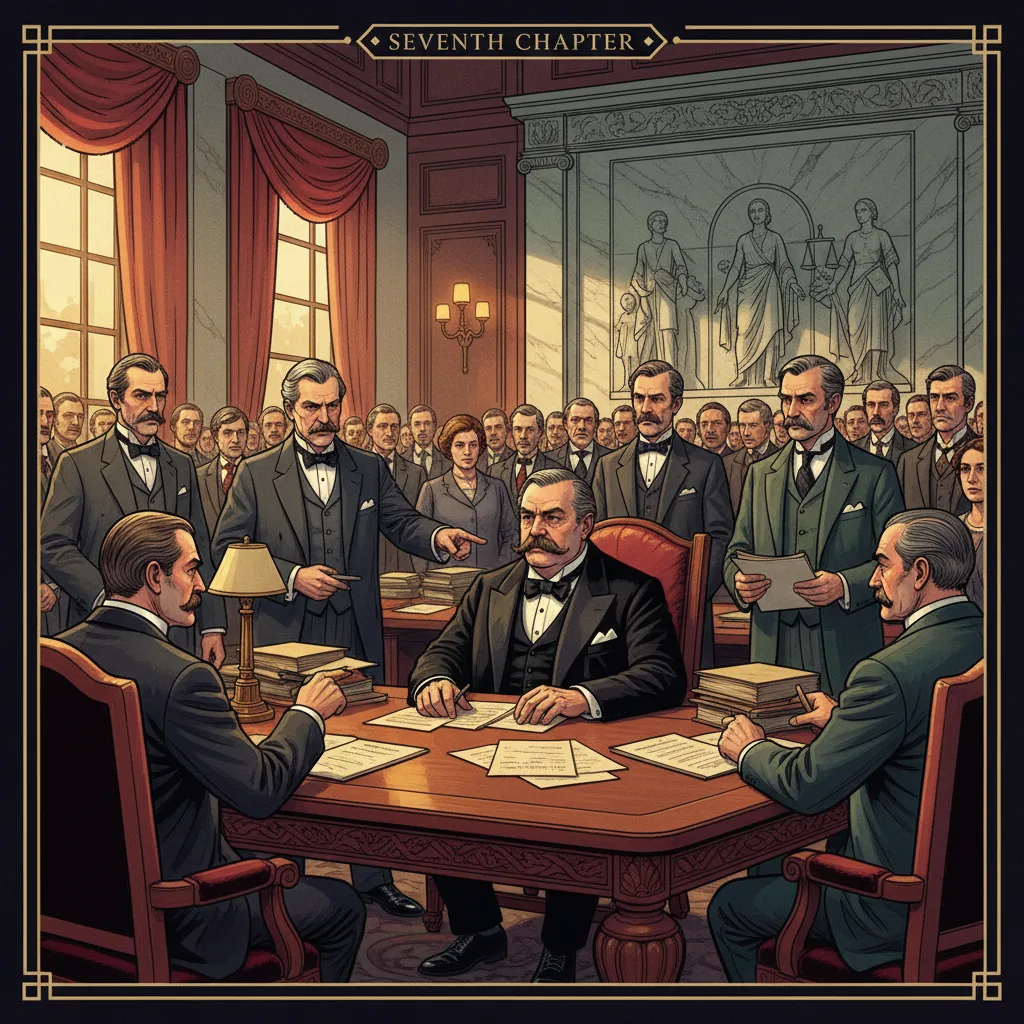
Morgan’s power eventually attracted the attention it deserved: congressional investigation.
In 1912, the Pujo Committee — a subcommittee of the House Committee on Banking and Currency — launched an investigation into the “money trust” — the alleged concentration of financial power in the hands of a small number of Wall Street banks, with Morgan at the center.
The committee’s chief counsel, Samuel Untermyer, called Morgan to testify on December 19, 1912. Morgan was 75 years old, in declining health, and deeply resentful of being questioned by what he considered his inferiors.
The exchange between Untermyer and Morgan became one of the most famous in congressional history:
UNTERMYER: “Is not commercial credit based primarily on money or property?”
MORGAN: “No, sir. The first thing is character.”
UNTERMYER: “Before money or property?”
MORGAN: “Before money or anything else. Money cannot buy it… Because a man I do not trust could not get money from me on all the bonds in Christendom.”
“Character. That was Morgan’s answer to everything. He didn’t trust systems. He didn’t trust regulations. He didn’t trust democracy. He trusted his own judgment of character. And for most of his life, that judgment was remarkably good.”
The Pujo Committee’s report was damning. It documented the extraordinary concentration of financial power in Morgan’s hands and recommended reforms. These recommendations ultimately contributed to the creation of the Federal Reserve System in 1913 — a central bank designed to perform the stabilizing functions that Morgan had performed privately during the panics of 1895 and 1907.
The Fed was, in essence, the institutionalization of J.P. Morgan. It was designed to do systematically and publicly what Morgan had done personally and privately. The message was clear: America could not afford to depend on one man’s judgment and goodwill for the stability of its financial system.
Morgan did not live to see the Fed’s creation. He died on March 31, 1913, in Rome, Italy. He was 75 years old.
📚 Chapter 8: The Collection
When J.P. Morgan died, his estate was valued at approximately $68 million — a large fortune by the standards of the time, but surprisingly modest for a man who was widely regarded as the most powerful financier in the world.
Andrew Carnegie, upon hearing the figure, reportedly remarked, “And to think he was not even a rich man.”
Carnegie’s comment was revealing. Morgan’s power had never been primarily about personal wealth. It was about the control of other people’s wealth. Morgan directed capital flows that dwarfed his personal fortune. He sat at the center of a web of trust, obligation, and institutional power that could not be measured in dollars alone.
But if Morgan’s financial legacy was somewhat modest, his cultural legacy was immense. His art collection — valued at approximately $60 million at his death (equivalent to well over $1 billion today) — was one of the greatest ever assembled by a single individual.
He collected with the same imperial authority he brought to banking. He didn’t browse. He acquired. Entire collections were purchased wholesale. Dealers and curators across Europe knew that when Morgan wanted something, the only question was price — and price was rarely an obstacle.
“Morgan collected art the way he organized railroads — systematically, comprehensively, and without sentimentality. He didn’t collect because he loved beauty, though he did. He collected because he believed that America deserved the greatest art in the world, and he was the man to give it.”
His collection included medieval manuscripts, Renaissance paintings, ancient Egyptian artifacts, Gutenberg Bibles, drawings by Rembrandt and Dürer, and decorative arts spanning two millennia. Much of the collection was donated to the Metropolitan Museum of Art, where Morgan served as president from 1904 until his death.
The Morgan Library — his private library on Madison Avenue, where he had coordinated the rescue of the American financial system in 1907 — was opened to the public by his son, Jack Morgan, in 1924. It remains one of New York’s finest cultural institutions.
🏦 Chapter 9: The House of Morgan After Morgan
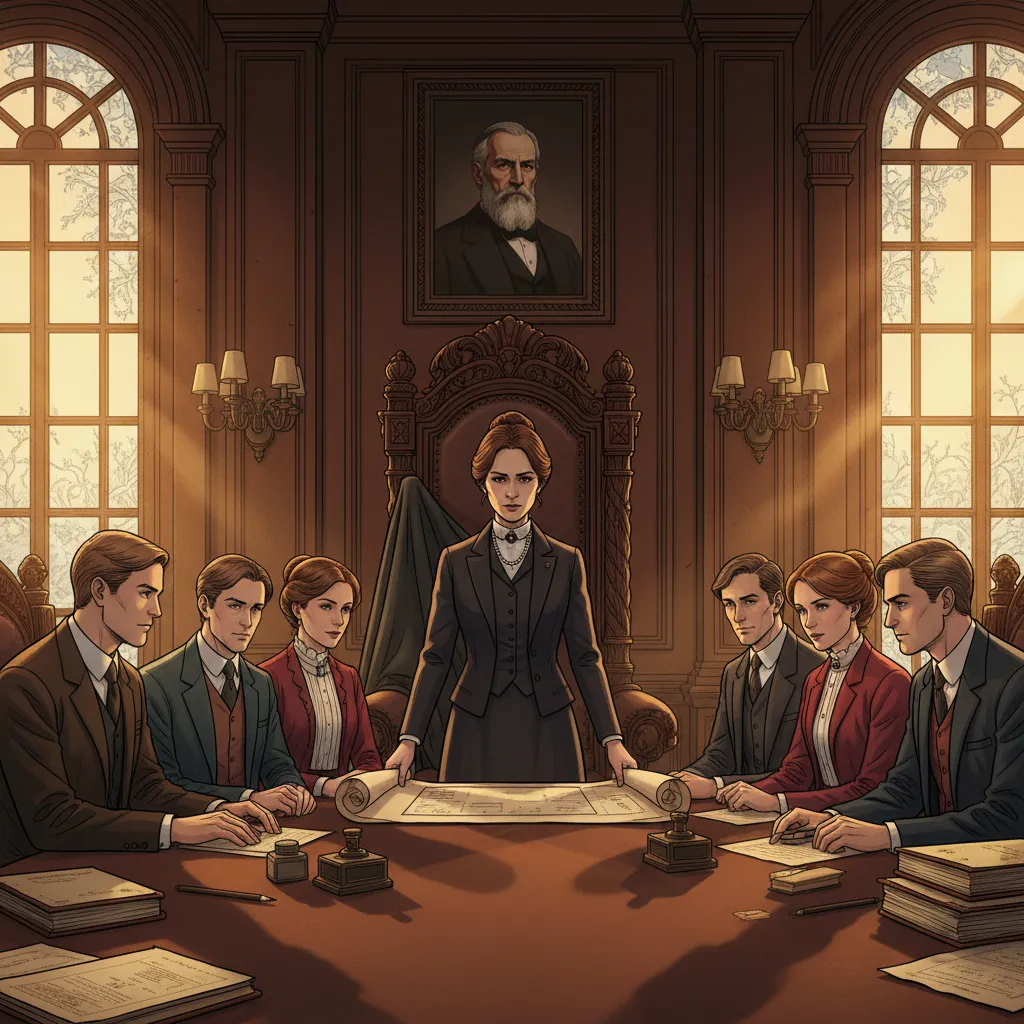
J.P. Morgan’s death did not end the House of Morgan. It transformed it.
His son, John Pierpont Morgan Jr. (known as “Jack”), took over the firm. Jack was a capable but less dominant figure than his father. He maintained the firm’s prestige and continued its role as the premier American banking house through World War I and the 1920s.
During World War I, the Morgan bank served as the official purchasing agent for the British and French governments in the United States — a role that generated enormous profits and enormous controversy. Isolationists accused the firm of profiting from war and of pushing America toward intervention to protect its loans to the Allies.
The Banking Act of 1933 (the Glass-Steagall Act) forced the House of Morgan to choose between commercial banking and investment banking. The firm chose commercial banking, continuing as J.P. Morgan & Co. The investment banking business was spun off as Morgan Stanley — which would itself become one of the most powerful financial institutions in the world.
In 2000, J.P. Morgan & Co. merged with Chase Manhattan Corporation to form JPMorgan Chase — which, by the mid-2020s, had grown into the largest bank in the United States and one of the largest in the world, with over $4 trillion in assets and a market capitalization exceeding $600 billion.
“The bank that bears his name is now the largest in America. Morgan would probably be pleased by its size and appalled by its democracy. He believed in concentrated power, not institutional management.”
The Morgan name lives on in multiple institutions: JPMorgan Chase (banking), Morgan Stanley (investment banking), the Morgan Library & Museum (culture), and the countless institutions shaped by Morgan’s philanthropic gifts during his lifetime.
🔮 Chapter 10: The Man and the Myth
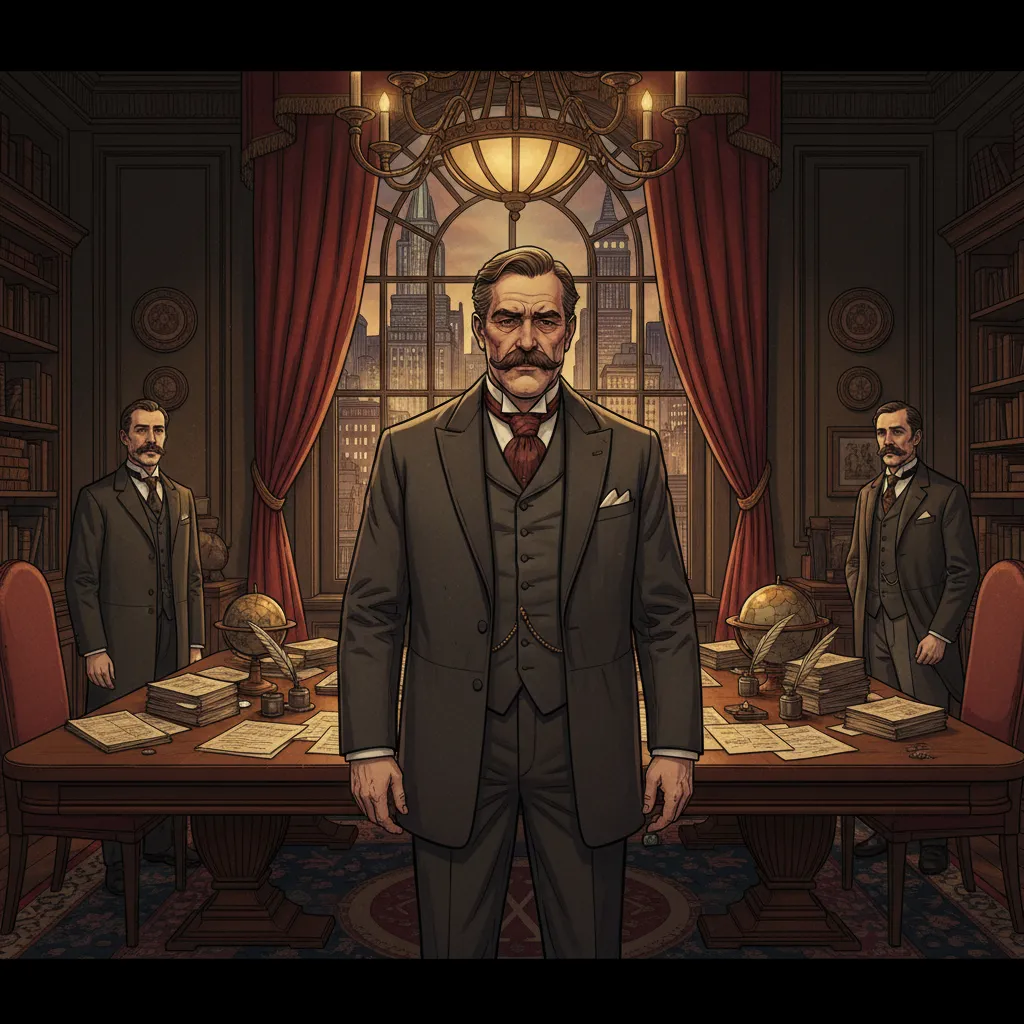
J.P. Morgan is one of the most complex figures in American history, and any attempt to reduce him to a simple narrative is doomed to fail.
He was a patriot who saved the nation’s financial system — twice — at personal risk and with no guarantee of reward. He was also a monopolist who concentrated economic power to a degree that threatened democratic governance.
He was a philanthropist who endowed museums, libraries, churches, and hospitals. He was also a plutocrat who believed that the wealthy had an inherent right to govern and that democracy was, at best, a necessary inconvenience.
He was a man of genuine religious faith who attended church regularly and supported religious institutions generously. He was also a man of considerable appetites who maintained multiple romantic relationships and lived with an extravagance that would make modern billionaires blush.
He believed in order, stability, and the power of concentrated capital to drive economic progress. His critics believed that concentrated capital was inherently antidemocratic and that the stability Morgan created came at the cost of economic freedom.
“Was Morgan good or bad for America? The answer is yes. He was both. He stabilized the system and he monopolized it. He created order and he concentrated power. He was the best and worst of capitalism in a single, complicated, bulbous-nosed man.”
The Morgan Lessons:
-
Trust is the ultimate currency. Morgan built his empire on trust — the trust of investors, governments, and counterparties. In finance, trust compounds more reliably than interest.
-
Control the flow, not the stock. Morgan’s power came from controlling capital flows between Europe and America, not from accumulating personal wealth. Positioning yourself at the intersection of supply and demand is more powerful than being either the supplier or the demander.
-
Systems need architects. The American economy in the late 19th century was chaotic. Morgan imposed order — through consolidation, reorganization, and the sheer force of his personality. Sometimes industries need someone to impose structure from outside.
-
Private power has limits. Morgan’s ability to rescue the financial system was also an argument for why he shouldn’t need to. The creation of the Federal Reserve was an implicit acknowledgment that no democracy should depend on the goodwill of a private citizen for its survival.
-
Collect something. Morgan’s art collection outlived his financial empire. The things he bought with his money endured longer than the money itself.
🏆 Chapter 11: The Shadow That Never Fades
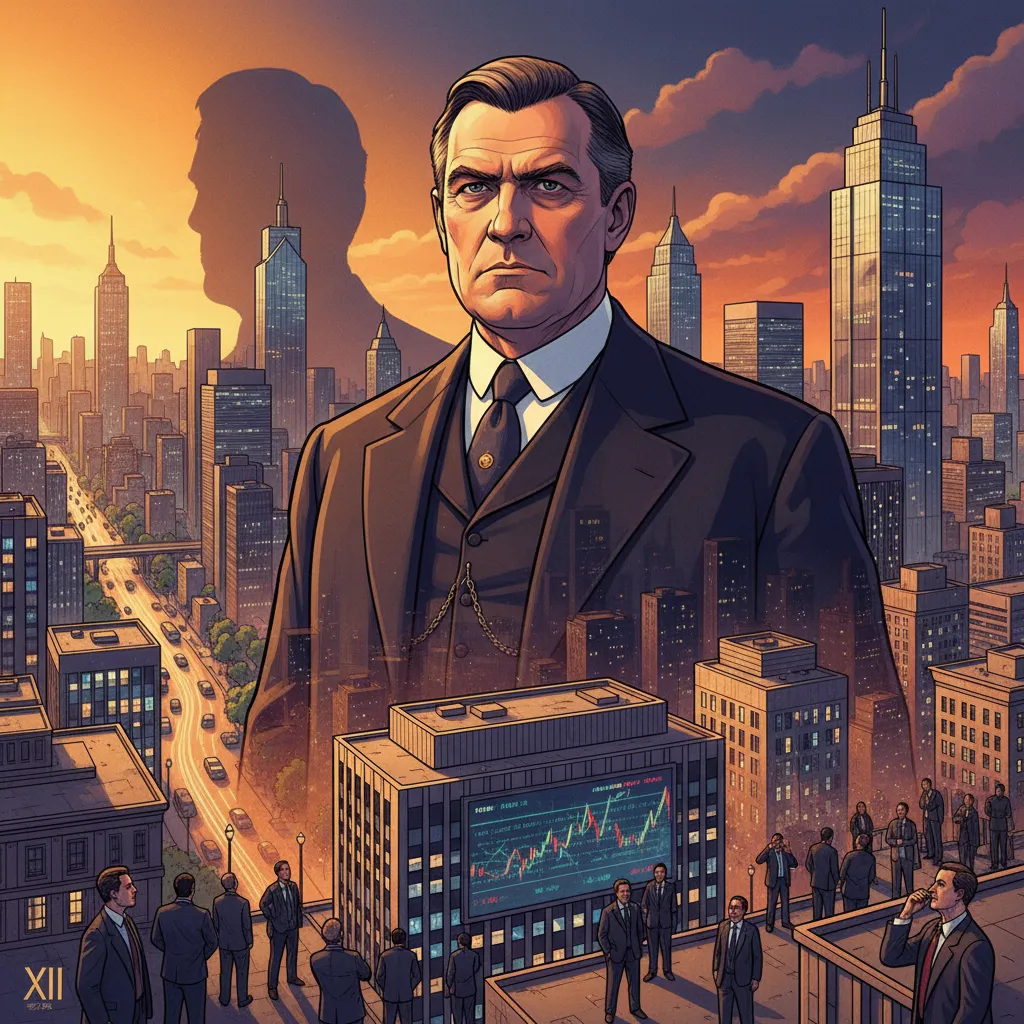
J.P. Morgan died over a century ago, but his shadow falls across modern finance like a permanent eclipse.
Every time JPMorgan Chase reports quarterly earnings, his name is invoked. Every time Morgan Stanley underwrites an IPO, his legacy is cited. Every time the Federal Reserve intervenes in a financial crisis, it is doing — with institutional authority — what Morgan did with personal authority in 1895 and 1907.
The questions Morgan raised are as relevant today as they were in 1907: How much power should private capital have over public life? Who should serve as the lender of last resort? Can a financial system designed by the wealthy serve the interests of everyone?
These are not historical questions. They are permanent questions. And J.P. Morgan, for better or worse, defined the terms on which they are still debated.
He was the most powerful private citizen in American history. He bailed out the United States government — not once, but twice. He created the modern corporation. He assembled one of the greatest art collections ever made. He was feared, admired, hated, and needed in roughly equal measure.
“A man always has two reasons for what he does — a good one and the real one.”
That was J.P. Morgan’s most famous quote. It applies to everyone. It applied, most of all, to him.
JPMorgan Chase, the institution that bears his name, is the largest bank in the United States with over $4 trillion in assets as of 2025. Morgan Stanley, the investment bank spun off from the House of Morgan in 1935, manages over $1.5 trillion in client assets. The Morgan Library & Museum in New York City is open to the public.
💔 Chapter 12: The Banker’s Shadow & Personal Storms (1860-1871)
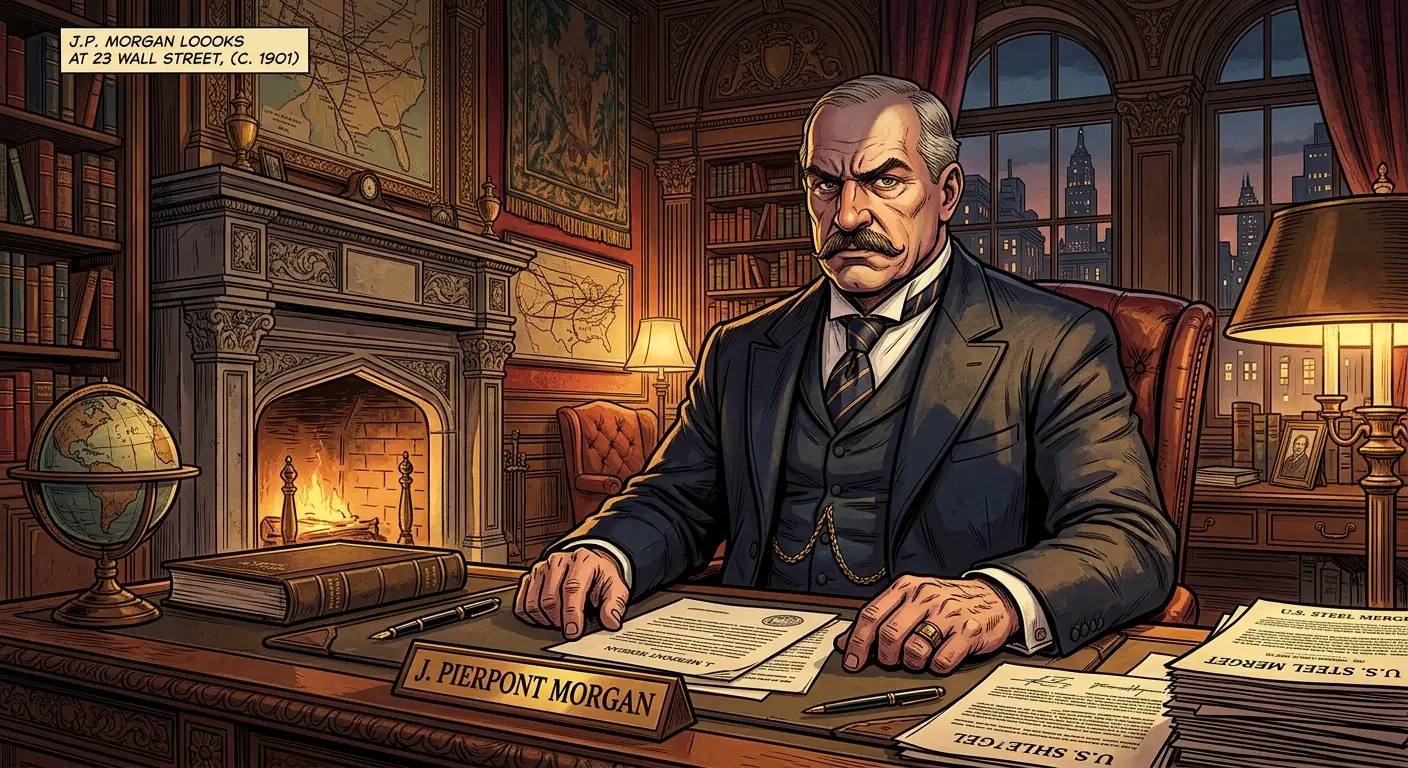
So far, we’ve painted Pierpont as the financial titan, the man who brought order to chaos, the guy you called when the country was going broke. And he was all of that. But like any good superhero origin story, there are some messy bits, some early stumbles, and a whole lot of personal heartbreak that shaped the man behind the myth. Let’s peel back the layers and see the younger, perhaps less polished, Morgan.
The Rifleman’s Reproach: A Wartime Controversy
While his peers were marching off to fight in the Civil War, J.P. Morgan, like many wealthy young men of his era, paid a substitute to serve in his stead for $300. (A common, if ethically murky, practice at the time, but still, not exactly heroic.) What truly raised eyebrows, however, was a business deal during the war that put a rather large, unsavory stain on his early reputation.
In 1861, Morgan purchased 5,000 obsolete Hall carbine rifles from the U.S. Army for $17,486. These rifles were considered surplus and defective. What did he do next? He promptly resold them to a Union general, John C. Frémont, for $109,918 – a tidy profit of over 500%. Frémont’s general then turned around and sold them back to another Union arsenal for $100,000. Yes, you read that right. The government effectively bought back its own defective rifles at an astronomical markup, lining Morgan’s pockets in the process.
This wasn’t just a clever flip; it was a scandal. The rifles were so poor they were “dangerous to fire” for the soldiers using them. A congressional committee investigated, and though Morgan was ultimately cleared of direct wrongdoing by a technicality (the government contract was with a partner, not Morgan directly, and the partner had already resold them before the government tried to cancel), the stench of wartime profiteering clung to him. It was a stark reminder that even the man who would later save the nation’s finances wasn’t above a ruthless deal or two. Some might call it shrewd business; others, a deeply cynical exploitation of a national crisis. We’ll let you decide.
A Heartbreak in Marble: The Mimi Tragedy
Beyond the cutthroat world of finance, Morgan experienced a profound personal tragedy that left an indelible mark. In 1861, he married Amelia Sturges, affectionately known as “Mimi.” She was a beautiful, cultured woman, and by all accounts, Pierpont was utterly devoted to her. This wasn’t a marriage of convenience or dynastic ambition; it was a love match.
Their honeymoon in Europe was cut short when Mimi fell gravely ill with what was likely tuberculosis. Morgan, ever the man of action, tried everything, consulting doctors across Europe, desperately seeking a cure. He was, for once, powerless. Mimi succumbed to the illness on February 17, 1862, just four months after their wedding. She was only 25 years old.
The loss devastated Morgan. He reportedly kept a portrait of Mimi in his office for the rest of his life and rarely spoke of her. Her death, so early and so tragic, undoubtedly contributed to the formidable, often remote, persona he cultivated. It’s easy to imagine a man, already prone to illness and social anxiety, retreating further inward after such a profound blow. The world became a colder, more logical place, perhaps, where emotions were a luxury he could no longer afford.
The Family Man (Sort Of): A Second Chance
Four years later, in 1865, Morgan married Frances Louisa Tracy, known as Fanny. This marriage was more conventional, producing four children: Louisa Pierpont Morgan, Anne Tracy Morgan, John Pierpont Morgan Jr. (known as Jack), and Juliet Pierpont Morgan. Fanny was a steady, supportive presence, providing the domestic stability that Morgan’s demanding life required.
However, Morgan remained an imposing, often distant, figure within his own home. He was a man of immense will and exacting standards, and those traits didn’t magically disappear when he walked through his front door. His children often found him intimidating, and his relationship with his son, Jack, was complex, marked by Morgan’s high expectations and Jack’s quiet struggle to live up to them. Despite his immense wealth and power, Morgan’s personal life was tinged with a deep, private sorrow and a demanding nature that made true intimacy a rare commodity. He built empires, but perhaps at the cost of some personal warmth.
💡 Chapter 13: The Banker of Light: Morgan and the Electric Revolution (1878-1892)
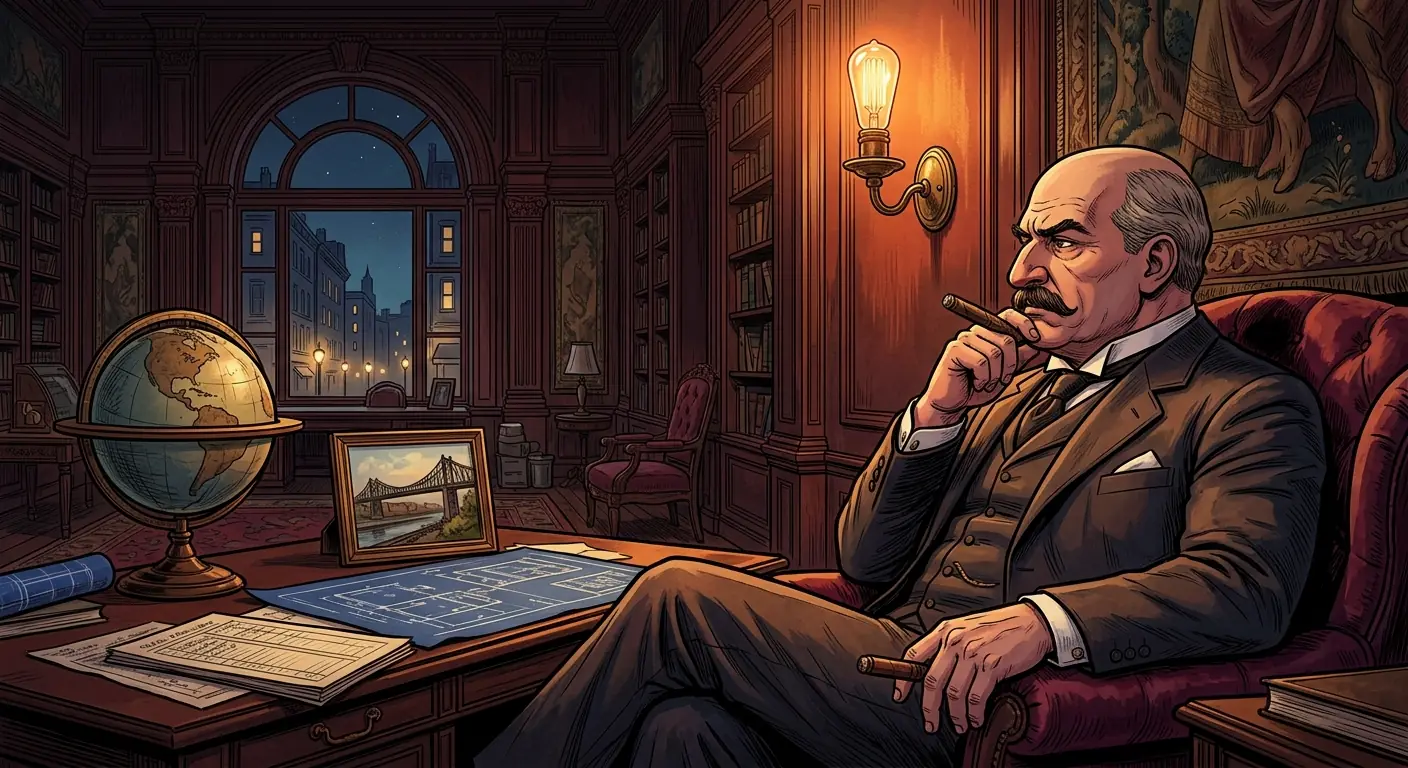
We’ve seen J.P. Morgan dominate railroads and steel, but before he built U.S. Steel, before he bailed out the U.S. Treasury, he saw the future in something far more intangible, yet utterly transformative: electricity. And like everything else he touched, he didn’t just invest; he fundamentally reshaped the emerging industry, forever linking his name with the very concept of “power.”
Lighting Up Wall Street: A Vision for Illumination
It’s one thing to invest in a new technology; it’s another to literally bring it into your own home, making yourself a guinea pig for the future. But that’s exactly what Morgan did. He was captivated by Thomas Edison’s incandescent light bulb, seeing its potential long before most others. In 1878, Morgan was one of the founding investors in the Edison Electric Light Company, eventually becoming a director.
But his commitment went beyond board meetings. In 1882, Morgan’s luxurious brownstone at 219 Madison Avenue became one of the very first privately wired homes in New York City, powered by its own private generating plant in the basement! Imagine the dinner parties: while his peers still fumbled with gas lamps, Morgan could flick a switch and bask in the gentle glow of Edison’s revolutionary invention. It wasn’t just a status symbol; it was a powerful statement of belief. He saw the potential for a world lit up, not by dangerous, flickering gas, but by a clean, controllable, electric current. He was, quite literally, lighting the way for America.
The War of the Currents & Morgan’s Bold Bet
The dawn of electricity wasn’t all bright ideas and innovation; it was also a brutal, high-stakes battle known as the “War of the Currents.” On one side was Edison, backed by Morgan, advocating for Direct Current (DC) – safer for short distances, but inefficient for long-distance transmission. On the other side was George Westinghouse and his brilliant protégé Nikola Tesla, championing Alternating Current (AC) – more dangerous initially, but far more efficient for transmitting power over vast distances.
Morgan, ever loyal to his initial investment and Edison himself, was firmly in the DC camp. He poured millions into Edison’s DC infrastructure, convinced it was the superior technology. This wasn’t just a scientific debate; it was a cutthroat business war. Edison, with Morgan’s financial muscle behind him, launched a vicious public relations campaign against AC, even resorting to electrocuting animals (and famously, an elephant named Topsy) to demonstrate its supposed dangers. It was a bizarre, shocking display, all designed to scare the public away from Westinghouse’s system.
Ultimately, physics won. AC’s superior long-distance transmission capabilities made it the clear choice for powering a burgeoning nation. Morgan, ever the pragmatist, eventually had to acknowledge the inevitable. His initial bet on DC might have been strategically flawed, but his unwavering commitment to electrifying America wasn’t. He learned, adapted, and then, as always, consolidated.
Forging the Future: General Electric
Recognizing that the future lay in consolidating fragmented electric companies, Morgan orchestrated one of his signature moves. In 1892, he engineered the merger of the Edison General Electric Company with the Thomson-Houston Electric Company. The result? The behemoth we know today as General Electric (GE). Morgan installed his own men, like Charles Coffin, to manage the new entity, ensuring it was run with the ruthless efficiency he demanded.
This wasn’t just about making money (though it certainly did that); it was about creating a unified, powerful entity capable of building the infrastructure for an electrified America. GE quickly became a global powerhouse, producing everything from light bulbs and generators to streetcars and industrial machinery. Morgan’s vision wasn’t just for a few lit homes; it was for an entirely new industrial landscape, powered by a force that was once unimaginable. He didn’t just invest in electricity; he built the company that would bring it to the masses, forever changing how we live, work, and even think. From gas lamps to light bulbs, Morgan helped pull America out of the dark ages and into the incandescent glow of the future.
💡 Key Insights
- ▸ Morgan's ultimate power came not from his wealth (others were richer) but from his position as the trusted intermediary between European capital and American enterprise. He was the bridge that connected the world's surplus savings to the world's greatest investment opportunities. The lesson: controlling the flow of capital is more powerful than possessing capital.
- ▸ The Panic of 1907 demonstrated both the power and the danger of having a private citizen serve as the lender of last resort. Morgan's ability to rescue the financial system was impressive, but it also meant the stability of the American economy depended on the judgment and goodwill of one man. The Federal Reserve was created in 1913 specifically to ensure that America would never again need a J.P. Morgan. The irony: the Fed was modeled on what Morgan had done instinctively.