Madam C. J. Walker Left the Washtub and Sold Women a New Occupation
Madam C. J. Walker paired hair preparations with sales training, giving Black women a route into business while financing a factory, philanthropy and civil rights.
View all stories about this mogul
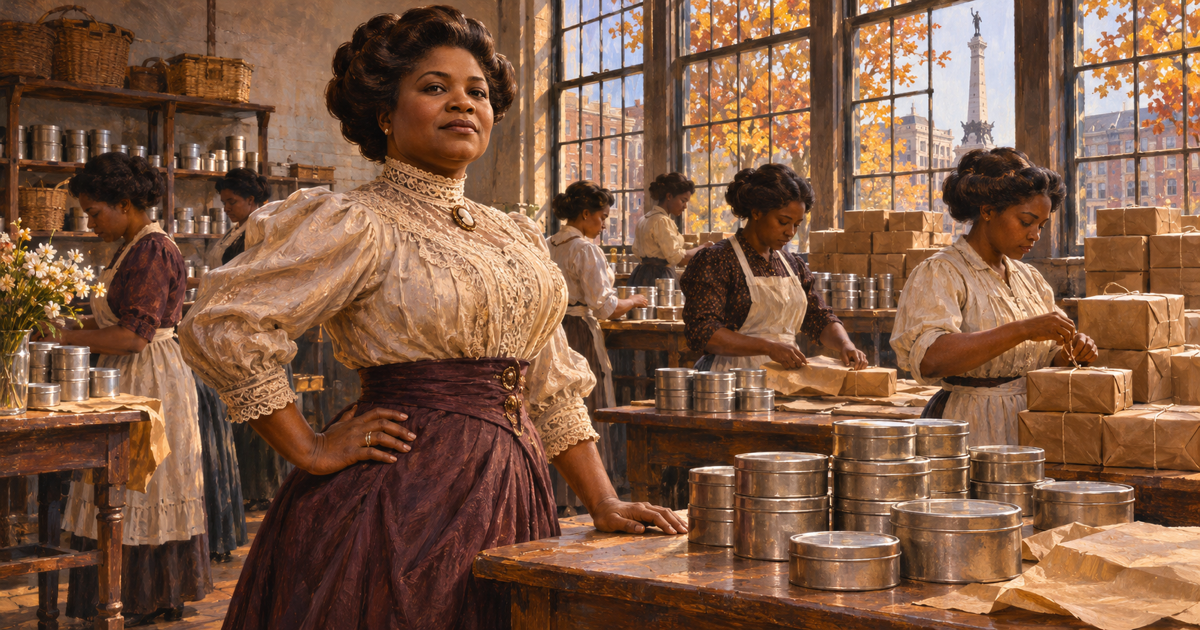
In 1911, the Madam C. J. Walker Manufacturing Company incorporated in Indianapolis. Its founder had established her operation at 640 North West Street, where a house and converted outbuildings accommodated a business selling hair preparations to Black women. Sarah Breedlove, previously a laundress, now had a manufacturing concern bearing her professional name. The incorporation and company records are documented by the Indiana Historical Society.
The factory explains only part of the achievement. Walker also developed schools, sales relationships and a recognizable professional identity for women who handled her products. A preparation could leave Indianapolis in a parcel; knowledge of its application could spread through an instructor, a home salon or a demonstration. Those activities made the company both a supplier of goods and a source of commercial skills.
Her story is frequently compressed into the distance between a washtub and a fortune. That leaves out the decisions connecting them: learning an existing trade, choosing a manufacturing location, training representatives, appointing managers and using commercial gatherings for public purposes. The business becomes more instructive when those decisions receive as much attention as the wealth they produced.
A customer entered an existing industry
Born Sarah Breedlove in Delta, Louisiana, on December 23, 1867, Walker was the daughter of formerly enslaved parents. Orphaned as a child, she married young and later supported her daughter through laundry work in St. Louis. Her own scalp problems and hair loss led her to experiment with treatments. These details are established in the biographical essay by A’Lelia Bundles, her great-great-granddaughter and official biographer.
The starting point matters because Walker understood the customer’s problem through personal experience. Hair care involved recurring work, expense and uncertainty. Selling a preparation required persuading someone that a purchase belonged in her routine. A demonstration could therefore carry information that a package alone could not: what to apply, how to apply it and what the seller claimed it would accomplish.
Walker also entered a field where another Black businesswoman had already established a substantial presence. In Denver in 1905, she worked as a sales agent for Annie Turnbo Malone, founder of the Poro Company. She subsequently developed and sold her own preparations. The Smithsonian’s Walker collection introduction records that commercial connection.
Acknowledging Malone changes the business history. Walker’s achievement did not require an empty industry or a product without predecessors. She had experience selling within an existing beauty trade before competing under her own name. The useful question is what she organized around her products: instruction, distribution, promotion and a relationship with the women selling them.
In 1906, she married Charles Joseph Walker and adopted the professional name Madam C. J. Walker. Her husband had newspaper advertising experience and assisted with early promotion. They divorced in 1912, but she retained the name. The Encyclopedia of Indianapolis documents both the advertising connection and the continuity of her business identity.
Keeping that identity preserved an asset customers already recognized. Her name connected the founder, the preparation and the representative offering it. This is a business interpretation rather than evidence of a quantified advertising advantage: the surviving history establishes the continuity of the name, but does not isolate its financial contribution.
One correction is essential. Walker did not invent the straightening comb or chemical permanent waves. Bundles explicitly rejects both claims. Giving her an invention she did not make obscures the work she actually performed. Product development and commercial organization were significant achievements without an invented patent story attached to them.
Training gave the product a route to customers
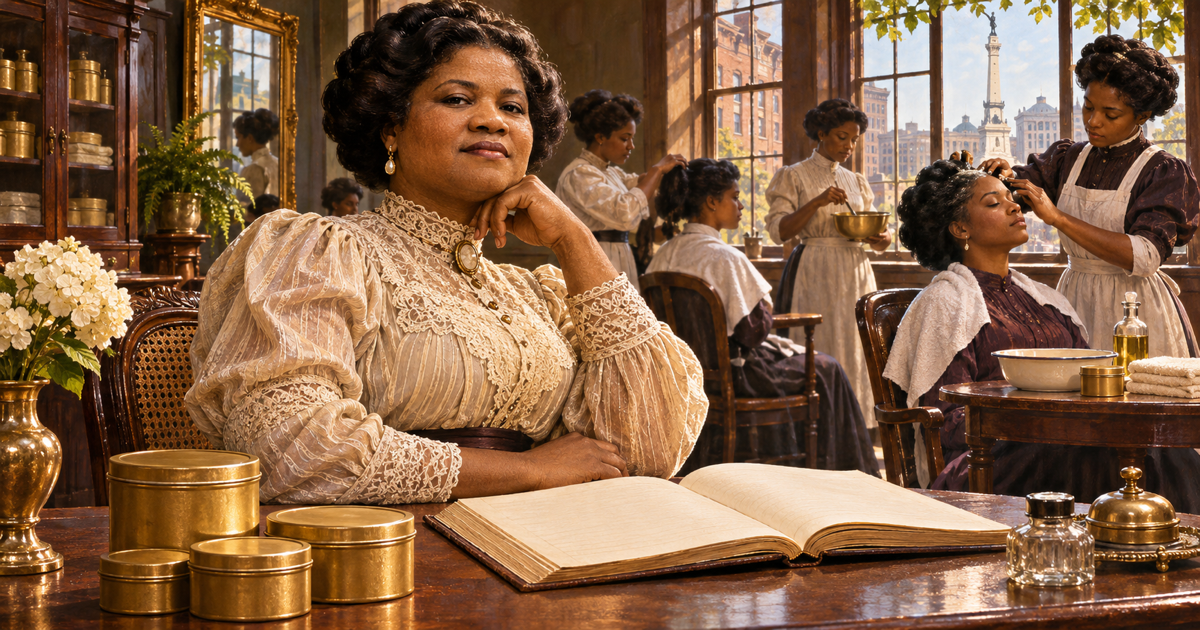
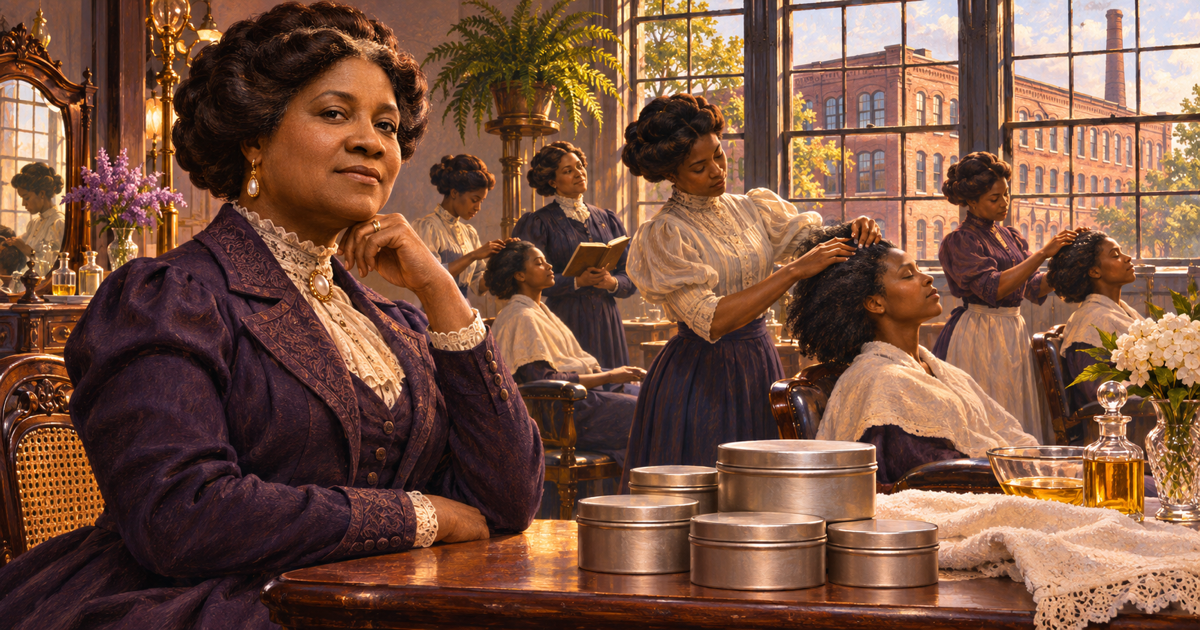
In 1908, Walker established Lelia College in Pittsburgh, naming it for her daughter. The school trained women as hair culturists and representatives of her business. Wonderful Hair Grower formed part of a broader approach known as the Walker Method or Walker System of Beauty Culture. The Smithsonian describes this progression from preparations to instruction and licensed representation.
A school addressed a problem that manufacturing alone could not solve. Increasing production makes more goods available; it does not automatically produce more capable sellers. Instruction offered a way to explain services and applications beyond the founder’s personal reach. Each trained practitioner could carry knowledge into another set of customer relationships.
This arrangement joined two commercial activities. A woman could provide beauty services and sell preparations used in those services. The distinction matters. A sale transferred a product, while a service gave the customer a reason to spend time with someone familiar with its use. Together, they offered more opportunities for explanation than a distant advertisement could provide.
The National Park Service’s account describes traveling representatives teaching women to establish beauty shops in their homes, maintain business records and attend to customers. That is evidence of practical business instruction alongside beauty training. It also explains why the occupation appealed beyond women already working as hairdressers. See the National Park Service teaching history.
The economic appeal was a different relationship to work. A home salon could give its operator responsibility for appointments, supplies and customer service. Responsibility also meant exposure to business uncertainty. Having a recognized product and training did not remove the need to find customers or manage expenses. Opportunity and guaranteed earnings are different claims, and the evidence supports the former.
For that reason, large totals of Walker agents need careful handling. People trained over several years, active representatives at one moment and employees drawing factory wages are different populations. Combining them produces an impressive number while erasing the organization it supposedly describes. The company depended on several kinds of work, with different relationships to its headquarters.
The more durable achievement was a repeatable path into the trade. The school gave instruction a location; the professional title gave graduates a public identity; the preparations gave them something recognizable to offer. These elements could reinforce one another, although the surviving overview sources do not provide a controlled comparison of their separate effects on sales.
Indianapolis connected production with distribution
Walker relocated her headquarters to Indianapolis in 1910. The city offered railway connections and a substantial Black community. The National Park Service identifies access to eight major railway systems as an advantage for her mail-order operation. Her choice brought manufacturing closer to transport infrastructure and an established commercial community.
Those were complementary advantages. A mail-order concern needed to move goods beyond the neighborhood where they were made. It also needed people who could manufacture, administer and represent the business. Indianapolis offered a setting in which a company serving dispersed customers could maintain a fixed operational base.
The property on North West Street made that base concrete. Walker converted a stable and warehouse behind her home into factory and office space. Alice Kelly managed the factory, while attorney Freeman B. Ransom became general manager. These appointments and the use of the property are recorded by the Encyclopedia of Indianapolis.
Putting names to those jobs prevents the founder from swallowing the company. Production management and legal administration required sustained attention even when Walker was elsewhere. Her public visibility could attract interest, but an order still had to pass through an organization capable of fulfilling it. The business had to function between appearances by its most recognizable person.
The arrangement also illustrates the difference between owning a company and personally performing every task. Appointing managers allowed authority to be distributed without removing the founder from the business. It created a practical basis for geographic expansion: Walker could pursue relationships elsewhere while Indianapolis remained responsible for operations.
The records surviving at the Indiana Historical Society include correspondence, financial material, advertisements, convention documents and beauty-school records. Their range shows the administrative breadth of the concern. It was an organization that generated decisions and paperwork across production, promotion and instruction, rather than merely a sequence of memorable sales encounters.
Those records also establish limits on a simplified success story. A photograph of a prosperous founder cannot reveal operating profit. A sales figure cannot establish what individual agents earned after their expenses. Different documents answer different questions. Taking the company seriously means preserving those distinctions instead of using every surviving number as another measure of personal fortune.
New York expansion required managers elsewhere
In 1913, A’Lelia established a Walker salon and training school in Harlem. Madam Walker moved to New York in 1916, while the manufacturing headquarters remained in Indianapolis. The Smithsonian collection introduction establishes the Harlem expansion; Bundles’s biography identifies Ransom and Kelly as the managers handling daily Indianapolis operations.
This was a consequential separation of functions. The founder’s residence, a customer-facing branch and the manufacturing center did not have to share an address. New York offered another place to maintain a business presence, while Indianapolis retained the operational role Walker had already established there.
The move is useful evidence of organizational development. A company tied completely to one person’s physical presence would struggle to operate across those locations. Walker’s arrangement depended on other people exercising responsibility. It does not prove that delegation was effortless, but it shows that expansion involved management as well as geographic ambition.
A photograph reproduced by SFO Museum makes that wider organization visible. Taken in 1912, it shows Walker driving a Model T with her niece Anjetta Breedlove, bookkeeper Lucy Flint and factory forelady Alice Kelly. Kelly also served as Walker’s private tutor. The identification comes from the museum’s exhibition captions, based on historical collections.
The image offers more than a symbol of purchasing power. A bookkeeper and a factory manager belong to the history of the fortune as surely as its owner does. Their presence draws attention to work that an account centered on personal determination can miss: keeping accounts, supervising production and developing the founder’s own capabilities.
The product range expanded too. SFO Museum dates the addition of cold cream, witch hazel and face powder to 1918, alongside established preparations including Wonderful Hair Grower, Glossine and Vegetable Shampoo. The company was offering customers more than its best-known treatment.
Commercially, a broader range could give an established representative more products to discuss with an existing customer. It could also increase the complexity of purchasing and stocking goods. The exhibition establishes the additions; it does not disclose the profitability of each item. The defensible conclusion is that Walker widened the assortment, not that every extension succeeded financially.
Sales organization became a civic resource
Walker organized agents into local and state clubs and convened them nationally in Philadelphia in 1917. She used the gathering to encourage political activity as well as commercial achievement. Following the East St. Louis racial violence that year, she also joined Harlem leaders seeking federal action against lynching. Bundles records these activities in her official biographical essay.
A commercial organization gave those efforts practical resources: people accustomed to corresponding, arranging meetings and acting under a shared identity. A gathering assembled for business could also provide an audience for a public appeal. That connection helps explain why Walker’s activism belongs within her business history rather than in a detached paragraph about generosity.
Her agents’ recognition extended beyond sales. The Encyclopedia of Indianapolis records prizes for clubs contributing time and money to charity, alongside awards for selling products and recruiting representatives. The company thus made community activity part of what it publicly celebrated.
An award is a statement about what an organization wants noticed. Recognizing charitable work alongside commercial results placed both before the same audience. It would be too strong to infer that every representative shared Walker’s political commitments, but the prizes establish that the founder made public service visible within the company’s own gatherings.
Her contributions also supported institutions outside the business. SFO Museum documents a $1,000 donation to the Senate Avenue YMCA project and reproduces a photograph of Walker with Booker T. Washington at its 1913 opening. The gift was a specific allocation of money to a local institution, rather than a general declaration of concern.
These activities did not make business ownership a substitute for civil rights. Walker’s advocacy addressed violence and exclusion that commercial success could not remove. Her experience demonstrates the coexistence of individual wealth and continuing vulnerability within a discriminatory society. A profitable company could provide resources for protest without resolving the conditions that made protest necessary.
That distinction keeps the account from becoming a promise that entrepreneurship alone could overcome structural barriers. Walker created opportunities through a particular organization, serving particular customers and training particular workers. Her political activity acknowledged problems extending beyond the reach of a product, a salon or even a successful manufacturer.
The organization continued after its founder
Walker died on May 25, 1919, aged 51. Her business continued under her daughter, and the Indianapolis building associated with her name opened in 1927. SFO Museum credits A’Lelia and Ransom with erecting the $350,000 headquarters, which included manufacturing facilities, offices, a beauty shop, a theater, a drugstore and a ballroom.
The building should not be described as a headquarters Walker personally opened. Its completion eight years after her death belongs to the history of succession. It shows other people carrying an undertaking forward, using an organization and a name that had outlasted the founder.
Its mix of uses also gives the legacy a physical form. Manufacturing and offices accommodated commerce; the theater and ballroom accommodated public gathering. Those functions occupied the same development. The building made visible the association between business activity and community space that had also appeared in Walker’s donations and conventions.
The distinction between founder and institution is central to assessing her achievement. Personal salesmanship could establish early relationships, but successors needed something they could continue: products, records, facilities, responsibilities and a recognized identity. Walker’s history contains evidence of all those organizational elements. It does not depend entirely on anecdotes about her determination.
Nor does its significance require assigning every participant the same outcome. A manufacturer could prosper while individual representatives experienced different results. Training could create a valuable opening without eliminating commercial risk. Those qualifications make the story more precise, because the change Walker offered was access to an occupation and its possibilities, rather than a universal promise of wealth.
The washtub remains an appropriate starting image because it identifies the work she left. The fuller measure of her achievement lies in what followed it: a business capable of manufacturing goods, teaching their use, supporting representatives and continuing after her death. Her fortune was personal; the organization required many people’s work.
Frequently asked questions
What did Madam C. J. Walker sell?
She sold hair and beauty preparations, including Wonderful Hair Grower, and trained women in beauty services and product sales.
Did Walker invent the straightening comb?
No. Her official biographer, A’Lelia Bundles, explicitly rejects that frequently repeated claim.
Why was Indianapolis important to her company?
It provided railway connections, a substantial Black community and the manufacturing headquarters that remained after Walker moved to New York.
💡 Key Insights
- ▸ Beauty training helped representatives offer services alongside products.
- ▸ Railway access supported the Indianapolis mail-order operation.
- ▸ Managers enabled expansion beyond the manufacturing headquarters.
- ▸ Agent gatherings supported charitable work and political advocacy.
Sources
- Indiana Historical Society — African-American History Materials ↗
- A’Lelia Bundles — Madam C. J. Walker: A Brief Biographical Essay ↗
- Smithsonian Transcription Center — Madam C. J. Walker Collection ↗
- Encyclopedia of Indianapolis — Madam C. J. Walker ↗
- National Park Service — Two American Entrepreneurs ↗
- SFO Museum — In the Driver’s Seat: The Rise of Madam C. J. Walker ↗