Masayoshi Son Lost $70 Billion in the Dot-Com Crash and Kept Betting Bigger
SoftBank's founder turned a $3.5 billion Alibaba stake into a $150 billion fortune, but the same appetite for risk nearly erased his empire twice.

View all stories about this mogul
The $70 Billion Wipeout
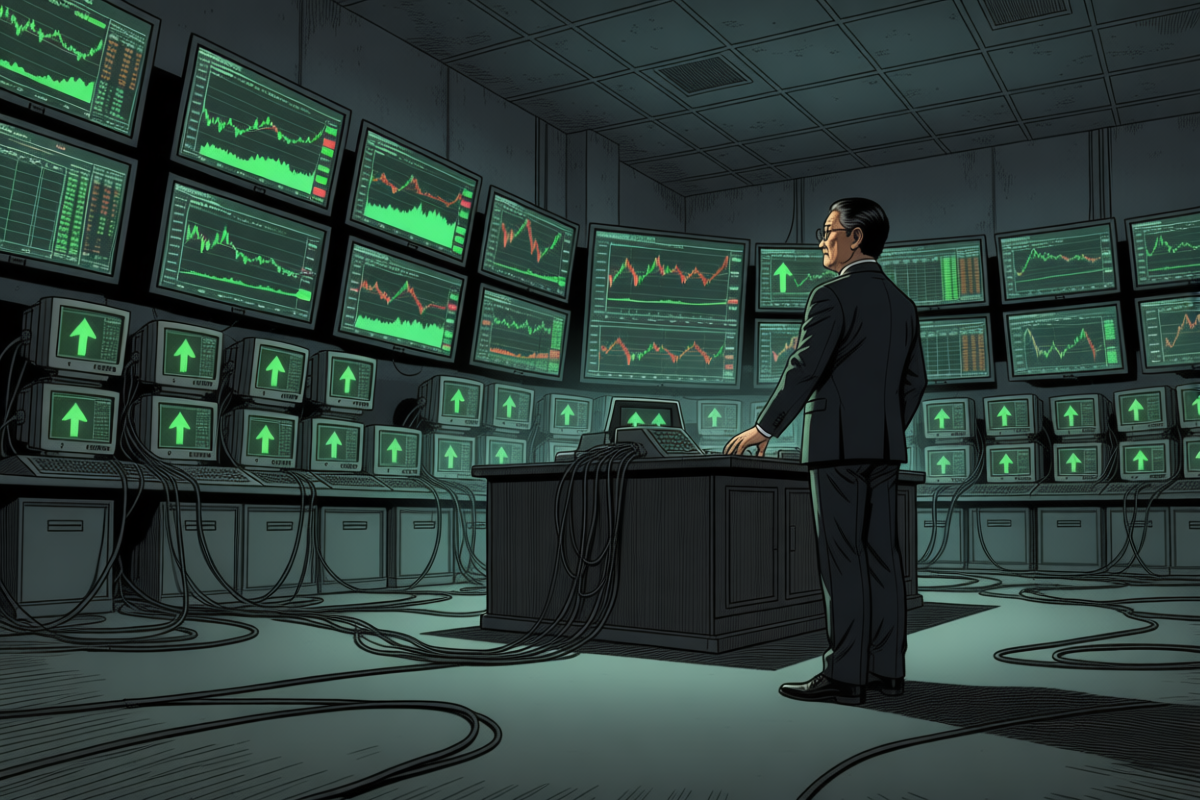
At the height of the dot-com bubble in February 2000, Masayoshi Son’s SoftBank was worth more than $180 billion, making him briefly the richest person in the world. Eighteen months later, the collapse of internet stocks erased roughly $70 billion of his personal wealth. SoftBank’s stock fell 99% from its peak. Son later said he felt like he had been “reborn” after the crash, but he did not retreat. He doubled down.
That sequence — the vertiginous rise, the near-total erasure, the refusal to step back — is the whole story in miniature. What makes the wipeout instructive is not the size of the number, though $70 billion is difficult to hold in the mind, but what Son did next. Most fortunes of that magnitude are built once and then defended. Son’s was built, destroyed, and rebuilt on a larger scale, and the rebuilding began almost immediately, in the same months that the wreckage was still being counted.
The mechanism of the collapse is worth understanding, because it explains why the loss was so complete rather than merely severe. SoftBank in early 2000 was not a diversified conglomerate so much as a leveraged bet on the internet itself. Its value was tied to holdings in internet companies and to the market’s willingness to price those holdings at multiples of any reasonable earnings estimate. When sentiment turned, the assets did not simply fall to a lower but stable level; the leverage amplified the decline, and the same mechanism that had magnified gains on the way up magnified losses on the way down. A 99% decline is not a normal market event. It is what happens when a balance sheet built on conviction meets a market that has stopped sharing it.
For the reader, the first lesson is about the difference between a loss and a liquidation. Son’s wealth fell by roughly $70 billion on paper, but he was not forced out. He retained control of SoftBank, and control is what allowed him to keep playing. The investors who were ruined in 2000 were, in many cases, the ones who had borrowed against inflated positions or who panicked and sold at the bottom. Son’s advantage was structural as much as temperamental: he still had a seat at the table when the table was reset.
The Alibaba Bet That Saved Him
In 2000, Son invested $20 million in a little-known Chinese e-commerce startup called Alibaba. Jack Ma later recalled that Son agreed to a $35 million deal in five minutes without reading the business plan. That stake, diluted over time, was worth roughly $150 billion at its peak. It became the foundation of SoftBank’s modern empire and gave Son the capital to pursue his next obsession: the Vision Fund.
The timing is the part that resists easy explanation. Son made the Alibaba investment in 2000, the same year the bubble burst, when capital was fleeing internet companies and the case for a Chinese e-commerce startup with no clear path to profit was anything but obvious. The five-minute decision, as Ma told it, was not the product of deep diligence. It was a bet on a person and a market, made at the moment when most investors were running the other way.
The dilution matters to the arithmetic. Son did not hold the full value of that early stake to the peak; SoftBank sold down portions over the years and the position was diluted by subsequent financing rounds. Even so, the remaining stake became one of the most valuable single holdings in the history of venture investing, and it did something no amount of cost-cutting could have done: it gave SoftBank a balance sheet capable of supporting enormous new commitments. When people ask how Son could afford to launch a $100 billion fund after nearly losing everything, the honest answer runs through Hangzhou.
There is a counter-reading worth holding alongside the heroic one. The Alibaba bet is often told as evidence of Son’s genius for spotting founders, but a single extraordinary outcome cannot by itself validate a method. Venture returns are famously skewed; a handful of investments produce most of the gains, and the rest are written off. Son’s career contains both the outsized winner and the outsized loser, sometimes in the same portfolio. The Alibaba story is real, and so is the caution it invites: the bet that saved him was also a bet made on instinct, and instinct is not reliably right.
The Vision Fund and the WeWork Lesson
In 2017, SoftBank launched the $100 billion Vision Fund, backed by Saudi Arabia and Abu Dhabi. It poured money into Uber, WeWork, and dozens of other startups. The WeWork IPO collapse in 2019 forced Son to write down billions and admit that his judgment had been clouded by founder charisma. He told investors he had been “foolish.” Yet he kept raising capital and kept investing.
The Vision Fund was a structural innovation as much as an investment vehicle. By pooling sovereign capital at a scale no venture firm had previously commanded, Son could write checks large enough to make a startup’s competitive position almost independent of its underlying business. Companies could buy growth, subsidize prices, and outspend rivals. That strategy worked spectacularly in some cases and became a liability in others, because capital can accelerate a good business and just as easily inflate a weak one.
WeWork is the clearest case. The company’s pitch rested on a founder’s narrative and on the promise that office space could be treated as a technology business. When the IPO prospectus exposed the gap between the story and the financials, the market balked, the offering was pulled, and SoftBank was left holding an enormous position in a company whose valuation had been built on belief. Son’s admission that he had been “foolish” was notable less for its humility than for its specificity: he identified the failure as one of judgment, clouded by founder charisma, rather than as a market accident. That is a rare thing for an investor of his scale to say publicly.
The counter-evidence to the WeWork narrative is that the same willingness to back charismatic founders produced Alibaba and, later, a portfolio of companies that would not have been funded by more cautious investors. The Vision Fund’s record is mixed rather than uniformly bad, and the losses that dominate headlines coexist with gains that rarely do. What the WeWork episode changed was not Son’s appetite for risk but the scrutiny applied to it; the fund’s later investments were structured and sized with more attention to downside, even as the overall strategy remained recognizably his.
For the reader, the practical takeaway is about the danger of narrative as an underwriting standard. Charisma is a signal, but it is not evidence. The investors who lost the most in 2019 were often the ones who had confused a compelling founder with a durable business, and the correction came when the two were finally separated in public.
The Arm Gamble
SoftBank acquired the British chip designer Arm in 2016 for $32 billion. After a failed sale to Nvidia, Son took Arm public in 2023. The listing valued the company at over $50 billion, and its shares later tripled on AI demand. Son has called Arm the “core” of his AI strategy. He has also said he wants to build a $100 billion AI chip company to challenge Nvidia.
The Arm story is the clearest illustration of how Son converts a setback into a position. The sale to Nvidia, which would have been one of the largest semiconductor deals in history, collapsed under regulatory resistance. Rather than treat that as a defeat, Son took the asset public, and the market’s appetite for anything connected to artificial intelligence did the rest. The listing valued Arm at over $50 billion; the subsequent tripling of the shares turned a stranded asset into one of SoftBank’s most valuable holdings.
What makes Arm strategically interesting is its position in the stack. Arm designs the instruction set and core architectures that underpin much of the world’s mobile and embedded computing, and it licenses those designs rather than manufacturing chips itself. That licensing model gives it reach across the industry without the capital intensity of a fabrication plant. As AI workloads move from centralized data centers toward devices at the edge, the architectures that sit inside those devices become more valuable, which is why Son describes Arm as the “core” of his AI strategy rather than as one asset among many.
The $100 billion AI chip company he has said he wants to build is the logical extension of that logic: rather than only licensing designs, SoftBank would own more of the value chain, and rather than only investing in the companies that use AI, it would supply the silicon they run on. Whether that ambition is achievable is an open question, and the market’s willingness to fund it depends on the same enthusiasm that has already tripled Arm’s shares. But the intent is consistent with everything that came before: identify the layer of the stack that everything else depends on, and buy or build a position there.
The Pattern
Son’s career is defined by extreme swings: massive losses, followed by even larger bets. He lost $70 billion and still controls one of the world’s largest technology investment firms. He does not hedge. He doubles down. That is the lesson of Masayoshi Son: the same appetite for risk that nearly destroyed him is the engine that rebuilt him.
The pattern is not merely psychological. It reflects a specific view of how technology markets work: that the returns are concentrated in a small number of enormous outcomes, that the cost of missing one is greater than the cost of several failures, and that the only way to capture those outcomes is to remain able to make large bets when others cannot. Son’s tolerance for drawdowns is the price of admission to that strategy, and his ability to keep raising capital after losses is what makes the strategy sustainable in practice.
The counter-evidence is that survivorship bias flatters the doubling-down approach. For every Son who survives a 99% decline and rebuilds, there are investors who doubled down and were wiped out, and the difference is often access to capital rather than judgment. Son’s edge is partly that sovereign backers were willing to commit at scale, which is not a resource available to most people. The lesson for an ordinary reader is therefore not “take more risk” but something narrower and more useful: distinguish between a loss that destroys your ability to keep playing and one that merely hurts, and protect the former at all costs.
What the record does show is that Son’s judgment has been right often enough, and at sufficient scale, to outweigh the times it was wrong. The $70 billion wipeout, the WeWork write-down, and the failed Nvidia sale are all real. So are Alibaba, Arm, and the fund that made them possible. The same appetite for risk that nearly destroyed him is the engine that rebuilt him, and the story is less a morality tale about caution than a case study in what it takes to keep making large bets after the market has told you, loudly and expensively, that you were wrong.
💡 Key Insights
- ▸ Son's $20 million Alibaba bet became the most profitable venture investment in history.
- ▸ The dot-com crash erased $70 billion of his wealth, but he kept investing.
- ▸ The Vision Fund's WeWork losses forced Son to publicly admit mistakes.
- ▸ Arm's public listing and AI pivot show Son's willingness to double down on new technologies.