Sol Price: The Warehouse Club Inventor Who Taught Costco the Model
Sol Price transformed retail by charging members for access to a deliberately limited assortment, honest markups, and warehouse-level efficiency.

View all stories about this mogul
Sol Price invented a retail format whose most important product was not merchandise. It was trust that the price on the pallet had been stripped of unnecessary cost.
Price built FedMart and later Price Club, pioneering ideas that would shape Costco and the global warehouse-club industry. His model combined paid membership, limited selection, austere buildings, rapid inventory turnover, and strict markup discipline. What looked like a bare warehouse was actually a carefully designed economic machine.
How did FedMart teach Sol Price to remove retail costs?
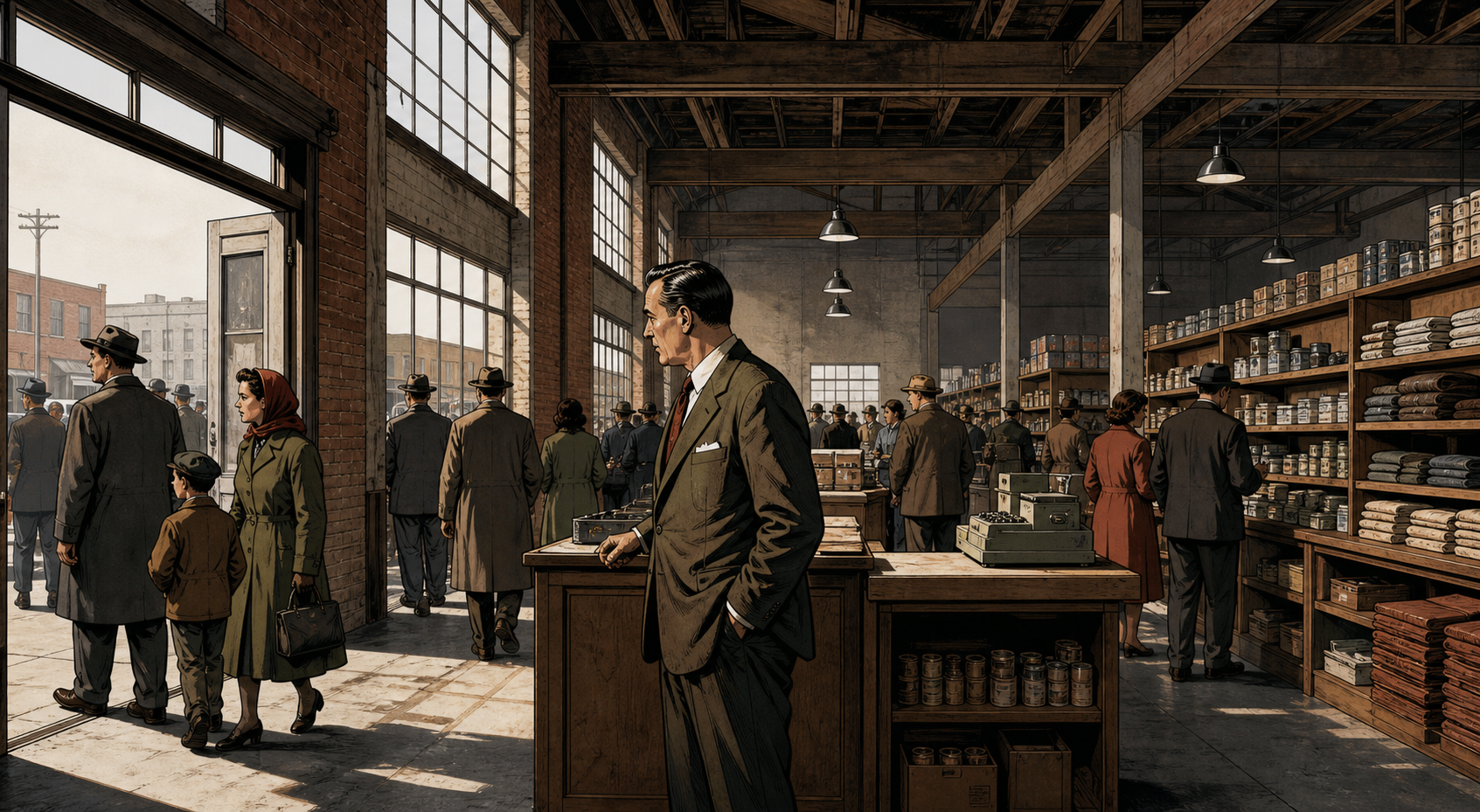
Price trained as a lawyer before entering retail in San Diego. In 1954 he and partners launched FedMart, initially serving government employees and their families through a membership structure. The stores used converted facilities and emphasized low prices over conventional department-store polish.
FedMart taught Price that shoppers would accept fewer services and a plain environment if the savings were real. It also showed how purchasing scale, fast turnover, and operational simplicity reinforced one another. Lower margins could produce greater volume; volume could improve buying power; stronger buying could support lower prices.
Price developed an ethical view of the bargain. The retailer should make a fair profit without exploiting customer ignorance. That principle became operational through disciplined markups rather than occasional promotions. Trust reduced the need for customers to treat every visit as a negotiation.
After losing control of FedMart, Price did not merely recreate it. He focused the next venture more sharply around businesses and institutional buyers, using membership fees to support extremely lean merchandise economics.
Why did Price Club charge people to shop in a warehouse?

Price Club opened in 1976 in a former aircraft hangar on Morena Boulevard in San Diego. The format sold goods from pallets in a no-frills setting. Membership created a recurring revenue stream and screened for customers likely to buy in volume.
The fee changed incentives. Traditional retailers can earn more when product margins rise. A warehouse club that depends heavily on renewal must keep members convinced that savings exceed the price of access. Membership therefore makes customer trust an asset with a measurable annual test.
Selection was deliberately limited. Rather than carry many versions of the same item, buyers concentrated volume on a smaller number of products. That improved negotiating leverage, simplified inventory, and accelerated turnover. The club could feature high-quality national brands while maintaining a reputation for value.
The physical store communicated the model honestly. Concrete floors, exposed fixtures, bulk packages, and inventory on racks told members that money was being spent on goods rather than decoration. Scarcity and changing deals added discovery, but the operating core remained disciplined replenishment and volume.
How did Sol Price’s system become Costco’s foundation?

Price influenced executives who carried his principles forward, including future Costco co-founder Jim Sinegal, who had worked under him. Costco opened in 1983 and grew rapidly with a related commitment to membership, limited assortment, employee productivity, and capped markups.
Price Club and Costco merged in 1993. The combined company later adopted the Costco name, while the operating philosophy Price pioneered continued at much larger scale. His influence also extended to warehouse retailers in other markets and to entrepreneurs who studied the format’s cash flow and loyalty.
The model had tradeoffs. Bulk sizes do not suit every household, car-oriented warehouses require space, and supplier concentration gives buyers significant power. Yet its clarity remains powerful: reduce assortment, handling, advertising, and decor; turn inventory quickly; and return the savings visibly enough that members renew.
Price devoted substantial later effort to philanthropy and community development in San Diego. He died in 2009, but the retail grammar he established is now familiar worldwide.
His deepest innovation was incentive design. Membership revenue, markup rules, warehouse operations, and buyer discipline made it costly for the company to betray its value promise. Sol Price proved that a retailer could build an empire by making restraint—not endless choice or luxurious presentation—feel like a benefit customers were willing to pay to access.
💡 Key Insights
- ▸ Membership revenue can fund lower product margins and align the retailer with customer savings.
- ▸ A deliberately narrow assortment increases purchasing leverage and simplifies operations.
- ▸ Trust compounds when pricing rules are consistent enough for customers to understand.
- ▸ An operating model can be more influential than the company that first commercialized it.