Changpeng Zhao: How the World's Most Powerful Crypto CEO Built Binance, Dodged Every Regulator, and Finally Got Caught
He was a McDonald's worker turned engineer turned crypto trader who built the world's largest cryptocurrency exchange in 180 days. A decade later, he pleaded guilty to federal money laundering charges and paid a $4.3 billion fine.

View all stories about this mogul
On November 21, 2023, Changpeng Zhao — the billionaire founder of Binance, the largest cryptocurrency exchange in the world — stood in a federal courtroom in Seattle and pleaded guilty to a single count of violating the Bank Secrecy Act. He was quiet, composed, and wearing a dark suit. He was the most powerful CEO in the history of cryptocurrency. He was 46 years old. And in front of a U.S. federal judge, he admitted that Binance had willfully failed to maintain an effective anti-money-laundering program while he was in charge.
As part of the plea, Zhao — known universally by his initials CZ — resigned as CEO of Binance. His company agreed to pay a total of $4.3 billion in fines and penalties — one of the largest corporate penalties in U.S. history. Zhao himself agreed to pay $50 million personally and to serve prison time for his role in the violations.
It was a surreal moment for anyone who had followed crypto over the previous decade. Six years earlier, in July 2017, CZ had launched Binance out of nothing. In under 180 days, it had become the largest crypto exchange in the world by trading volume — a position it has held almost continuously ever since. CZ had been, by any reasonable measurement, the most dominant figure in a trillion-dollar global industry. He had tweeted markets up. He had tweeted rivals down. He had humiliated Sam Bankman-Fried in public. He had outlasted every major crypto CEO of his generation except Vitalik Buterin.
And now, in a Seattle courtroom, he was standing before a federal judge and admitting guilt.
This is the story of how a McDonald’s fry cook from Vancouver became the most powerful man in crypto, built one of the largest exchanges in financial history in record time, and then pushed his luck with the U.S. government one tweet too many.
🍟 Chapter 1: From Jiangsu to Vancouver

Changpeng Zhao was born on September 10, 1977, in the Jiangsu province of China. His father was a professor; his mother was a teacher. During the Cultural Revolution and its aftermath, his family suffered the kind of upheaval that shaped millions of Chinese households — political denouncement, rural resettlement, and an abiding distrust of authoritarian institutions. In 1989, amid China’s broader post-Tiananmen anxieties, the Zhao family emigrated to Canada and settled in Vancouver, British Columbia.
Young CZ was twelve years old. He spoke almost no English. His family had little money. He took odd jobs to help out — working at a gas station, handing out flyers, and, most famously, flipping burgers at a McDonald’s in Vancouver. He would later joke in interviews that his time at McDonald’s had taught him more about efficient operations than his later engineering degrees had.
He was a gifted student. He enrolled at McGill University in Montreal, where he studied computer science, graduating in 1999. After graduation, he took a series of jobs building high-frequency trading systems — first at the Tokyo Stock Exchange, then at Bloomberg’s trading platform, then at the New York-based trading firm Fusion Systems, where he worked on futures trading infrastructure.
By 2013, CZ was a well-respected but relatively obscure financial technology engineer, with a specific skill set — building fast, reliable trading systems for exchanges and market makers. Then he stumbled into Bitcoin.
₿ Chapter 2: The Poker Game Conversion

In the summer of 2013, CZ was at a poker game in Shanghai when one of his friends began explaining Bitcoin. The friend argued that it was a revolutionary new form of digital money, decentralized and mathematically provable. CZ, who understood financial systems deeply, listened carefully. The explanation was good enough to make him curious.
Shortly after, he sold his apartment in Shanghai for roughly $1 million and used the proceeds to buy Bitcoin. The price at the time was around $600 per coin. Over the next several months, the price rose and fell. CZ held. By late 2013, Bitcoin reached a then-all-time-high of over $1,100 — a roughly 80% gain from his purchase.
That was enough for CZ. He quit his job at Fusion Systems and devoted himself full-time to crypto. He joined Blockchain.info as its third employee, then moved to OKCoin, a major Chinese exchange, where he became chief technology officer. He learned the inner workings of crypto exchanges — not just the trading engines, but the settlement systems, the risk models, and the regulatory gray zones in which they operated.
By 2016, CZ had concluded that most existing crypto exchanges were poorly engineered, badly managed, and inadequately capitalized. He decided to build his own.
🚀 Chapter 3: 180 Days to Number One

Binance was launched in July 2017. The ICO — the sale of Binance’s native BNB token — raised approximately $15 million in just over two weeks. The money was used to build out the exchange infrastructure, hire a small team, and begin operations.
From the beginning, Binance was designed to be extremely fast, extremely easy to use, and extremely open. Users could sign up with just an email address, without providing any identity verification for basic trading. The exchange listed hundreds of tokens that other major exchanges refused to touch. Trading fees were low. The user interface, while not beautiful, was functional and familiar to professional traders.
The timing was perfect. Binance launched just as the 2017 ICO boom was reaching fever pitch. Retail investors around the world were desperate to buy the hundreds of new cryptocurrencies being issued every week, and most existing exchanges couldn’t keep up with the demand. Binance did. Within weeks of launch, Binance was handling hundreds of millions of dollars in daily trading volume. Within months, it was processing billions.
By January 2018 — less than six months after launch — Binance was the largest cryptocurrency exchange in the world by trading volume. CZ went from being an obscure trading-systems engineer to becoming one of the most powerful men in crypto, almost overnight.
🌏 Chapter 4: The Headquarters That Didn’t Exist

From the beginning, Binance had an unusual legal structure. When asked where the company was headquartered, CZ would give deliberately evasive answers. Binance had been founded in China, but it had moved out after China’s September 2017 crackdown on crypto exchanges. It had briefly operated out of Japan, then Malta, then Taiwan, then the Cayman Islands. Eventually CZ began saying that Binance was “headquarters-less,” existing only as a distributed global team of thousands of employees working remotely from dozens of countries.
The structure was a regulatory arbitrage strategy dressed up as corporate philosophy. By refusing to have a headquarters, Binance could avoid being subject to any single country’s financial regulations. Users around the world could trade any token, at any time, without going through the know-your-customer (KYC) and anti-money-laundering (AML) processes that traditional exchanges were required to enforce.
For years, this strategy worked. Binance grew faster than any regulator could keep up with. When one country tried to restrict it, CZ would simply move operations to another country. When users in one jurisdiction were blocked, they could use VPNs to access Binance from a different country. The result was one of the freest, most chaotic, most profitable financial platforms in the world — and a regulator’s worst nightmare.
💰 Chapter 5: The Rise of BNB

One of CZ’s most strategically brilliant moves was the creation of BNB — Binance Coin. BNB was Binance’s native token, originally issued during the 2017 ICO. Users who paid trading fees with BNB received discounts. Users who held BNB received perks on new token launches. Binance promised to use a portion of its profits to buy back and “burn” BNB, reducing its total supply over time and, theoretically, increasing its value.
The mechanism created a flywheel. As Binance grew, demand for BNB grew. As demand grew, BNB’s price rose. As BNB rose, CZ’s personal net worth exploded. At BNB’s peak in 2021, its market capitalization exceeded $100 billion, making it one of the largest cryptocurrencies in the world. CZ’s personal stake in BNB alone was worth tens of billions of dollars.
BNB later became the foundation for BNB Chain, a full blockchain competing directly with Ethereum. BNB Chain was faster, cheaper, and more centralized than Ethereum. It became a popular home for DeFi projects, gaming applications, and high-volume traders who couldn’t tolerate Ethereum’s gas fees. By 2022, BNB Chain was handling more daily transactions than Ethereum — a remarkable achievement for a blockchain that had only been launched in 2020.
The combination of Binance the exchange and BNB Chain the blockchain gave CZ a vertically integrated crypto empire unlike anything else in the industry.
💥 Chapter 6: The FTX Tweet

By 2022, Binance had a serious rival. Sam Bankman-Fried’s FTX had grown explosively, winning celebrity endorsements, sports sponsorships, and political credibility that CZ had never been able to match. Bankman-Fried was being celebrated in the mainstream media as the respectable face of crypto. CZ was being quietly sidelined.
The tension between the two men was mutual. CZ had been an early Binance investor in FTX — owning a stake through Binance’s corporate venture arm — and had sold it back to FTX in 2021 for a package that included a significant number of FTT tokens, FTX’s native exchange token. By 2022, CZ held hundreds of millions of dollars’ worth of FTT.
On November 6, 2022, CZ tweeted that Binance had decided to liquidate its remaining FTT holdings “due to recent revelations that have come to light.” The tweet referenced a CoinDesk investigation that had raised questions about the health of Alameda Research, SBF’s trading firm, and its exposure to FTT. CZ’s tweet triggered a run on FTX. Within days, FTX’s customers had demanded billions of dollars in withdrawals. Within a week, FTX was bankrupt.
The tweet was, by any historical measurement, the single most consequential tweet in corporate finance history. It wiped out a reported $32 billion company in under a week. It destroyed Sam Bankman-Fried’s career. And it briefly made CZ look like the cleaner, more trustworthy alternative in crypto.
The appearance wouldn’t last.
🕵️ Chapter 7: The DOJ Investigation

Unbeknownst to most observers, the U.S. Department of Justice had been investigating Binance for years. The investigation had begun in 2018 and intensified through 2020 and 2021, as prosecutors gathered evidence that Binance had allowed U.S. users to trade on its platform without enforcing anti-money-laundering rules, had failed to file required suspicious activity reports, and had processed transactions for sanctioned entities including Iranian users, Russian oligarchs, and Hamas-linked organizations.
Internal Binance communications — eventually unsealed in court filings — painted a damning picture. Compliance employees had warned CZ and other executives for years that Binance was not complying with U.S. regulations. One senior compliance officer allegedly wrote in an internal message: “We need a bigger boat.” Another joked that Binance was “operating as a fucking unlicensed securities exchange in the USA.” The messages would become central exhibits in the eventual plea agreement.
The investigation culminated in November 2023. Federal prosecutors presented Binance and CZ with a choice: accept a settlement and guilty plea, or face criminal indictment. CZ agreed to the settlement.
⚖️ Chapter 8: The Seattle Courtroom

On November 21, 2023, CZ appeared in the U.S. District Court for the Western District of Washington in Seattle and pleaded guilty to violating the Bank Secrecy Act. Binance agreed to pay $4.3 billion in penalties. CZ personally agreed to pay $50 million and to step down as Binance’s CEO. He was also required to serve prison time — the length of which would be determined at a later sentencing hearing.
In April 2024, a federal judge sentenced CZ to four months in federal prison. The sentence was shorter than some had expected — prosecutors had requested three years — but it was still a historic moment. CZ was the most prominent crypto executive ever convicted and imprisoned for regulatory violations. He reported to prison in June 2024 and was released in September 2024, having served his full sentence.
Binance, meanwhile, was placed under a multi-year monitorship. A new CEO, Richard Teng, was appointed. Binance was required to fully implement anti-money-laundering controls, to stop serving users in the United States, and to file extensive reports with the Treasury Department, the CFTC, and the DOJ. The company’s freewheeling era was over.
🏢 Chapter 9: Binance After CZ
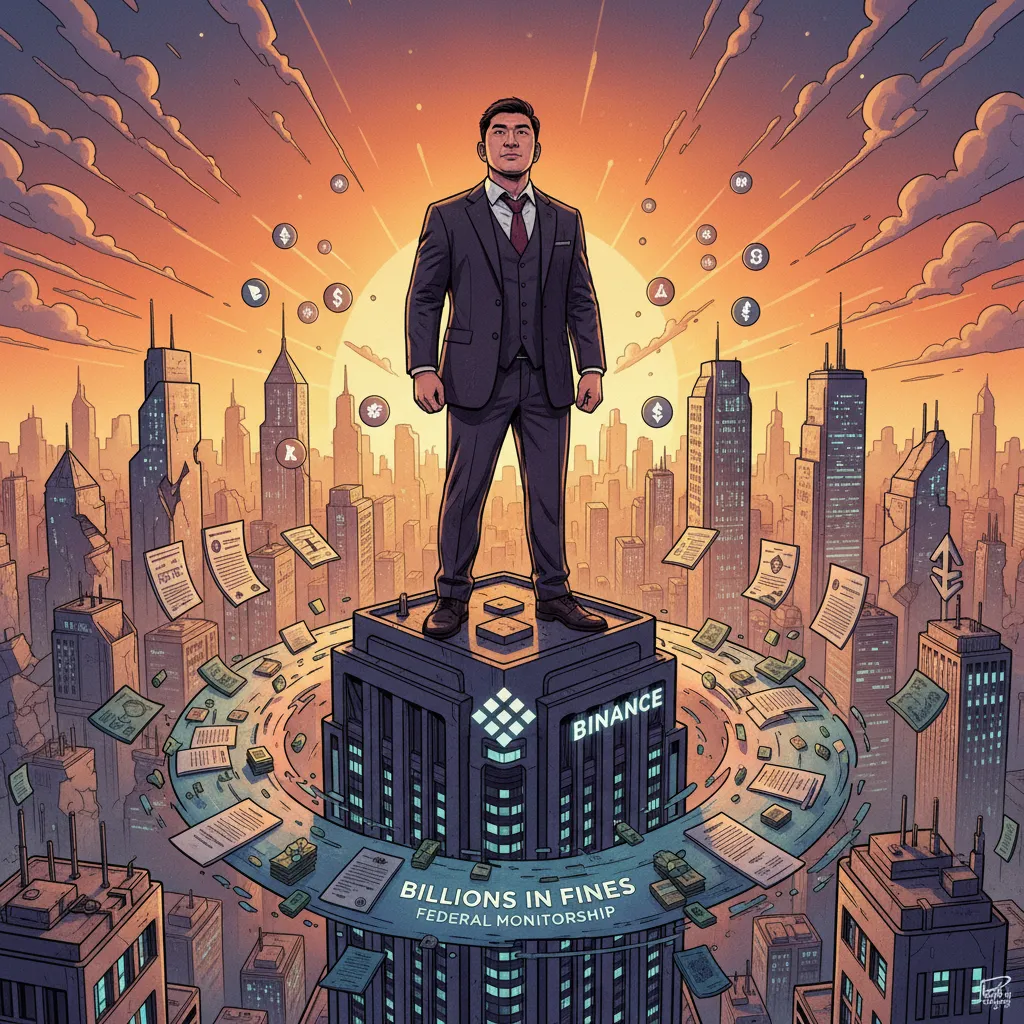
Remarkably, Binance survived — and, in most metrics, thrived. Despite losing its founder, despite paying billions in fines, despite being placed under federal monitorship, Binance remained the largest cryptocurrency exchange in the world by trading volume throughout 2024 and into 2025. It continued serving tens of millions of users in dozens of countries. It continued generating billions of dollars in annual revenue.
The survival was a testament to the network effects Binance had built during its chaotic early years. Once users had their funds on the platform, once market makers had routed their flows, once DeFi protocols had integrated with Binance’s infrastructure, moving away was difficult. The new leadership under Richard Teng kept most of the old team in place and worked carefully to rebuild regulator relationships country by country.
CZ, meanwhile, retained enormous personal influence. Even after stepping down as CEO, he remained Binance’s largest shareholder, controlling a significant portion of BNB and of Binance’s equity. His personal net worth — despite the $50 million penalty and the $4.3 billion corporate settlement — was estimated at over $30 billion by mid-2025. He had been briefly imprisoned, then released, then quietly reestablished as one of the wealthiest individuals in crypto.
🎙️ Chapter 10: The Post-Prison Reinvention

After his release from prison in September 2024, CZ spent several months out of the spotlight. Then, in early 2025, he began a cautious public return. He started tweeting again — carefully at first, then more frequently. He launched a personal educational initiative focused on blockchain literacy. He made small investments in new crypto startups. He appeared at conferences in the Middle East and Asia, though he avoided the United States entirely.
CZ’s framing of his own story became relentlessly optimistic. He spoke publicly about the lessons he had learned, about the importance of compliance, about building crypto for the long term. He largely avoided commenting on his former rivals or on the details of his plea agreement. Some observers found his reinvention convincing; others saw it as a carefully managed public relations campaign to rehabilitate his image.
Either way, CZ’s post-prison strategy appeared to work. By late 2025, he was once again being invited to speak at industry events, once again being profiled as an influential voice in global crypto, and once again commanding enormous attention whenever he tweeted. The stain of a federal conviction had not erased his power.
⚖️ Chapter 11: The Verdict on a Generation

CZ’s story is inseparable from the broader story of the 2017-to-2023 crypto era. It was a period defined by breathtaking ambition, reckless regulatory arbitrage, and enormous personal fortunes built almost overnight. It was also a period that ended in a wave of criminal convictions: Sam Bankman-Fried sentenced to 25 years for FTX’s collapse; Do Kwon extradited to face fraud charges for Terra/Luna’s collapse; dozens of smaller exchange operators indicted for fraud, theft, or money laundering.
CZ was one of the few from that generation to survive with his freedom, his wealth, and most of his influence intact. His plea agreement — in hindsight — looks like one of the most skilled legal negotiations in crypto history. He preserved Binance as an operating entity. He preserved his personal ownership. He served only four months in prison. He paid penalties that, while enormous, were manageable given his personal fortune. And he was positioned, by 2025, to begin rebuilding his public role.
Whether CZ represents a success story or a cautionary tale depends on how you measure outcomes. He avoided the devastating fate of Sam Bankman-Fried. He paid a cost significantly lower than most observers expected. But he also pleaded guilty to willfully breaking U.S. law — a fact that will follow him permanently and that has permanently changed how regulators view crypto executives everywhere.
🌅 Chapter 12: The Ledger
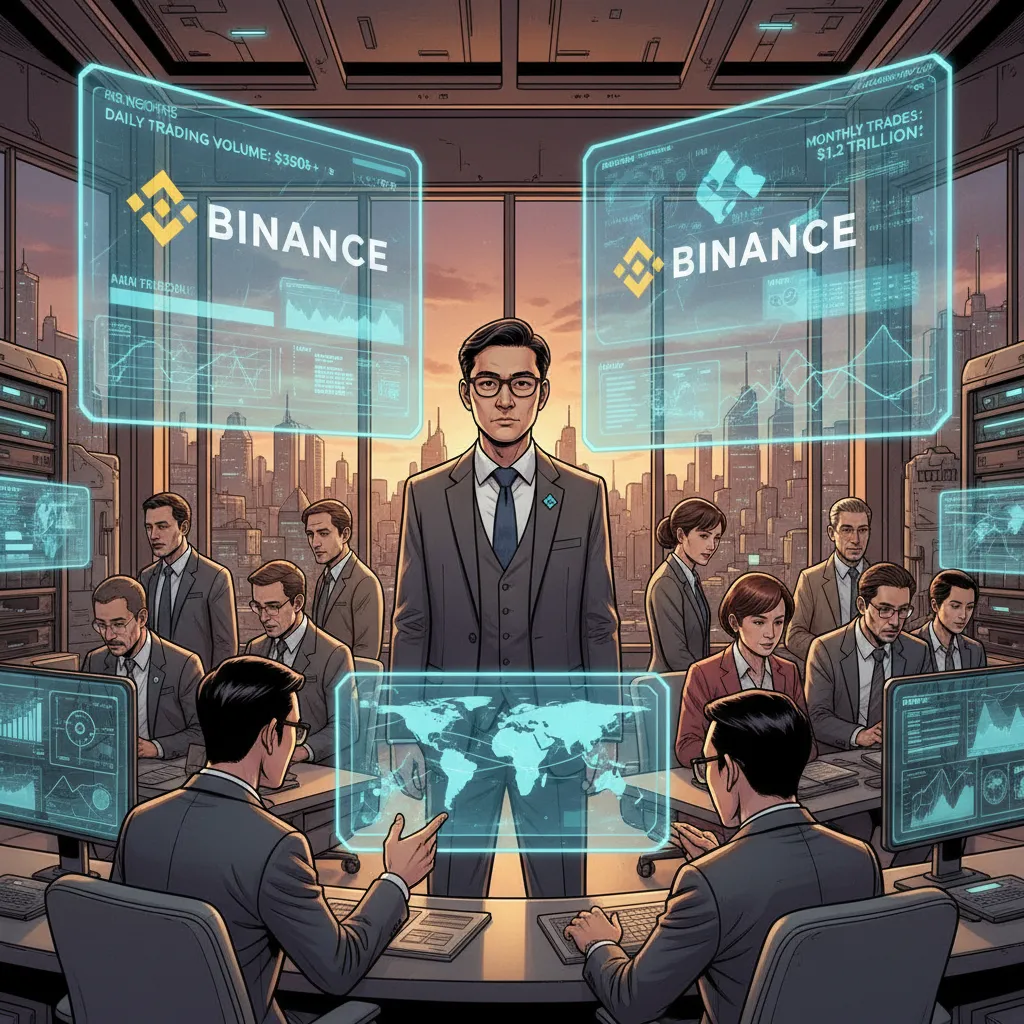
As of early 2026, Binance remains the largest cryptocurrency exchange in the world by daily trading volume. It processes hundreds of billions of dollars in monthly trades. It serves tens of millions of users in over 100 countries. Its BNB Chain blockchain hosts thousands of decentralized applications. It has paid over $4.3 billion in fines to U.S. authorities and is operating under a multi-year federal monitorship.
Changpeng Zhao is 48 years old. He has served his federal prison sentence. He remains Binance’s largest individual shareholder. His personal net worth is estimated at around $35 billion — higher, adjusted for penalties and market moves, than it was before his conviction. He lives in the United Arab Emirates. He travels widely but carefully avoids U.S. territory. He tweets again. He speaks at industry events. He is, in many practical ways, back.
The McDonald’s worker from Vancouver built the largest cryptocurrency trading platform in history. He outlasted nearly every competitor. He tweeted one of his biggest rivals into bankruptcy. He accumulated a fortune that eclipses nearly every other crypto founder of his generation. And he did all of it by deliberately exploiting every regulatory gray zone he could find — until the U.S. Department of Justice finally forced him into a courtroom.
CZ’s story is the purest expression of the move-fast-and-break-things ethos applied to global finance. It was devastatingly effective in the short run. It was legally catastrophic in the long run. And it remains, at the end of the day, the defining case study in how to build a financial empire from nothing, how to lose control of it to regulators, and how — astonishingly — to keep most of it anyway.
💡 Key Insights
- ▸ Binance's rise was driven by a brilliant regulatory-arbitrage strategy: move headquarters constantly, refuse to acknowledge any single jurisdiction, and let users self-onboard with minimal verification. The same strategy eventually became the reason the U.S. Department of Justice charged CZ with willful violations of anti-money-laundering law.
- ▸ CZ's willingness to fight FTX publicly in the days leading up to its collapse — tweeting that Binance would sell its FTT holdings — was the precipitating event for Sam Bankman-Fried's downfall. The lesson: in concentrated industries, a single tweet from a rival CEO can topple a multi-billion-dollar empire overnight.
- ▸ The $4.3 billion Binance settlement with U.S. authorities in November 2023 was one of the largest corporate penalties in U.S. history. CZ personally pleaded guilty to violating the Bank Secrecy Act and served prison time — the highest-profile crypto CEO ever convicted.
- ▸ Binance's survival despite the settlement — and its continued dominance of global crypto trading volumes — shows that regulatory penalties alone cannot dismantle a platform with genuine network effects. The user base is the moat, not the corporate structure.
- ▸ CZ's story is the definitive cautionary tale of the 'move fast and break things' ethos applied to financial regulation. The same recklessness that made Binance the world's largest crypto exchange also made it inevitable that its founder would one day face federal charges.