Dan Snyder: The NFL Franchise That Minted Billions While Everything Else Burned
The rise and fall of Dan Snyder's Washington ownership: how a beloved NFL franchise became a value extraction machine, sold for $6.05 billion, and left wreckage behind.
View all stories about this mogul
Dan Snyder: The NFL Franchise That Minted Billions While Everything Else Burned
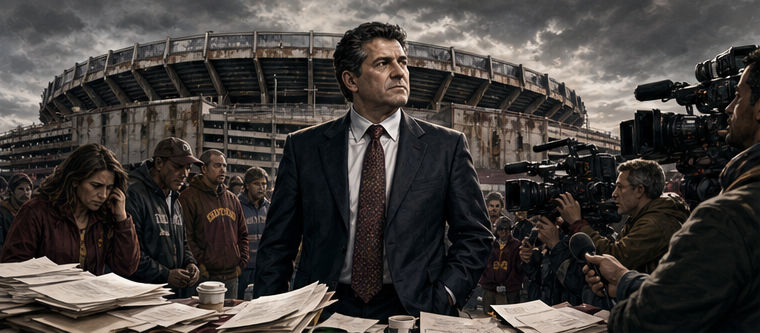
Dan Snyder bought Washington’s NFL team in 1999 for $800 million and sold it in 2023 for $6.05 billion. In between, the franchise lost games, lost trust, lost its name, lost sponsors, lost employees’ faith, lost its waiting-list mythology, and became a case study in how a scarce sports asset can make its owner rich while the institution around it burns.
This is the rise and fall of Dan Snyder’s Washington empire: how Snyder built his fortune, how he acquired one of the NFL’s crown-jewel franchises, how the value-extraction machine worked, and why the final number was so staggering. The biography of Dan Snyder is not a simple story of business failure. It is stranger than that.
On paper, Snyder won. He turned an $800 million purchase into the highest sports-team sale ever recorded at the time. In every other human sense, the Washington years became a warning.
🧾 Key facts: What happened to Dan Snyder’s Washington franchise?
| Category | Detail |
|---|---|
| Owner | Daniel Marc Snyder |
| Franchise | Washington Redskins / Washington Football Team / Washington Commanders |
| Purchase price | $800 million in 1999 |
| Sale price | $6.05 billion in 2023 |
| Buyer | Group led by Josh Harris, with partners including Mitchell Rales and Magic Johnson |
| Ownership period | 1999 to 2023 |
| Playoff wins under Snyder | 2 |
| Super Bowl appearances under Snyder | 0 |
| NFL workplace fine | $10 million against the team in 2021 |
| Snyder fine | $60 million in 2023 after Mary Jo White’s investigation |
| Major controversies | Workplace misconduct allegations, sexual harassment findings, financial impropriety allegations, fan lawsuits, stadium decay, name-change pressure |
| Core business lesson | Scarcity can protect valuation, but it cannot protect reputation forever |
🔥 How did Dan Snyder build his empire before the NFL?
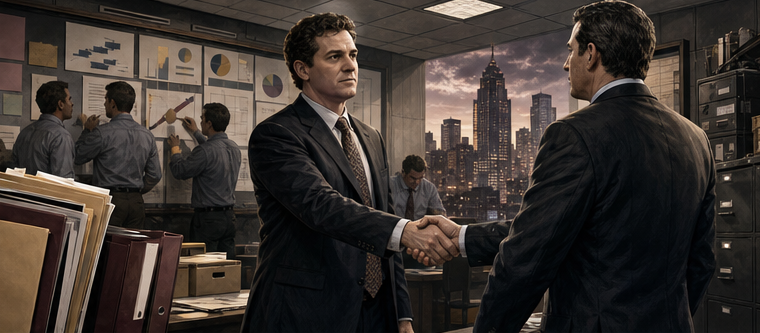
Before the stadium suites, the lawsuits, the investigations, and the $6.05 billion exit, Dan Snyder was a direct-marketing prodigy from Maryland.
Born in Silver Spring in 1964, Snyder came of age close enough to Washington to understand what the local football team meant. The franchise was not just a team. It was civic religion. Under Jack Kent Cooke, Washington won Super Bowls after the 1982, 1987, and 1991 seasons. The team had a waiting list, a fight song, a national fan base, and a mythology of competence.
Snyder did not inherit that institution. He bought into it.
His original fortune came from Snyder Communications, a marketing company he co-founded in 1989. The business was built around outsourced sales, direct marketing, call centers, sampling programs, and database-driven customer acquisition. It was not glamorous, but it was perfectly suited to Snyder’s temperament: sell aggressively, measure relentlessly, extract margin wherever possible.
The company went public in the 1990s. Snyder was young, intense, and rich before he was 35. In 2000, French advertising group Havas agreed to buy Snyder Communications in a transaction valued at more than $2 billion. But Snyder had already made his bigger move.
In April 1999, The New York Times reported that Snyder had won the bidding for Washington’s NFL franchise and Jack Kent Cooke Stadium for $800 million. At the time, it was the most expensive sports-team purchase in history. The deal was heavily financed, but that was part of the genius and danger of it. Snyder was using leverage to buy a scarce asset in a league whose economics were about to become much more powerful.
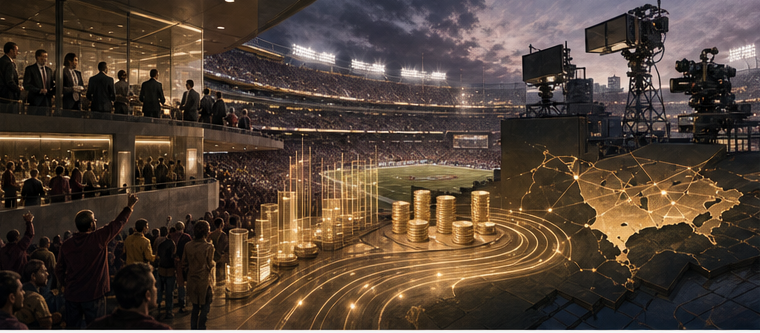
The NFL was entering the modern media-rights age. Live sports were becoming the last television product people watched in real time. Franchise supply was fixed. Billionaires wanted entry. Cities subsidized stadiums. Networks paid more. Sponsors followed the eyeballs.
Snyder had bought a machine.
🏟️ Why was Washington such a valuable NFL franchise?
To understand the Dan Snyder story, start with what he acquired.
Washington was not a small-market reclamation project. It was one of the league’s historic brands, located in the capital region, with decades of fan loyalty and a stadium that had opened in 1997. The franchise had three Super Bowl trophies, a valuable media market, and a fan base trained to believe tickets were precious.
Snyder’s opportunity was obvious: monetize every inch of it.
He sold naming rights to the stadium, which became FedExField. He chased sponsorships. He pushed premium seating. He leaned into parking, concessions, radio rights, and every revenue stream that could be intensified. The Snyder model was not to build patient institutional excellence. It was to discover how much cash a beloved brand could produce even while disappointing the people who loved it.
For a while, the machine worked because the emotional capital had been prepaid by earlier generations. Fans were not buying Snyder’s Washington. They were buying memories of Joe Gibbs, John Riggins, Art Monk, Darrell Green, Doug Williams, and the old RFK roar.
That is the hidden balance sheet of a sports franchise: nostalgia. Snyder inherited it. Then he spent it.
The first season gave false hope. In 1999, Washington went 10-6 and won the NFC East. The team beat Detroit in the wild-card round before losing to Tampa Bay. It looked like Snyder had arrived just in time to accelerate a winner.
Instead, it was the peak.
📉 How did Dan Snyder’s football operation fall apart?
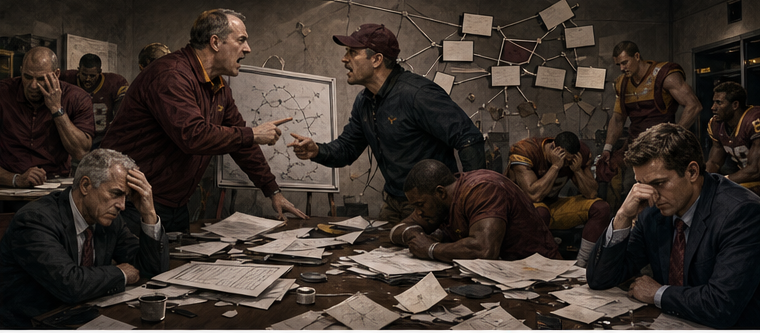
Snyder behaved like a fan with a billionaire’s checkbook and a marketer’s impatience.
He cycled through coaches, executives, quarterbacks, and splashy signings. Washington repeatedly chased famous names instead of coherent systems. Marty Schottenheimer lasted one season. Steve Spurrier was imported from college football. Joe Gibbs returned for a second act. Mike Shanahan arrived with Super Bowl credibility. Jay Gruden got a long run. Ron Rivera inherited the late-stage cleanup.
The results were mostly mediocre. From 1999 to 2023, Washington won only two playoff games. The franchise never reached a conference championship under Snyder, let alone a Super Bowl. The NFC East became a recurring humiliation: Dallas remained the glamour brand, Philadelphia built and rebuilt competitive teams, the Giants won two Super Bowls, and Washington became the chaotic rich cousin who kept changing quarterbacks.
The football failures mattered because they weakened the emotional subsidy. Fans will tolerate expensive parking, bad food, obstructed views, and corporate language if the team wins. Losing turns every inconvenience into evidence.
FedExField became part of the symbolism. The stadium was large, inconveniently located for many fans, and widely criticized for its game-day experience. Over time, seats were removed. The once-mythic season-ticket waiting list looked less like a civic treasure and more like marketing residue from a different era.
The business still appreciated because NFL economics kept rising. But the local relationship was deteriorating.
That is the paradox of Snyder’s empire: the franchise became more valuable as the product became less beloved.
🧨 What was the value extraction machine?
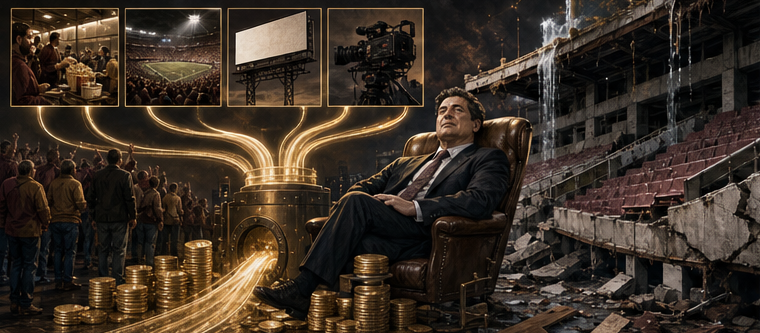
The phrase sounds harsh, but it captures the business logic.
A value creation machine improves the asset by making the product better, the employees stronger, the customers happier, and the brand more durable. A value extraction machine asks a colder question: how much can be pulled out before the damage hits the sale price?
Washington under Snyder often looked like the second kind.
Fans paid high prices for a bad experience. Employees described a toxic workplace. Sponsors stayed because the NFL was too powerful to ignore. League-wide television revenue kept flowing regardless of local dysfunction. Other owners had every incentive to protect the sanctity of franchise valuations. The team could stumble on the field and still ride the rising tide of NFL economics.
This is what makes the net worth of Dan Snyder so important to the story. His personal fortune was not built because Washington became a model franchise. It ballooned because the NFL became an even more valuable cartel of scarce entertainment assets. Snyder owned one of 32 licenses to print cultural relevance on Sunday afternoons.
That license appreciated.
The fans did not need to be happy for the asset to rise. The employees did not need to feel safe for the media checks to clear. The stadium did not need to be beloved for billionaires to bid.
Until the scandals became too large to compartmentalize.
🚨 What allegations and investigations engulfed the franchise?
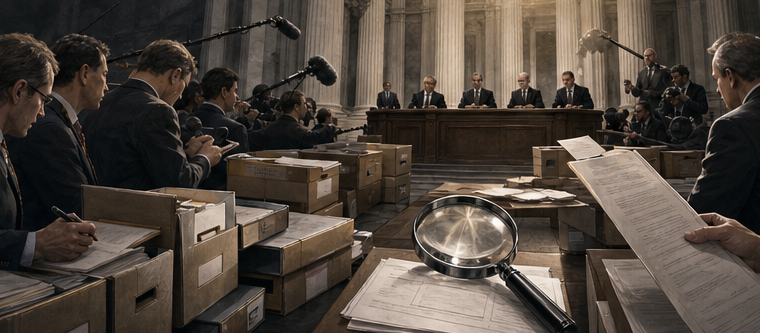
The public collapse accelerated in 2020.
In July 2020, The Washington Post published an investigation in which former female employees described sexual harassment and verbal abuse inside the organization. More reports followed. The claims extended beyond one bad actor or one department. They painted a picture of a workplace culture where women said they were demeaned, harassed, and punished for speaking up.
Snyder denied many allegations and often disputed characterizations of his role. But the story did not go away. It widened.
Attorney Beth Wilkinson led an investigation into the team’s workplace culture. In July 2021, the NFL fined the team $10 million and announced that Tanya Snyder would take over day-to-day operations for a period. The league did not release a full written Wilkinson report, a decision that fueled more suspicion.
Congress then stepped in. The House Committee on Oversight and Reform investigated the franchise and the NFL’s handling of the matter. Its 2022 report accused Snyder of giving misleading testimony and said the league and team failed to protect workers adequately. The report also discussed allegations of hush money, intimidation, and financial improprieties. Because these were congressional findings and allegations, they should be read as part of the public record rather than as a criminal verdict. But reputationally, they were devastating.
Then came Mary Jo White’s investigation, commissioned by the NFL. In July 2023, the NFL said White’s findings substantiated that Snyder sexually harassed former employee Tiffani Johnston and that the club had improperly shielded revenue from sharing. Commissioner Roger Goodell said the conduct had “no place in the NFL.” Snyder was fined $60 million.
That fine landed on the same day NFL owners approved the sale.
It was the cleanest possible business ending to a dirty governance story: pay the fine, approve the transaction, move the asset to new owners, and declare the era over.
🧾 How did the money keep growing?
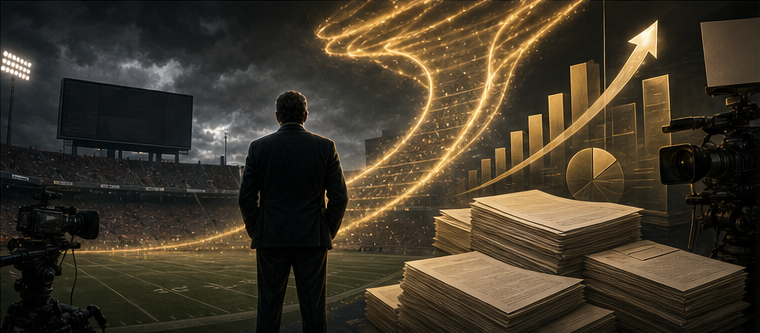
The most brutal fact in the Dan Snyder story is the math.
He bought the franchise for $800 million. He sold it for $6.05 billion. Even after debt, minority-owner transactions, taxes, legal costs, and the $60 million fine, the long-term appreciation was extraordinary.
The question is why.
First, NFL media rights exploded. Live football became more valuable as the rest of television fragmented. Advertisers still needed mass audiences. Networks and streamers needed appointment viewing. The NFL had the best inventory.
Second, franchise scarcity became more powerful. There are only 32 NFL teams. Billionaires who want one cannot simply create a new Washington Commanders. Expansion is controlled. Sales are rare. That scarcity creates auction pressure.
Third, owners benefit from league-level socialism and local-level capitalism. National media money is shared. The brand value of the NFL supports every club. But local sponsorships, stadium economics, and market size still matter. Washington had one of the best theoretical markets in the country.
Fourth, the asset class became institutional. Sports teams went from rich-person trophies to global alternative investments. Private equity, family offices, sovereign-adjacent money, and celebrity investors all began treating franchises as scarce cultural infrastructure.
That is why Snyder could be a failed steward and still exit rich. The NFL did the compounding for him.
It is also why his story matters beyond football. In business, a rising asset class can hide operational rot for a long time. When valuations rise faster than consequences, bad governance can look like genius.
🏷️ Why did the team name become a business crisis?
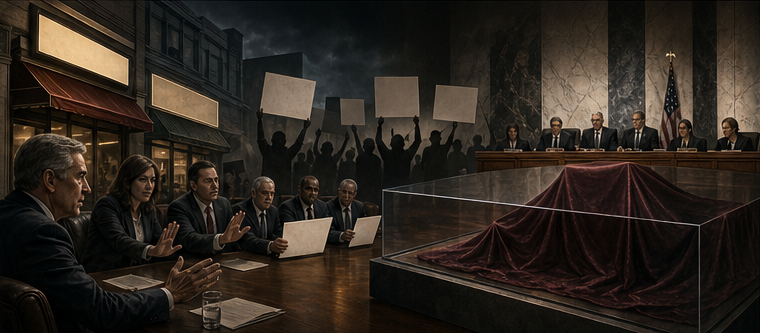
For years, Snyder resisted changing the team’s former name, which Native American groups and others had long criticized as a slur. In a 2013 USA Today interview, Snyder said, “NEVER,” adding that readers could use capital letters. It became one of the defining quotes of his ownership: defiant, absolute, and badly misjudged.
The pressure did not disappear. It compounded.
By 2020, after national protests over racial justice and mounting sponsor pressure, the franchise retired the old name and logo. FedEx, Nike, PepsiCo, and other commercial partners had leverage that activists alone had struggled to create. The team became the Washington Football Team for two seasons before rebranding as the Commanders in 2022.
The name change was not just cultural. It was strategic. Snyder had delayed until the brand risk became commercially intolerable.
That delay cost the franchise something hard to price: the ability to lead its own transformation. Instead of changing as an act of vision, Washington changed under pressure. The rebrand became another episode in the larger Snyder pattern: resist, litigate, deny, monetize, retreat only when forced.
🧯 What happened with fans and ticket holders?
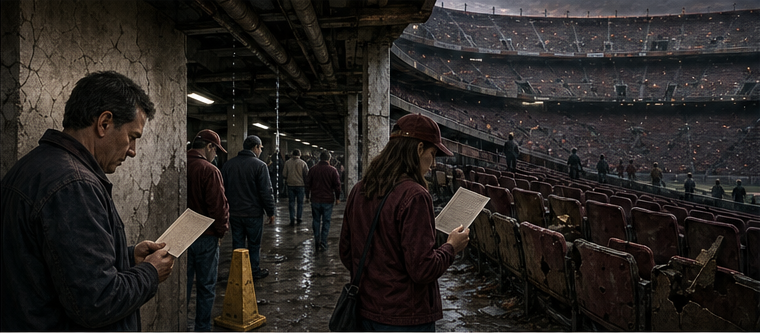
The fan relationship deteriorated in layers.
There were the obvious wounds: losing seasons, expensive game days, and a stadium experience many fans disliked. But there were also more specific controversies.
Washington drew criticism for suing some season-ticket holders who could not keep up with payments during the Great Recession. Later, attorneys general in D.C., Maryland, and Virginia scrutinized or acted over allegations involving season-ticket security deposits. The D.C. attorney general accused the team of failing to return deposits properly; the team disputed aspects of the claims and later settlements did not necessarily include admissions of wrongdoing.
The details matter less than the pattern. Fans increasingly felt less like a community and more like a receivables ledger.
That is catastrophic for a sports brand. Fans are not normal customers. They wear the product. They inherit it. They pass it to children. The best franchises understand that loyalty is an asset to be stewarded. Snyder’s Washington often seemed to treat loyalty as a resource to harvest.
By the end, the empty seats were not just about football. They were a referendum on trust.
📅 Timeline: the rise and fall of Dan Snyder’s Washington era
| Year | Event |
|---|---|
| 1989 | Dan Snyder co-founds Snyder Communications. |
| 1999 | Snyder buys Washington’s NFL franchise and stadium for $800 million. |
| 1999 | Washington wins the NFC East and one playoff game in Snyder’s first season. |
| 2000 | Havas agrees to acquire Snyder Communications in a deal valued at more than $2 billion. |
| 2005 | Washington wins a playoff game under returning coach Joe Gibbs. |
| 2009 | Fan anger grows amid losing, high costs, and public criticism of the stadium experience. |
| 2013 | Snyder says he will “NEVER” change the team’s former name. |
| 2020 | The team retires its former name after sponsor pressure and years of criticism. |
| 2020 | The Washington Post publishes investigations into workplace misconduct allegations. |
| 2021 | NFL fines the team $10 million after the Wilkinson workplace investigation. |
| 2022 | The franchise rebrands as the Washington Commanders. |
| 2022 | House Oversight report criticizes Snyder, the team, and the NFL’s handling of workplace issues. |
| 2023 | NFL owners approve the $6.05 billion sale to Josh Harris’s group. |
| 2023 | NFL fines Snyder $60 million after Mary Jo White’s investigation. |
| 2024 | Under new ownership, Washington begins a visible organizational reset. |
💰 What is Dan Snyder’s net worth?
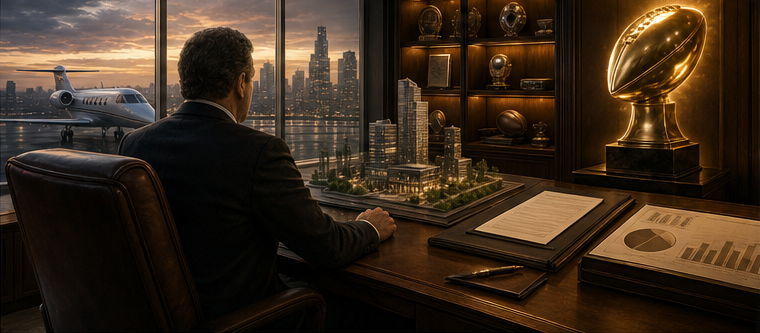
The net worth of Dan Snyder fluctuates depending on taxes, debt, investments, liquidity, and how publications estimate private assets. But the central driver is clear: the 2023 Commanders sale.
A $6.05 billion transaction does not mean Snyder personally kept $6.05 billion. He had financing obligations, minority ownership history, transaction costs, and tax exposure. Still, the sale made him one of the clearest examples of how NFL ownership can create dynastic wealth even without operational excellence.
Forbes and other wealth trackers have generally placed Snyder in the multi-billionaire category after the sale. The exact figure should be treated as an estimate, not a bank statement. The more important point is structural: his wealth came from owning an asset whose scarcity and league economics overwhelmed his local failures.
That is the business thesis of the entire Snyder era. He did not need to build the best organization in football. He needed to hold the license long enough for the market to rerate it.
🏈 How did Dan Snyder’s fall end?
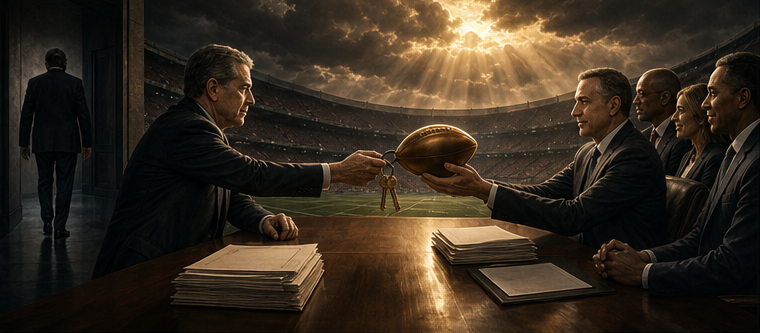
The fall did not end with bankruptcy. It ended with a record sale.
That is what makes it so unsatisfying. In many business collapses, the numbers punish the operator. Enron imploded. FTX went bankrupt. Theranos dissolved. Washington did not collapse. It appreciated.
But Snyder himself became the liability.
By late 2022, pressure from investigations, other owners, sponsors, fans, and public officials had made his continued ownership increasingly costly for the league. The NFL is protective of its owners, but it is even more protective of the shield. Snyder had become a reputational tax on everyone else.
In November 2022, Dan and Tanya Snyder announced they had hired Bank of America Securities to explore a possible sale. In 2023, Josh Harris’s group emerged with a $6.05 billion agreement. NFL owners approved the deal unanimously on July 20, 2023. The transaction closed the next day.
Washington fans celebrated an ownership change the way other fan bases celebrate a championship parade. That was the final indictment.
The new ownership group inherited a wounded asset with enormous upside: a major-market NFL franchise whose local trust had been crushed so thoroughly that basic competence looked revolutionary.
❓ FAQ: Dan Snyder, Washington, and the $6.05 billion exit
What is Dan Snyder’s net worth?
Dan Snyder’s net worth is generally estimated in the billions, largely because he sold the Washington Commanders for $6.05 billion in 2023. Exact estimates vary because they depend on taxes, debt, private investments, and transaction details.
How did Dan Snyder make his money?
Snyder first made serious money through Snyder Communications, a direct-marketing company he co-founded in 1989. He then made his largest fortune through ownership of Washington’s NFL franchise, which he bought for $800 million and sold for $6.05 billion.
Why did Dan Snyder sell the Commanders?
Snyder sold after years of controversy, including workplace misconduct allegations, investigations by the NFL and Congress, lawsuits and attorney general actions, fan anger, and pressure from within the NFL ecosystem. The sale transferred the franchise to a group led by Josh Harris.
How much did Dan Snyder pay for the team?
Snyder bought Washington’s NFL franchise and its stadium for $800 million in 1999, then the highest price ever paid for a sports team.
How much did Dan Snyder sell the Commanders for?
The Commanders were sold for $6.05 billion in 2023 to a group led by Josh Harris. At the time, it was the highest price ever paid for a sports franchise.
🧠 The real lesson
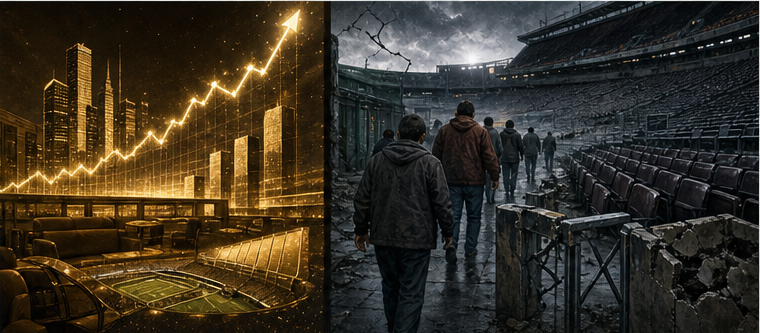
The rise and fall of Dan Snyder is not a story about a man who failed to make money. It is a story about a man who made extraordinary money while almost everything that should have mattered got worse.
That is the uncomfortable lesson. Some assets are so scarce, so protected, and so structurally advantaged that they can enrich owners despite weak stewardship. The NFL’s media machine, revenue sharing, and franchise scarcity created a financial floor that Snyder’s mistakes could not easily break.
But reputation has its own accounting system.
By the end, Snyder had the billions, but not the city. He had the exit, but not the applause. He had owned one of America’s great sports institutions and left with fans celebrating his disappearance.
Dan Snyder’s Washington franchise minted billions while everything else burned. The money was real. So was the damage.
💡 Key Insights
- ▸ Dan Snyder's Washington tenure shows how scarce sports assets can compound in value even when the operating culture deteriorates.
- ▸ The NFL's revenue-sharing, media-rights, and franchise-scarcity model protected enterprise value from years of fan alienation and reputational damage.
- ▸ Snyder's biggest business win was buying a monopoly-like asset; his biggest failure was treating trust, employees, and fans as extractable resources.
- ▸ The $6.05 billion sale was not a clean vindication. It was the final proof that franchise value and institutional health can diverge for years.
Sources
- The New York Times - Redskins Are Sold for $800 Million ↗
- Washington Commanders - Josh Harris Announces Acquisition ↗
- Axios - NFL: Commanders' Dan Snyder fined for sexually harassing employees ↗
- U.S. House Committee on Oversight and Reform - Washington Commanders Workplace Investigation Report ↗
- Forbes - Washington Commanders Team Value ↗
- ESPN - Washington Football Team settled sexual misconduct allegation against Dan Snyder for $1.6 million ↗
- D.C. Attorney General - Commanders ticket holder and consumer protection actions ↗