Larry Fink: How BlackRock Became a Major Force in Global Asset Management
BlackRock manages more money than the GDP of every country except the US and China. Larry Fink built it from nothing — and his influence over global markets makes central bankers nervous.
View all stories about this mogul
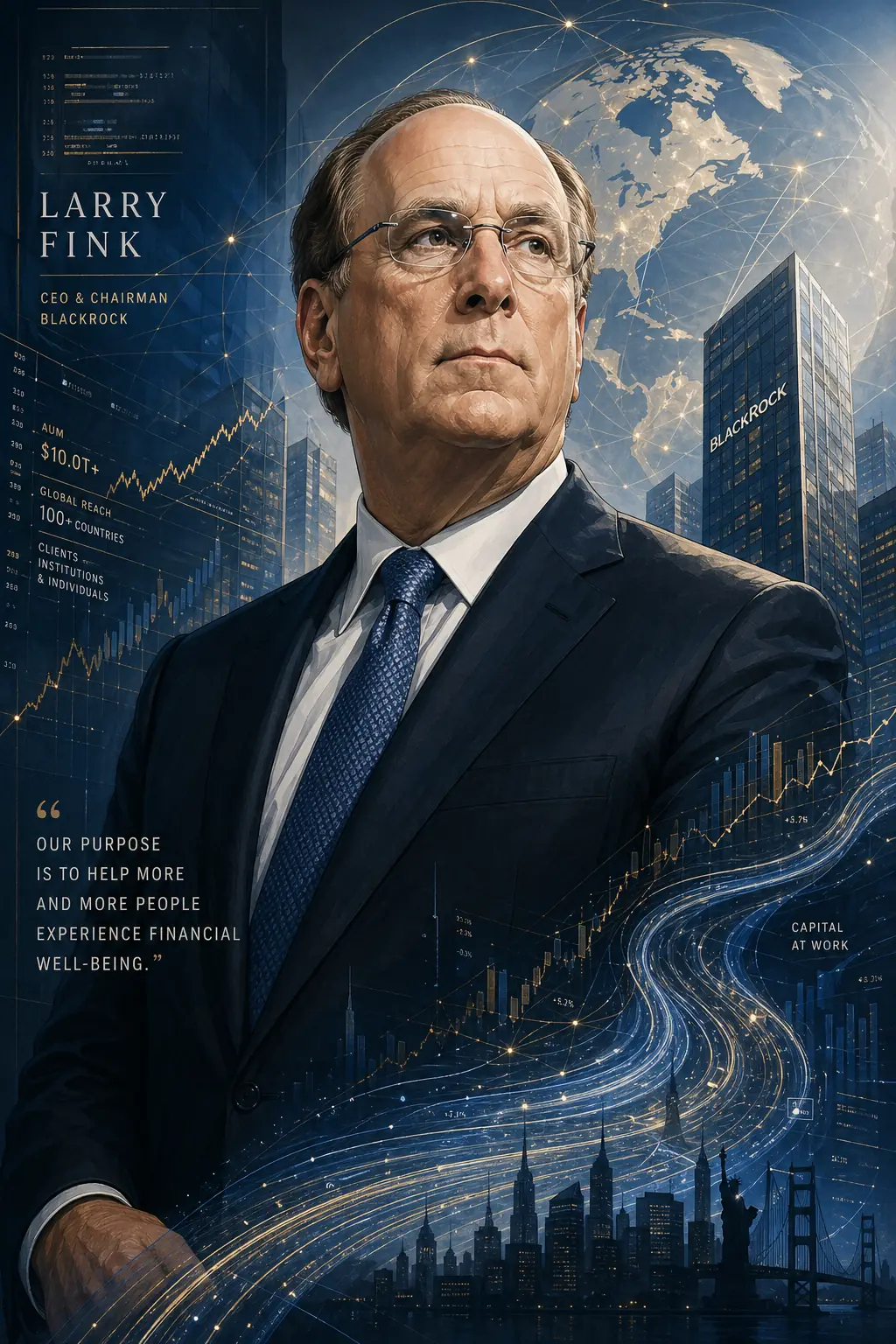
Larry Fink runs the most powerful financial institution most people have never heard of. BlackRock manages over $10 trillion in assets — more than the GDP of every country on Earth except the United States and China. It’s the largest shareholder in hundreds of the world’s biggest companies. Its risk management platform, Aladdin, is used by institutions managing an additional $20+ trillion. When the US government needed someone to manage the toxic assets from the 2008 financial crisis, it called Larry Fink. When the Federal Reserve needed to buy corporate bonds during COVID, it called Larry Fink. The man from Van Nuys, California, who lost $100 million early in his career and nearly had his career destroyed, built something that makes central banks look small.
Chapter 1: Van Nuys to Wall Street (1952–1976)

Laurence Douglas Fink was born on November 2, 1952, in Van Nuys, California. His father owned a shoe store; his mother was a college English professor. The family was middle class and Jewish in a suburban California community that was neither particularly affluent nor particularly cosmopolitan. Nothing about Fink’s background suggested he would become the most powerful person in global finance.
Fink attended UCLA, where he studied political science and planned to become a real estate developer. But a class in real estate finance introduced him to the mortgage market, and he was captivated. The mathematics of mortgages — how cash flows were structured, how risk was priced, how securities could be created from pools of individual loans — fascinated him in a way that pure academics never had.
After earning his MBA at UCLA, Fink joined First Boston (later Credit Suisse First Boston) in 1976. He was twenty-three years old and had found his calling: fixed income, the part of finance that most people find boring but that, in terms of total dollar volume, dwarfs the stock market.
Chapter 2: The Mortgage Revolution at First Boston (1976–1986)

At First Boston, Fink became one of the pioneers of mortgage-backed securities — the financial instruments that would later become infamous in the 2008 financial crisis but that, in the early 1980s, were a genuine innovation. By pooling thousands of individual mortgages into tradeable securities, banks could transfer risk, free up capital, and make more loans. The innovation made home ownership more accessible and generated enormous profits for the banks that created and traded the securities.
Fink rose rapidly. By his early thirties, he was head of First Boston’s mortgage department and a member of the firm’s management committee — the youngest person in the firm’s history to achieve that rank. His team was generating hundreds of millions in revenue, and Fink was being mentioned as a future leader of Wall Street.
Then came the loss. In 1986, Fink’s trading desk lost approximately $100 million in a single quarter due to a bet on interest rate movements that went catastrophically wrong. The loss was a shock — both to the firm and to Fink personally. He had been the golden boy, and now he was the guy who lost $100 million. The experience was humiliating, but it planted the seed for everything that followed: Fink became obsessed with risk management, determined to build tools that would prevent the kind of loss he had just experienced.
Chapter 3: The Founding of BlackRock (1988)

In 1988, Fink co-founded BlackRock with seven partners under the umbrella of The Blackstone Group (run by Stephen Schwarzman and Pete Peterson). The firm initially managed $1 billion in fixed income assets — a modest start by institutional standards. What differentiated BlackRock from the beginning was not its investment performance but its risk management capabilities.
Fink and his team built a proprietary risk analytics platform that would eventually become Aladdin (Asset, Liability, Debt, and Derivative Investment Network). The platform could model the risk characteristics of complex portfolios — analyzing how bonds, mortgages, derivatives, and other instruments would behave under different economic scenarios. It was, in essence, a crystal ball for institutional investors.
The relationship with Blackstone deteriorated over time. Schwarzman reportedly felt that BlackRock was growing too independent and that Fink was insufficiently deferential. In 1994, BlackRock split from Blackstone in a transaction that valued BlackRock at approximately $240 million. Schwarzman later described the split as one of his greatest business regrets — an understatement, given that BlackRock would eventually be worth hundreds of billions.
Chapter 4: Building the Machine (1994–2006)

After the Blackstone split, Fink grew BlackRock through a combination of organic growth and strategic acquisitions. The company went public in 1999, giving it access to capital markets and a public currency for future deals. Revenue grew steadily as institutional investors — pension funds, sovereign wealth funds, insurance companies — recognized that BlackRock’s risk analytics were superior to anything else available.
The 2001 Enron collapse and the 2002 WorldCom scandal highlighted the importance of understanding the risk in complex financial instruments. Institutional investors who had been burned by inadequate risk management became BlackRock’s most eager clients. The firm’s assets under management grew from $165 billion in 1999 to $1 trillion by 2006.
Fink’s management style was demanding and data-driven. He expected his team to understand every aspect of the portfolios they managed and to be able to explain how those portfolios would behave under stress. “Know your risk” was the firm’s unofficial motto, and Fink enforced it with the intensity of someone who had personally experienced what happens when you don’t.
Chapter 5: The 2008 Crisis — Becoming Indispensable (2007–2009)

The 2008 financial crisis was a catastrophe for the global economy and a transformative moment for BlackRock. As mortgage-backed securities — the instruments Fink had helped pioneer — collapsed in value, financial institutions needed someone who could actually understand the toxic assets on their books. BlackRock, with its Aladdin platform and deep expertise in fixed income analytics, was uniquely qualified.
The US Treasury hired BlackRock to manage the toxic assets of Bear Stearns and AIG. The Federal Reserve hired BlackRock to manage its portfolio of mortgage-backed securities. JPMorgan hired BlackRock to evaluate Bear Stearns’ assets before its emergency acquisition. In the darkest hours of the financial crisis, BlackRock was the firm that governments and banks called because nobody else had the analytical tools to understand what was happening.
The crisis work was enormously lucrative and, more importantly, established BlackRock as an indispensable utility of the global financial system. The firm’s reputation shifted from “large asset manager” to “essential infrastructure.” When the most powerful institutions in the world need help with risk, they call BlackRock. That positioning — being too important to ignore, too useful to replace — became the foundation of Fink’s power.
Chapter 6: The iShares Acquisition — Becoming the Passive Investing Giant (2009)

In June 2009, BlackRock acquired Barclays Global Investors (BGI) for $13.5 billion. The deal was transformative because BGI brought with it iShares — the world’s largest provider of exchange-traded funds (ETFs). Overnight, BlackRock went from being primarily an institutional bond manager to being the dominant force in passive investing.
ETFs — which track indices like the S&P 500 and allow investors to buy diversified portfolios for minimal fees — were growing explosively. The shift from active management (where fund managers pick stocks) to passive management (where funds simply track indices) was the most significant trend in investing in decades. By acquiring iShares, Fink positioned BlackRock at the center of this transformation.
The numbers grew staggering. iShares assets under management exceeded $3 trillion. Combined with BlackRock’s institutional business, total AUM surpassed $10 trillion. The scale created a new kind of power: as the largest shareholder in virtually every major public company, BlackRock had a vote on corporate governance that no other single institution could match.
Chapter 7: The Annual Letter — CEO of CEOs (2012–2024)

Starting in 2012, Fink began writing annual letters to the CEOs of the companies in which BlackRock invested. The letters started as routine communications about investment strategy but evolved into something far more influential: public statements about how companies should be managed, with the implicit backing of trillions of dollars in shareholder power.
In 2018, Fink’s letter argued that companies must serve a social purpose beyond profit — that long-term value creation requires attention to environmental sustainability, employee welfare, and community impact. The letter was praised by ESG advocates and attacked by critics who argued that a fund manager had no business telling companies how to operate beyond maximizing shareholder returns.
The annual letters became one of the most closely read documents in corporate America. When Fink wrote about climate change, companies adjusted their environmental policies. When he wrote about board diversity, companies added diverse directors. When he wrote about long-term thinking, companies modified their investor communications. Whether this influence was appropriate — whether an unelected fund manager should have this much power over corporate behavior — became one of the most debated questions in finance.
Chapter 8: The ESG Backlash (2022–2025)

Fink’s ESG advocacy made BlackRock a target for conservative politicians and commentators who viewed environmental, social, and governance investing as a form of political activism disguised as finance. Republican state treasurers and attorneys general launched a coordinated campaign against BlackRock, pulling state pension fund assets and accusing the firm of using investors’ money to advance a liberal political agenda.
Texas, Florida, Louisiana, and other red states withdrew billions from BlackRock management. Republican politicians called Fink before congressional committees to answer for BlackRock’s ESG policies. The attacks were politically motivated but commercially significant — losing state pension fund mandates cost BlackRock meaningful revenue.
Fink responded by moderating his public rhetoric. He stopped using the term “ESG” in his annual letters, replacing it with language about “transition investing” and “long-term value creation.” Critics on the left accused him of capitulating to political pressure. Critics on the right said the moderation was cosmetic and that BlackRock’s voting behavior hadn’t changed. Fink was in the uncomfortable position of being attacked from both sides — a position that, he might argue, suggests he’s roughly in the right place.
Chapter 9: Aladdin — The Invisible Infrastructure (2000–2025)

BlackRock’s most powerful and least understood asset is Aladdin, its proprietary risk management and trading platform. Aladdin processes over 2,000 risk calculations per second, models the behavior of trillions of dollars in assets under various economic scenarios, and provides the analytical infrastructure that institutional investors use to make decisions.
What makes Aladdin extraordinary is its reach. The platform isn’t just used by BlackRock — it’s licensed to other institutions, including pension funds, insurance companies, and sovereign wealth funds. The total assets monitored by Aladdin exceed $20 trillion — roughly 10% of all financial assets on Earth. This means that a significant portion of global investment decisions are informed by a single software platform controlled by a single company.
The concentration of analytical power raises systemic risk questions. If Aladdin’s models contain a blind spot — if they underestimate a particular type of risk or mismodel a correlation — the consequences could ripple across the entire global financial system. BlackRock argues that Aladdin is a tool, not a decision-maker, and that the diversity of its users prevents herding. Critics argue that a shared analytical framework inevitably produces correlated behavior, and that the next financial crisis might originate in the code of a platform nobody outside of finance has heard of.
Chapter 10: The Political Operator (2008–2025)

Fink’s influence extends well beyond finance. He is a regular at the World Economic Forum in Davos, a confidant of world leaders, and a fixture at the intersection of finance and policy. His political contributions span both parties, though he has been personally closer to Democratic administrations. He was reportedly considered for Treasury Secretary under both Obama and Hillary Clinton.
His relationship with government regulators is complex. BlackRock has been hired by the Federal Reserve, the US Treasury, and the European Central Bank to manage assets during crises — a relationship that blurs the line between private firm and public utility. Critics argue that BlackRock’s crisis work creates conflicts of interest: the firm that manages the government’s toxic assets also manages trillions in private assets that are affected by government policy.
Fink navigates these conflicts with the skill of a diplomat, maintaining relationships across the political spectrum while carefully avoiding positions that would alienate either side. His ability to remain useful to governments regardless of which party is in power is perhaps his most impressive political skill — and the one that most ensures BlackRock’s continued dominance.
Chapter 11: The Succession Question (2024–2025)

As Fink entered his seventies, the question of who would succeed him became one of the most closely watched succession debates in finance. BlackRock’s identity was so closely tied to Fink — his relationships, his reputation, his vision — that imagining the firm without him was difficult.
Fink promoted a generation of potential successors, including Rob Kapito (BlackRock’s president and co-founder), Rob Goldstein (COO), and several other senior executives. But none had Fink’s unique combination of investment expertise, political savvy, and public influence. The firm’s strategy of building institutional relationships and government partnerships was deeply personal — it depended on Fink’s ability to be in the room with heads of state and central bank governors.
The succession challenge reflected a broader question about personality-driven institutions: can a company built around one person’s network and reputation survive the transition to new leadership? Fink had built BlackRock into an organization with deep institutional capabilities, but the relationships at the top — with governments, regulators, and corporate boards — remained personally his.
Chapter 12: Legacy — The Shadow Banker

Larry Fink’s legacy is power. Not the visible power of a president or the flashy power of a tech billionaire, but the quiet, structural power of managing more money than most countries produce. BlackRock’s $10+ trillion in assets under management makes it the largest single influence on global capital markets. Aladdin’s analytical reach extends that influence further. Fink’s personal relationships with world leaders extend it further still.
His net worth, estimated at approximately $1.5 billion, is modest relative to his influence. Fink doesn’t own BlackRock the way Bezos owns Amazon or Zuckerberg owns Meta. He’s a professional manager who built a firm rather than a product. But his influence over the global economy — through the companies BlackRock invests in, the governments it advises, and the analytical tools it provides — is arguably greater than any tech billionaire’s.
The kid from Van Nuys who lost $100 million and nearly lost his career built the most powerful financial institution on Earth by obsessing over risk management — the least glamorous function in all of finance. He proved that understanding risk is more valuable than taking risk, that managing other people’s money can be more powerful than having your own, and that the most consequential institutions are often the ones that operate in the shadows. Larry Fink built his empire in the space between the headlines, and that’s exactly where he wants it to stay.
💡 Key Insights
- ▸ Fink's genius was recognizing that risk management — boring, technical, invisible risk management — was more valuable than stock picking. BlackRock's Aladdin platform, which models risk across trillions in assets, is the company's real product.
- ▸ BlackRock's $10+ trillion in assets under management gives Fink a vote in virtually every major public company on Earth. His annual letters to CEOs about ESG and stakeholder capitalism carry more weight than most legislation.
- ▸ The tension at the heart of BlackRock is that it's simultaneously the world's largest passive investor (through iShares ETFs) and one of the most active voices in corporate governance. Passive investing with active influence is a paradox that Fink has navigated — but not resolved.