Masaru Ibuka: The Forgotten Sony Founder Who Helped Engineer Modern Consumer Tech
Masaru Ibuka rarely gets the same popular attention as Sony's most famous executives, but his product instincts, engineering ambition, and refusal to think small helped define the modern consumer-electronics playbook.
View all stories about this mogul
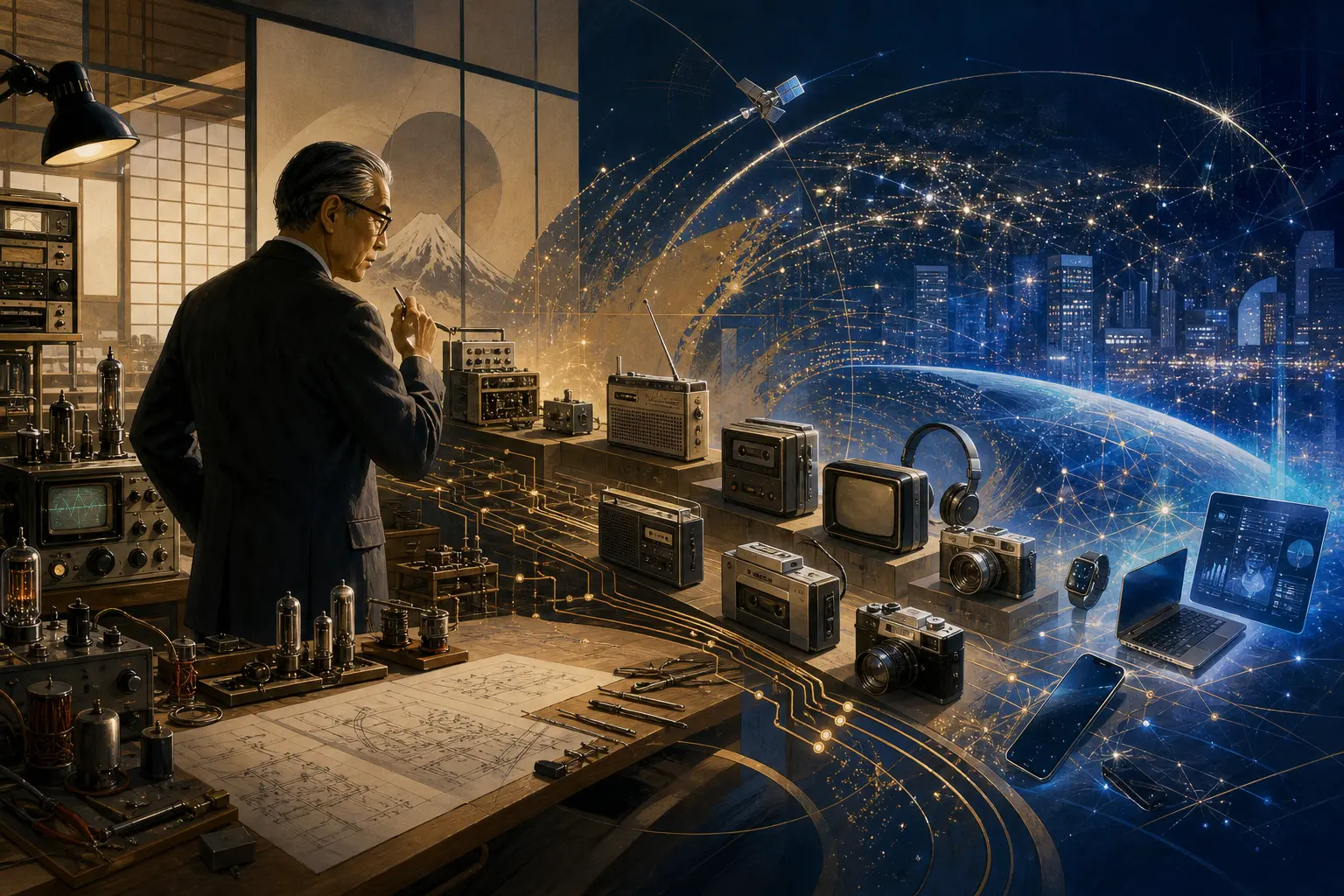
Masaru Ibuka helped build the template for modern consumer technology before “consumer tech” even existed as a prestige category. He belonged to the generation that had to imagine a new industrial future out of postwar ruin, scarce resources, and enormous uncertainty. That alone would make him notable. What makes him legendary is that he did not stop at rebuilding capacity. He helped redefine what electronics could mean in everyday life.
That is why he belongs in Legends. Masaru Ibuka was not just an engineer, and not merely a corporate founder. He was one of the people who pushed technology away from institutional heaviness and toward personal intimacy — toward devices that felt portable, desirable, and culturally alive.
Chapter 1: Sony Began in a Country Trying to Reassemble Itself
It is impossible to understand Ibuka without understanding the timing. Sony’s roots trace back to the devastated landscape of postwar Japan, where rebuilding was not abstract strategy but national necessity. Starting a technology company in that environment required more than optimism. It required stubbornness bordering on audacity.
Ibuka and his collaborators began with repair work and experimentation, not with the confidence of a fully formed industrial champion. That early phase matters because it shaped the culture. Sony was born close to constraints. Constraints force clarity.
When resources are thin, you do not survive by being average. You survive by making unusually good bets about what the future will actually need.
Chapter 2: Ibuka Thought Like an Engineer, But Not Only Like an Engineer
Many technically gifted founders fail because they cannot bridge performance and desirability. They know how to make a machine work, but not how to make a market care. Ibuka was more expansive.
He respected technical rigor, but he also understood that the real victory came when engineering changed daily behavior. This is what made Sony different. The company did not just produce electronics. It kept trying to produce new experiences of listening, watching, carrying, and interacting.
That is a commercial imagination, not just a lab mindset.
Chapter 3: The Early Breakthrough Was Confidence in New Categories
Sony’s history is full of products that mattered because they were not merely better versions of old devices. They nudged people into new relationships with technology. Smaller radios, new recording formats, more personal electronics — these things reshaped habits.
Ibuka’s importance sits in that willingness to believe that ordinary consumers would want technology that felt modern, compact, and emotionally resonant. He was helping build a world where electronics were not confined to military, industrial, or institutional uses. They could become part of personal identity.
That is a foundational move in modern tech history.
Chapter 4: Miniaturization Was Not a Detail. It Was a Philosophy
One of Sony’s defining strengths was miniaturization. That can sound like a technical footnote until you realize what it did culturally. Smaller devices are easier to own, easier to carry, and easier to weave into everyday life. Miniaturization turns machinery into companionship.
Ibuka saw that engineering progress becomes much more powerful when it reduces friction between people and products. The smaller, cleaner, and more elegant the device, the more likely it is to move from novelty to habit.
This philosophy helped prepare the ground for the portable-electronics age that Sony would later become famous for.
Chapter 5: Branding Japan Differently Was Part of the Job
In the early postwar era, Japanese industry had to fight through global skepticism. Trust was not automatic. Prestige was not automatic. Companies had to prove that Japanese manufacturing could stand for quality, precision, and originality.
Ibuka was part of the cohort that made that transformation real. Sony became one of the clearest global symbols that Japan could build technology people admired, not merely tolerated. That shift had enormous consequences far beyond one company.
It helped rewrite what industrial credibility looked like.
Chapter 6: Partnership and Division of Strengths Mattered
Sony’s founding story is often told through a small set of famous names, and rightly so. But what matters in mogul terms is how rare the partnership model was. Ibuka’s strengths worked in combination with other leadership talents around him. The company benefited from a blend of technical ambition, commercial instinct, and global storytelling.
Great companies are not always built by singular geniuses acting alone. Sometimes they are built by unusually effective combinations. Ibuka’s role in that combination was critical. He anchored product seriousness and forward-looking engineering culture.
Without that anchor, the brand story would have floated. With it, the brand could expand confidently.
Chapter 7: Sony Did Not Win by Selling Specifications Alone
Lots of electronics firms can publish impressive specs. Far fewer can create affection. Sony repeatedly managed to make technology feel aspirational. That did not happen by accident.
Ibuka understood that industrial achievement had to be translated into form, trust, and usability. The company had to feel modern. It had to feel consumer-first. It had to feel like the future arriving in a package you would actually want in your home or hand.
This is what distinguishes category-defining electronics companies from component vendors. One sells performance. The other sells a new way of living with machines.
Chapter 8: He Helped Normalize the Idea That Technology Could Be Personal
It is easy to forget how radical this became. Before the age of phones, headphones, game consoles, and constant connectedness, the notion that electronics would become intimate was not inevitable. It had to be designed into existence.
Ibuka helped push technology toward the personal scale. He worked in the lineage that made consumers expect portability, elegance, and emotional attachment from devices. That expectation still shapes the entire industry.
Modern consumer tech giants all operate inside a world that pioneers like Ibuka helped make imaginable.
Chapter 9: The Forgotten Founder Problem Is Real
Some builders become symbols. Others become infrastructure beneath the symbol. Ibuka often lands in the second category. The public memory of Sony is broad, but individual founder credit is uneven. That is common in industrial history.
Yet forgetting him produces a distorted story. It implies that the rise of consumer electronics was driven only by brand mythology or later executive fame. In reality, it required early leaders who could marry engineering discipline to product courage. Ibuka was one of those leaders.
He should be remembered not as a side note, but as one of the architects of how modern electronics learned to behave.
Chapter 10: His Legacy Lives Inside Every Elegant Device That Feels Obvious
Masaru Ibuka’s deepest achievement is that the future he helped build now feels normal. That is how transformative technology often works. Once it wins, people stop seeing how strange it once was.
Portable, desirable, carefully engineered consumer devices now feel inevitable. They were not inevitable. They were created through decades of product conviction by people willing to imagine ordinary users wanting more from technology than raw function.
Ibuka belongs in MogulFeed because his wealth or fame alone is not the story. His real story is influence. He helped engineer the cultural logic of consumer electronics itself.
That is legendary power, even when history remembers it too quietly.
💡 Key Insights
- ▸ Masaru Ibuka helped define the consumer-electronics future by insisting that engineering excellence should be translated into products ordinary people would actually desire, carry, and trust.
- ▸ Sony's early advantage was not just technical competence. It was the belief that miniaturization, design, and user imagination could create entirely new habits of living.
- ▸ Ibuka's legacy matters because he proved that postwar Japanese manufacturing could move from imitation anxiety to category-making confidence.