Marc Andreessen: The Man Who Built the Browser, Then Bet on Everything Else
He created Netscape and brought the internet to the masses. Then he became the most powerful venture capitalist in Silicon Valley, funding the future while fighting anyone who questioned it.
View all stories about this mogul
Marc Andreessen built the tool that let ordinary people use the internet, became a billionaire before he was thirty, watched his company get destroyed by Microsoft, spent a decade in the wilderness, then reinvented himself as the most influential venture capitalist of his generation. Along the way he developed a worldview so aggressively optimistic that it borders on ideology: technology is good, progress is inevitable, and anyone who disagrees is either ignorant or an obstacle to be overcome. He’s six-foot-five, bald, endlessly combative on social media, and has funded more billion-dollar companies than most people can name. Love him or hate him, Marc Andreessen has shaped the modern internet more than almost any living person.
Chapter 1: The Kid From Iowa Who Saw the Future (1971–1993)

Marc Lowell Andreessen was born on July 9, 1971, in Cedar Falls, Iowa. His father worked for a seed company; his mother worked at a clothing store. There was nothing about his background that predicted he would become one of the most important figures in the history of technology. Iowa in the 1970s and 1980s was not exactly a hotbed of innovation.
What Andreessen had was curiosity and a computer. His parents bought him a TRS-80 when he was young, and he taught himself BASIC programming by reading the manual cover to cover. He was bored in school — not the cool, rebellious kind of bored, but the restless, impatient kind of bored that comes from a mind that processes information faster than the world delivers it. He read voraciously, gravitated toward science fiction, and spent hours at the local library consuming books about computers and technology.
He enrolled at the University of Illinois at Urbana-Champaign, one of the best computer science programs in the country. It was there, at the National Center for Supercomputing Applications (NCSA), that he would change the world. Working alongside a programmer named Eric Bina, Andreessen spent late nights and weekends building something that would transform human civilization: a graphical web browser.
Chapter 2: Mosaic — Giving the Internet a Face (1993)
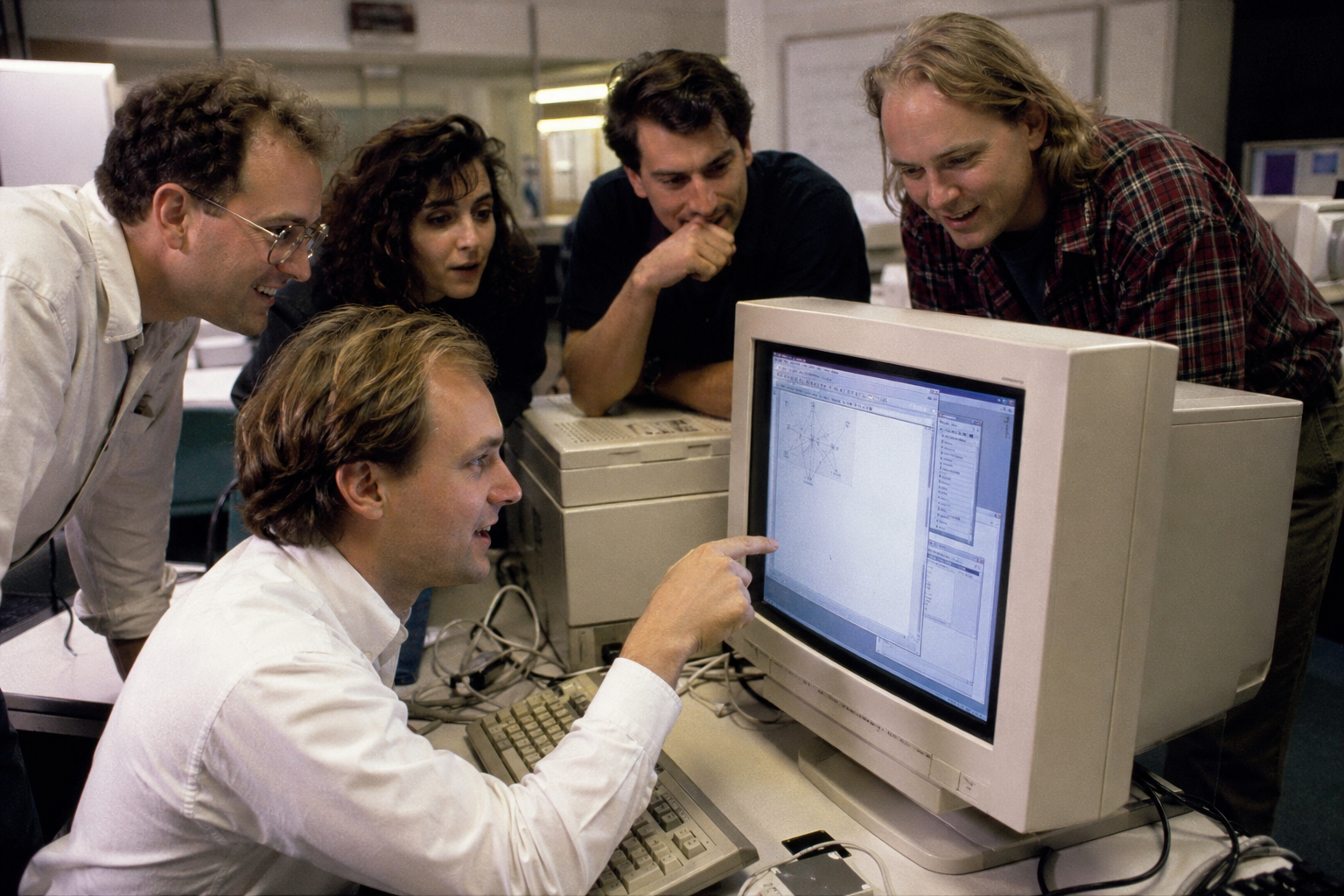
In 1993, the internet existed but was essentially unusable for normal people. It was a text-based wilderness of FTP servers, Gopher menus, and command-line interfaces. The World Wide Web had been invented by Tim Berners-Lee in 1989, but browsing it required technical expertise that 99% of the population didn’t have. Andreessen and Bina changed that.
Their browser, Mosaic, was the first to display images inline with text — a seemingly simple feature that made the web visual, intuitive, and compelling. Before Mosaic, the web was text on a screen. After Mosaic, it was a magazine you could click through. The browser was released in January 1993 as free software, and its adoption was explosive. Within months, web traffic increased by over 300,000%. People who had never heard of the internet were suddenly surfing it.
Andreessen graduated from Illinois in December 1993, moved to California, and was almost immediately contacted by Jim Clark, the legendary founder of Silicon Graphics. Clark had just left his own company and was looking for the next big thing. He saw what Mosaic had done and wanted to commercialize it. He proposed a partnership: Clark would provide the business experience and funding; Andreessen would provide the technology and vision. They shook hands, and Mosaic Communications Corporation was born — later renamed Netscape Communications after the University of Illinois complained about the use of the Mosaic name.
Chapter 3: Netscape — The Company That Lit the Fuse (1994–1995)
Netscape Navigator launched in December 1994 and was, by any measure, a sensation. The browser was fast, reliable, and beautiful by the standards of 1994. Netscape gave it away for free to consumers and charged businesses — a distribution model that was radical at the time and would later become standard in tech. Within four months, Netscape had 75% of the browser market.
On August 9, 1995, Netscape went public. The company was barely a year old, had minimal revenue, and had never turned a profit. The IPO was priced at $28 per share and opened at $71. By the end of the first day, the stock closed at $58.25, giving Netscape a market capitalization of $2.9 billion. Andreessen, at twenty-four years old, was worth roughly $58 million. He appeared on the cover of Time magazine, barefoot in a golden throne.
The Netscape IPO is widely considered the moment the dot-com era began. It proved that internet companies could generate enormous investor excitement even without profits. It inspired thousands of entrepreneurs and investors to flood into the internet economy. And it put a target on Netscape’s back that was visible from Redmond, Washington — where Bill Gates was watching very, very carefully.
Chapter 4: The Browser War — David vs. Goliath (1995–1998)

Bill Gates famously wrote his “Internet Tidal Wave” memo in May 1995, declaring the internet Microsoft’s top priority. Within months, Microsoft launched Internet Explorer and began the most aggressive competitive campaign in tech history. Microsoft bundled IE with Windows — which was installed on over 90% of the world’s PCs — making it free and instantly available to hundreds of millions of users.
Netscape fought back with product innovation, but the math was impossible. When your competitor can give away a comparable product by leveraging a monopoly operating system, no amount of engineering excellence can save you. Netscape’s market share fell from 80% to under 30% in three years. The company’s revenue collapsed.
In January 1998, Netscape made a desperate, brilliant move: it open-sourced its browser code, creating the Mozilla project. The code would eventually become Firefox, which would later recapture significant market share from IE. But it was too late to save Netscape as a company. In November 1998, AOL acquired Netscape for $4.2 billion. Andreessen became AOL’s chief technology officer and lasted about a year before leaving. The browser he built had changed the world, but the company he co-founded had been destroyed by monopolistic force.
Chapter 5: The Wilderness Years (1999–2006)

After Netscape, Andreessen entered a period that he would later describe as educational but that looked, from the outside, like a series of mixed results. He co-founded Loudcloud in 1999, a cloud computing company that was conceptually ahead of its time but launched at the worst possible moment — just as the dot-com bubble was bursting.
Loudcloud burned through cash at an alarming rate and nearly went bankrupt. Andreessen and his co-founder Ben Horowitz made a desperate pivot, selling the managed services business to EDS for $63.5 million and reinventing the company as Opsware, an enterprise software firm focused on data center automation. It was an ugly, grueling transformation. Opsware’s stock dropped to $0.35 per share at one point. Most people would have given up.
They didn’t. Through relentless execution and sheer stubbornness, Horowitz and Andreessen rebuilt Opsware into a profitable, growing enterprise software company. In 2007, Hewlett-Packard acquired Opsware for $1.6 billion. The experience taught Andreessen two things that would shape his entire future career: first, that building companies is brutally hard and most people have no idea how hard until they try; and second, that the best founders are the ones who survive the moments when everything looks hopeless.
Chapter 6: Andreessen Horowitz — Reinventing Venture Capital (2009–2014)

In 2009, Andreessen and Horowitz launched their own venture capital firm: Andreessen Horowitz, commonly known as a16z. Their pitch to the venture capital establishment was essentially: everything you’re doing is wrong, and we’re going to fix it. Traditional VC firms were small partnerships that provided money and advice. A16z would be a full-service platform — providing portfolio companies with recruiting, marketing, executive coaching, and engineering support alongside capital.
The firm raised $300 million for its first fund and immediately started making aggressive bets. Early investments included Skype, Facebook, Groupon, Zynga, Twitter, and Airbnb. The returns were spectacular. But what set a16z apart wasn’t just the investments — it was the firm’s media operation. Andreessen Horowitz built a content machine that produced blogs, podcasts, and research reports that shaped how the entire tech industry thought about itself.
Andreessen himself became a prolific Twitter user and blogger, firing off provocations and predictions with machine-gun frequency. His most famous essay, published in the Wall Street Journal in 2011, was titled “Why Software Is Eating the World.” The thesis: every industry would eventually be transformed by software, and software companies would dominate the economy. It was prescient, influential, and became the intellectual foundation for a16z’s investment strategy.
Chapter 7: Crypto, Bio, and the Frontier Bets (2015–2021)

A16z didn’t just invest in safe software companies. Under Andreessen’s direction, the firm made massive bets on frontier technologies that many in Silicon Valley considered too risky or too speculative. The biggest was cryptocurrency. A16z launched dedicated crypto funds totaling over $7.5 billion, investing in Coinbase, Solana, Uniswap, and dozens of other blockchain projects.
The crypto bet was controversial. Critics accused a16z of promoting speculative assets to retail investors while insiders cashed out. The firm’s massive holdings in crypto tokens meant that its public enthusiasm for the technology was inseparable from its financial interest in the technology’s success. When Andreessen tweeted bullishly about crypto, he was simultaneously talking his own book.
The firm also invested heavily in biotechnology, including companies working on gene editing, synthetic biology, and drug discovery. These investments were less controversial but reflected the same underlying philosophy: technology would transform every aspect of human life, and the firms that backed those transformations early would capture enormous value. By 2021, a16z was managing over $35 billion in assets and was arguably the most influential venture capital firm in the world.
Chapter 8: The Clubhouse Moment and the Hype Machine (2020–2022)

In early 2021, Andreessen became the most prominent user and evangelist for Clubhouse, an audio-based social network. He hosted rooms that attracted thousands of listeners, debated critics in real time, and used the platform to promote his worldview. A16z led Clubhouse’s Series B investment at a $1 billion valuation — and Andreessen’s personal promotion of the platform raised eyebrows about the blurry line between investor and influencer.
Clubhouse’s rise and fall became a cautionary tale about hype cycles in Silicon Valley. The platform peaked during COVID lockdowns, when people were desperate for social interaction, then collapsed as the world reopened and competition from Twitter Spaces and other audio features decimated its user base. A16z’s investment, once heralded as another brilliant early bet, began to look like a case study in how investor enthusiasm can inflate a bubble.
The episode highlighted a broader concern about Andreessen’s dual role. When the most powerful venture capitalist in Silicon Valley is also one of the most vocal public advocates for his portfolio companies, it becomes impossible to separate genuine conviction from financial promotion. Andreessen’s defenders said his enthusiasm was sincere. His critics said sincerity and self-interest are not mutually exclusive, and that the combination is more dangerous than either alone.
Chapter 9: The Techno-Optimist Manifesto (2023)

In October 2023, Andreessen published “The Techno-Optimist Manifesto,” a 5,000-word essay that read like a declaration of war against what he called the “decel” movement — anyone who advocated slowing down technological development for reasons of safety, ethics, or social impact. The manifesto argued that technology is the solution to virtually all human problems, that market capitalism is the engine of progress, and that attempts to regulate or constrain technological development are fundamentally anti-human.
The essay was incendiary. Andreessen explicitly listed concepts he considered “the enemy,” including sustainability, social responsibility, stakeholder capitalism, ESG, and tech ethics. He cited a range of thinkers from Friedrich Nietzsche to Ayn Rand to support his argument. The reaction was polarized. Tech optimists cheered; critics accused Andreessen of nihilistic utopianism — using philosophical grandeur to justify the unchecked accumulation of power by technology companies and their investors.
The manifesto crystallized a divide that had been growing in Silicon Valley for years: between those who believed technology needed guardrails and those who believed guardrails were the problem. Andreessen had planted his flag firmly in the latter camp, and he showed no interest in moving it.
Chapter 10: The Political Turn (2024–2025)

The manifesto was the intellectual foundation; what followed was political action. In 2024, Andreessen became one of the most prominent tech figures to support Donald Trump’s presidential campaign. He appeared on podcasts, made substantial donations, and argued publicly that the Biden administration’s regulatory approach to technology — particularly AI and cryptocurrency — was stifling innovation and threatening American competitiveness.
For many in Silicon Valley, Andreessen’s political shift was shocking. He had been a Democratic donor for years. His social circle included progressives and centrists. But he had grown increasingly frustrated with what he perceived as a regulatory assault on the tech industry — SEC actions against crypto companies, proposed AI regulations, antitrust actions against big tech, and what he described as a hostile bureaucratic climate.
His political engagement went beyond donations. Andreessen and Horowitz created a political operation within a16z, hosting candidate forums and making it clear that the firm’s political interests aligned with candidates who supported deregulation and tech-friendly policies. The move was unprecedented for a venture capital firm and blurred the line between financial investment and political influence in ways that made many observers uncomfortable.
Chapter 11: A16z Empire — Media, Markets, and Influence (2020–2025)

By the mid-2020s, Andreessen Horowitz had evolved from a venture capital firm into something closer to a media-financial conglomerate. The firm ran one of the most popular tech podcasts, published a constant stream of blog posts and research reports, operated an in-house media team, and managed a newsletter with hundreds of thousands of subscribers. Its content operation was larger than many media companies.
This wasn’t accidental. Andreessen understood that in the modern economy, attention is the scarcest resource. By controlling significant mindshare in the tech industry, a16z could shape narratives, promote portfolio companies, attract deal flow, and influence policy. The firm’s media operation was, in effect, a marketing machine disguised as journalism.
A16z also expanded internationally, opening offices and making investments in markets across Europe, Asia, and Africa. The firm’s thesis — that software-driven companies would dominate every industry in every country — was being tested on a global scale. Some bets worked brilliantly; others didn’t. But the firm’s willingness to invest at scale across geographies gave it a reach that no previous venture capital firm had achieved.
Chapter 12: Legacy — The Builder Who Became the Funder

Marc Andreessen’s legacy is a story of transformation. He transformed the internet from an academic curiosity into a mass medium. He transformed venture capital from a clubby, relationship-driven business into a platform-driven media operation. He transformed the discourse around technology from cautious optimism into aggressive, unapologetic techno-utopianism.
His net worth, estimated at $1.7 billion as of 2025, understates his influence. Through a16z, he controls billions more in investment capital. Through his media operation, he shapes how an entire industry thinks. Through his political activities, he influences policy at the highest levels. He is not just an investor; he is an ideology with a checkbook.
The question that hangs over Andreessen’s legacy is the same one that hangs over Silicon Valley itself: is the relentless pursuit of technological progress a net positive for humanity, or does it concentrate power in the hands of a techno-elite who are accountable to no one? Andreessen has his answer. He’s been shouting it from every rooftop, podcast, and tweet for three decades. Whether history validates that answer depends on whether the future he’s funding turns out to be the one humanity actually wants.
💡 Key Insights
- ▸ Andreessen's trajectory from builder to investor mirrors a broader Silicon Valley pattern: the people who create the first wave of technology often become the financiers of the next wave, accumulating power that compounds across generations.
- ▸ The 'software is eating the world' thesis wasn't just a prediction — it was a self-fulfilling prophecy. By funding software companies in every industry, Andreessen Horowitz actively made it come true.
- ▸ Andreessen's increasing political engagement shows what happens when tech billionaires feel threatened by regulation: they don't lobby quietly — they wage ideological war.