Meg Whitman: The CEO Who Scaled eBay, Stumbled at HP, and Learned That Lightning Doesn't Strike Twice
She turned eBay from a quirky auction site into a global commerce empire. Then she tried to fix HP, ran for governor, and discovered that the skills that build one company don't always translate to another.
View all stories about this mogul
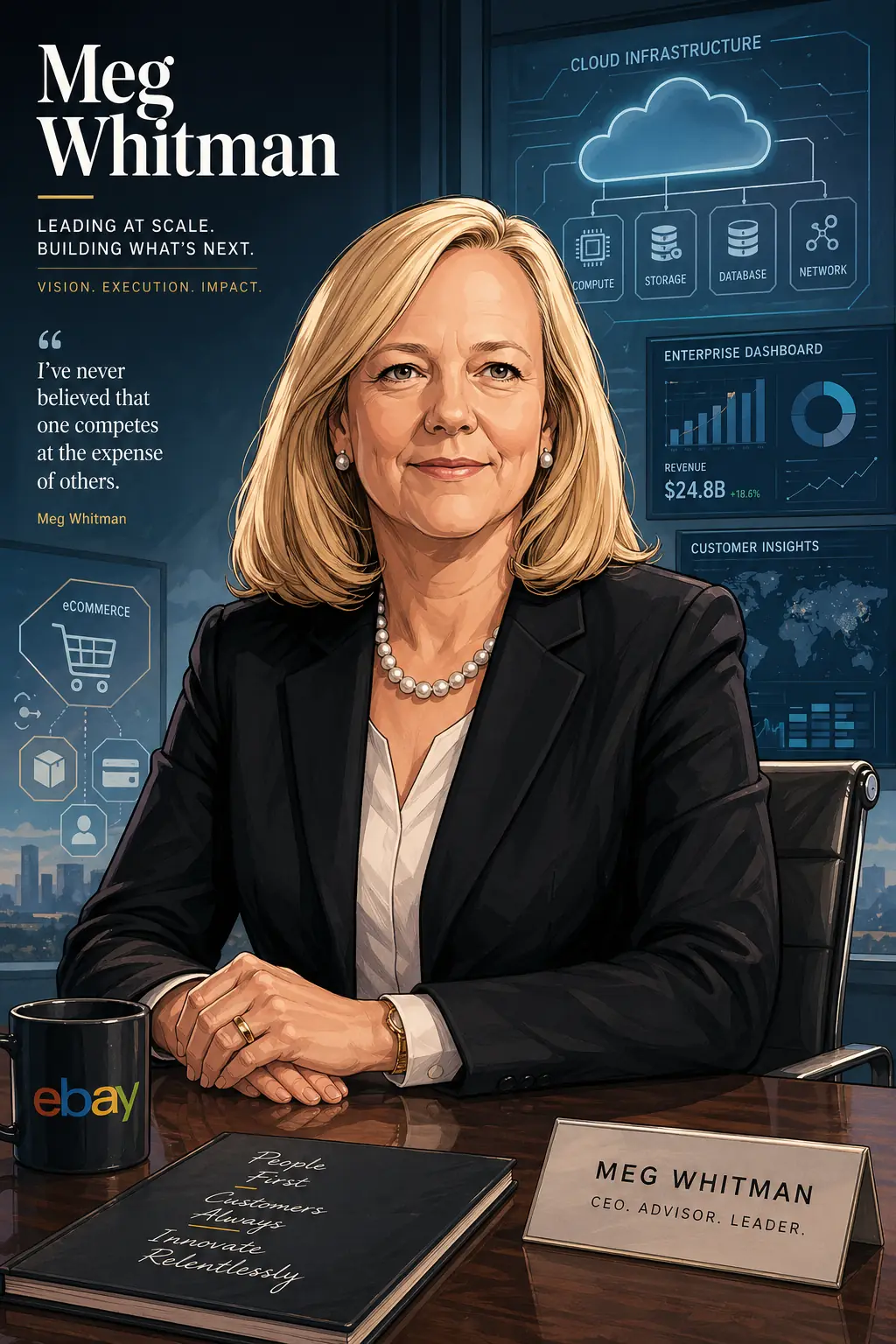
Meg Whitman took a website where people auctioned Pez dispensers and turned it into a $70 billion global commerce platform that processed more transactions than the NASDAQ. At eBay, she was one of the most successful CEOs of the internet era — scaling the company from 30 employees and $4 million in revenue to over 15,000 employees and $8 billion in revenue. Then she spent $144 million of her own money running for governor of California and lost. Then she tried to fix Hewlett-Packard and discovered that some companies are too broken to save. Her career is a study in what scales and what doesn’t.
Chapter 1: Cold Spring Harbor — The Making of a Competitor (1956–1979)

Margaret Cushing Whitman was born on August 4, 1956, in Cold Spring Harbor, New York, into a prosperous family. Her father was a corporate executive; her mother was a homemaker who had been a competitive swimmer. The family was affluent, educated, and ambitious. Whitman grew up in an environment where excellence was expected and achievement was the default setting.
She attended Princeton University — one of the first cohorts of women admitted to the previously all-male institution — and studied economics. At Princeton, she discovered a competitive intensity that would define her career. She was not the most intellectually brilliant person in her class, but she was among the most driven. She knew how to outwork people, how to organize complex projects, and how to motivate teams.
After Princeton, Whitman earned an MBA from Harvard Business School. Her early career reads like a tour of blue-chip corporate America: she worked at Procter & Gamble, Bain & Company, The Walt Disney Company (where she helped grow Disney’s consumer products division), Stride Rite (as CEO), and FTD (the flower delivery company). Each position taught her something about brand management, operations, and consumer behavior. She was a professional manager — highly skilled at optimizing existing businesses.
Chapter 2: eBay — Joining the Auction (1998)

In January 1998, a headhunter called Whitman about a job at a company called eBay. She almost didn’t take the meeting. eBay was a small website — 30 employees, $4 million in annual revenue — where people bought and sold collectibles through online auctions. It sounded like a hobby, not a business.
But when Whitman visited eBay’s offices in San Jose, she saw something that changed her mind: the community. eBay’s users were passionate, engaged, and fiercely loyal. They had built businesses on the platform. They had formed friendships. They had created an ecosystem of trust — buyer ratings, seller feedback, dispute resolution — that made commerce between strangers possible. Whitman recognized that this community was the product, and it was extraordinarily valuable.
She joined as CEO in March 1998. The company had thirty employees and was processing a few hundred thousand auctions per month. It was profitable — barely — but had no professional management, no scalable infrastructure, and no strategy for growth. Whitman’s job was to take a functioning community and build a global business around it.
Chapter 3: Scaling the Marketplace (1998–2002)

Whitman’s approach to scaling eBay was methodical and disciplined. She hired professional management, built customer service operations, invested in technology infrastructure, and expanded the platform internationally. She took eBay public in September 1998, and the stock price nearly tripled on its first day of trading.
Her most important early decision was to resist the urge to change what was working. Many new CEOs would have redesigned the platform, launched new features, or tried to impose a corporate vision. Whitman understood that eBay’s value came from its community, and the community was working fine. Her job wasn’t to reinvent eBay — it was to build the infrastructure that would let it scale.
She expanded eBay into Europe (acquiring Alando in Germany, iBazar in France), Asia (investing in partnerships in Japan, Korea, and China), and new product categories. She launched eBay Motors, which became one of the largest used car marketplaces in the world. Revenue grew from $47 million in 1998 to $1.2 billion in 2002. The company was growing faster than almost any other internet company, and unlike most dot-com darlings, it was actually profitable.
Chapter 4: PayPal — The Acquisition That Changed Everything (2002)

In July 2002, eBay acquired PayPal for $1.5 billion. It was the most important acquisition in eBay’s history and, in retrospect, one of the most important acquisitions in internet history. PayPal solved eBay’s biggest friction point: payment. Before PayPal, completing an eBay transaction required mailing a check or money order — a process that was slow, unreliable, and deeply annoying. PayPal made payment instant and digital.
The acquisition was controversial. eBay had developed its own payment system, Billpoint, which was failing. Many eBay sellers had already adopted PayPal independently, effectively choosing the market’s solution over eBay’s internal offering. Whitman recognized the reality — PayPal had won — and bought it rather than fighting it.
PayPal would eventually become more valuable than eBay itself. When eBay spun off PayPal as an independent company in 2015, PayPal’s market capitalization quickly exceeded eBay’s. The alumni of PayPal — Elon Musk, Peter Thiel, Reid Hoffman, and others — went on to create or fund some of the most valuable companies in history. Whitman’s $1.5 billion acquisition was, dollar for dollar, one of the best deals in tech history.
Chapter 5: The Plateau and the Exit (2003–2008)

eBay’s growth began slowing in the mid-2000s. The core auction business was being disrupted by fixed-price competitors — most significantly Amazon, which was building a retail empire that made the auction format seem quaint. Craigslist was eating eBay’s classified advertising business. International expansion was stalling in China, where local competitor Taobao (owned by Alibaba) was dominating.
Whitman tried to diversify. eBay acquired Skype for $2.6 billion in 2005 — a deal that was widely criticized at the time and looks even worse in retrospect. The strategic rationale — that voice communication would enhance the eBay marketplace — never materialized. eBay eventually sold Skype to a group of investors in 2009 for $2 billion (Microsoft later acquired it for $8.5 billion, making eBay’s exit look poorly timed as well).
Whitman stepped down as CEO in March 2008, after ten years at the helm. During her tenure, eBay had grown from 30 employees to over 15,000, from $4 million in revenue to $8 billion, and from a quirky auction site to a global commerce platform. Her track record was extraordinary by any measure, even if the final years had been more difficult.
Chapter 6: The $144 Million Governor’s Race (2009–2010)

Whitman’s departure from eBay was followed by an unexpected move: she announced her candidacy for governor of California as a Republican. The campaign was notable for two things: its cost and its result. Whitman spent approximately $144 million of her own money — the most ever spent by a self-funded candidate in American history at that time.
The money bought name recognition but not votes. Whitman was attacked for having not voted in most elections for nearly three decades — an embarrassing revelation for someone seeking public office. She was also damaged by a scandal involving an undocumented housekeeper, which undermined her position on immigration. Her Democratic opponent, Jerry Brown, ran a low-budget, experience-focused campaign that contrasted sharply with Whitman’s corporate approach.
Brown won by over 12 percentage points. The defeat was a humbling lesson for Whitman and for the broader assumption that business success translates to political viability. Running a company is fundamentally different from running a campaign: customers choose products based on utility; voters choose candidates based on identity, values, and emotion. Whitman’s operational skills were irrelevant in a contest that was decided on completely different terms.
Chapter 7: HP — Inheriting a Disaster (2011–2013)

In September 2011, Whitman was named CEO of Hewlett-Packard — one of the most storied names in Silicon Valley, and at that moment, one of the most troubled. HP was in crisis. Her predecessor, Léo Apotheker, had lasted less than a year and had made a series of disastrous decisions: he had announced HP would exit the PC business (then reversed the decision), acquired the British software company Autonomy for $11.1 billion (a deal that would later be written down by $8.8 billion due to alleged fraud), and generally created strategic chaos.
Whitman inherited a company with $120 billion in revenue, 300,000 employees, and no coherent strategy. HP was simultaneously a PC company, a printer company, an enterprise services company, and an enterprise software company — and it was losing ground in every segment. Morale was terrible. The stock price had halved under Apotheker.
Whitman committed to a multi-year turnaround. She told investors and employees that the recovery would take at least five years. She stabilized the organization, committed to the PC business (reversing Apotheker’s planned exit), and began the slow work of restructuring. It was not glamorous work, and the market remained skeptical.
Chapter 8: The HP Split — Two Companies, Neither Dominant (2014–2015)

Whitman’s most consequential decision at HP was to split the company in two. In October 2014, she announced that HP would separate into HP Inc. (PCs and printers) and Hewlett Packard Enterprise (servers, networking, enterprise services). The split, effective November 2015, was designed to allow each company to focus on its core market and move faster than the combined entity could.
The logic was sound: the PC/printer business and the enterprise business had different customers, different competitive dynamics, and different capital requirements. Combining them under one roof created bureaucratic overhead and strategic confusion. Separating them would allow each company to compete more effectively.
In practice, the results were mixed. HP Inc. maintained a strong position in PCs and continued to dominate the printer market. Hewlett Packard Enterprise, which Whitman led as CEO, struggled to compete with Dell EMC, Cisco, and cloud providers who were all growing faster. The enterprise IT market was shifting toward cloud computing, and HPE’s traditional hardware-focused approach was losing relevance.
Chapter 9: Post-HP and Quibi — The Short-Form Fiasco (2018–2020)

After leaving HPE in February 2018, Whitman joined Quibi — a mobile-first streaming service founded by Hollywood mogul Jeffrey Katzenberg — as CEO. Quibi’s premise was that viewers wanted premium, short-form content (episodes under ten minutes) designed specifically for mobile viewing. Katzenberg provided the Hollywood connections; Whitman provided the operational and technology expertise.
Quibi raised $1.75 billion before launch — an extraordinary amount for an unproven concept. It launched in April 2020, at the height of the COVID pandemic. The timing was catastrophic: people were stuck at home with full-sized screens, not commuting on mobile devices. But the problems went deeper than timing. The content was forgettable. The user experience was clunky. The value proposition — pay $5–8/month for short videos when TikTok and YouTube offered unlimited short content for free — was unclear.
Quibi shut down in December 2020, just six months after launch, having burned through nearly all of its $1.75 billion in funding. It was one of the most spectacular failures in entertainment history and a painful coda to Whitman’s career. The failure demonstrated that capital and experience don’t guarantee product-market fit — and that assumptions about consumer behavior can be catastrophically wrong.
Chapter 10: Ambassador to Kenya — A New Chapter (2022–2024)

In a surprising pivot, Whitman was appointed US Ambassador to Kenya by President Biden in 2022. The appointment was partly reward for her political support (she had endorsed Biden in 2020, crossing party lines) and partly recognition of her business experience in a region where American economic interests were growing.
As ambassador, Whitman focused on trade relations, technology partnerships, and climate initiatives. She brought her business perspective to diplomacy, treating the embassy’s operations with the same efficiency-focused approach she had applied at eBay and HP. The role was less visible than her corporate career but gave Whitman a platform to apply her skills in a completely different context.
The ambassadorship also provided distance from the Quibi debacle and allowed Whitman to rebuild her public profile around service and statesmanship rather than corporate performance. It was, in its own way, a strategic repositioning — the same instinct that had driven every career move she had made.
Chapter 11: The Net Worth and the Influence

Whitman’s net worth, estimated at approximately $5 billion, came primarily from her eBay compensation and the appreciation of her eBay stock. The eBay years were the financial engine — ten years of equity grants in a company whose market cap grew from roughly $600 million to over $40 billion generated wealth that subsequent career setbacks couldn’t erode.
Her influence extended beyond any single company. Whitman served on the boards of Procter & Gamble, DreamWorks Animation, and other major corporations. She was a prominent political figure — a Republican who endorsed Democrats when she felt the party had gone astray, a position that earned her criticism from both sides.
As one of the most powerful women in American business history, Whitman’s career was inevitably analyzed through the lens of gender. She navigated male-dominated industries and a male-dominated political system with a combination of competence and toughness that earned respect even from critics. Whether the scrutiny she faced was harsher than what a male executive would have received is debatable; that she performed at the highest levels despite it is not.
Chapter 12: Legacy — The Scaler, Not the Creator

Meg Whitman’s legacy is defined by a paradox: her greatest success (eBay) came from not trying to change things, and her subsequent struggles came from trying to change too much. At eBay, she scaled a platform by respecting the community that built it. At HP, she tried to transform a company whose problems were too deeply rooted for any single leader to solve. At Quibi, she bet on a concept that was fundamentally flawed.
The common thread is operational excellence. Whitman is one of the most skilled operators in the history of American business — the ability to take a complex organization, identify its inefficiencies, and make it run better is a genuine and rare talent. But operational excellence has limits. It can scale a working model but cannot fix a broken one. It can optimize a strategy but cannot create one from nothing.
Whitman’s eBay tenure alone justifies her place in the business pantheon. She took a website that processed Pez dispenser auctions and built it into a global commerce platform that changed how hundreds of millions of people buy and sell goods. That transformation required vision, discipline, and judgment of the highest order. The fact that subsequent chapters didn’t match that standard doesn’t diminish the achievement — it just proves how rare that kind of perfect alignment between leader, company, and moment really is.
💡 Key Insights
- ▸ Whitman's eBay tenure proved that scaling a platform business requires different skills than inventing one. She didn't create eBay — she built the infrastructure that let eBay become a global marketplace.
- ▸ Her HP experience revealed that operational excellence cannot overcome strategic confusion. HP was trying to be a PC company, an enterprise company, a services company, and a printer company simultaneously — and none well.
- ▸ Whitman's $144 million self-funded gubernatorial campaign and its failure showed that business success doesn't automatically translate to political success. Voters aren't customers, and campaigns aren't companies.