The Audacious Architect: How Akio Morita Forged Sony, Invented the Walkman, and Transformed 'Made in Japan' from a Punchline to a Powerhouse
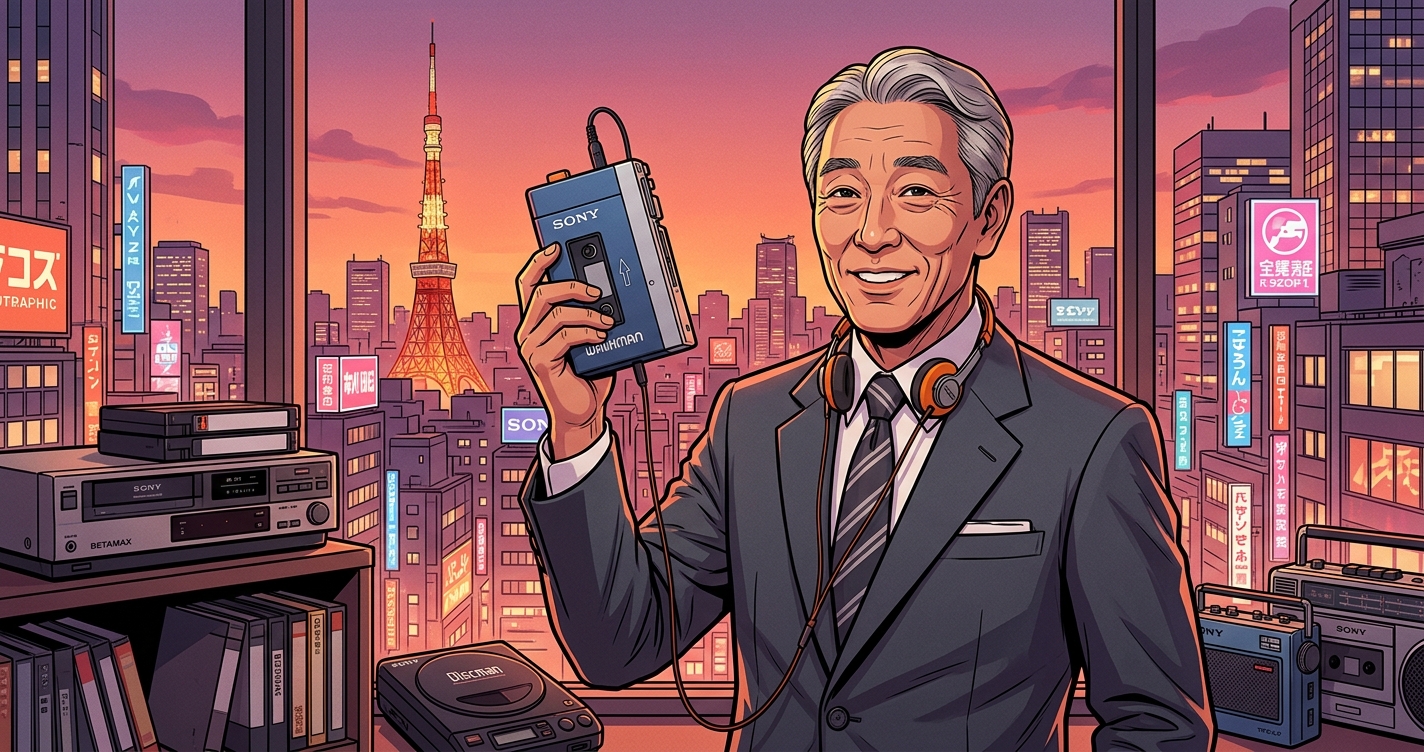
Meet **Akio Morita**, the visionary who dared to dream of a global empire from the ashes of war, co-founding **Sony** and forever changing how the world listened to music. This is the wild, dramatic saga of a man who didn't just build a company; he rewrote the rules of innovation, branding, and national perception, turning 'Made in Japan' from a joke into a global gold standard.
View all stories about this mogul
🔥 Chapter 1: The Ash, The Spark, and The Audacity of Hope

Imagine the scene: Japan, 1946. A nation utterly flattened, its cities reduced to rubble, its spirit scarred by defeat. The air still thick with the acrid smell of burnt dreams. The future? A blank, terrifying canvas. Most people were just trying to survive, to scrounge enough food, to put one foot in front of the other. But in the midst of this desolation, two men, an unlikely pair, dared to dream beyond mere survival. They dreamt of electronics. They dreamt of global domination. They dreamt of building something that would redefine their shattered nation’s identity.
One of them was Masaru Ibuka, a brilliant, restless engineer, a whirlwind of technical genius. He was the kind of guy who saw problems and immediately started sketching solutions on napkins, on walls, on the back of his hand. His mind was a perpetual-motion machine of circuits and possibilities. He had a vision for a country that would build not just for itself, but for the world.
The other was Akio Morita, a smooth, charismatic physicist, a born salesman, an aesthete with an uncanny sense for what people wanted, even before they knew they wanted it. Morita was the closer, the storyteller, the man who could make you believe in a future you couldn’t even imagine. He was the bridge between Ibuka’s raw genius and the messy, unpredictable world of markets and consumers. He came from a family of sake brewers, a lineage rooted in tradition, but his gaze was fixed firmly on the horizon, on a future crafted from silicon and sound.
They met during the war, collaborating on research for the Japanese Navy. When the war ended, they didn’t just go their separate ways. They looked at the ruins and saw opportunity. An opportunity to create a new kind of company, built on innovation, quality, and a relentless pursuit of the impossible. In a drafty, bombed-out department store in Tokyo, with just 20 employees and a paltry ¥190,000 (about $500 at the time), they founded Tokyo Tsushin Kogyo (TTK), or Tokyo Telecommunications Engineering Corporation.
This wasn’t just a startup; it was an act of audacious defiance against despair. While everyone else was looking backward, licking their wounds, Ibuka and Morita were staring straight ahead, imagining a world humming with their inventions. They had no real product, no market, just a burning conviction that Japan could, and would, build things of value again. This was the genesis of Sony, a name that would one day become synonymous with cutting-edge technology, sleek design, and a quality so undeniable it would transform an entire nation’s global reputation. They weren’t just building a company; they were laying the foundation for a cultural revolution, one transistor at a time. The world had no idea what was coming, but Morita and Ibuka were already sketching it out in their minds, in the flickering candlelight of a devastated Tokyo. This was where the legend began, a legend forged in the crucible of ambition and the ashes of war.
💥 Chapter 2: The Transistor Gamble – A Bet Against the Odds

Post-war Japan was a land starved for resources, for capital, for hope. The concept of “Made in Japan” was, frankly, a joke. It conjured images of shoddy knock-offs, cheap toys, and unreliable trinkets. To build a high-tech company in this environment was not just ambitious; it was borderline insane. Yet, Ibuka and Morita were nothing if not insane in the best possible way.
Their first real product wasn’t some grand innovation. It was a rice cooker. And it failed spectacularly. It either burned the rice to a crisp or left it a soggy mess. A humble start, indeed. But they weren’t deterred. They were learning. And then came the breakthrough moment, a flicker of light from across the Pacific.
In 1953, Akio Morita made a pilgrimage to the United States. He wasn’t there for sight-seeing. He was there to secure a license for a revolutionary new technology developed by Bell Labs: the transistor. This tiny semiconductor promised to shrink electronics, replacing bulky, fragile vacuum tubes. Morita saw it not just as a component, but as the key to a new era of consumer devices.
The price for the license was $25,000 – a king’s ransom for their struggling little company. Japanese banks laughed in their faces. The Ministry of International Trade and Industry (MITI) was skeptical, urging them to focus on simpler, more established technologies. They thought the transistor was too complex, too risky for a war-torn nation. But Morita, with his characteristic blend of charm and steel, was unrelenting. He saw beyond the immediate hurdles, visualizing a world where everyone carried powerful electronics in their pockets. He convinced the powers that be, scraping together the funds, taking on immense personal and corporate risk.
“Our business is unique. We’re in the business of creating a future. It’s not about what the market wants now, but what the market will want.”
This wasn’t just a financial gamble; it was a cultural one. Japan’s entire industrial complex was geared towards heavy industry, towards rebuilding infrastructure. Consumer electronics were seen as a frivolous pursuit. But Morita knew better. He saw the transistor as a democratizing force, bringing technology into every home, every pocket. He envisioned a world where music, information, and entertainment were portable, personal.
The early days of transistor production were brutal. Engineers worked around the clock, battling the unforgiving physics of semiconductors, trying to miniaturize the components to an unprecedented degree. Yields were low, failures were common. But the spirit of Ibuka and Morita permeated the company: relentless experimentation, unwavering quality control, and a fierce belief in their mission. They didn’t just want to build a transistor radio; they wanted to build the best transistor radio, one that would make the world forget the “Made in Japan” stigma. They were not just building radios; they were building credibility, one perfectly soldered joint at a time. The transistor wasn’t just a component; it was the DNA of their future empire.
🌐 Chapter 3: Naming a Dynasty – From TTK to Sony
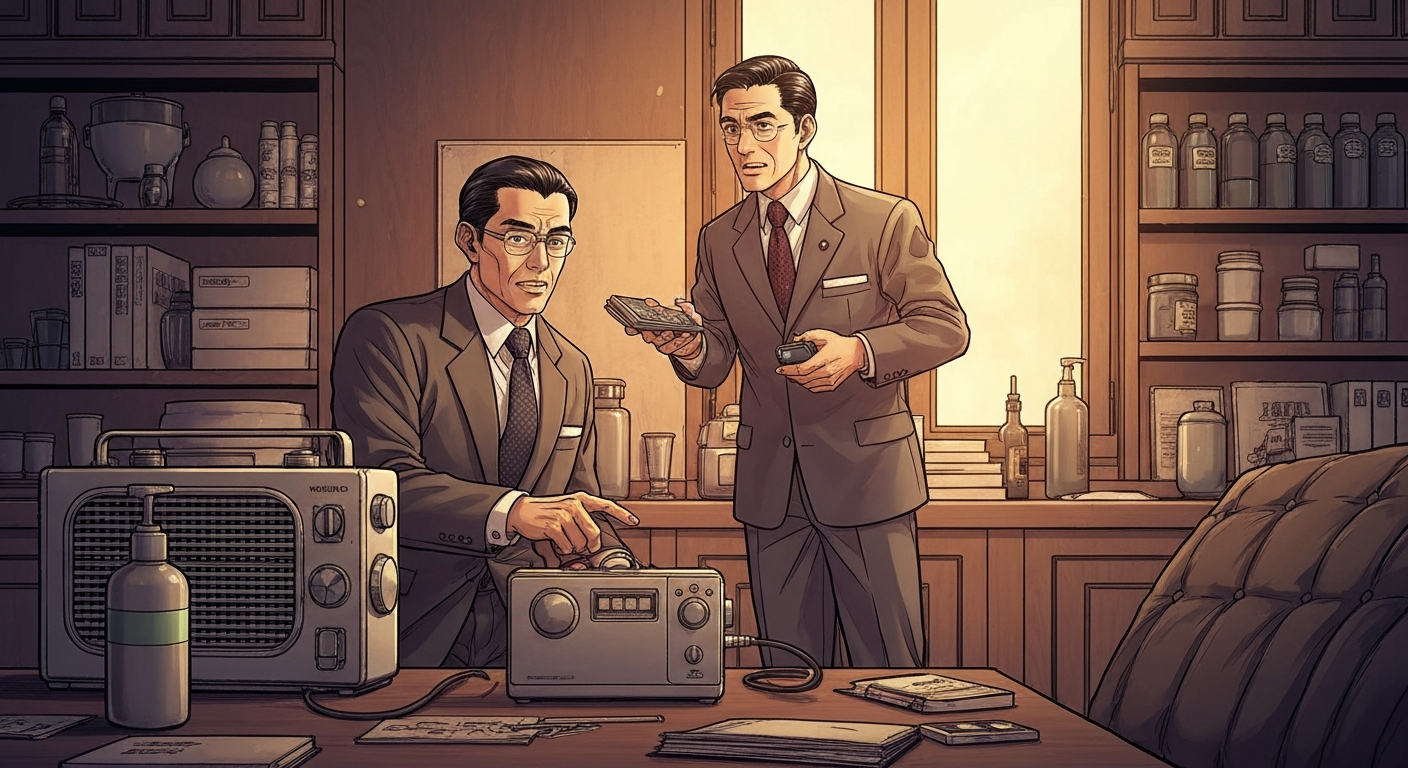
The year is 1955. Tokyo Tsushin Kogyo (TTK) has just launched its first transistor radio, the TR-55. It’s a marvel of miniaturization, a testament to their engineering prowess. But there was a problem, a very big problem, for a company with global ambitions: the name.
“Tokyo Tsushin Kogyo.” Try saying that five times fast. Try remembering it. Try pronouncing it if you’re not Japanese. It was clunky, provincial, and utterly unsuited for the international stage that Akio Morita envisioned. He knew, instinctively, that a global brand needed a global name. Something simple, catchy, universally pronounceable, and devoid of any negative connotations across different languages.
His partner, Masaru Ibuka, initially resisted. TTK was their baby, their identity. It had the weight of their early struggles, their triumphs, their very Japanese essence. But Morita, the marketing visionary, was relentless. He understood that a company’s name isn’t just a label; it’s a promise, a beacon, a shorthand for everything it stands for. If they wanted to transcend the “Made in Japan” stereotype, they needed a name that could stand on its own, unburdened by past perceptions.
Morita scoured dictionaries, consulted linguists, brainstormed endlessly. He stumbled upon “sonus,” the Latin root for sound, and “sonny,” a popular American slang term for a bright young boy. He liked the combination: “Sony.” It was short, symmetrical, playful, and had no existing meaning in any major language that could cause offense or confusion. Crucially, it evoked sound, a core element of their burgeoning electronics business, and youth, dynamism, and innovation. It was a name that could be pronounced the same way in Tokyo, New York, or Paris.
The decision to change the company name was met with internal resistance and even some ridicule from the Japanese business establishment. Companies just didn’t change their names so casually, especially not to something so decidedly Western-sounding. It was seen as abandoning tradition, as an act of cultural betrayal by some. But Morita was unyielding. He understood that true innovation wasn’t just about the product; it was about the entire package, from the sleek design to the powerful, memorable brand.
“We must look beyond our borders. If we want to be a global company, our name must be global. It must resonate everywhere.”
In 1958, Tokyo Tsushin Kogyo officially became Sony Corporation. This wasn’t just a name change; it was a declaration of intent. It signaled to the world that this Japanese company wasn’t content to be a regional player. It was aiming for the stars. It was a bold, unprecedented move that reflected Morita’s deep understanding of global commerce and branding. He wasn’t just building radios; he was building a brand identity, a global lingua franca for quality and innovation. The name “Sony” became the vanguard of a new era, a symbol of a Japan that was ready to re-enter the world stage, not as a vanquished foe, but as a technological pioneer. The little company from the ashes of war now had a name that could conquer the world.
🇺🇸 Chapter 4: The American Invasion – Cracking the Goliath

With the Sony name emblazoned on their products, Akio Morita knew the real battle lay ahead: cracking the immensely competitive American market. This wasn’t just about selling radios; it was about selling trust, about changing deeply ingrained perceptions. “Made in Japan” still carried the stench of inferiority, a mark of cheap, disposable goods. Morita was determined to obliterate that stereotype.
In 1960, Morita packed his bags and moved his family to New York. Not for a brief visit, but to immerse himself, to truly understand the American consumer, the American retail landscape. He set up Sony Corporation of America, not as a distant outpost, but as a direct pipeline to the heart of the market. This move was revolutionary. Most Japanese companies at the time relied on trading houses or local distributors, creating a buffer between the manufacturer and the customer. Morita refused this. He wanted direct control, direct feedback, direct engagement.
His first major challenge was the TR-63, the world’s smallest transistor radio. It was a marvel, fitting snugly into a shirt pocket. But distributors were skeptical. They wanted to sell it under their own brand, offering a higher price point for a superior product. Morita, however, had seen American marketing tactics up close. He knew the power of a brand name. He refused to let them rebrand it. He famously declared that if they couldn’t sell it under the Sony name, he’d take it home and sell it himself.
This was vintage Morita: audacious, uncompromising, utterly confident in his product and his brand. He understood that building a global powerhouse meant establishing your own identity, not just being a white-label manufacturer. He walked away from lucrative deals because they compromised his vision for the Sony brand. Instead, he went direct, forging relationships with retailers, educating salespeople, and demonstrating the quality and innovation of Sony products firsthand.
“If you simply want to sell products, you can let others brand them. But if you want to build a company, an identity, a legacy, then your name must be on it.”
The TR-63 became a sensation. It wasn’t just a radio; it was a fashion accessory, a status symbol. Teenagers flocked to buy it. The sheer novelty and portability were intoxicating. Morita capitalized on this, using clever advertising that highlighted the radio’s compact size and superior sound. He understood that in America, marketing was as important as engineering. He was selling a lifestyle, not just a gadget.
Morita didn’t just sell radios; he sold a new perception of Japan. Every reliable Sony product, every satisfied customer, chipped away at the old “Made in Japan” prejudice. He showed the world that Japan could produce not just good products, but great products, products that set new standards for quality, design, and innovation. His personal presence, his articulate explanations of Sony’s commitment to excellence, played a crucial role. He was an ambassador, tirelessly advocating for his company and, by extension, for his nation’s renewed industrial prowess. The American invasion wasn’t just a business success; it was a psychological victory, paving the way for Japan’s global electronics dominance.
🔬 Chapter 5: Innovation as Religion – From Trinitron to Betamax

At the heart of Sony’s meteoric rise was an almost religious devotion to innovation. For Akio Morita and Masaru Ibuka, complacency was the ultimate sin. They didn’t just want to keep up; they wanted to dictate the pace, to define the future of consumer electronics. This ethos led to a string of groundbreaking products, some triumphs, some cautionary tales.
One of their most iconic achievements was the Trinitron color television. In the late 1960s, color TVs were bulky, expensive, and often displayed fuzzy, inaccurate colors. Ibuka, ever the engineer, challenged his team to create a better color picture tube. The result, after years of intense research and development, was the Trinitron. It used a single electron gun and an aperture grille, producing brighter, sharper, and more vibrant images than anything else on the market. It was a technical masterpiece, a testament to Sony’s unwavering commitment to pushing the boundaries of what was possible.
Developing the Trinitron was a monumental undertaking, costing Sony an enormous amount of money and resources. There were moments of doubt, fears that it would bankrupt the company. But Morita stood firm, backing his engineers, understanding that true breakthroughs require immense courage and investment. When it launched in 1968, the Trinitron wasn’t just a TV; it was a revolution. It dominated the high-end TV market for decades, winning awards and cementing Sony’s reputation as a premium brand. It was the epitome of “Made in Japan” excellence, a product so superior it silenced all doubters.
“Research is not just about finding new things. It’s about finding new ways to make things better, to create something the world has never seen before, and then making it perfect.”
But even an innovation powerhouse like Sony could stumble. Enter Betamax. In the mid-1970s, video recording was the next frontier. Sony poured its resources into developing a home video cassette recorder (VCR) that was compact, easy to use, and offered superior picture quality. The result was Betamax, launched in 1975. Technically, it was brilliant. The cassettes were smaller, the recording quality often better than its impending rival.
Then came the VHS format, introduced by JVC a year later. What followed was one of the most famous format wars in technological history. Betamax was technically superior, but VHS had a critical advantage: longer recording time. While Betamax initially offered an hour, VHS could record for two, then four hours. This was crucial for recording entire movies or sporting events. Morita and Sony, ever focused on technical excellence, failed to grasp the market’s preference for convenience and longer recording capacity over marginal picture quality. They also refused to license Betamax widely, hoping to control the standard. VHS, on the other hand, was aggressively licensed to multiple manufacturers, quickly building a dominant market share.
The Betamax story is a brutal, yet invaluable, lesson in business strategy. It highlights that technical superiority alone isn’t enough. Market adoption, ecosystem building, and understanding consumer behavior (even if it means compromising on some technical ideals) are equally, if not more, critical. Morita later reflected on Betamax as a painful but important learning experience, reinforcing his belief that while innovation was religion, market understanding was scripture. It taught Sony that sometimes, being first or even being “best” isn’t enough; you also have to be smartest about how you bring your innovation to the world.
🎧 Chapter 6: The Eureka Moment – A Walkman is Born

The year is 1978. Masaru Ibuka, now honorary chairman of Sony, is a man with a problem. He loves opera. He loves listening to it on his long international flights. But his existing portable cassette player is a clunky, heavy beast, a burden to carry around. He yearned for something lighter, something he could easily take anywhere. He approached his engineers with a simple request: strip down one of Sony’s existing portable cassette recorders (the Pressman, used by journalists) and remove the recording function. Just make it play. Make it small. Make it personal.
This was the seed. A seemingly trivial request from a retired executive. But Akio Morita, with his unparalleled intuition for market trends and human desire, saw something more profound. He saw a product that didn’t just solve Ibuka’s problem; it solved a problem people didn’t even realize they had.
The initial reaction from many within Sony was skepticism, even outright derision. “A cassette player that can’t record? Who would buy that? It’s half a product!” The conventional wisdom held that recording capability was essential. Customers expected features, not fewer. The marketing department was particularly resistant, fearing a commercial flop. They argued it was a niche product at best, a toy for a select few.
But Morita was unyielding. He had a sixth sense for consumer desire. He envisioned people walking down the street, listening to their own music, creating their own personal soundtracks. He saw it as liberating, as empowering. It wasn’t about the absence of recording; it was about the presence of personal, portable music. He saw the social implications, the cultural shift it could ignite.
“Don’t ask the customer what they want. They don’t know. Show them what they could want. Create the demand.”
He personally championed the project, pushing his engineers to make it smaller, lighter, and more aesthetically pleasing. He insisted on high-quality headphones, understanding that the listening experience was paramount. He even played a direct role in the naming. Early prototypes were considered for names like “Soundabout” or “Stereo Story.” But Morita, with his global vision, wanted something punchy, memorable, and indicative of its function. He settled on “Walkman,” a bold, slightly quirky name that perfectly captured the essence of its portability and personal use. Again, internal resistance flared – the name sounded like “Japlish” (Japanese English) and might not translate well. But Morita was resolute. He knew its simplicity and directness would resonate.
The development was incredibly fast, a testament to Morita’s drive. From Ibuka’s initial request to product launch took less than a year. Engineers worked feverishly, overcoming technical hurdles to miniaturize the components, improve battery life, and ensure sound quality. They were building not just a device, but a paradigm shift. The Walkman wasn’t just a gadget; it was a revolution waiting to happen, a testament to Morita’s genius for creating markets, not just serving them. He wasn’t just inventing a product; he was inventing a new way to experience the world.
🌎 Chapter 7: Unleashing the Walkman – A Cultural Earthquake
When the Sony Walkman (originally called the “Walkman” in Japan and “Soundabout” in the US, but quickly standardized to Walkman globally due to its popularity) launched in Japan on July 1, 1979, the initial sales were sluggish. The skeptics inside Sony felt vindicated. “See? We told you so. Nobody wants a player that can’t record!” But Akio Morita was not one to back down. He had an unwavering belief in the Walkman’s potential, and he knew it needed more than just a traditional advertising push. It needed a cultural ignition.
Morita unleashed a marketing blitz that was as innovative as the product itself. Instead of just placing ads, Sony literally put Walkmans on the streets. They hired young people to walk around fashionable districts, offering passersby a chance to try the device. Imagine the scene: people stopping, putting on headphones, and suddenly being enveloped in their own private soundscape. Their eyes would widen. A smile would spread across their faces. It was an experiential marketing masterstroke. They weren’t just selling a product; they were selling an experience of personal freedom and auditory bliss.
This guerilla marketing, coupled with Morita’s insistence on aggressive pricing (he wanted it accessible), quickly turned the tide. Within two months, the initial production run of 30,000 units sold out. The buzz exploded. Word-of-mouth spread like wildfire. The Walkman wasn’t just a gadget; it was a phenomenon.
“We didn’t just sell a device; we sold a new way of life. We sold freedom, personal space, and the soundtrack to your own world.”
Suddenly, everyone wanted one. Joggers, commuters, students, office workers – the Walkman became an indispensable companion. It freed music from living rooms and car stereos, making it truly portable and personal. It democratized the listening experience, allowing individuals to curate their own audio environment wherever they went. It created a new category of personal electronics, spawning countless imitators and solidifying Sony’s reputation as a trailblazer.
The impact was profound. The Walkman became a global cultural icon of the 1980s. It symbolized individuality, modernity, and the burgeoning digital age. It literally changed the soundscape of public spaces, turning noisy streets into a mosaic of private musical journeys. For Sony, it was an unprecedented commercial success, selling over 400 million units in various iterations over its lifetime. It wasn’t just a home run; it was a grand slam that redefined the very notion of personal entertainment.
The Walkman’s success wasn’t just about its innovative design or its clever marketing; it was about Akio Morita’s audacious vision to create a market where none existed. He didn’t just respond to consumer needs; he anticipated them, shaped them, and then delivered a product that seamlessly integrated into people’s lives, becoming an extension of themselves. The Walkman wasn’t just a portable cassette player; it was a testament to the power of a single, bold idea, backed by relentless execution and an unwavering belief in the future. It proved, once and for all, that “Made in Japan” now meant groundbreaking, desirable, and utterly essential.
🎌 Chapter 8: ‘Made in Japan’ Reborn – From Derision to Desire
The journey from “Made in Japan” being a global punchline to a revered mark of excellence is one of the most astonishing transformations in modern economic history, and Akio Morita and Sony were at its absolute vanguard. For decades after World War II, the label signified cheap, shoddy imitations – disposable trinkets that fell apart almost as soon as they left the factory. It was a brand liability, a scar from a nation trying to rebuild on the cheap.
But Morita had a different vision. He believed that Japan, with its meticulous craftsmanship, its dedication to detail, and its innate sense of aesthetics, could produce goods of unparalleled quality. He didn’t just want to compete; he wanted to set the global standard. This wasn’t just a business strategy; it was a matter of national pride, a way to reclaim dignity and redefine Japan’s place in the world.
From the very beginning, with the humble transistor radio, Sony implemented stringent quality control measures. Every component was scrutinized. Every assembly line worker was trained to uphold the highest standards. This wasn’t just about avoiding defects; it was about building products that were robust, reliable, and aesthetically pleasing. Morita understood that true quality encompassed not just functionality, but also design, user experience, and durability.
“We must not be content with merely being ‘good enough.’ We must strive for perfection, for excellence that speaks for itself, regardless of origin.”
Morita’s commitment extended to every aspect of the company. He fostered a culture where engineers were celebrated, where design was paramount, and where customer satisfaction was the ultimate metric. He famously insisted on selling Sony products under the Sony name, refusing to be a mere OEM (Original Equipment Manufacturer) for Western brands. This direct approach ensured that every success, every delighted customer, directly contributed to building the Sony brand and, by extension, the “Made in Japan” reputation.
The Trinitron television, with its superior picture quality, and the Walkman, with its revolutionary portability and flawless performance, were not just products; they were manifestos. They were tangible proof that “Made in Japan” no longer meant cheap. It meant cutting-edge. It meant innovative. It meant reliable. It meant desirable.
This transformation wasn’t solely Sony’s doing, of course. Other Japanese companies like Toyota, Honda, and Panasonic were also making similar strides in their respective industries. But Sony, particularly with its high-profile consumer electronics that directly entered homes and lives, became the most visible and impactful symbol of this shift. Morita’s willingness to move to America, to directly engage with global markets, and to fiercely defend his brand’s integrity played an enormous role in dismantling the old prejudices.
The ripple effect was immense. As Sony products conquered global markets, the perception of all Japanese goods began to change. Consumers started actively seeking out “Made in Japan” labels, associating them with technological sophistication, meticulous craftsmanship, and enduring quality. What was once a mark of derision became a badge of honor, a powerful differentiator in a competitive world. Akio Morita didn’t just build an empire; he helped rebuild a nation’s industrial reputation, proving that with unwavering vision and commitment to excellence, even the deepest-seated prejudices can be overcome. He didn’t just change minds; he changed the world’s perception of an entire country.
🚀 Chapter 9: The Global Visionary – Morita’s Leadership Principles

Akio Morita was more than just a co-founder and a marketing genius; he was a revolutionary leader whose management philosophy defied convention and set new standards for global business. His principles were rooted in a deep respect for people, a relentless pursuit of innovation, and an unwavering belief in a borderless world for his products.
One of Morita’s defining traits was his emphasis on a relatively flat organizational hierarchy. He believed in empowering his engineers and designers, fostering an environment where creativity could flourish without bureaucratic red tape. He encouraged direct communication, often walking the factory floor, engaging with employees at all levels, soliciting their ideas, and listening to their concerns. He understood that the best ideas often came from those closest to the product, not just from the executive suite. This hands-on, approachable style was unusual for Japanese corporate culture at the time, which tended to be more rigid and seniority-based.
He was also a fierce advocate for design and user experience. For Morita, a product wasn’t just a collection of components; it was an integrated experience. He pushed his teams to consider aesthetics, ergonomics, and the emotional connection users would have with Sony devices. This meant investing heavily in industrial design, ensuring that Sony products were not only technologically superior but also beautiful, intuitive, and a joy to use. This holistic approach to product development was a key differentiator for Sony.
“Our future is not just in technology, but in understanding people. We must create products that touch their hearts, not just their minds.”
Morita’s global vision extended beyond just selling products overseas. He genuinely believed in cultural exchange and understanding. He immersed himself in foreign markets, learning their customs, their tastes, their aspirations. His decision to live in the US was a testament to this commitment. He insisted that Sony employees, particularly those in leadership, gain international experience, fostering a truly global mindset within the company. He saw national borders as administrative lines, not barriers to commerce or innovation.
Perhaps one of his most controversial, yet impactful, statements was co-authoring the book “The Japan That Can Say No” with Shintaro Ishihara. Published in 1989, it was a provocative call for Japan to assert its own interests on the global stage, particularly in relation to the US, and to recognize its technological leadership. While it stirred considerable debate and some backlash, it also reflected Morita’s deep-seated confidence in Japan’s capabilities and his belief that his nation should be an equal partner, not a subordinate, in global affairs. It was a bold declaration of independence and a powerful statement of national self-assurance, echoing the very transformation he had helped engineer.
Morita also preached the importance of long-term thinking over short-term profits. He was willing to invest heavily in R&D, knowing that breakthroughs might take years, even decades, to materialize. He nurtured a culture of patience and perseverance, understanding that true innovation is not a sprint, but a marathon. His leadership wasn’t just about managing a company; it was about shaping a philosophy, inspiring a generation, and proving that with vision, courage, and a relentless pursuit of excellence, a company from a devastated nation could indeed conquer the world. He was a statesman of industry, an ambassador for innovation, and a testament to the power of visionary leadership.
🎬 Chapter 10: The Legacy Beyond Gadgets – Sony’s Diversification

By the late 1980s, Sony was a global technology titan, its name synonymous with innovation in consumer electronics. But Akio Morita was never one to rest on his laurels. His mind was always looking for the next frontier, the next convergence of technology and human experience. He foresaw a future where hardware and content would be inextricably linked, where the devices people used would be meaningless without compelling media to consume on them. This foresight led Sony down a path of audacious diversification into the entertainment industry, a move that would redefine the company and further cement Morita’s legacy as a visionary.
The first major foray was into music. In 1988, Sony acquired CBS Records (later renamed Sony Music Entertainment) for a staggering $2 billion. This was an unprecedented move for a Japanese electronics company. Many analysts and critics were baffled. What did a hardware manufacturer know about managing artists, producing albums, and navigating the fickle world of popular music? But Morita saw the synergy. He envisioned a world where Sony would not only make the devices that played music but would also create the music itself. It was a bold, vertical integration strategy, anticipating the digital content revolution long before it fully materialized.
This acquisition was followed, even more dramatically, by the purchase of Columbia Pictures (later renamed Sony Pictures Entertainment) in 1989 for $3.4 billion. Again, the global business community reeled. A Japanese company owning a legendary Hollywood studio? It seemed almost unthinkable. Yet, Morita’s rationale was crystal clear: just as people needed music for their Walkmans, they would need movies and television shows for their future high-definition screens and home entertainment systems. He understood that owning the content library would give Sony a strategic advantage, ensuring a steady stream of media for its cutting-edge hardware.
“Hardware without software is a box. Software without hardware is a ghost. We must master both to truly shape the future.”
These acquisitions were met with significant challenges. Integrating the famously distinct cultures of Hollywood and Tokyo was fraught with difficulties. There were clashes over management styles, creative control, and financial philosophies. The entertainment industry was notoriously volatile, and Sony faced steep learning curves and periods of significant financial struggle, particularly with its film studio.
However, Morita’s vision was ultimately validated. In the decades that followed, as the digital revolution accelerated, the lines between technology and entertainment blurred irrevocably. Companies like Apple, Amazon, and Netflix would later build empires on the very premise that Morita had articulated: the seamless integration of hardware, software, and content. Sony’s early, often painful, forays into entertainment positioned it uniquely for this converged future.
Morita’s legacy wasn’t just about creating iconic gadgets; it was about reimagining the very structure of a global technology company. He understood that an enterprise needed to be agile, adaptable, and willing to venture into uncharted territory. He set the stage for Sony to become a true media and technology conglomerate, a sprawling empire encompassing everything from cameras and gaming consoles to movies, music, and animation. His foresight in this diversification proved that true visionaries don’t just innovate within their existing categories; they define entirely new ones, anticipating the future and building the infrastructure to own it.
👑 Chapter 11: The Man, The Myth, The Mogul

Akio Morita was a force of nature. Born into a conservative, centuries-old sake brewing family, he defied expectations, eschewing tradition for a future he had to invent himself. He was a physicist by training, an engineer at heart, a marketer by instinct, and a global statesman by necessity. His life’s work at Sony wasn’t just about building a company; it was about building a legacy that transcended borders, technologies, and even his own lifetime.
What made Morita truly unique was his incredible blend of capabilities. He possessed the technical acumen to understand the intricacies of a transistor, the strategic vision to see its potential in a pocket-sized radio, and the marketing genius to sell that radio to a skeptical world. He was comfortable in a lab coat, a boardroom, or a diplomatic reception, effortlessly switching between roles as innovator, executive, and cultural ambassador.
He was a master communicator, articulate and persuasive, whether he was convincing skeptical bankers to fund a risky venture or charming foreign dignitaries. He possessed an almost prophetic ability to anticipate consumer desires, to envision products that people didn’t know they needed until they held them in their hands. The Walkman is the quintessential example of this: a product born not from market research, but from a profound understanding of human behavior and a bold leap of faith.
“You can’t just copy. You have to create. You have to innovate. That is the only way to lead, to truly make a mark on the world.”
Morita’s insistence on quality wasn’t just good business practice; it was a personal crusade. He understood that for “Made in Japan” to shed its negative connotations, every single Sony product had to be an exemplar of excellence. This relentless pursuit of perfection, coupled with a deep respect for design, allowed Sony to elevate itself above mere functionality, turning its products into objects of desire.
His global mindset was revolutionary. At a time when many Japanese companies were insular, Morita looked outward. He moved his family to the US, learned the culture, and built direct relationships, demonstrating a profound understanding that true global success required immersion, not just export. He was a bridge-builder, connecting East and West through the universal language of technology and innovation.
Morita’s leadership extended beyond his company. He became an unofficial ambassador for Japanese industry, traveling the world, speaking on behalf of his nation’s renewed economic prowess, and advocating for fair global trade. He was a fierce defender of Japanese innovation, but always with an eye toward mutual understanding and cooperation.
When he passed away in 1999, Akio Morita left behind not just a multinational corporation but a transformed global landscape. He showed the world that a nation could rise from devastation to become a technological leader. He proved that innovation isn’t just about invention; it’s about vision, courage, and the audacity to challenge conventional wisdom. His story is a powerful testament to the impact a single, determined individual can have on business, culture, and the very fabric of national identity. He wasn’t just a mogul; he was a legend, an architect of the modern world.
🎶 Chapter 12: The Unbreakable Sound of Innovation
The story of Akio Morita and Sony isn’t just a business chronicle; it’s an epic saga of human ingenuity, unwavering conviction, and the relentless pursuit of a dream against all odds. From the ashes of a defeated nation, Morita, alongside Masaru Ibuka, didn’t just rebuild; they reimagined. They didn’t just compete; they revolutionized.
Consider the sheer audacity of their venture. In a world that dismissed “Made in Japan” as a punchline, they dared to stamp their name on products of unparalleled quality and innovation. They took a technology like the transistor, which was considered complex and niche, and transformed it into the beating heart of consumer electronics, shrinking the world and bringing sound into every pocket.
The Walkman, in particular, stands as a monument to Morita’s genius. It was a product born of intuition, not focus groups. A device that, on paper, seemed destined for failure (“A player that can’t record? Nonsense!”). Yet, Morita’s unwavering belief in the human desire for personal freedom and self-curated experience turned a niche idea into a global cultural earthquake. It didn’t just sell millions of units; it redefined personal space, revolutionized music consumption, and became an enduring symbol of the era. It demonstrated that true innovation often means creating a demand the market didn’t even know it had.
Morita’s leadership principles — his emphasis on empowering engineers, his devotion to design, his global mindset, and his long-term vision — remain a powerful blueprint for entrepreneurs and business leaders today. He taught us that a brand isn’t just a logo; it’s a promise of quality and a declaration of ambition. He showed that true competitive advantage comes not from cutting corners, but from relentlessly pushing the boundaries of what’s possible, even when the world tells you it can’t be done.
“The future belongs to those who create it, not to those who merely react to it. Be bold. Be audacious. And never stop inventing.”
Today, Sony continues to be a global powerhouse, albeit one navigating the ever-shifting sands of the digital age. Its diversification into gaming (PlayStation), movies, and music, initiated by Morita’s visionary acquisitions, underscores his prescience regarding the convergence of hardware and content. While no company remains immune to market pressures and evolving technologies, the foundational spirit of innovation, quality, and global ambition that Akio Morita instilled continues to resonate within its walls.
The transformation of “Made in Japan” from a derogatory label to a global benchmark of excellence is perhaps Morita’s most profound and far-reaching legacy. He didn’t just build a company; he helped rebuild the industrial reputation of an entire nation, demonstrating that with courage, vision, and an unwavering commitment to quality, any challenge can be overcome. He proved that excellence knows no geographical bounds, and that a bold idea, backed by relentless execution, can indeed change the world.
So, the next time you slip on your headphones, or marvel at a sleek piece of technology, remember Akio Morita. Remember the man who, from the rubble of war, dared to dream of a world filled with sound, innovation, and a quality so undeniable it would transform an entire nation’s destiny. His story is the unbreakable sound of innovation, echoing through time, reminding us that the greatest empires are built not just with steel and silicon, but with audacious vision and an unyielding spirit.
💡 Key Insights
- ▸ Market Creation Over Market Research: Morita consistently demonstrated that true innovation isn't always about asking customers what they want, but often about showing them what they *could* want. The Walkman was a product nobody asked for, but everyone soon needed, proving that visionary entrepreneurs must sometimes trust their gut and create the demand for truly disruptive technologies.
- ▸ Brand is More Than a Name: Sony's transformation from 'Tokyo Tsushin Kogyo' to a globally recognized brand wasn't just a linguistic shift; it was a strategic declaration of international ambition and a commitment to quality. Entrepreneurs should understand that a brand name is a promise, and consistently delivering on that promise, especially in the face of skepticism, is how you build an empire.
- ▸ Global Vision from Day One: Morita didn't just think about selling in Japan; his ambition was always to conquer the world, even when his home country was in ruins. This 'born global' mindset, coupled with an unwavering commitment to quality and understanding diverse consumer needs, is a critical blueprint for any company aiming for international dominance, transcending local limitations from the outset.