Nikola Tesla: The Genius Who Powered the World and Died Broke in a Hotel Room
He invented AC power, envisioned wireless communication, and tore up a royalty contract worth billions. Tesla gave everything to humanity and got nothing in return.
View all stories about this mogul
Nikola Tesla: The Genius Who Powered the World and Died Broke in a Hotel Room
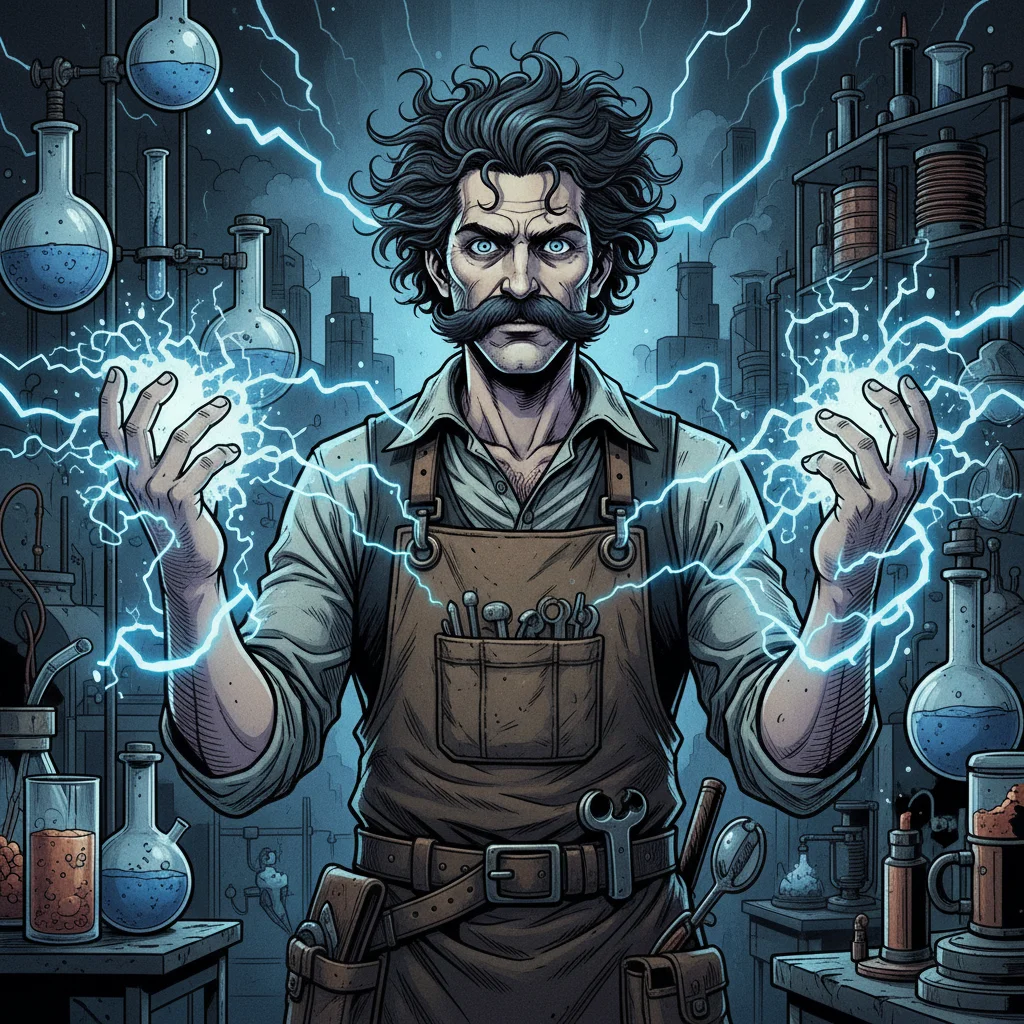
On January 7, 1943, a maid at the New Yorker Hotel in Manhattan entered Room 3327 and found the body of an 86-year-old man. He was alone. He was penniless. He had been feeding pigeons on the windowsill of his darkened room for years, living on a diet of warm milk and crackers. His name was Nikola Tesla — and he had invented the electrical system that powered the very hotel where he died. This is the story of the most brilliant, most tragic, and most criminally underappreciated inventor in human history.
⚡ Chapter 1: The Boy Who Saw Lightning

Nikola Tesla was born on July 10, 1856, in the village of Smiljan, in the Austrian Empire (present-day Croatia). His father, Milutin Tesla, was a Serbian Orthodox priest. His mother, Georgina (Djuka) Mandic, was an inventor in her own right — she created household tools and mechanical devices despite having no formal education.
Tesla inherited his mother’s gift for visualization. From an early age, he possessed what he described as an extraordinary ability to picture objects in his mind with perfect clarity — rotating them, examining them from every angle, even testing them mentally before building anything physical.
“I do not rush into actual work,” Tesla later wrote. “When I get an idea, I start at once building it up in my imagination… When I have gone so far as to embody in the invention every possible improvement I can think of… I proceed to the actual construction.”
This ability was both a superpower and a burden. Tesla experienced vivid flashes of light and suffered from what modern psychologists would likely classify as obsessive-compulsive disorder. He was tormented by specific numbers, textures, and patterns. He counted his steps. He required his hotel room number to be divisible by three. He couldn’t touch human hair.
As a young man, Tesla studied engineering at the Technical University of Graz, Austria, where he first encountered the Gramme dynamo — a direct current (DC) electrical generator. When his professor demonstrated the machine, its commutator sparked violently. Tesla suggested that the commutator was unnecessary — that an alternating current motor could be designed without one.
His professor told him it was impossible.
It would take Tesla six years to prove him wrong.
🔌 Chapter 2: The Vision in Budapest and the Journey to America
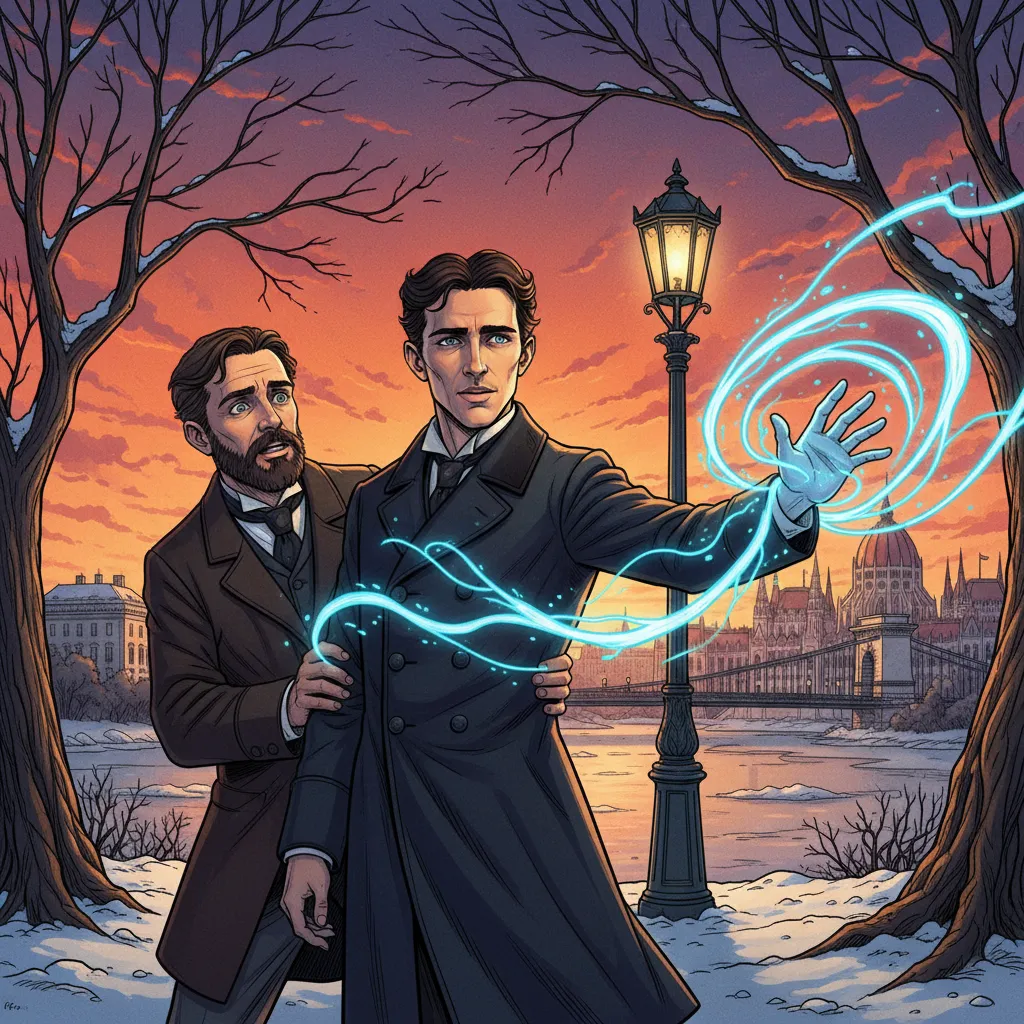
In February 1882, while walking through a park in Budapest with a friend, Tesla experienced the moment that would change the world.
He was reciting a passage from Goethe’s Faust when, suddenly, the complete design for a rotating magnetic field — an alternating current (AC) induction motor — appeared in his mind. He grabbed a stick and drew the diagrams in the dirt.
“The idea came like a flash of lightning, and in an instant the truth was revealed,” Tesla recalled. “I drew with a stick on the sand the diagrams… The images I saw were wonderfully sharp and clear and had the solidity of metal.”
The AC induction motor would prove to be one of the most important inventions in history. But in 1882, Tesla was a 26-year-old immigrant with no money, no connections, and no way to build his creation.
He worked briefly for the Continental Edison Company in Paris, then decided to go where the electrical revolution was happening: America.
Tesla arrived in New York City on June 6, 1884, with four cents in his pocket, a book of his own poetry, some calculations for a flying machine, and a letter of introduction to Thomas Alva Edison — already the most famous inventor in America.
The letter, written by Edison’s associate Charles Batchelor, allegedly contained the words: “I know two great men and you are one of them; the other is this young man.”
Tesla went to work for Edison immediately. But the relationship between the two men — the two greatest electrical minds of the age — was doomed from the start.
⚔️ Chapter 3: The War of Currents
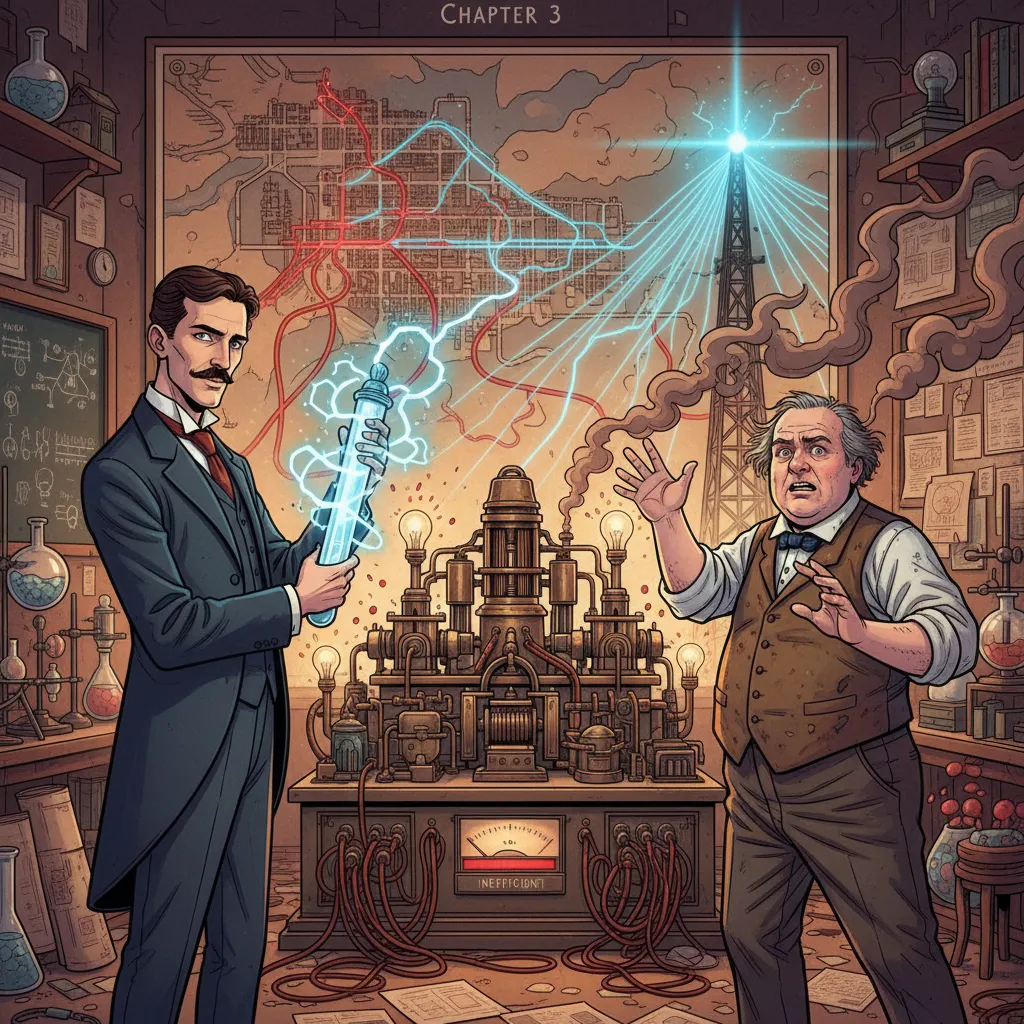
Thomas Edison had bet everything on direct current (DC). His power stations, his distribution systems, his entire business model was built on DC electricity. There was just one problem: DC was inefficient. It couldn’t be transmitted more than a mile or two without significant power loss. This meant that every neighborhood needed its own power station — an expensive and impractical limitation.
Tesla’s alternating current (AC) system solved this problem. AC could be “stepped up” to high voltages using transformers, transmitted over long distances with minimal loss, and then “stepped down” to usable voltages at the destination. One power plant could electrify an entire city.
Tesla tried to explain the superiority of AC to Edison. Edison wasn’t interested. He had too much invested — financially and emotionally — in DC. According to Tesla, Edison even wagered $50,000 that Tesla couldn’t improve the efficiency of Edison’s DC generators. When Tesla succeeded, Edison allegedly laughed and said he had been joking: “Tesla, you don’t understand our American humor.”
Tesla quit Edison’s employ in 1885. He spent a miserable year digging ditches and doing odd electrical work to survive. But in 1887, he secured funding from Western Union superintendent Alfred S. Brown and attorney Charles F. Peck to establish the Tesla Electric Company.
In 1888, Tesla demonstrated his AC induction motor and polyphase electrical system to the American Institute of Electrical Engineers. The demonstration was a sensation. Among those paying close attention: George Westinghouse, the industrialist who had made his fortune with railroad air brakes.
Westinghouse recognized the significance of Tesla’s invention immediately. In July 1888, he offered Tesla a deal: $60,000 in cash and stock (approximately $2 million today) for the patents, plus a royalty of $2.50 per horsepower of AC electricity generated using Tesla’s patents.
Tesla accepted.
What followed was the “War of Currents” — one of the most vicious corporate battles in American history. Edison, desperate to discredit AC and protect his DC empire, launched a public campaign to portray alternating current as deadly.
Edison’s tactics were shocking — literally. He publicly electrocuted dogs, cats, and horses using AC to demonstrate its danger. He secretly funded the development of the electric chair, which used AC, to associate alternating current with death in the public mind. He coined the term “Westinghoused” as a synonym for electrocution.
In one of the most infamous episodes, Edison’s associates arranged the public electrocution of Topsy, a circus elephant, using AC power. The event was filmed by Edison’s company.
Despite Edison’s fear campaign, the truth was overwhelming: AC was simply better. The decisive moment came in 1893, when Westinghouse — using Tesla’s patents — won the contract to illuminate the World’s Columbian Exposition in Chicago. The fair’s “White City” dazzled 27 million visitors with AC-powered electric lights, conclusively demonstrating AC’s superiority.
In 1895, the Niagara Falls Power Company chose Tesla’s AC system to harness the power of the falls and transmit electricity to Buffalo, New York — 26 miles away. It was impossible with DC. With AC, it was routine.
The War of Currents was over. Tesla had won. AC became the standard for electrical distribution worldwide — and remains so to this day.
💸 Chapter 4: The Royalty Contract That Made History — and the Decision That Destroyed a Fortune
Here is where Tesla’s story turns from triumph to tragedy.
The royalty agreement Tesla had signed with Westinghouse — $2.50 per horsepower of AC electricity — was, by the mid-1890s, becoming potentially the most valuable contract in the history of business. As AC power spread across America and the world, the royalties owed to Tesla were growing to astronomical sums.
But Westinghouse was in financial trouble. The cost of the War of Currents, combined with the Panic of 1893 (a severe economic depression), had pushed the Westinghouse Electric Company to the brink of bankruptcy. Westinghouse’s creditors and bankers were pressuring him to renegotiate the Tesla royalty agreement, which they viewed as an unsustainable obligation.
George Westinghouse went to Tesla personally. He explained that the royalties were threatening to bankrupt the company — the very company that had championed AC and brought Tesla’s invention to the world. If Westinghouse went under, Edison’s DC interests might buy the patents and suppress AC technology.
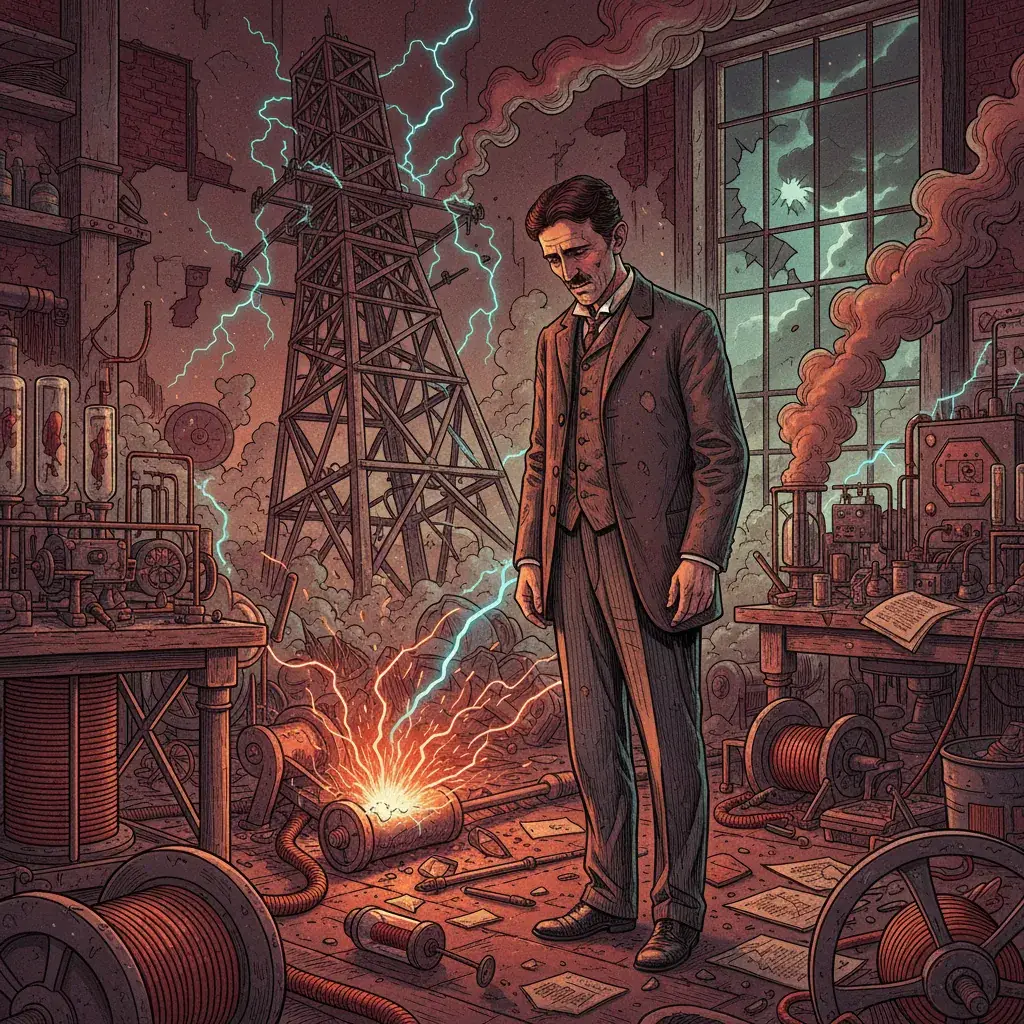
Tesla, according to multiple accounts, walked over to the desk, picked up the royalty contract, and tore it in half.
“Mr. Westinghouse, you have been my friend,” Tesla reportedly said. “You believed in me when no one else would. You were brave enough to go ahead… I will tear up this contract, and you will have your troubles no more.”
With that gesture, Tesla gave up royalties that would have been worth billions of dollars — potentially making him the richest man in the world. Some historians estimate the lifetime value of the royalties at $12-17 billion in today’s money.
Why did he do it? Multiple explanations have been offered:
- Loyalty: Tesla genuinely valued his friendship with Westinghouse and wanted to save the company
- Idealism: Tesla cared more about his inventions reaching the world than about personal wealth
- Naivete: Tesla simply didn’t understand the magnitude of what he was giving up
- Pride: Tesla believed he would make more money from future inventions
Whatever the reason, the decision haunted Tesla for the rest of his life. He had just given away a fortune that would have funded every experiment he ever dreamed of.
📡 Chapter 5: Wardenclyffe and the Dream of Wireless Power
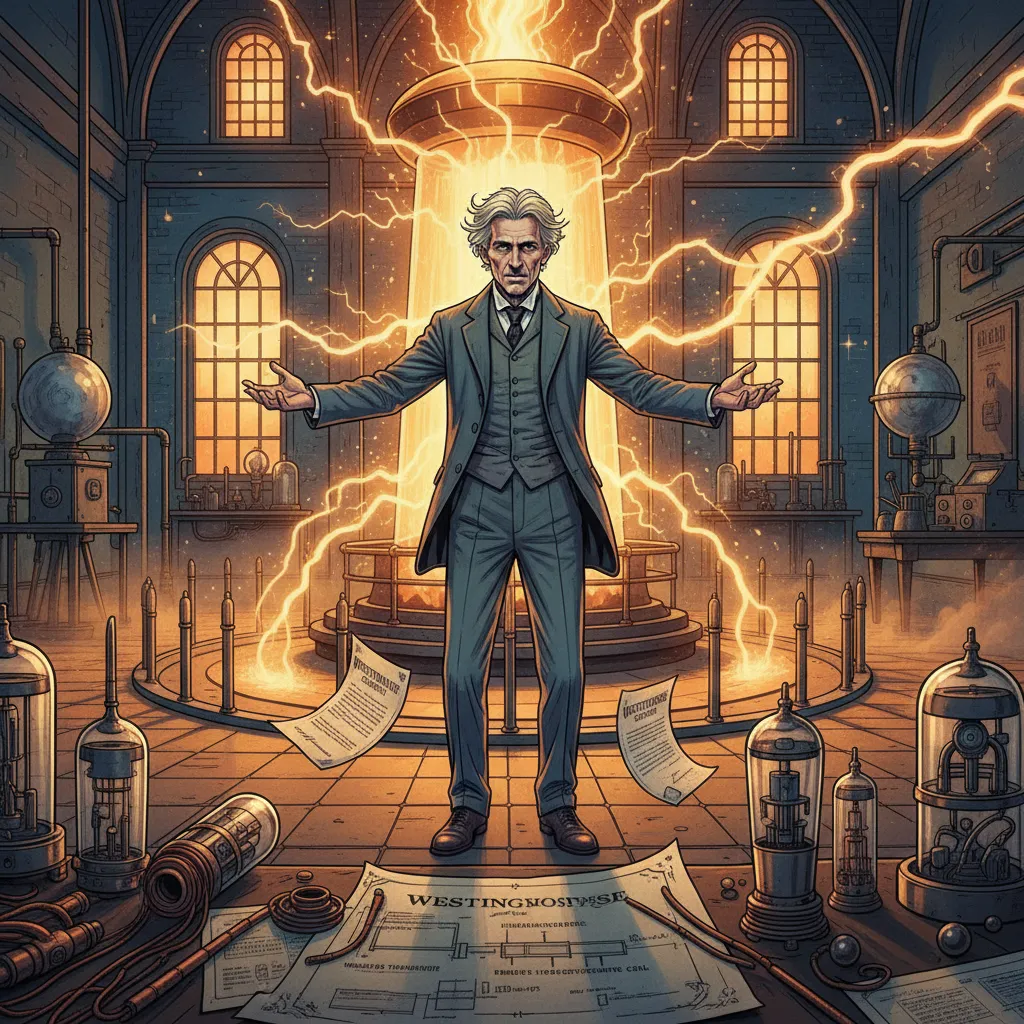
After tearing up the Westinghouse contract, Tesla threw himself into his next obsession: wireless transmission of energy and information.
In 1899, Tesla moved to Colorado Springs, where he conducted some of the most spectacular electrical experiments in history. He built a massive Tesla coil that produced artificial lightning bolts 135 feet long — visible from miles away. He claimed to have received signals from extraterrestrial sources (likely natural radio interference, though Tesla believed otherwise until his death).
The Colorado Springs experiments convinced Tesla that he could transmit electrical energy wirelessly across the globe. He envisioned a network of towers that would provide free, unlimited power to every person on Earth — no wires, no meters, no utility companies.
In 1901, Tesla convinced J.P. Morgan — the most powerful banker in America — to invest $150,000 in a wireless transmission facility on Long Island, New York. The facility, called Wardenclyffe Tower, would be Tesla’s masterpiece: a 187-foot tower topped with a 68-foot copper dome, designed to transmit both information and energy wirelessly.
Construction began, but problems mounted immediately. Costs spiraled far beyond the $150,000 budget. Tesla needed more money. He went back to Morgan.
Morgan asked a pointed question: If Tesla succeeded in transmitting energy wirelessly — for free — who would pay for it? Where was the business model?
“Where do I put the meter?” Morgan reportedly asked.
Tesla had no answer. His vision was utopian: free energy for all of humanity. Morgan’s vision was capitalist: investments require returns.
Morgan refused additional funding. Without money, construction on Wardenclyffe halted. The tower stood unfinished and unused. In 1917, it was demolished for scrap metal to pay Tesla’s debts.
The failure of Wardenclyffe broke something in Tesla. He had lost his fortune, his most ambitious project, and his patron. He was 61 years old and increasingly alone.
🕊️ Chapter 6: The Lonely Years
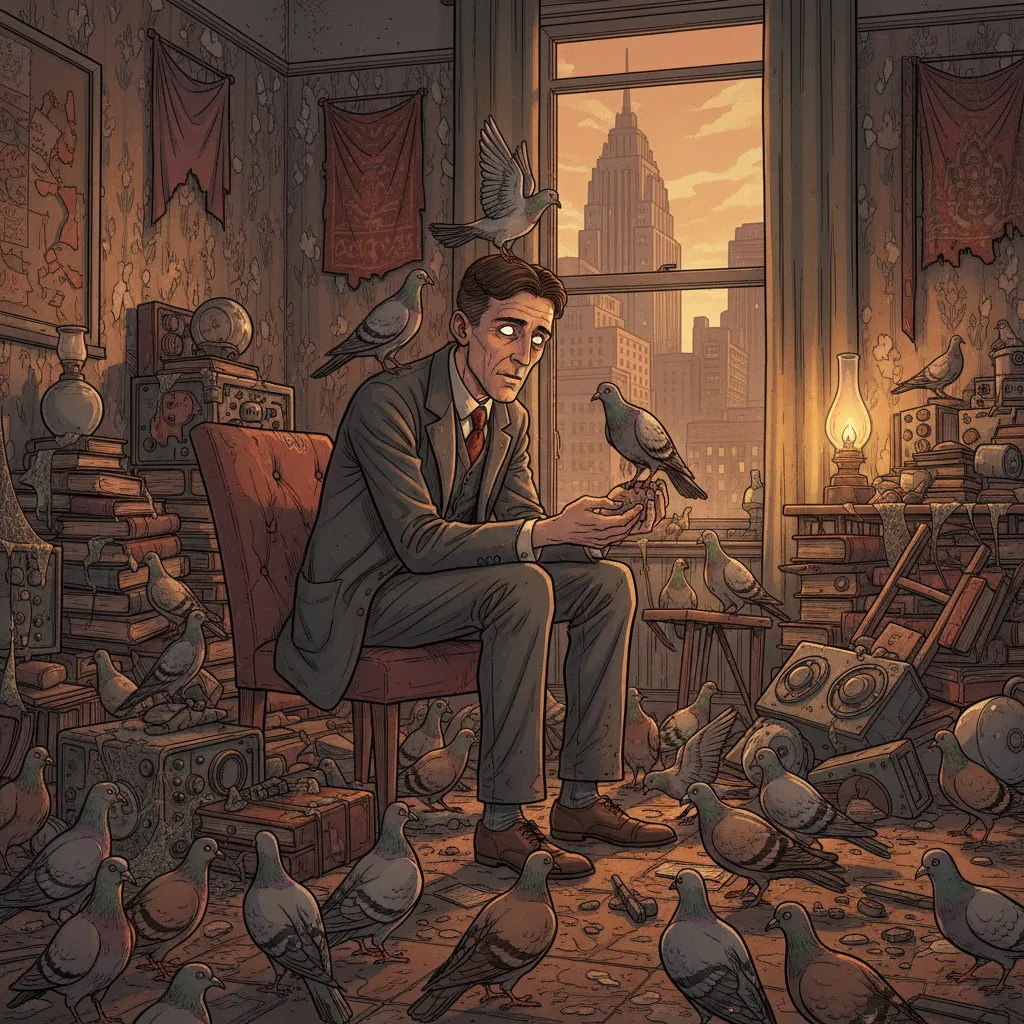
The last three decades of Tesla’s life were a long, slow descent into poverty, isolation, and eccentricity.
He continued to generate ideas — radar, vertical takeoff aircraft, particle beam weapons (the “death ray”), wireless energy — but he lacked the money to build any of them. He filed fewer patents. His income dwindled. He moved from one New York hotel to another, often leaving unpaid bills behind.
Tesla’s personal habits became increasingly unusual. He developed an intense relationship with the pigeons he fed in Bryant Park and the steps of the New York Public Library. He was particularly attached to a specific white pigeon, which he described in language that bordered on romantic:
“I loved that pigeon as a man loves a woman, and she loved me. As long as I had her, there was a purpose to my life.”
He became obsessed with the number three, walking around a building three times before entering. He refused to shake hands. He calculated the cubic volume of his food before eating it. He lived alone. He never married. He had no close friends in his final years.
The engineering community largely forgot about him. Thomas Edison, despite losing the War of Currents, had successfully branded himself as America’s greatest inventor. Guglielmo Marconi won the Nobel Prize for radio in 1909 — using technology that relied heavily on Tesla’s patents. (The U.S. Supreme Court would vindicate Tesla’s radio patents in 1943, months after his death, but by then it was too late to matter.)
Tesla’s financial situation became dire. By the 1930s, he was living at the New Yorker Hotel on a stipend arranged by the Westinghouse Corporation — a monthly payment of $125 that the company made out of a sense of obligation to the man whose inventions had made them billions.
On his 75th birthday in 1931, Tesla appeared on the cover of Time magazine, which described him as one of the greatest inventors alive. It was a bittersweet honor: recognition without reward.
In 1934, Tesla told The New York Times that he had developed a “death ray” — a particle beam weapon that could destroy 10,000 enemy aircraft at a distance of 250 miles. The claim generated headlines but no funding. The military was skeptical. The scientific community was dismissive.
Tesla spent his last years in Room 3327 of the New Yorker Hotel, feeding pigeons, writing letters to world leaders that were never answered, and dreaming of inventions he could no longer build.
💀 Chapter 7: Death in Room 3327
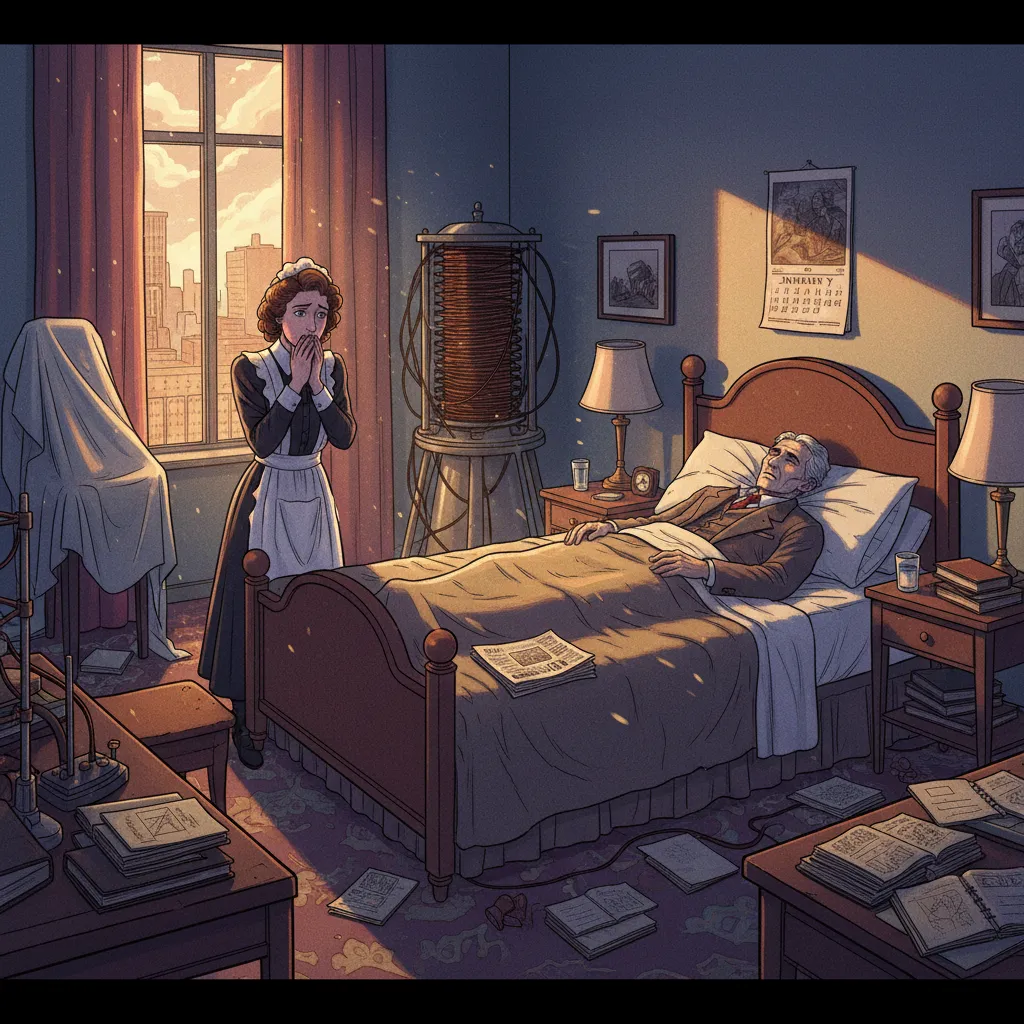
On January 7, 1943, Alice Monaghan, a maid at the New Yorker Hotel, entered Tesla’s room and found him lying in bed, dead. He was 86 years old. The cause of death was coronary thrombosis. He had been dead for approximately two days before anyone noticed.
His estate was valued at practically nothing. The most valuable things he owned were his notebooks and papers — which the FBI immediately seized, citing national security concerns related to Tesla’s particle beam weapon claims. The papers were examined by John G. Trump, an MIT electrical engineer and uncle of future president Donald Trump. Trump concluded that the papers contained no material of significant military value.
Tesla’s funeral was held at the Cathedral of St. John the Divine in Manhattan on January 12, 1943. Over 2,000 people attended. Three Nobel Prize winners sent tributes. Eleanor Roosevelt sent a message of condolence.
His ashes were placed in a gold sphere and eventually sent to Belgrade, Serbia, where they remain at the Nikola Tesla Museum.
🌍 Chapter 8: The Legacy That Grew After Death
For decades after his death, Nikola Tesla remained a footnote in the history of electricity — overshadowed by Edison’s mythology, Marconi’s Nobel Prize, and the corporate machines that had commercialized his work without crediting him.
Then something remarkable happened. Tesla was rediscovered.
Starting in the 1990s and accelerating through the 2000s and 2010s, Tesla’s reputation underwent a transformation unprecedented in the history of science. A combination of factors drove the resurgence:
The internet: Online communities discovered Tesla’s story and spread it virally. The Oatmeal, a popular webcomic, published a widely shared piece titled “Why Nikola Tesla Was the Greatest Geek Who Ever Lived” in 2012, reaching tens of millions of readers.
Elon Musk: The naming of Tesla Motors (now Tesla, Inc.) in 2003 brought the inventor’s name back into daily conversation. Every Tesla car on the road is a rolling advertisement for the name “Tesla.”
Historical reassessment: Scholars reexamined Tesla’s contributions and found that his work on AC power, radio, X-rays, remote control, fluorescent lighting, and wireless communication had been systematically under-credited.
The U.S. Supreme Court ruling: The 1943 ruling that Tesla’s radio patents preceded Marconi’s was rediscovered and popularized, challenging the long-held narrative that Marconi invented radio.
As of 2026, Nikola Tesla is arguably more famous than at any point during his lifetime. His name is synonymous with genius, innovation, and the tragedy of brilliance unrecognized.
But there is an irony in Tesla’s posthumous fame. He has become a symbol for internet culture, meme culture, and the tech industry — yet the essence of his story is a warning about what the tech industry does to people: it takes their ideas, commercializes them, and discards the creators.
Tesla powered the world. The world let him die alone in a hotel room.
The royalties he tore up would have been worth over $300 billion by one estimate — making him, had he lived and held onto them, potentially the richest person in the history of the planet.
Instead, he died with nothing but his pigeons and his dreams.
🔮 Epilogue: What Tesla Saw
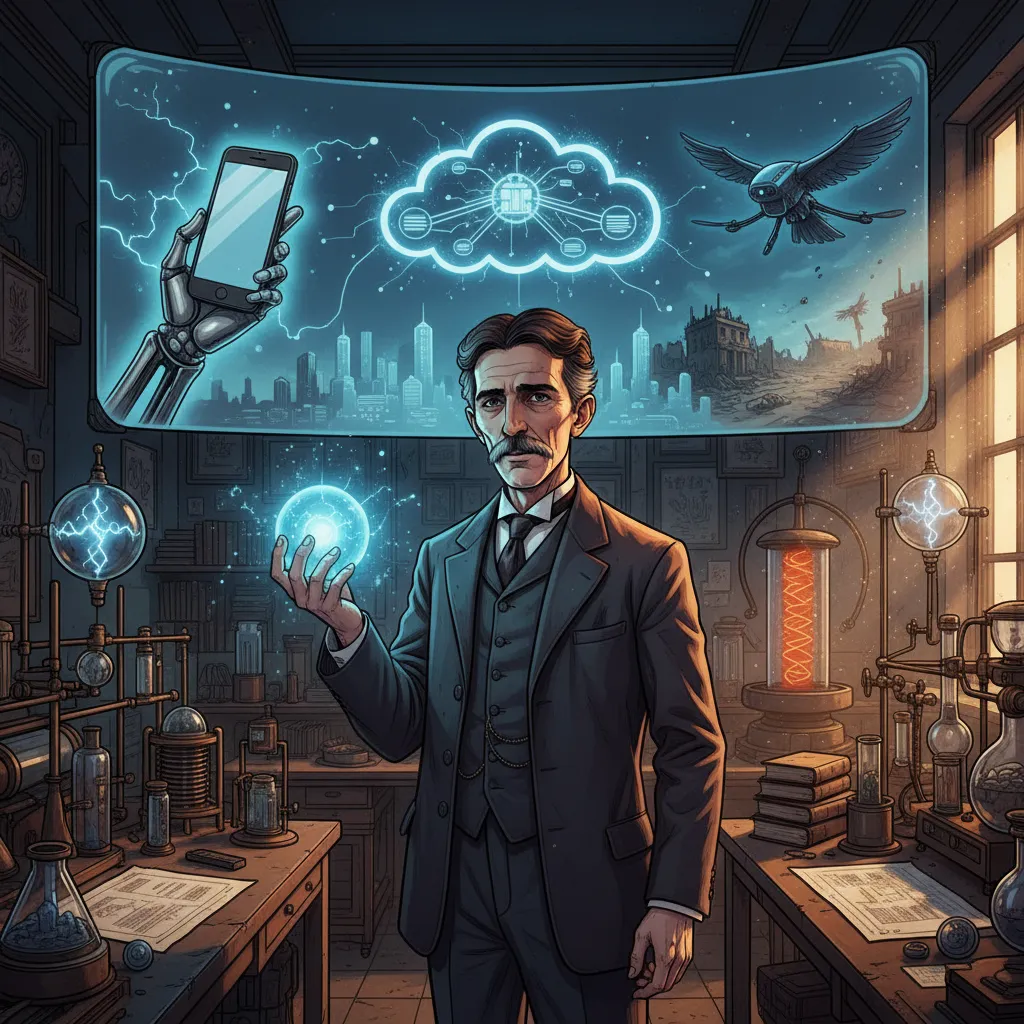
Perhaps the most haunting aspect of Tesla’s legacy is how much he predicted.
In 1926, Tesla told Collier’s magazine:
“When wireless is perfectly applied the whole earth will be converted into a huge brain… We shall be able to communicate with one another instantly, irrespective of distance. Not only this, but through television and telephony we shall see and hear one another as perfectly as though we were face to face… and the instruments through which we shall be able to do this will be amazingly simple compared with our present telephone. A man will be able to carry one in his vest pocket.”
He described the smartphone — 81 years before the iPhone.
He envisioned the internet. He predicted wireless power (now being developed). He imagined renewable energy harnessed from natural forces. He saw a world connected by invisible waves of information.
Nikola Tesla saw the future more clearly than almost anyone who has ever lived. He just couldn’t figure out how to charge for it.
Nikola Tesla is the patron saint of every inventor who was too brilliant for their own good, every genius who couldn’t play the business game, and every dreamer who gave away what they should have kept. He powered the modern world and died penniless. If there is justice in the universe, it operates on a very long delay.
😡 Chapter 9: The “$50,000 Problem” and the First Betrayal (1884-1885)
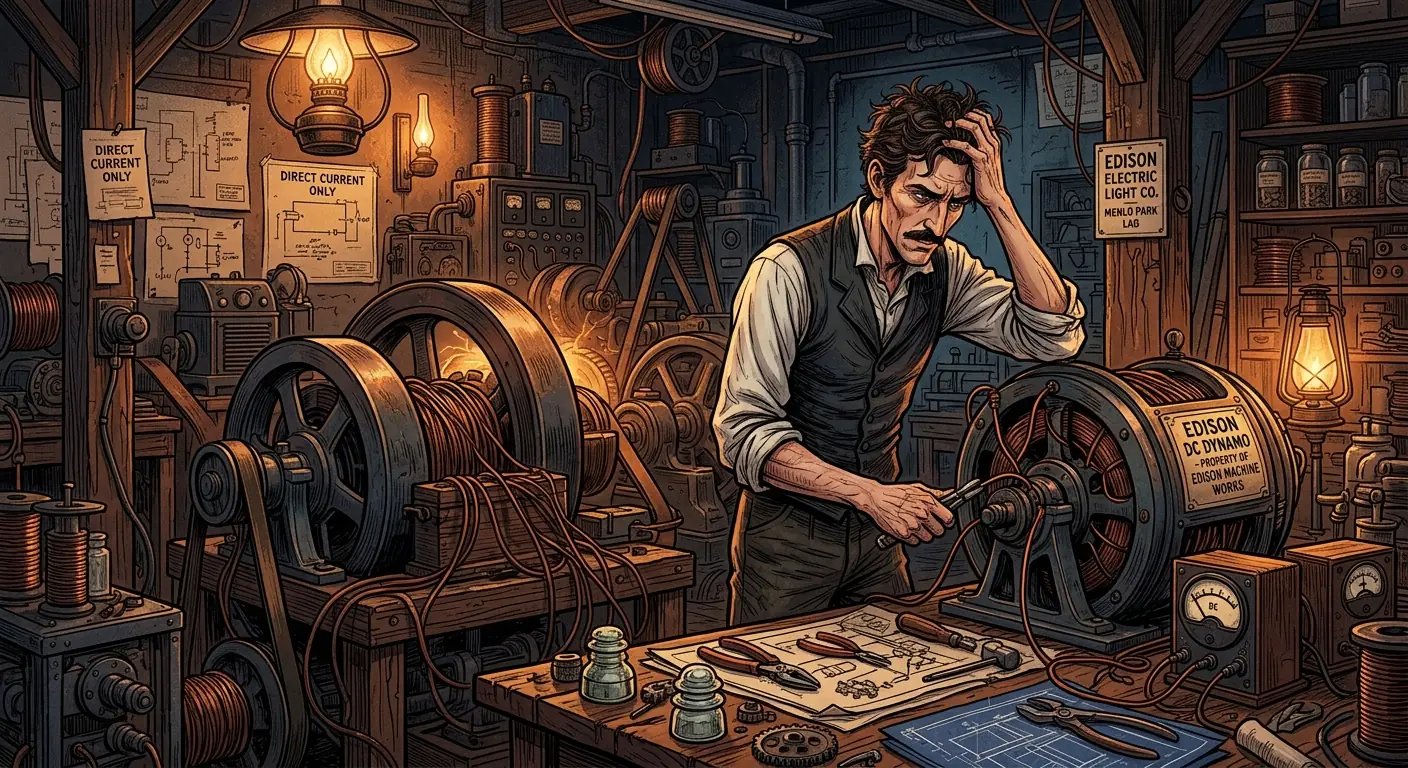
When Nikola Tesla stepped into Thomas Edison’s machine works in New York City in 1884, it was like a brilliant, meticulous surgeon being asked to perform in a butcher shop. Edison’s lab was a whirlwind of practical, often crude, experimentation. Tesla, with his elegant mental designs, was a stark contrast to Edison’s “try everything until something works” approach. Initially, Edison, impressed by the young Serbian’s intensity and intellect, put him to work improving his DC dynamos. It sounds mundane, but these were the beating hearts of Edison’s electrical empire.
The Edison Dynamo Challenge
Tesla, ever the perfectionist, dove in. Edison’s DC motors and generators were inefficient, spark-prone, and prone to overheating. Tesla, with his innate understanding of magnetic fields and electrical systems, could see the flaws instantly. He spent nearly a year, working incredibly long hours – often 18 hours a day, seven days a week – completely redesigning Edison’s inefficient DC generators. He introduced regulators, improved commutators, and made them more stable and powerful. By all accounts, his improvements were revolutionary for Edison’s existing system. He increased their efficiency and performance significantly, saving Edison a fortune in potential costs and improving his product line.
It was during this period that the infamous “$50,000 problem” allegedly occurred. Edison, known for his pragmatic and often ruthless business acumen, supposedly offered Tesla $50,000 (an astronomical sum at the time, equivalent to over $1.5 million today) if he could dramatically improve the DC motors and generators. Tesla, taking the challenge seriously, worked tirelessly and delivered. He presented his refined designs and working prototypes, fully expecting his promised reward.
The Betrayal and the Walkout
What happened next is a tale of corporate trickery that stung Tesla deeply and shaped his lifelong distrust of employers. When Tesla approached Edison for the promised payment, the “Wizard of Menlo Park” reportedly laughed him off.
“Tesla, you don’t understand our American humor,” Edison allegedly quipped.
Instead of the princely sum, Edison offered him a paltry $10 a week raise, bringing his salary to $28 per week. For Tesla, a man who valued his intellectual property and honest dealings above all else, this was a profound betrayal. It wasn’t just about the money; it was about the principle, the blatant disregard for his genius and effort. His meticulous mind, which saw the world in precise electrical and magnetic fields, found this kind of human deceit utterly repugnant. He saw it as a calculated insult, a dismissal of his monumental contribution.
A Ditch Digger’s Resolve
Furious and disillusioned, Tesla quit on the spot in 1885. He walked out of Edison’s company, leaving behind the very DC system he had improved, carrying with him only his resentment and his unshakeable belief in his own AC vision. This wasn’t just a career change; it was a character-defining moment. It cemented his perception that established industrialists would exploit inventors, and it fueled his desire for independent success. For a brief, humiliating period, he was so desperate for work that he resorted to digging ditches for $2 a day to survive. Imagine the man who saw the future of electricity, literally shoveling dirt. It was a harsh dose of reality, but it also hardened his resolve, transforming him from a brilliant employee into a determined, albeit often naive, entrepreneur. This setback, while devastating, ultimately pushed him towards the path where his alternating current dreams would truly ignite.
⛏️ Chapter 10: The Tesla Electric Light Company and the Shovel (1885-1887)
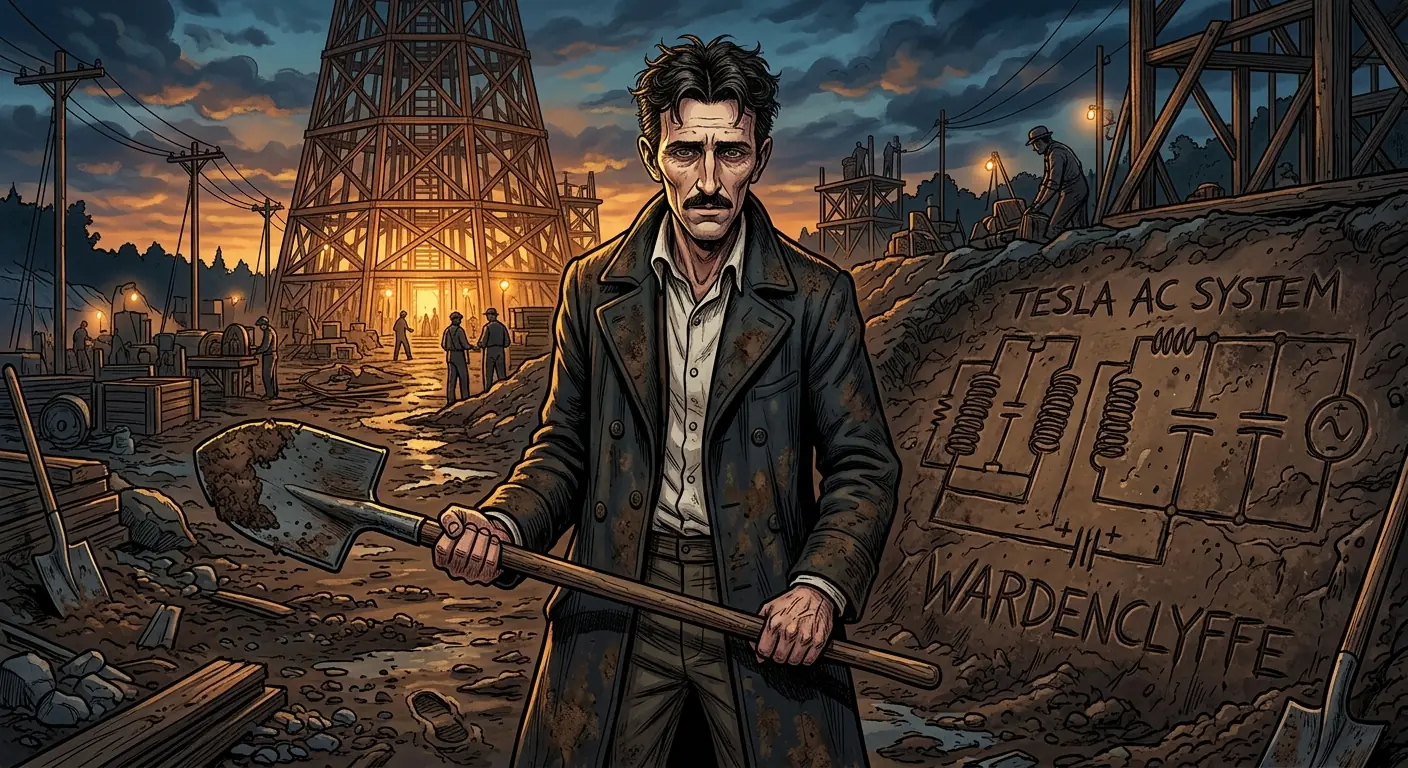
After his acrimonious departure from Edison’s employ in 1885, Nikola Tesla found himself in a precarious position. He had proven his brilliance, but his pockets were empty, and he had no powerful allies. He was a visionary without a venture capitalist, a genius without a gilded cage. This period marked one of the darkest, yet most defining, chapters of his life. It was a harsh crucible that forged his unyielding determination, even as it exposed his naiveté in the cutthroat world of business.
The Investors’ Promise
It wasn’t long before Tesla’s undeniable talent caught the eye of a few investors. Robert Lane and Benjamin Vail, recognizing the potential in Tesla’s arc lighting system (a DC technology, ironically, as his AC motor was still just a brilliant concept in his mind), offered him a chance to form his own company. In December 1886, the Tesla Electric Light and Manufacturing Company was born in Rahway, New Jersey. This was it! His own name on the door, a chance to prove himself without Edison’s shadow or his “American humor.” Tesla designed and patented improved arc lamps, which were crucial for street lighting at the time. He even managed to secure a contract to light the streets of Rahway, a small but significant victory.
He worked tirelessly, pouring his inventive energy into refining these systems, convinced that his investors understood his ultimate goal: the development of his alternating current motor. He believed this was merely a stepping stone, a way to generate capital and demonstrate his immediate value. He dedicated himself to the practical demands of the company, expecting that once the arc lighting system was established, he would be given the resources and freedom to pursue his grander vision of AC power. He was, as usual, more focused on the invention than the finer print of the business deal.
From Inventor to Laborer
However, the investors had other plans. They were interested in immediate returns from the established arc lighting market, not in a revolutionary but unproven AC system that Tesla endlessly championed. Once the Rahway contract was fulfilled and the company was generating revenue, Lane and Vail saw no further use for their brilliant, but expensive, inventor. They unceremoniously pushed Tesla out of his own company, stripping him of his patents in exchange for stock certificates that turned out to be worthless. They took control of his arc lighting patents and left him with nothing.
Once again, Tesla was betrayed. In late 1886 and early 1887, the man who would one day light the world found himself literally digging ditches in New York City for $2 a day. It was a crushing blow, a profound humiliation for a mind that operated on the highest planes of theoretical physics and engineering. Imagine the man who could visualize complex machinery in three dimensions, covered in mud, feeling the bite of hunger. This wasn’t just a setback; it was a testament to the brutal realities of invention without capital or savvy business partners. He later recounted this period with stark honesty:
“My high education in various branches of science, mechanics and literature seemed to me like a mockery.”
The Seeds of AC Power
Despite the crushing poverty and indignity, Tesla never lost sight of his ultimate goal. Even while toiling away, he continued to refine his AC motor designs in his head. The physical labor, far from breaking him, seemed to sharpen his focus. He met foreman Alfred S. Brown, who saw more than just a ditch digger. Brown, impressed by Tesla’s intellect and his persistent talk of an alternating current motor, introduced him to Charles F. Peck, a wealthy attorney. This connection would prove to be the lifeline Tesla desperately needed. In April 1887, Brown and Peck agreed to back Tesla, forming the Tesla Electric Company (a new one, thankfully) and providing the funding for a laboratory at 89 Liberty Street in Manhattan. This partnership would finally allow Tesla to build and demonstrate the alternating current system that would change the world, proving that even a genius forced to dig ditches could, given the right chance, rise and electrify the future.
🤖 Chapter 11: Remote Control, Radio Waves, and the Marconi Mess (1898-1901)
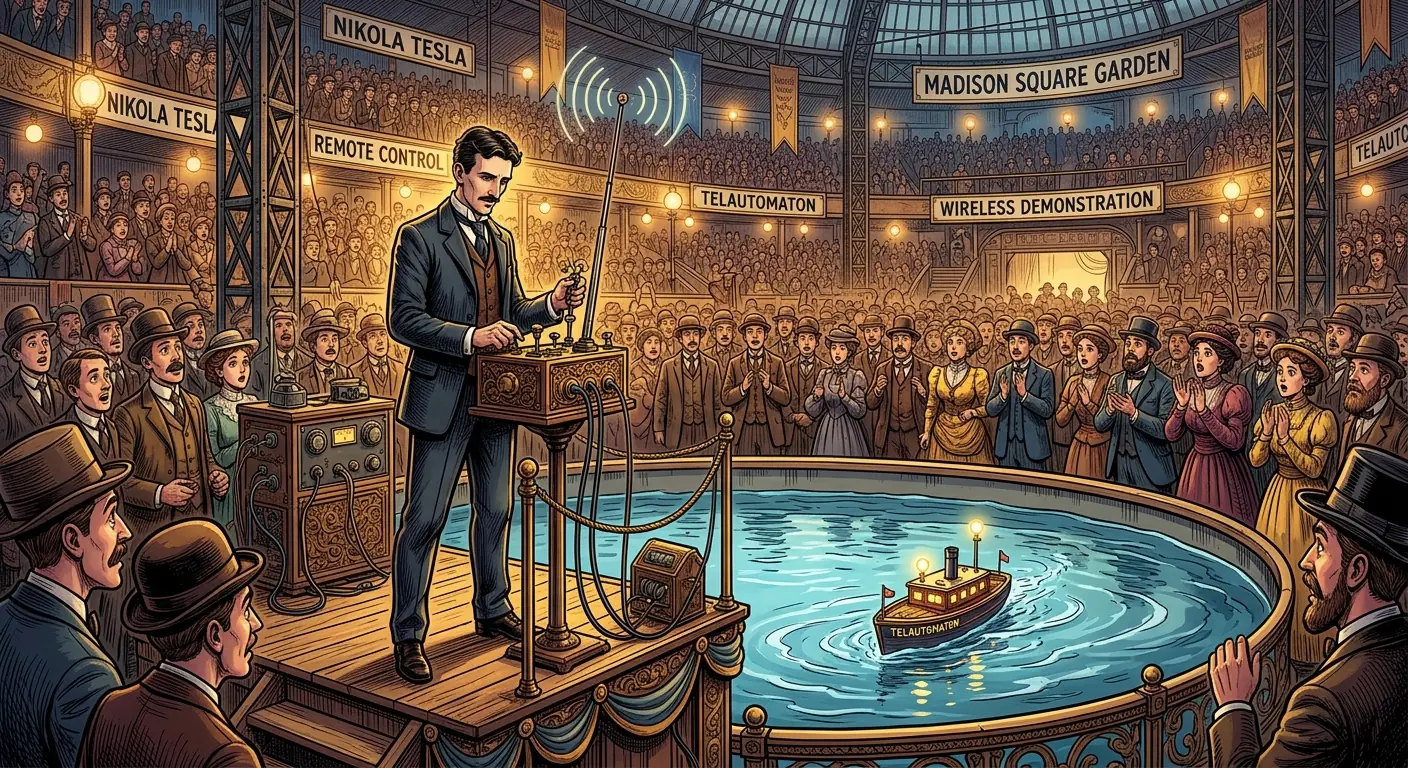
While the “War of Currents” raged and eventually settled with AC’s victory, Tesla wasn’t content to rest on his laurels. His mind, a restless storm of invention, was already leaping decades ahead. He envisioned a world not just powered by alternating current, but connected by invisible waves, a world where machines responded to thought, or at least, to distant signals. This period saw some of his most startling, and sometimes controversial, demonstrations, laying the groundwork for technologies we now take for granted, while also embroiling him in one of history’s great patent battles.
The First Robot
In 1898, at an electrical exhibition in Madison Square Garden, Tesla unveiled a marvel that left the public utterly dumbfounded: a remote-controlled boat. He called it a “teleautomaton.” Imagine the gasps as a small, unmanned vessel moved across a pool of water, seemingly of its own volition, responding to commands from Tesla’s console. He navigated it, turned its lights on and off, and even fired a small cannon. It was the world’s first demonstration of a remote-controlled device, powered by radio waves.
“When I showed the ‘teleautomaton’ to the public in the Madison Square Garden in 1898, it was looked upon as a miracle,” Tesla later recalled. “I thought it would be possible to operate a great number of such automata in a city, and thus perform any kind of work. The possibilities of the future are endless.”
He envisioned a future of robotic warfare, automated factories, and even remote-controlled vehicles. The U.S. Navy, intrigued by the potential for remote-controlled torpedoes, considered his invention but ultimately didn’t adopt it. The public, however, struggled to grasp the concept, some even believing there was a monkey hidden inside the boat. Tesla, ever the showman, was often frustrated by the public’s lack of imagination, but he had, once again, planted a seed for the future of robotics and automation.
The Race for Radio
Tesla’s work on radio technology predated almost everyone. As early as 1893, he was publicly demonstrating the principles of radio communication at a lecture in St. Louis, Missouri. He spoke of generating and transmitting “wireless energy” through the air to light lamps and power motors without wires. His work on high-frequency alternators and resonant circuits was fundamental to understanding and generating radio waves. He was granted U.S. patents 645,576 and 649,621 in 1900 for a “System of Transmission of Electrical Energy” and an “Apparatus for Transmission of Electrical Energy,” which clearly described basic radio transmission and reception.
Meanwhile, Guglielmo Marconi, an Italian inventor, was also developing wireless telegraphy. Marconi’s approach was more practical and focused on commercial applications, and he managed to achieve the first transatlantic radio transmission in 1901. This feat garnered him immense fame and, critically, significant financial backing. The world hailed Marconi as the inventor of radio, while Tesla’s earlier, more fundamental work was largely overlooked, especially in the scramble for commercial dominance. This was a classic Tesla problem: brilliant pioneer, poor businessman, terrible publicist.
A Posthumous Victory
The ensuing patent battle between Tesla and Marconi was long and complex. Initially, the U.S. Patent Office sided with Marconi, granting him key patents in 1904 for his wireless telegraphy apparatus. This decision deeply wounded Tesla, who saw it as a blatant theft of his intellectual property. He vehemently argued that Marconi’s system relied heavily on his earlier patented work, particularly his tuned circuits. The legal battles continued for decades, a financial drain on both sides.
However, justice, or at least legal recognition, eventually prevailed for Tesla, albeit posthumously. In June 1943, just a few months after Tesla’s death, the U.S. Supreme Court overturned four of Marconi’s key patents (Marconi Wireless Telegraph Co. of America v. United States). The Supreme Court ruled that Marconi’s patent for radio transmission was invalid because it had been anticipated by prior art, specifically citing Tesla’s earlier patents. The court clarified that Marconi’s patents were derivative of Tesla’s prior inventions. While this ruling primarily served to protect the U.S. government from paying royalties during World War II, it was a profound, if belated, vindication for Tesla, solidifying his rightful place as one of the true fathers of radio technology. It’s a bittersweet testament to his genius that the world often needed a legal decree to acknowledge what he had known all along.
🕊️ Chapter 12: The Visionary’s Retreat and the Pigeons (1900s-1943)
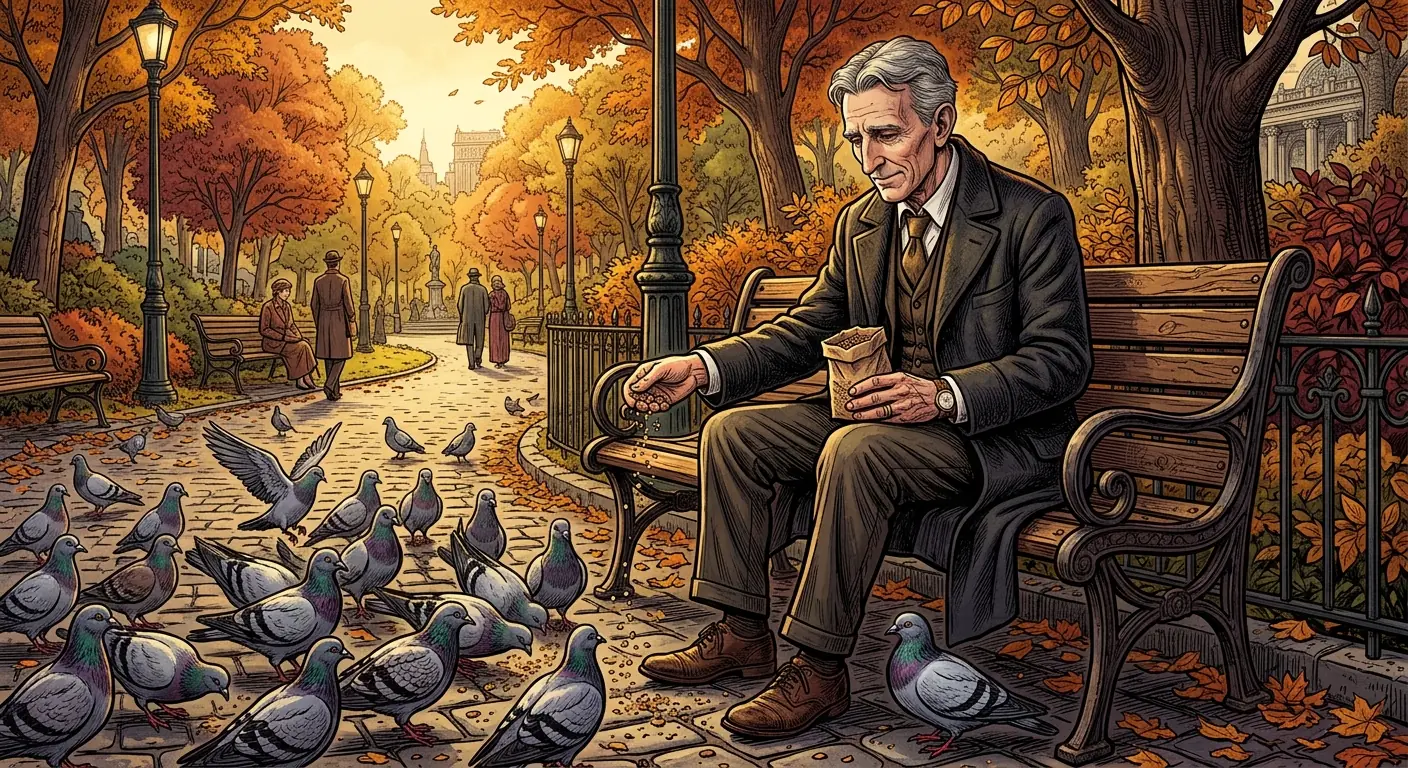
As the 20th century dawned, Tesla’s public profile began to shift. The brilliant, dashing inventor who had captivated audiences with his AC demonstrations gave way to a more reclusive, eccentric figure. While his mind continued to churn out groundbreaking ideas, his practical engagement with the world of commerce and industry waned. This period, stretching from the early 1900s to his death, is marked by a deepening of his personal quirks, increasing financial struggles, and a poignant retreat into his own extraordinary internal world.
The “Earthquake Machine” and Other Wonders
Tesla’s prolific imagination didn’t stop at AC or radio. He continued to pursue grand, often fantastical, projects. In the early 1900s, he claimed to have invented a small, vibrating device that, when attached to a building, could generate resonant frequencies. During a demonstration in his Manhattan laboratory, he allegedly caused vibrations that nearly brought down the building and reportedly confessed to the police that he could “split the Earth in two” with a larger version – earning it the nickname “Tesla’s earthquake machine.” While likely an exaggeration, it showcased his fascination with resonance and power.
He also conceptualized what he called a “death ray” or “teleforce weapon” in the 1930s, a particle beam weapon he believed could end all wars by creating an impenetrable defense. He tried to sell the idea to various governments, including the U.S., but it was never taken seriously enough for development. These later inventions, often presented without concrete proof or practical prototypes, contributed to his growing reputation as a “mad scientist” and pushed him further to the fringes of mainstream science, which increasingly focused on quantum mechanics and relativity, fields Tesla openly dismissed. His unwavering belief in his own vision, even when it seemed outlandish to others, was both his strength and, in some ways, his undoing.
The Public Spectacle and Private Decline
Tesla was a creature of habit and increasingly rigid routines. He was known for his elegant dress, his fastidious cleanliness, and his aversion to human contact. He held annual birthday press conferences in his later years, often making sensational claims about new inventions or predicting future technologies, many of which never materialized. These events, while providing fodder for newspapers, also highlighted his detachment from reality. He would often speak in riddles, hint at world-changing discoveries, and rail against the scientific establishment that he felt had wronged him.
Financially, he was a disaster. Having famously torn up his royalty contract with Westinghouse (Chapter 4), and lacking the business acumen to capitalize on his later inventions, he relied on sporadic funding from benefactors, or simply ran up debts. He moved from hotel to hotel, often leaving behind unpaid bills. The Hotel St. Regis, The Waldorf-Astoria, and finally, The New Yorker Hotel became his temporary residences, each stay eventually ending in eviction due to mounting arrears. This dramatic decline from the man who envisioned global power to a penniless recluse is one of the most tragic ironies of his story.
His Feathered Friends and Final Days
Perhaps the most poignant aspect of Tesla’s later life was his deep, almost obsessive, connection with pigeons. He frequented the parks of New York City, particularly Bryant Park, to feed them, spending countless hours observing them and nursing injured birds back to health. He would even bring sick or injured pigeons back to his hotel room, caring for them meticulously. He claimed to have a profound connection with one particular white pigeon, stating:
“I have been feeding pigeons, thousands of them for years. But there was one, a beautiful bird, pure white with light gray tips on its wings; that one was different. It was a female. I had only to wish and call her and she would come flying to me. I loved that pigeon as a man loves a woman, and she loved me. As long as I had her, there was a purpose to my life.”
This intense bond, while peculiar to outsiders, provided a profound source of comfort and companionship for the increasingly isolated inventor. It was in room 3327 of the New Yorker Hotel, surrounded by his thoughts and perhaps the lingering presence of his feathered friends, that Nikola Tesla died alone on January 7, 1943. The man who had once dreamed of lighting the world and connecting humanity through invisible waves, ended his days in quiet solitude, his genius often misunderstood, his contributions undervalued, but his spirit unbroken by the world’s indifference.
💡 Key Insights
- ▸ Genius without business acumen leads to poverty — Tesla's story is the cautionary tale every inventor should study.
- ▸ Tearing up the Westinghouse royalty contract was either the most selfless or the most self-destructive act in business history.
- ▸ The 'War of Currents' proved that the best technology doesn't always win on merit — it takes marketing, politics, and capital.
- ▸ Visionaries who are too far ahead of their time often die unrecognized — Tesla imagined wireless communication, smartphones, and renewable energy decades before they existed.
- ▸ Legacy isn't built in a lifetime — Tesla's reputation has grown more in death than it ever was in life.