The Ambani Family: Inside India's Richest Dynasty and the Reliance Empire
From a two-room apartment in Mumbai to a $100 billion fortune — how the Ambanis built, split, and rebuilt the most powerful business dynasty in Asia.
View all stories about this mogul
The Ambani Family: Inside India’s Richest Dynasty and the Reliance Empire
No family dominates an economy of 1.4 billion people the way the Ambanis dominate India. From Dhirubhai Ambani’s audacious rise from a gas station attendant in Yemen to the construction of Antilia — a 27-story, $2 billion personal residence towering over Mumbai — the Ambani story is one of relentless ambition, bitter family feuds, revolutionary business strategies, and wealth on a scale that defies comprehension. This is the saga of India’s first family of business — and the empire that shapes the daily lives of hundreds of millions.
🛢️ Chapter 1: Dhirubhai — The Man Who Built Reliance from Nothing

Dhirubhai Hirachand Ambani was born on December 28, 1932, in Chorwad, a small village in Gujarat, western India. His father was a schoolteacher who earned a modest salary. There was no family wealth, no business connections, no inherited advantage.
At 16, Dhirubhai left India for Aden, Yemen, where he worked as a gas station attendant and later as a clerk for A. Besse & Co., a French trading company. He earned a salary of approximately 300 rupees per month. It was in Aden, surrounded by the bustle of international trade, that Dhirubhai developed his instinct for business.
Legend has it that during the Suez Crisis of 1956, Dhirubhai noticed that Yemeni coins contained a high proportion of silver. He began melting down the coins and selling the silver on the London Metal Exchange at a profit. Whether apocryphal or true, the story captured something essential about Dhirubhai: he saw opportunity where others saw ordinary life.
In 1958, Dhirubhai returned to India with the equivalent of $500 and a vision. He settled in Mumbai (then Bombay) with his wife Kokilaben and started a small trading company dealing in spices and textiles. The business operated out of a two-room apartment in a middle-class Mumbai neighborhood. His wife cooked meals for the workers. There was no office, no secretary, no infrastructure.
In 1966, Dhirubhai founded Reliance Commercial Corporation, initially a textile trading firm. By 1966, he had established a textile mill in Naroda, near Ahmedabad, Gujarat. The mill produced polyester fabric under the brand name “Vimal,” which would become one of India’s most recognized consumer brands.
What set Dhirubhai apart from other textile traders was his understanding of India’s bureaucratic system — the infamous “License Raj,” under which virtually every business activity required government permission. While other entrepreneurs cursed the system, Dhirubhai mastered it. He cultivated relationships with politicians and bureaucrats at every level. He understood that in India, business success required not just commercial skills but political navigation.
By the late 1970s, Reliance had grown from a textile trader to an integrated textile manufacturer. Dhirubhai began looking upstream — into petrochemicals, the raw materials that fed the textile industry. This vertical integration strategy, mirroring Carnegie’s approach to steel a century earlier, would become the foundation of the Reliance empire.
📈 Chapter 2: The IPO That Changed India

In 1977, Dhirubhai Ambani did something revolutionary: he took Reliance public.
The IPO was audacious for its time. Dhirubhai didn’t market the offering primarily to institutional investors or wealthy elites. He marketed it to ordinary Indians — middle-class families, shopkeepers, small savers — who had never owned a stock in their lives.
He held investor meetings in stadiums. Literally stadiums. In 1985, Reliance held its annual general meeting at the Cross Maidan in Mumbai, attracting an estimated 35,000 shareholders. It was the largest shareholder meeting in the world.
Dhirubhai’s pitch was simple and powerful: “Invest in Reliance and grow with India.” He promised that he would make every shareholder wealthy, and for decades, he delivered. Reliance shares became the single most widely held stock in India.
This wasn’t just business — it was social engineering. Dhirubhai created a shareholder base of millions of ordinary Indians who became personally invested in Reliance’s success. These shareholders became advocates, customers, and a political constituency. Any government action against Reliance would anger millions of voters.
Throughout the 1980s and 1990s, Reliance expanded aggressively into petrochemicals, petroleum refining, and oil and gas exploration. Dhirubhai leveraged India’s protectionist policies to build capacity behind tariff walls, then achieved economies of scale that made Reliance competitive even as India began liberalizing its economy in 1991.
The crown jewel was the Jamnagar refinery in Gujarat, which Dhirubhai began building in the 1990s. When completed, it became the largest petroleum refinery in the world, processing 1.24 million barrels per day. The refinery was a testament to Dhirubhai’s philosophy: go big or go home.
By the time of his death on July 6, 2002, from a massive stroke at age 69, Dhirubhai had transformed Reliance from a two-room textile operation into India’s largest private-sector company, with revenues exceeding $15 billion. He left behind a fortune estimated at $6 billion and two sons — Mukesh and Anil — who would fight bitterly over the empire.
⚔️ Chapter 3: Brother vs. Brother — The Great Ambani Split

Dhirubhai Ambani died without leaving a will. It was either a catastrophic oversight or a deliberate choice to let his sons work it out. Either way, it led to one of the most dramatic family business feuds in corporate history.
Mukesh Ambani, born in 1957, was the elder son — a chemical engineer from the University of Mumbai who had dropped out of Stanford’s MBA program to join the family business. He was reserved, strategic, and deeply involved in Reliance’s manufacturing operations.
Anil Ambani, born in 1959, was the younger son — a Wharton MBA graduate who was more flamboyant, media-savvy, and charismatic. He managed Reliance’s newer ventures in telecom, financial services, and entertainment.
After Dhirubhai’s death, the brothers initially shared leadership. But tensions quickly escalated. The brothers had different management styles, different visions for Reliance, and — according to numerous reports — different relationships with their mother, Kokilaben, who became the family matriarch.
By 2004, the feud had become public. Reports of shouting matches in boardrooms, competing press leaks, and mutual sabotage filled Indian newspapers. The brothers were barely speaking. Reliance employees were forced to choose sides. India’s business community watched in horror.
In January 2006, Kokilaben brokered a settlement. Reliance would be split:
- Mukesh received the core businesses: petroleum refining (including the Jamnagar refinery), petrochemicals, oil and gas exploration, and the retail business. This became Reliance Industries Limited (RIL).
- Anil received the newer businesses: telecom (Reliance Communications), financial services (Reliance Capital), power generation (Reliance Energy), and entertainment (Reliance Entertainment). These became the Reliance Anil Dhirubhai Ambani Group (ADAG).
The split included a non-compete agreement preventing either brother from entering the other’s industries for ten years.
At the time, many observers thought Anil had gotten the better deal. Telecom and financial services seemed like the future. Oil refining seemed like the past.
They were spectacularly wrong.
📱 Chapter 4: Jio — The Revolution That Changed India

The non-compete agreement between the brothers expired in 2010. Mukesh Ambani immediately did what everyone had expected and feared: he entered the telecom business.
But Mukesh didn’t just enter telecom. He nuked the entire industry.
Reliance Jio Infocomm Limited — known simply as Jio — launched commercially on September 5, 2016. Its strategy was simple and devastating: offer free voice calls and data at prices so low that every competitor would bleed.
Jio’s launch offer was staggering: free unlimited voice calls and 4G data for six months. Completely free. For a country where most people had never experienced mobile internet, it was irresistible. Tens of millions signed up in the first weeks.
The capital investment behind this giveaway was enormous. Mukesh had spent approximately $35 billion building Jio’s network infrastructure — a nationwide 4G LTE network with over 100,000 cell towers. It was the largest private-sector investment in Indian history.
The economics were counterintuitive: lose money on every customer for years, but acquire so many customers so quickly that you become the dominant platform for India’s digital future.
The strategy worked with devastating efficiency:
- By December 2016 (three months after launch): 72 million subscribers
- By March 2017 (six months): 109 million subscribers
- By March 2018: 187 million subscribers
- By 2020: 400 million subscribers
- By 2025: over 480 million subscribers
Jio didn’t just gain subscribers. It destroyed competitors. Bharti Airtel saw its profits collapse. Vodafone Idea (the merged entity of Vodafone India and Idea Cellular) was pushed to the brink of bankruptcy. Reliance Communications — Anil Ambani’s telecom company — was obliterated. Several smaller operators shut down entirely.
The Indian telecom market went from a dozen major players to essentially three: Jio, Airtel, and the struggling Vodafone Idea.
The impact on Indian society was profound. Before Jio, mobile data in India cost approximately $3 per gigabyte — expensive for a country where the average monthly income was around $150. After Jio, the effective cost of data fell to roughly $0.09 per gigabyte, making India the cheapest data market in the world.
This data revolution brought hundreds of millions of Indians online for the first time. Farmers accessed commodity prices on their phones. Students in rural villages watched educational videos. Small businesses created digital storefronts. India’s digital economy exploded, and Jio was the catalyst.
💰 Chapter 5: The $100 Billion Man

By 2020, Mukesh Ambani had transformed Reliance Industries from an oil-and-gas company into a digital conglomerate — and the world’s investors came calling.
Between April and July 2020, in the middle of the COVID-19 pandemic, Reliance raised approximately $27 billion by selling minority stakes in Jio Platforms (the digital holding company) and Reliance Retail to a constellation of global investors:
- Facebook (Meta) invested $5.7 billion for 9.99% of Jio Platforms
- Google invested $4.5 billion for 7.7%
- Intel, Qualcomm, and Silver Lake each invested over $1 billion
- KKR, General Atlantic, and TPG all took stakes
- Saudi Arabia’s PIF and Abu Dhabi’s ADIA invested billions
The fundraising was extraordinary — both in speed and scale. In four months, Mukesh had attracted the world’s most sophisticated investors and eliminated Reliance’s net debt, which had been a major concern for the stock market.
Mukesh Ambani’s personal net worth surged. By 2021, he had surpassed $100 billion, making him the richest person in Asia and among the ten richest people in the world. His wealth fluctuated between $85-115 billion depending on Reliance’s stock price, but the trajectory was unmistakable: Mukesh had built one of the largest personal fortunes in history.
His lifestyle reflected it. Antilia, the Ambani family residence in Mumbai, is a 27-story skyscraper that cost an estimated $1-2 billion to build. It features three helipads, a 168-car garage, a 50-seat theater, hanging gardens, a health spa, and a staff of approximately 600 people. The building towers over one of Mumbai’s poorest neighborhoods — a visual metaphor for India’s extreme inequality that has drawn both criticism and fascination.
🔻 Chapter 6: The Fall of Anil

While Mukesh soared, Anil Ambani experienced one of the most dramatic declines in Indian business history.
At the time of the 2006 split, Anil’s net worth was estimated at approximately $42 billion, making him the sixth-richest person in the world. He was young, charismatic, and ran a portfolio of businesses in telecom, finance, power, and entertainment.
A decade later, he was essentially bankrupt.
The decline was multi-causal:
Telecom disaster: Reliance Communications, Anil’s telecom company, was crushed by Jio’s launch. Unable to compete with his brother’s free data, Anil tried to merge with Aircel, but the deal fell apart. Reliance Communications defaulted on its debt and entered insolvency proceedings in 2019. The company that had once been worth over $30 billion was sold for scraps.
Financial sector troubles: Reliance Capital and Reliance Infrastructure were burdened with debt and deteriorating business performance. Reliance Capital defaulted on its obligations in 2019 and was placed under insolvency by the Reserve Bank of India.
Power sector setbacks: Reliance Power, which had launched India’s largest-ever IPO in 2008 (raising $3 billion), saw its stock price collapse from an IPO price of 450 rupees to below 10 rupees.
The 2G scandal: Anil’s companies were tangentially linked to India’s 2G spectrum allocation scandal, which involved allegations of corruption in the allocation of telecom licenses. While Anil was never personally charged, the controversy damaged his reputation.
In February 2020, Anil Ambani told a London court that his net worth was effectively zero. He owed over $700 million to creditors, including Chinese banks. The man who had been worth $42 billion had nothing left.
The contrast between the brothers became the defining business story of modern India. Mukesh, with the “boring” oil-and-gas business, had become one of the richest people on Earth. Anil, with the “exciting” telecom-and-finance portfolio, had gone broke. The lesson was brutal: boring cash flows beat exciting growth stories when the tide goes out.
👨👩👧👦 Chapter 7: The Next Generation
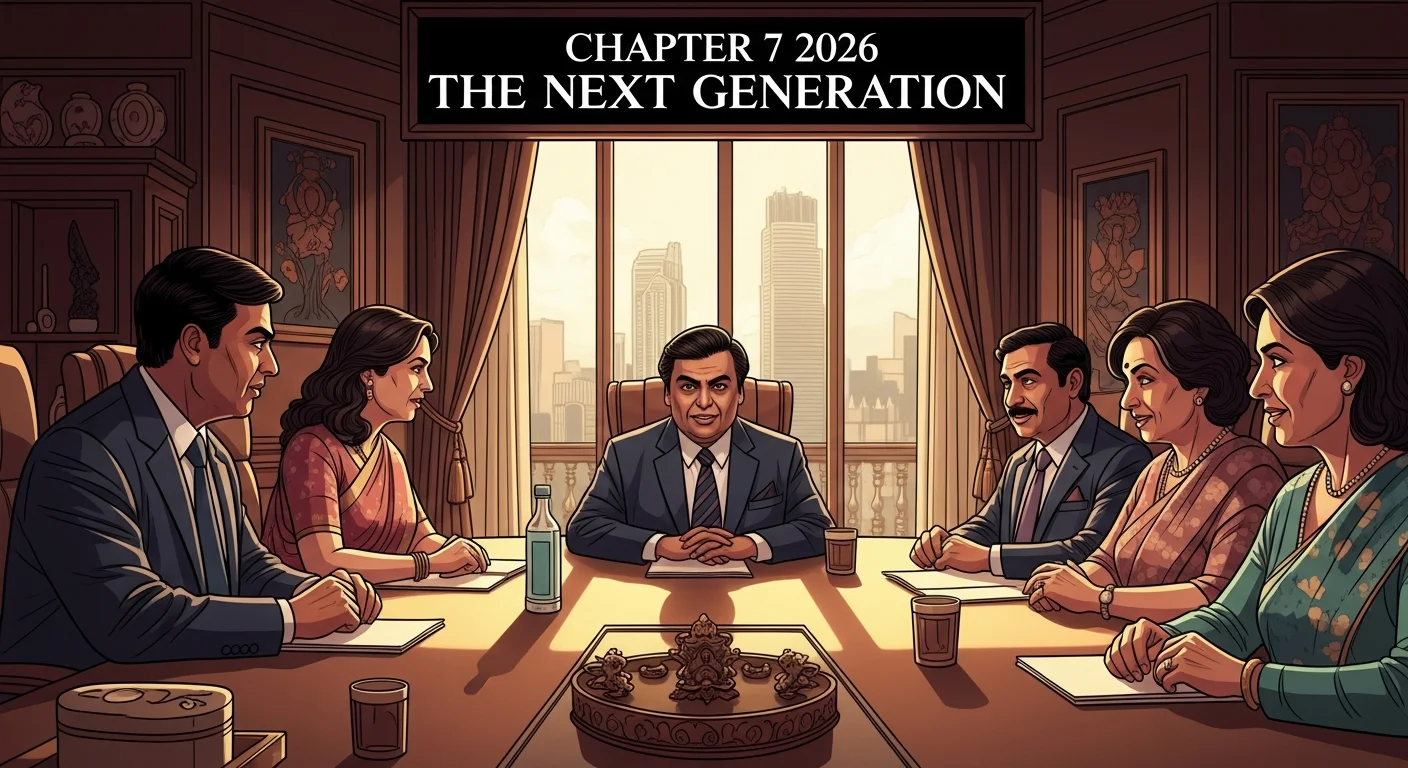
As of 2026, Mukesh Ambani is 68 years old, and the question of succession looms large over Reliance Industries.
Mukesh and his wife Nita Ambani have three children:
-
Akash Ambani (born 1991): Chairman of Reliance Jio, the telecom arm. Akash has been the most visible of the next generation, leading Jio’s continued expansion and its push into 5G services.
-
Isha Ambani Piramal (born 1991, Akash’s twin): Formerly involved in Reliance Retail, Isha married Anand Piramal of the Piramal business family in a wedding that reportedly cost over $100 million.
-
Anant Ambani (born 1995): Appointed to Reliance’s board in 2024, Anant has been given responsibility for the company’s new energy ventures, including solar manufacturing and green hydrogen.
Mukesh has been methodical in preparing the next generation. Each child has been given a major division of Reliance to manage, with clear reporting lines and mentoring from experienced executives. The structure echoes the successful succession strategies of other family empires like the Waltons (Walmart) and the Mars family.
But the specter of the Mukesh-Anil split haunts every discussion of Ambani succession. Will the next generation cooperate or compete? Can three siblings share an empire without the rivalries that nearly destroyed it the last time?
Mukesh appears to have learned from his father’s mistake. He is actively structuring Reliance to survive beyond his own leadership, with clear governance mechanisms and professional management alongside family members.
🌏 Chapter 8: The Empire in 2026
Reliance Industries Limited is, by almost any measure, India’s most important private company. As of March 2026:
- Market capitalization: Approximately $250 billion, the largest in India
- Revenue: Over $100 billion annually
- Employees: Over 350,000
- Jio subscribers: 480+ million
- Retail stores: 18,000+ (Reliance Retail is India’s largest retailer)
- Refining capacity: The world’s largest single-location refinery complex
The company touches Indian life at almost every level. If you’re an Indian consumer in 2026, you likely use Jio for your phone service, shop at a Reliance Retail store, watch content on JioCinema, pay for things with JioMoney, and buy products that were refined or manufactured in Reliance facilities.
Critics argue that this level of corporate concentration is dangerous — that one family controlling telecom, retail, energy, and media gives them too much power over India’s economy and democracy. Reliance’s close relationship with the Indian government, particularly under Prime Minister Narendra Modi, has drawn scrutiny from journalists and opposition politicians.
Supporters counter that Reliance has created millions of jobs, brought connectivity to hundreds of millions of people, and helped modernize India’s economy at a pace the government alone could never have achieved.
Both perspectives contain truth. The Ambani story is, in many ways, the story of modern India itself: explosive growth, staggering inequality, family drama, political entanglement, and a constant tension between the old world and the new.
From Dhirubhai’s two-room apartment to Mukesh’s 27-story tower, the Ambanis have traveled farther, faster, and more dramatically than perhaps any business dynasty in history. Where the next generation takes the empire remains the most consequential business question in the world’s most populous nation.
The Ambanis didn’t just build a company. They built a parallel infrastructure for India’s economy. Dhirubhai dreamed it, Mukesh realized it, and the next generation must sustain it. In a country of 1.4 billion people, no family casts a longer shadow.
🧪 Chapter 9: Petrochemicals & Backward Integration — The Unseen Foundation (1980s-1990s)

You know, everyone talks about Dhirubhai Ambani starting with textiles and then the big splash of Jio. But sandwiched right in the middle, arguably the real bedrock of the modern Reliance empire, was a strategic pivot so audacious it made other industrialists scratch their heads. We’re talking petrochemicals and a relentless drive for backward integration. It wasn’t sexy like a stock market frenzy, but it was the gritty, industrial muscle that turned Reliance from a textile player into an industrial behemoth.
The Bold Leap into Polymers
After mastering textiles with Vimal, Dhirubhai didn’t just want to weave fabric; he wanted to make the yarn that made the fabric. And then the polyester that made the yarn. And then the chemicals that made the polyester. It was like he looked at the entire supply chain, whispered “Mine,” and then went about acquiring or building every single link. This wasn’t just about efficiency; it was about insulating Reliance from volatile raw material prices and India’s notorious import restrictions. In the early 1980s, while others were still navigating the “License Raj” by importing, Dhirubhai began plotting to make the raw materials himself. He saw India’s insatiable demand for everything, from clothes to packaging, and realized the future wasn’t just in finished goods, but in the building blocks of modern life.
Jamnagar: A City Built on Ambition
This vision culminated in the construction of the Jamnagar Refinery Complex in Gujarat, a project so mind-bogglingly huge it deserves its own epic poem. When it began operations in 1999, it was the largest grassroots refinery in the world. Imagine: a barren desert patch transformed into a sprawling industrial city covering 7,500 acres (that’s over 3,000 hectares, folks!), capable of processing millions of barrels of crude oil a day. This wasn’t just an oil refinery; it was an integrated behemoth producing everything from fuels to the very petrochemicals that fed Reliance’s polyester plants. It was a logistical marvel, built against incredible odds and often ahead of schedule. Mukesh Ambani, then taking a more active role, was instrumental in bringing this vision to life. The sheer scale and speed of its construction became legendary, cementing Reliance’s reputation as a company that not only dreamed big but executed even bigger.
“Growth has no limits at Reliance. I keep setting new targets as soon as old ones are achieved. I dream of a day when Reliance will be the most admired company in the world.” — Dhirubhai Ambani
This backward integration strategy, from textiles to polyester to petrochemicals, and finally to oil refining, meant Reliance became a self-sufficient powerhouse. They weren’t just selling products; they were controlling the entire value chain, from crude oil to consumer goods. It was a masterclass in industrial strategy, a move that secured Reliance’s future and cemented its position as India’s undisputed industrial giant long before anyone had even heard of a smartphone. This wasn’t just business; it was building an economic fortress, brick by chemical brick.
💎 Chapter 10: The Jewels of Nita Ambani — Beyond Business (2000s-Present)

When you think Ambani, you often picture Mukesh, Dhirubhai, towering refineries, and telecom wars. But there’s another incredibly influential figure whose impact, while perhaps less about quarterly earnings, is deeply woven into the family’s public image and philanthropic legacy: Nita Ambani. Mukesh’s wife, she’s not just the matriarch of India’s wealthiest family; she’s a force in education, sports, philanthropy, and culture, shaping how the Ambanis interact with the world beyond their balance sheets.
From Teacher to Visionary: Educating India
Before she was an Ambani, Nita was a teacher, a passion she never truly abandoned. In 2003, she founded the Dhirubhai Ambani International School (DAIS) in Mumbai, which quickly became one of India’s most prestigious and sought-after educational institutions. This wasn’t just a vanity project; it was a serious commitment to global-standard education, producing stellar academic results and sending students to top universities worldwide. She envisioned a school that fostered holistic development, not just rote learning. It’s a testament to her dedication that DAIS consistently ranks among the best schools in India, a tangible legacy of the Ambani commitment to social upliftment that goes beyond mere donations. It’s hard to put a price tag on quality education, but the impact on thousands of students’ lives is immeasurable.
Game On: Mumbai Indians and the Power of Sport
Perhaps her most visible public role is as the owner of the Mumbai Indians cricket team in the Indian Premier League (IPL). Acquired by Reliance Industries in 2008 for a reported $111.9 million, the Mumbai Indians quickly became one of the most successful and valuable franchises in the league, winning multiple titles. Nita Ambani’s hands-on involvement, from attending auctions to cheering passionately from the stands, transformed the team into a beloved brand. It’s more than just a sports team; it’s a powerful symbol of regional pride and a savvy business investment that taps into India’s cricket obsession. She understood the emotional connect of sports and leveraged it to build community and brand affinity in a way that corporate advertising often can’t. Who knew winning T20 matches could be such a brilliant PR move?
The Reliance Foundation: Quiet Philanthropy, Massive Impact
Beyond the glitz of cricket and the excellence of schooling, Nita Ambani chairs the Reliance Foundation, the philanthropic arm of Reliance Industries. Established in 2010, the foundation has become one of India’s largest non-profit organizations, focusing on rural transformation, health, education, arts, culture, and disaster response. During the COVID-19 pandemic, for instance, the foundation was instrumental in providing oxygen, medical supplies, and food relief on an unprecedented scale. They’ve impacted over 69 million people across India, a staggering number that often flies under the radar amidst all the talk of billions and business deals. This is where the Ambani family, often perceived as living in an opulent bubble (Antilia, anyone?), directly connects with the grassroots needs of India. Nita Ambani’s work here isn’t just about charity; it’s about strategic, large-scale social investment, leveraging the family’s resources and organizational prowess to tackle some of India’s most pressing challenges. It’s a powerful reminder that while wealth can build empires, it can also build hope.
🛢️ Chapter 11: The KG-D6 Gas Controversy — A Tangle of Billions (2000s-2010s)
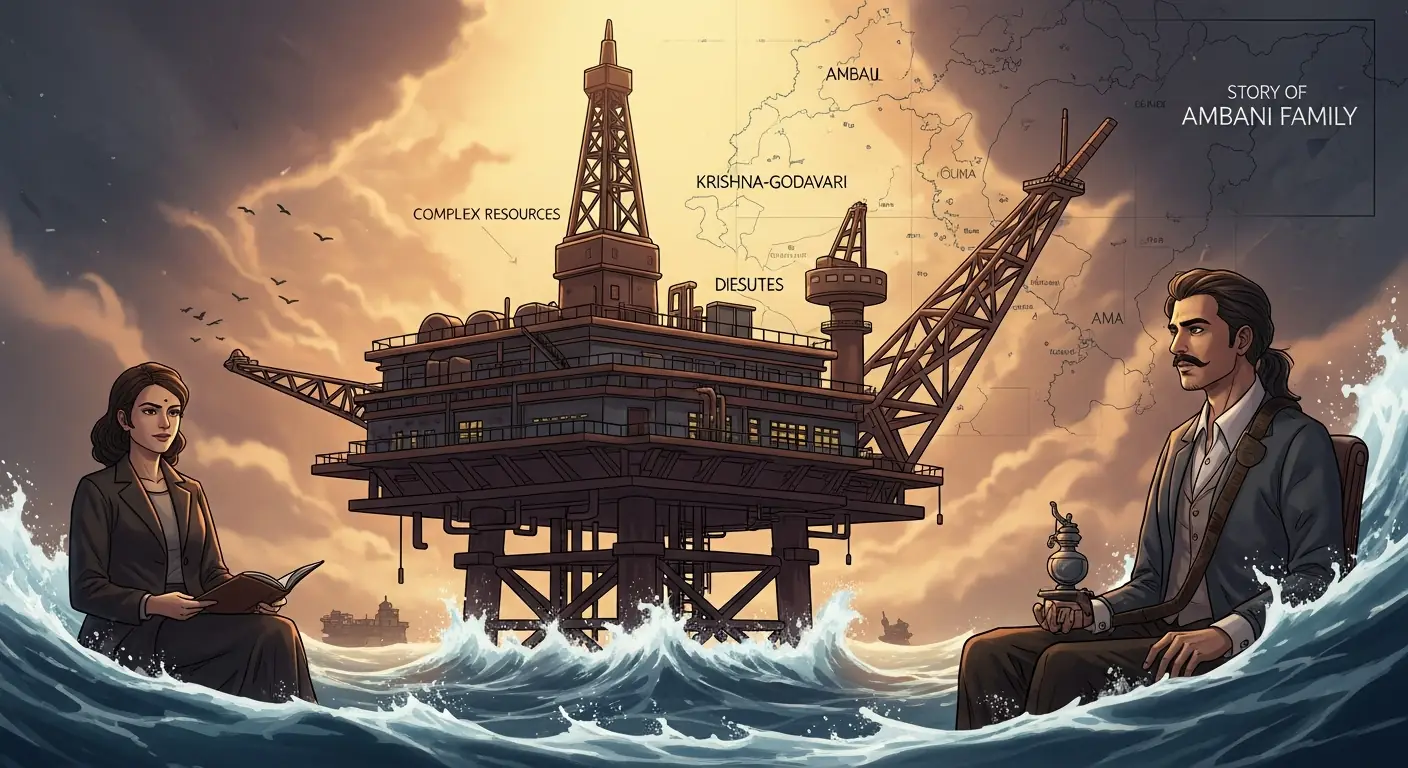
Not every chapter in an empire’s story is about triumphant growth and world-changing innovation. Sometimes, there are murky waters, allegations, and the kind of high-stakes disputes that can make even the most powerful families sweat. For Reliance, one such chapter revolved around the Krishna-Godavari (KG-D6) gas field, a saga that promised to fuel India’s energy needs but instead became a tangled web of controversy, production shortfalls, and political sparring. It was a stark reminder that even with immense power, natural resources come with immense headaches.
The Promise of Gas: India’s Energy Future?
In 2002, Reliance Industries, along with its partner Niko Resources, announced a massive discovery of natural gas in the deep-water block D6 of the Krishna-Godavari Basin off India’s east coast. This was heralded as one of the largest gas finds in the world in decades, with estimated reserves of 10 to 12 trillion cubic feet (TCF). The excitement was palpable; this gas field, named Dhirubhai-1 and 3, was supposed to be a major change, significantly reducing India’s reliance on expensive energy imports. Production began in 2009, promising to deliver 80 million standard cubic meters per day (mmscmd) of gas to power India’s rapidly growing economy. For a nation hungry for energy, this was a beacon of self-sufficiency, a truly monumental discovery.
Production Plunge and Political Pushback
However, the euphoria was short-lived. Almost as quickly as it ramped up, gas production from KG-D6 began to decline sharply. By 2011, output had plummeted to less than half of the projected figures, falling to around 30 mmscmd, and continued to drop. This dramatic reduction raised serious questions. Was Reliance intentionally under-producing to inflate future gas prices? Were they hoarding reserves? Or were the geological complexities of deep-water exploration simply more challenging than anticipated? The Indian government certainly leaned towards the former, accusing Reliance of failing to meet its commitments and even attempting to invoke penal clauses. The Comptroller and Auditor General (CAG) of India, in a scathing report, criticized the Ministry of Petroleum and Natural Gas for granting Reliance undue favors and allowing cost overruns, fueling public suspicion.
“The decline in production has caused immense concern to the nation. We have given them the best terms in the world. They have to deliver.” — Jaipal Reddy, then Petroleum Minister (circa 2012)
The controversy escalated, involving allegations of inflated capital expenditure claims (reportedly $8.8 billion by 2012, far exceeding initial estimates), which would allow Reliance to recover more costs before sharing profits with the government. The legal battles dragged on for years, with various government agencies, including the Petroleum Ministry and the Directorate General of Hydrocarbons (DGH), locking horns with Reliance. The feud even spilled into the public domain, with activists and politicians demanding transparency. While Reliance consistently maintained that the production shortfalls were due to unforeseen geological challenges and not deliberate actions, the episode cast a shadow over their otherwise stellar reputation for execution. It was a bruising battle that highlighted the intricate, often contentious, relationship between big business and national resources, proving that even a powerful empire can get bogged down in the quicksand of public doubt and bureaucratic scrutiny.
🛍️ Chapter 12: Reliance Retail — The Unstoppable Juggernaut (2006-Present)
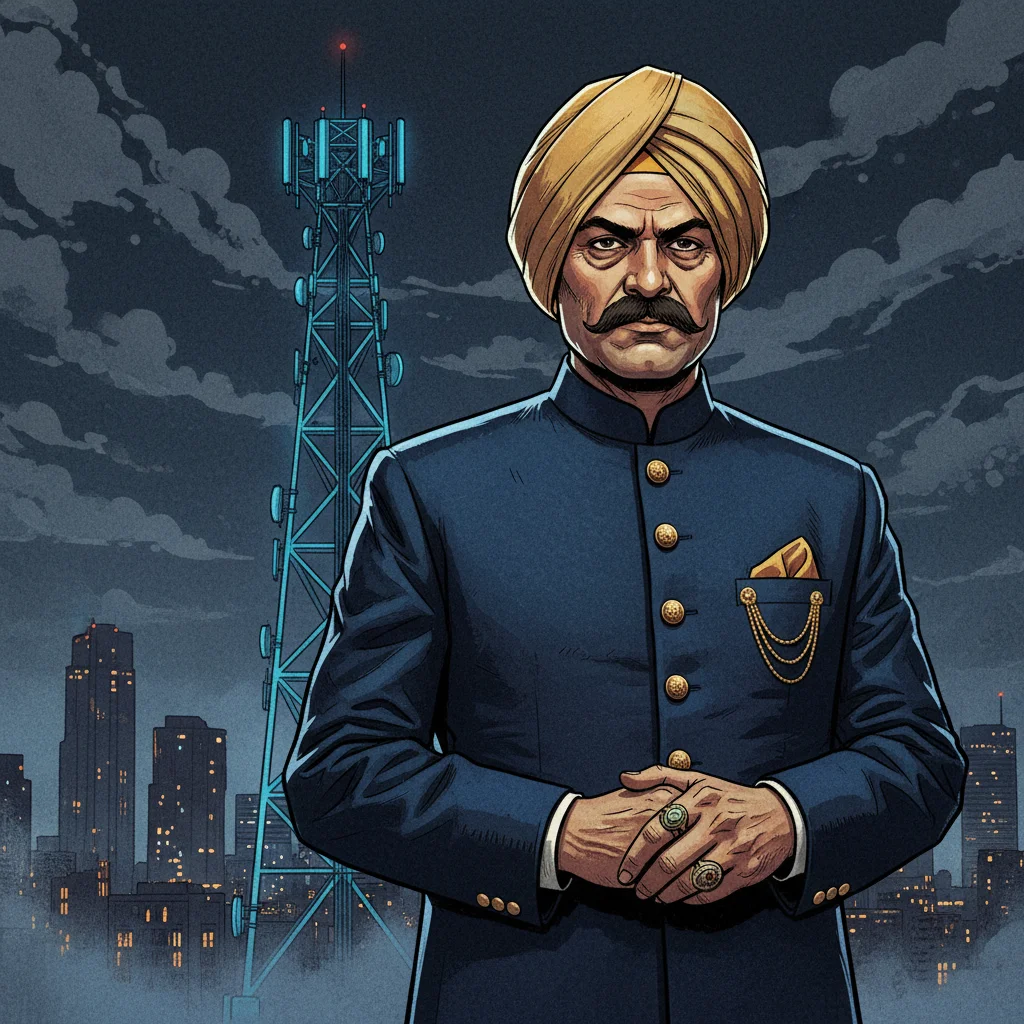
So, you’ve heard about Reliance building refineries, laying fiber optic cables, and conquering the digital world. But what about that time they decided to take on your local grocery store, your favorite fashion brand, and pretty much every other shopping experience you can imagine? Enter Reliance Retail, the quiet giant that has been systematically reshaping India’s consumption landscape since 2006. It’s arguably one of Mukesh Ambani’s most ambitious, yet often underestimated, ventures, proving that even in the cutthroat world of everyday commerce, the Ambanis play for keeps. And win.
The Big Bet on India’s Consumer
When Reliance Retail first launched, the organized retail sector in India was nascent and fragmented. While the global giants like Walmart and Carrefour eyed India cautiously, grappling with complex regulations, Reliance dove headfirst. Their strategy was simple, yet incredibly complex in execution: leverage their vast logistical network, deep pockets, and understanding of the Indian consumer to build an ecosystem of retail formats. From hypermarkets (Reliance Mart) to electronics stores (Reliance Digital), fashion outlets (Reliance Trends), and even neighborhood convenience stores (Reliance Fresh), they wanted to be everywhere. The initial years were tough, facing resistance from traditional retailers and struggling with supply chain kinks. But Ambani’s vision was long-term. He saw the burgeoning middle class, the rising disposable incomes, and the eventual shift from mom-and-pop stores to modern retail. He wasn’t just building stores; he was building a consumer habit.
A Shopping Spree of Acquisitions and Innovation
Fast forward to today, and Reliance Retail is an absolute behemoth. It is, by revenue, India’s largest retailer, operating over 18,000 stores across the country, spanning a mind-boggling 45.8 million square feet of retail space. That’s like a small city dedicated entirely to shopping! But their growth isn’t just organic; it’s fueled by strategic acquisitions. They’ve gobbled up brands like Hamleys (the iconic British toy store), Netmeds (an online pharmacy), Urban Ladder (furniture), and countless others. Remember when they raised a staggering $5.7 billion in funding from global investors like KKR and Silver Lake in 2020? That was a clear signal that the world understood the sheer potential of their retail play. They’re not just selling products; they’re building an integrated ecosystem that combines physical stores with e-commerce (JioMart), creating an omni-channel experience that caters to every whim of the Indian shopper.
Changing the Face of Indian Commerce
Reliance Retail’s impact on India’s retail landscape is profound. They’ve introduced modern shopping experiences to tier-2 and tier-3 cities, formalized supply chains, and, crucially, empowered millions of small kirana (neighborhood) stores by integrating them into their JioMart platform. This isn’t just about selling more; it’s about formalizing a massive informal sector, bringing technology and efficiency to the corner store. They’ve gone head-to-head with international e-commerce giants and local players alike, often outmaneuvering them through sheer scale and local insight. Today, Reliance Retail isn’t just a business; it’s a force multiplier for India’s consumer economy, dictating trends, setting prices, and quite literally, stocking the shelves of a nation of 1.4 billion people. It’s an empire within an empire, proving that whether it’s oil, data, or a packet of biscuits, the Ambanis are masters of distribution.
🎬 Chapter 13: Bollywood, Media, and Soft Power — The Ambani Touch (2000s-Present)
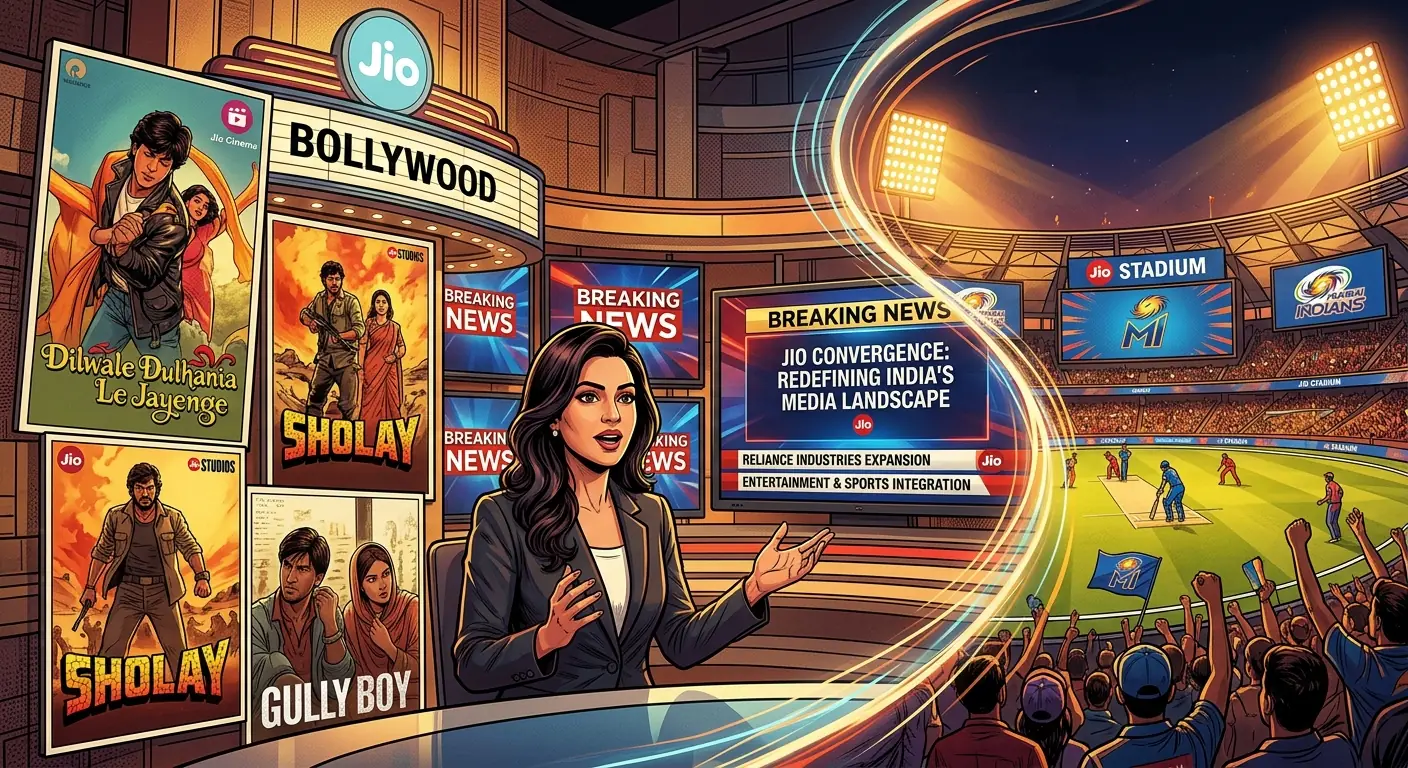
You’ve heard how the Ambanis power India’s homes and connect its people. But what about how they entertain them, inform them, and shape their cultural narratives? Beyond the hard-nosed industries of oil, telecom, and retail, the Ambani empire has made significant, often subtle, inroads into the glitzy world of media and entertainment, wielding a powerful form of “soft power” that influences everything from box office hits to daily news cycles. It’s where the crunch of numbers meets the magic of storytelling, and the Ambanis, predictably, want a piece of that action too.
From Film Financing to Media Conglomerate
Reliance’s foray into entertainment began relatively early, with Reliance Entertainment making its mark in film production, distribution, and even gaming. But it was their more strategic moves in the 2010s that truly solidified their media footprint. The big splash came with their acquisition of a significant stake in Network18 Media & Investments Ltd. in 2012, and later a full takeover in 2014. This wasn’t just buying a few channels; Network18 is a sprawling media conglomerate that owns a vast portfolio including news channels (CNN-News18, CNBC-TV18, News18 India), digital properties (Moneycontrol, Firstpost), and a joint venture with Viacom for entertainment channels (Colors, MTV India, Comedy Central India). Suddenly, the Ambanis weren’t just building infrastructure; they were controlling the content that flowed through it.
“Our vision for the media business is not just to provide content, but to create platforms that democratize access to information and entertainment for every Indian.” — Mukesh Ambani (paraphrased, reflecting the company’s stated intent)
This strategic alignment was a stroke of genius, especially with the impending launch of Jio. Imagine owning the pipes (Jio) and a huge chunk of what flows through those pipes (Network18/Viacom18). It’s a vertically integrated media empire, ensuring that whether you’re streaming a movie, watching the news, or catching up on your favorite TV show, there’s a good chance an Ambani-backed entity is involved somewhere along the line. This synergy ensures a captive audience for their content and a powerful distribution channel for their media assets.
JioCinema: The Streaming Power Play
With the rise of streaming, Reliance wasn’t going to be left behind. JioCinema, initially a complimentary service for Jio subscribers, has rapidly evolved into a major player in India’s OTT (Over-The-Top) streaming wars. They’ve invested heavily in acquiring premium content, most notably securing the digital streaming rights for the Indian Premier League (IPL) cricket matches for 5 years (2023-2027) for a whopping $2.6 billion. This move, which made IPL streaming free on JioCinema, instantly catapulted the platform’s user base, showcasing their willingness to disrupt market norms with aggressive strategies. Beyond sports, JioCinema has been pumping money into original Indian content, competing directly with Netflix and Amazon Prime Video for eyeballs and subscriptions. They’re not just buying content; they’re cultivating a new generation of digital consumers, proving that even in the subjective realm of entertainment, the Ambani Midas touch is very much at play.
Cultural Influence and Celebrity Connections
Beyond the balance sheets, the Ambanis wield significant cultural influence. Their lavish family events are often attended by Bollywood’s biggest stars, cementing their status as cultural arbiters. Nita Ambani’s involvement with the Nita Mukesh Ambani Cultural Centre (NMACC), inaugurated in 2023, further highlights their commitment to arts and culture, positioning them as patrons of India’s rich artistic heritage. This isn’t just about business; it’s about soft power – shaping opinions, fostering national pride through sports, and influencing the stories that define India. In a nation obsessed with Bollywood and cricket, the Ambanis aren’t just industrialists; they are increasingly the curators of India’s collective imagination, proving that true empires aren’t just built on steel and silicon, but on stories and dreams too.
💡 Key Insights
- ▸ Dhirubhai Ambani proved that in India's bureaucratic 'License Raj,' understanding the government was as important as understanding the market.
- ▸ Family succession battles can split empires — but they can also create two separate engines of growth.
- ▸ Jio demonstrated that giving away a product for free can be the most profitable strategy of all, if you have the scale.
- ▸ In emerging markets, the relationship between business and government is inseparable from the business itself.
- ▸ Generational wealth transfer requires not just capital but vision — Mukesh's pivot from petrochemicals to digital was the key to Reliance's survival.
Sources
- Polyester Prince: The Rise of Dhirubhai Ambani by Hamish McDonald ↗
- Forbes Billionaires Profile: Mukesh Ambani ↗
- Bloomberg Billionaires Index - Ambani ↗
- Financial Times - Jio's Disruption of Indian Telecom ↗
- The Economist - Reliance Industries Profile ↗
- Reuters - Ambani Family Split and Reconciliation ↗
- Economic Times India - Reliance Next Generation ↗