The Knight, The Cricket, And The Colossal Con: How Allen Stanford Built And Burned A $7 Billion Empire
Meet **Allen Stanford**, the self-styled Texan knight who charmed investors with promises of impossible returns, built a cricket empire, and flaunted a lifestyle of unimaginable opulence. But behind the glittering facade of his offshore bank, a $7 billion Ponzi scheme was ticking like a time bomb, waiting to explode and leave thousands utterly ruined. This is the wild, dramatic story of a financial illusionist's rise, his audacious deception, and the brutal crash that sent him to prison for life.
View all stories about this mogul
🔥 Chapter 1: The Illusionist’s Entrance – A Texan Dream, Offshore Shadows

Picture this: It’s the early 2000s, and the global financial markets are buzzing, a relentless hum of ambition and innovation. Dot-com bust? Old news. Subprime mortgages? Just a little tremor, nothing to see here. The party, as far as most were concerned, was still raging. And then there was Allen Stanford. Not a titan of Wall Street, not a tech visionary, but a self-styled Texas good ol’ boy with a drawl as smooth as aged whiskey and a smile that could sell sand to a Bedouin. He wasn’t just in the game; he was playing a whole different sport, on his own private island, with his own rules.
This wasn’t some backroom boiler-room operation. Oh no. This was a global financial empire, shiny and slick, built on the promise of impossible returns and the bedrock of trust. From his sprawling Houston headquarters, to the sun-drenched beaches of Antigua, to the polished boardrooms of London and Zurich, Stanford Financial Group was everywhere. It had all the trappings of legitimate wealth: private jets emblazoned with the company logo, sponsorship deals for major sporting events (especially cricket, his personal obsession), and a network of advisors who truly believed they were offering their clients a slice of financial paradise.
But behind the veneer of respectability, beneath the veneer of Sir Allen Stanford (yes, Sir), a title he purchased with more cash than chivalry, lay a truth so rotten it would make your stomach churn. This wasn’t a sophisticated investment strategy; it was a shell game on a scale that dwarfed even the most infamous swindlers. This was a house of cards constructed not just with money, but with the hopes, dreams, and life savings of tens of thousands of ordinary people, all glued together by one man’s audacious lie.
Imagine the scene: a plush, mahogany-paneled office. The scent of success hangs heavy in the air. On the wall, a framed photo of Stanford shaking hands with some dignitary. On the desk, a prospectus touting “unparalleled returns” on Certificates of Deposit (CDs) issued by his offshore bank, Stanford International Bank (SIB), based in Antigua. The numbers were irresistible, consistently beating market rates, year after year, no matter what the global economy was doing. It was a financial perpetual motion machine, defying gravity, logic, and every single law of investing.
And that, my friends, is where the story truly begins. Not with a bang, but with a whisper of impossible returns, a siren song that lured investors into a web of deceit, spun by a man who saw himself as a financial deity, above the fray, above the law. He wasn’t just selling investments; he was selling a dream, a promise of security in an uncertain world. And for a long, terrifying stretch, people bought it, hook, line, and sinker.
🎲 Chapter 2: From Humble Beginnings to Offshore Empire – The Architect of Ambition

Every conman has a backstory, a genesis of their grand design. For Robert Allen Stanford, born in Mexia, Texas, in 1950, it wasn’t a sudden flash of villainy. It was a slow, calculated ascent, a relentless pursuit of wealth and status that began with relatively humble origins. He wasn’t born into old money; he was a self-made man, a quintessential American striver.
His early career wasn’t in finance, but in health clubs and real estate in Texas. He learned the art of the deal, the power of persuasion, and perhaps most importantly, the allure of a charismatic pitch. He started making money, enough to feed an ambition that clearly outstripped the confines of small-town Texas. The real turning point came in the 1980s when he began exploring the world of offshore finance. The Caribbean, with its lax regulations and promise of secrecy, beckoned like a tropical mirage.
In 1985, Stanford made a pivotal move, establishing Stanford Financial Group (SFG) on the tiny, volcanic island of Montserrat. Why Montserrat? Because it was small, relatively unknown, and crucially, offered a regulatory environment that was, shall we say, flexible. It was the perfect incubator for an operation that needed to operate largely out of sight, away from the prying eyes of the SEC or any serious financial watchdog. He was planting a flag in a regulatory blind spot, a strategic move that would define his empire.
The initial years were about building a foundation, attracting investors, and cultivating relationships. Stanford wasn’t just selling a product; he was selling access to a perceived exclusive club, a way to safeguard wealth from taxes and scrutiny. He preyed on a fundamental human desire: security, wealth preservation, and just a little bit of rebellion against the system.
“Stanford understood the psychological sweet spot: people want high returns, but they also want to feel safe. He crafted a narrative of offshore stability and superior management that was utterly detached from reality.”
As his operation grew, he moved his primary banking operations to Antigua, another Caribbean island nation with even more lax oversight and a government notoriously susceptible to influence. Here, Stanford International Bank (SIB) became the beating heart of his burgeoning empire. He wasn’t just an investor; he became a major player in the Antiguan economy, employing hundreds, investing in infrastructure, and essentially becoming a shadow government unto himself. This deep embedding in the local political and economic fabric provided a crucial layer of protection, making it incredibly difficult for outside regulators to intervene.
He cultivated a persona that was a potent cocktail of Southern charm, business acumen, and a touch of the eccentric billionaire. He was a man who knew how to make friends in high places, donate generously to political campaigns (both in the US and the Caribbean), and host lavish parties that cemented his image as a powerful, benevolent figure. This wasn’t just networking; it was an elaborate form of social engineering, building a protective bubble around his increasingly precarious financial structure. He was constructing not just a bank, but an entire ecosystem designed to legitimize his grand illusion.
💰 Chapter 3: The CD That Couldn’t Fail – The Core of the Con

Now, let’s talk about the product, the golden goose, the irresistible bait that drew in thousands of investors: the Certificates of Deposit (CDs) issued by Stanford International Bank (SIB). These weren’t your grandma’s CDs from the local credit union. Oh no. These were marketed as the Rolls-Royce of safe investments, offering returns that consistently, year after year, dwarfed anything available from legitimate banks or even the most aggressive mutual funds.
Imagine this: the stock market is volatile, interest rates are low, and traditional investments are barely treading water. Then, along comes Stanford, promising 8%, 10%, sometimes even 12% annual returns on a “safe” CD. And not just any CD, but one supposedly backed by a diversified portfolio of liquid assets, managed by a team of brilliant, secretive financial wizards. It was a financial unicorn, shimmering with impossible promise.
The pitch was simple, elegant, and utterly devastating in its effectiveness. Stanford’s army of financial advisors, many of whom were genuinely convinced they were selling a legitimate, superior product, would tell clients that SIB’s returns were achievable due to:
- Superior Offshore Management: The idea that SIB had access to exclusive, sophisticated investment strategies unavailable to onshore banks.
- Lower Overhead: Operating from Antigua supposedly meant lower costs, allowing higher returns.
- Diversified Global Portfolio: A “black box” of investments, ranging from real estate to private equity to high-yield bonds, all managed with unparalleled expertise.
The reality? The “diversified global portfolio” was a fiction. The vast majority of the funds were not invested in anything legitimate. Instead, they were funneled directly into Allen Stanford’s personal accounts, his lavish lifestyle, his failed businesses, and crucially, used to pay off earlier investors – the classic, chilling hallmark of a Ponzi scheme.
“The genius and the depravity of the Stanford scheme was its simplicity: he didn’t invent a new financial product; he just slapped impossible returns on a familiar one – the CD – and wrapped it in a veneer of offshore mystique.”
The target audience was particularly vulnerable: retirees looking for stable income, Latin American investors seeking to protect their wealth from political instability and inflation, and individuals who were either skeptical of mainstream finance or simply wanted more than the market was offering. These were people who had worked hard, saved diligently, and were looking for a secure future, not a speculative gamble. Stanford offered them exactly what they thought they needed: safety and high returns.
The SIB CDs were sold through a network of Stanford Financial Group offices across the US, Latin America, and Europe. The advisors were incentivized with generous commissions, further fueling their belief and their sales efforts. They saw the lifestyle of their boss, the constant growth, the seemingly endless stream of new money, and they believed. They saw the consistent payouts to clients, and they believed. It was a self-perpetuating cycle of faith and fraud, where new money was the only oxygen sustaining the entire, teetering structure. Every payout wasn’t a return on investment; it was a withdrawal from the principal of the next unsuspecting victim. The ticking time bomb was getting louder, but few could hear it over the seductive hum of those incredible returns.
👑 Chapter 4: The Glamour and the Gimmick – A Knight, Cricket, and a Lifestyle of Lies

If you’re going to pull off a multi-billion dollar fraud, you can’t just operate from a dingy basement. You need spectacle. You need a show. And Allen Stanford was a master showman, creating a persona and a lifestyle so dazzling, it served as both a smokescreen and a powerful marketing tool. He understood that perception is reality, especially in the world of high finance.
His most audacious move? Becoming “Sir Allen Stanford.” In 2006, the Antiguan government, deeply indebted to and influenced by Stanford, bestowed upon him a knighthood. Yes, a real knighthood. No dragons slayed, no queens rescued, just a hefty check and a powerful patron. This wasn’t just a vanity title; it was a badge of legitimacy, a powerful endorsement that he leveraged relentlessly. “Sir Allen” wasn’t just a businessman; he was an esteemed philanthropist, a national benefactor, a man above reproach. The knighthood gave him an air of unimpeachable credibility, especially to international investors less familiar with the nuances of Caribbean politics.
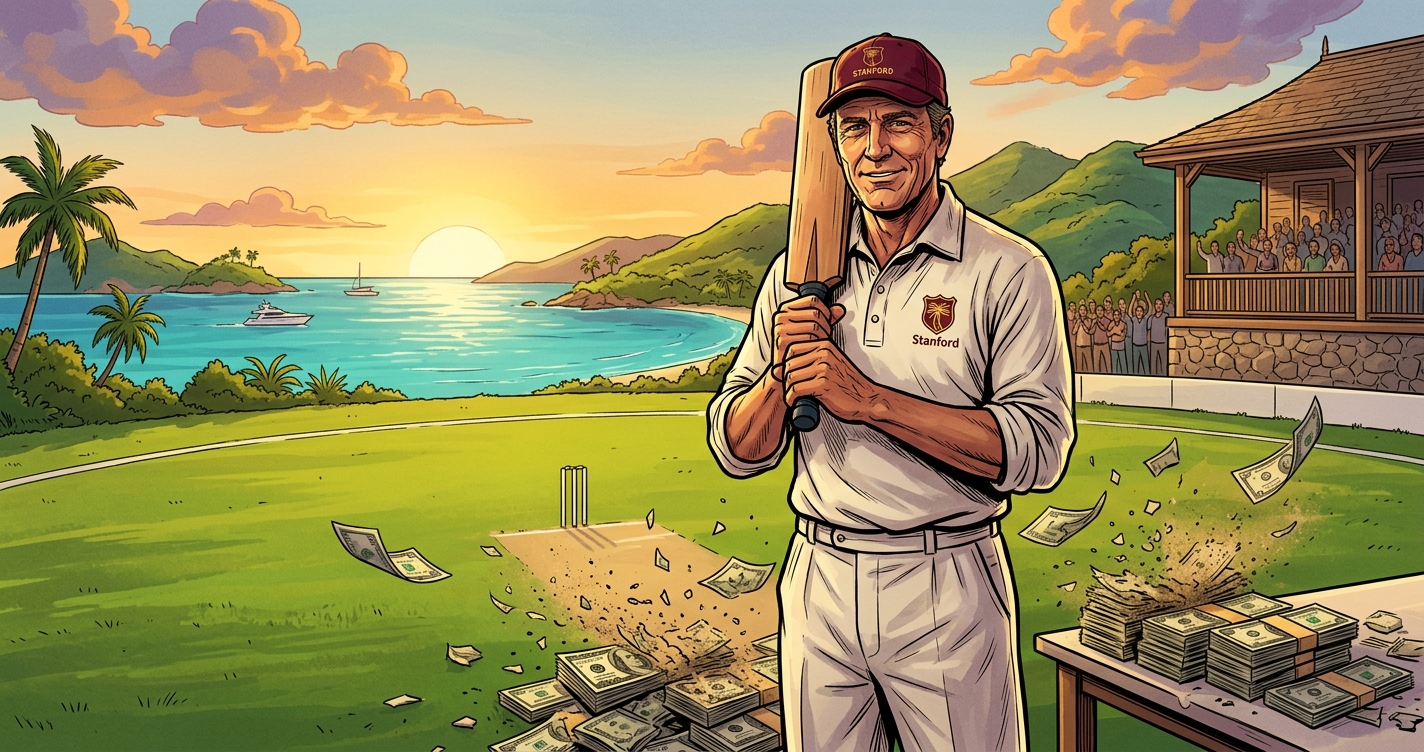
Then there was the cricket. Stanford wasn’t just a fan; he became a patron on a scale previously unheard of in the sport. He poured millions into West Indies cricket, creating the Stanford 20/20 Cricket Tournament, complete with a personal helicopter landing on the pitch, huge prize money, and a glittering trophy that bore his name. He even famously landed his helicopter at Lord’s Cricket Ground in London, scattering 20 million dollars in cash on the pitch in a publicity stunt that screamed “I have so much money I don’t know what to do with it.” This wasn’t just sports sponsorship; it was a colossal branding exercise, linking the Stanford name with prestige, excitement, and unimaginable wealth. For many, his involvement in cricket was proof positive of his success and generosity.
His personal life was a tapestry of extravagance. He owned multiple private jets (including a custom-fitted Airbus A320), a fleet of luxury yachts, and homes across the globe. He reportedly maintained multiple mistresses, showering them with gifts and properties. He hosted opulent parties, flew clients and associates around on his private planes, and cultivated an image of boundless generosity and success. This wasn’t just self-indulgence; it was a calculated projection of invincibility. “How could a man with all this,” the unspoken message went, “be anything but legitimate?”
“Stanford’s lifestyle wasn’t just a side effect of his wealth; it was an integral part of his Ponzi scheme. The private jets, the cricket empire, the knighthood – these were all props in a meticulously staged play designed to convince the world he was a legitimate billionaire.”
He made significant political donations in both the US and the Caribbean, buying influence and ensuring that when questions arose, there were powerful figures willing to vouch for him or, at the very least, look the other way. He operated with an air of untouchability, a man who moved in circles where rules bent and exceptions were made. This elaborate facade, built on borrowed money and breathtaking lies, allowed the scheme to grow unchecked for years, blinding regulators, investors, and even his own employees to the terrifying truth simmering beneath the surface. The glamour was dazzling, but it was also paper-thin, ready to ignite at the slightest spark of real scrutiny.
🕵️♀️ Chapter 5: Whispers in the Wind – The Cracks in the Facade
For years, Allen Stanford’s empire hummed along, seemingly impervious to economic downturns or regulatory scrutiny. But even the most meticulously constructed illusions eventually show cracks. While the vast majority of investors and even many employees were charmed by the Stanford mystique, a few keen observers, a handful of skeptical minds, started to hear whispers in the wind. These were the early warning signs, the faint tremors before the earthquake.
The first, most glaring red flag was the unrealistic and consistent returns on the Stanford International Bank (SIB) CDs. In a world where financial markets ebb and flow, where even the most brilliant investors have bad years, SIB consistently delivered double-digit returns. Year after year. Through recessions, market crashes, and global instability. It simply defied economic gravity. Any seasoned financial analyst would have immediately flagged this as highly suspicious. If a legitimate bank could consistently generate such returns, every major financial institution on the planet would be scrambling to replicate their strategy, or at least understand it. The fact that SIB was the only one doing it, and doing it so quietly, should have screamed “fraud.”
Then there was the opacity of SIB’s investment portfolio. When investors or even financial journalists asked for detailed breakdowns of where the money was actually invested, they were met with vague generalities, boilerplate statements about “diversified global strategies,” and claims of proprietary, secretive methods. Stanford and his executives would cite competitive reasons or market sensitivity for their lack of transparency. It was the classic “black box” approach: trust us, we’re geniuses, just send money. For sophisticated investors, a lack of transparency is like seeing a smoke detector with the batteries removed – a clear sign of danger.
“The moment a financial entity tells you their extraordinary returns are due to ‘proprietary, secretive strategies’ and refuses to provide transparent breakdowns, that’s not exclusivity; that’s a red carpet leading to a financial abyss.”
Regulatory oversight was another massive blind spot. Operating out of Antigua, SIB was under the jurisdiction of the Antigua and Barbuda Financial Services Regulatory Commission (FSRC). The FSRC, a tiny agency in a small island nation, simply did not have the resources, the expertise, or, crucially, the political independence to effectively regulate a multi-billion dollar international banking operation. Stanford had effectively captured his regulator, ensuring they were toothless. Attempts by US regulators to gain access to SIB’s books were often met with resistance, delays, and jurisdictional quibbles, allowing the scheme to fester.
A few individuals did raise alarms. Whistleblowers within Stanford’s organization, former employees who saw the discrepancies, tried to warn authorities. Journalists from publications like Bloomberg and the Wall Street Journal published articles questioning Stanford’s operations and the legitimacy of his knighthood. Even the SEC had opened preliminary inquiries as early as 2005. But the sheer audacity of Stanford’s lifestyle, his political connections, and the sheer volume of money flowing into his coffers created a powerful psychological barrier. People wanted to believe. The dazzling light of his persona often overshadowed the faint, unsettling shadows. The whispers were there, but they were often drowned out by the roar of the cricket crowds and the clinking of champagne glasses. The cracks were forming, but the facade was still holding, for now.
🚨 Chapter 6: The Watchdogs Stir – The Slow Burn of Investigation

While Allen Stanford was busy flying around in his private jet, dazzling dignitaries, and staging cricket spectaculars, the quiet, relentless machinery of regulatory investigation was slowly grinding into motion. The whispers in the wind, the impossible returns, the opaque balance sheets – they weren’t entirely ignored. Across the Atlantic, in the staid offices of the U.S. Securities and Exchange Commission (SEC), a few dedicated individuals were starting to connect the dots.
The SEC’s initial inquiries into Stanford Financial Group dated back to the mid-2000s. But investigating an offshore entity like Stanford International Bank (SIB) was like trying to catch smoke. SIB was incorporated in Antigua, meaning it fell primarily under Antiguan regulatory authority. The SEC, bound by international laws and diplomatic protocols, couldn’t simply barge in and demand documents. They had to rely on requests, cooperation from Antiguan authorities (which was often slow or nonexistent due to Stanford’s deep influence), and the painstaking process of gathering evidence from US-based operations and disgruntled former employees.
It was a bureaucratic nightmare. Stanford, with his army of expensive lawyers, knew how to play the game. He’d provide just enough information to appear cooperative, while simultaneously stonewalling, delaying, and deflecting. He consistently maintained that SIB was a legitimate, well-managed bank, and that any inquiries were simply politically motivated attacks by jealous competitors or overzealous regulators who didn’t understand his unique business model. This narrative, repeated often and loudly, further muddied the waters.
“Investigating an offshore Ponzi scheme is like trying to dismantle a bomb with a pair of chopsticks. The jurisdictional hurdles, the lack of transparency, and the sheer audacity of the perpetrator conspire to make every step a monumental battle.”
The SEC had a hunch, a strong one, that something was profoundly wrong. The consistent, market-beating returns on the SIB CDs were the biggest giveaway. Mathematically, it simply didn’t add up. No legitimate diversified portfolio, especially one claiming low risk, could deliver those numbers consistently. The only way to achieve such returns over time, without legitimate investments, is to pay existing investors with new investors’ money.
The investigation intensified in late 2008, a crucial period when the global financial crisis was already shaking confidence in the financial system. Stanford’s claims of being insulated from market downturns began to sound less like genius and more like outright delusion. The financial crisis, ironically, accelerated the downfall. As investors worldwide became more nervous, some began to request redemptions from their SIB CDs. A Ponzi scheme relies on a constant influx of new money to pay off existing investors. When redemptions accelerate and new money slows, the scheme begins to gasp for air.
The SEC started to piece together a picture of a vast, interconnected web of shell companies, sham investments, and a frightening concentration of power in Allen Stanford’s hands. They realized they weren’t just dealing with a rogue investment fund; they were dealing with a full-blown criminal enterprise designed from the ground up to defraud. The slow burn of the investigation was nearing its ignition point, and the fuse was getting shorter by the day. The watchdogs were stirring, and their barks were about to turn into a full-throated howl.
💥 Chapter 7: The Hammer Falls – A February Morning, A Global Shockwave

The date was February 17, 2009. The world was still reeling from the financial crisis, looking for any sign of stability, any glimmer of hope. Instead, it got Allen Stanford.
That morning, the SEC, having finally amassed enough evidence and secured the necessary court orders, moved. It wasn’t a gentle tap on the shoulder; it was a full-blown, coordinated assault. Federal agents descended upon Stanford Financial Group’s lavish Houston headquarters. Imagine the scene: polished glass and chrome, bustling employees, and then, suddenly, a swarm of agents, badges flashing, papers rustling. The doors were locked. The computers were seized. The game was officially over.
Simultaneously, similar raids and asset freezes were executed across Stanford’s global network of offices, from Miami to Memphis, from Panama to Peru. The SEC charged Allen Stanford, along with several of his top executives, with orchestrating an alleged $7 billion Ponzi scheme through Stanford International Bank (SIB). They alleged that the entire operation was a massive fraud, that the SIB CDs were simply a vehicle for Stanford to siphon off billions for his personal use and to prop up other failing ventures, all while paying earlier investors with funds from newer ones.
The immediate aftermath was pure chaos. News of the raids spread like wildfire, sending shockwaves through the financial world and, more tragically, through the lives of tens of thousands of investors. Panic set in. Call centers for Stanford Financial Group were overwhelmed. Investors, many of whom had poured their entire life savings into SIB CDs, tried desperately to access their funds, only to find accounts frozen, offices shuttered, and the phone lines dead.
“The moment federal agents walk through the door, the air changes. The illusion shatters. For Allen Stanford, February 17, 2009, was the day his carefully constructed kingdom of lies crumbled to dust, leaving a crater where billions once stood.”
In Antigua, the reaction was equally dramatic. The Antiguan government initially tried to protect its deeply entrenched “national hero,” but the weight of the US investigation was too heavy. Local authorities eventually seized SIB, installing a conservator. The island, which had benefited so greatly from Stanford’s largesse, was left reeling, facing economic uncertainty and a profound sense of betrayal.
Allen Stanford himself, ever the showman, tried to put on a brave face. He was served with the civil complaint while on a private jet, ironically attempting to flee to Antigua. He landed in Houston, maintained his innocence, and claimed the SEC was conducting a “vendetta.” But the bravado was thin. The world was watching, and the evidence was piling up. His assets were frozen, his lavish lifestyle abruptly curtailed. The private jets were grounded, the cricket empire in tatters.
The hammer had fallen. The sound wasn’t just the crash of a financial empire; it was the shattering of trust, the evaporation of life savings, and the brutal awakening for countless individuals who had believed in a Texan knight who turned out to be nothing more than a common thief on an impossibly grand scale. The true horror of the scheme was only just beginning to unravel.
🕸️ Chapter 8: Unraveling the Web – The Horrors Unearthed

With the hammer fallen and assets frozen, the real work began: unraveling the intricate, decades-long web of deceit that Allen Stanford had spun. What investigators from the SEC, the FBI, and eventually the Department of Justice found was a horror show of financial chicanery, a breathtaking display of greed and manipulation.
The core discovery confirmed the worst fears: the Stanford International Bank (SIB) CDs were not backed by legitimate, diversified investments. Instead, the vast majority of the funds – billions of dollars – had been siphoned off. Where did it go?
- Personal Enrichment: A significant chunk funded Stanford’s unbelievably lavish lifestyle: the private jets, the yachts, the mansions, the mistresses, the endless parties. He was living like a king, directly off the principal of his investors.
- Failing Businesses: Stanford used investor money to prop up other, unrelated businesses he owned, many of which were losing propositions. He treated SIB’s coffers like his personal slush fund, diverting billions to keep his other ventures afloat, regardless of their viability.
- Political Donations and Bribes: Millions were spent on political contributions in the US and, more significantly, in the Caribbean, where he essentially bought influence and protection from scrutiny.
- Ponzi Payouts: Crucially, a substantial portion was used to pay the promised, impossible returns to earlier investors, creating the illusion of profitability and attracting new victims. This is the engine of any Ponzi scheme: using new money to pay old debts.
Investigators discovered a series of shell companies, intricately layered, designed to obscure the true flow of funds. Documents were falsified, financial statements were fabricated, and independent auditors were either complicit or utterly duped. The entire financial reporting system of SIB was a sham, a fantasy created to fool regulators and investors.
“What they found wasn’t a bank with bad investments, but a sophisticated criminal enterprise where every document was a lie and every transaction was a theft. It was a financial house of horrors, built on the bones of trust.”
Perhaps one of the most damning discoveries was the role of James M. Davis, SIB’s chief financial officer, who eventually became a key witness for the prosecution. Davis confessed that SIB’s financial statements were routinely falsified at Stanford’s direction, and that he himself had helped create the illusion of legitimate investments where none existed. He revealed how Stanford would pressure him to produce specific, inflated returns on paper, regardless of actual performance. This wasn’t incompetence; it was deliberate, systematic fraud from the very top.
The human element of this unraveling was particularly grim. Investigators spoke with thousands of victims, many of whom were elderly, retired, or otherwise financially vulnerable. They recounted stories of losing everything: retirement funds, inheritances, the money set aside for their children’s education or their own medical care. The emotional toll was immense. For these individuals, the “secretive, superior offshore management” was nothing but a cruel joke, and the promise of security turned into a devastating betrayal.
The sheer scale of the fraud – $7 billion – made it one of the largest Ponzi schemes in history, second only to Bernie Madoff’s staggering $65 billion deception. But unlike Madoff’s scheme, which often targeted sophisticated institutional investors, Stanford’s net caught a wider, often more vulnerable, demographic. The unraveling of his web wasn’t just a financial forensic exercise; it was an excavation of shattered lives and a stark reminder of the corrosive power of unchecked greed.
⚖️ Chapter 9: The Trial of the Billionaire Bandit – Justice’s Long, Hard Road

After the dramatic raids and the chilling revelations, the focus shifted to the legal arena. Allen Stanford, the self-proclaimed billionaire bandit, was indicted by a federal grand jury in June 2009 on 21 counts, including wire fraud, mail fraud, money laundering, and obstruction of justice. The charges were comprehensive, painting a picture of a criminal mastermind who had deliberately set out to defraud tens of thousands of people.
The road to trial, however, was long, arduous, and fraught with delays. Stanford, ever defiant, maintained his innocence. He fought tooth and nail, employing a legal strategy that was aggressive and often chaotic. His defense team argued that he was a legitimate businessman who had simply made some bad investments, and that the government was unfairly targeting him. They also attempted to portray him as a victim of a corrupt Antiguan government.
But the prosecution had a mountain of evidence. They had the testimony of former insiders, most notably James M. Davis, SIB’s former CFO, who turned state’s witness. Davis’s testimony was crucial, providing a chilling, firsthand account of how the fraud was orchestrated, how financial statements were fabricated, and how Stanford personally directed the deception. He detailed how he and Stanford created fraudulent financial statements and even backdated documents to cover their tracks.
They had the paper trail: the complex web of shell companies, the bank records showing the diversion of billions from SIB into Stanford’s personal accounts and failing businesses. They had the emails, the internal memos, and the falsified audit reports. The evidence meticulously laid out how new investor money was systematically used to pay off old investors, masking the complete lack of legitimate underlying assets.
“The courtroom was where the glamorous illusion of Sir Allen Stanford met the cold, hard reality of the law. And in that clash, the truth emerged, stark and devastating, for all to see.”
The trial itself was a spectacle. It began in January 2012 in Houston, Texas, lasting seven weeks. Prosecutors presented a detailed narrative of Stanford’s rise, his lavish lifestyle, and the calculated deception at the heart of his empire. They brought in victims who testified about losing their life savings, painting a vivid picture of the human cost of his fraud. Imagine sitting in court, watching people recount how their retirement dreams were shattered, their trust utterly violated, all because of the man sitting just feet away.
Stanford’s defense struggled to counter the overwhelming evidence. Their arguments often seemed desperate, trying to shift blame or discredit witnesses. But the numbers didn’t lie. The consistent, impossible returns, the opaque investments, the personal enrichment – it all pointed to one conclusion.
Ultimately, the jury saw through the facade. On March 6, 2012, after three days of deliberation, they delivered their verdict: Allen Stanford was found guilty on 13 of the 14 counts he faced, including mail fraud, wire fraud, conspiracy to commit mail and wire fraud, and money laundering. He was acquitted on one count of wire fraud. The “billionaire bandit’s” reign was officially over. The long, hard road to justice had reached its destination, but for the victims, the road to recovery was only just beginning.
⛓️ Chapter 10: The Reckoning – 110 Years, A Legacy of Loss

The guilty verdict was a decisive victory for the prosecution and a moment of grim vindication for the tens of thousands of victims. But the story wasn’t over. The final act was the sentencing. On June 14, 2012, Allen Stanford stood before U.S. District Judge David Hittner in Houston. The judge didn’t mince words.
Considering the colossal scale of the fraud, the devastating impact on victims, and Stanford’s complete lack of remorse, the sentence was always going to be severe. Prosecutors had asked for 230 years, reflecting the maximum penalties for each count. Stanford’s lawyers pleaded for leniency, citing his age and suggesting a sentence that would allow him to someday be released.
Judge Hittner listened, but the evidence of human suffering was too compelling. He sentenced Allen Stanford to 110 years in federal prison. It was a life sentence, effectively ensuring that the man who had stolen billions would spend the rest of his days behind bars. The judge also ordered a forfeiture of $5.9 billion, representing the proceeds of his criminal enterprise, though recovering that money would prove to be another monumental challenge.
“110 years. Not just a number, but a stark, undeniable declaration from the justice system: the price of orchestrating a $7 billion Ponzi scheme, of shattering tens of thousands of lives, is every single day you have left.”
Stanford, defiant to the end, continued to maintain his innocence, claiming he was the victim of a political conspiracy. But his protests rang hollow against the backdrop of the verdict and the stories of the ruined.
The aftermath of the conviction and sentencing was a complex and ongoing saga. For the victims, the verdict provided a measure of justice, but it didn’t magically restore their lost savings. The process of asset recovery was incredibly slow and frustrating. Stanford’s assets were scattered across multiple jurisdictions, hidden in complex legal structures, and often entangled in disputes with various creditors and governments. Litigation against institutions that allegedly aided Stanford or failed in their oversight (like some banks and auditors) dragged on for years.
Many victims never recovered a significant portion of their losses. Their retirement plans were shattered, their financial security obliterated. For some, the emotional and psychological scars ran even deeper, a profound sense of betrayal and anger that time could not easily heal. The scheme didn’t just steal money; it stole peace of mind, trust, and futures.
The Stanford Financial Group empire, once a glittering symbol of success, vanished, leaving behind a trail of debt, lawsuits, and broken promises. The lavish properties were seized, the private jets sold, the cricket empire dismantled. The knighthood, once a symbol of prestige, became a mark of infamy, eventually revoked by the Antiguan government. Allen Stanford’s name, once associated with wealth and philanthropy, became synonymous with one of the most audacious financial frauds in history. The reckoning was complete, but the wounds it inflicted would linger for decades.
📉 Chapter 11: The Scars Remain – Legacy and Lessons Learned (Or Not?)

The spectacular collapse and subsequent conviction of Allen Stanford left deep scars on the financial landscape, exposing vulnerabilities not just in individual investor due diligence, but in the very fabric of global financial regulation. While the immediate aftermath focused on justice for victims, the enduring legacy of the Stanford Ponzi scheme extends far beyond his prison cell.
One of the most significant lessons was the glaring inadequacy of offshore regulatory oversight. Stanford deliberately chose Antigua for Stanford International Bank (SIB) precisely because of its lax financial regulations and the ease with which he could exert influence. The case starkly highlighted the challenges faced by national regulators (like the SEC) when trying to investigate entities operating in jurisdictions with weaker laws, less transparency, and governments susceptible to corruption. It underscored the critical need for greater international cooperation, information sharing agreements, and stricter enforcement across borders to prevent fraudsters from exploiting these regulatory arbitrage opportunities.
For investors, the Stanford case was a brutal reminder of the timeless adage: if it sounds too good to be true, it probably is. The consistently high, market-beating returns offered by SIB, especially during periods of economic uncertainty, should have been a screaming red flag. The lack of transparency regarding SIB’s actual investments, the “black box” approach, should have been a deal-breaker. The scheme preyed on human greed and the desire for security, but it also exposed a fundamental failure in critical thinking and due diligence. Investors, even those less sophisticated, must ask tough questions, demand transparent answers, and be deeply suspicious of any investment that promises guaranteed, outsized returns without verifiable, underlying assets.
“The Stanford scandal wasn’t just about one man’s greed; it was a brutal, multi-billion dollar stress test for the global financial system. It showed us where the seams were weak, where oversight was blind, and how desperately we need to learn from these epic failures.”
The role of charisma and perceived legitimacy also stands out. Stanford cultivated an image of a benevolent billionaire, a “Sir” who was a friend to the common investor. His lavish lifestyle, his political connections, and his high-profile sponsorship of cricket created an aura of invincibility. This emotional appeal, this sense of trust in a charismatic leader, often overrides rational financial analysis. The lesson here is that character and reputation, especially when self-proclaimed or purchased, are not substitutes for rigorous financial transparency and independent oversight. A strong leader is one thing; an opaque, unquestionable oracle is another, far more dangerous thing.
The scheme also put financial advisors under the microscope. Many of Stanford’s advisors were genuinely unaware of the fraud, believing they were selling a legitimate product. However, the case raised questions about their fiduciary duty: should they have questioned the extraordinary returns more aggressively? Should they have demanded greater transparency on behalf of their clients? It emphasized the importance of advisors conducting their own independent due diligence on the products they recommend, rather than simply taking a company’s claims at face value.
The scars of the Stanford fraud remain. For the victims, they are personal and deeply painful. For the financial industry, they serve as a permanent reminder of the vigilance required to protect against sophisticated scams, the ongoing battle against jurisdictional havens, and the eternal fight to ensure that trust, when given, is genuinely earned, not cunningly stolen. The lessons are clear, but whether they are truly learned, or merely etched into history, remains an open question for the next generation of investors and regulators.
☠️ Chapter 12: The MogulFeed Take – An Empire of Smoke and Mirrors
So there you have it, folks. The epic, tragic, and utterly infuriating saga of Allen Stanford. From a relatively unknown Texan to a self-styled Caribbean knight, from a real estate hustler to the architect of a $7 billion Ponzi scheme. It’s a story so wild, so audacious, you’d swear it was ripped from the pages of a graphic novel. Except this wasn’t fiction. This was real life, played out with real money, and real, devastating consequences for tens of thousands of people.
At MogulFeed, we’ve seen our share of moguls rise and fall, but Stanford’s story hits different. It’s not just about the money, though $7 billion is a number that still makes your eyes water. It’s about the sheer audacity of the man, the psychological brilliance and moral depravity required to build an entire empire on a foundation of pure, unadulterated lies. He didn’t just defraud people; he charmed them, flattered them, and then systematically stripped them of their life’s work.
What’s the takeaway for you, the savvy entrepreneur, the diligent investor, the curious mind navigating the cutthroat world of finance? First, trust, but verify – then verify again. Stanford’s entire edifice was built on an appeal to trust, bolstered by superficial glamour. Don’t let a “Sir” title, a private jet, or a cricket tournament blind you to the fundamentals. If the numbers don’t add up, if the transparency is missing, if the returns are consistently too good to be true, it’s not because they’ve found a secret formula. It’s because they’ve found a way to lie to you.
Second, jurisdictional risk is real, and it bites. Stanford chose Antigua for a reason: it was a regulatory Wild West. When you’re dealing with offshore entities, understand that you are often venturing into a legal and oversight vacuum. The protections you take for granted in established markets might simply not exist. That’s not always a bad thing for legitimate businesses seeking efficiency, but for anyone looking to hide illicit activity, it’s a golden ticket.
Finally, and perhaps most importantly, remember the human element. Behind every billion-dollar fraud are countless individuals whose lives are irrevocably altered. Stanford wasn’t just moving numbers on a spreadsheet; he was shattering retirements, obliterating inheritances, and erasing the hard-earned security of families. His story is a stark reminder that in the relentless pursuit of wealth and status, some will sacrifice everything, including the truth, the law, and the well-being of others.
Allen Stanford now sits in a federal prison, stripped of his wealth, his knighthood, and his freedom. His empire, once a dazzling beacon of offshore prosperity, is nothing more than a cautionary tale, a monument to greed and deception. So next time you hear about those “exclusive, high-yield, perfectly safe” offshore investments, remember Sir Allen. Remember the cricket. And then, for the love of your portfolio, run the other way. Because sometimes, the most magnificent show is just an illusion, designed to make your money disappear.
💡 Key Insights
- ▸ The allure of outsized, 'guaranteed' returns, especially from opaque offshore entities, is a siren song for a reason. Entrepreneurs and investors must cultivate an almost paranoid level of due diligence, not just on the product, but on the regulatory oversight and the character of the individuals behind the promises. If it sounds too good to be true, it's not just a cliché; it's a flashing red light demanding deeper scrutiny than ever before.
- ▸ For entrepreneurs, the Stanford saga underscores that charisma is a powerful tool, but it's a double-edged sword. True, sustainable growth is built on robust internal controls, independent oversight, and unwavering transparency, not just the magnetic personality of a founder. Investors should view a lack of clear financial reporting or an over-reliance on a single individual's 'genius' as significant red flags, regardless of the perceived success.
- ▸ The Stanford case exposed glaring vulnerabilities in international financial regulation, particularly how fraudsters exploit jurisdictional arbitrage to evade oversight. It highlights the critical, ongoing challenge for regulators worldwide to collaborate effectively, share intelligence, and close the seams in the global financial fabric that allow sophisticated schemes to fester. The market needs to understand that these regulatory gaps aren't just theoretical; they're the fertile ground for the next billion-dollar fraud.