An Wang: The Rise and Fall of Wang Laboratories and the Word Processing Empire
An Wang helped make magnetic-core memory practical, built Wang Laboratories into a minicomputer and word-processing power, then watched proprietary success become a trap.

View all stories about this mogul
An Wang helped solve one of computing’s early memory problems, then built Wang Laboratories into a word-processing empire that once employed tens of thousands of people. The same focus that made Wang machines beloved in offices also made the company slow to accept the open personal-computer world. This is the rise and fall of Wang Laboratories: an inventor’s empire caught between proprietary brilliance and platform change.
How did An Wang build Wang Laboratories?
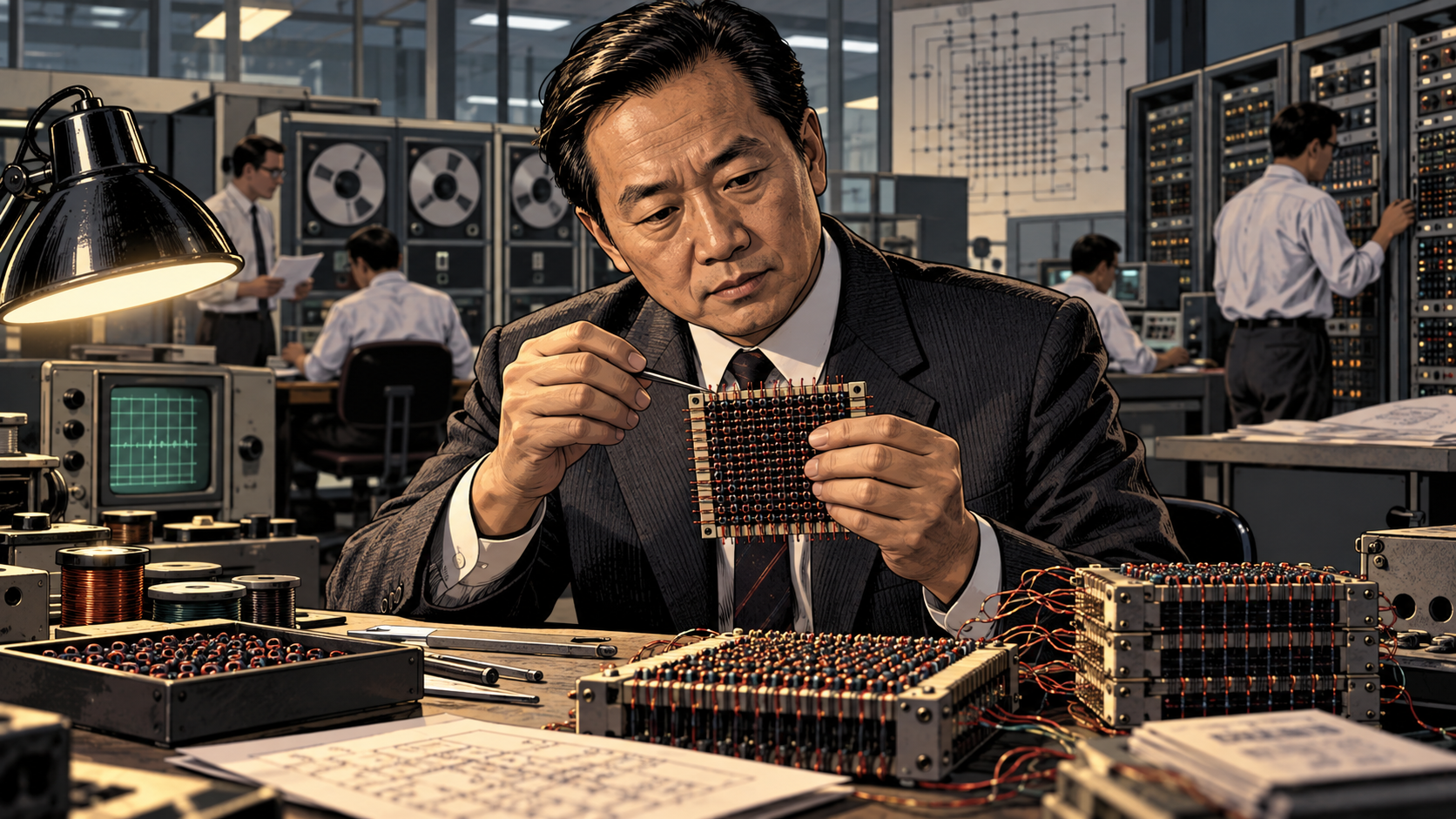
An Wang was born in Shanghai in 1920 and came to the United States after World War II for graduate study at Harvard. He earned a doctorate in applied physics and worked in the Harvard Computation Laboratory, close to the emerging world of large electronic computers.
His technical contribution centered on magnetic-core memory. Early computers needed reliable ways to store information. Wang’s work on pulse transfer control helped address the destructive-read problem in core memory systems, where reading data could erase it unless the system restored the value. He received a patent and later sold rights connected to the technology to IBM.
The money from that early intellectual property did more than reward an inventor. It helped fund a company. Wang Laboratories was founded in 1951 and moved through several product eras: electronic calculators, typesetting equipment, minicomputers, and eventually word-processing and office systems.
That sequence matters. Wang was not a single-product founder. He kept searching for commercial applications where specialized computing could solve expensive work problems. The company sold to organizations, not hobbyists. Its customers cared about reliability, office productivity, and support.
By the 1970s, offices were drowning in typed documents, revisions, carbon copies, and administrative labor. Wang Laboratories found its opening by making word processing a dedicated business tool. Secretaries, legal departments, government offices, and corporations could revise documents on screens before printing. That sounds ordinary now. In the 1970s, it changed office rhythm.
The biography of An Wang is therefore a story about translating invention into systems. He did not merely invent a component and stop. He used technical authority to build machines, sales channels, and a brand that stood for serious office computing.
Why did Wang’s word processing empire grow so fast?

Wang’s great commercial insight was that offices did not always want general-purpose computers. They wanted work done. A dedicated word-processing system could be easier to buy, easier to train on, and easier to justify than a broad computer strategy.
The Wang WPS and Office Information System gave organizations a visible productivity upgrade. Workers could edit, store, retrieve, and print documents with far less retyping. In law firms, corporations, and public agencies, that saved time and reduced errors. Managers did not need to imagine a personal-computer future. They could see piles of paper shrinking.
Wang Laboratories became one of the most prominent companies in the Massachusetts technology boom. Public histories commonly describe peak annual revenue in the billions of dollars and employee counts in the tens of thousands. Harvard Business School’s Baker Library notes that at its peak in the 1980s Wang Laboratories had about 23,000 employees and annual revenue of about $2 billion. Other summaries cite even higher peak figures depending on year and definition.
The company’s culture reflected its founder. Wang was technically confident, intensely competitive, and personally involved in strategy. He saw IBM as both model and rival. That ambition gave the company nerve. It also created a dangerous gravitational pull: if the founder believed the proprietary path was right, dissent had to fight uphill.
For customers, the system worked. For a time, the tighter Wang stack was an advantage. Hardware, software, storage, terminals, support, and workflow were integrated. The company could optimize for the document worker, not for abstract compatibility.
| Year | Event | Why it mattered |
|---|---|---|
| 1920 | An Wang was born in Shanghai | His life bridged Chinese engineering education and American computing |
| 1948 | Earned a Harvard PhD in applied physics | The technical base for his computing career |
| 1951 | Founded Wang Laboratories | Converted invention into a business platform |
| 1955 | Core-memory patent rights were sold to IBM | Patent value helped fund expansion |
| 1976 | Wang word-processing systems gained traction | The company found its office-productivity engine |
| Early 1980s | Wang reached multibillion-dollar scale by public historical accounts | Proprietary office systems became a major enterprise market |
| 1990 | An Wang died | The company lost its defining founder during a strategic transition |
| 1992 | Wang Laboratories filed for Chapter 11 bankruptcy protection | The proprietary empire failed to adapt quickly enough |
What caused the rise and fall of Wang Laboratories?

The rise and fall of Wang Laboratories was not caused by one bad product or one missed meeting. It came from a strategic mismatch between a company optimized for dedicated office systems and a market moving toward open personal computers and networked software.
In the dedicated-system era, Wang controlled the experience. That made implementation simpler. But as IBM PCs and compatibles spread, customers began to value interoperability, lower hardware costs, third-party software, and standards. A proprietary system that once felt safe began to feel restrictive.
Wang also faced the classic innovator’s problem. Its most profitable customers had invested in existing systems. Abandoning that base too quickly risked revenue and trust. Moving too slowly risked irrelevance. The company tried to bridge the gap, including moves toward Unix and IBM-compatible hardware, but public accounts of the period repeatedly describe those efforts as late or insufficient.
Succession deepened the issue. Wang’s son Fred Wang became president in the 1980s, a decision that drew scrutiny as the company struggled. Founder-led companies often face this test: can technical charisma become institutional adaptability? At Wang, the answer came too late.
The company’s financial pressure became visible in layoffs, losses, and restructuring. In August 1992, Wang Laboratories filed for Chapter 11 bankruptcy protection. Contemporary reporting described thousands of additional job cuts and a company trying to reorganize after years of decline.
The tragedy is that Wang was not wrong about office productivity. He was early and right about the value of digital documents. The company lost because the architecture of that value shifted. Customers still needed writing, editing, storage, and retrieval. They simply no longer needed Wang’s closed world to get it.
What was An Wang’s net worth and legacy?

Estimates of An Wang’s personal net worth varied with Wang Laboratories’ public valuation, stock price, and the timing of measurement. At the company’s height, he was widely treated as one of the most successful immigrant technology entrepreneurs in America. After the decline, the market value attached to that empire shrank dramatically.
The more durable legacy is not a single net-worth figure. It is the pattern. Wang turned a technical patent into capital, capital into a company, and a company into a major office-computing force. That arc remains one of the most important Asian American entrepreneurship stories in twentieth-century technology.
His legacy also includes philanthropy and civic presence, especially in the Boston area. The Wang name became attached not only to laboratories and office machines but to public institutions and cultural spaces. The founder’s life entered the broader history of immigrants who changed American technology from inside its universities and companies.
Yet legacy has to hold the failure too. Wang Laboratories is a case study because it reached real scale and still fell. A smaller company can blame obscurity. Wang could not. It had customers, revenue, engineers, brand recognition, and time. What it lacked was a transition fast enough to survive a platform shift.
That makes the story more useful than a clean success myth. It warns founders that the system customers love today can become the system they need to escape tomorrow. It also warns investors not to confuse installed base with permanent moat.
What can founders learn from An Wang’s biography?

The first lesson is that proprietary integration can be a weapon. Wang won because the company packaged complexity into systems customers could use. In markets where buyers are overwhelmed, an integrated product can beat a collection of flexible parts.
The second lesson is that integration can become captivity. Once the broader market standardizes around open platforms, the closed stack must justify itself every year. If it cannot, customers begin to count the exits.
The third lesson is that founder conviction has an expiration date unless it is paired with learning. Wang’s confidence was essential in the early years. It let him challenge giants. But the same confidence made strategic reversal harder.
The final lesson is about timing. Wang did not miss digital office work. He helped create it. The company missed the moment when digital office work moved from dedicated machines to commodity personal computers and networked software. That is a subtler failure and a more frightening one: being right about the need but wrong about the winning form.
FAQ
What did An Wang invent?
An Wang is best known for contributions to magnetic-core memory, especially pulse transfer control concepts connected to making core memory practical.
How did An Wang make his money?
He built Wang Laboratories, which sold calculators, minicomputers, word-processing systems, and office information systems to business and government customers.
What happened to Wang Laboratories?
The company declined as personal computers and open systems displaced proprietary office systems, then filed for Chapter 11 bankruptcy protection in August 1992.
What was An Wang’s net worth?
His wealth rose and fell with Wang Laboratories’ valuation. The most reliable way to discuss it is as founder equity in a once multibillion-dollar public technology company, rather than a fixed current figure.
Why is the Wang Laboratories story important?
It shows how a company can invent an important category, scale rapidly, and still lose when market architecture shifts from closed systems to open platforms.
💡 Key Insights
- ▸ The rise and fall of Wang Laboratories shows how a brilliant proprietary system can become a strategic prison.
- ▸ An Wang built from invention to enterprise by selling tools that made office work faster before personal computers became standard.
- ▸ The biography of An Wang is also a succession and platform-transition case study.
- ▸ A company can be right about a customer problem and still lose if the architecture of the market changes.