Ben Francis: How Gymshark Turned Community Into a Global Fitness Brand
Ben Francis began sewing gym clothes in a Birmingham garage. Gymshark scaled by turning athletes, creators, and customers into a distribution machine.
View all stories about this mogul
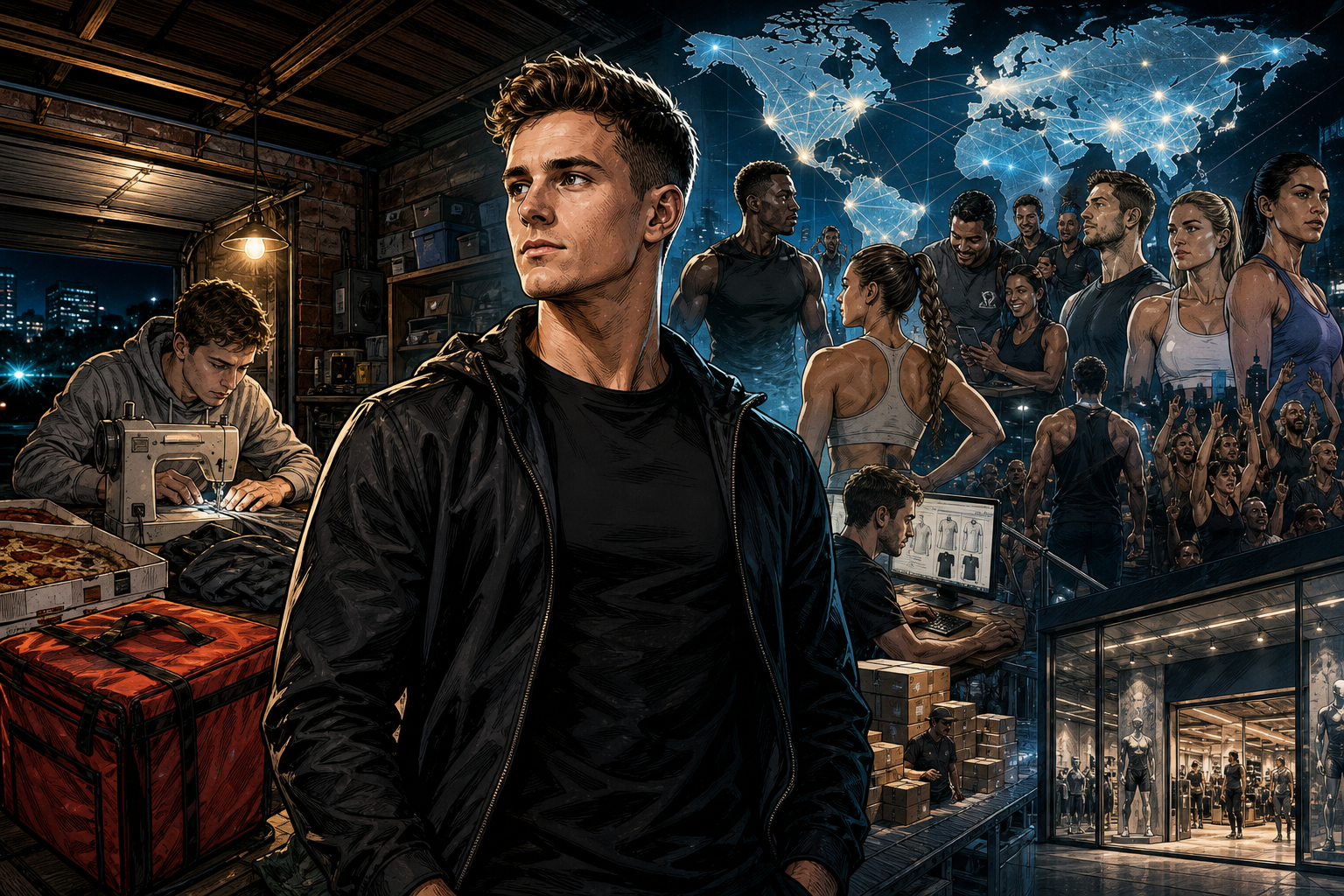
Before Gymshark became a global fitness brand, Ben Francis was a university student delivering pizzas and trying to make bodybuilding clothes that actually fit the bodies he saw online.
The company did not begin with a fashion-house pedigree, a celebrity contract, or a network of stores. It began in 2012 around Birmingham, England, with Francis and Lewis Morgan experimenting with a website, supplements, a sewing machine, and the visual language of an emerging internet fitness culture.
What Gymshark eventually built was larger than apparel. It created a feedback and distribution system in which athletes demonstrated the product, customers copied the lifestyle, and social media made a young brand feel like a club with global membership.
The Garage, the Pizza Route, and a Product Gap

Francis was studying at Aston University and working as a Pizza Hut delivery driver when he started Gymshark. The first version of the business reportedly sold supplements through dropshipping. It was cheap to start, but it gave the founders little control over the thing customers actually received.
Apparel offered a different opportunity. The fast-growing online bodybuilding scene had specific tastes: fitted silhouettes, stretch, dramatic taper, and clothing that photographed well during training. Traditional sportswear companies served broad athletic markets. Gymshark could speak directly to a narrower tribe.
Francis learned to sew with his grandmother and began making garments with basic equipment. That origin story became part of the brand, but the business logic mattered more than the romance. Making product created a tighter learning loop. Gymshark could watch how a shirt fit, hear complaints, alter the cut, and release again without persuading a giant retailer to care.
The founders also chose direct-to-consumer e-commerce when online apparel still carried meaningful friction. Customers could not touch the fabric or try the size. Gymshark compensated by showing the clothes repeatedly on recognizable bodies in recognizable workouts. The content reduced uncertainty while building aspiration.
Athletes Became the First Distribution Network

Gymshark sent products to YouTube fitness personalities before “influencer marketing” became an agency line item. Creators such as Lex Griffin and Nikki Blackketter had audiences that trusted their routines, personalities, and recommendations. Their reach was smaller than a global celebrity’s, but their relevance was concentrated.
The company called many of these partners athletes, a framing that did more than describe a sponsorship. It made them members of the Gymshark world. Fans could see the same person over months, watch the clothing survive actual workouts, and associate the logo with progress.
This distribution model matched the product cycle. Social engagement revealed what people wanted. Limited launches created urgency. Sold-out items produced visible demand and reduced some inventory risk, although scarcity could also frustrate customers.
The 2013 BodyPower fitness trade show became an important proof point. Gymshark’s online community appeared in physical form, overwhelming a small booth and demonstrating that digital attention could produce queues, sales, and belonging. The company learned that events were not merely marketing. They were rituals where online identity became real.
Competitors could hire creators. The harder asset to copy was the network effect of association: athletes wanted access to the audience, customers wanted access to the culture, and each new release gave everyone content to share.
Hypergrowth Forced the Founder to Step Aside

Founder stories often skip the moment when improvisation stops working. Gymshark grew faster than the management experience of its creators. International shipping, forecasting, customer service, finance, technology, and people systems were no longer garage problems.
Francis made an unusual move: he stepped away from the chief executive role and let experienced operators run the company while he learned different parts of the organization. Steve Hewitt, who became CEO, helped professionalize the business. Francis worked across functions and later described the period as an education rather than an exile.
The decision protected a valuable distinction. Founding insight and executive readiness are not the same asset. A founder can retain product instinct, cultural authority, and long-term ownership while accepting that another person is better prepared for the current operating stage.
Gymshark also had to survive the less glamorous consequences of growth. A heavily promoted 2015 Black Friday sale reportedly overwhelmed the website. Francis publicly apologized, and the company compensated affected customers. The failure became an infrastructure lesson: community-driven demand is only valuable when checkout, inventory, and fulfillment can carry it.
By learning inside the scaled company, Francis prepared for a later return to the CEO role. The path was not the standard mythology of an irreplaceable genius. It was a recognition that the founder himself had to become a new system.
From Online Drop Culture to Global Institution

In 2020, General Atlantic acquired a minority stake in a deal that valued Gymshark above £1 billion, according to the firms’ announcement. Francis remained the controlling owner, while the partnership added capital and experience for international expansion.
The timing was dramatic. Pandemic restrictions accelerated home fitness and e-commerce, but they also disrupted supply chains and changed the competitive environment. The brand that had grown without permanent stores eventually opened a major Regent Street location in London. The store was less a rejection of digital than an extension of the community logic: training spaces, events, and human contact gave the brand another kind of media.
Scale creates tension. Gymshark must serve a wider population without losing the specificity that made early customers care. It faces sportswear giants with vast technical budgets, celebrity pipelines, and retail distribution. It also faces hundreds of digitally native apparel brands using the same creator playbook.
Its defense cannot be “we use influencers.” That tactic is now ordinary. The deeper advantage is organizational: a direct relationship with customers, a recognizable design language, event capability, creator management, and a founder whose personal story remains tied to the user base.
But community can turn against a brand when quality slips, inventory misses demand, or values feel performative. Every launch tests whether belonging still produces a product worth buying.
The Real Lesson: Community Is an Operating System

Gymshark is often reduced to a lesson in influencer marketing. That is too shallow. The company connected community to product development, demand generation, physical events, founder identity, and direct commerce.
The most transferable insight is not to send free products to popular people. It is to find a group with a shared identity, listen closely enough to make a product that signals membership, and build operations that can honor the attention when it arrives.
Francis also demonstrated a second discipline: surrendering a title can protect control over the long term. By allowing stronger operators to professionalize Gymshark, he gave himself time to grow into the company he had created.
The garage made the story memorable. The machine behind it—fast feedback, concentrated cultural relevance, operational learning, and patient founder ownership—made the story durable.
💡 Key Insights
- ▸ A subculture can become distribution when the brand gives its members status, identity, and a reason to gather.
- ▸ Direct customer feedback helped Gymshark turn creator attention into faster product decisions.
- ▸ Founder mythology attracts attention, but operational executives and systems make international scale possible.
- ▸ Scarcity can ignite demand; durable value depends on product quality, inventory discipline, and repeat purchase.