George Eastman: The Kodak System That Put Photography in Everyone's Hands
George Eastman transformed photography from a specialist craft into a mass habit by combining roll film, simple cameras, processing, distribution, and a global brand.
View all stories about this mogul
George Eastman did not merely make cameras cheaper. He redesigned photography so the customer no longer needed to understand most of it.
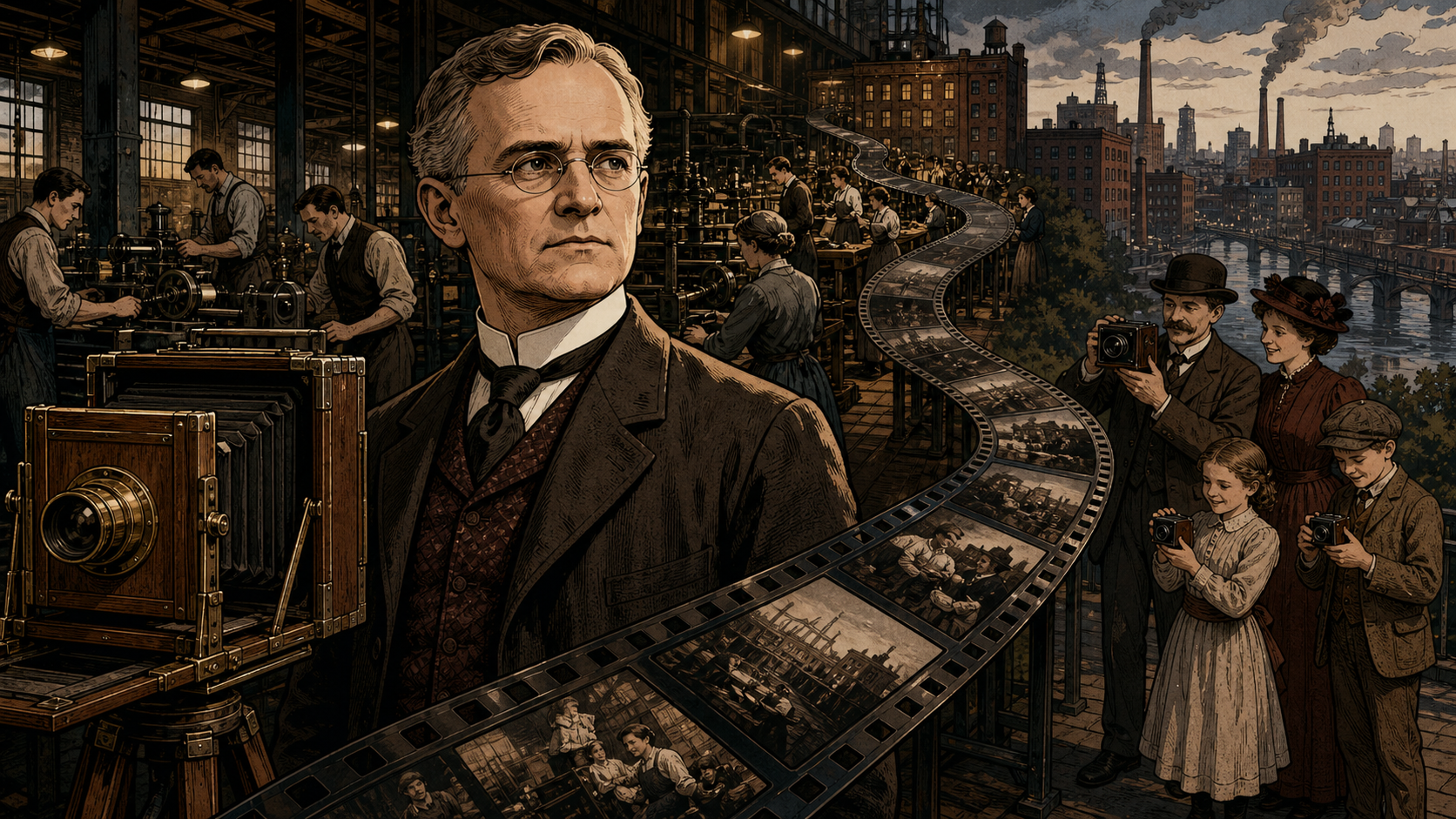
In the nineteenth century, photography demanded heavy equipment, fragile glass plates, chemical preparation, and technical patience. Eastman separated the magical moment—pointing a camera at life—from the industrial work required to produce an image.
The famous promise, “You press the button, we do the rest,” described more than advertising. It described a vertically coordinated system of camera, roll film, processing, printing, distribution, and trust.
How did George Eastman turn photography into a consumer product?

Eastman was born in 1854 in Waterville, New York, and went to work young after his father’s death strained the family’s finances. He became interested in photography while planning a trip and discovered that the available process was closer to operating a portable laboratory than carrying a modern camera.
That inconvenience became the opportunity. Photographers were moving from wet plates, which had to be prepared and developed quickly, toward dry plates that could be manufactured in advance. Eastman experimented with coating methods and built machinery to produce plates consistently.
The strategic leap was flexible film. Replacing individual glass plates with a roll reduced weight and created a path toward smaller, simpler cameras. Eastman’s company introduced the Kodak camera in 1888, loaded with enough film for many exposures. Customers sent the whole camera back for processing, printing, and reloading.
This removed the most intimidating steps. The customer did not need a darkroom, chemistry training, or a collection of plate holders. Kodak converted a complex craft into a service experience.
Eastman understood that invention alone would not create the market. Film had to be consistent. Cameras had to survive ordinary handling. Processing had to be dependable. Dealers needed supply and support. The brand had to explain a new behavior: recording vacations, children, friends, and daily life for no professional purpose at all.
The name Kodak was short, distinctive, and easy to protect. Eastman reportedly favored the letter K and wanted a word that worked as a trademark rather than a description. The brand could therefore gather meaning as the category grew.
Why was Kodak’s business model more powerful than the camera?
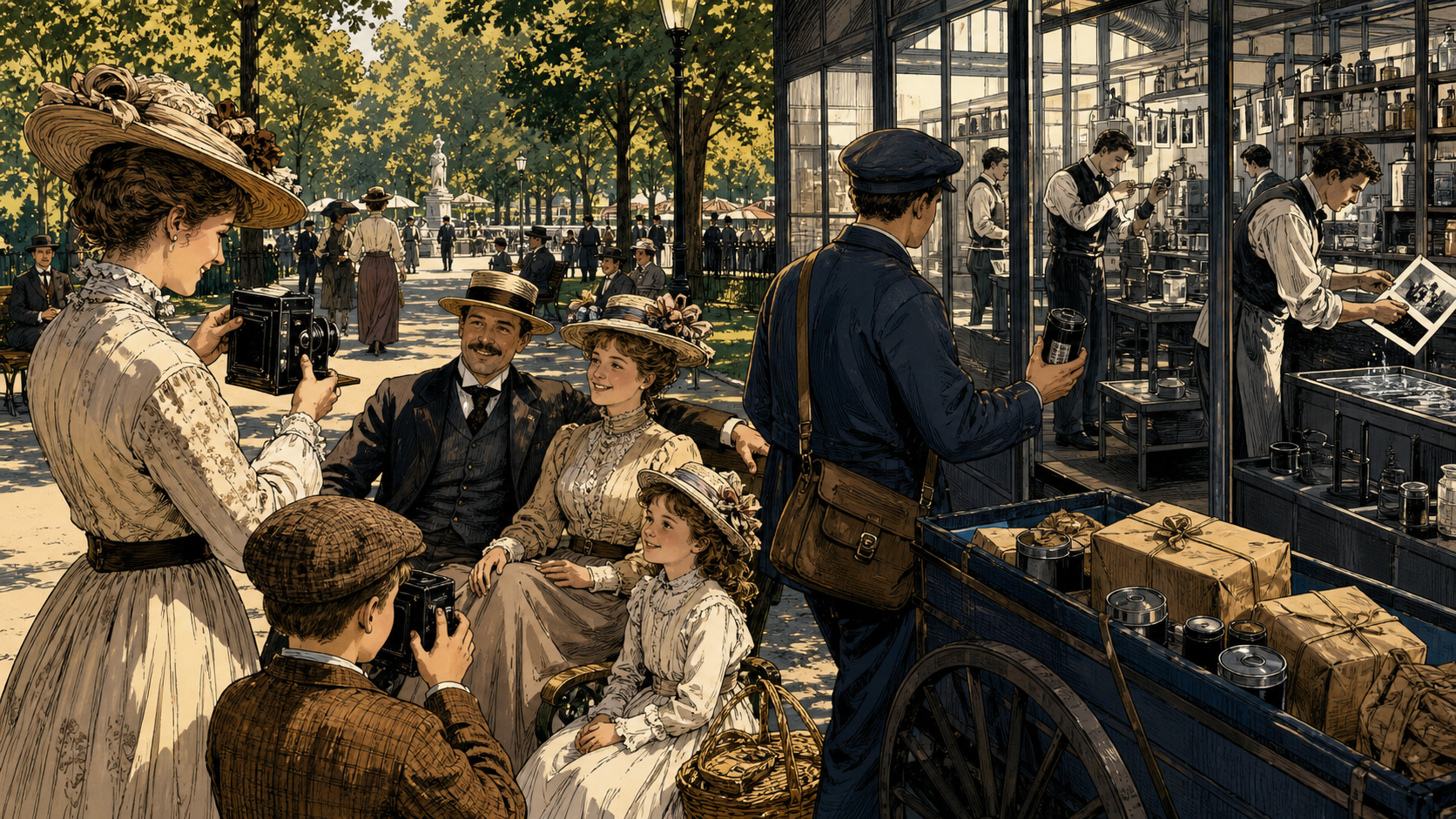
The camera opened the door, but film and processing created repetition. Every roll represented another purchase and another trip through Kodak’s system. A growing installed base of cameras increased demand for consumables, while better film and broader processing made the cameras more attractive.
Eastman used scale aggressively. Standardized manufacturing lowered unit costs. Mass advertising expanded the social meaning of photography. Distribution placed products near consumers. Research improved emulsions, film bases, color processes, and motion-picture applications.
The Brownie camera, introduced in 1900 at a very low price, pushed the model further. Children and families could become photographers. Kodak was not simply selling hardware; it was teaching a population to generate memories that required Kodak materials.
The model also influenced cinema. Flexible film made motion-picture capture practical, and Kodak became a critical supplier to an industry whose demand for reliable film stock could be enormous. Consumer snapshots and Hollywood productions looked different, but both depended on sophisticated chemical manufacturing hidden behind the image.
Eastman’s management combined paternalism with unusually broad employee programs for the era, including profit-sharing and benefits. Those programs could support retention and productivity while reflecting his views about distributing some gains from industrial scale. They did not erase the hierarchy or conflicts of a large corporation, but they became part of his operating reputation.
He also gave substantial sums to education, health, dentistry, music, and institutions including the University of Rochester and the Massachusetts Institute of Technology. His philanthropy often favored systems that could expand capability rather than ceremonial monuments.
What does Kodak’s later decline reveal about Eastman’s legacy?

Kodak’s twentieth-century dominance made photography nearly synonymous with film. That success also concentrated the company’s economics around chemical consumables and processing. Digital imaging broke the repetition loop: once a customer owned a digital camera, taking another photograph no longer required another frame of film.
Kodak researchers built an early digital-camera prototype in the 1970s, but possessing technical knowledge and reorganizing a profitable company around it were different problems. Digital photography threatened margins, factories, channels, and internal measures of success. The system Eastman had perfected became difficult to abandon.
That later failure should not be projected backward as proof that the original model was mistaken. Eastman’s achievement lasted because it aligned technology, operations, distribution, and behavior for generations. The caution is that a system can be both brilliantly designed and eventually obsolete.
His deepest contribution was abstraction. The user pressed a button; an industrial network handled the rest. Modern cloud services, app stores, and managed platforms use the same strategic move: conceal expert complexity behind a reliable interface, then build recurring economics around the simplified experience.
Eastman helped billions of ordinary moments become records. He also demonstrated that the company controlling a workflow may be more powerful than the company selling one device—and more exposed when that workflow disappears.
💡 Key Insights
- ▸ A breakthrough product becomes a mass market when the surrounding workflow becomes simple.
- ▸ Recurring consumables can subsidize adoption and align distribution around repeat use.
- ▸ Brand language can make an unfamiliar technology feel safe enough for ordinary customers.
- ▸ A company can invent a category and still become vulnerable when the category's economics change.