Hasso Plattner: How SAP Built the Operating System of Global Business
Hasso Plattner helped turn real-time business software into SAP, challenged the database industry with HANA, and built an institution beyond the founder.
View all stories about this mogul
Hasso Plattner helped build software most consumers never see but much of global business cannot easily stop using.
SAP’s systems sit inside finance departments, factories, warehouses, procurement teams, utilities, airlines, and governments. They record orders, close books, plan production, and connect processes that once lived in separate files. That reach turned five former IBM employees in Germany into the founders of Europe’s most important software company.
Plattner’s legacy is not only scale. He repeatedly pushed SAP through architectural change, then spent years confronting the consequences of the complexity the company had created.
How did five IBM engineers build SAP around real-time business data?
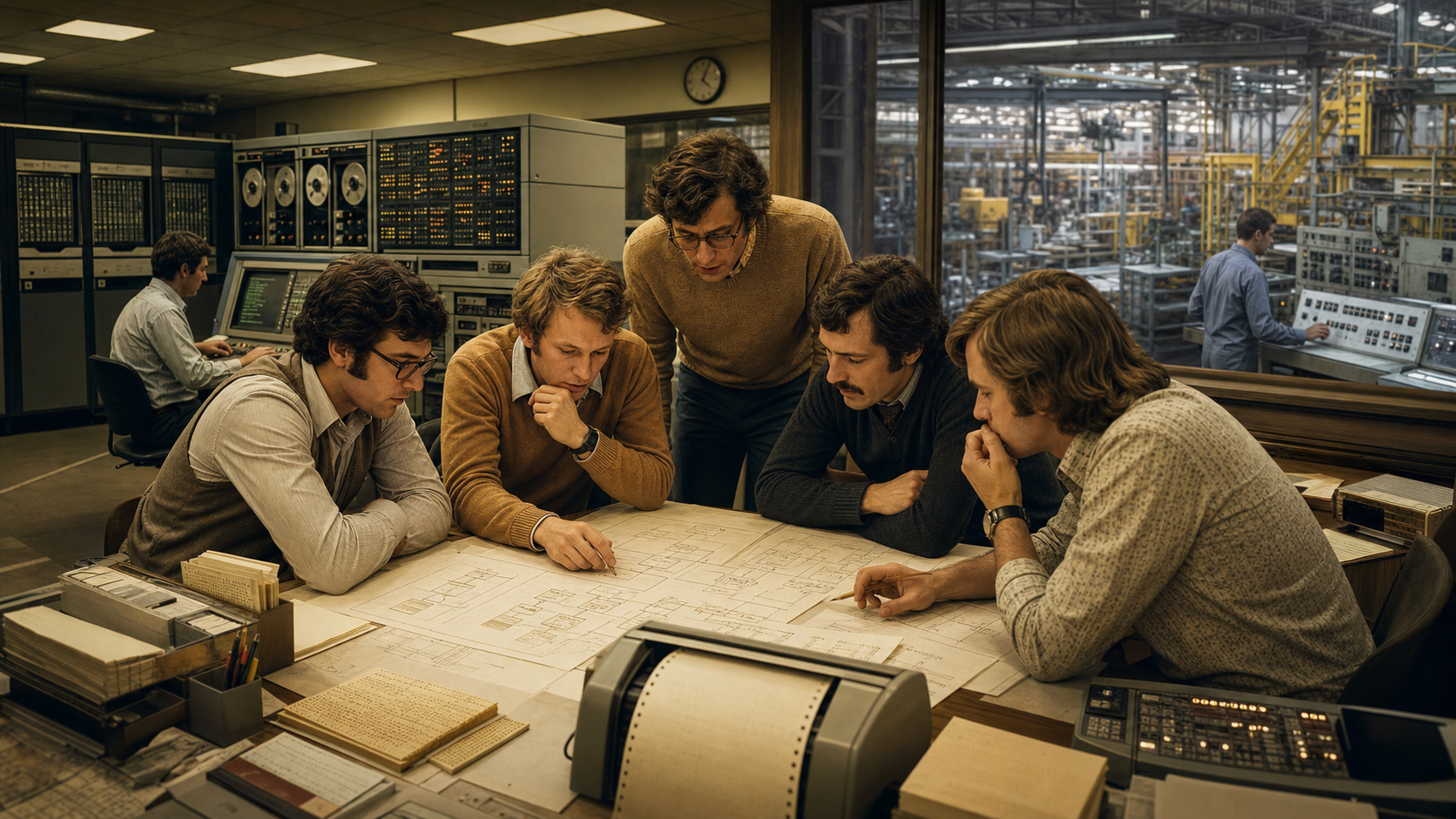
In 1972, Plattner, Dietmar Hopp, Claus Wellenreuther, Klaus Tschira, and Hans-Werner Hector left IBM and created what became SAP. Their core idea challenged the batch-processing norm. Business data should be available in real time, and multiple functions should work from an integrated system.
That sounds obvious now. It was not obvious when computing was scarce and departments often built separate workflows. Integration required a common data model, disciplined configuration, and software flexible enough to serve different industries and countries.
SAP’s early financial accounting product led to the R/2 system for mainframes. The company grew with major European industrial customers that needed reliable, standardized processes. SAP did not merely automate a clerk’s task. It embedded itself in the operating logic of the enterprise.
| Year | Turning point | Why it mattered |
|---|---|---|
| 1972 | SAP founded by five former IBM employees | Real-time integrated business software became the mission |
| 1979 | SAP R/2 emerged | The mainframe suite expanded enterprise reach |
| 1988 | SAP went public | Capital and visibility supported global expansion |
| 1992 | SAP R/3 launched | Client-server architecture opened a new growth era |
| 1998 | SAP listed in New York | The German company asserted global software status |
| 2010 | SAP HANA introduced | In-memory computing became Plattner’s next architectural bet |
| 2024 | Plattner left the supervisory board | More than five decades of formal leadership ended |
Why did SAP R/3 become a global corporate standard?

R/3 shifted SAP from the mainframe era into client-server computing. Companies could run applications across distributed systems while keeping integrated processes. The timing aligned with globalization, process reengineering, the rise of consulting firms, and corporate fear surrounding the year-2000 transition.
SAP’s moat expanded beyond code. Consultants learned implementation methods. Universities trained users. Partners built add-ons. Employees developed careers around modules and certifications. Customers customized processes and accumulated years of operational data.
This ecosystem made SAP powerful and difficult. Implementations could take years and cost heavily. Customization helped a customer fit the software, but too much customization made upgrades painful. The system became indispensable partly because replacing it required changing the organization around it.
Plattner served as co-chief executive and later chairman of the supervisory board. His influence came from technical credibility as much as title. He could argue about architecture with engineers and about competitive positioning with directors.
What was Hasso Plattner trying to prove with SAP HANA?
By the 2000s, SAP depended heavily on database products supplied by other companies. Plattner championed in-memory computing: keeping large datasets in memory and using a column-oriented architecture to accelerate analysis and transactions.
SAP HANA, introduced in 2010, was both technology and strategy. It offered the possibility of simplifying data layers, combining transactional and analytical work, and controlling more of the platform beneath SAP applications. It also forced customers toward a major migration.
Critics questioned cost, lock-in, maturity, and whether the promised simplification arrived quickly enough. Supporters saw HANA as a necessary break from accumulated architecture. SAP later made HANA central to S/4HANA, the next-generation enterprise suite.
The bet reveals Plattner’s founder pattern. He was willing to destabilize the installed base to prevent the company from becoming a caretaker of old software. That instinct is valuable and dangerous. Enterprise customers prize innovation, but they also prize continuity because payroll, procurement, and factories cannot become experiments.
What is the real lesson of Hasso Plattner’s SAP legacy?
Plattner’s influence extended into education and philanthropy. The Hasso Plattner Institute in Potsdam became a center for digital engineering, while his support helped popularize design thinking and connect academic work with practical software building.
His long supervisory-board tenure also raised the central governance question of founder-led companies: when does continuity become dependence? SAP cycled through leadership models and strategic transitions while Plattner remained a powerful reference point. His departure from the board in 2024 marked the end of formal control but not the disappearance of the architecture and culture he shaped.
Frequently asked questions
Did Hasso Plattner found SAP alone?
No. He co-founded SAP in 1972 with Dietmar Hopp, Claus Wellenreuther, Klaus Tschira, and Hans-Werner Hector.
What was Hasso Plattner’s main technical contribution?
He was central to SAP’s product and architecture direction, including the company’s shift through R/3 and later the HANA in-memory platform.
Why is SAP so hard for customers to replace?
Its software is woven into core processes, data, employee skills, consulting relationships, and industry-specific configurations.
What is the Hasso Plattner Institute?
It is a university institute in Potsdam focused on digital engineering and computer science, established with Plattner’s support.
The real lesson is that the deepest software moats are organizational. SAP became durable because companies built their own operating habits around it. Plattner’s achievement was to see integrated real-time data before it became standard—and to keep forcing architectural change after the first insight had already made him wealthy.
💡 Key Insights
- ▸ SAP won by integrating business functions around shared data rather than selling isolated departmental software.
- ▸ Plattner repeatedly used architecture shifts—from real time to client-server to in-memory computing—to force organizational renewal.
- ▸ Enterprise software creates a deep moat because customer processes, partners, skills, and data grow around the product.
- ▸ Founder succession is not a single handover; it is a long transfer of product authority, governance, and institutional identity.