Henry Ford: The Broke Mechanic Who Put the Entire World on Wheels
Two bankruptcies, one radical idea, and the $5/day wage that terrified every capitalist in America — how Henry Ford built the machine that built the modern world.
View all stories about this mogul
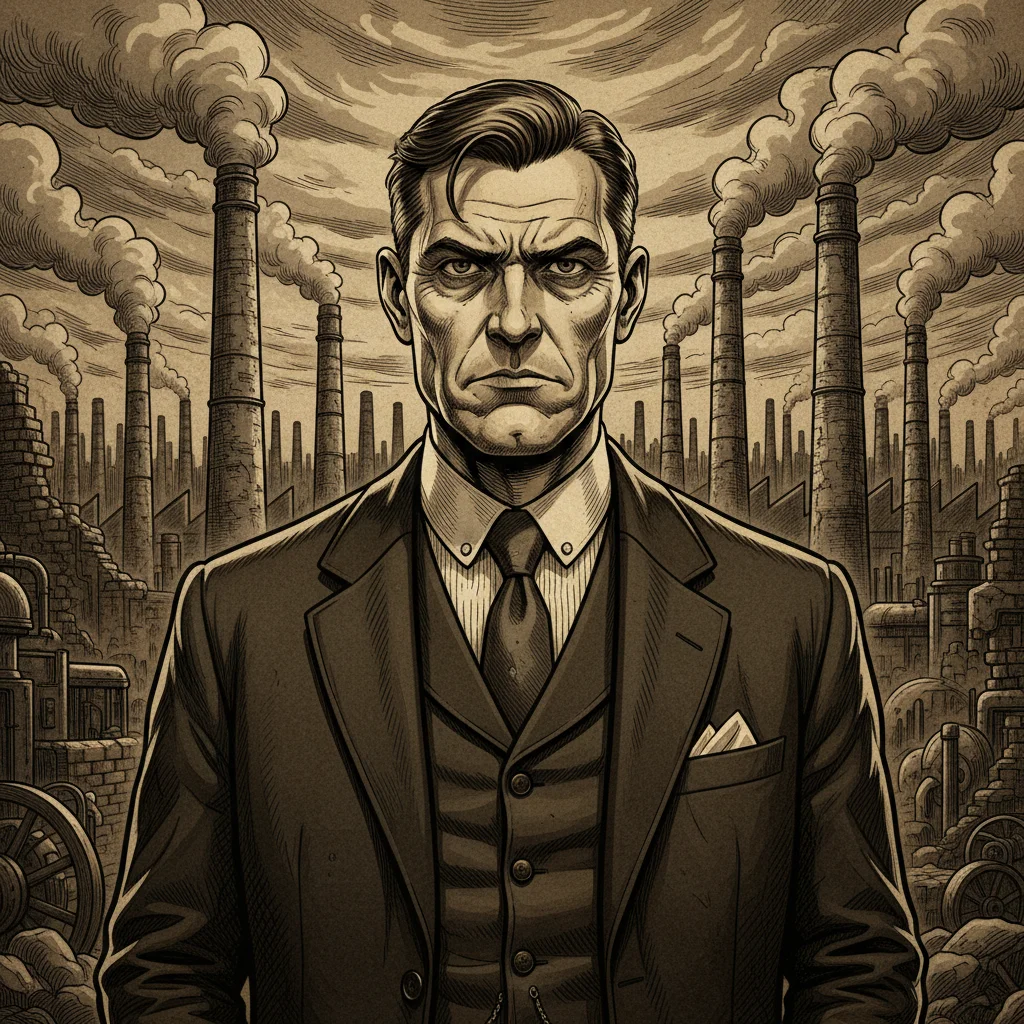
Henry Ford failed twice before he succeeded once. His first company collapsed. His second company’s investors literally fired him. He was a 40-year-old mechanic with no college degree, no family money, and a reputation for being impossible to work with when he finally launched the Ford Motor Company on June 16, 1903, with $28,000 in cash — about $970,000 in today’s money. Within two decades, he’d become the richest man in America, put 15 million identical black cars on the road, and fundamentally rewire how human beings build things, buy things, and earn a living.
He also used his fortune to run one of the most poisonous antisemitic propaganda campaigns in American history, and Adolf Hitler kept a life-size portrait of Ford in his office in Munich. So maybe “complicated” is an understatement.
This is the story of the broke mechanic who democratized the automobile, accidentally invented the American middle class, and proved that the same brain capable of world-changing brilliance can also produce world-historic evil.
🔧 Chapter 1: The Farm Boy Who Hated Farming (1863–1896)

Henry Ford was born on July 30, 1863, on a prosperous farm in Dearborn, Michigan — roughly eight miles west of Detroit. His father, William Ford, was an Irish immigrant who’d done well. Good land. Comfortable house. The expectation was crystal clear: Henry would take over the farm.
Henry wanted absolutely nothing to do with it.
The Boy Who Dismantled Everything
From the time he could hold a screwdriver, Ford was obsessed with machines. He took apart every mechanical object he could get his hands on — watches, clocks, farm equipment — and put them back together to see how they worked. His sister Margaret later recalled: “Every clock in the house shuddered when it saw him coming.”
When his mother, Mary Litogot Ford, died in 1876, thirteen-year-old Henry was devastated. He later said: “I never had any particular love for the farm. It was the mother on the farm I loved.” With her gone, the farm became a prison.
At sixteen, he walked to Detroit — literally walked — and got a job as an apprentice machinist at James F. Flower & Bros. He earned $2.50 a week (about $80 in today’s dollars) and paid $3.50 for room and board. Do the math. He was losing money. So he picked up night work repairing watches — the same watches he’d been dismantling since childhood — to close the gap. This is a pattern that will repeat throughout Ford’s life: obsessive work ethic subsidizing an income that doesn’t yet match his ambition.
Steam, Gas, and the Idea That Wouldn’t Die
Ford bounced between jobs throughout the 1880s — running a sawmill, repairing steam engines, working for Westinghouse. He married Clara Bryant in 1888, and she became the single most important stabilizing force in his entire life. Clara believed in Henry when literally no one else did. Ford called her “The Believer.”
In 1891, Ford took a job as an engineer at the Edison Illuminating Company in Detroit, earning $45 a month. Good, steady work. A future. But Ford wasn’t thinking about electricity. He was thinking about gasoline.
The internal combustion engine had been around for years — Karl Benz patented his Motorwagen in Germany in 1886. But in America, cars were handmade toys for the rich. Ford became consumed with the idea of building a gasoline-powered “horseless carriage” that ordinary people could afford. He spent every night and every weekend in a brick shed behind his apartment at 58 Bagley Avenue, piecing together an engine from scrap parts.
On June 4, 1896, at 2:00 AM, Henry Ford rolled his first car — the Quadricycle — out of that shed. There was just one problem: the door wasn’t wide enough. He grabbed an axe and smashed through the brick wall. The metaphor writes itself.

The Quadricycle was absurd by modern standards. It looked like two bicycles bolted together with a motor strapped on. It had no reverse gear, no brakes to speak of, and a top speed of about 20 mph. But it ran. And Ford drove it through the empty streets of Detroit at 2 AM with Clara following behind on a bicycle. That night, the automobile age in America began in a brick shed with an axe hole in the wall.
💀 Chapter 2: Two Failures and a Firing (1899–1902)

Here’s the part most people skip: Henry Ford didn’t go from Quadricycle to world domination. He went from Quadricycle to disaster. Twice.
The Detroit Automobile Company (Failure #1)
In August 1899, Ford left his secure job at Edison Illuminating to co-found the Detroit Automobile Company with a group of wealthy investors, including William H. Murphy, a prominent lumber baron. The investors put up $150,000 (about $5.6 million today). Ford was supposed to build cars.
He didn’t build cars. He tinkered. He experimented. He refused to ship anything he didn’t consider perfect. Month after month, investors watched their money burn while Ford endlessly refined prototypes that never reached customers. By January 1901, the company had produced approximately 20 vehicles — maybe fewer — and the quality was inconsistent. The investors pulled the plug. The Detroit Automobile Company was dissolved.
Ford was 37 years old, unemployed, and labeled as the guy who burned through $150,000 of other people’s money with almost nothing to show for it. In a town the size of Detroit’s business community, that reputation was a death sentence.
The Henry Ford Company (Failure #2)
But William Murphy gave Ford a second chance. In November 1901, they launched the Henry Ford Company. This time, Murphy brought in Henry Leland — a precision machinist and one of the most respected engineers in Detroit — as a consultant to keep Ford in line.
It went about as well as you’d expect. Ford and Leland clashed immediately. Leland wanted to build refined, precision-engineered luxury cars. Ford wanted to build cheap cars for the masses. The investors sided with Leland. In March 1902, Ford was effectively pushed out of the company that bore his own name.
The Henry Ford Company was renamed Cadillac. Yes, that Cadillac. The company Ford was fired from became one of the most prestigious luxury car brands in history. Leland turned it into a showcase for precision manufacturing. Meanwhile, Ford walked away with $900 and the designs he’d been working on.
He was 38 years old. Two companies down. No money. No investors willing to touch him. His own name was now attached to a company run by someone else. Most people would have gone back to fixing steam engines. Ford did the opposite — he went racing.
The Race That Saved Everything
Ford realized that the fastest way to attract new investors was to prove his engineering with speed. On October 10, 1901 — between his two company failures — he’d raced a car he built himself against Alexander Winton, the most famous race car driver in America, at the Grosse Pointe track in Detroit. Winton’s car broke down. Ford won. The crowd went insane.
That race, and a subsequent speed record attempt, caught the attention of Alexander Malcomson, a prosperous Detroit coal dealer with a gambler’s instinct. Malcomson agreed to bankroll Ford one more time. Third time’s the charm — or third time’s the biggest industrial revolution in human history.
🚗 Chapter 3: Ford Motor Company and the Model T (1903–1908)

The Ford Motor Company was incorporated on June 16, 1903. The founding capital was $28,000 in cash from twelve investors — roughly $970,000 in 2026 dollars. Ford owned 25.5% of the company and was named vice president and chief engineer. Malcomson was president. The operation ran out of a converted wagon factory on Mack Avenue in Detroit with about a dozen workers.
This time, Ford shipped product. The first car — the Model A — sold for $850 (about $29,000 today) and was a solid, simple, reliable machine. It wasn’t fancy. It wasn’t fast. But it worked, it was affordable for the upper-middle class, and Ford could actually build them in reasonable quantities. The company sold 1,708 cars in its first fifteen months and turned a profit almost immediately.
Over the next five years, Ford iterated through Models B, C, F, K, N, R, and S — each one an experiment in what the market wanted. The expensive Model K, pushed by Malcomson, flopped. The cheap Model N, Ford’s baby, sold like wildfire. Ford used the K’s failure to maneuver Malcomson out of the company, buying his shares and taking full control. By 1907, Henry Ford was president, majority owner, and the undisputed boss.
October 1, 1908: The Model T
Then came the car that changed everything.
The Model T was announced on October 1, 1908. Its initial price was $825 — about $28,000 in today’s money. That sounds expensive now, but in 1908, most cars cost $2,000 to $3,000 (roughly $68,000 to $102,000 today). Ford wasn’t competing with other carmakers. He was competing with the horse.

The Model T was purpose-built for American life in 1908, which meant dirt roads, mud, rocks, and no mechanics within 50 miles. It had high ground clearance. It was simple enough that a farmer could repair it with basic tools. It ran on gasoline, kerosene, or ethanol. The engine block was cast as a single piece — revolutionary for its time — making it cheaper and more durable than anything else on the market.
Ford described his vision with a quote that became legendary: “I will build a motor car for the great multitude. It will be so low in price that no man making a good salary will be unable to own one.”
The market’s response was immediate and overwhelming. Ford sold 10,607 Model Ts in the first year. Then demand exploded. By 1911, Ford couldn’t build them fast enough. He needed a way to produce cars not ten times faster, but a hundred times faster. He needed to reinvent manufacturing itself.
⚙️ Chapter 4: The Assembly Line Revolution (1913–1914)

Henry Ford did not invent the assembly line. Let’s get that straight right now. Continuous-flow production had been used in flour mills, meatpacking plants, and breweries for decades. Ransom Olds (of Oldsmobile) had used a rudimentary assembly line as early as 1901. The concept of interchangeable parts goes back to Eli Whitney and the musket factories of the 1790s.
What Ford did was take every one of these existing ideas — interchangeable parts, continuous flow, specialized labor, gravity slides, conveyor belts — and combine them into a single, relentless, meticulously optimized system at a scale that nobody had attempted before. And the results were staggering.
The Highland Park Plant
In January 1910, Ford moved production to a massive new factory in Highland Park, Michigan — designed by architect Albert Kahn with enormous windows and open floor plans specifically optimized for production flow. This was the laboratory where the assembly line was born.
Ford’s engineers, led by production chief Charles Sorensen and plant superintendent Peter E. Martin, began experimenting with moving assembly in the spring of 1913. The first test was on the flywheel magneto — a small component. Previously, one worker assembled an entire magneto from start to finish, taking about 20 minutes. They broke the job into 29 separate operations performed by 29 different workers along a moving belt.
Assembly time dropped from 20 minutes to 5 minutes. Then they refined the belt speed and it dropped to 5 minutes flat.
They applied the same principle to the engine, then the chassis, then the entire car. On October 7, 1913, they tested the first moving chassis assembly line. A bare frame was dragged by rope along a 250-foot line while workers added components at each station. Previously, a chassis took 12 hours and 28 minutes to assemble. The moving line cut it to 5 hours and 50 minutes. Further refinements brought it down to 1 hour and 33 minutes.
Let those numbers sink in. From 12 hours to 93 minutes. Same car. Same parts. Different system.
The Results Were Obscene
By 1914, the Highland Park plant could produce 1,000 cars per day. Ford was building more cars than all other American automakers combined. The efficiency gains were so extreme that Ford could continuously cut prices while increasing his profit margins:
- 1908: Model T price — $825 ($28,000 today)
- 1911: Price dropped to $690 ($23,000 today)
- 1914: Price dropped to $490 ($15,400 today)
- 1916: Price dropped to $360 ($10,200 today)
- 1924: The absolute lowest price — $260 ($4,700 today)
A brand-new car for $4,700 in today’s money. Ford had turned the automobile from a rich man’s plaything into something a factory worker could park in his driveway. In less than a decade, he’d done what the entire European auto industry hadn’t managed in twenty years.
But the assembly line created a problem: the work was soul-crushing. Standing in one spot, performing one repetitive motion, hundreds of times per day, at a pace dictated by the belt. Workers quit in droves. In 1913, Ford’s annual turnover rate was 370 percent — meaning he had to hire more than 52,000 workers in a single year just to keep 14,000 positions filled. The line was a machine that chewed people up.
Ford needed a solution. And the solution he came up with terrified every industrialist in America.
💰 Chapter 5: The $5 Day That Shook the World (January 5, 1914)

On January 5, 1914, Ford Motor Company made an announcement that landed on the front page of every newspaper in the country: the company would immediately raise its minimum daily wage from $2.34 to $5.00 — more than doubling pay overnight. In today’s money, that’s roughly going from $73 to $157 per day, or from about $18,000 to nearly $40,000 annually.
The business world lost its mind.
The Wall Street Journal called it “an economic crime” and warned it would lead to industrial catastrophe. The New York Times ran alarmed editorials. Other industrialists accused Ford of class treason, of trying to destabilize the labor market, of dangerous socialism. One manufacturer said Ford had “injected a virus into the system.”
Ford’s response was characteristically blunt: “There is one rule for the industrialist, and that is: make the best quality of goods possible at the lowest cost possible, paying the highest wages possible.”
Why It Was Genius, Not Charity
The $5 day was not altruism. It was one of the most brilliant business moves in American history, and the math proves it:
Turnover collapsed. That 370% annual turnover rate? It dropped to roughly 16% within a year. Ford stopped bleeding money on constantly hiring and training new workers. The savings were enormous.
The best workers in America came to Ford. When you’re paying double the going rate, you get to pick the cream of the labor force. Productivity per worker surged.
Absenteeism plummeted. Workers stopped calling in sick when losing a day meant losing $5 instead of $2.34. Daily absenteeism dropped from approximately 10% to 0.5%.
Ford created his own customers. This is the insight that made Ford a legend. A worker earning $5 a day could save up and buy a Model T. Ford was manufacturing demand for his own product. He’d closed the loop — the factory that built the cars also built the consumers who bought them.
Within two years of the $5 announcement, Ford’s profits doubled — from $30 million in 1914 to $60 million in 1916 (approximately $940 million to $1.7 billion today). The critics who called it economic suicide were humiliated.
The $5 day didn’t just change Ford Motor Company. It changed the relationship between labor and capital in America forever. It demonstrated that high wages could drive higher profits, that workers were also consumers, and that a prosperous working class was good for business. This idea — that companies should pay enough for workers to participate in the consumer economy they’re building — is the conceptual foundation of the American middle class.
The Catch
There was a dark side. To qualify for the $5 wage, workers had to submit to inspection by Ford’s “Sociological Department” — a team of investigators who visited workers’ homes to ensure they were living “properly.” Were they drinking? Gambling? Was their house clean? Were they saving money? Were immigrant workers learning English fast enough? Were their wives staying home?
Ford called it uplift. Modern observers would call it corporate surveillance. The Sociological Department was eventually disbanded, but it reveals something important about Ford’s psychology: he genuinely believed he knew how other people should live, and he had no qualms about using his economic power to enforce that belief. This paternalistic authoritarianism would metastasize into something far uglier in the 1920s.
🏭 Chapter 6: The Rouge, the Stranglehold, and Stubbornness (1917–1927)

By the late 1910s, Ford was the most famous industrialist on Earth and one of its richest men. His personal fortune reached an estimated $1.2 billion by the mid-1920s — roughly $21 billion in today’s dollars. Ford Motor Company had a near-monopoly on the American car market, selling more than half of all automobiles in the United States.
In 1917, Ford began construction on the Rouge River Complex in Dearborn — a factory so massive, so vertically integrated, that it became a wonder of the industrial world. At its peak, the Rouge employed over 100,000 workers. Raw iron ore, rubber, and sand went in one end. Finished automobiles came out the other. Ford owned the iron mines, the rubber plantations, the forests for lumber, the railroads, and the ships. He controlled every step of production from raw earth to finished car.
It was the largest industrial complex on the planet. The Rouge had its own power plant, its own steel mill, its own glass factory. It was less a factory than a self-contained industrial city. Architect Albert Kahn designed the buildings. Diego Rivera painted murals of its workers that now hang in the Detroit Institute of Arts.
The Model T Problem
But Ford had a fatal flaw, and it was the same trait that had made him great: stubbornness.
The Model T was an extraordinary car for 1908. By 1920, it was outdated. Customers wanted choices — colors, styles, enclosed cabins, electric starters. Ford refused. He allegedly told his sales team: “Any customer can have a car painted any color that he wants so long as it is black.” (Whether he actually said this is debated, but it perfectly captures his attitude.)
Alfred Sloan at General Motors saw the opening and drove a truck through it. GM offered cars in different colors, styles, and price ranges — the “car for every purse and purpose” strategy. Chevrolet began eating into Ford’s market share year after year. By 1926, Ford’s market dominance was collapsing.
On May 26, 1927, Ford finally shut down Model T production after building 15,007,034 units — a record that stood for decades. The transition to the new Model A forced Ford to shut down the Rouge for nearly six months, laying off tens of thousands of workers and costing the company an estimated $250 million ($4.4 billion today). By the time the Model A launched in December 1927, GM had seized the lead in the American auto market. Ford would never get it back.
The lesson is brutal: the same stubbornness that let Ford ignore every critic and build the Model T against all advice also prevented him from adapting when the market moved. He confused his product with his vision. The Model T was supposed to be the means to democratize transportation. Instead, Ford treated it as a monument to his own rightness.
📰 Chapter 7: The Darkest Chapter — Ford and Antisemitism (1919–1927)

This is the part of the Henry Ford story that must not be minimized, sanitized, or treated as a footnote. It is central to understanding who Ford was.
In 1918, Ford purchased a small newspaper called The Dearborn Independent. Starting on May 22, 1920, the paper began publishing a series titled “The International Jew: The World’s Foremost Problem.” Over 91 consecutive weekly issues, the newspaper blamed Jewish people for everything from World War I to jazz music to the decline of American morals. It recycled conspiracy theories from The Protocols of the Elders of Zion — a fabricated antisemitic text that had been debunked years earlier — and presented them as fact.
Ford didn’t just publish this garbage. He distributed it. Ford dealerships across America were required to carry copies of The Dearborn Independent. At its peak, the paper had a circulation of nearly 700,000 — making it one of the most widely read publications in the country. The antisemitic articles were compiled into a four-volume book, The International Jew, which was translated into sixteen languages and distributed globally.
The impact was real and measurable. In Germany, a young Adolf Hitler read Ford’s writings with admiration. In Mein Kampf, published in 1925, Hitler singled out Ford as the only American he admired by name. When a New York Times reporter visited Hitler’s office in Munich in 1931, there was a life-size portrait of Henry Ford on the wall. In 1938, the Nazi government awarded Ford the Grand Cross of the German Eagle — the highest honor the Third Reich could bestow on a foreign citizen. Ford accepted it.
The Lawsuit and the Non-Apology
In 1927, a Jewish lawyer named Aaron Sapiro sued Ford for defamation over articles that had specifically targeted him. Facing an embarrassing trial and mounting public pressure, Ford issued a public apology in June 1927 and shut down The Dearborn Independent. His statement claimed he was “deeply mortified” and hadn’t been aware of the articles’ content — a claim that virtually no historian takes seriously. Ford had personally directed the paper’s editorial direction and met regularly with its editor, William Cameron.
Ford biographer Steven Watts put it plainly: Ford’s antisemitism was not a minor eccentricity. It was a sustained, funded, industrially distributed propaganda campaign that provided intellectual ammunition to the most destructive antisemitic movement in human history. No honest account of Ford’s legacy can omit this.
✈️ Chapter 8: WWII and the Arsenal of Democracy (1941–1945)

When the United States entered World War II after Pearl Harbor on December 7, 1941, the nation needed to convert its industrial might into military production at a speed never before attempted. Henry Ford, now 78 years old and in declining health, threw the Ford Motor Company into the war effort — though his initial reluctance and his earlier sympathies with Nazi Germany made the transition politically uncomfortable.
The crown jewel of Ford’s wartime production was the Willow Run Bomber Plant — a factory built from scratch in Ypsilanti, Michigan, specifically to mass-produce the B-24 Liberator heavy bomber. The building was staggering: 3.5 million square feet, the largest factory under one roof in the world at that time. Ford’s engineers applied assembly-line principles to aircraft manufacturing — something the aviation industry considered impossible.
The results were slow at first. Critics mocked the plant as “Will It Run?” But by 1944, Willow Run was producing one B-24 bomber every 63 minutes. Over the course of the war, the plant built 8,685 B-24 bombers — nearly half of all B-24s produced. Ford’s factories also churned out jeeps, tank engines, armored cars, and aircraft engines.
President Franklin D. Roosevelt called America the “Arsenal of Democracy,” and Ford Motor Company was arguably its most important single weapon. The same assembly-line principles that had put 15 million Model Ts on American roads now put thousands of bombers in the skies over Europe and the Pacific. The war demonstrated that Ford’s manufacturing philosophy wasn’t just about cars — it was a universal system for producing anything, at any scale, faster than anyone thought possible.
The Old Man Fades
Henry Ford suffered a series of strokes beginning in 1938, and by the early 1940s, his mental faculties were visibly declining. His only son, Edsel Ford, had been running the company day-to-day but was constantly undermined by his father and by Harry Bennett, Ford’s brutal head of security who ran a small army of thugs and informants inside the company. Edsel died of stomach cancer on May 26, 1943, at the age of 49 — his health almost certainly worsened by the stress of working under his own father’s sabotage.
Henry Ford resumed the presidency of the company at age 79, but he was a shell of his former self. Government officials quietly worried that the nation’s critical war production was being run by a man who could no longer remember the names of his own executives. In September 1945, the Ford family staged an intervention: Henry Ford II, Edsel’s 28-year-old son, was installed as president. The old man didn’t go quietly, but he went.
Henry Ford died on April 7, 1947, at the age of 83, at his estate in Dearborn. Cause of death: cerebral hemorrhage. The power was out due to a flood, so he died by candlelight in a house without electricity — the man who had helped power the modern world, extinguished in the dark.
🏛️ Chapter 9: The Balance Sheet of History

Henry Ford’s legacy is enormous, contradictory, and impossible to reduce to a single verdict.
What He Built
The numbers: By the time of his death, Ford Motor Company had produced over 30 million vehicles. The company was worth billions. Ford had personally accumulated a fortune equivalent to roughly $200 billion in today’s dollars at its peak, making him one of the ten wealthiest people who ever lived.
The system: Ford’s assembly line didn’t just make cars cheaper. It created the template for modern manufacturing. Every factory in the world — from Toyota in Japan to Foxconn in China — operates on principles Ford systematized at Highland Park in 1913. The Toyota Production System, which revolutionized manufacturing in the 1970s, was explicitly built as a refinement of Ford’s methods.
The middle class: The $5/day wage and the philosophy behind it — that workers should earn enough to buy the products they make — helped create the American consumer economy. Before Ford, most industrial workers were interchangeable, disposable, and poor. After Ford, the idea that a factory worker could own a car, a house, and a future became the defining promise of American life.
Philanthropy: The Ford Foundation, established in 1936, became the largest philanthropic organization in the world by the 1950s, funding everything from public television to civil rights organizations. (Ironically, the Foundation eventually distanced itself from the family and took positions Ford himself would have despised.)
What He Destroyed
His own family: Ford’s treatment of his son Edsel was cruel. He publicly humiliated him, overruled his decisions, and allowed Harry Bennett to torment him. Multiple historians have argued that the stress Ford inflicted on Edsel contributed to his early death.
His moral legacy: The antisemitic campaign was not a mistake or a phase. It was a seven-year, industrially distributed hate operation that inspired the Nazis and contributed to the ideological groundwork for the Holocaust. Ford received the Grand Cross of the German Eagle in 1938 and never returned it.
His own company’s dominance: By refusing to evolve past the Model T, Ford handed market leadership to General Motors — a lead GM held for the next 70 years. Ford’s stubbornness cost the company a generation of dominance.
The Final Calculation
Henry Ford is proof that human greatness and human monstrousness are not opposites — they’re roommates. The same mind that figured out how to give a Michigan farmer a car he could afford also decided that Jewish people were responsible for the world’s problems. The same willpower that let him ignore every critic and build the assembly line also made him torture his own son and cling to an obsolete product for two decades.
He put the world on wheels. He paid workers enough to join the consumer economy. He helped win a world war. He also amplified hatred on an industrial scale and gave intellectual cover to fascism. History doesn’t require us to choose between these truths. It requires us to hold all of them at once.
Ford once said: “Whether you think you can, or you think you can’t — you’re right.” The line is usually quoted as inspiration. But it works as a warning, too. Henry Ford thought he could remake transportation, and he was right. He thought he understood the world’s problems, and he was catastrophically wrong. The belief that powers invention is the same belief that powers delusion. The only difference is whether reality agrees with you.
Henry Ford was born on July 30, 1863, in Dearborn, Michigan. He died on April 7, 1947, in the same town, by candlelight. Between those two dates, he built 15 million Model Ts, created the modern assembly line, doubled workers’ wages, ran one of the most toxic propaganda campaigns in American history, and helped produce the bombers that defeated the regime his propaganda had inspired. He was 83 years old. The world he left behind was unrecognizable from the one he’d entered — and that was largely his doing, for better and for worse.
⚖️ Chapter 10: The Dodge Brothers, Dividends, and Dictatorship (1916–1919)
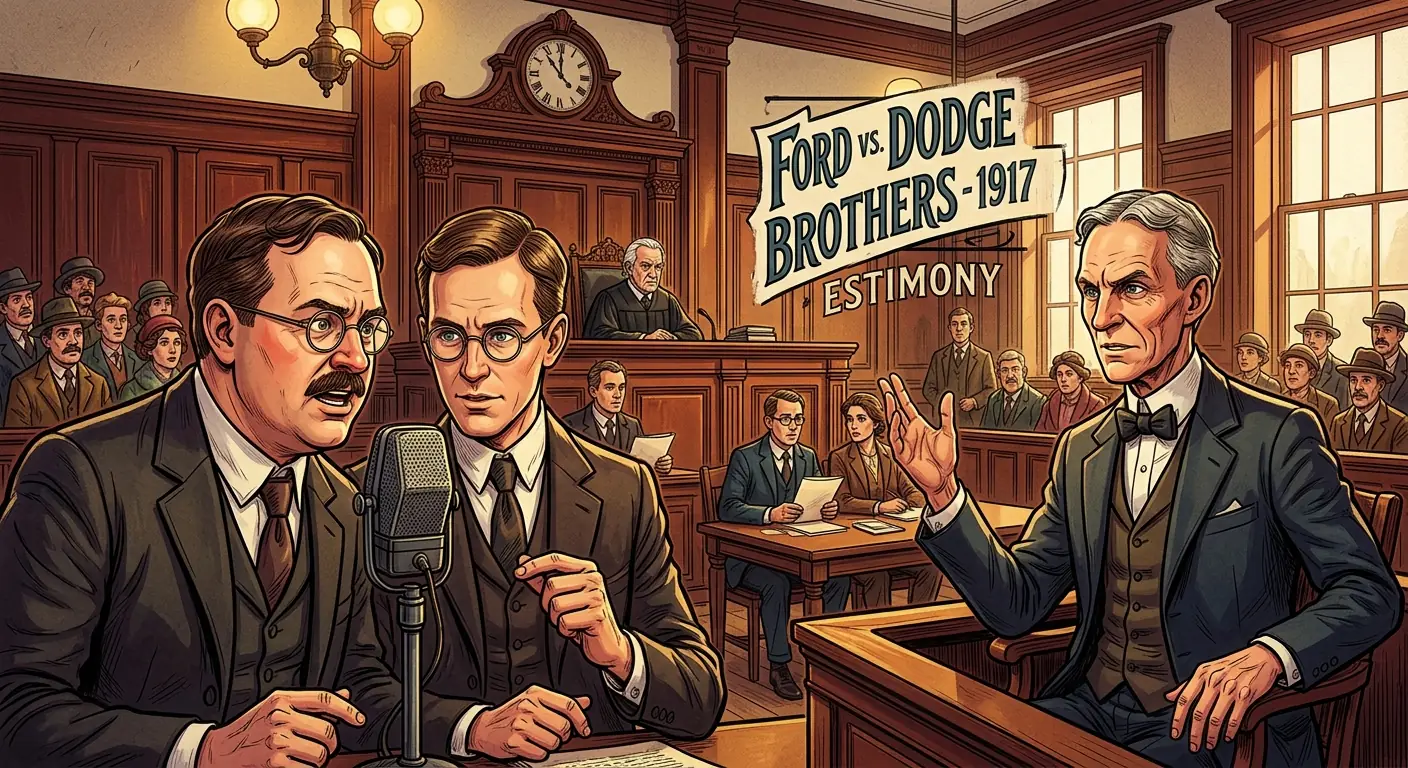
By 1916, Henry Ford was a titan, but even titans have bosses. Or, at least, shareholders. He might have founded Ford Motor Company, but he didn’t own 100% of it. Far from it. Early investors like the Dodge Brothers, Horace and John, who originally supplied parts to Ford and owned 10% of the company, were getting very rich. But Ford had a vision: make cars cheaper, make them available to everyone. And that meant reinvesting profits, not just handing them out as fat dividends. His shareholders, particularly the Dodges, disagreed. Vehemently.
The Lawsuit Heard ‘Round the World
Ford, in his typical folksy-but-firm manner, announced he was slashing the special dividends to reinvest profits into expansion, aiming to lower car prices and increase worker wages. Noble, right? Not if you’re a shareholder looking for a quick buck. The Dodge Brothers, who by this point had started their own car company (the audacity!), sued Ford Motor Company in 1916. Their argument? A corporation’s primary purpose is to make money for its shareholders, not to be a philanthropic institution for the public good or, heaven forbid, a giant savings account for its founder’s pet projects.
The case, Dodge v. Ford Motor Company, went all the way to the Michigan Supreme Court. Ford famously testified:
“My ambition is to employ still more men, to spread the benefits of this industrial system to the greatest possible number, to help them build up their lives and their homes. To do this, we are putting the greatest share of our profits back in the business.”
Sounds great, right? The court, however, sided with the Dodges in 1919. They ruled that Ford had to pay out a special dividend of $19 million (a staggering $330 million in today’s money!) because his stated intentions were “altruistic” rather than purely profit-driven. This case set a precedent that still echoes in corporate law today: a company’s primary duty is to maximize shareholder value. Ford, naturally, was furious. He didn’t just want to build cars; he wanted to build his vision of society, and these pesky shareholders were getting in the way.
Buying Out the Bosses
Henry Ford, never one to be told what to do, hatched a plan. A truly audacious, slightly Machiavellian plan. He publicly threatened to resign from Ford Motor Company and start a new company, promising to make an even cheaper car. The implication was clear: the value of Ford Motor Company, without Ford at the helm, would plummet. This sent a shiver down the spines of his minority shareholders. They knew Ford was Ford Motor Company.
Panicked, they came to him. Ford, with a smirk likely hidden by his famous scowl, offered to buy them out. He borrowed heavily – we’re talking tens of millions of dollars – and, by July 1919, he had bought out every single minority shareholder, including the Dodges. The total cost was $105.5 million (over $1.8 billion today). This made Ford Motor Company a privately owned company, a status it would maintain for decades.
Absolute Power
With this move, Henry Ford achieved ultimate control. He no longer had to answer to anyone but himself (and Clara, of course, who was probably shaking her head). The company became his personal fiefdom, a laboratory for his industrial, social, and sometimes deeply misguided ideas. This absolute power allowed him to pursue vertical integration with the Rouge complex (as discussed in Chapter 6) and push his social experiments like the $5 day. But it also meant there were no checks and balances. No board to temper his stubbornness, no shareholders to question his sometimes-erratic decisions or his deeply troubling personal beliefs. The stage was set for both unparalleled innovation and some of his darkest chapters.
🥊 Chapter 11: The Battle of the Overpass and the Iron Fist (1930s)
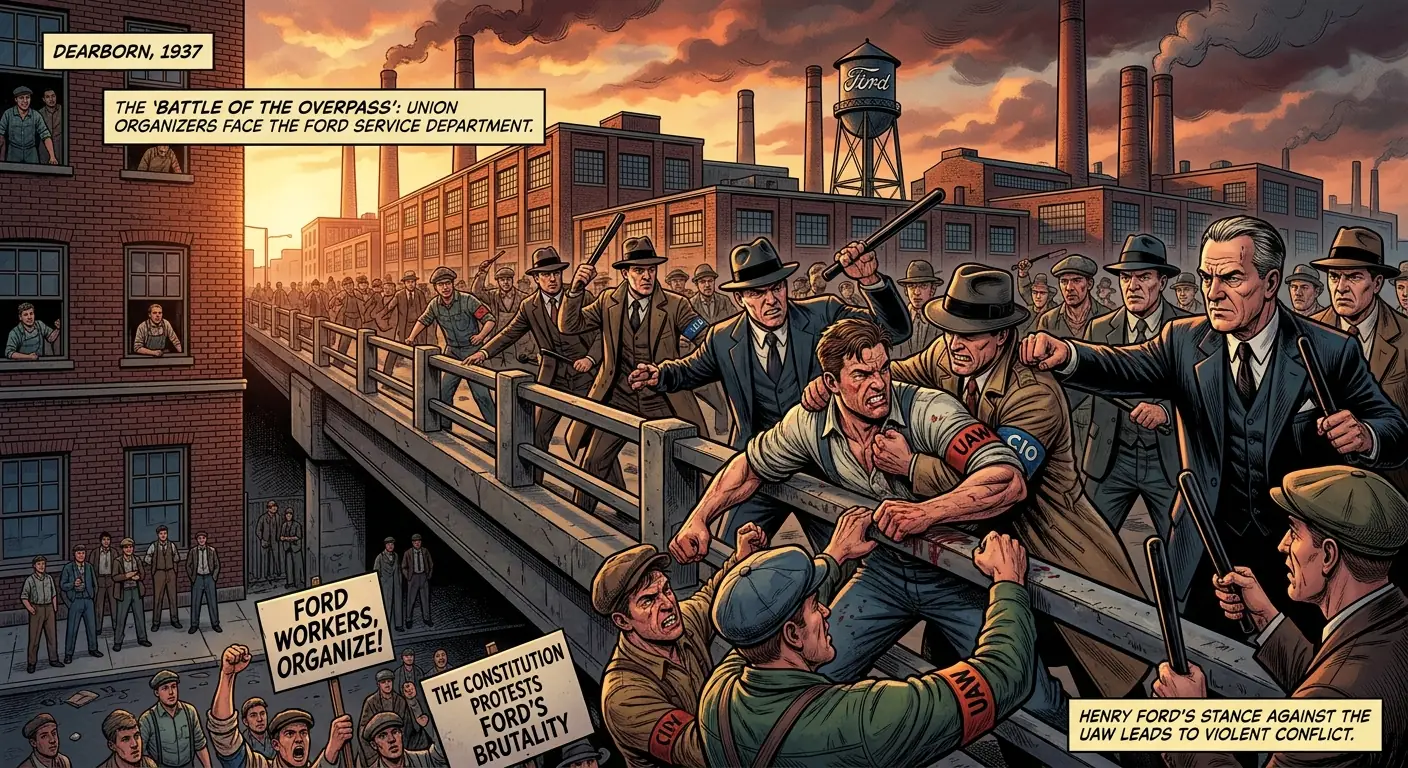
The roaring twenties ended with a whimper and then a crash. The Great Depression hit, and suddenly, the dream of a car in every driveway felt distant. While other companies struggled, Ford, with its immense cash reserves and streamlined production, weathered the initial storm better than most. But the economic downturn also fueled a new movement: labor unionization. And Henry Ford, the man who gave the world the $5 day, would become one of the most brutal anti-union industrialists in American history. The irony, as always with Ford, was thick enough to cut with a Model T crank.
The $5 Day Fades
While the $5 day (Chapter 5) was revolutionary in 1914, by the 1930s, its luster had faded. Ford’s wages, though still respectable, hadn’t kept pace with inflation or the demands of the grueling assembly line. Worse, the company’s paternalism had morphed into outright authoritarianism. Ford’s “Sociological Department” initially managed the $5 day’s moral standards but quickly became a tool for surveillance and control. Workers were monitored, their homes inspected, and any sign of dissent or “un-American” activity (read: union sympathy) could lead to dismissal.
As the Depression deepened, Ford laid off thousands, reduced working hours, and intensified the pace of work, leading to immense pressure on the remaining workforce. The benevolent capitalist image was long gone, replaced by a rigid, unyielding industrial dictator.
Harry Bennett’s Reign
Enter Harry Bennett. A former boxer and Navy strongman, Bennett became Ford’s head of the “Service Department” in the 1920s. This wasn’t your typical customer service; it was Ford’s private police force, a gang of ex-cons, boxers, and toughs whose primary job was to keep the union out and enforce Ford’s will, often through intimidation and violence. Bennett, a diminutive man with a fearsome reputation, became Ford’s loyal enforcer, his personal consigliere in all matters dirty. He had Ford’s ear and wielded immense power, creating a climate of fear throughout the company. Workers lived in terror of Bennett and his men, knowing that a single word could cost them their jobs, or worse.
Ford himself seemed to genuinely like Bennett, seeing him as a man who “got things done” and protected him from the “agitators.” This bizarre loyalty speaks volumes about Ford’s own increasingly paranoid and dictatorial mindset.
Blood on the Pavement
The inevitable clash came to a head in the mid-1930s. The United Auto Workers (UAW) was gaining traction in Detroit, successfully organizing General Motors and Chrysler. Ford remained the last, formidable holdout. On May 26, 1937, a group of UAW organizers, including Walter Reuther, attempted to distribute leaflets to workers outside the Rouge River Plant in Dearborn. They were on public property – an overpass leading to the plant.
What followed became known as the Battle of the Overpass. Bennett’s Service Department thugs brutally attacked the organizers. They were punched, kicked, beaten with clubs, and thrown down the concrete stairs. Women involved in the protest were also targeted. Journalists covering the event had their cameras smashed, but not before a Detroit News photographer captured iconic, damning images of the violence. Reuther was left with a broken back and other injuries.
This wasn’t just a street brawl; it was a carefully orchestrated act of intimidation designed to crush unionism at Ford. But it backfired spectacularly. The shocking photos and eyewitness accounts turned public opinion against Ford, painting him as a cruel tyrant. It took another four years and a combination of legal pressure from the National Labor Relations Board and continued public outcry, but Ford finally signed a contract with the UAW in 1941, becoming the last major automaker to unionize. The victory, however, came at a terrible cost in human suffering, a testament to Ford’s unyielding stubbornness and the dark side of his industrial genius.
👨👦 Chapter 12: Edsel’s Burden and the Model A’s Redemption (1927–1943)
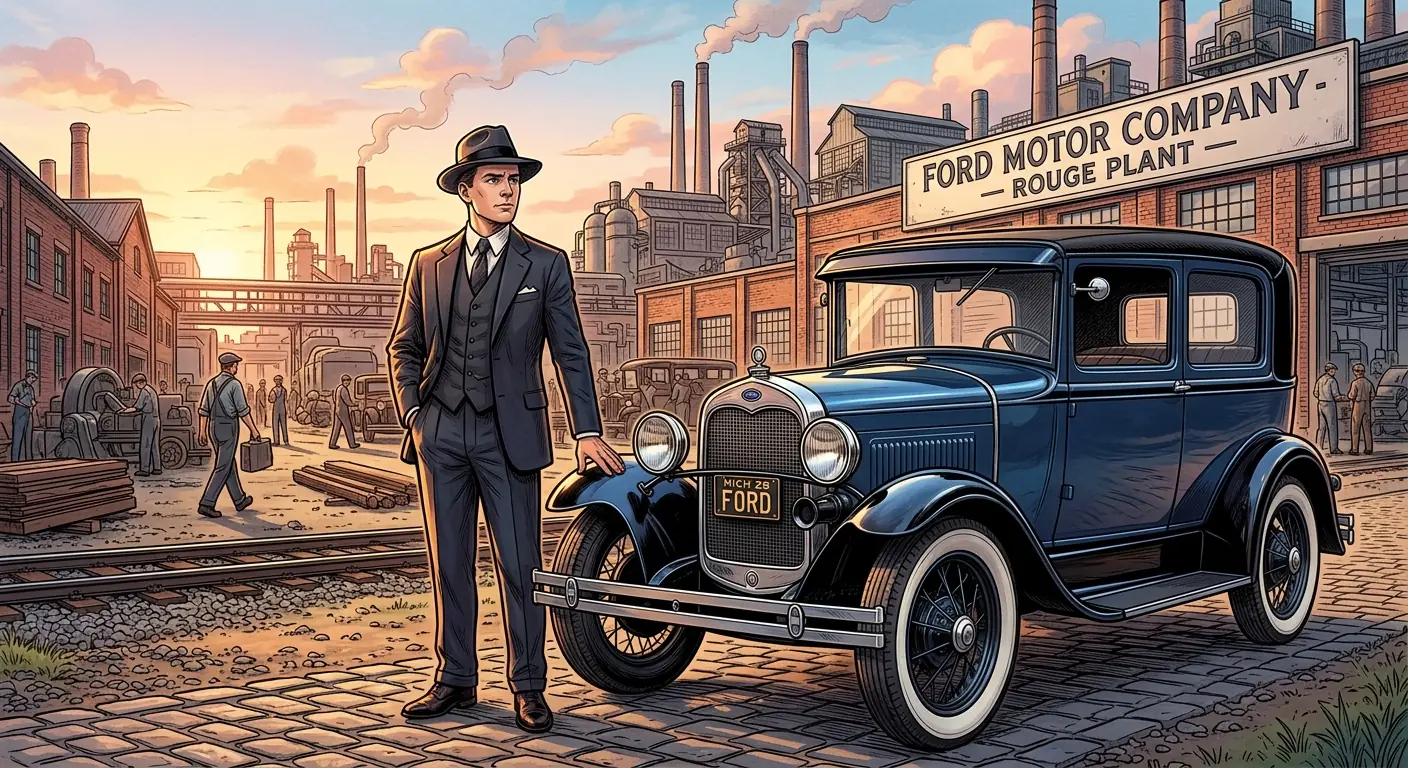
For nearly two decades, the Model T reigned supreme. It was cheap, reliable, and famously available in “any color so long as it is black.” But by the mid-1920s, that stubborn refusal to change was becoming a liability. Competitors like General Motors, under the shrewd leadership of Alfred Sloan, were offering variety, style, and annual model changes. Cars were no longer just utilitarian conveyances; they were fashion statements, symbols of status. Ford, stuck in its monochromatic past, was bleeding market share. The man who saw this clearly, and fought tirelessly to modernize the company, was Henry’s only son: Edsel Ford.
From T to A: A Painful Birth
Edsel Ford, born in 1893, was everything his father wasn’t: refined, educated, interested in art and design, and a quiet visionary. He became president of Ford Motor Company in 1919, but it was largely a title. Henry, still very much in charge, constantly undermined his son, publicly belittling his ideas and micromanaging every decision. This dynamic would define Edsel’s tragic career.
As GM’s market share soared with its multi-brand strategy (Chevrolet, Pontiac, Oldsmobile, Buick, Cadillac, oh my!), Edsel pleaded with his father to replace the Model T. Henry, however, was sentimentally attached to his “Tin Lizzie,” convinced it was still all the public needed. It took a dramatic drop in sales, a closure of the entire Ford plant for six months in 1927, and immense internal pressure before Henry finally relented. The transition was agonizing.
The result was the Model A, introduced in late 1927. It was a triumph of design and engineering, largely thanks to Edsel’s influence. It featured a more powerful engine, a conventional three-speed transmission, four-wheel brakes, and, crucially, came in a variety of colors and body styles. The public went wild. Ford received 400,000 orders in the first few weeks, and by 1931, over 4.8 million Model As had been sold. It was a spectacular comeback, proving Edsel’s instincts were correct. Yet, even in this success, Henry often took sole credit, further diminishing his son’s contributions.
The Son Who Never Escaped
Edsel’s life at Ford was a constant struggle for autonomy. He pushed for design innovation, for better labor relations (he was horrified by Harry Bennett’s tactics), and for a more modern, less autocratic management style. He was responsible for initiating Ford’s push into aviation, helping to create the iconic tri-motor plane, and later overseeing the company’s war production efforts in WWII (Chapter 8). He was, by all accounts, a brilliant and compassionate executive, beloved by many employees.
But Henry, aging and increasingly stubborn and paranoid, treated Edsel not as a successor, but as a subordinate to be controlled and often humiliated. He would often side with Harry Bennett against Edsel, further eroding his son’s authority. This constant undermining, coupled with the immense stress of running a global empire under the shadow of a domineering father, took a heavy toll.
A Father’s Loss, A Company’s Crisis
Edsel’s health began to decline in the early 1940s. He suffered from stomach issues, stress, and eventually, stomach cancer. He died tragically young, at the age of 49, on May 26, 1943. His death devastated Clara, but Henry’s reaction was complicated. While he undoubtedly loved his son, his grief was intertwined with a profound sense of loss for the company’s future and, perhaps, a belated realization of the burden he had placed on Edsel.
With Edsel gone, the company was in crisis. Henry, at 80 years old and increasingly frail and erratic, resumed the presidency. It was a disaster. His decisions became even more bizarre, his paranoia deepened, and the company’s efficiency plummeted. Ford Motor Company, the industrial marvel, was on the brink of collapse, desperately needing new leadership. Edsel’s death was not just a personal tragedy; it was a major turning point that forced the company to confront its deeply flawed governance structure.
⏳ Chapter 13: The Final Ride: Legacy, Decline, and the Paradox (1943–1947)
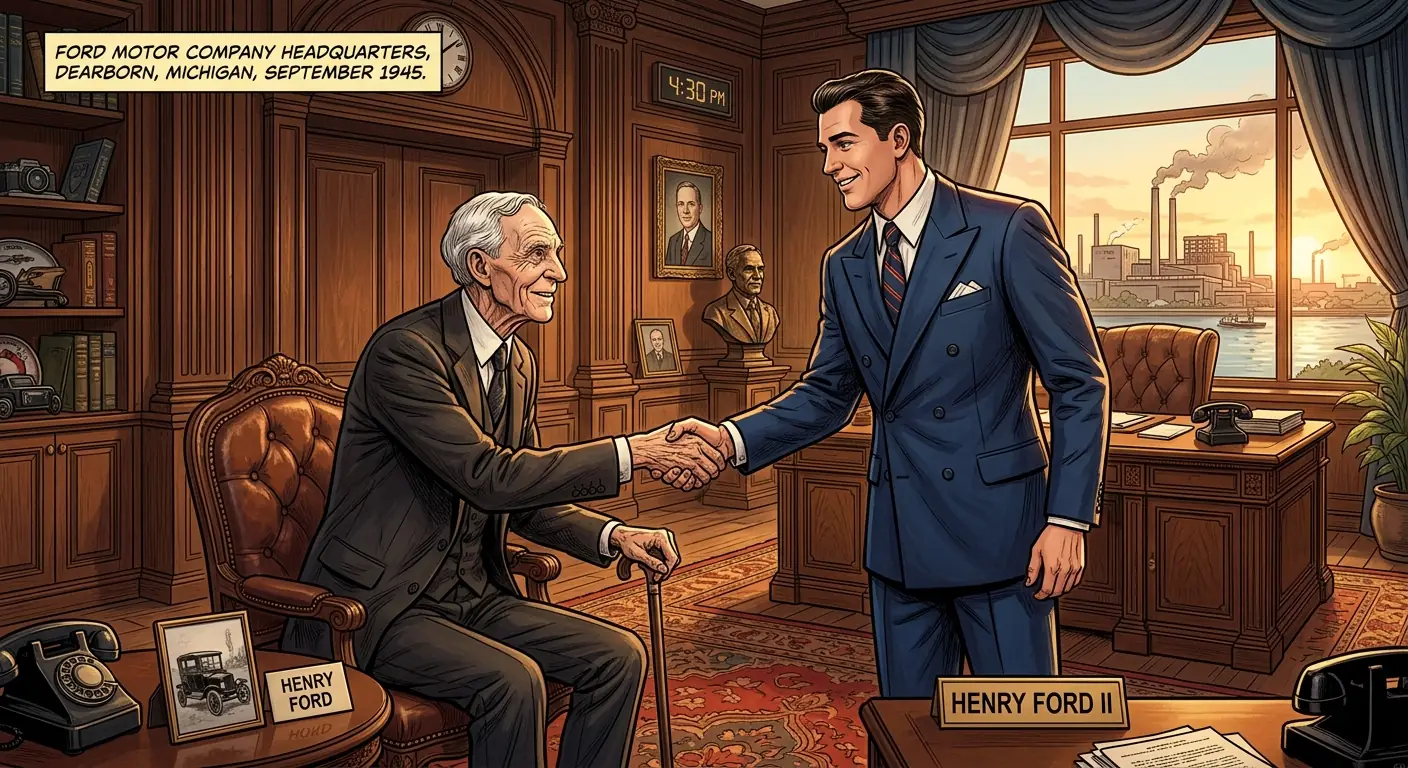
After Edsel’s tragic death in 1943, the reins of Ford Motor Company snapped back into the shaky hands of an 80-year-old Henry Ford. It was a disaster waiting to happen, and happen it did. The man who had revolutionized industry was now a shadow of his former self, increasingly disconnected from reality, his once-sharp mind clouded by age and possibly a series of strokes. The company, a vital cog in America’s “Arsenal of Democracy” during WWII, teetered on the brink of ruin under his erratic leadership.
The Titan Fades
Henry Ford’s final years were a sad spectacle for those close to him. His decisions were impulsive, his memory unreliable, and his paranoia, always a lurking presence, intensified. Harry Bennett, the feared head of the Service Department (Chapter 11), gained even more influence in this period, effectively running the company while Henry drifted in and out of lucidity. Production suffered, costs spiraled, and the company, once the undisputed king of the auto industry, was hemorrhaging money – losing $9 million a month by 1945 (roughly $150 million today). The federal government, concerned about Ford’s critical role in wartime production, even considered taking over the company.
Clara Ford, ever the steadfast anchor, finally put her foot down. She threatened to leave Henry if he didn’t step aside. This was the one person Henry truly listened to, the one force capable of breaking through his stubborn resolve. In September 1945, bowing to Clara’s ultimatum and immense pressure from within the company and government, Henry Ford finally retired.
Passing the Torch (Reluctantly)
Who would succeed the industrial giant? The natural choice was Edsel’s eldest son, Henry Ford II. Young “Hank the Deuce” was only 28 years old at the time, but he had served in the Navy during the war and possessed a keen mind and a strong will, perhaps inherited from his grandfather. He was determined to save the company his father had sacrificed so much for.
When Henry Ford II took over, the company was a chaotic mess. He famously quipped that he “didn’t know if Ford was an automobile company or a scrap-metal business.” His first major act was to fire Harry Bennett, literally having the locks changed while Bennett was out. He brought in a team of brilliant young executives, including the “Whiz Kids” – former Air Force statistical control officers like Robert McNamara and Tex Thornton – who instilled modern management practices, financial controls, and strategic planning into the antiquated empire. It was a radical transformation, pulling Ford Motor Company back from the precipice and setting it on a path to modern corporate success.
The End of an Era, The Start of a Debate
Henry Ford died on April 7, 1947, at the age of 83, at his Fair Lane estate in Dearborn, during a severe flood that caused a power outage, plunging his home into darkness. The irony of the man who brought light and power to so many dying in the dark was not lost on observers. His passing marked the end of an era, not just for Ford Motor Company, but for American industry.
Henry Ford’s legacy is, without question, one of the most complex and contradictory in history. He was a visionary who democratized the automobile and sparked the consumer revolution, creating the modern factory and the middle class. His innovations in production and labor relations (the $5 day) reshaped the global economy. Yet, he was also a ruthless autocrat, a virulent antisemite whose hateful propaganda fueled Nazism, a union-buster who employed violence, and a father whose domineering nature cast a long, tragic shadow over his son’s life.
He was a genius and a bigot, a liberator and a tyrant, a benefactor and a destroyer. He proved that one mind could hold both world-changing brilliance and world-historic evil. His story remains a powerful, often uncomfortable, reminder that progress is rarely pure, and the titans who shape our world are often deeply, disturbingly human.
💡 Key Insights
- ▸ Ford didn't invent the automobile, the assembly line, or mass production. He combined existing ideas — interchangeable parts, continuous flow, division of labor — and applied them at a scale nobody else had imagined. His genius was synthesis, not invention.
- ▸ The $5/day wage wasn't charity — it was the most ruthless business move of the early 20th century. Ford realized that if his workers could afford to buy his product, he'd created a self-sustaining demand loop. He manufactured his own customers.
- ▸ Ford's greatest strength became his greatest weakness. The same stubbornness that let him ignore every skeptic and build the Model T also made him refuse to adapt when the market changed. He clung to a single model for 19 years while GM ate his lunch with variety and style.
- ▸ Ford's antisemitism wasn't a footnote — it was an industrial-scale propaganda campaign. His newspaper, The Dearborn Independent, published 91 consecutive issues of anti-Jewish conspiracy theories, and his ideas directly influenced Adolf Hitler. Genius and moral catastrophe can coexist in the same person.
- ▸ Ford proved that paying workers well is not the opposite of profit — it's a driver of profit. His $5/day wage cut turnover by 90%, slashed training costs, attracted the best workers in America, and created a consumer class that didn't exist before. The entire modern middle class is, in part, a consequence of this single decision.
Sources
- Steven Watts — The People's Tycoon: Henry Ford and the American Century ↗
- Douglas Brinkley — Wheels for the World: Henry Ford, His Company, and a Century of Progress ↗
- Ford Motor Company Historical Archives ↗
- The Henry Ford Museum — Digital Collections ↗
- PBS American Experience — Henry Ford ↗
- Neil Baldwin — Henry Ford and the Jews: The Mass Production of Hate ↗
- History.com — Henry Ford ↗