Indra Nooyi: The CEO Who Rewired PepsiCo Before the Market Caught Up
Wall Street wanted a cleaner soda story. Indra Nooyi built something harder and far more durable: a snacks-and-drinks machine designed for the world consumers were slowly becoming.
View all stories about this mogul
When Indra Nooyi took over PepsiCo in 2006, she inherited one of the most famous product portfolios on Earth and one of the most obvious strategic headaches. The world still drank oceans of soda. Pepsi still printed money. But the future was already leaking into the present: nutrition labels were becoming political documents, obesity was becoming a boardroom topic, and the old carbonated-soft-drink machine was starting to look less like a fortress than a countdown clock.
Most CEOs in that position would have protected the legacy franchise and dressed caution up as discipline. Nooyi did something riskier. She started rewiring the company while the cash engine was still humming.
She pushed PepsiCo deeper into juice, sports drinks, water, nutrition, and better-for-you snacks. She fought to keep snacks and beverages under one roof when activists wanted the company sliced apart. She bought time, bought distribution, bought categories, and — most of all — bought a version of the future before the market had fully decided it wanted it.
That made her look early, complicated, and occasionally inconvenient. It also made her right.
Chapter 1: Madras, Merit, and a Restless Daughter

Indra Krishnamurthy was born in 1955 in Madras, now Chennai, into a middle-class Tamil family that prized education, composure, and ambition in equal measure. This was not a household built around celebrity dreams. It was built around performance. Dinner-table conversations often turned into mock interviews and presidential thought experiments. Her mother would ask the girls to imagine they were national leaders and then defend their decisions out loud.
That kind of training does something subtle to a person. It teaches you that leadership is not a costume you inherit. It is a language you practice before anyone hands you the microphone.
Nooyi studied at Madras Christian College, played cricket, performed in an all-girl rock band, and learned early how to move between worlds that were not designed to fit together neatly. She could be disciplined without becoming brittle. Competitive without becoming theatrical. That ability — switching codes without losing force — would later become one of her greatest executive weapons.
Because PepsiCo was never really her first reinvention. She had been reinventing herself for years.
Chapter 2: America, Accent, and the Education of Reinvention
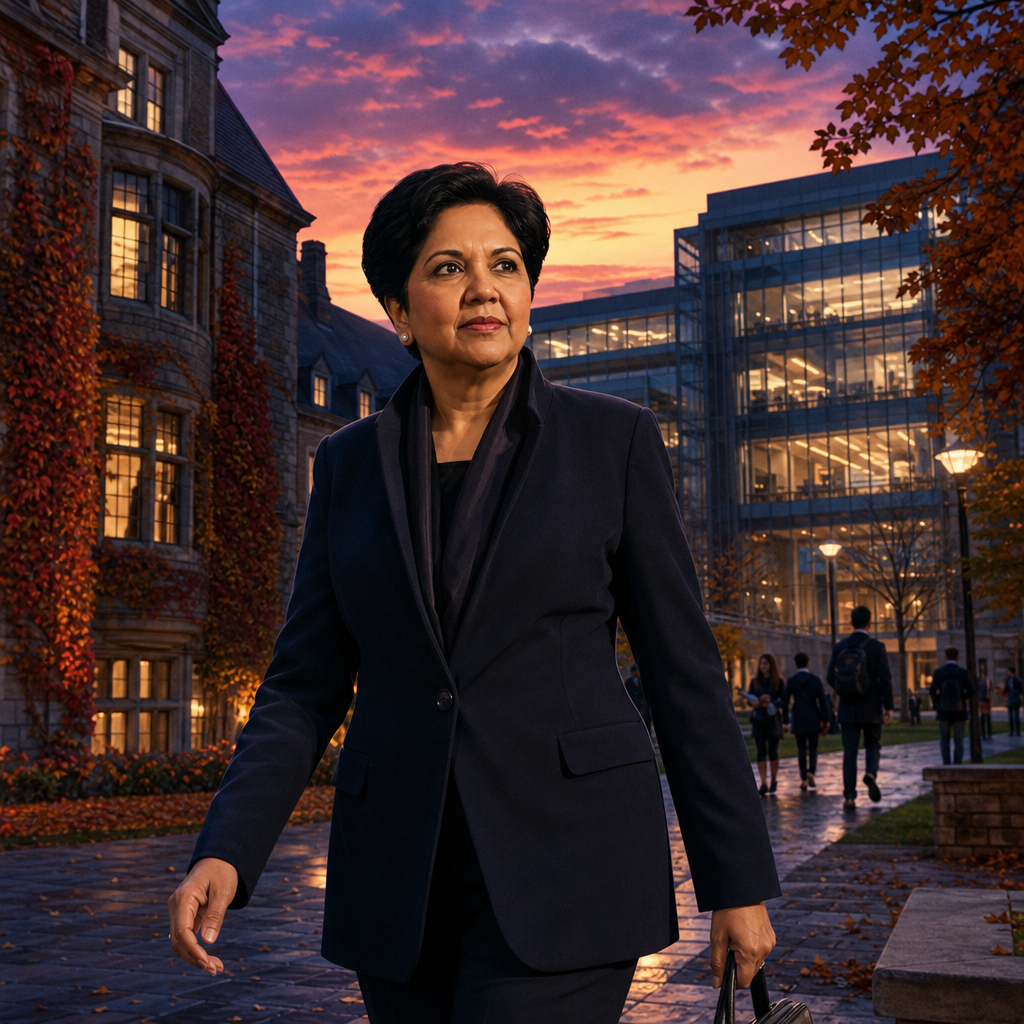
Before PepsiCo, there was the long apprenticeship. Nooyi studied at the Indian Institute of Management Calcutta, worked at Johnson & Johnson in India and at the textile firm Mettur Beardsell, then crossed oceans again for Yale School of Management in the late 1970s.
America did not receive her as a finished executive product. She had to build that version of herself in public. She has often described the awkwardness of being smart, foreign, female, and visibly different in elite corporate rooms that were still overwhelmingly male and overwhelmingly American. The talent was there. The ease was not. She had to manufacture that under pressure.
After Yale came the hardening phase: Boston Consulting Group, then Motorola, then Asea Brown Boveri. These were not glamorous years. They were industrial years. Strategic years. Portfolio years. She learned how large companies calcify, how bureaucracies lie to themselves, and how good strategy is often less about inventing magic than about deciding what the company must stop pretending to be.
That last insight mattered. Because when Nooyi eventually arrived at PepsiCo, the company was profitable, powerful, and slightly trapped by its own image.
Chapter 3: The Strategist Who Came to Cut, Not Decorate
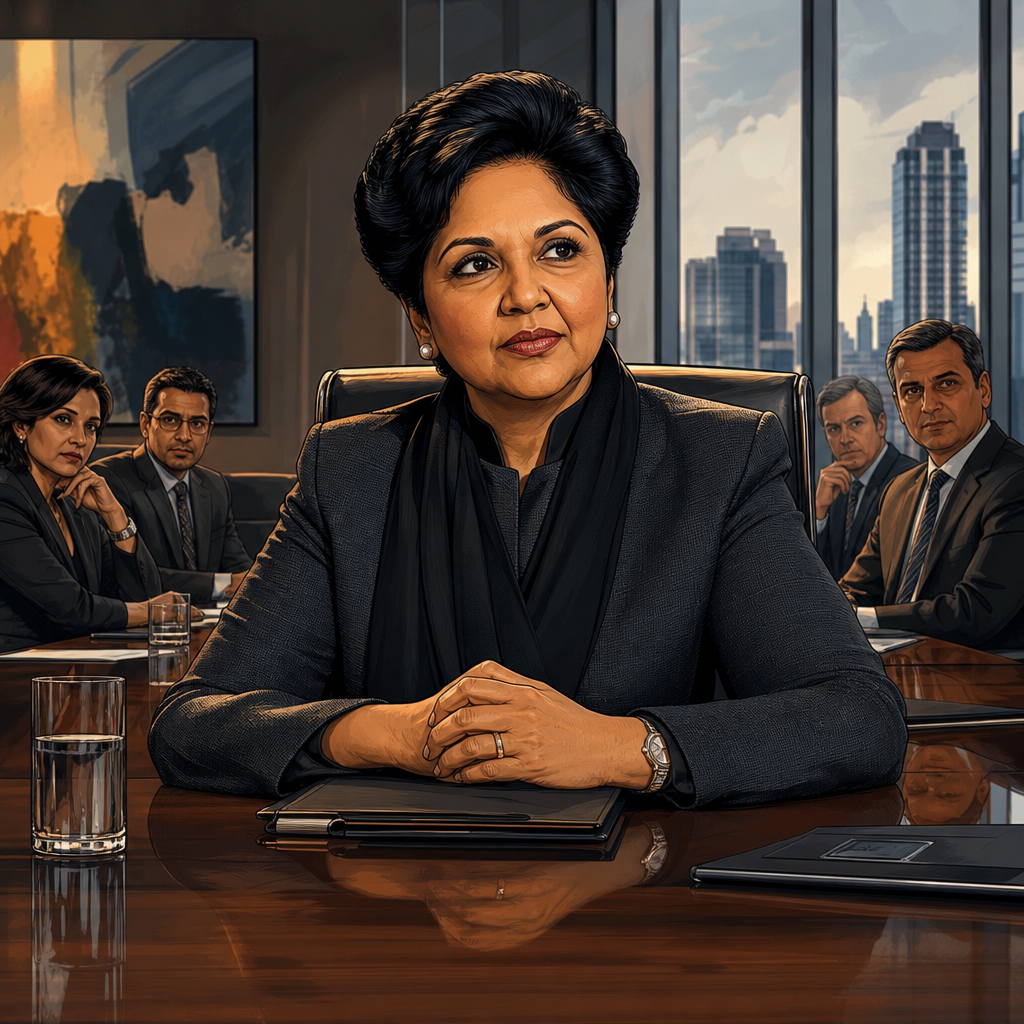
Nooyi joined PepsiCo in 1994 as a senior executive in strategy and development. She was not hired to add polish. She was hired because the company needed someone who could look at a beloved empire and ask which parts of it no longer belonged together.
At the time, PepsiCo was still a strange composite. It sold drinks and snacks, yes, but it also owned major restaurant chains: Pizza Hut, KFC, and Taco Bell. On paper, that diversification looked impressive. In practice, it made the company noisier, more capital-intensive, and harder to manage. Restaurants were a different operating religion entirely.
Nooyi became one of the internal architects of the decision to separate the restaurant business. In 1997, PepsiCo spun those chains into what became Tricon Global Restaurants, later Yum! Brands. It was a classic Nooyi move before the market fully understood what a Nooyi move looked like: remove the distracting asset, simplify the machine, and free management attention for the businesses that can actually compound.
That was the first signal. She was not a caretaker. She was a portfolio surgeon.
Chapter 4: Tropicana, Quaker, and the Purchase of a Different Future

If the restaurant separation was subtraction, the next phase was carefully chosen addition.
In 1998, PepsiCo acquired Tropicana for roughly $3.3 billion. In 2001, it acquired Quaker Oats for about $13.4 billion, bringing Gatorade into the portfolio. These were not ordinary deal-book trophies. They were directional bets. Tropicana expanded PepsiCo beyond carbonated indulgence into a breakfast habit. Gatorade gave it dominance in sports hydration. Quaker added a nutrition halo that soda could never provide on its own.
Seen up close, these deals were messy, expensive, and arguable. Seen from a decade later, they look like defensive architecture. Nooyi and her allies were building escape routes from the possibility that the cola business would one day face a health backlash strong enough to compress growth, invite regulation, and damage brand intimacy.
A weaker strategist would have treated soda as destiny because soda was still lucrative. Nooyi treated it as cash flow — valuable, enormous, but not sacred. That distinction is the heart of her career.
Chapter 5: Performance With Purpose Was Not Branding. It Was Strategy.
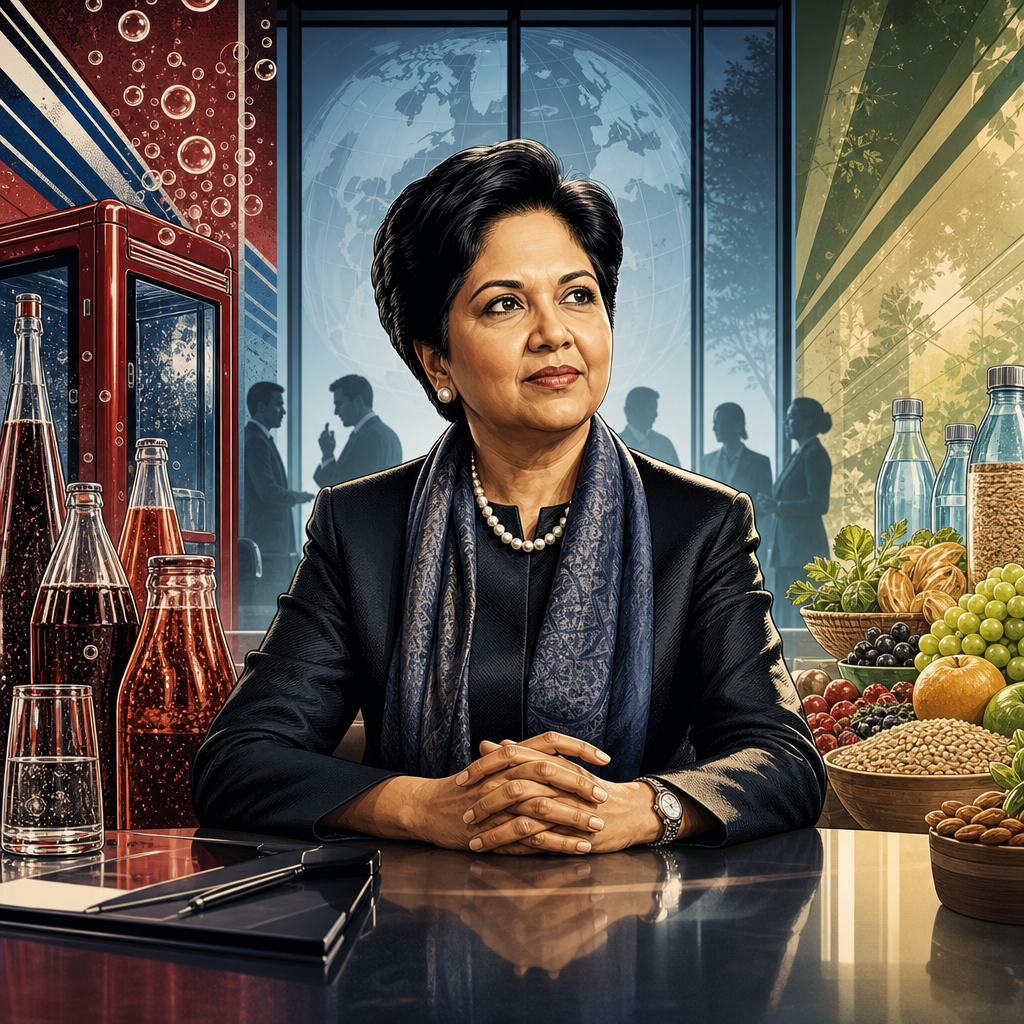
Nooyi became PepsiCo’s CFO, then president, and in 2006 she rose to chief executive. A year later she also became chairman. By then the outline of her thesis was visible, but she gave it a name that many critics misunderstood: Performance with Purpose.
To skeptics, it sounded like the kind of corporate phrase that looks elegant on conference banners and vanishes on contact with quarterly earnings. But inside PepsiCo, it was much sharper than that. The idea was that long-term performance would increasingly depend on whether the company could reformulate products, widen the portfolio, reduce sodium, sugar, and saturated fat where possible, and run a supply chain that looked less wasteful and more resilient.
In other words: the old consumer packaged goods playbook was aging. The next era would reward companies that could keep their indulgence brands alive while also building credibility in wellness, convenience, and responsibility.
Nooyi was early enough that this language made some investors uncomfortable. They worried she was moralizing the business. What she was actually doing was updating the business model before the demand curve forced everyone else to do it at worse prices.
Chapter 6: The Bottling Bet in the Middle of the Storm

Then came the financial crisis, and with it one of the most consequential operating bets of her tenure.
In 2009, PepsiCo moved to buy back its two largest bottlers, Pepsi Bottling Group and PepsiAmericas, in a deal valued at roughly $7.8 billion. To outsiders, it looked counterintuitive. Why add complexity and capital intensity when the economy was under stress? Why move closer to the plumbing of the business when Wall Street usually rewards companies for floating above it?
Because control matters when the environment gets violent.
Owning more of the bottling system gave PepsiCo greater command over pricing, shelf execution, innovation speed, and coordination across drinks and snacks. It tightened the link between strategy on PowerPoint and reality in stores. For a company trying to sell not just cola but water, juice, sports drinks, and a sprawling snack portfolio, that control was not cosmetic. It was operational leverage.
This is one of the quiet truths of Nooyi’s career: she was often described as a visionary, but many of her boldest moves were about boring things done at scale. Distribution. Packaging. manufacturing. Execution. She understood that the future does not arrive through keynote slides. It arrives through supply chains that can carry it.
Chapter 7: Wall Street Wanted a Simpler Story. She Refused.

By the early 2010s, the pressure intensified. Soda demand in developed markets was softer. Health criticism was louder. Activists, most notably Nelson Peltz and Trian Fund Management, argued that PepsiCo should split its snacks business from its beverage business.
On the surface, the argument had appeal. A pure-play beverage company would be easier to model. A separate snacks company might command its own premium multiple. Wall Street loves clean narratives, and “unlock value” is one of its favorite fairy tales.
Nooyi said no.
She argued that the combination was the advantage. Frito-Lay’s margins, retailer relationships, and cash-generation power stabilized the broader enterprise. Shared distribution and shelf relationships mattered. Consumer occasions overlapped. Most important, the combined structure gave PepsiCo more resilience than a narrower beverage company staring down secular pressure in soda.
This was the recurring conflict of her tenure. Investors often asked for simplicity. Nooyi kept defending capability. She preferred a tougher machine to a prettier slide.
Chapter 8: The Cost of Being Early

Being right too early is one of the loneliest positions in corporate life.
Nooyi spent years absorbing criticism from multiple directions at once. Traditionalists worried she was drifting too far from the high-sugar, high-salt brands that built the empire. Short-term investors worried that healthier products were lower-margin, slower-growing, or too expensive to scale. Cultural critics sometimes treated any move from a giant food company as cynicism dressed up in green language.
And beneath the boardroom theater sat the harder private truth: a global chief executive does not perform this job at humane scale. Nooyi spoke openly about the strain of trying to be a mother, daughter, wife, and CEO inside systems built as if senior executives have no home life at all. That candor became part of her public identity because it exposed something many corporate legends prefer to hide — the machine is often designed around invisible domestic labor and impossible tradeoffs.
The result was unusual. She was simultaneously one of the most admired CEOs in America and one of the most persistently second-guessed.
That usually happens when a leader is dragging the institution into a future the scorecard has not yet learned how to measure.
Chapter 9: The Market Finally Caught Up After She Was Already Leaving

When Nooyi stepped down as CEO in 2018, PepsiCo was a different company from the one she inherited. Revenue had climbed from roughly $35 billion at the start of her tenure to more than $64 billion near the end. The portfolio was broader. The international footprint was deeper. The nutrition story was stronger. The operating system was tougher.
Most important, PepsiCo was less dependent on any single idea of what a food-and-beverage giant had to be. That is a profound form of corporate risk reduction, even if it rarely gets celebrated with the drama of a flashy product launch.
Her legacy looks even clearer in hindsight. The snacks-and-drinks combination she defended became one of PepsiCo’s great strengths. The pressure to offer lower-sugar, lower-sodium, and more functionally diverse products only intensified. Supply-chain discipline became a strategic weapon. ESG language, once mocked by many investors, moved toward the center of corporate life. The future she was accused of overemphasizing kept arriving.
Indra Nooyi did not build PepsiCo by trying to make it sound more virtuous than it was. She built it by making it harder to break.
That is the reason her story matters. She was not the loudest CEO of her era. She was the one doing structural work inside the walls while everyone else was still arguing about the paint.
💡 Key Insights
- ▸ Nooyi's central move was portfolio engineering, not slogan engineering. She reduced PepsiCo's dependence on cola years before the market fully rewarded the shift.
- ▸ The Tropicana and Quaker Oats deals were not random expansions. They were strategic hedges against a future in which sugar would become a political, medical, and reputational problem.
- ▸ Performance with Purpose looked like soft language to critics, but it functioned as a hard operating thesis: reformulate products, widen the portfolio, and make the supply chain sturdier before consumers demanded it all at once.
- ▸ Buying back the bottlers during the financial crisis was a control play disguised as a recession trade. It gave PepsiCo more direct command of execution at exactly the moment demand and distribution were under pressure.
- ▸ The market spent years asking whether PepsiCo should split snacks from beverages. Nooyi's legacy is that the combination turned out to be the shock absorber.