The K Street Kingpin's Crown of Thorns: Jack Abramoff's Epic Rise and Devastating Fall
Meet **Jack Abramoff**, the lobbying legend who didn't just play the game—he rewrote the rules, then burned the whole damn stadium down. This is the story of Washington's most audacious power broker, a man who built an empire on influence, greed, and a staggering betrayal of trust, only to watch it crumble in a spectacular blaze of scandal that rocked the very foundations of American politics.
View all stories about this mogul
💥 Chapter 1: The Predator’s Smile and the Promise of Power
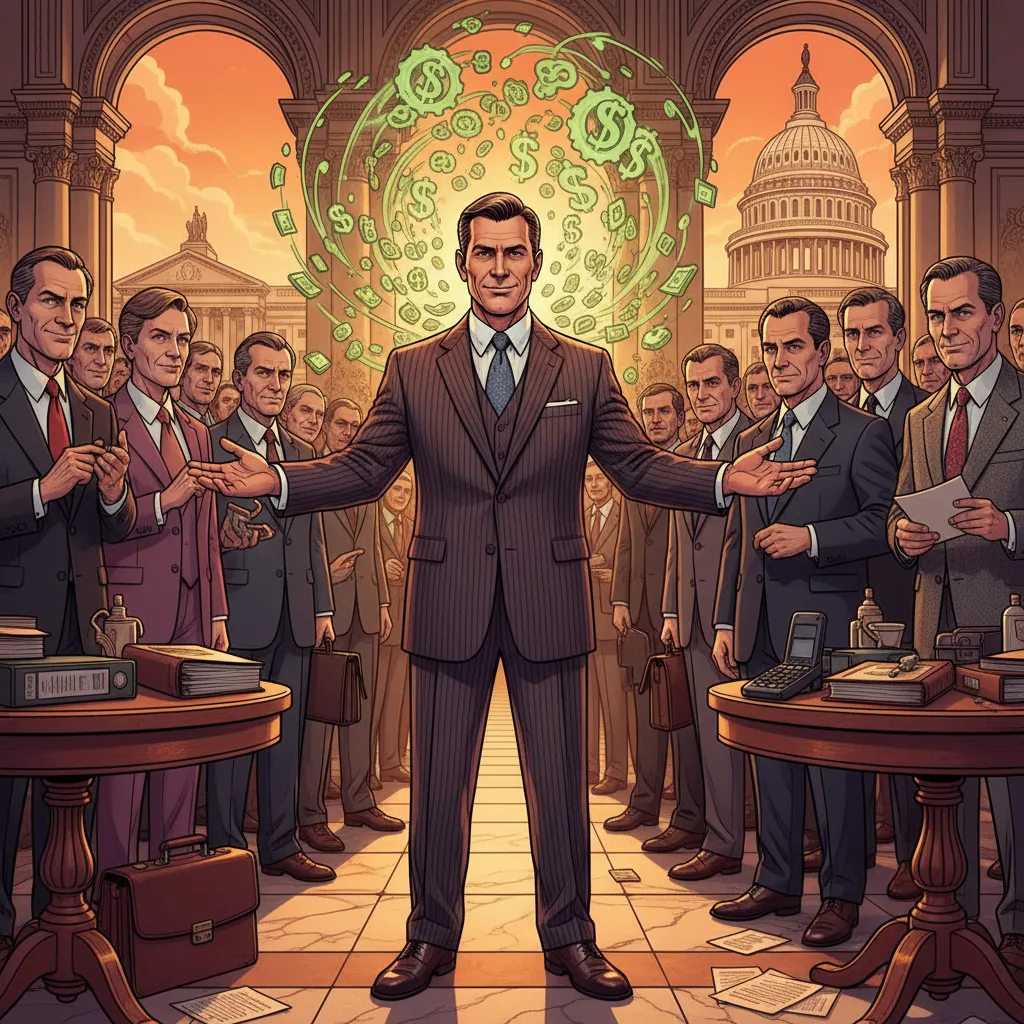
Picture this: Washington D.C., early 2000s. A city buzzing with ambition, where power isn’t just a currency, it’s the very air you breathe. In this shark tank of influence, one man didn’t just swim; he hunted. His name was Jack Abramoff, and he was, for a fleeting, incandescent moment, the undisputed king of K Street.
He had a smile that could disarm a nuclear physicist, eyes that glittered with an almost evangelical fervor, and a handshake that promised the moon – or at least, a direct line to the Oval Office. He was a master manipulator, a strategic genius, and a charismatic showman rolled into one perfectly tailored suit. When Jack Abramoff walked into a room, heads didn’t just turn; they snapped. He exuded an aura of boundless energy, a manic intensity that convinced clients he was working 25 hours a day, seven days a week, just for them. He was the guy who could get things done, the ultimate fixer, the man with the golden rolodex and the silver tongue.
His clients weren’t just paying for access; they were paying for the illusion of omnipotence. They believed Abramoff could bend the will of Congress, shape legislation, and steer the colossal ship of state with a whisper. And for a while, it seemed he could. He pulled strings, brokered deals, and opened doors that remained bolted shut for mere mortals. His power was palpable, a gravity well pulling in money, favors, and more power.
But this isn’t just a story about a brilliant lobbyist. This is a Greek tragedy played out on the marble floors of Capitol Hill, a Shakespearean drama where ambition devours itself, and a man who reached for the stars ends up crashing to earth in a blaze of disgrace. This is the tale of Jack Abramoff’s spectacular rise as Washington’s most feared and revered lobbyist, and the even more spectacular corruption scandal that would send shockwaves through the entire political establishment, leaving a trail of shattered careers, federal indictments, and a searing indictment of the dark underbelly of American democracy.
Imagine you’re at a dimly lit bar, the clinking of glasses and murmur of conversations fading into the background. Someone leans in, eyes wide, and starts, “You wanna hear about a guy who played God in Washington, then got smote by lightning?” That’s the story we’re about to tell. Grab a drink. You’re gonna need it.
🔥 Chapter 2: From Campus Radical to K Street Revolutionary

Before he was the K Street Kingpin, Jack Abramoff was a different kind of firebrand. Born in Atlantic City, New Jersey, in 1959, he wasn’t born into privilege, but he was born with an insatiable drive. His early life was a prelude to the relentless ambition that would define him. He wasn’t just smart; he was ferociously smart, with a mind like a steel trap and a zeal that bordered on fanaticism.
His political awakening came during his time at Brandeis University. This wasn’t a journey from obscurity to influence; it was a metamorphosis. He became a conservative activist, a vocal opponent of what he perceived as liberal excesses. He wasn’t content to merely observe; he needed to lead, to shape the narrative. This was where the seeds of his future influence were sown – not in the halls of power, but in the trenches of campus politics. He mastered the art of organizing, fundraising, and, crucially, persuasion. He learned to frame arguments, mobilize supporters, and demonize opponents with a skill that would make seasoned political operatives nod in grudging admiration.
After Brandeis, he moved to the University of California, Los Angeles, School of Law. It was there, during the early 1980s, that he truly began to flex his political muscles. He became the national chairman of the College Republican National Committee (CRNC). This wasn’t just a student group; it was a feeder system for the Republican Party. Abramoff, along with future power players like Grover Norquist (who would become a conservative anti-tax guru) and Ralph Reed (a prominent Christian Coalition leader), forged a powerful alliance. They were young, ideological, and absolutely ruthless.
“Abramoff’s early career wasn’t about money; it was about power. He understood that true influence came not from being rich, but from being connected, from having the ear of those who could change the world. He was building his network, brick by brick, long before K Street ever entered his lexicon.”
He even directed a ridiculous, low-budget action movie called Red Scorpion starring Dolph Lundgren, a bizarre detour into filmmaking that nonetheless showcased his ability to raise capital and organize complex projects, even if the creative output was questionable. It was a testament to his boundless energy and his chutzpah. He wasn’t afraid to try anything, to chase any opportunity, no matter how outlandish.
But the real game, the ultimate arena for his particular brand of talent, lay elsewhere. It lay in Washington D.C., a city that thrives on connections, on knowing the right people, and on the delicate dance of quid pro quo. He saw the political landscape not as an impenetrable fortress, but as a vast, intricate game board, waiting for a master player to make his move. He didn’t just want a seat at the table; he wanted to own the table.
His transition to lobbying wasn’t a sudden leap; it was a calculated pivot. He had built an unparalleled network of conservative contacts, from nascent Congressional staffers to rising stars in the Reagan administration. He knew the players, understood the rules, and, most importantly, grasped the unspoken language of influence. He joined the lobbying firm Preston Gates Ellis & Rouvelas Meeds (later Preston Gates & Ellis), a respectable firm, but he wasn’t content to be just another cog in the machine. He was ready to forge his own path, to create his own legend. The stage was set for a new kind of K Street operator, one who would push the boundaries of ethical conduct to their absolute breaking point.
🎲 Chapter 3: The Golden Goose: Hunting for Tribal Gold
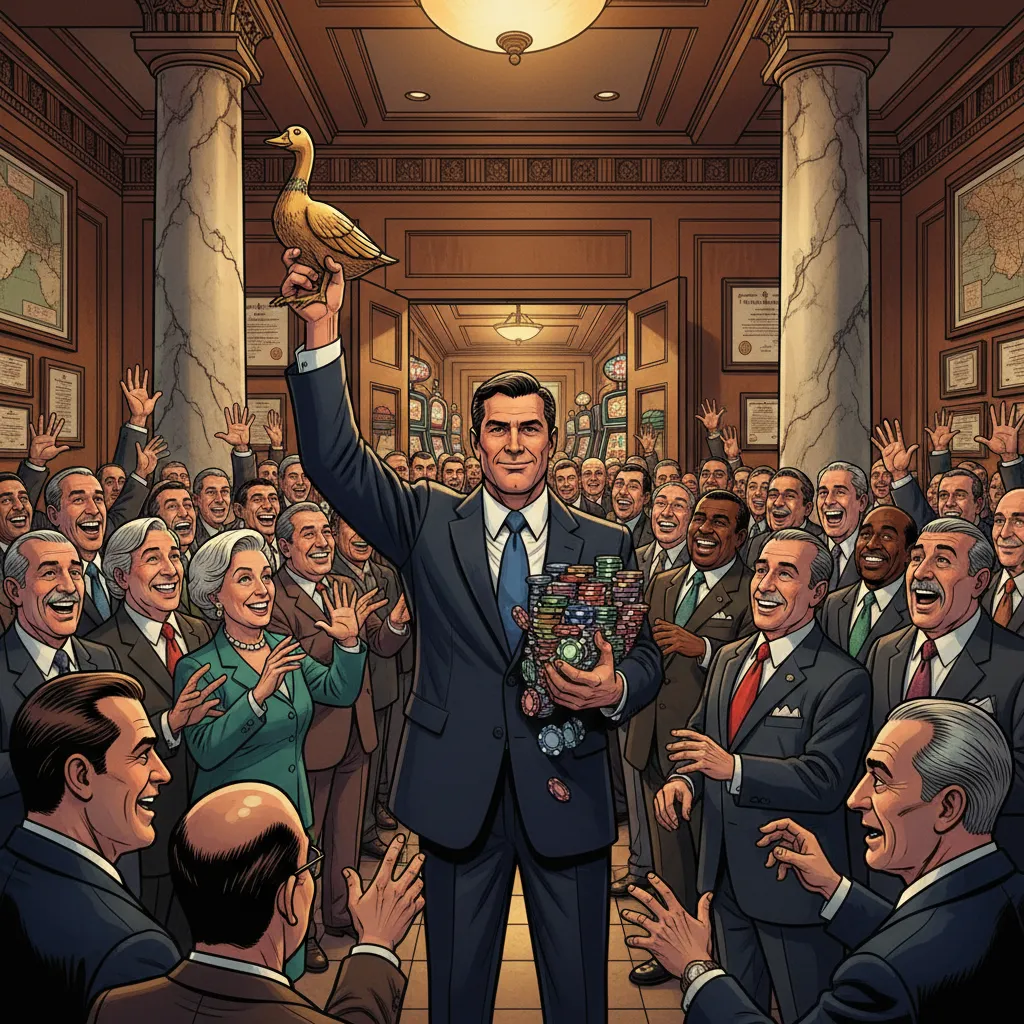
Washington D.C. is a city of niches, of specialized markets where fortunes are made and lost. For Jack Abramoff, the discovery of his golden goose wasn’t in tech, defense, or pharmaceuticals. It was in the unlikely, yet incredibly lucrative, world of Native American tribal gaming.
In the 1990s, after the passage of the Indian Gaming Regulatory Act (IGRA) in 1988, tribal casinos were exploding across the country. These sovereign nations, often located in remote areas, suddenly found themselves sitting on potential goldmines. But with great wealth came great responsibility, and even greater political challenges. They needed help navigating the labyrinthine corridors of federal and state government, protecting their casino interests, and fighting off legislative threats from anti-gaming forces or rival tribes.
Enter Abramoff. He saw not just a market, but an underserved market. These tribes, often historically marginalized, were suddenly flush with cash but lacked the sophisticated political machinery to protect their newfound prosperity. They were ripe for the picking, and Abramoff, with his charming demeanor and deep conservative connections, was the perfect predator.
He pitched himself as a champion of tribal sovereignty, a conservative who understood their plight and could bridge the gap between their unique legal status and the often-hostile political landscape of Washington. He spoke their language, understood their concerns, and presented himself as a fierce advocate. He promised them access to the highest echelons of power, a direct line to Congressmen, Senators, and even the White House. And he delivered, at least initially. He got meetings, he got attention, and he got results. Or, more accurately, he got paid for the perception of results.
His primary target was the Mississippi Band of Choctaw Indians. Led by the charismatic Chief Phillip Martin, the Choctaw had built a wildly successful casino empire. They were rich, powerful, and in need of top-tier representation. Abramoff, through sheer force of personality and political acumen, won their business. This wasn’t just a client; it was a flagship, a testament to his growing prowess.
“Abramoff understood a fundamental truth about lobbying: it’s not always about changing minds; it’s about managing perceptions. He created an aura of invincibility, a belief among his clients that he was the only one who could truly protect their interests. And for that illusion, they were willing to pay handsomely.”
But here’s where the scam began to twist. Abramoff didn’t just charge exorbitant fees; he began to orchestrate a system of internal cannibalization. He would often represent one tribe, then secretly work against their interests by simultaneously representing another entity that sought to undermine them, all while collecting fees from both sides. He would then bill the tribes for millions of dollars, much of which was funneled through his intricate network of shell companies and non-profit organizations, eventually finding its way back into his own pockets and those of his associates.
He didn’t just take their money; he took their trust, leveraging their desperation and their unfamiliarity with the cutthroat world of D.C. politics. He convinced them that the threats against their gaming operations were constant and severe, requiring his expensive, round-the-clock protection. He was creating the monsters he would then claim to slay, all while billing his clients for the privilege of fighting phantoms of his own design. It was a brilliant, cynical, and utterly corrupt business model, built on fear, illusion, and a breathtaking lack of ethics. The tribal gold rush became Abramoff’s personal ATM, and the tribes, unknowingly, were paying for their own elaborate fleecing.
💰 Chapter 4: The Abramoff Playbook: Influence for Sale
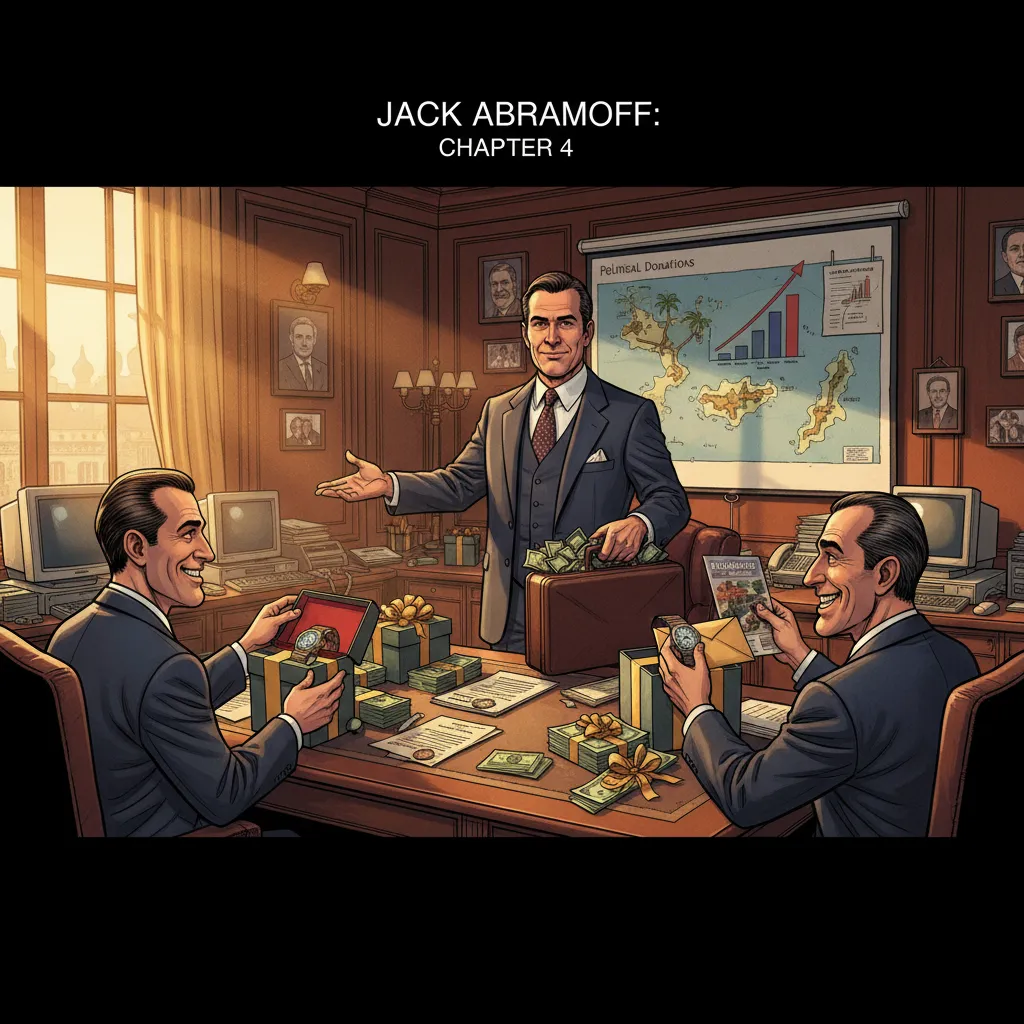
By the late 1990s and early 2000s, Jack Abramoff had perfected his lobbying playbook. It was a masterclass in influence peddling, a complex ballet of political donations, lavish gifts, exotic trips, and outright fraud. He didn’t just send emails or make phone calls; he cultivated relationships, nurtured dependencies, and created an ecosystem where favors flowed like water.
His core team was a tightly knit group of loyalists, most notably his partner Michael Scanlon. Scanlon, a former Tom DeLay aide, was the operational brains behind much of the illicit activity, handling the intricate financial flows and the dirty work of setting up shell corporations. Together, they were a formidable force.
The playbook had several key components:
-
The Campaign Contribution Carousel: Abramoff understood that money talked, but direct payments were risky. Instead, he channeled vast sums of client money into political campaigns and conservative causes, primarily Republican ones. This wasn’t just about gaining access; it was about building chits, accumulating political capital that could be cashed in later. He would tell tribes to donate to specific politicians, then use those donations as leverage for meetings, legislative favors, or simply to gain an audience.
-
The Lavish Lifestyle & “Gifts”: This was where the “fun” began. Abramoff didn’t just take politicians out for dinner; he flew them on private jets to golf resorts in Scotland, paid for expensive meals at his own upscale restaurant, Signatures, in D.C., and arranged for tickets to sporting events, concerts, and luxury boxes. These weren’t bribes, he argued; they were “gifts” – a way to foster goodwill, to build personal relationships. But the line between gratitude and obligation blurred quickly. These were carefully calibrated investments in influence.
-
The Fake Grassroots & Think Tanks: To give his operations a veneer of legitimacy, Abramoff created a network of supposedly independent conservative “think tanks” and “grassroots” organizations. Organizations like Americans for a Republican Majority (ARMPAC) and the Capital Athletic Foundation were ostensibly dedicated to conservative causes or youth sports. In reality, they served as conduits for client money, funneling funds to political campaigns or, more often, directly into Abramoff’s and Scanlon’s pockets. They were phantom armies, designed to create the illusion of broad support for his clients’ causes.
-
The “Friends of Jack” Network: Abramoff cultivated a wide array of political figures, from Congressional staffers to powerful committee chairmen. He employed former staffers, offering them lucrative positions and access, thereby embedding his influence deep within the legislative machinery. These individuals, often eager to please, became crucial cogs in his wheel, providing insider information, facilitating meetings, and pushing legislation on behalf of his clients. Tom DeLay, the powerful House Majority Leader, was a particularly close ally, benefiting greatly from Abramoff’s network and largesse.
“The Abramoff Playbook wasn’t just about bending rules; it was about weaponizing them. He didn’t just exploit loopholes; he drove a Mack truck through them, leaving a gaping hole in the integrity of the political system.”
The scale of his operation was breathtaking. His lobbying firm, first Preston Gates, then Greenberg Traurig, where he moved in 2001 with his entire team, saw millions upon millions of dollars flow through its doors, much of it from desperate Native American tribes. He was charging some tribes tens of millions of dollars over just a few years, a sum that dwarfed what even the largest corporations paid for lobbying.
He didn’t just represent clients; he became their indispensable handler, their all-powerful protector. He created an environment where clients believed they needed him, not just for his connections, but for his strategic genius in navigating the treacherous waters of Washington. It was a business model built on perceived indispensability, fueled by exorbitant fees, and lubricated by a river of dark money. The ethical lines weren’t just blurred; they were erased, replaced by a cynical calculus of power and profit.
💸 Chapter 5: The Web of Deceit: Guam, Marianas, and the Offshore Maze

While Jack Abramoff’s tribal gaming empire was his cash cow, his ambition wasn’t limited to Native American affairs. His hunger for influence and wealth led him to expand his web of deceit far beyond the continental United States, reaching into the distant territories of Guam and the Commonwealth of the Northern Mariana Islands (CNMI). These ventures exposed a new layer of his complex fraud, demonstrating his ability to exploit vulnerabilities on a global scale.
The story of the CNMI is particularly damning. These islands, a U.S. territory in the Pacific, had a booming garment industry that relied heavily on cheap foreign labor, often under exploitative conditions. They were exempt from many U.S. labor laws and minimum wage requirements, making them an attractive location for factories. However, there was a growing movement in Congress to apply federal labor laws to the CNMI, threatening their economic model.
The CNMI government, desperate to protect its garment industry, hired Abramoff. He promised to quash any legislation that would impose federal wage and immigration laws. For years, he received millions of dollars from the CNMI government, funneling much of it through various shell organizations like the Center for Moral Soundness (a supposedly conservative think tank) and other non-profits controlled by him and his associates.
What did the CNMI get for their millions? Not genuine advocacy, but an elaborate pantomime. Abramoff organized “fact-finding” trips to the islands for Congressional staffers, but these were thinly veiled luxury vacations, complete with golf, lavish dinners, and dubious entertainment. The staffers, often young and impressionable, returned to D.C. with a skewed perspective, convinced the CNMI was a thriving example of free-market enterprise, not a place rife with labor abuses. He even paid for op-eds in conservative publications, ghostwritten by his associates, extolling the virtues of the CNMI.
“Abramoff didn’t just sell influence; he sold a manufactured reality. He understood that in the echo chamber of Washington, if you repeat a lie often enough, and back it with enough lavish entertainment, it can start to sound like the truth.”
Meanwhile, in Guam, another U.S. territory, Abramoff engaged in a different, equally audacious scheme. He worked to defeat legislation that would have transferred a significant chunk of federal land to the island’s indigenous Chamorro people. He represented a wealthy businessman, Alfredo C. “Al” Zapanta, who had interests in maintaining the status quo, and allegedly sought to acquire some of this land himself. Abramoff’s tactics included creating a fake grassroots organization in Guam, secretly funded by Zapanta, to oppose the land transfer. He also helped Zapanta secure a multi-million-dollar contract to provide security for Guam’s commercial port, a contract that allegedly involved kickbacks.
The money trail was a dizzying maze. Abramoff and Scanlon used a series of shell companies, often with benign-sounding names, to launder client funds. One prominent entity was Kaymar Ltd., an offshore corporation in the Mariana Islands, which served as a funnel for millions in client fees that eventually found their way back to Abramoff and his co-conspirators. They inflated invoices, billed for services never rendered, and created a complex financial ecosystem designed to obscure the true destination of their clients’ money. It was a sophisticated operation, built on layer upon layer of deception, designed to extract maximum profit while minimizing any paper trail leading back to their illicit activities.
These international ventures weren’t just side hustles; they were integral to Abramoff’s business model. They allowed him to diversify his income streams, leverage his network in new ways, and practice his unique brand of influence peddling free from some of the immediate scrutiny he might face with purely domestic clients. He was a master illusionist, making millions disappear into his own pockets while his clients believed he was tirelessly fighting their battles. The web was growing, intricate and fragile, destined to unravel under the weight of its own immense corruption.
🤝 Chapter 6: The Enablers: Scanlon, DeLay, and the DC Machine
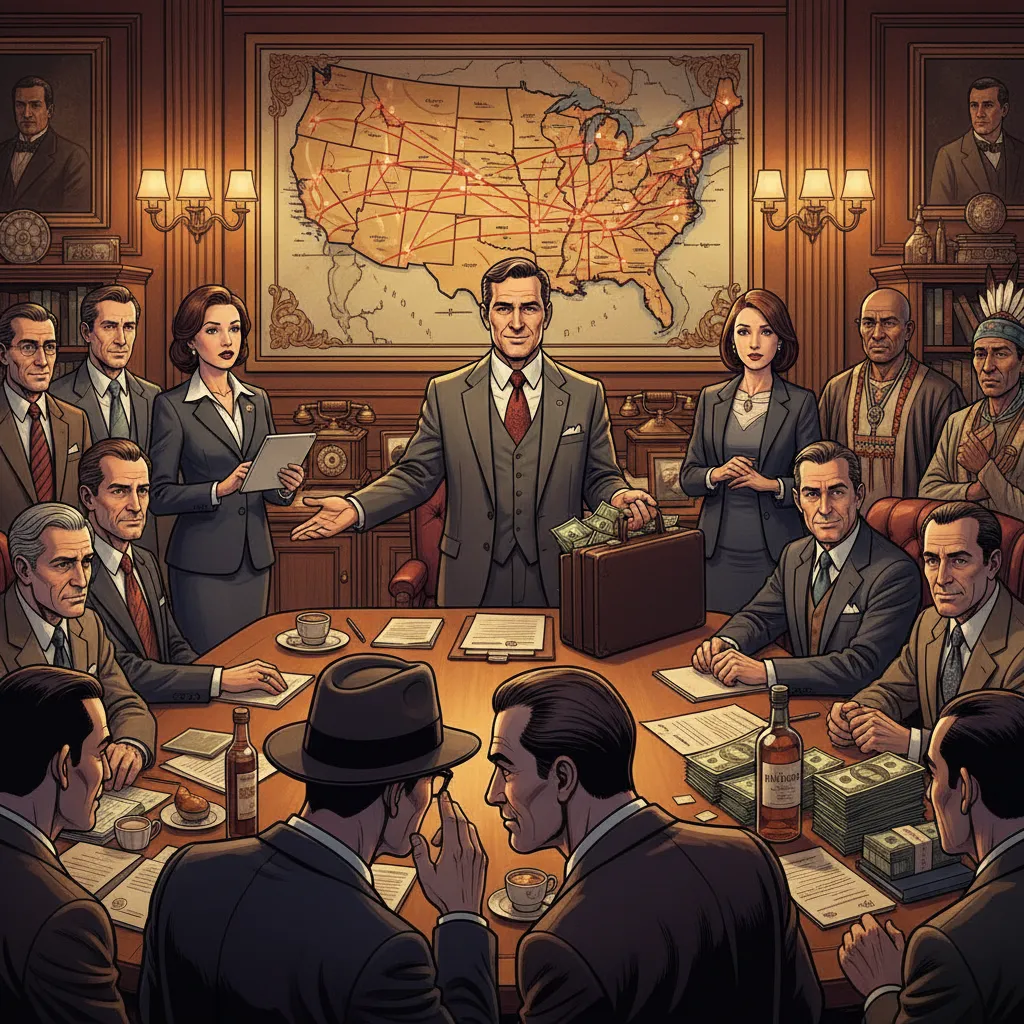
No empire, however corrupt, is built by one person alone. Jack Abramoff’s spectacular ascent was fueled by a network of enablers, collaborators, and complicit figures who either turned a blind eye or actively participated in his schemes. The most prominent among them were his business partner Michael Scanlon and the powerful House Majority Leader, Tom DeLay.
Michael Scanlon was Abramoff’s right-hand man, his trusted lieutenant, and arguably the operational genius behind much of the illicit financial machinery. Scanlon, a former aide to DeLay, brought not only a deep understanding of Congressional workings but also a willingness to engage in the shadiest of dealings. He was the architect of the shell companies, the offshore accounts, and the inflated invoices. While Abramoff was the charming frontman, Scanlon was the quiet, calculating enforcer, ensuring the money flowed where it needed to go—mostly into their own pockets.
Together, they masterminded the “choo-choo” scheme, a particularly egregious example of their financial chicanery. They would instruct client tribes to donate to a supposedly conservative grassroots organization, then bill that organization for “services” that were never rendered or grossly overvalued. The money would then flow to another organization, and another, until it eventually landed in an entity controlled by Abramoff or Scanlon, often disguised as legitimate business expenses. It was a money laundering scheme masquerading as political consulting.
Then there was Tom DeLay, the “Hammer,” a formidable figure in Republican politics. DeLay, as House Majority Leader, wielded immense power, controlling the legislative agenda and the careers of countless Congressmen. Abramoff cultivated DeLay assiduously, showering him and his staff with gifts, campaign contributions, and lavish trips. These weren’t just casual friendships; they were symbiotic relationships.
Abramoff used his tribal clients’ money to fund DeLay’s political action committees and favored causes. He provided DeLay’s staff with high-paying jobs after their stints on Capitol Hill, a classic revolving door maneuver that ensured continued access and loyalty. DeLay, in turn, used his influence to push legislation favorable to Abramoff’s clients, to block legislation detrimental to them, and to generally facilitate Abramoff’s agenda.
“The relationship between Abramoff and DeLay wasn’t just a handshake deal; it was a political fusion, a dangerous cocktail of power and money that left a toxic residue across the entire legislative branch.”
The DeLay connection was crucial. It gave Abramoff an aura of invincibility, a direct line to the heart of Republican power. When Abramoff told a client he could get something done, and then it got done, it reinforced his image as a wizard, even if the magic was actually just millions of dollars changing hands in illicit ways.
But the web of enablers extended beyond Scanlon and DeLay. It included:
- Congressional Staffers: Many young, ambitious staffers were lured into Abramoff’s orbit with promises of lucrative jobs post-Capitol Hill, lavish meals, and free golf trips. They became his eyes and ears on the inside, providing crucial intelligence and access.
- Other Lobbyists and Consultants: Abramoff often partnered with other lobbyists, sometimes legitimate, sometimes less so, to expand his reach and obscure the origins of funds.
- Non-Profit Organizations: He created or co-opted several conservative non-profits, using them as fronts to funnel money, hide expenses, and generate what appeared to be grassroots support for his clients’ causes. These were often run by friends or associates, completing the circle of complicity.
This intricate network of relationships, built on a foundation of mutual benefit and shared ambition, created an echo chamber of corruption. Everyone had a role to play, everyone benefited, and for a long time, no one dared to question the dazzling success of Jack Abramoff. The DC machine, in its relentless pursuit of power and money, had not only allowed Abramoff to operate but had actively facilitated his spectacular ascent, setting the stage for an equally spectacular fall.
📉 Chapter 7: The Cracks Appear: Whispers Turn to Roars

For years, Jack Abramoff operated with impunity, his star rising higher and higher in the Washington firmament. His network was vast, his connections deep, and his clients seemingly endless. But even the most meticulously constructed house of cards eventually faces the wind. The first cracks in Abramoff’s empire began to appear not from a sudden collapse, but from a slow, insidious erosion of trust and a few persistent whispers that refused to be silenced.
The initial tremors weren’t from law enforcement, but from the very clients he was supposedly serving. The Louisiana Coushatta Tribe, one of his tribal clients, began to question the astronomical fees he was charging. They noticed that despite paying millions, their legislative goals weren’t always being met, or were being met at an exorbitant cost. Their skepticism was a dangerous seed, planting doubt in a system that relied on blind faith.
Then came the first journalistic investigations. Publications like Roll Call and The Washington Post started digging into Abramoff’s unusual billing practices and the opaque flow of money through his various organizations. These weren’t front-page exposes yet, but they were persistent, raising questions about his ties to Tom DeLay and the conservative movement. Journalists, often with less access to the internal workings but a keen eye for anomalies, began to connect the dots.
One particularly damning revelation concerned Abramoff’s secret ownership of SunCruz Casinos, a gambling boat operation in Florida. In a classic Abramoff move, he and Michael Scanlon purchased the company, then billed two of their tribal clients millions of dollars for “consulting” work related to the acquisition. This was a clear conflict of interest, an egregious example of self-dealing that went far beyond mere influence peddling. The details of the SunCruz deal, including the mysterious murder of its previous owner, Gus Boulis, brought a new, darker dimension to Abramoff’s story, attracting the attention of federal investigators.
“The first sign of trouble often isn’t a thunderclap, but a distant rumble. For Abramoff, it was the slow, agonizing realization that his carefully constructed illusions were starting to fray at the edges, that the emperor’s new clothes were beginning to look suspiciously threadbare.”
The Senate Indian Affairs Committee, led by Senator John McCain, began its own investigation. McCain, known for his straight-shooting demeanor and commitment to ethics, was particularly incensed by the exploitation of Native American tribes. His committee launched a full-scale probe into Abramoff’s dealings with tribal clients, demanding documents and testimony. This was no longer just a few journalists asking questions; it was a powerful Congressional committee with subpoena power, shining a bright, unforgiving spotlight on Abramoff’s operations.
The pressure mounted. Abramoff’s lobbying firm, Greenberg Traurig, initially stood by him, but as the allegations grew more serious and the media scrutiny intensified, they began to distance themselves. The firm, conscious of its reputation, started to feel the heat. They initiated an internal review, and the findings, though not fully public at the time, were clearly damning enough to prompt action. In March 2004, Jack Abramoff resigned from Greenberg Traurig, claiming he wanted to “focus on clearing his name.” In reality, the firm was shedding a toxic asset.
His departure from Greenberg Traurig was a watershed moment. It signaled that his shield of institutional legitimacy was gone. He was no longer a powerful K Street lobbyist with the backing of a major firm; he was an increasingly isolated figure, under intense scrutiny, with a growing list of powerful enemies and disgruntled former clients. The whispers had turned into roars, and the federal investigators, now armed with compelling evidence and a trail of breadcrumbs, were closing in. The spectacular fall, once unthinkable, was now an inevitable certainty.
⚖️ Chapter 8: The Hammer Drops: Indictments, Plea Deals, and the Domino Effect
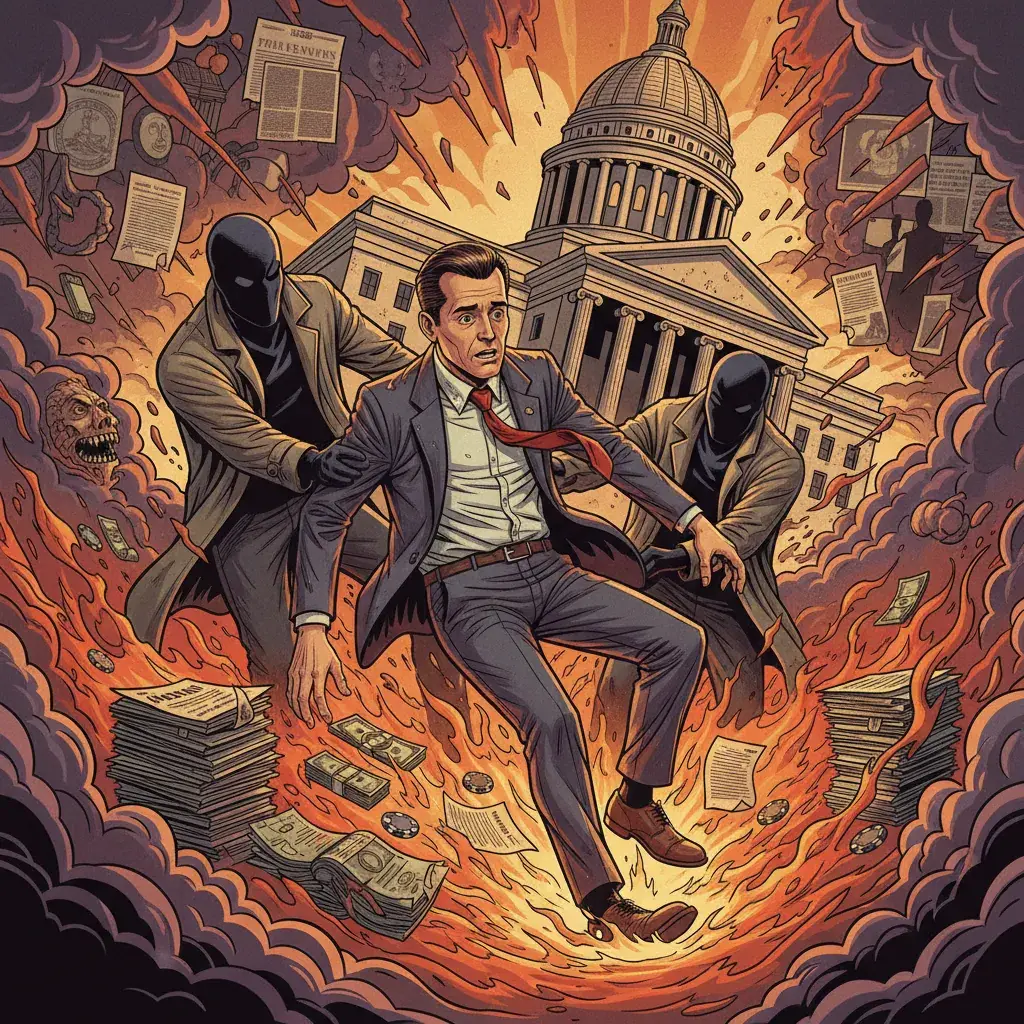
Once the federal government decided to move, the speed and ferocity of the investigation were breathtaking. The slow-burning whispers coalesced into a raging inferno, consuming Jack Abramoff and dragging down many in his orbit. The hammer didn’t just drop; it shattered his world.
The first major blow came in January 2005. Michael Scanlon, Abramoff’s loyal partner in crime, pleaded guilty to conspiracy to commit bribery and honest services fraud. Scanlon, facing serious jail time, agreed to cooperate with prosecutors, turning state’s evidence against Abramoff and others. This was a catastrophic development for Abramoff. Scanlon knew everything: the shell companies, the kickbacks, the inflated invoices, the “choo-choo” scheme, the lavish gifts, the entire rotten core of their operation. His testimony would be devastating.
The pressure on Abramoff intensified exponentially. He was now facing a mountain of evidence, a cooperating co-conspirator, and the full might of the Justice Department. His carefully constructed facade of legitimacy crumbled.
On January 3, 2006, the inevitable happened. Jack Abramoff himself pleaded guilty to three felony counts: conspiracy, honest services fraud, and tax evasion. The plea agreement was a stunning admission of guilt, detailing a wide array of crimes, including defrauding his tribal clients of tens of millions of dollars, bribing public officials, and corrupting the political process. He admitted to showering public officials with gifts, meals, and trips in exchange for legislative favors. He admitted to concocting schemes to conceal the true nature and destination of his clients’ money.
“Abramoff’s plea wasn’t just a legal maneuver; it was an earthquake that rumbled through Washington, exposing the fault lines of corruption that ran deep beneath the surface of power.”
His plea agreement also contained a crucial clause: he agreed to cooperate fully with federal investigators in their ongoing probes. This sent a collective shiver down the spine of Washington. Abramoff, the man who knew where all the bodies were buried, was now singing to the Feds. He had an unparalleled understanding of the intricate web of influence, money, and favors that permeated K Street and Capitol Hill.
The domino effect was immediate and brutal.
- Tom DeLay, the powerful House Majority Leader, was particularly vulnerable. Abramoff’s admissions directly implicated DeLay and his associates in schemes to trade political favors for campaign contributions and other benefits. While DeLay maintained his innocence, he was ultimately forced to resign his leadership position and, later, his Congressional seat amidst the growing scandal and unrelated ethics investigations. He was eventually convicted on money laundering and conspiracy charges in Texas, though that conviction was later overturned.
- Rep. Bob Ney (R-Ohio), a former chairman of the House Administration Committee, was the first sitting Congressman to plead guilty in connection with the Abramoff scandal. He admitted to accepting lavish gifts, meals, and trips from Abramoff in exchange for legislative favors, including helping Abramoff’s clients and even inserting a statement into the Congressional Record. He was sentenced to 30 months in prison.
- Numerous Congressional staffers and other lobbyists were indicted and pleaded guilty to various charges, including conspiracy, fraud, and bribery. The sheer number of individuals implicated revealed the systemic nature of the corruption.
- Abramoff’s former associate, Adam Kidan, who co-owned SunCruz Casinos with Abramoff, also pleaded guilty to fraud charges related to the SunCruz acquisition.
The scandal was a full-blown crisis for the Republican Party, which controlled both houses of Congress and the White House at the time. It fueled public cynicism about Washington and contributed to a broader narrative of corruption that would have significant political consequences.
Jack Abramoff, once the master of his universe, found himself stripped of his power, wealth, and reputation. He was sentenced to prison, serving 3.5 years of a 6-year sentence. His fall wasn’t just personal; it was a seismic event that exposed the rot at the heart of the lobbying industry, forever changing the perception of K Street and shaking the very foundations of American politics. The hammer had indeed dropped, and its reverberations would be felt for years to come.
🌪️ Chapter 9: The Fallout: DC in Shockwaves and the Scramble for Reform
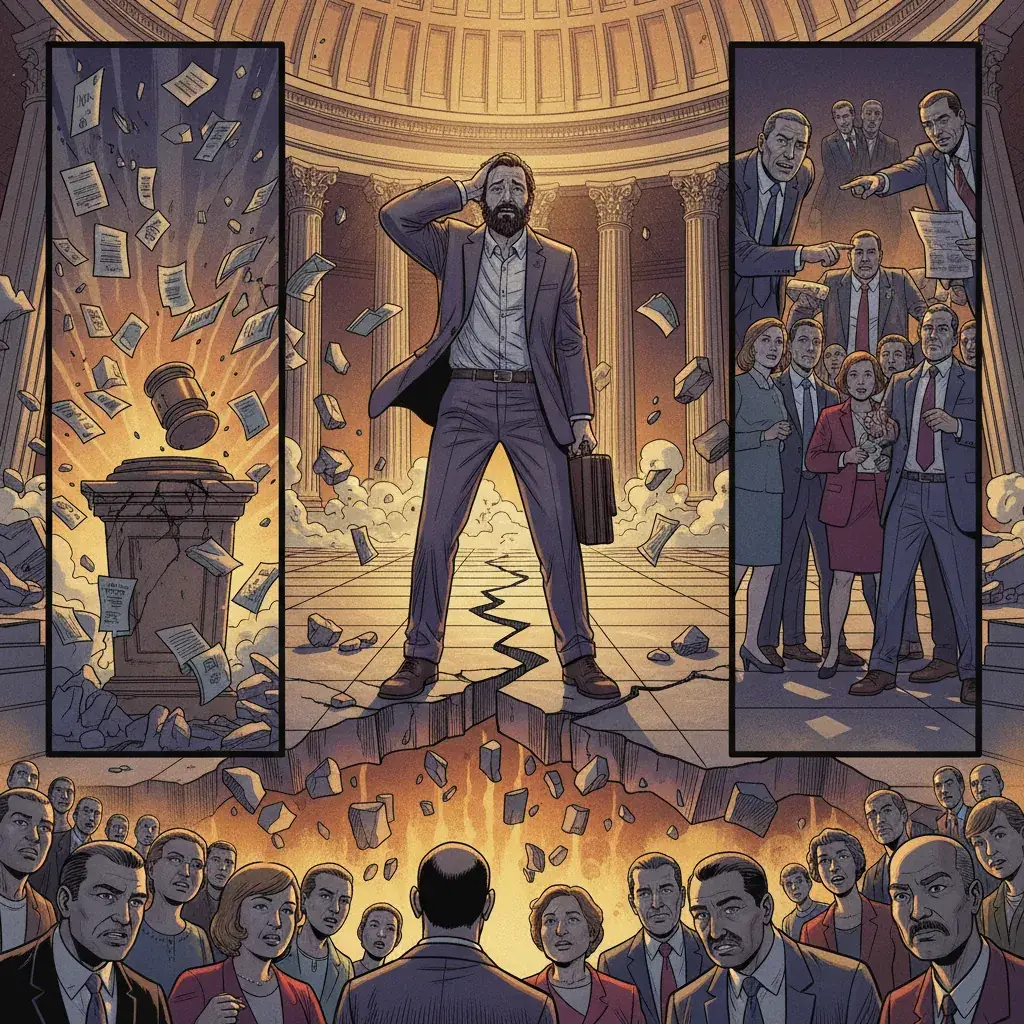
The Jack Abramoff scandal wasn’t just a story about one bad apple; it was a systemic shock that sent Washington D.C. reeling. The fallout was immediate, widespread, and forced a painful reckoning within the lobbying industry and on Capitol Hill. The city that had once celebrated Abramoff’s audacious success now scrambled to distance itself from his toxic legacy.
The political consequences were immense. For the Republican Party, which had been so closely intertwined with Abramoff and his network, the scandal was a devastating blow. It became a potent symbol of “the culture of corruption” that critics had long accused the party of fostering. The stain of Abramoff’s actions contributed significantly to the Democratic Party’s sweeping victories in the 2006 midterm elections, which saw them regain control of both the House and the Senate. The public, fed up with perceived ethical lapses, voted for change.
On K Street, the reaction was a mixture of fear, denial, and a desperate scramble for self-preservation. Lobbying firms, suddenly under intense scrutiny, reviewed their practices, tightened their ethics policies, and tried to reassure clients and the public that they were nothing like Abramoff. There was a palpable sense of paranoia, as lobbyists wondered who else Abramoff might have implicated in his cooperation with the feds. The golden age of unchecked influence peddling, at least for a time, was over.
“The Abramoff scandal didn’t just expose corruption; it ripped the lid off the entire lobbying ecosystem, forcing Washington to confront the uncomfortable truth about how power really changed hands, and at what cost.”
Congress, facing intense public pressure and a crisis of legitimacy, was forced to act. The scandal spurred a wave of ethics reform efforts, culminating in the passage of the Lobbying Transparency and Accountability Act of 2006 and later, the Honest Leadership and Open Government Act of 2007. These reforms aimed to:
- Increase Transparency: Mandate more frequent and detailed disclosure of lobbying activities, including the specific issues lobbied on and the amounts spent.
- Restrict Gifts and Travel: Place stricter limits on gifts from lobbyists to members of Congress and their staff, and curb the practice of lobbyists paying for lavish trips.
- Slow the Revolving Door: Extend the “cooling-off” period before former members of Congress and senior staff could become lobbyists, though this provision proved controversial and its effectiveness debated.
- Strengthen Ethics Oversight: Bolster the House and Senate ethics committees, giving them more resources and power to investigate potential violations.
While these reforms were lauded as necessary steps, their long-term impact remains a subject of debate. Critics argue that many loopholes still exist, and that while the overt Abramoff-style corruption might be rarer, the more subtle forms of influence peddling — through campaign donations, Super PACs, and “dark money” groups — continue to thrive. The reforms arguably made the corruption more sophisticated, less obvious, and therefore, harder to detect, rather than eradicating it entirely.
The scandal also had a profound impact on public trust. It reinforced the cynical view that Washington was a swamp, a place where the powerful and wealthy could buy influence, and where ethical lines were constantly blurred. It eroded faith in the integrity of the legislative process and the honesty of elected officials.
For the individuals involved, the personal toll was immense. Careers were shattered, reputations irrevocably tarnished, and lives upended. Abramoff himself, after serving his time, emerged a changed man, publicly expressing remorse and becoming a vocal advocate for lobbying reform – a bizarre, full-circle twist for the man who epitomized the problem.
The Abramoff scandal was a brutal, public autopsy of Washington’s influence industry. It revealed the seductive power of money, the fragile nature of ethical boundaries, and the chilling ease with which a charismatic operator could exploit systemic weaknesses for personal gain. Its legacy is a permanent scar on the face of K Street, a cautionary tale etched into the very foundations of American politics.
🎭 Chapter 10: The Mogul’s Morality Play: A Look in the Mirror
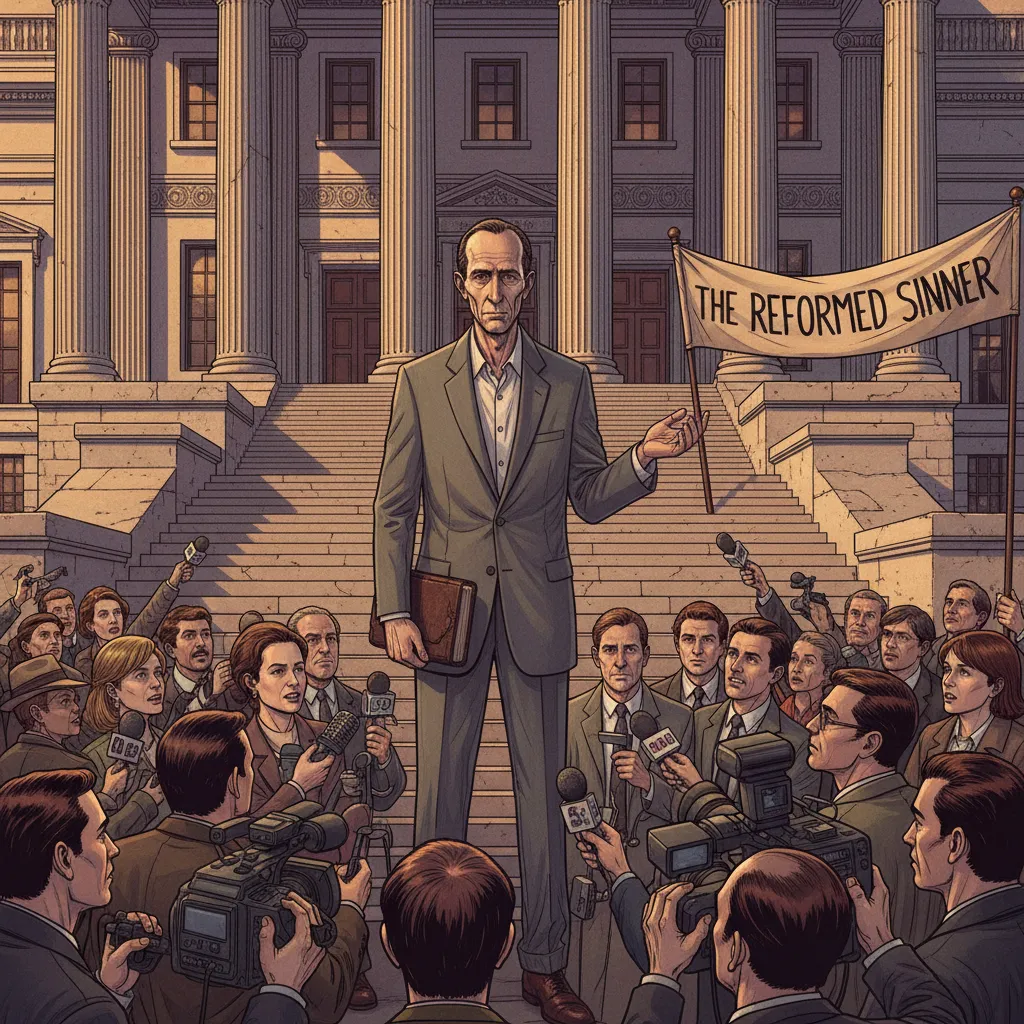
After serving 3.5 years in federal prison, Jack Abramoff emerged, a shadow of his former self, but with a new, unexpected role: that of a reformed sinner, a cautionary tale walking among us. His post-prison narrative is as fascinating, and perhaps as calculated, as his rise to power. It’s a complex morality play, forcing us to ask: what lessons, if any, did the K Street Kingpin truly learn?
Upon his release, Abramoff became a vocal critic of the very system he had so expertly corrupted. He wrote a book, Capitol Punishment: The Hard Truth About Washington Corruption From America’s Most Notorious Lobbyist, and embarked on a speaking tour. He gave interviews, appeared in documentaries, and testified before Congress, detailing the insidious ways money and influence intertwine in Washington. He spoke with a chilling clarity about the systemic nature of the problem, arguing that he was merely a product of a broken system, not its sole architect.
His insights, though offered from a uniquely compromised perspective, were often sharp and unsettling. He explained how politicians are constantly fundraising, creating an insatiable demand for money that lobbyists are all too eager to supply. He described how “friendships” are cultivated through lavish gifts and experiences, blurring the lines between personal relationships and professional transactions. He highlighted the “revolving door” phenomenon, where former government officials quickly transition to lucrative lobbying careers, leveraging their insider knowledge and connections.
“Abramoff’s redemption arc, if you can call it that, is a stark reminder that even the most morally bankrupt can offer valuable insights into the mechanics of corruption. He became a reluctant prophet, dissecting the very beast he once rode.”
But here’s the rub: can a master manipulator truly be reformed? Is his post-prison advocacy genuine, or simply another, more sophisticated form of self-preservation and narrative control? Some critics argue that Abramoff’s “remorse” is just another performance, a way to rebrand himself and remain relevant, albeit on different terms. Others believe that the harsh reality of prison, the loss of everything he built, genuinely humbled him and provided a unique vantage point from which to dissect the system.
From a business perspective, Abramoff’s story offers a devastating case study in the dangers of unchecked ambition and the illusion of invincibility.
- The Perils of Moral Erosion: His career shows a gradual, then rapid, descent into unethical and illegal behavior. It wasn’t a single catastrophic decision, but a series of compromises that ultimately led to his downfall. For any entrepreneur or professional, it’s a warning about the slippery slope of cutting corners and the cumulative cost of ethical transgressions.
- Value Proposition vs. Value Extraction: Initially, Abramoff offered a legitimate, albeit aggressive, value proposition to his clients. Over time, however, his business model shifted from genuine advocacy to pure value extraction, where the clients’ money was primarily used to enrich him and his associates, rather than advance their interests. This is a critical lesson for any business: sustainable success relies on delivering genuine value, not on elaborate schemes of self-enrichment.
- The Fragility of Reputation: Abramoff meticulously built a formidable reputation, only to see it utterly annihilated. In a networked world, reputation is paramount. His story underscores that no amount of power or wealth can insulate you from the consequences of a shattered public image, especially when that image is shattered by criminal acts.
- The Systemic Nature of Corruption: Abramoff’s analysis of D.C.’s “pay-to-play” culture rings true for many. It highlights how environments that reward access and financial contributions can inadvertently create incentives for unethical behavior. For businesses operating in regulated or politically sensitive sectors, understanding these systemic pressures is crucial for risk management and maintaining integrity.
Jack Abramoff’s story is a modern-day Icarus myth, a dazzling flight fueled by ambition and hubris, ending in a catastrophic plunge. It serves as a chilling reminder that while the pursuit of power and profit can build empires, a foundation of fraud and deceit will inevitably lead to ruin. His legacy is not just a tale of personal failure, but a powerful, enduring morality play about the seductive dangers of influence and the enduring struggle to maintain integrity in the cutthroat arena of business and politics.
🏛️ Chapter 11: Epilogue: The Shadow of K Street

The dust has long settled on the Jack Abramoff scandal. He’s served his time, written his books, and carved out a new, albeit controversial, niche as a reformed lobbyist-turned-ethics-guru. But the shadow he cast over Washington D.C., and indeed over the entire American political system, remains. His story is more than just a sensational true-crime saga; it’s a stark, enduring lesson for anyone navigating the treacherous waters where money, power, and influence converge.
What did we truly learn from the K Street Kingpin’s crown of thorns?
First, it illuminated the often-opaque world of lobbying. Before Abramoff, many Americans had a vague understanding of what lobbyists did. After him, the term became synonymous with backroom deals, lavish gifts, and the unsettling notion that legislation could be bought. He ripped the curtain back, exposing the mechanics of influence-peddling in excruciating, undeniable detail. He showed us that the political process, far from being pristine, was deeply susceptible to those willing to exploit its vulnerabilities.
Second, it underscored the human element in corruption. Abramoff was not a cartoon villain. He was charismatic, intelligent, and deeply connected. He had a family, a faith, and, by many accounts, a genuine desire to help his clients. Yet, he systematically defrauded them, bribed officials, and engaged in a breathtaking array of illegal activities. His story reminds us that corruption often begins with small compromises, a gradual erosion of ethical boundaries, fueled by ambition and the intoxicating allure of power. It’s a cautionary tale for every entrepreneur and executive: the ethical line, once crossed, is incredibly difficult to uncross.
Third, it sparked a conversation, however fleeting, about the need for reform. The post-Abramoff era saw new ethics rules, stricter disclosure requirements, and attempts to slow the revolving door between Capitol Hill and K Street. While these reforms have arguably made the most egregious forms of corruption harder to execute, they haven’t eradicated the fundamental challenge: the immense amount of money flowing into politics, and the inherent tension between private interests and public good. The game continues, albeit with slightly altered rules. The money still talks, and the access it buys remains a potent force.
“Abramoff’s legacy isn’t just a mugshot and a prison sentence; it’s a permanent question mark hanging over the integrity of Washington, a reminder that the price of democracy is eternal vigilance against those who would commodify power.”
For the aspiring mogul, the investor, the entrepreneur, Abramoff’s saga is a masterclass in what not to do. It’s a vivid illustration that even the most brilliant strategists, the most formidable networkers, and the most audacious dealmakers will ultimately fail if their foundations are built on fraud and deceit. Sustainable success, true legacy, requires integrity. It demands a genuine value proposition, transparent dealings, and an unwavering commitment to ethical conduct. Anything less, no matter how spectacular the initial ascent, is merely postponing an inevitable and devastating fall.
The shadow of K Street still looms large. The lobbying industry continues to exert enormous influence, and the ethical dilemmas remain. But because of Jack Abramoff, we understand the game a little better. We see the potential for darkness, the seductive power of unchecked ambition, and the profound importance of accountability. His story isn’t just a historical footnote; it’s a living lesson, a constant reminder that in the high-stakes world of business and politics, the pursuit of power without principle is a highway to ruin. And sometimes, the most compelling stories aren’t about building an empire, but watching one spectacularly burn.
💡 Key Insights
- ▸ The 'value-add' in any business, especially influence-peddling, must be tangible and ethical. Abramoff's initial success came from identifying an underserved, high-stakes market (tribal gaming), but his fatal flaw was substituting genuine advocacy with an elaborate scheme of self-enrichment, demonstrating that even a brilliant networker's empire will collapse if built on fraud rather than legitimate service.
- ▸ Entrepreneurs and investors must rigorously vet partners and maintain transparent financial practices. Abramoff's intricate web of shell companies, offshore accounts, and kickbacks highlights the dangers of opaque operations, which can mask significant liabilities and ultimately destroy trust, reputation, and capital. Due diligence isn't just a formality; it's a firewall against catastrophic moral and financial failure.
- ▸ The Abramoff scandal underscores the systemic risks within industries where power and money intersect with limited oversight. It serves as a stark reminder for market participants to push for greater transparency and accountability, as unchecked influence can distort market dynamics, create unfair advantages, and ultimately erode public and investor confidence in the integrity of the system itself.