Jack Ma: From English Teacher to China's Richest Man — Then He Vanished
He built Alibaba from a cramped apartment, made $25B+, then gave a speech that angered Beijing. What happened next shocked the world.

View all stories about this mogul
He was rejected from 30 jobs after college — including KFC. Harvard turned him down ten times. The police academy said no. He failed his university entrance exams twice. And then this 5’5”, 120-pound former English teacher from Hangzhou, China, built the largest e-commerce company in the world, amassed a peak net worth exceeding $25 billion, became the most famous entrepreneur in Chinese history, and delivered a single 21-minute speech that made him vanish from public life for nearly three months. When he resurfaced, it was on a grainy video call, looking like a man who had been thoroughly reminded of something he’d apparently forgotten: in China, there is no billionaire bigger than the Party.
This is the story of Jack Ma — the most spectacular rise-and-fall in modern Chinese capitalism, and a cautionary tale about what happens when you confuse being rich with being untouchable.
🧒 Chapter 1: The Kid Nobody Wanted — Hangzhou, 1964–1995

Ma Yun — the world would later know him as Jack Ma — was born on September 10, 1964, in Hangzhou, a city in eastern China that was, at the time, a long way from being anyone’s idea of a business capital. His parents were traditional storytellers and musicians who performed “pingtan,” a local folk art. They weren’t poor in the dramatic, made-for-Hollywood sense. They were just ordinary. And in 1960s-70s China, ordinary meant no connections, no advantages, and no margin for error.
The Rejection Machine
What Ma had going for him was a work ethic that bordered on pathological and a fascination with English that, in retrospect, looks like the most consequential hobby in Chinese business history.
Starting at age 12, Ma reportedly rode his bicycle 40 minutes each way to the Hangzhou Hotel, where he’d offer free tours to foreign tourists in exchange for English practice. He did this every morning for nine years. “I rode my bike for 40 minutes every morning, rain or snow, for nine years,” Ma later recalled at the Economic Club of New York. “I showed tourists around as a free guide. Those China trips changed me.”
But here’s the part that should make every person who’s ever been rejected from anything sit up straight: Ma was a rejection magnet of historic proportions.
He failed his college entrance exam — the gaokao — twice. The first time, he scored a 1 out of 120 in math. One. Out of a hundred and twenty. He finally passed on his third attempt, barely, and enrolled at Hangzhou Teacher’s Institute, a school that was nobody’s first choice.
After graduating in 1988 with a degree in English, he applied for 30 jobs. Every single one rejected him. He applied to KFC when it first opened in Hangzhou — 24 people applied, 23 were hired, and the only one who wasn’t? Jack Ma. “I went for a job with the police; they said, ‘You’re no good,’” he told Charlie Rose in 2015. “I even went to KFC when it came to my city. Twenty-four people went for the job. Twenty-three were accepted. I was the only one they turned down.”
He applied to Harvard Business School. Ten times. Rejected every time.
The Teacher Years
So he became what his degree qualified him for: an English teacher at Hangzhou Dianzi University, earning roughly 100 to 150 yuan per month — about $12 to $20. For five years, Ma taught English. He was, by most accounts, an exceptional teacher. Energetic, funny, deeply committed to his students. If the story had ended there, he’d have been remembered as a beloved local professor and nothing more.
But in 1995, something happened that would redirect the entire trajectory of Chinese commerce.
💻 Chapter 2: “What Is Internet?” — The Spark, 1995–1999

In January 1995, Ma traveled to Seattle as a translator for a Chinese trade delegation. A friend showed him the internet. Ma had never used a computer before. He sat down, opened a primitive browser, and typed “beer” into a search engine. Results from Germany, Japan, the United States — but nothing from China.
He typed “China.” Nothing.
“Even though the page took three and a half hours to download half the page,” Ma recalled, “I was so excited.” He immediately saw the gap: 1.2 billion people, zero presence on the emerging global network. Whatever the internet was going to become, China was missing from it entirely.
Ma returned to Hangzhou and, with $2,000 scraped together from friends and family, launched China Pages — one of China’s first internet companies. It was a directory service that helped Chinese businesses build websites. The idea was sound. The execution was rocky. Ma had no technical knowledge, no capital, and no real understanding of how the internet worked beyond the conviction that it mattered.
China Pages limped along and eventually failed. Ma then spent a miserable year working for the Ministry of Foreign Trade’s internet venture in Beijing, an experience he reportedly described as being “like an elephant trying to dance with ants.”
By 1999, Ma was 34 years old, broke, and back in Hangzhou. He’d tried the internet twice and failed twice. Most people would have gone back to teaching. Jack Ma gathered 17 friends in his apartment.
The Apartment Meeting
On February 21, 1999, Ma sat in his small lakeside apartment in Hangzhou and gave what might be the most consequential pitch in Chinese business history. The now-legendary video of this meeting — grainy, Ma pacing in a sweater, gesturing wildly — has been viewed millions of times. He told the assembled group of friends, former students, and colleagues that they were going to build an internet company that would last 80 years and serve small businesses around the world.
“We will make it because we are young and we never, never give up,” Ma said to the room, his voice rising. “We’re China’s hope.”
The group pooled $60,000. They called the company Alibaba — a name Ma chose because, he said, it was universally recognized, easy to spell, and associated with “Open Sesame,” a phrase about unlocking hidden treasures. He reportedly tested the name by asking random people on the streets of San Francisco if they knew the name “Alibaba.” They did. Done.
The company’s first product was Alibaba.com, a business-to-business marketplace connecting Chinese manufacturers with buyers worldwide. It was, in essence, the Yellow Pages of Chinese factories — but online, searchable, and free to list. The timing was extraordinary. China was on the verge of joining the World Trade Organization. Millions of small manufacturers were desperate for global customers. Ma gave them a doorway.
🚀 Chapter 3: Building the Everything Company — 2000–2013

Alibaba grew. Fast. But it wasn’t a straight line. The dot-com crash of 2000 nearly killed the company. Ma had expanded too quickly — offices in Hong Kong, London, Silicon Valley — and was burning cash at a rate the tiny company couldn’t sustain. He pulled back. Retreated to Hangzhou. Laid off most of the international staff.
The Goldman Sachs Bet and SoftBank
What saved Alibaba was a $5 million investment from Goldman Sachs in 1999, followed by a $20 million bet from Masayoshi Son’s SoftBank in 2000. The SoftBank story is legend: Son and Ma reportedly met for six minutes before Son offered $20 million, which Ma initially tried to talk down because he didn’t need that much. Ma says the whole deal took six minutes. Son reportedly says it was five. Either way, it was the fastest $20 million ever deployed — and it would eventually be worth over $100 billion to SoftBank, one of the greatest venture returns in history.
But the real breakthrough wasn’t Alibaba.com. It was what came next.
Taobao: The eBay Killer
In 2003, Ma launched Taobao — a consumer-to-consumer marketplace designed to compete directly with eBay, which had entered China through its acquisition of EachNet and was spending aggressively to dominate the Chinese market. eBay had more money, more experience, and more brand recognition. Every rational analysis said Alibaba would lose.
Ma didn’t care. He made Taobao free to use — no listing fees, no transaction fees — while eBay charged sellers for everything. He invested in features Chinese consumers wanted: instant messaging between buyer and seller, escrow payment systems that protected both parties, and a deep understanding that Chinese consumers didn’t trust online transactions and needed their hands held through every step.
“eBay is a shark in the ocean,” Ma reportedly told his team. “We are a crocodile in the Yangtze River. If we fight in the ocean, we will lose. But if we fight in the river, we will win.”
By 2006, eBay effectively surrendered the Chinese market. Taobao had over 70% market share. The crocodile had swallowed the shark.
Alipay: Inventing Trust
Ma’s next masterstroke was Alipay, launched in 2004 as an escrow payment system for Taobao transactions. Chinese consumers didn’t trust online payments. Alipay held the buyer’s money until they confirmed receipt and satisfaction with the product. It solved the fundamental trust problem of Chinese e-commerce.
Alipay grew beyond Taobao into a standalone payment platform that would eventually process more transactions than Visa and Mastercard combined. By 2020, its successor entity — Ant Group — would serve over 1 billion users and facilitate more than $17 trillion in annual digital payments.
But the separation of Alipay from Alibaba’s corporate structure — done in 2011 without the full prior approval of major shareholders including Yahoo and SoftBank — created controversy that foreshadowed Ma’s complicated relationship with authority. Ma argued it was necessary to comply with Chinese regulations. Critics said he’d transferred the most valuable asset out of the company foreign investors owned shares in. Either way, the episode revealed something important: Ma would do what Ma thought was right, and worry about permission later.
🎉 Chapter 4: Singles’ Day and the IPO — Peak Ma, 2009–2014

In 2009, Ma’s team invented something that would become the single biggest shopping event in human history: Singles’ Day.
November 11 — 11/11, because all those ones looked lonely — was already an informal anti-Valentine’s Day holiday among Chinese university students, a day for single people to treat themselves. Alibaba turned it into a 24-hour online shopping festival with massive discounts across its platforms.
The first Singles’ Day generated about $7.8 million in sales. Solid, not spectacular. But the event grew exponentially. By 2012, it did $3.1 billion. By 2015, $14.3 billion. By 2019, $38.4 billion — in a single day. For context, that’s more than Black Friday and Cyber Monday combined, multiplied by several times over.
Singles’ Day became Ma’s ultimate proof of concept: Chinese consumers were not just willing to shop online, they were desperate to. And Alibaba had built the infrastructure — the marketplace, the payment system, the logistics network — to serve all of them simultaneously.
The $25 Billion IPO
On September 19, 2014, Alibaba went public on the New York Stock Exchange in what was, at the time, the largest initial public offering in history. The company raised $25 billion. Its market capitalization on the first day of trading exceeded $230 billion, making it instantly worth more than Amazon, eBay, and Facebook.
Jack Ma — the guy who scored 1 out of 120 on his math exam, the guy KFC wouldn’t hire — was now the richest man in China, with a personal net worth exceeding $25 billion.
“Today what we got is not money,” Ma told reporters on IPO day. “What we got is the trust of the people.”
He was 50 years old. He’d spent two decades building something that had reshaped the daily life of over a billion people. He was a global celebrity, a fixture at Davos, a friend to world leaders, a martial arts movie star (he literally made a kung fu short film with Jet Li), and possibly the most admired businessman in Asia.
This is the point in the story where, if this were a fairy tale, you’d get the “happily ever after.” But this isn’t a fairy tale. This is China.
🎤 Chapter 5: The Speech That Changed Everything — October 24, 2020

Ma had stepped down as Alibaba’s executive chairman in September 2019, on his 55th birthday, in a ceremony that featured him performing in a rock star costume. He was supposed to be entering his legacy phase: philanthropy, education, maybe some painting.
But behind the scenes, something much bigger was happening. Ant Group — the financial technology colossus that had grown out of Alipay — was preparing for a dual listing on the Shanghai and Hong Kong stock exchanges. The IPO was expected to raise approximately $37 billion, the largest initial public offering in global history. Ant Group was valued at roughly $315 billion.
And then Jack Ma walked onto a stage in Shanghai and set his empire on fire.
The Bund Finance Summit
On October 24, 2020, Ma delivered a 21-minute speech at the Bund Finance Summit in Shanghai. The audience included some of the most powerful financial regulators in China, including Wang Qishan, the Vice President of China. What Ma said to that room was either the most courageous or the most reckless speech in modern Chinese business history.
He called China’s state-owned banks — the backbone of the CCP’s financial control — “pawnshops” that relied on collateral instead of innovation. He said the Basel Accords, the international banking regulations that China’s regulators were working to implement, were a “club of old people” that stifled innovation. He argued that China’s financial regulatory system was designed for yesterday and was “strangling” the future.
“We shouldn’t use the way to manage a train station to manage an airport,” Ma told the room. “We cannot regulate the future with yesterday’s means.”
He accused regulators of having a “pawnshop mentality” and essentially told the room — full of the people who had the power to approve or block Ant Group’s IPO — that they didn’t understand modern finance and were holding China back.
The speech was, to put it charitably, bold. To put it accurately, it was a billionaire publicly humiliating the Chinese Communist Party’s financial establishment 10 days before he needed their approval to list his company.
Some who were present reportedly described the atmosphere as stunned silence. Others said regulators in the room were visibly furious. Within hours, transcripts of the speech were circulating among China’s political elite.
The Hammer Falls
Eleven days later, on November 3, 2020 — just 48 hours before Ant Group’s shares were set to begin trading — Chinese regulators summoned Ma and Ant Group executives for a meeting. What was said in that room has never been publicly disclosed.
On November 3, the Shanghai Stock Exchange suspended the IPO.
The largest public offering in history was dead. $37 billion — gone. Ant Group’s $315 billion valuation — vaporized overnight. Investors who had borrowed money to subscribe were left scrambling. It was the most dramatic regulatory intervention in modern financial history.
The official explanation cited “major issues” related to changes in the financial regulatory environment. The real explanation, widely reported by outlets including the Wall Street Journal, Reuters, and the Financial Times, was simpler: Xi Jinping personally ordered the IPO halted after being briefed on Ma’s Bund speech.
Jack Ma had poked the dragon. The dragon responded.
👻 Chapter 6: The Vanishing — Late 2020 to 2021

After the IPO suspension, Jack Ma disappeared.
Not dramatically. Not with police cars or midnight raids — this wasn’t that kind of disappearance. Ma simply stopped appearing in public. He missed the finale of a television talent show he’d been judging — “Africa’s Business Heroes,” a competition he’d personally funded. His social media accounts went silent. His last Weibo post was in October 2020. He was absent from events he’d never missed. He stopped giving speeches. He stopped being photographed.
For three months, from roughly November 2020 through January 2021, the most famous businessman in China — a man with over 25 million followers on Weibo, a man whose face was more recognizable in China than most movie stars — simply wasn’t there.
The world noticed. Media outlets from the New York Times to the BBC ran stories asking the same question: Where is Jack Ma?
Speculation ranged from house arrest to detention to something worse. The Chinese government said nothing. Alibaba said nothing. Ma’s representatives said nothing. The silence was deafening and deliberate. In China’s political system, the silence was the message.
What Was Actually Happening
While Ma was invisible, Beijing was dismantling his empire.
In December 2020, China’s State Administration for Market Regulation launched an antitrust investigation into Alibaba, focusing on the company’s practice of requiring merchants to sell exclusively on its platforms — a practice known as “choose one from two.” In April 2021, Alibaba was hit with a record $2.8 billion antitrust fine — the largest in Chinese corporate history.
Simultaneously, regulators forced Ant Group to restructure itself as a financial holding company subject to banking-level capital requirements. This effectively gutted the business model that had made Ant Group so valuable. The company that was worth $315 billion in October 2020 was, by some estimates, worth less than $75 billion after the restructuring — a destruction of roughly $240 billion in value.
The message was unmistakable: the Party builds billionaires, and the Party can unmake them.
📉 Chapter 7: The Crackdown — China’s Tech Winter, 2021–2023

Jack Ma’s humbling wasn’t an isolated event. It was the opening shot in what became the most sweeping crackdown on private enterprise in China since the Mao era.
Starting in late 2020 and accelerating through 2021–2022, Beijing systematically targeted virtually every major Chinese tech company. Didi Chuxing — China’s Uber — was forced to delist from the NYSE after a cybersecurity review. Tencent saw new game approvals frozen and minors restricted to three hours of gaming per week. Meituan was fined $530 million. ByteDance shelved its IPO indefinitely. The education technology sector was annihilated overnight when Beijing banned for-profit tutoring in core school subjects, destroying companies like TAL Education and New Oriental, which lost over 90% of their market value.
In total, the crackdown erased more than $1 trillion from the combined market capitalization of Chinese tech companies.
Ma’s Personal Toll
For Jack Ma specifically, the damage was staggering. At his peak in late 2020, Ma’s net worth was estimated at approximately $61 billion, making him the richest person in China. By mid-2023, various estimates placed it between $20 billion and $30 billion — a loss of potentially $30 billion or more from his peak.
More importantly, Ma had lost something money couldn’t measure: his influence. He was no longer the keynote speaker that every conference wanted. He was no longer the face of Chinese entrepreneurship. He was a cautionary tale.
🔄 Chapter 8: The Reappearance — A Smaller Man, 2023–Present

On January 7, 2023 — more than two years after the Bund speech — Jack Ma reappeared.
A 50-second video surfaced showing Ma visiting a rural school in China. He looked thinner. He spoke briefly about rural education. The video was stilted and clearly choreographed — less a genuine public appearance than a proof-of-life video.
Over the following months, Ma was spotted traveling abroad — Japan, Thailand, Australia. He wasn’t imprisoned. He wasn’t under formal house arrest. He was simply… diminished. Reports indicated he was spending significant time in Tokyo, far from Beijing.
Handing Over the Reins
In September 2023, Ma gave up control of Ant Group, ceding his voting power as part of the company’s restructuring. The man who had built Alipay from an escrow payment button into a $300 billion financial empire had been effectively separated from his creation.
Alibaba itself split into six independent business groups in March 2023 — widely interpreted as an attempt to appease regulators. The company donated billions to “common prosperity” initiatives. The corporate culture shifted from Ma’s swashbuckling philosophy to something far more deferential.
The New Jack Ma
The Jack Ma who occasionally surfaces now bears little resemblance to the man who once told the World Economic Forum, “I’m not afraid of anyone.” He has, according to multiple reports, told associates that he regrets the Bund speech. Not the substance — Ma reportedly still believes regulators are too conservative — but the timing and the tone.
“The lesson,” one person close to Ma reportedly told the Financial Times, “is that Jack always thought he was too big to fail. He found out nobody is.”
🪞 Chapter 9: What Jack Ma’s Story Actually Means

Jack Ma’s story is not a simple morality tale. He wasn’t brought down by fraud (like Elizabeth Holmes), or by financial recklessness (like Adam Neumann), or by personal scandal. He was brought down by a system that he helped build and then forgot he was subject to.
The Paradox of Chinese Capitalism
For two decades, China’s model was clear: the Party provides stability, infrastructure, and a massive consumer market. In exchange, entrepreneurs build, innovate, employ millions, and — critically — stay in their lane. Get rich, but remember who made it possible.
Ma followed this formula brilliantly for 20 years. He credited the Party with creating the conditions for Alibaba’s success. He joined the Communist Party (his membership was revealed in 2018, to the surprise of many in the West). He was the model of the successful Chinese entrepreneur who understood the rules. And then, at the Bund, he acted like he’d forgotten all of them.
The Global Implications
Ma’s fall sent shockwaves far beyond China. The NASDAQ Golden Dragon China Index — which tracks Chinese companies listed in the US — fell roughly 60% from its peak. Major institutional investors began quietly reducing their China exposure. The message was received globally: investing in Chinese technology companies carries a category of risk that doesn’t exist in other markets. The CEO of your biggest investment can give one wrong speech and lose $37 billion overnight.
The Human Story
Strip away the geopolitics and the billions, and Jack Ma’s story is fundamentally human. A kid from a modest family who was told “no” more times than almost anyone in business history, who kept getting up, who built something extraordinary, who changed how a billion people shop and pay for things, and who lost much of what he’d built because he couldn’t resist the urge to tell powerful people they were wrong.
The financial regulators Ma criticized were, by many expert assessments, genuinely behind the curve on fintech regulation. Ma wasn’t wrong about the substance. He was catastrophically wrong about the venue, the timing, and the assumption that being right would protect him.
“I’ve learned a lot of lessons,” Ma said in a rare comment during a brief public appearance in Hong Kong in late 2023. “I want to be a good teacher again.”
The apartment where Alibaba was founded is now a tourist attraction. The company Ma built processes trillions of dollars in transactions annually. Singles’ Day still breaks records every November. Alipay is still how a billion people pay for everything from groceries to train tickets.
Jack Ma built all of it. And then he learned, in the hardest way possible, that in China, building something doesn’t mean you own it. Not really. Not ever.
Jack Ma’s net worth, as tracked by Bloomberg, fluctuated between approximately $20 billion and $30 billion through 2025 — a fortune that would make him one of the richest people on Earth by any normal standard, but a dramatic decline from his peak. Alibaba’s market capitalization, which once exceeded $800 billion, settled in the range of $200–300 billion. The Ant Group IPO has never been relaunched.
Ma turned 61 in September 2025. He spends most of his time abroad. He does not give speeches.
🥊 Chapter 10: The Brawl for China’s Soul — Taobao vs. eBay (2003–2006)
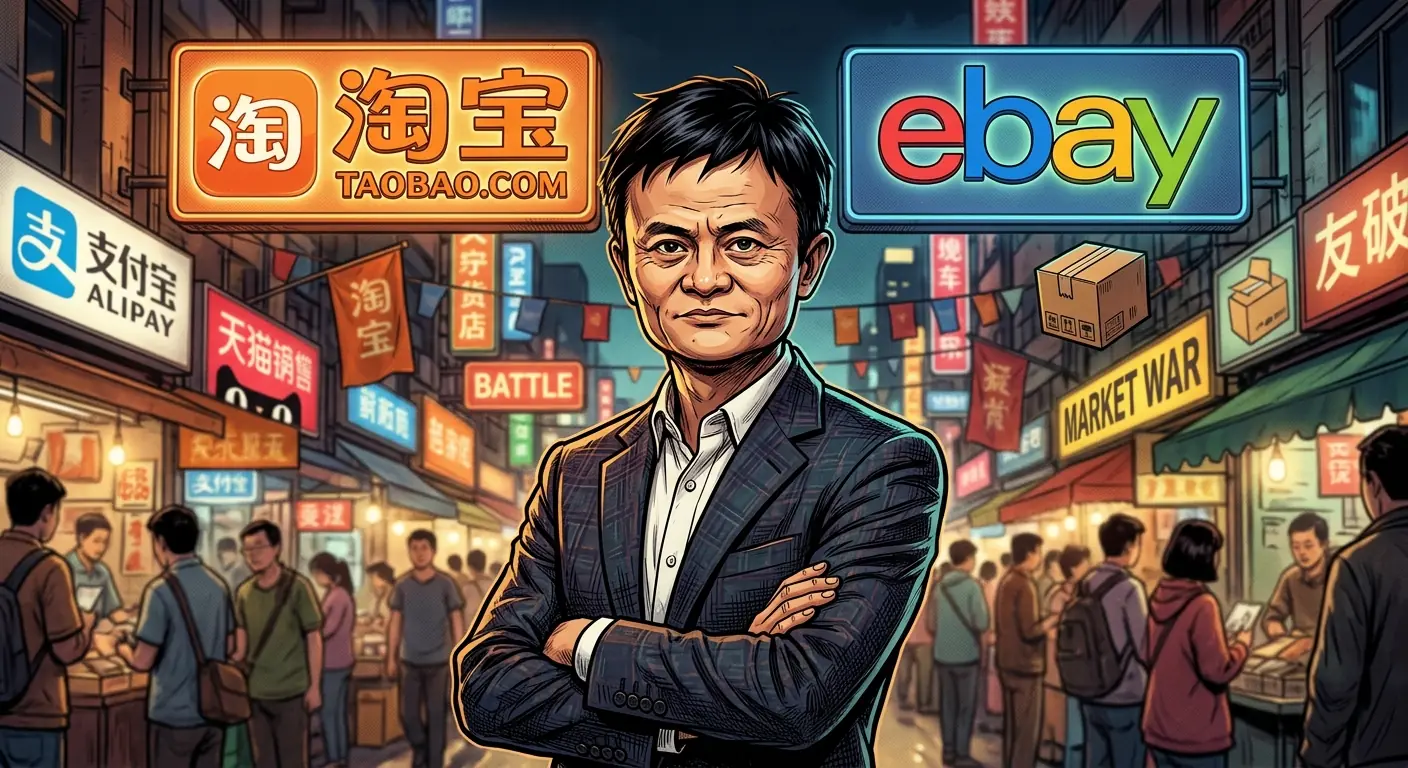
If Chapter 2 was about the spark, and Chapter 3 about building the foundation, then the early 2000s were about Alibaba’s first true fight for survival – a brutal, winner-take-all brawl against an international Goliath: eBay. The year was 2003, and eBay, fresh off acquiring its Chinese rival EachNet for a cool $150 million, swaggered into China with deep pockets and a global reputation. They were the undisputed king of online auctions everywhere else. China, they figured, would be no different. Ma, ever the contrarian, saw a different future.
David vs. Goliath: The eBay Onslaught
eBay’s entry was less an invasion and more an assertion of global dominance. They poured resources into China, reportedly spending $100 million on marketing and infrastructure in their first year alone. Their strategy was simple: replicate their successful model. Charge listing fees, charge transaction fees, and leverage their brand. They probably thought Taobao, launched by Alibaba in May 2003 from a cramped apartment in Hangzhou, was a cute local quirk. A fly on the elephant’s hide. Oh, how wrong they were.
Ma, with his characteristic mix of audacity and street smarts, understood something crucial: China wasn’t America. Credit cards were rare. Trust was low. And most importantly, Chinese consumers and small businesses were extremely price-sensitive. While eBay insisted on its fee-based model, Taobao launched with a radical, game-changing proposition: it was completely free for sellers. “eBay may be a shark in the ocean,” Ma famously quipped, “but I am a crocodile in the Yangtze River. If we fight in the ocean, we lose. But if we fight in the river, we win.” It was a declaration of war, delivered with a smile.
The Free Model: A Masterstroke
Ma’s decision to make Taobao free was pure genius, or madness, depending on who you asked. It bled Alibaba financially in the short term, but it attracted millions of small vendors who couldn’t afford eBay’s fees. Ma also focused on localizing the platform: Taobao offered instant messaging between buyers and sellers, a feature eBay initially lacked, understanding that direct communication built trust in a market wary of online transactions. He reportedly spent just $1 million on marketing for Taobao in its early days, focusing instead on word-of-mouth and building a community.
By 2005, just two years after its launch, Taobao had overtaken eBay EachNet in market share. By 2206, eBay threw in the towel, selling its remaining stake in EachNet to Tom Online, a Chinese internet company. It was a stunning victory for Alibaba, cementing its position as the dominant force in Chinese e-commerce and proving that Ma’s unconventional wisdom could beat even the biggest global players. The “crocodile” had devoured the “shark.”
Alipay: The Trust Machine
But the victory wasn’t just about free listings. A critical component was solving China’s biggest e-commerce hurdle: trust. How do you convince a buyer to send money to a stranger online when neither has credit card protection? Ma’s answer was Alipay, launched in 2004. Alipay acted as an escrow service: buyers would pay Alipay, Alipay would hold the money until the buyer confirmed receipt and satisfaction with the goods, and then Alipay would release the funds to the seller.
This simple yet revolutionary concept bypassed the lack of credit card infrastructure and created a layer of trust that was missing. It was a move so audacious, and technically so risky given regulatory uncertainty, that it arguably saved Taobao. Alipay wasn’t just a payment system; it was a promise. It built the bridge of trust that allowed Chinese e-commerce to explode, transforming Alibaba from a B2B platform into a consumer powerhouse and laying the groundwork for a financial empire that would soon make global headlines.
💰 Chapter 11: From E-commerce to Everything Else — Ant Financial and the IPO (2010–2014)
With Taobao’s triumph over eBay, Alibaba’s e-commerce dominance was secure. But Jack Ma, never one to settle, saw a far grander vision unfolding. He wasn’t just building an online marketplace; he was constructing the digital infrastructure for China’s entire economy. The next big frontier? Finance. And the crown jewel of this ambition was Alipay, which would soon morph into a behemoth known as Ant Financial.
The Alipay Empire Rises
Alipay, initially conceived as a simple escrow service for Taobao, quickly grew beyond its parent platform. By the early 2010s, it was becoming the default payment method for millions of Chinese consumers, not just for online shopping but for everything from utility bills to taxi rides. This expansion, however, created a thorny problem. China’s financial regulations were murky regarding foreign ownership of payment systems, and Alibaba had major foreign shareholders in Yahoo and SoftBank.
In a move that would later spark considerable controversy with his partners, Ma decided in 2011 to unilaterally spin off Alipay from Alibaba Group, transferring ownership to a new, wholly Chinese-owned entity, later renamed Ant Financial. He argued it was a necessary step to secure the required financial licenses and ensure Alipay’s future.
“We had to take action to comply with People’s Bank of China regulations,” Ma stated at the time, insisting it was for the good of the company.
While the legality and ethics of the move were debated for years, it undeniably paved the way for Alipay’s explosive growth. In 2013, Ant Financial launched Yu’e Bao, a money market fund that allowed users to invest small sums directly from their Alipay accounts. It was a revelation for ordinary Chinese citizens, offering higher returns than traditional bank deposits and unprecedented ease of access. Within a year, Yu’e Bao became the world’s largest money market fund, managing over $90 billion. Ant Financial wasn’t just a payment processor; it was a full-fledged financial services innovator, disrupting traditional banking at warp speed.
The IPO That Shook the World
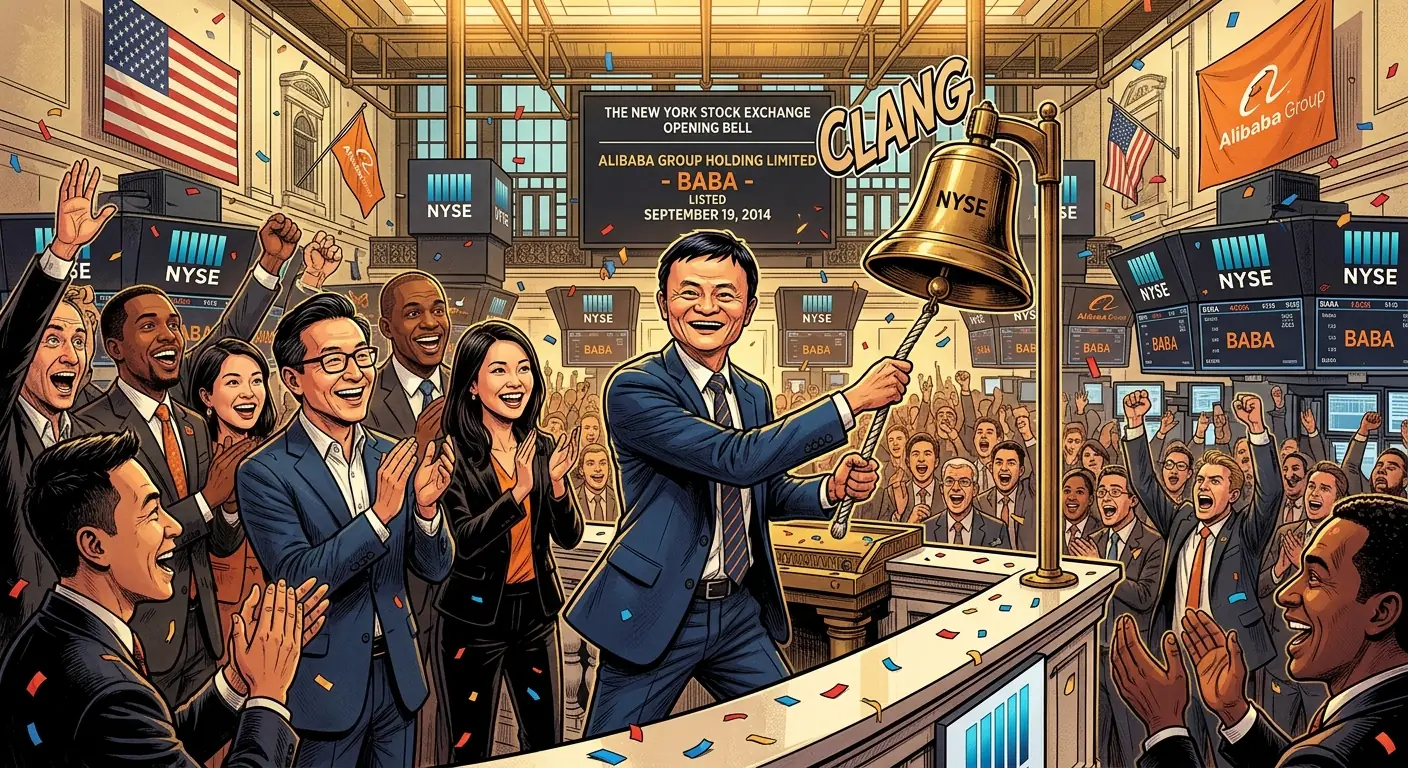
As Ant Financial was busy revolutionizing personal finance, its parent company, Alibaba Group, was preparing for its own moment in the global spotlight. After years of speculation, Alibaba finally made its grand debut on the New York Stock Exchange on September 19, 2014. Ma, ever the showman, chose eight of Alibaba’s loyal customers – not bankers or executives – to ring the opening bell, symbolizing the company’s commitment to its users.
The Alibaba IPO was nothing short of historic. It raised an astonishing $25 billion, making it the largest initial public offering in global history at the time. Ma’s net worth soared, and Alibaba’s market capitalization instantly surpassed those of Amazon and eBay combined. It was a crowning achievement, a validation of Ma’s improbable journey from English teacher to global titan. The world watched in awe as the once-rejected entrepreneur stood on the global stage, a symbol of China’s economic ascent and the power of digital commerce.
Global Dreams, Local Realities
The IPO fueled Ma’s global ambitions. He envisioned Alibaba as a company that would “make it easy to do business anywhere” for small and medium-sized enterprises worldwide. Alibaba invested heavily in companies like Lazada in Southeast Asia and Paytm in India, extending its e-commerce and payment ecosystems across Asia. Ma became a global ambassador for entrepreneurship, meeting with world leaders and advocating for globalization.
However, not every market was ready for the “Ma treatment.” Attempts to gain significant traction in Western markets, particularly the U.S., proved challenging due encountering established players and different consumer habits. Yet, the sheer scale of Alibaba’s domestic growth and its financial arm, Ant Financial, meant its influence was undeniable. Ma was no longer just a Chinese billionaire; he was a global figure, and his companies were redefining how business was done on an unprecedented scale.
🎭 Chapter 12: The Man Behind the Myth — Charisma, Control, and Conundrums (Throughout Ma’s Career)
Jack Ma’s public persona was always larger than life: the energetic, witty, slightly mischievous underdog who defied expectations. He was a master storyteller, a motivational guru, and an undeniable showman. But behind the captivating speeches and rockstar CEO antics lay a complex individual, a shrewd businessman, and a man whose journey was punctuated by both brilliant insights and significant controversies. His character, his relationships, and the persistent challenges his companies faced paint a richer, more nuanced picture than the simple rags-to-riches narrative.
The Ma Mystique: Charisma and Leadership
Ma cultivated a unique leadership style that blended visionary zeal with folksy charm. He was known for his ability to inspire, to rally his troops with tales of perseverance and the “six veins sword” culture, a nod to a Chinese martial arts novel emphasizing teamwork and shared values. He’d dress up as a punk rocker at company events, sing pop songs, and even perform magic tricks. This charisma wasn’t just for show; it was a potent tool for attracting talent, motivating employees during tough times, and captivating investors.
He believed deeply in a “customer first, employees second, shareholders third” philosophy, a mantra that sounded great but sometimes clashed with the realities of running a multi-billion-dollar enterprise. Ma’s leadership was highly centralized, even autocratic at times, despite his outwardly democratic rhetoric. He was the ultimate decision-maker, his vision guiding every major pivot. This intense personal control, while effective in Alibaba’s early, scrappy days, would become a double-edged sword as the company scaled and its influence grew to touch every corner of Chinese life.
Mrs. Ma: The Unsung Partner
Behind every great man, they say, is a great woman. In Jack Ma’s case, it was his wife, Cathy Zhang (Zhang Ying). She was not only his college sweetheart but also one of Alibaba’s original 18 founders, often considered its very first employee. While Ma became the public face, Zhang was a quiet, steady force, working tirelessly in the early, lean years. She famously handled domestic chores for the team in their cramped apartment office, ensuring they were fed and focused.
“He is not a handsome man, but I fell for him because he can do a lot of things handsome men cannot do,” Zhang once reportedly said of Ma. “He founded a company, and now he is doing something big.”
Zhang eventually stepped back from day-to-day operations to focus on family, choosing a more private life away from the relentless public scrutiny that followed her husband. Her decision reflected a common dynamic for many entrepreneurial families, but also subtly underscored the immense personal sacrifices made to build the empire. While Ma was the flamboyant frontman, Zhang was the crucial, often unacknowledged, bedrock.
The Counterfeit Headache
One of the persistent, dark clouds over Alibaba’s otherwise sunny trajectory was the pervasive problem of counterfeit goods on its platforms, particularly Taobao. For years, major international brands, from luxury fashion houses like Gucci and Kering to everyday electronics manufacturers, accused Alibaba of not doing enough to combat the sale of fake products. This led to high-profile disputes, including Alibaba’s suspension from the International Anti-Counterfeiting Coalition (IACC) in 2016 due to member complaints.
Ma himself made some rather tone-deaf comments on the issue. In 2016, he controversially stated that “the problem is that the fake products today are better quality and better price than the real products… it’s not the fake products that destroy the real products, it’s the new business model.” This ignited a firestorm of criticism, forcing him to walk back the remarks, but it highlighted a deep tension. Alibaba’s massive ecosystem, built on the sheer volume of small sellers, made policing counterfeits an immense challenge, and many felt the company prioritized growth over brand protection. This issue was a constant source of friction with international partners and a reminder that even the most charismatic leader couldn’t escape the darker underbelly of their vast enterprise.
🌱 Chapter 13: What Next for the Farmer-Philosopher? — The Unfinished Legacy (2023–Present and Beyond)

After his dramatic vanishing act in late 2020 and a period of intense government scrutiny, Jack Ma has slowly, cautiously, reappeared in the public eye. But it’s a different Ma, a quieter Ma, a Ma whose flamboyant rhetoric has been replaced by a more subdued, almost philosophical tone. His current activities and public pronouncements offer a glimpse into the “new” Jack Ma, and perhaps, a deeper understanding of the enduring legacy he is attempting to carve out in a China that has fundamentally shifted.
The Quiet Return: From Tech Mogul to Agritech Advocate
Since his full re-emergence in early 2023, Ma has deliberately steered clear of the spotlight that once defined him. His focus has conspicuously shifted away from the dizzying world of e-commerce, fintech, and AI. Instead, he’s been spotted touring agricultural research facilities, visiting schools, and engaging with environmental projects. He’s been seen in the Netherlands studying flower and pig farming, in Japan researching fish cultivation, and even in his hometown of Hangzhou, championing smart agriculture initiatives.
This pivot from digital platforms to planting potatoes (metaphorically speaking) is more than just a hobby. It signals a strategic alignment with Beijing’s priorities, which increasingly emphasize “common prosperity,” rural revitalization, and technological self-reliance in fundamental sectors like agriculture. Ma, the ultimate entrepreneur who once pushed boundaries, is now outwardly embracing a role as a contributor to societal good, exploring how technology can empower traditional industries. He’s no longer the ambitious disruptor but a quiet benefactor, a mentor, an “agritech advocate.” It’s a very public, very deliberate demonstration that he has understood the Party’s message: private enterprise must serve the state’s broader goals.
The Jack Ma Spirit: A Cautionary Tale?
Ma’s story, particularly the tumultuous years from 2020 onwards, has become a powerful, if sobering, lesson for entrepreneurs not just in China but globally. He built an empire that rivaled, and in some ways surpassed, the reach of the state, only to be reminded, with brutal efficiency, that in China, the Party always holds ultimate authority. The “Jack Ma spirit” – the audacious, risk-taking, boundary-pushing entrepreneurship – is now viewed through a different lens. It’s still celebrated, but with an implicit caveat: know your limits.
His reduced public profile, his focus on less politically sensitive areas, and his less flamboyant demeanor all suggest a man who has learned a profound lesson about the true nature of power in China. He still holds significant influence as a major shareholder in Alibaba and Ant Group (though he gave up control of Ant in early 2023). But the days of him freely criticizing regulators or challenging the status quo seem firmly behind him. His legacy is now intertwined with the cautionary tale of what happens when a private individual becomes too powerful, too outspoken, and too visible in a system that values collective control above all else.
The Enduring Enigma
What does Jack Ma’s story truly mean for the future of entrepreneurship in China? It suggests a recalibration, a shift from unbridled growth to “responsible” innovation that serves national interests. For global businesses, it’s a stark reminder of the unique political and economic landscape of operating in China. The “Party’s mandate” can reshape even the most formidable private enterprises overnight.
Ma himself remains somewhat of an enigma. Is he genuinely content with his new, quieter life, pursuing passions in agriculture and education? Or is he merely navigating a gilded cage, strategically playing a long game to maintain his freedom and influence? The truth, perhaps, lies somewhere in between. Jack Ma built an empire that changed China forever. But his story is also a powerful testament to the ever-present tension between individual ambition and state control, a tension that continues to define the landscape of modern China. His journey from English teacher to global titan, and then to farmer-philosopher, is far from over, and its final chapters are still being written.
💡 Key Insights
- ▸ Jack Ma's fall proves that in an authoritarian system, no amount of personal wealth insulates you from political risk. A $25 billion fortune and global celebrity status meant nothing the moment the Party decided he'd crossed a line. Entrepreneurs everywhere should understand: the rules of the game depend entirely on who controls the game board.
- ▸ The Bund Speech is a case study in knowing your audience. Ma criticized regulators to their faces at the exact moment his company needed their approval. Brilliance in business does not guarantee wisdom in politics — and confusing the two can cost you everything.
- ▸ Ant Group's halted IPO — what would have been the largest in history at $37 billion — shows that market size and consumer demand mean nothing if the state decides your business model threatens its control. Regulatory risk isn't a line item; it's an existential variable.
- ▸ China's tech crackdown erased over $1 trillion in combined market value from its biggest companies. The lesson for global investors: when you invest in companies operating under authoritarian governance, you're not just betting on the business — you're betting on the mood of the regime.
- ▸ Ma's quiet reappearance — stripped of influence but still alive and free — reveals Beijing's preferred playbook: not destruction, but domestication. The CCP doesn't need to imprison billionaires. It just needs them to understand who's really in charge.
Sources
- Duncan Clark — Alibaba: The House That Jack Ma Built ↗
- Wall Street Journal — Jack Ma and Ant Group Coverage ↗
- Bloomberg Billionaires Index — Jack Ma Net Worth Tracking ↗
- Reuters — Ant Group IPO Suspension and Aftermath ↗
- Financial Times — China Tech Crackdown Coverage ↗
- The Bund Finance Summit — Jack Ma October 2020 Speech (Transcript) ↗
- South China Morning Post — Jack Ma Timeline and Alibaba Reporting ↗