James Sinegal: The Membership Flywheel That Made Costco Almost Impossible to Copy
James Sinegal built a retailer that distrusted retail margins. Membership fees, low markups, fast inventory, and employee loyalty became one reinforcing machine.

View all stories about this mogul
James Sinegal built one of retail’s most durable businesses by refusing to behave like a normal retailer.
Normal retailers search for margin. Costco caps it. Normal retailers expand assortment. Costco deliberately limits choice. Normal retailers treat labor as a cost to be minimized. Sinegal argued that better-paid, experienced employees could become an operating advantage.
The visible warehouse is easy to copy. The economic loop behind it is not.
Members pay before they shop. That recurring fee gives the company room to price merchandise aggressively. Low prices encourage renewal and larger baskets. High volume improves purchasing terms and inventory turnover. Efficient operations fund wages and expansion. Better execution strengthens trust, which supports more renewals.
Every choice pushes the next one.
Chapter 1: How Did James Sinegal Learn the Warehouse Model From Sol Price?
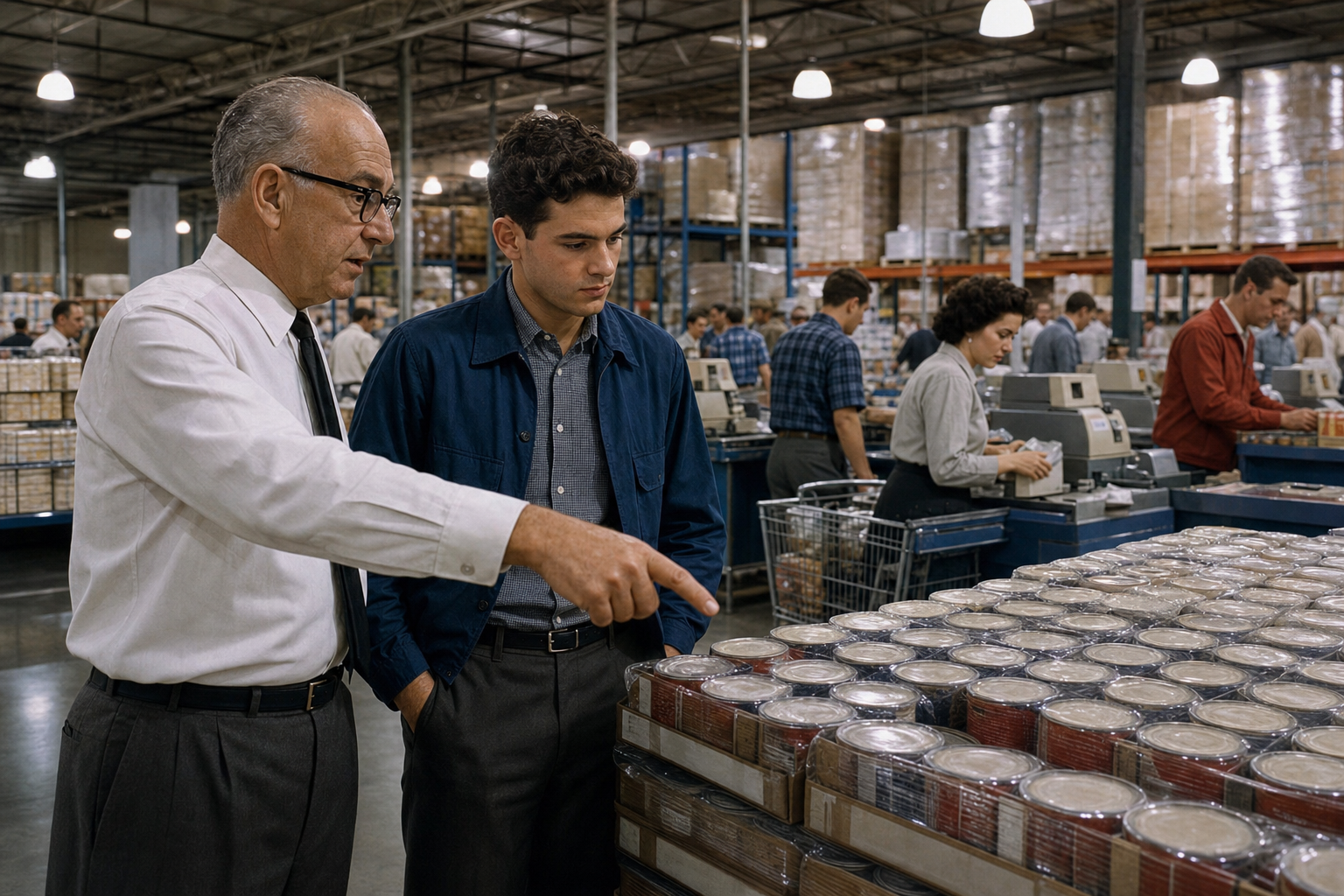
Sinegal’s retail education began under Sol Price, the pioneer behind FedMart and later Price Club. Price challenged the department-store assumption that shoppers wanted elaborate merchandising and endless variety. Some customers—especially small businesses—would accept a plain warehouse if the value was obvious.
The model stripped out decoration and concentrated on throughput. Goods arrived in bulk, often remained on pallets, and moved quickly. Membership restricted the audience and created a direct relationship with shoppers.
Sinegal absorbed more than a format. He learned a philosophy of retail trust. The operator should make money because members keep returning, not because a shopper fails to notice an inflated markup.
In 1983, Sinegal and Jeff Brotman opened the first Costco warehouse in Seattle. The timing was not comfortable. Price Club already existed, and warehouse retail was becoming a real category. Costco needed scale fast enough to negotiate with suppliers and spread operating costs.
Expansion was aggressive, but the proposition stayed narrow: pay a fee for access to consistently sharp prices on a curated selection. The concrete floors and steel racks were not signs of an unfinished store. They were evidence that the customer was not paying for decoration.
Costco and Price Club merged in the 1990s, uniting Sinegal with the business lineage that had trained him. The combined company eventually settled on the Costco name and scaled the model across markets.
The founder remained unusually close to operations. Sinegal was known for visiting warehouses, talking to employees, checking details, and resisting executive distance. In a model with thin merchandise margins, small execution failures matter. The chief executive could not manage only through financial reports.
Sol Price’s Most Important Lesson Was Ethical, Not Architectural
The warehouse format is visually obvious. Put goods on pallets, reduce decoration, use large packages, and charge a membership fee. The deeper Price lesson was about the relationship with the customer.
Retailers possess an information advantage. They know wholesale costs, promotional allowances, package changes, and comparative margins. A merchant can use that knowledge to extract as much as possible from each visit. Price believed the stronger long-term strategy was to make the value clear enough that members trusted the institution.
Sinegal absorbed that constraint. Costco would not treat every shortage, fad, or supplier increase as an excuse to push price to the limit. The company could accept less merchandise margin because the membership relationship had value beyond a single basket.
That philosophy sounds moral, but it is also economic. Trust lowers the customer’s need to compare every item. It increases renewal probability and purchase frequency. It makes a private label credible because the member believes the retailer will protect quality.
Why the First Warehouse Needed Volume Immediately
The model has a harsh startup problem. Low markups leave little room for inefficiency. A new warehouse needs enough members, purchasing volume, and inventory velocity to cover fixed costs. It cannot wait years to become operationally serious.
Sinegal and Brotman therefore expanded with urgency while standardizing the format. Each warehouse reinforced the network: more volume improved supplier negotiations; stronger terms supported lower prices; lower prices attracted more members.
Yet rapid expansion could not become careless expansion. The site needed the right trade area and access. The warehouse needed disciplined receiving and inventory control. Buyers needed to select a small number of items capable of carrying concentrated demand.
The merger with Price Club accelerated scale and brought together related operating traditions. Integration still required choices about systems, locations, people, and identity. Settling on the Costco name created one banner under which the model could compound.
Chapter 2: How Do Costco’s Membership Economics and Markup Rules Work?

Costco’s central move is to separate much of its profit engine from the merchandise.
The company collects membership fees and uses the store to prove that renewal is worthwhile. Merchandise can therefore be priced closer to cost than at a conventional retailer. Sinegal became associated with strict limits on markups, including the often-cited rule that branded merchandise should generally not be marked up beyond roughly the mid-teens.
The exact economics vary by category and period, but the strategic constraint is more important than the number. A buyer cannot casually raise price to make a quarterly target. The team must negotiate better, simplify packaging, improve volume, or find another product.
Limited assortment increases leverage. A supermarket may offer dozens of variations in a category. Costco may choose only a few. Concentrated volume makes each selected item important to the supplier and keeps inventory moving.
Fast turnover reduces capital trapped on shelves. Large package sizes raise basket value and simplify handling. Private-label products can offer differentiated value while reinforcing member trust—if quality holds.
Then there is the “treasure hunt.” Staples create reliability, while rotating discretionary items create discovery and urgency. The shopper may arrive for household basics and leave with a television, patio set, or imported food discovered in the aisle.
This balance is difficult. Too much predictability removes excitement. Too much rotation undermines trust. Too much assortment weakens purchasing concentration. Too little assortment sends the member elsewhere.
Membership closes the loop. Renewal is a recurring referendum on the value proposition. If shoppers believe savings and quality exceed the fee, they return. That makes trust a balance-sheet asset even though accounting does not label it that way.
The Inventory-Velocity Advantage
Retail profit is not determined only by margin percentage. Speed matters.
An item sold at a modest markup can produce attractive economics if it turns rapidly, requires little handling, and is paid for by the customer before the retailer must pay the supplier. Concentrated volume helps Costco move inventory while negotiating favorable terms.
This creates a working-capital advantage. Cash is not trapped for long periods in a broad assortment of slow-moving goods. The warehouse can devote space to products that earn their place through value and velocity.
Limited selection also simplifies the customer’s decision. Instead of comparing twenty nearly identical options, the member sees a smaller set chosen by buyers who can demand quality and price. The reduction in choice becomes a service when the curation is trusted.
There is risk in this concentration. A poor selection affects a large volume. A supply disruption can leave a category thin. Buyers must understand demand precisely because each item carries more weight.
Why the Treasure Hunt Does Not Break the Low-Cost Promise
Costco combines dependable staples with unpredictable discoveries. The staples justify the practical trip; rotating products create excitement.
The treasure hunt increases visit frequency and basket size without requiring conventional luxury presentation. A premium food, seasonal product, appliance, or piece of furniture can appear for a limited period. Members learn that hesitation may mean losing the item.
Scarcity can be manipulative, but within Costco’s model it is constrained by the value promise. The item still needs a compelling price. Discovery works because members assume the buyer found an unusual deal, not because the store manufactured artificial prestige.
This combination is difficult to imitate. A retailer with high everyday prices cannot create the same trust. A retailer with endless assortment cannot create the same urgency. Costco uses discipline to make unpredictability feel safe.
Chapter 3: Why Did Costco’s Culture Become Its Hardest-to-Copy Moat?

Wall Street periodically pushed Costco to raise prices, reduce wages, or extract more margin. Sinegal’s resistance was not generosity detached from economics. It was a different theory of optimization.
Warehouse retail depends on execution: receiving goods, moving pallets, keeping lines fast, preventing damage and shrink, answering member questions, and promoting supervisors who understand the floor. Constant turnover destroys that knowledge.
Paying better and promoting internally can reduce churn, improve productivity, and create managers steeped in the operating culture. The expense is visible immediately; the savings emerge across retention, training, service, and error reduction.
That makes the policy vulnerable to short-term analysis. An outsider can calculate a wage increase in one spreadsheet cell. The benefits are distributed across dozens of cells and several years.
Sinegal also modeled restraint at the top. His compensation and public style were modest compared with many large-company CEOs. The symbolism supported the operating contract: leaders could not preach frugality to stores while behaving like royalty at headquarters.
Costco is not immune to criticism. No giant retailer is. Supplier power, land use, consumption, worker disputes, and international execution remain real issues. The point is not that the model is perfect. It is that its choices are aligned.
Employee Economics Are Part of Member Economics
Experienced warehouse employees know how to move goods safely, manage queues, recognize damaged inventory, answer questions, and respond when demand changes. Their knowledge is embedded in thousands of small actions.
High turnover destroys that capability and forces the company to recruit and train repeatedly. Lower wages can reduce one visible cost while increasing mistakes, absence, shrink, safety incidents, and management burden.
Sinegal’s approach treated better pay, benefits, and internal promotion as investments in throughput and loyalty. The model did not depend on luxury service. It depended on competent execution at enormous volume.
The effect extended to culture. An employee who sees a path from the warehouse floor to management has a reason to master the system. A manager promoted internally understands why apparently strange constraints—limited markups, simple presentation, disciplined selection—exist.
Why Wall Street Kept Asking for More Margin
Costco’s restraint creates a recurring temptation. Because members demonstrate loyalty and the company has purchasing power, it appears capable of charging more. A modest increase across a large sales base can produce a dramatic short-term earnings gain.
Sinegal viewed that opportunity as dangerous. If the company began optimizing each transaction, members might not notice immediately. Trust would erode gradually, and renewal behavior would weaken later. The delayed damage makes extraction especially seductive.
This creates a governance challenge. Management must defend value that does not appear as a single line item. Member trust, employee experience, and supplier credibility are real assets, but quarterly reports reveal them indirectly.
Costco’s culture functions as a commitment device. Stories about markup limits, executive frugality, warehouse visits, and the hot-dog price are repeated because they tell employees which easy profits are off-limits.
A Timeline of the Costco Flywheel
| Year | Turning point | Strategic meaning |
|---|---|---|
| 1950s | Sinegal begins working for Sol Price | He learns warehouse economics and a customer-trust philosophy |
| 1976 | Price Club opens | The membership warehouse model proves that sparse presentation can support compelling value |
| 1983 | Sinegal and Jeff Brotman open the first Costco in Seattle | A new operator begins scaling the model aggressively |
| 1993 | Costco and Price Club merge | Purchasing volume and warehouse reach increase dramatically |
| 1997 | The combined company adopts the Costco name | One identity supports national and international growth |
| 2012 | Sinegal retires as chief executive | The operating system continues under internally developed leadership |
The Real Lesson
Competitors often copy the visible pieces: a membership card, bulk packages, concrete floors, or a private label. They struggle to copy the constraint system.
Low markups require membership income. Membership renewal requires trust. Trust requires consistent value and execution. Execution benefits from experienced employees. Concentrated assortment and rapid turnover support the prices that restart the loop.
Sinegal’s achievement was not inventing every component. Sol Price supplied much of the blueprint. The achievement was preserving the uncomfortable tradeoffs long enough for the flywheel to become a fortress.
The company wins because it repeatedly declines easy profit today to protect member trust tomorrow. That discipline is simple to describe and exceptionally hard to maintain.
Frequently Asked Questions
Who founded Costco?
James Sinegal and Jeff Brotman founded Costco and opened the first warehouse in Seattle in 1983. Sinegal had learned the warehouse-club model while working for retail pioneer Sol Price.
How does Costco make money from memberships?
Members pay annual fees for access. That recurring income allows Costco to operate merchandise at lower margins than many conventional retailers. Low prices support renewal, and renewals preserve the fee stream.
Why does Costco carry fewer products than supermarkets?
Limited assortment concentrates purchasing volume into a smaller number of items. That gives buyers leverage with suppliers, improves inventory turnover, simplifies operations, and reduces decision overload for members.
Why did James Sinegal support higher employee pay?
He believed experienced employees improved productivity, service, safety, and execution while reducing turnover and training costs. In a thin-margin, high-volume warehouse, those operating benefits can outweigh the visible wage expense.
What makes Costco difficult to copy?
Its advantage is a system rather than one feature. Membership fees, low markups, limited selection, rapid turnover, supplier leverage, employee retention, private label, and member trust reinforce one another. Copying a warehouse floor or membership card does not reproduce the loop.
That system also explains the endurance of Sinegal’s influence after retirement. A founder’s preferences disappear when they remain personal habits. They persist when pricing rules, promotion paths, buyer incentives, warehouse routines, and member expectations all reward the same behavior. Costco institutionalized restraint. The moat is strongest when no single executive has to order the company to protect it.
💡 Key Insights
- ▸ Membership income allows the retailer to treat low merchandise margins as a loyalty investment rather than a weakness.
- ▸ A limited assortment concentrates purchasing power and increases inventory velocity.
- ▸ Employee pay and internal promotion reinforce execution, which is critical in a low-margin model.
- ▸ The moat is a web of mutually reinforcing choices; copying one visible feature does not reproduce the economics.