John McAfee: The Antivirus Pioneer Who Became the World's Most Wanted Tech Fugitive
He created the antivirus software that protected millions of computers, then spent his fortune on drugs, guns, and a life on the run that ended in a Spanish prison cell.
View all stories about this mogul
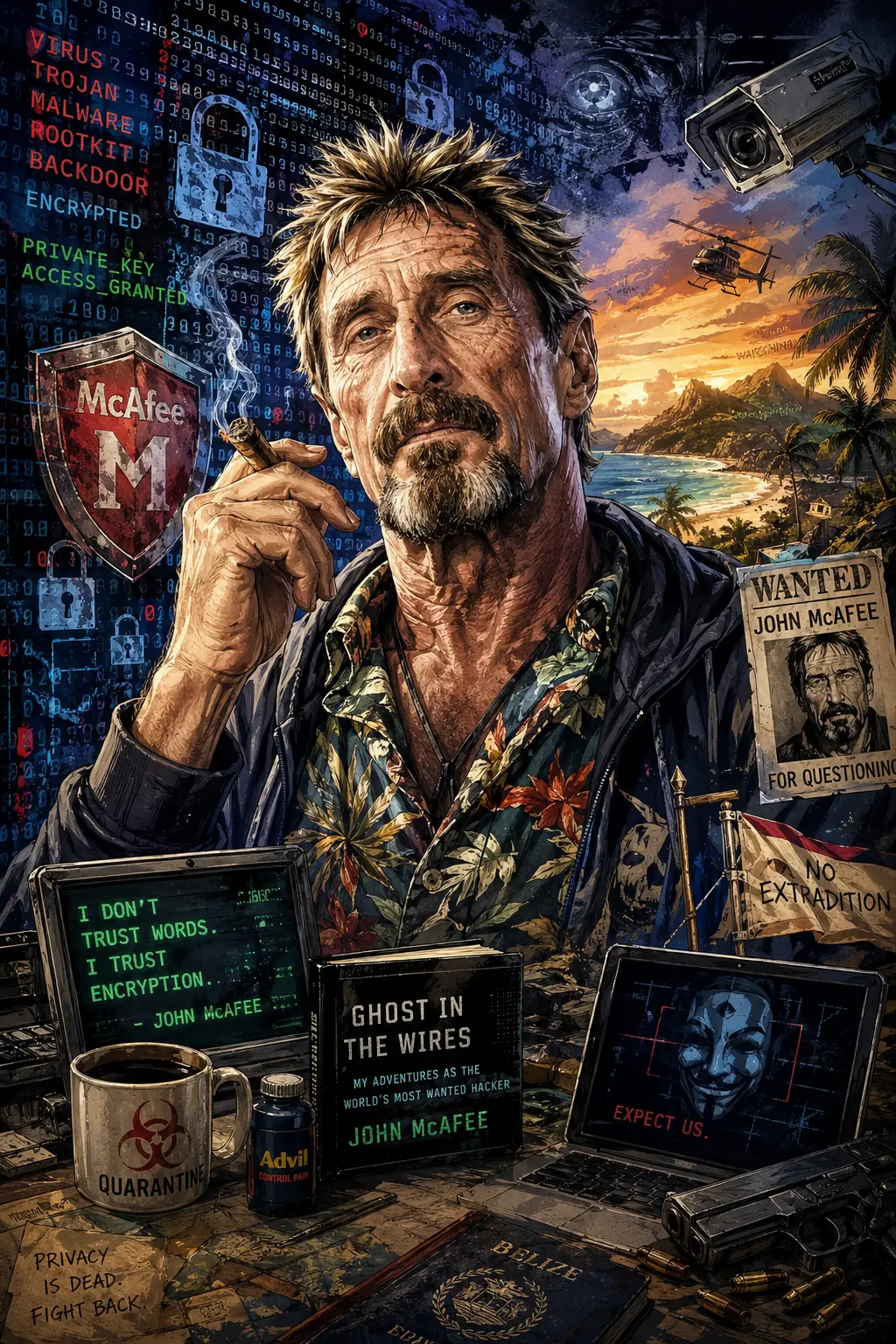
John McAfee invented the antivirus software that protected hundreds of millions of computers, made a fortune, lost most of it, became a person of interest in a murder case in Belize, ran for president of the United States (twice), promoted cryptocurrency while allegedly committing tax evasion and fraud, and died in a Spanish prison cell while awaiting extradition to the United States. It is, by any measure, the most bizarre trajectory of any tech founder in history — a life that started with genuine innovation and ended in paranoia, fugitive status, and death under circumstances that remain disputed. This is the story of a man who couldn’t stop running.
Chapter 1: The British Kid With the Alcoholic Father (1945–1968)

John David McAfee was born on September 18, 1945, on a US Army base in Cinderford, Gloucestershire, England. His father was an American serviceman; his mother was British. The family moved to Salem, Virginia, when John was a child, and it was there that the dysfunction began. His father was an alcoholic who became increasingly violent. According to McAfee, his father beat him regularly and terrorized the household. When John was fifteen, his father shot himself. The suicide would haunt McAfee for the rest of his life.
McAfee was bright — exceptionally so. He excelled in mathematics and science, earning a bachelor’s degree in mathematics from Roanoke College and a PhD in mathematics from Northeast Louisiana State University (though the authenticity of the PhD has been disputed by some sources). His academic capabilities were genuine, but they were accompanied by an appetite for excess that was already evident in his student years: drinking, drugs, and a general disregard for social conventions.
In the late 1960s and early 1970s, McAfee worked for various technology companies including NASA, Xerox, and Lockheed. At Lockheed, he encountered the concept of computer viruses for the first time — the Brain virus, which had originated in Pakistan, infected Lockheed’s systems in 1986. McAfee was fascinated. A program that could replicate itself and spread through computer networks was, to a mathematician, a beautiful and terrifying concept. He decided to build a tool to stop them.
Chapter 2: McAfee Associates — The Antivirus Revolution (1987–1994)

In 1987, McAfee founded McAfee Associates from his home in Santa Clara, California. The company developed antivirus software — programs that could detect and remove malicious code from personal computers. The timing was perfect: the personal computer revolution was exploding, computer viruses were proliferating, and no one had a comprehensive solution.
McAfee’s distribution strategy was radical for its time: he gave the software away for free and charged businesses for licenses and support. This “freemium” model — now standard in software — was unusual in the late 1980s and allowed McAfee’s antivirus to spread rapidly. Within a few years, McAfee VirusScan was installed on millions of computers worldwide.
McAfee was also a gifted self-promoter. He positioned himself as the world’s leading expert on computer viruses, giving interviews, writing articles, and appearing on television. His warnings about virus threats were sometimes hyperbolic — critics accused him of exaggerating dangers to sell his product — but they were effective at generating publicity and driving demand. By the early 1990s, McAfee Associates was one of the fastest-growing software companies in America.
Chapter 3: The IPO and the Exit (1992–1994)

McAfee Associates went public in 1992, making John McAfee a very wealthy man. The stock price rose steadily as the antivirus market grew, and McAfee’s personal stake was worth tens of millions of dollars. But success didn’t bring satisfaction. McAfee was, by his own admission, bored. The corporate routines of a public company — board meetings, earnings calls, regulatory compliance — suffocated him.
In 1994, McAfee resigned as CEO. He sold most of his stock over the following years, realizing approximately $100 million before the company merged with Network Associates (later renamed back to McAfee, Inc., and eventually acquired by Intel for $7.7 billion in 2010). McAfee the man had no connection to the acquisition; he had left the company sixteen years earlier.
With his fortune, McAfee embarked on a life that would make every subsequent chapter of his biography progressively more unbelievable. He had built a genuine technology company that protected hundreds of millions of users. Everything that followed would be a descent into excess, paranoia, and chaos.
Chapter 4: The Aerotrekking Crash and New Mexico (1994–2008)

After leaving the company, McAfee threw himself into extreme hobbies. He became obsessed with aerotrekking — flying ultralight aircraft through narrow canyon passages at high speeds. The sport was spectacularly dangerous, and McAfee loved it. He established a ranch in New Mexico where he hosted aerotrekking events and attracted a community of fellow thrill-seekers.
A nephew died in an aerotrekking accident on McAfee’s property, leading to lawsuits and contributing to what McAfee described as a growing sense of danger and persecution. His behavior became increasingly erratic. He armed himself heavily, installed security systems throughout his property, and began expressing paranoid concerns about government surveillance.
He also began investing in various business ventures with mixed results. His fortune, which had peaked at approximately $100 million, began declining as his investments failed and his lifestyle consumed cash. By the late 2000s, the financial crisis wiped out additional wealth. McAfee later claimed his net worth fell to approximately $4 million. The tech millionaire was rapidly becoming a cautionary tale about wealth without discipline.
Chapter 5: Belize — Paradise Turns Dangerous (2008–2012)

In 2008, McAfee relocated to Belize, a small Central American country known for its beaches, diving, and lax regulation. He purchased properties in Ambergris Caye and the mainland, established a laboratory to research antibiotics derived from jungle plants, and cultivated relationships with local officials and residents.
But his behavior in Belize escalated. Multiple reports described McAfee living a lifestyle that included drugs, guns, and a rotating cast of young women. He maintained an armed compound and expressed increasingly paranoid beliefs about government conspiracies. Neighbors complained about his dogs and his security detail. His relationship with the local community deteriorated.
On November 12, 2012, McAfee’s neighbor, American expatriate Gregory Faull, was found shot dead in his home. Belizean police named McAfee a “person of interest.” McAfee denied involvement, claimed the police wanted to kill him, and went into hiding. He began blogging about his escape, turning his fugitive status into a media spectacle. He fled Belize, was briefly detained in Guatemala, and ultimately made his way back to the United States. He was never charged with Faull’s murder, and the case remains officially unsolved.
Chapter 6: The Media Circus and Presidential Campaigns (2013–2020)

McAfee returned to the US as a celebrity fugitive. He gave interviews, wrote blog posts, and cultivated a persona as a free-thinking rebel who had been persecuted by corrupt governments. The media couldn’t resist him — he was quotable, unpredictable, and unlike anyone else in the tech industry.
In 2016, he ran for president of the United States as a candidate for the Libertarian Party. His platform emphasized cybersecurity, personal freedom, and opposition to government surveillance. He didn’t win the nomination — Gary Johnson did — but the campaign generated enormous publicity and established McAfee as a political figure, however unconventional.
He ran again in 2020, this time from a boat in international waters, claiming he was evading IRS prosecution. The campaign was less about winning the presidency and more about maintaining his public profile and promoting his cryptocurrency ventures. By this point, McAfee’s public persona was so deliberately provocative that it was impossible to tell where the performance ended and the person began.
Chapter 7: Cryptocurrency and Alleged Fraud (2017–2020)

McAfee became one of the most vocal promoters of cryptocurrency, charging reportedly up to $105,000 per tweet to promote various coins and initial coin offerings (ICOs). His Twitter account, with millions of followers, became a marketing platform for crypto projects of varying legitimacy.
In 2018, the SEC began investigating McAfee’s crypto promotions, alleging that he had been paid millions to promote ICOs without disclosing the payments — a violation of securities law. McAfee denied the allegations and responded with characteristic defiance, threatening to expose government corruption.
The crypto promotion period was also marked by increasingly bizarre public statements. McAfee made a famous bet that Bitcoin would reach $1 million by 2020, pledging to perform an anatomically specific act on live television if it didn’t. Bitcoin didn’t reach $1 million. McAfee did not follow through on the bet. The episode captured the chaotic, nihilistic energy that had come to define his public life.
Chapter 8: Tax Evasion and the Indictment (2020–2021)
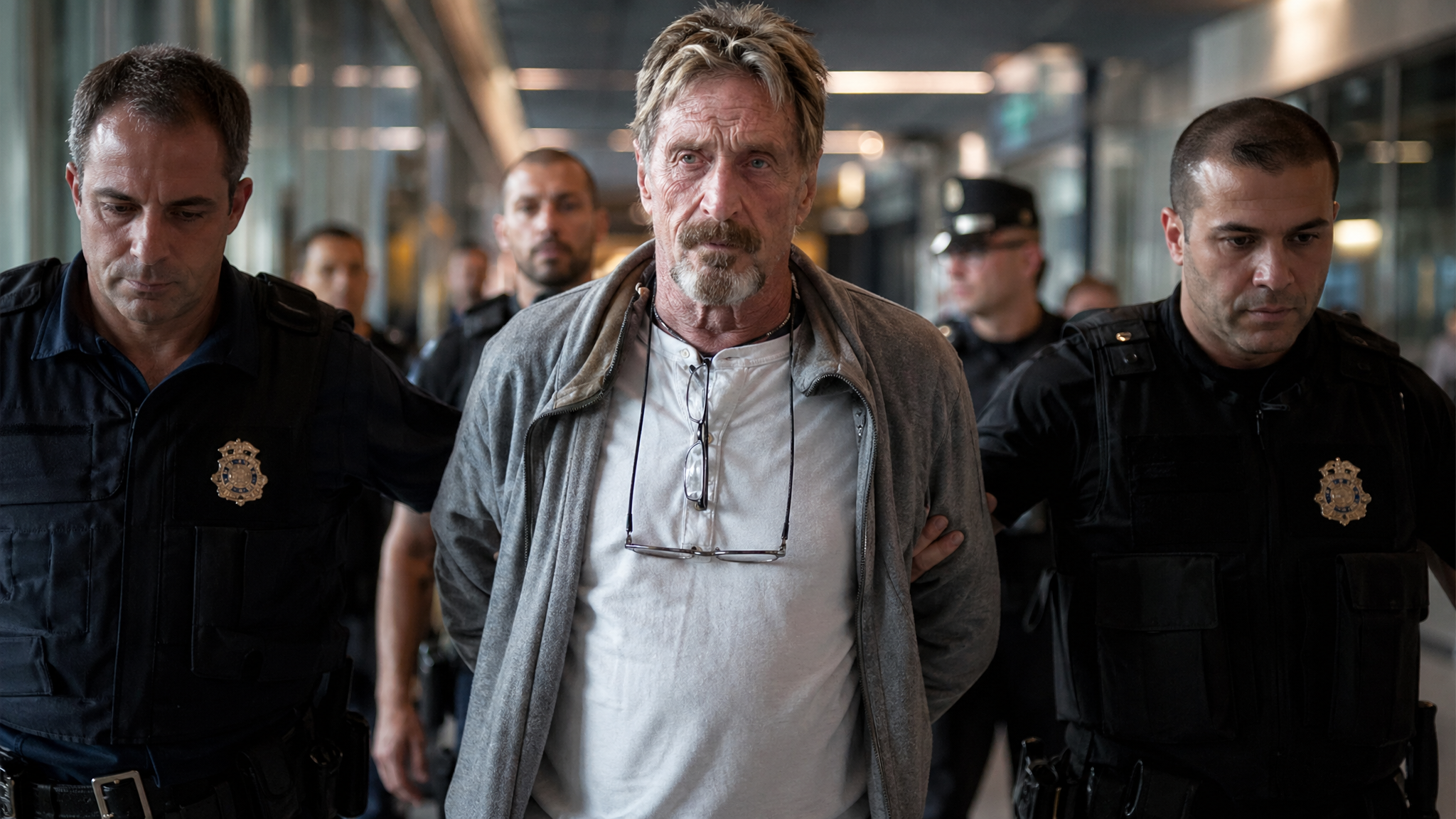
In October 2020, the Department of Justice indicted McAfee on federal tax evasion charges, alleging that he had earned millions from cryptocurrency promotion, speaking engagements, and consulting but had failed to file tax returns from 2014 to 2018. The DOJ alleged McAfee had hidden assets in cryptocurrency and bank accounts held in the names of associates.
McAfee was arrested in Spain in October 2020 at the Barcelona airport while attempting to board a flight to Istanbul. The arrest came the same day the DOJ unsealed the indictment. Spanish authorities detained him pending extradition proceedings to the United States.
The indictment charged McAfee with multiple counts of tax evasion and willful failure to file tax returns. If convicted, he faced up to thirty years in prison. McAfee maintained his innocence and claimed the charges were politically motivated — retaliation for his criticism of the IRS and federal government. He vowed to fight the extradition.
Chapter 9: The Spanish Prison and Final Days (2020–2021)

McAfee spent approximately eight months in a Spanish prison while fighting extradition. His communications from prison were sporadic and sometimes troubling. He posted on social media through intermediaries, alternating between defiance and despair. Some posts were combative, declaring he would never surrender. Others were more reflective, expressing regret and exhaustion.
His wife, Janice McAfee, advocated publicly for his release, arguing that the conditions of his confinement were harsh and that his health was deteriorating. She said McAfee told her repeatedly that he would not survive extradition to the United States. His lawyers argued that he faced an unfair trial and that the American prison system would be a death sentence for a seventy-five-year-old man.
On June 23, 2021, a Spanish court approved McAfee’s extradition to the United States. Hours later, John McAfee was found dead in his prison cell. Spanish authorities ruled the death a suicide by hanging. McAfee’s wife and lawyers disputed the ruling, claiming he was not suicidal and suggesting foul play. The controversy over his death continues, with no definitive resolution.
Chapter 10: The Murder Mystery That Won’t Go Away

Gregory Faull’s murder in Belize has never been officially solved. Belizean police named McAfee as a person of interest but never charged him. McAfee denied involvement and offered various theories about who might have committed the crime. In 2024, Faull’s family won a wrongful death lawsuit against McAfee’s estate, with a Florida court awarding $25 million in damages. The civil verdict, which requires a lower standard of proof than criminal prosecution, suggested that the jury believed McAfee was responsible.
The Faull case encapsulates the larger mystery of McAfee’s later life: how much of what he said was true, and how much was fabrication? McAfee was a documented liar who frequently contradicted himself, invented stories, and manipulated media coverage. Determining the truth about any specific claim — including his denials about Faull’s death — requires navigating a maze of conflicting statements, unreliable witnesses, and deliberate obfuscation.
Chapter 11: The Software Legacy

The irony of McAfee’s life is that the product that bears his name became one of the most widely used security tools in the world — and McAfee himself had nothing to do with it for the last three decades of his life. McAfee antivirus software, now owned by an investor group after being spun out from Intel, protects hundreds of millions of devices worldwide.
McAfee himself frequently mocked the product, publicly advising people not to use it and calling it “the worst software on the planet.” The critique was more performance than substance — the software had evolved far beyond anything McAfee had created — but it captured the surreal disconnect between the man and the brand that bore his name.
The software company’s success proved that a good product can transcend its founder. McAfee Associates thrived not because of John McAfee but despite him. The engineers, managers, and executives who built the company after his departure created enormous value. The founder, meanwhile, was on a decades-long journey of self-destruction that would end in a Spanish prison cell.
Chapter 12: Legacy — The Founder Who Couldn’t Be Contained

John McAfee’s legacy is a warning about the thin line between genius and madness. He was genuinely brilliant — his mathematical training, his insight about computer viruses, and his marketing instincts built a company that protected the digital world. The antivirus industry that he helped create is now worth billions and remains essential to cybersecurity.
But the same qualities that made him a successful entrepreneur — his risk appetite, his disregard for convention, his need for stimulation — became destructive when removed from the structure of a business organization. Without the constraints of corporate life, McAfee’s impulses ran wild. Each chapter after the company was more extreme than the last: the ultralight crashes, the Belize compound, the murder investigation, the presidential campaigns, the crypto promotion, the tax evasion, the fugitive life, and finally, the prison cell.
McAfee’s net worth at death was estimated at essentially zero — the $100 million fortune had been consumed by decades of lawsuits, bad investments, extravagant living, and legal fees. The man who created software that generated billions in revenue died with nothing. The trajectory from antivirus pioneer to prison suicide is the most extreme fall in tech history — not because of a business failure, but because of a personal one. John McAfee could build software to protect computers from viruses, but he couldn’t protect himself from himself.
💡 Key Insights
- ▸ McAfee's arc from tech pioneer to fugitive is the most extreme version of a pattern common among tech founders: the same traits that enable creation — obsessive focus, disregard for convention, appetite for risk — can destroy when left unchecked.
- ▸ His post-McAfee Associates life revealed that wealth without purpose or structure can be more dangerous than poverty. McAfee had tens of millions of dollars and absolutely no framework for how to spend them responsibly.
- ▸ McAfee's presidential campaigns, crypto promotion, and social media provocations were performance art from a man who had realized that attention was the only currency he valued more than money.