Travis Kalanick: The Ruthless Genius Who Built Uber, Then Got Kicked Out of His Own Car
He turned a $200K seed round into a $69B IPO — and got fired by his own board before the champagne was even cold.

View all stories about this mogul
He was the guy Silicon Valley whispered about in equal parts awe and horror. Travis Kalanick didn’t just disrupt the taxi industry — he napalmed it, city by city, country by country, lawsuit by lawsuit, while raising $25 billion in venture capital and turning a small app for hailing black cars into the most valuable startup on the planet. Then, in the span of about six months in 2017, it all came apart. A sexual harassment scandal. A viral video of him screaming at his own driver. A secret program to deceive law enforcement. A mass executive exodus that made the company look like a building on fire with people jumping out of windows. And finally, a letter — hand-delivered by five of his biggest investors — telling him to resign.
He was 40 years old. His company was worth $69 billion. And he was being told to get out.
This is how the most aggressive founder in Silicon Valley history built an empire, burned it down, and walked away with $2.7 billion in cash.
🔥 Chapter 1: The Serial Failure — A Founder Forged in Lawsuits (1976–2008)
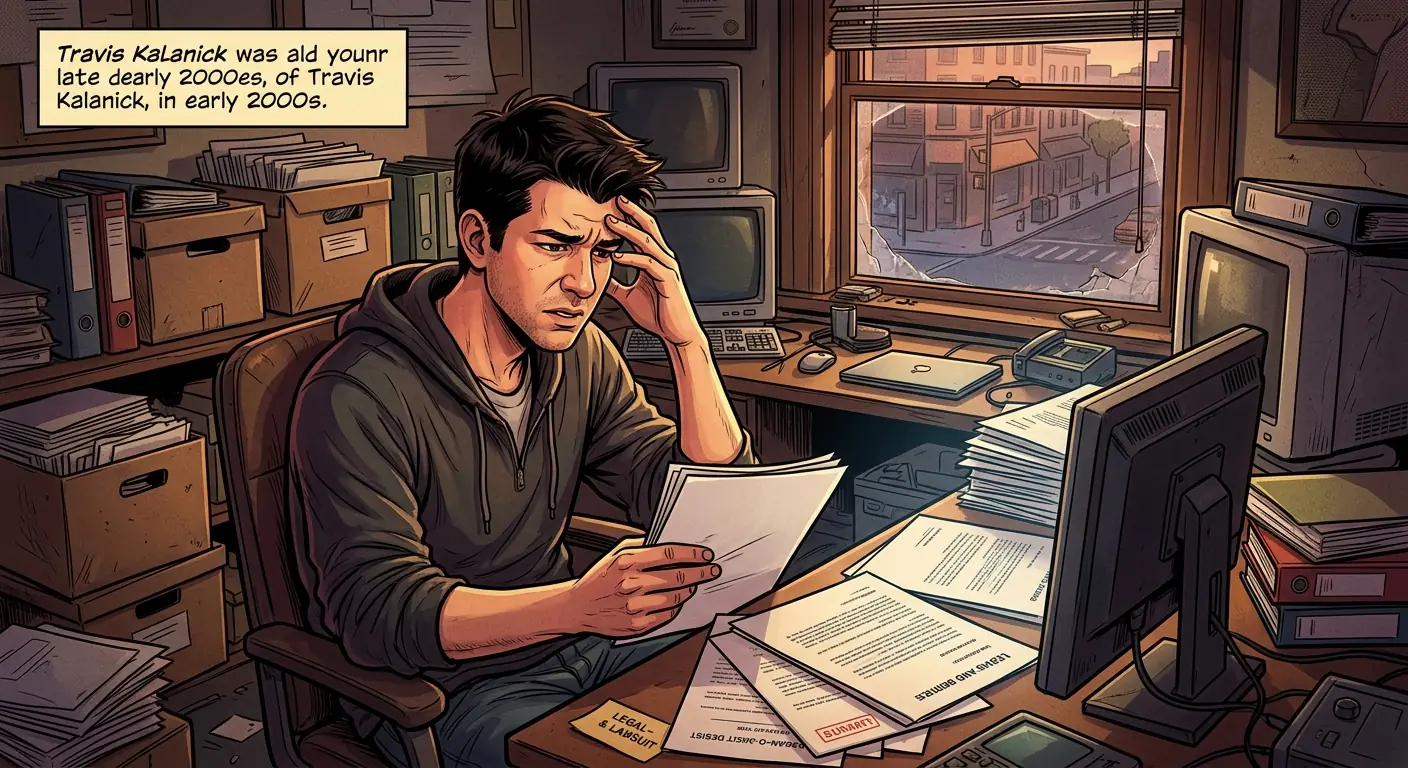
Travis Cordell Kalanick was born on August 6, 1976, in Los Angeles, California. His father, Donald, was a civil engineer. His mother, Bonnie, worked in retail advertising for the Los Angeles Daily News. Solid middle class. Nothing fancy. The kind of household where you learned that nobody was going to hand you anything.
Kalanick was a competitive kid in the most relentless sense of the word. Not “competitive” like he wanted to win the science fair. Competitive like he needed to destroy whoever was standing between him and first place. He was on the math team, the debate team, and the varsity tennis squad at Granada Hills High School. He reportedly went door-to-door selling knives for Cutco — the company that recruits college kids to sell overpriced kitchen cutlery to their parents’ friends — and was, by multiple accounts, very good at it.
He enrolled at UCLA to study computer engineering but dropped out in 1998, the height of the first dot-com bubble, to pursue his first startup: Scour.
Scour: The Napster Before Napster
Scour was a peer-to-peer file-sharing service — basically Napster with a search engine bolted on top. It launched in 1998 and quickly attracted millions of users who wanted to share music and video files. It also attracted $250 billion in lawsuits from the MPAA, RIAA, and every major entertainment company on the planet. Yes, $250 billion. For a company run by college dropouts out of a cramped apartment.
Scour filed for bankruptcy in 2000. Kalanick was 24 years old and already had a quarter-trillion dollars in legal claims against his name. Most people would have gone to law school after that experience. Kalanick started another company.
Red Swoosh: Stubbornness as Strategy
Red Swoosh was Kalanick’s attempt to take the same peer-to-peer technology and make it legal — essentially a content delivery network that used distributed computing to move large files around the internet. The company was a grind. At its lowest point, according to Kalanick’s own public accounts, the IRS came after him for $110,000 in unpaid payroll taxes because he’d been using withholding money to keep the lights on. He later described this period as “the formative experience of my life.”
Red Swoosh eventually sold to Akamai Technologies in 2007 for approximately $19 million. It wasn’t a home run, but it was a real exit. Kalanick walked away with a reported $2 million and, more importantly, a reputation as someone who absolutely refused to die. The tech press called him a “comeback kid.” His friends called him “TK.” His competitors called him something less printable.
He spent the next year traveling, skiing, and waiting for the next big idea.
🚗 Chapter 2: The Birth of Uber — A Button and a Black Car (2008–2011)
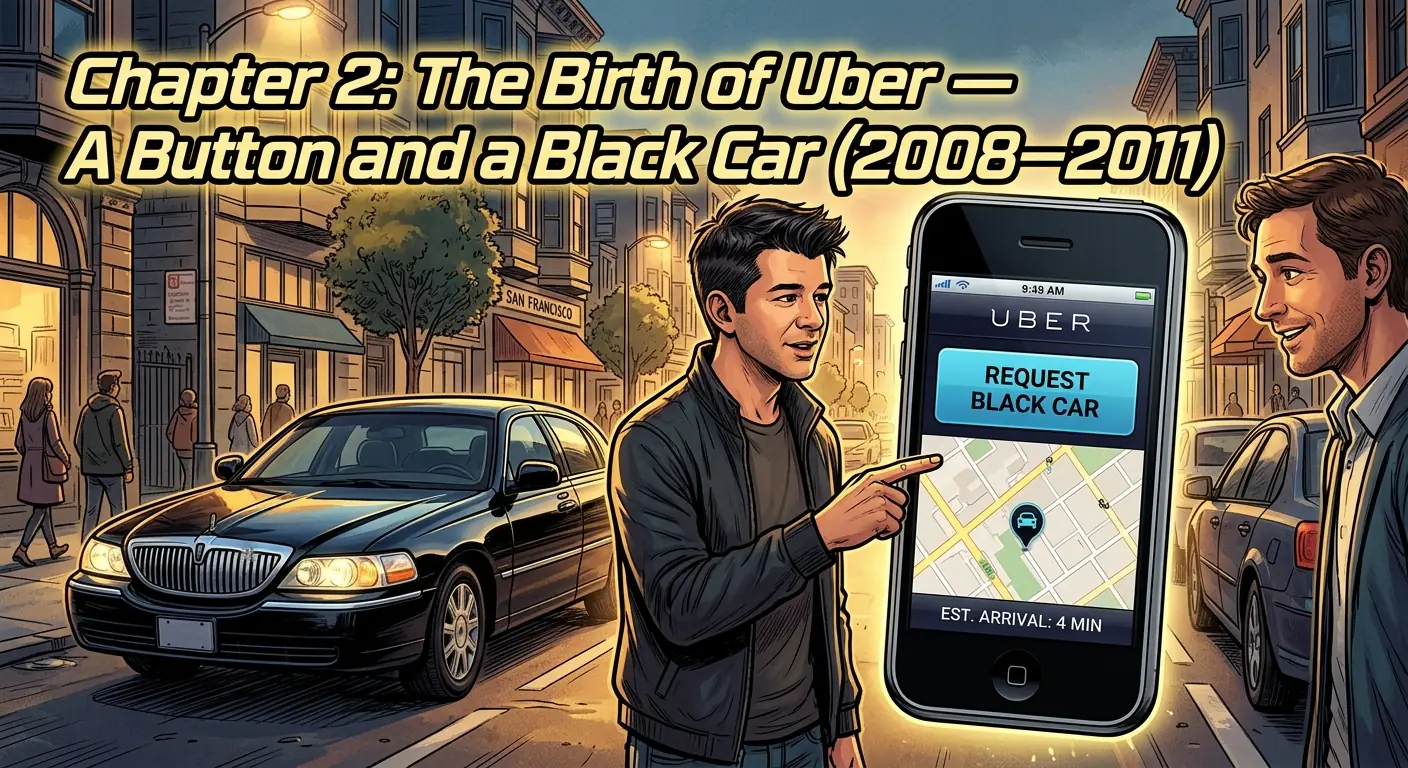
The origin story of Uber has been told so many times that it’s basically mythology at this point, and like all mythology, the details change depending on who’s telling it.
The most commonly cited version: In December 2008, Kalanick and his friend Garrett Camp — who had recently sold StumbleUpon to eBay for $75 million — were in Paris for the LeWeb tech conference. They couldn’t get a cab. It was cold. They were annoyed. Camp had already been noodling on the idea of a smartphone-based black car service, and that frustrating Parisian evening crystallized the concept.
Camp incorporated UberCab in 2009 and built the initial prototype. He brought in Kalanick, initially as an advisor who would later describe himself as the company’s “mega advisor” and then, increasingly, as the guy actually running the show. Ryan Graves, who answered a Twitter post about the job, became the first official CEO — but Kalanick took over as CEO in December 2010 after Graves moved into an operations role.
The First Ride
UberCab launched in San Francisco in May 2010. The first version was simple: open the app, tap a button, and a black town car shows up. It was luxury on demand. The price was roughly 1.5x what a regular taxi cost, but the experience was infinitely better — clean car, professional driver, no fumbling with cash, no “my credit card machine is broken” routine.
The early traction was immediate. Tech workers in San Francisco adopted it like oxygen. Within months, the company shortened its name to just “Uber” after the San Francisco Municipal Transportation Agency and the California Public Utilities Commission sent cease-and-desist letters about the word “cab” implying it was a licensed taxi service.
Kalanick’s response to the cease-and-desist was characteristic. According to multiple reports, including Mike Isaac’s Super Pumped, he basically shrugged and said the regulatory pressure was a sign they were onto something. This would become Uber’s defining operational philosophy: launch first, lawyer up second, apologize never.
The Seed Round and First Believers
Uber raised its seed round — approximately $200,000 from Camp, Kalanick, and a handful of angel investors — followed by a $1.25 million round from First Round Capital and other angels in late 2010. By early 2011, Benchmark Capital’s Bill Gurley led a $11 million Series A that valued the company at approximately $60 million.
Gurley would later describe the Uber investment as “the most ethically challenging” of his career. But in 2011, all he saw was a rocket ship.
⚔️ Chapter 3: Blitzscaling — The Most Aggressive Expansion in Tech History (2011–2015)
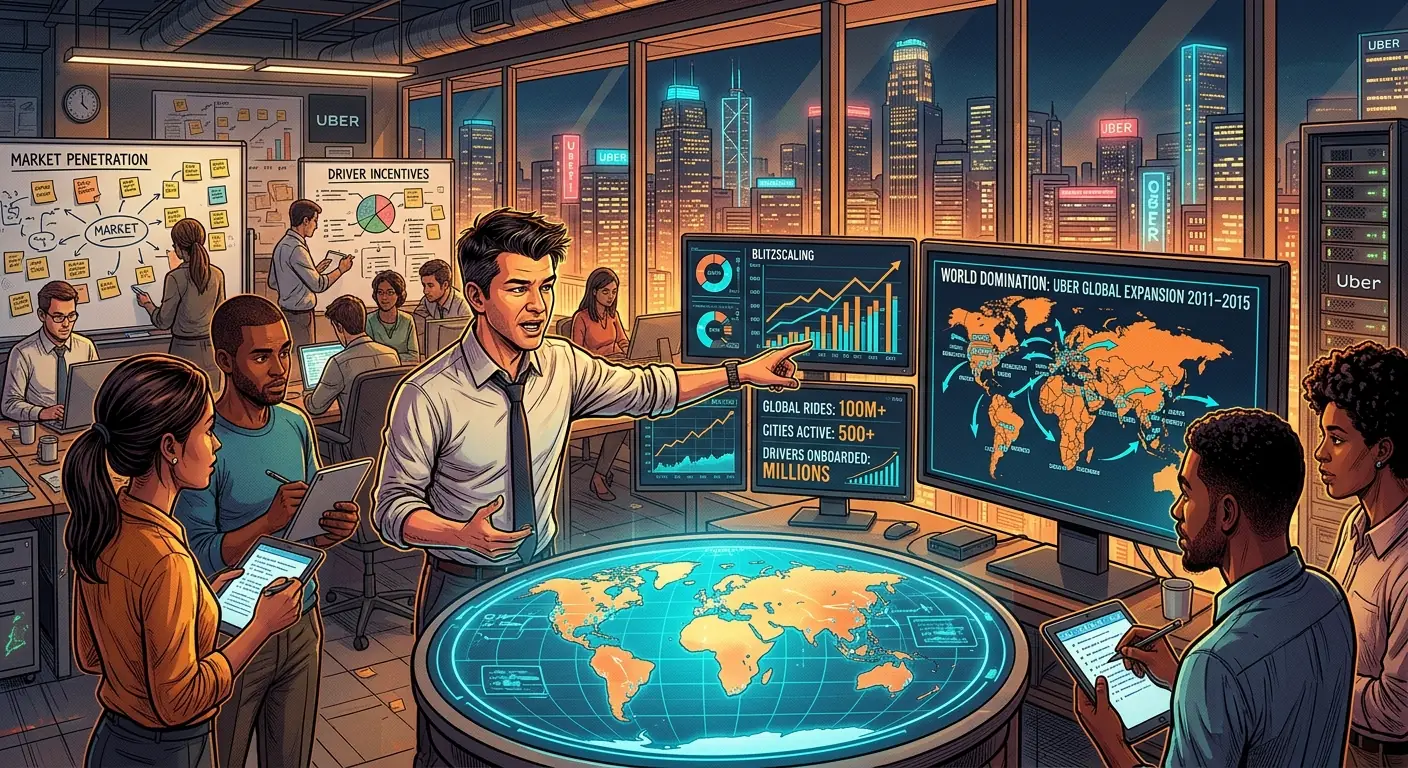
What happened next was unprecedented. Kalanick didn’t just want to grow Uber — he wanted to carpet-bomb every city on Earth with it, as fast as humanly possible, regulatory consequences be damned.
The UberX Gambit
In 2012, Uber launched UberX — the service that would change everything. Instead of licensed black car drivers in town cars, UberX let anyone with a car, a smartphone, and a background check become a driver. The price dropped to below taxi rates. The supply of drivers exploded. And the taxi industry, which had been watching Uber with mild irritation, suddenly realized this wasn’t a luxury novelty — it was an existential threat.
The economics were brutal and simple: flood every market with subsidized rides so cheap that consumers couldn’t say no, pay drivers so generously that they’d quit their day jobs, and worry about profitability later. Much later. Possibly never. The strategy was straight out of the Amazon playbook — lose money on every transaction, make it up in market dominance — but executed with a ferocity that made even Jeff Bezos look laid-back.
City by City, Fight by Fight
Uber’s expansion playbook, documented extensively in Super Pumped and various investigative reports, was something like this:
-
Launch without permission. Show up in a new city, turn on the app, start matching riders and drivers. Don’t ask the local taxi commission. Don’t apply for permits. Just go.
-
Let consumers fall in love. Once people use Uber, they don’t want to go back to taxis. This creates a constituency of users who will fight regulators on your behalf.
-
When regulators come knocking, mobilize. Uber would send push notifications to its users urging them to contact their city council members. In some cities, Uber sent hundreds of thousands of emails to users with pre-written letters to local politicians.
-
Hire the regulators. Uber poached officials from city governments and federal agencies, including David Plouffe, Barack Obama’s 2008 campaign manager, who became Uber’s head of policy in 2014.
By 2014, Uber was operating in over 200 cities across 45 countries. Each new market launch was essentially a small war. Taxi drivers protested. City councils held emergency hearings. In France, taxi drivers flipped cars and set fires. In London, black cab drivers staged massive demonstrations. Kalanick loved it. Every protest was free advertising.
The Money Firehose
The venture capital pouring into Uber was staggering:
- Series B (2011): $37 million led by Menlo Ventures. Valuation: ~$330 million.
- Series C (2013): $258 million led by Google Ventures. Valuation: ~$3.5 billion.
- Series D (2014): $1.2 billion led by Fidelity. Valuation: ~$17 billion.
- Series E (2014): $1.6 billion. Valuation: ~$41 billion.
- Series F (2015): $1 billion from Microsoft and others. Valuation: ~$51 billion.
- Series G (2016): $3.5 billion from Saudi Arabia’s Public Investment Fund. Valuation: ~$62.5 billion.
By mid-2016, Uber had raised more than $15 billion in total and was the most valuable private company in the world. Kalanick wasn’t just building a ride-hailing app — he was building what he called “the Amazon of transportation.” He expanded into food delivery (UberEats), freight, self-driving cars, and even briefly floated the idea of flying cars.
The burn rate was eye-watering. Uber reportedly lost $2.8 billion in 2016 alone, not counting its China operations. In China, Uber was hemorrhaging an estimated $1 billion per year fighting Didi Chuxing, the local ride-hailing giant backed by Alibaba and Tencent. Kalanick eventually surrendered China in August 2016, merging Uber’s Chinese operations with Didi in exchange for a 17.7% stake in the combined entity. It was one of the few times he ever admitted defeat.
🕶️ Chapter 4: Greyball — The Program That Fooled the Government (2014–2017)
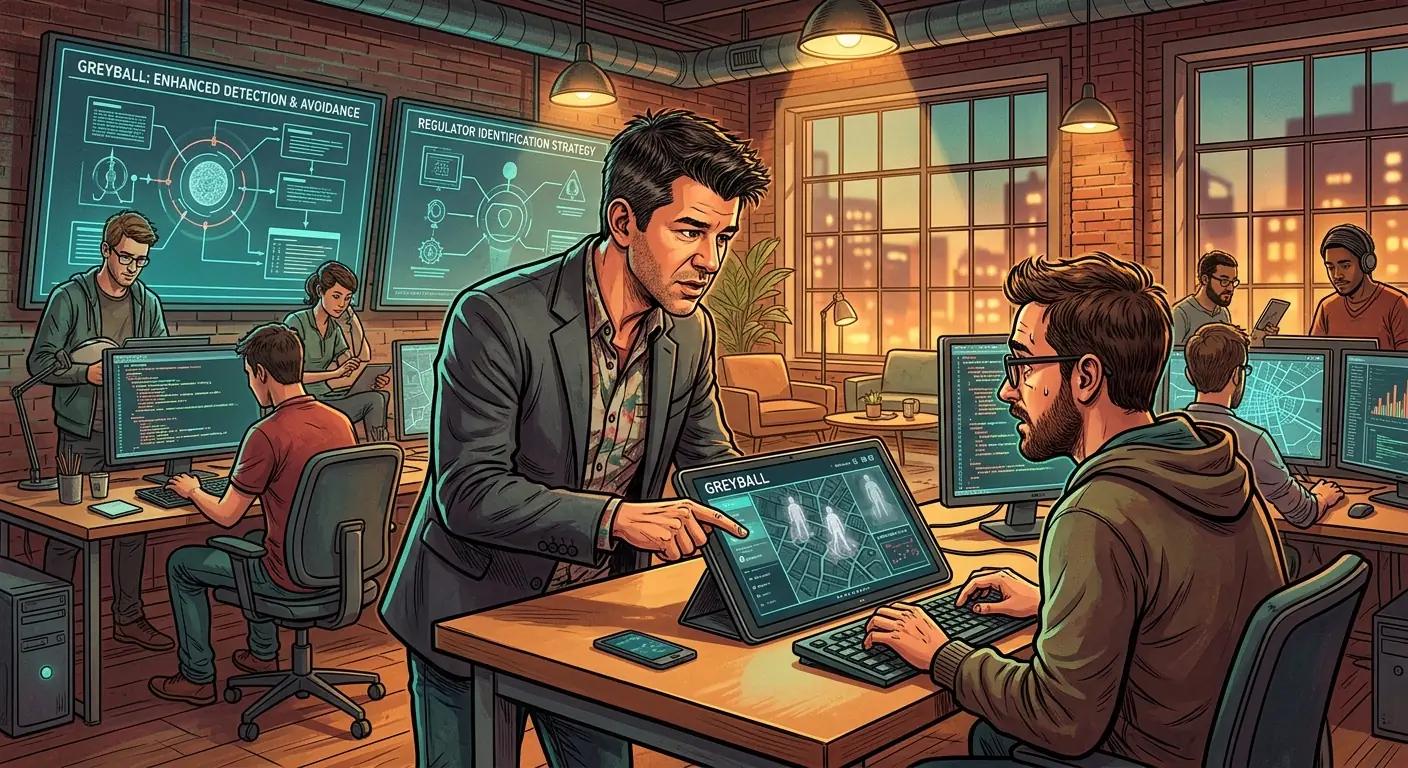
In March 2017, The New York Times broke a story that sounded like it came from a spy novel. Uber had developed an internal tool called “Greyball” — a sophisticated software program designed to identify and evade government officials, law enforcement officers, and regulators who were trying to catch Uber operating illegally.
Here’s how it worked, according to the Times investigation: Uber’s team would analyze data to identify people they suspected were government officials — using credit card information, device data, social media profiles, and location patterns near government buildings. Once flagged, those users would see a fake version of the Uber app. They’d open it and see ghost cars moving around the map — phantom vehicles that didn’t actually exist. If they managed to hail a ride, the driver would be instructed to cancel.
The program had been used in Portland, Philadelphia, Boston, Las Vegas, and cities across France, Australia, South Korea, and China. Uber had essentially built a two-tiered reality: the real app for regular users, and a Potemkin village for anyone trying to enforce the law.
Uber initially defended Greyball as a tool designed to protect drivers from physical harm in hostile markets and to prevent competitive intelligence gathering by rivals. The Department of Justice opened a criminal investigation. Portland’s Bureau of Transportation issued a $2,000 fine — pocket change for Uber — but the reputational damage was incalculable. The story made Uber look not just aggressive but genuinely deceptive in a way that even the company’s most ardent defenders couldn’t easily explain away.
💢 Chapter 5: 2017 — The Year Everything Burned
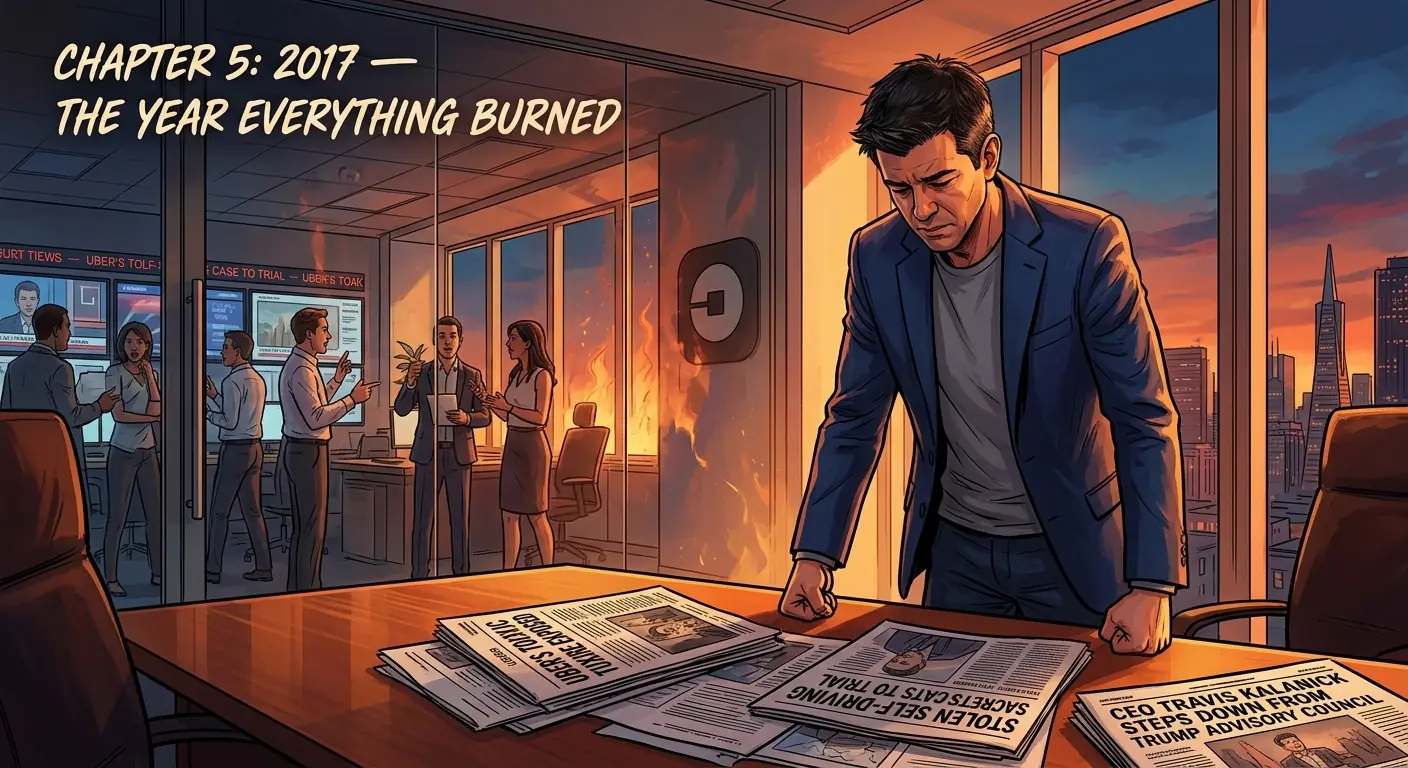
If 2016 was the year Uber became the most valuable startup in history, 2017 was the year the wheels came off. The cascade of crises that hit the company between January and June of that year remains one of the most extraordinary corporate meltdowns of the modern era.
#DeleteUber (January 2017)
On January 28, 2017, the New York Taxi Workers Alliance called for a one-hour work stoppage at JFK Airport to protest President Trump’s executive order banning travelers from seven Muslim-majority countries. Uber appeared to capitalize on the moment by turning off surge pricing during the strike — which many interpreted as strikebreaking. The hashtag #DeleteUber went viral. An estimated 200,000 users deleted the app in a single weekend.
Kalanick had also been serving on Trump’s economic advisory council, which added fuel to the fire. He resigned from the council on February 2, but the damage was done. Lyft — previously a distant second-place competitor — saw downloads surge 60% and ran an ad campaign positioning itself as the ethical alternative.
The Dashcam Video (February 2017)
On February 28, Bloomberg published dashcam footage of Kalanick arguing with an Uber Black driver named Fawzi Kamel. In the video, Kamel confronts Kalanick about falling driver pay and how lowered fares had cost him $97,000. Kalanick’s response, captured in devastating clarity: “Some people don’t like to take responsibility for their own shit. They blame everything in their life on somebody else.”
The video was catastrophic. Here was the CEO of a company worth $69 billion, sitting in the back seat of a car driven by a man whose livelihood his company had systematically devalued, lecturing that man about personal responsibility. Kalanick issued a public apology, saying he needed “leadership help” and that what people saw in the video was “a reflection of me — and the criticism we’ve received is a reflection of me.” It was the first time the carefully cultivated image of TK as a visionary disruptor started looking more like a bully who’d gotten too powerful for anyone to check.
The Susan Fowler Blog Post (February 2017)
Then came the bomb.
On February 19, 2017, Susan Fowler — a site reliability engineer who had worked at Uber for about a year — published a blog post titled “Reflecting on One Very, Very Strange Year at Uber.” In approximately 2,900 words, she described a workplace culture of systematic sexual harassment, HR departments that protected high-performing harassers, managers who threatened retaliation, and a leadership structure that either didn’t know or didn’t care.
Fowler wrote that on her very first day on a new team, her manager sent her messages in the company chat propositioning her for sex. When she reported it to HR, she was told it was the manager’s “first offense” and he was a “high performer,” so they wouldn’t feel comfortable giving him anything more than a warning. She later discovered that multiple women had reported the same manager — meaning each complaint was treated as a “first offense.” The system was designed to absorb complaints and neutralize them.
The post went nuclear. It was shared millions of times. It became the spark that ignited a broader reckoning about sexual harassment in Silicon Valley — a conversation that would escalate throughout 2017 and eventually merge with the #MeToo movement. Uber’s board hired former Attorney General Eric Holder and his law firm Covington & Burling to conduct an independent investigation.
The Executive Exodus
Between February and June 2017, Uber lost the following executives:
- Jeff Jones, President (resigned after six months, publicly stating Uber’s values were “inconsistent” with his own)
- Ed Baker, VP of Product (resigned amid reports of misconduct)
- Amit Singhal, SVP of Engineering (fired after it was revealed he’d left Google following a sexual harassment allegation he hadn’t disclosed to Uber)
- Eric Alexander, President of Business in Asia Pacific (fired after it was revealed he’d obtained the medical records of an Uber passenger who was raped by a driver in India, reportedly to undermine her credibility)
- Emil Michael, SVP of Business (departed amid the broader fallout)
The departures were so frequent that tech reporters started joking about needing a “who’s still at Uber” tracker. The company was leaking executives like a sinking ship leaks water.
📩 Chapter 6: The Board Coup — Five Investors and a Letter (June 2017)
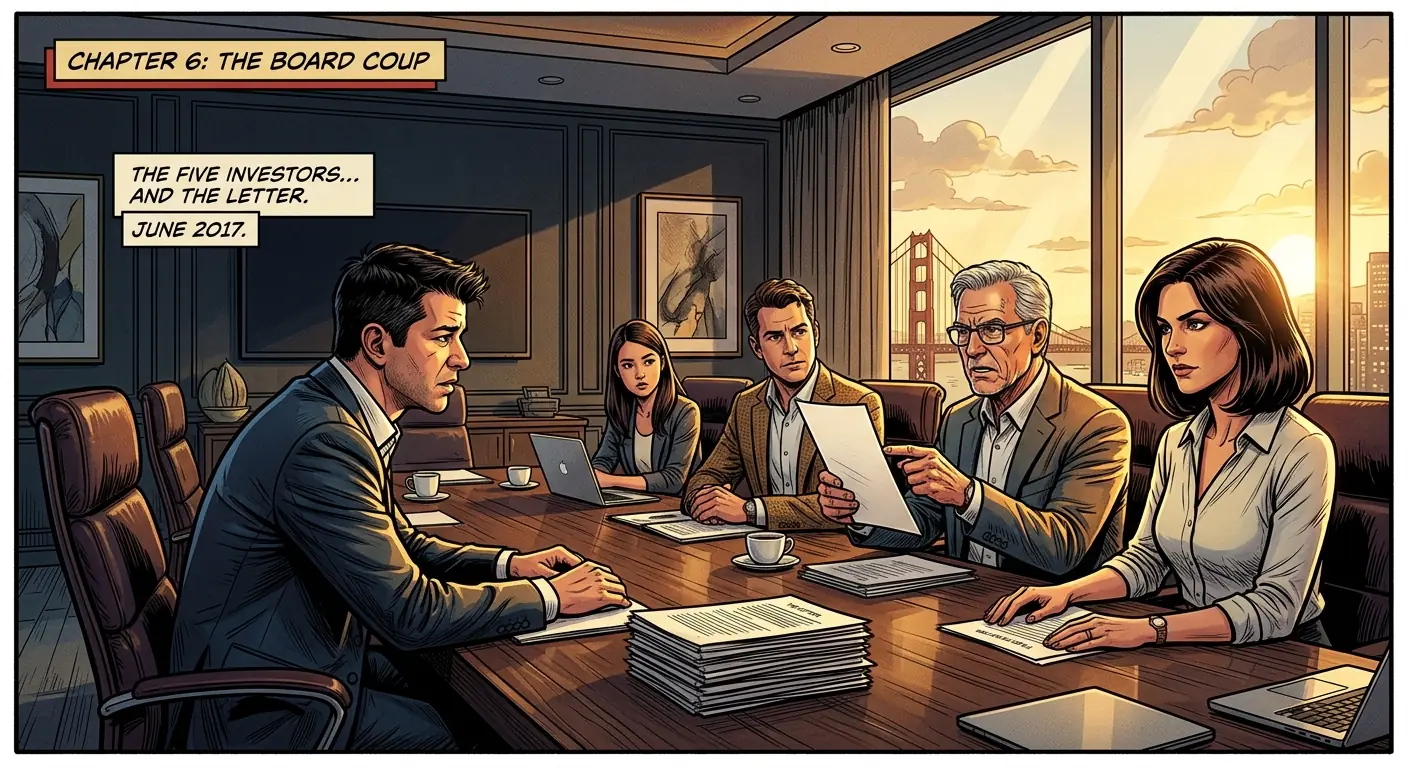
The Eric Holder report, delivered to Uber’s board in June 2017, contained 47 recommendations for reforming the company’s culture. But the real action was happening behind closed doors.
On June 11, 2017, Kalanick announced he would take an indefinite leave of absence. His mother, Bonnie, had died in a boating accident on May 26, and his father had been seriously injured in the same accident. Under normal circumstances, a grieving CEO stepping back would have generated sympathy. But Uber’s board saw an opening.
On June 20, 2017, five of Uber’s major investors — including Benchmark Capital’s Bill Gurley and Matt Cohler, along with representatives from First Round Capital, Lowercase Capital, and Menlo Ventures — confronted Kalanick with a letter demanding his immediate resignation. The letter was titled “Moving Uber Forward.” It was hand-delivered to Kalanick while he was in Chicago.
According to Super Pumped and multiple press accounts, Kalanick initially resisted. He called allies. He explored his options. He considered whether his voting control of the company — he held shares with 10 votes per share, giving him enormous governance power — could protect him. But the investors made it clear: resign, or we go public with our demand and the resulting PR firestorm will make everything that’s already happened look like a warm-up act.
On June 21, 2017, Kalanick resigned as CEO of Uber. His public statement read: “I love Uber more than anything in the world and at this difficult moment in my personal life I have accepted the investors’ request to step aside so that Uber can go back to building rather than be distracted with another fight.”
He was 40 years old. He had built Uber from a Paris daydream into a company operating in 77 countries with 16,000 employees and a valuation of $69 billion. And he got kicked out via a letter.
The board hired Dara Khosrowshahi, the CEO of Expedia, as Kalanick’s replacement in August 2017. Khosrowshahi’s first job was essentially cultural fumigation.
💵 Chapter 7: The Aftermath — Where the Money Landed (2017–Present)
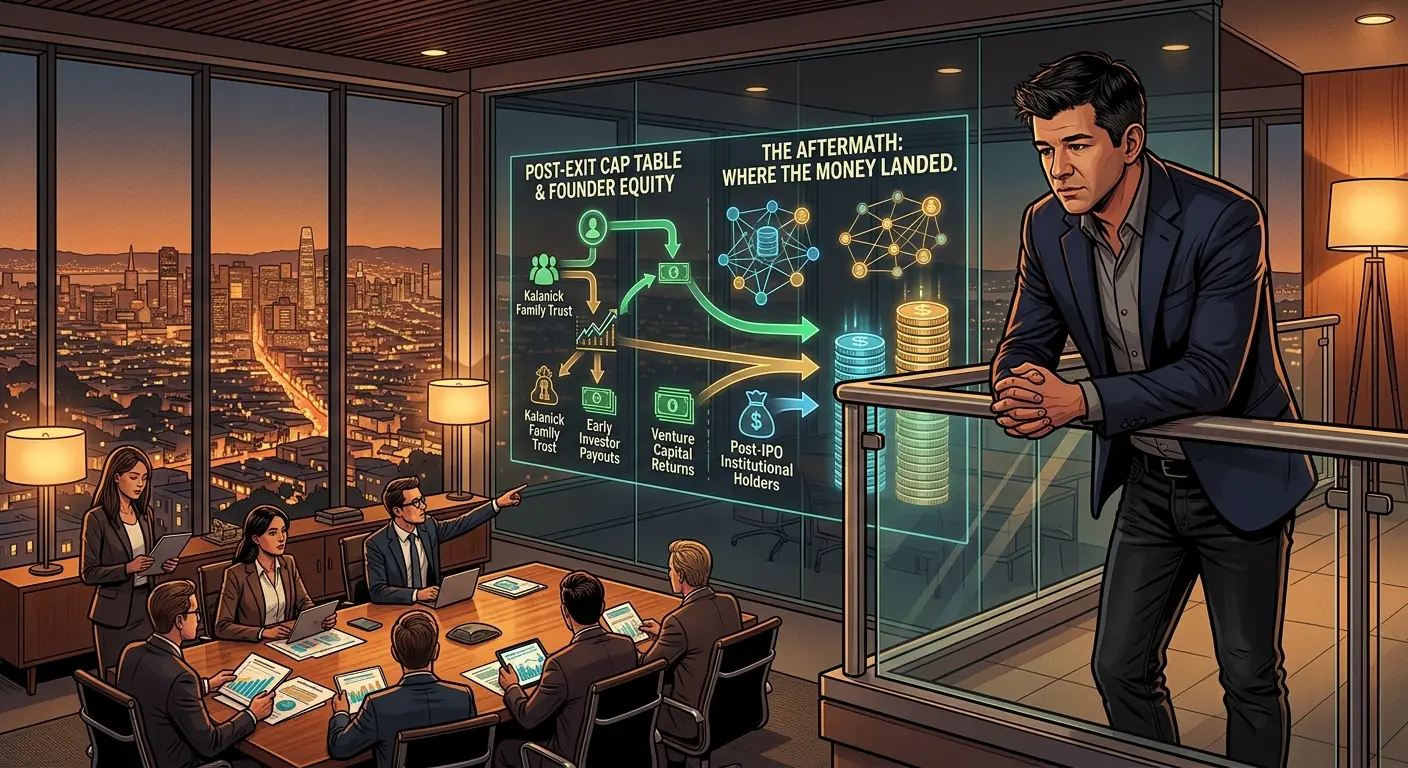
The IPO
Uber went public on May 10, 2019, at a valuation of approximately $82 billion — one of the largest tech IPOs in history. But the debut was rocky. The stock opened at $42, below its IPO price of $45, and the company lost $7.6 billion in value on its first day of trading. It was the biggest first-day dollar loss for a U.S. IPO on record.
The S-1 filing made for grim reading: Uber had lost $1.8 billion in 2018. It had lost $3 billion in 2017. The company had cumulative losses of over $7.8 billion since inception. The filing also contained one of the most remarkable risk disclosures ever written: “We may not achieve profitability.”
Kalanick’s Exit
Kalanick didn’t stick around for the public market experiment. He remained on Uber’s board until December 2019, when he resigned and began systematically selling his shares. Between November and December 2019, Kalanick sold approximately $2.5 billion worth of Uber stock. By the time he was done liquidating, he’d cashed out an estimated $2.7 billion.
Not bad for a guy who’d been fired.
CloudKitchens: The Quiet Comeback
After leaving Uber, Kalanick poured his money into City Storage Systems, a real estate venture that acquired distressed properties and converted them into “ghost kitchens” — shared commercial kitchen spaces that restaurants could use for delivery-only operations. The company rebranded as CloudKitchens and reportedly raised $400 million from Saudi Arabia’s sovereign wealth fund in January 2019 at a $5 billion valuation.
CloudKitchens has operated in near-total secrecy — a dramatic departure from the publicity-obsessed Uber years. Kalanick has given almost no interviews. The company has no public website to speak of. Whether this is strategic maturity or a response to the trauma of having his entire personality become a liability is an open question.
Reports as of 2024 suggest CloudKitchens has struggled in some markets, with real estate vacancy issues and lower-than-expected demand in certain cities. But the company continues to operate, and Kalanick — despite everything — remains a billionaire. Forbes estimated his net worth at approximately $2.9 billion as of 2024.
Uber Under Khosrowshahi
Under Dara Khosrowshahi, Uber has been systematically de-Kalanicked. The culture was overhauled. The company’s official values were rewritten — one of the old Kalanick-era values was literally “toe-stepping,” which explicitly encouraged employees to invade each other’s territory. Khosrowshahi replaced it with “We do the right thing. Period.”
Uber finally turned its first operating profit in Q2 2023, more than 14 years after the company was founded. The stock has recovered significantly from its disastrous IPO day, trading north of $60 by late 2024, giving the company a market capitalization of roughly $130 billion.
The irony is almost too on the nose: the company Kalanick built is now worth more than it’s ever been. It just had to get rid of him first.
📜 Chapter 8: The Kalanick Paradox — Was He a Visionary or a Villain?
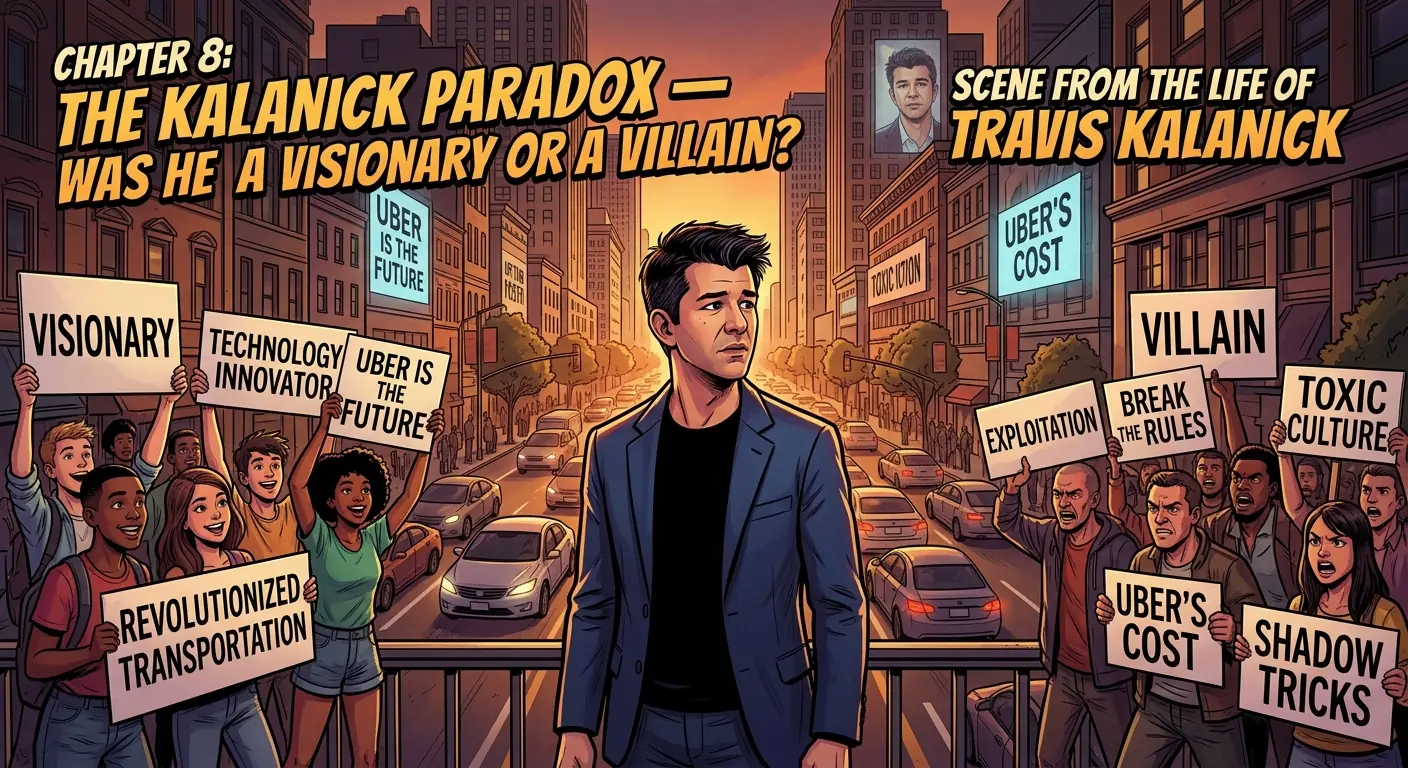
Here’s the uncomfortable truth that most Uber retrospectives try to avoid: Travis Kalanick was probably both.
The taxi industry that existed before Uber was, by almost any objective measure, a cartel. In New York City, a taxi medallion cost $1.3 million at its peak in 2013 — a government-enforced artificial scarcity that enriched medallion owners and hedge funds while providing a service that was dirty, unreliable, and frequently discriminatory. Studies consistently showed that taxis were far less likely to pick up Black passengers. The industry was ripe for disruption, and the incumbents had spent decades using regulatory capture to prevent competition.
Kalanick blew that system up. You can argue about the methods — and you should — but the result was that hundreds of millions of people around the world gained access to a transportation option that was cleaner, cheaper, more convenient, and more accountable than anything that existed before. That’s real. That matters.
But the methods did matter too. The sexual harassment that Susan Fowler described wasn’t an accident. The Greyball program wasn’t a rogue project. The dashcam video wasn’t an off day. These were all direct expressions of a culture that started at the top. Kalanick built Uber in his own image, and his image was someone who believed that rules were obstacles, that winning justified any means, and that anyone who couldn’t keep up deserved to be left behind.
The question isn’t whether Kalanick was a great founder. He clearly was — possibly one of the greatest operators in Silicon Valley history in terms of sheer execution speed and competitive intensity. The question is whether the thing he was great at — building a wartime culture of total aggression — was compatible with leading a company that employed tens of thousands of people, served hundreds of millions of customers, and operated in dozens of countries with different laws, cultures, and expectations.
The answer, delivered via a letter in a Chicago hotel room, was no.
🔑 Key Takeaways
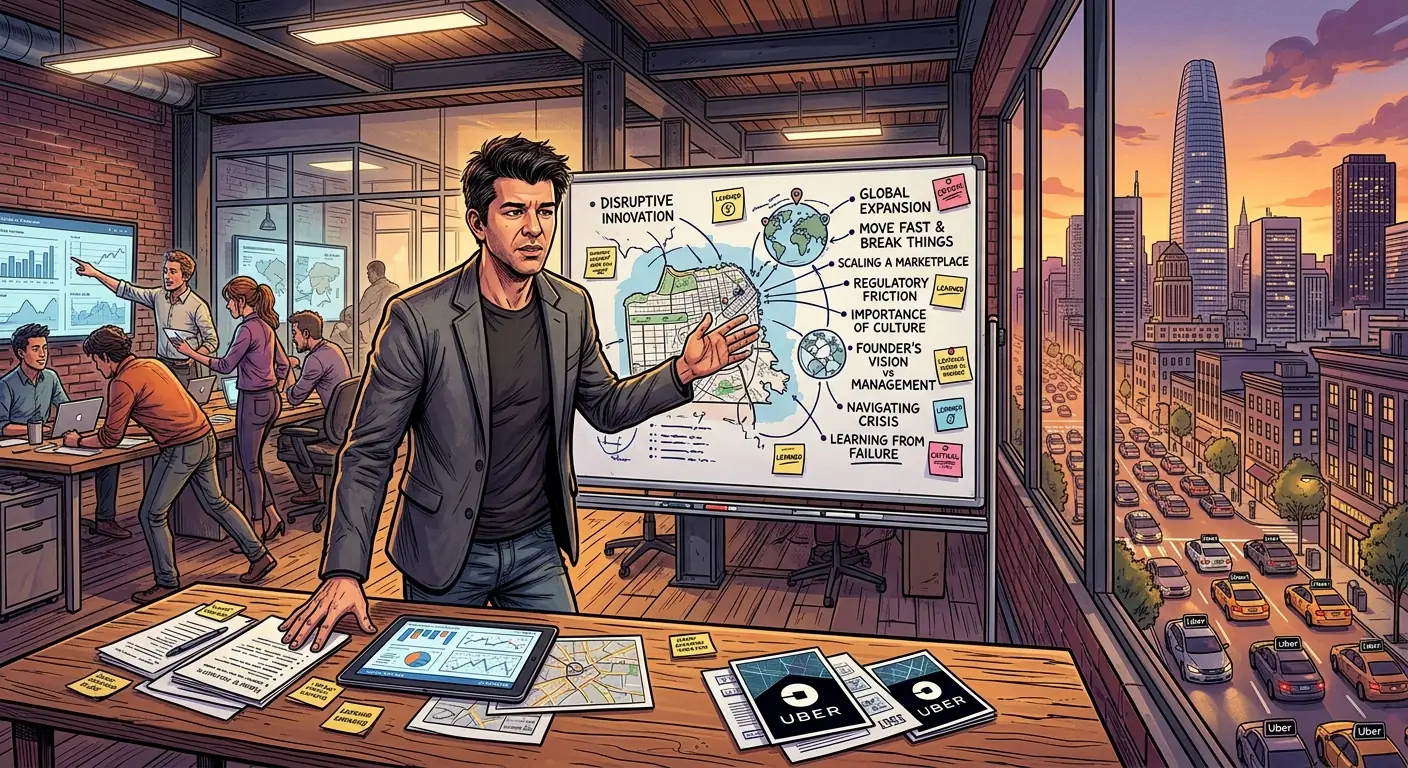
The Kalanick story isn’t really about one man. It’s about what happens when an entire ecosystem — investors, board members, employees, customers, regulators — lets a founder operate without accountability because the growth numbers are too good to question. Everyone knew. The culture was an open secret. The regulatory games were covered in real time by major publications. The sexism was endemic enough that hundreds of employees could describe it.
But Uber was growing. The valuation was climbing. The next funding round was always bigger. And as long as the rocket ship was going up, nobody wanted to be the person who asked whether the pilot was flying drunk.
The lesson isn’t “don’t be aggressive.” The lesson is that aggression without ethics is a time bomb. It might take years to detonate, but it always does. Kalanick built a $69 billion company in eight years. It took his own board about eight weeks to decide he had to go.
He left with $2.7 billion. The drivers who built Uber — the ones like Fawzi Kamel who watched their earnings get slashed year after year — got an app notification telling them the fare structure had changed again.
That’s the Travis Kalanick story. And no amount of money makes it a comfortable one.
😈 Chapter 9: The Culture Wars — “Uber-morals” and the Toxic Workplace (2015–2017)
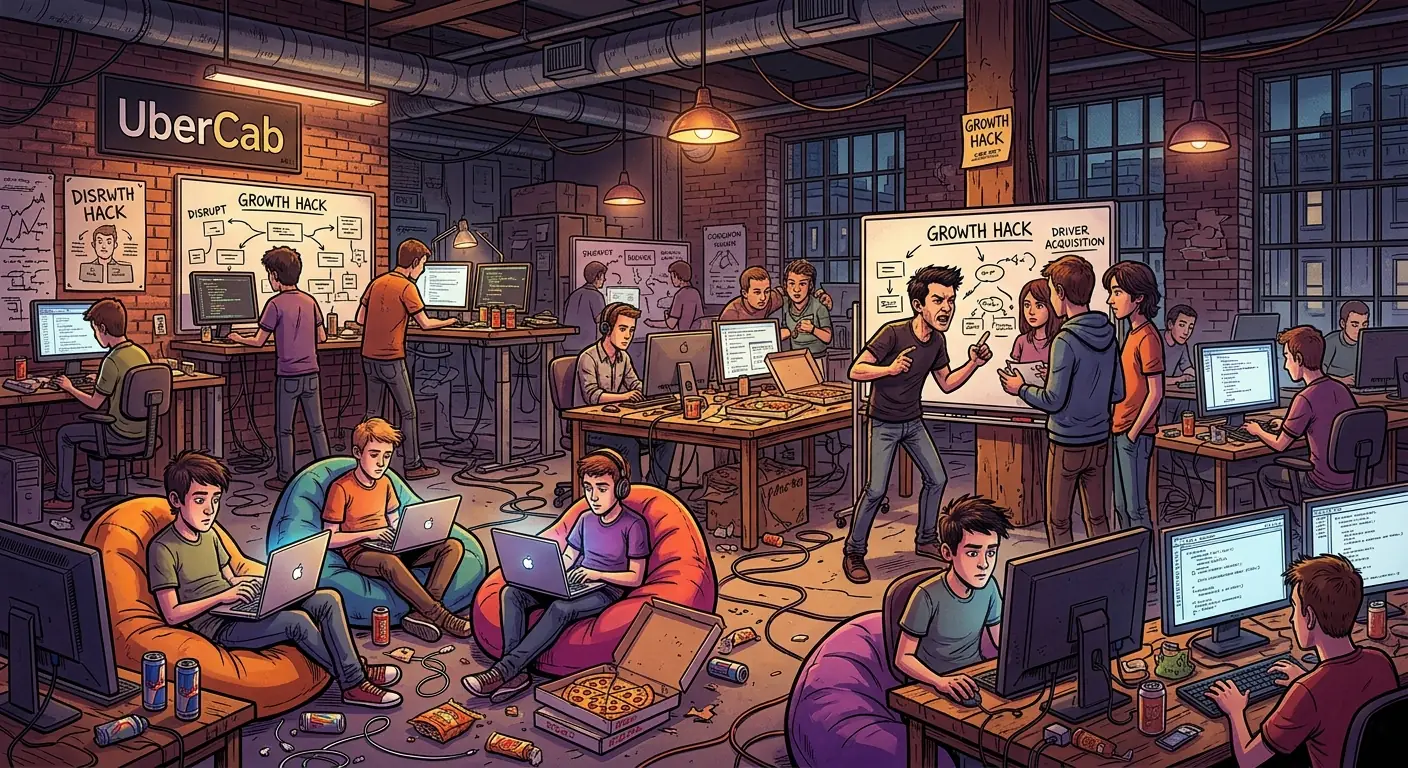
If Uber was a rocket ship, its internal culture was the jet fuel — highly potent, incredibly fast-burning, and prone to explosive decompression. While Travis Kalanick was pushing cities to their breaking point, the company he built was simultaneously fostering an internal environment that would become infamous for its aggressive “bro culture,” rampant sexism, and a general disdain for rules – both corporate and ethical. It was, shall we say, a vibe. And that vibe eventually became a full-blown scandal.
The Elephant in the Server Room: Susan Fowler’s Bombshell
The dam truly broke on February 19, 2017, when former Uber engineer Susan Fowler published a blog post titled “Reflecting On One Very, Very Strange Year At Uber.” It wasn’t just a blog post; it was a digital Molotov cocktail thrown directly into Uber’s gleaming, glass-walled offices. Fowler detailed a litany of horrors: a manager propositioning her for sex on her first day, HR dismissing her complaints because the manager was a “high performer,” women being systematically denied promotions, and a general atmosphere where sexual harassment was so pervasive it became normalized. She described how the number of women in her organization plummeted from 25% to 6% during her time there. The internet went ballistic.
Her account painted a picture of a company where the drive to win at all costs extended to internal power dynamics, creating a hostile environment that chased away talent and fostered a code of silence. Kalanick, ever the fighter, initially called for an “urgent investigation” but the damage was done. This wasn’t just a bad quarter; it was an existential crisis. The blog post wasn’t an isolated incident either; it opened the floodgates for countless other employees to share their own tales of “Uber-morals,” from casual misogyny to outright discrimination. It was less a tech company, more a frat house with a multi-billion-dollar valuation.
”God View” and the Culture of Disregard
Beyond the sexism, Uber’s culture was also characterized by a profound disregard for privacy and ethical boundaries. Take “God View,” for instance. This internal tool, initially designed to track Uber cars and drivers, became notorious for its alleged misuse. Stories emerged of employees using it to track celebrities, ex-partners, and even journalists. One infamous incident involved senior executives tracking a BuzzFeed reporter without her consent, leading to widespread outrage and an internal admission by Uber that the tool had been “misused.”
This wasn’t just a few bad apples; it was a symptom of a systemic problem. When the company’s founder famously said, “We’re in a political campaign, and the candidate is Uber,” he wasn’t just talking about regulators. He was talking about everything. Rules were for other people. Ethics were for the weak. This mindset, while arguably fueling Uber’s aggressive growth, ultimately corroded the very foundation of trust within the company and with its users. The “move fast and break things” mantra had apparently morphed into “move fast and break people.”
The Holder Report and the Fallout
In the wake of Fowler’s revelations, Uber launched an internal investigation, led by former U.S. Attorney General Eric Holder. The resulting 13-page “Holder Report,” released in June 2017, pulled no punches. It recommended sweeping changes, from limiting Kalanick’s authority to overhauling HR practices, banning alcohol during work hours, and re-evaluating Uber’s core values. The report effectively confirmed what Fowler and others had alleged: Uber’s culture was, in a word, toxic.
The consequences were swift and brutal. Over 20 employees were fired as a direct result of the investigation, including several senior executives. Kalanick himself was increasingly isolated. The culture issues, combined with other scandals like Greyball and the Waymo lawsuit (which we’ll get to), created a perfect storm. The internal rot became external poison, alienating customers, investors, and eventually, the very board that once championed Kalanick’s aggressive vision. It turned out that building a multi-billion-dollar company wasn’t just about code and cars; it was about people, too. Who knew?
🥊 Chapter 10: The Price of Innovation — Battles with Regulators and Rivals (2012–2016)
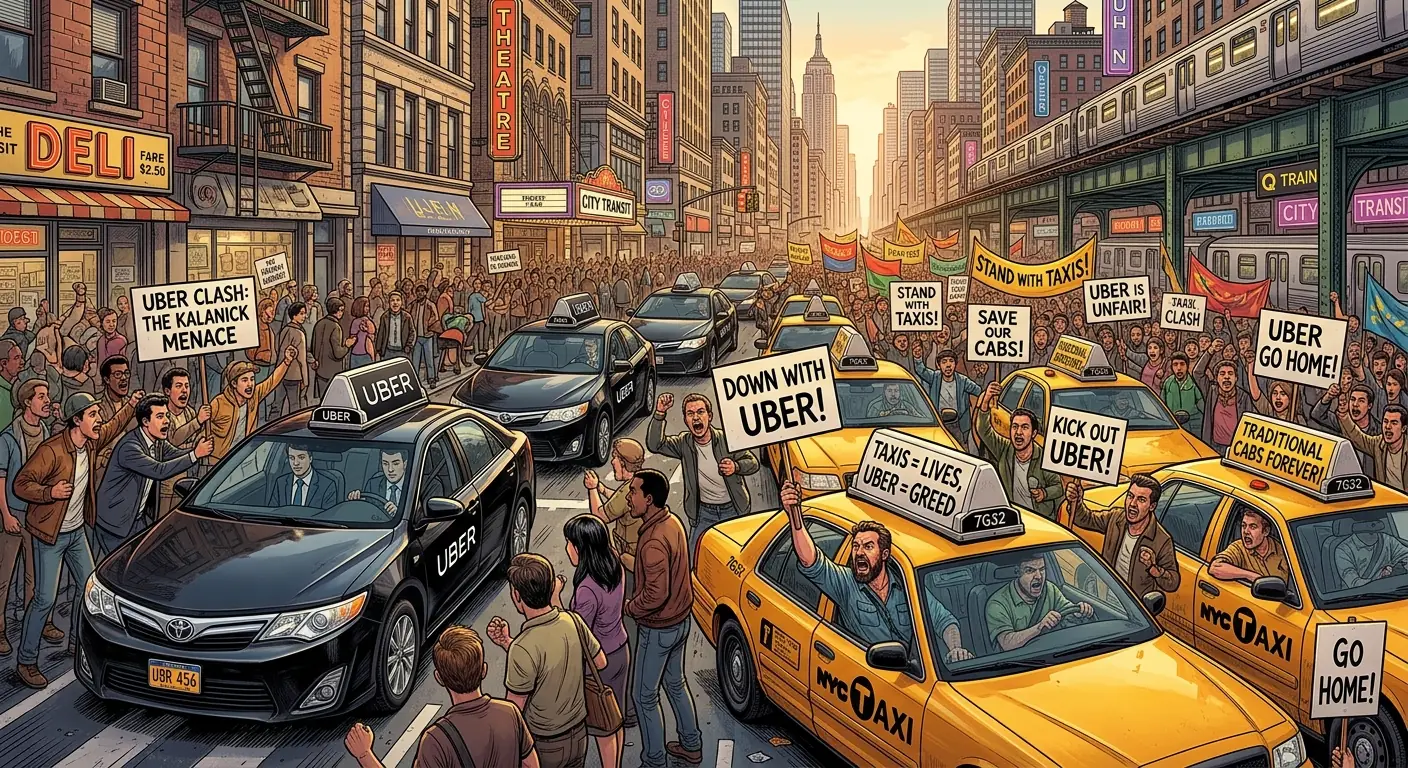
Before Uber became synonymous with convenience, it was synonymous with controversy. Travis Kalanick didn’t just walk into new markets; he kicked down the door, usually with a smirk and a phalanx of lawyers. For years, Uber’s operating model was essentially: launch first, ask for forgiveness (or just ignore the cease and desist letters) later. This approach, while undeniably effective for hyper-growth, ignited fierce battles on two fronts: with entrenched taxi industries and with fellow tech upstarts like Lyft. It was a brutal, no-holds-barred slugfest, and Kalanick was always spoiling for a fight.
The Taxi Wars: A Global Gauntlet
From its earliest days, Uber’s expansion was met with ferocious resistance from the highly regulated, often unionized, taxi industries worldwide. These weren’t just polite disagreements; they were street brawls, legal challenges, and sometimes even physical confrontations. In Paris, taxi drivers blockaded roads and burned tires in June 2015, protesting Uber’s low-cost UberPOP service. In London, over 10,000 black cab drivers brought traffic to a standstill in 2014. Cities like Austin, Texas, even saw Uber and Lyft temporarily pull out in 2016 rather than comply with local fingerprint background check requirements, only to return years later after the rules were softened.
Kalanick’s strategy was simple: overwhelm the regulators. He believed that if Uber could gain enough customer adoption and driver-partners in a city, the public pressure would eventually force politicians to bend. He wasn’t entirely wrong. But it meant Uber was constantly fighting legal battles, racking up fines, and being declared “illegal” in countless jurisdictions. It was a massive drain on resources, but Kalanick saw it as the necessary cost of disruption. “We’re not in the transportation business, we’re in the politics business,” he once quipped, a pretty telling indicator of his priorities. His critics, meanwhile, argued he was simply flouting laws and creating an unfair playing field. Both were probably right.
The Lyft Rivalry: A Battle for the Bottom Line
While fighting the old guard, Uber was also locked in a bare-knuckle brawl with its closest competitor, Lyft. From their inception, the two companies were engaged in a bitter rivalry, often characterized by aggressive, borderline unethical tactics. Remember “Operation Slog”? In 2014, The Verge reported that Uber employees and contractors were allegedly booking and canceling thousands of Lyft rides, tying up Lyft drivers and costing the company money. Lyft, for its part, accused Uber of poaching its drivers with aggressive incentives and even sending “brand ambassadors” to Lyft events to recruit.
The competition wasn’t just about market share; it was about who would dominate the entire ride-sharing landscape. Uber, with its massive war chest (it raised billions more than Lyft in its early years), often outspent and outmaneuvered its pink-mustachioed rival. This fierce competition drove innovation, certainly, but also pushed the boundaries of corporate ethics to their very limits. It was a zero-sum game, and Kalanick was a master of that game. He famously told an interviewer that he had a “compulsion to win,” and against Lyft, he certainly acted like it.
Global Chess: Didi and the China Retreat
The most costly competitive battle, however, wasn’t fought on American soil but in the gargantuan market of China. Uber poured billions of dollars into its Chinese operations, attempting to replicate its Western success against local behemoth Didi Chuxing. Kalanick saw China as a crucial frontier, a market so vast that winning it would cement Uber’s global dominance. He was willing to spend $1 billion a year to compete, according to reports.
But Didi, backed by local tech giants like Tencent and Alibaba, proved an insurmountable foe. They understood the local market better, had stronger government ties, and were equally ruthless. After a bruising, multi-year price war that bled both companies dry, Uber finally waved the white flag in August 2016. It sold its Chinese operations to Didi in exchange for an 18% stake in the combined entity, a deal valued at around $35 billion. It was a strategic retreat that, while financially advantageous in the long run, was a rare admission of defeat for Kalanick. He might have won most of his battles, but China was one war he simply couldn’t conquer.
🚀 Chapter 11: Vision to Venture — From Ride-Sharing to Self-Driving (2014–2017)
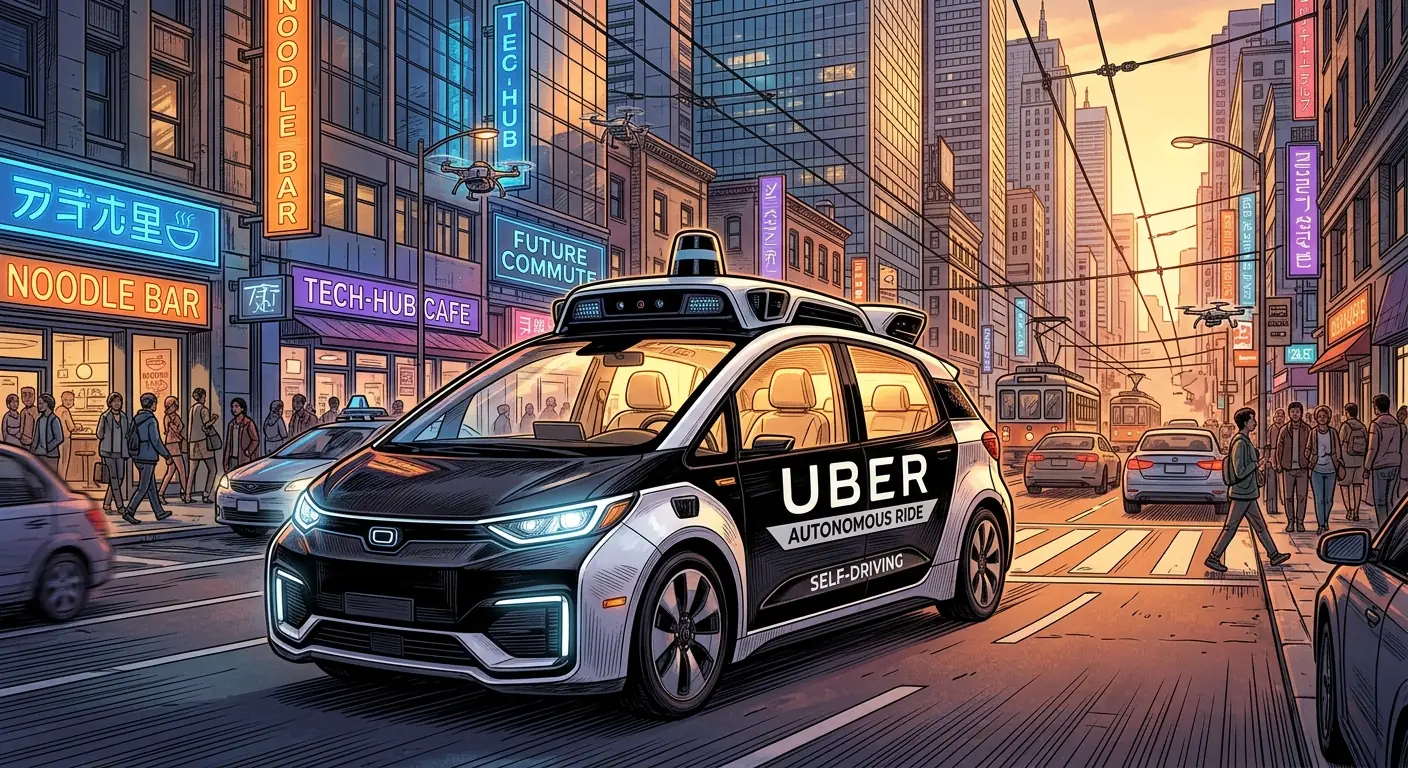
Travis Kalanick never saw Uber as just a ride-sharing company. He saw it as a logistics platform, a global network that could move anything, anywhere, anytime. This expansive vision led Uber far beyond simply ferrying people from point A to point B, pushing it into new, incredibly ambitious, and often controversial ventures. From delivering pad thai to pioneering autonomous vehicles, Kalanick’s insatiable desire to dominate every corner of urban mobility was both his greatest strength and, eventually, a major contributor to his downfall.
Beyond Rides: The Genesis of Uber Eats
While ride-sharing was Uber’s bread and butter, Kalanick quickly realized the network of drivers and the app infrastructure could be leveraged for other services. Enter Uber Eats. Initially launched as “UberFRESH” in 2014 in Santa Monica, offering a limited menu of pre-made meals, it quickly morphed into the on-demand restaurant delivery service we know today. By 2015, it rebranded as Uber Eats and began its aggressive global expansion, allowing users to order from thousands of restaurants.
The beauty of Uber Eats was its synergy with the existing ride-sharing business. Drivers could switch between ferrying passengers and delivering food, optimizing their income and Uber’s network efficiency. It was a brilliant move, transforming Uber from a single-service app into a multi-faceted logistics giant. Today, Uber Eats is a massive standalone business, generating billions in revenue and competing fiercely with DoorDash and Grubhub. It proved Kalanick’s vision for Uber as a comprehensive urban mobility platform wasn’t just hype; it was a potent strategy to unlock entirely new revenue streams, even if it meant competing with every local pizzeria’s delivery guy.
The Autonomous Ambition: Driving Towards a Driverless Future
But the most audacious of Kalanick’s ventures, and arguably the one that best encapsulated his blend of visionary thinking and ruthless execution, was Uber’s push into self-driving cars. Kalanick understood that drivers were Uber’s biggest cost – roughly 75% of every fare went to the human behind the wheel. The logical conclusion? Get rid of the human. By 2015, Uber had poached an entire research team from Carnegie Mellon University, establishing its Advanced Technologies Group (ATG) in Pittsburgh. This wasn’t just R&D; this was a race, and Kalanick was determined to win it.
He wasn’t subtle about his intentions. He famously told Business Insider in 2014: “The reason Uber could be expensive is because you’re not just paying for the car and the gas, you’re paying for the other dude in the car.” The pursuit of autonomous vehicles wasn’t just a cost-cutting measure; it was the ultimate expression of Uber’s disruptive ethos. Imagine Uber, without the pesky drivers, without the surge pricing complaints, just a seamless, fully automated network. It was a tantalizing, if slightly dystopian, future.
Waymo’s Legal Battle: A Speed Bump on the Road to Autonomy
This ambition, however, led directly to one of Uber’s darkest legal sagas: the lawsuit with Waymo, Google’s self-driving car division. In February 2017, Waymo sued Uber, alleging that Anthony Levandowski, a former Waymo engineer and founder of self-driving truck startup Otto (which Uber acquired for $680 million in 2016), had stolen 14,000 confidential files related to Waymo’s LiDAR technology before joining Uber. This wasn’t just a patent dispute; it was a bombshell accusation of industrial espionage.
The trial, which began in February 2018, revealed a treasure trove of damning evidence, including emails from Kalanick himself urging Levandowski to “bring the sauce” (i.e., proprietary technology). While Uber denied any wrongdoing, the optics were terrible. Kalanick testified, portraying himself as largely unaware of the specifics, but the damage was done. The case ultimately settled for $245 million in Uber equity, but the reputational cost, and the blow to its self-driving ambitions, was far greater. It was yet another instance where Kalanick’s “win at all costs” mentality pushed the company beyond acceptable boundaries, proving that sometimes, being first isn’t worth the price.
🏗️ Chapter 12: The Phoenix (Sort Of) — Kalanick’s Post-Uber Empire (2018–Present)
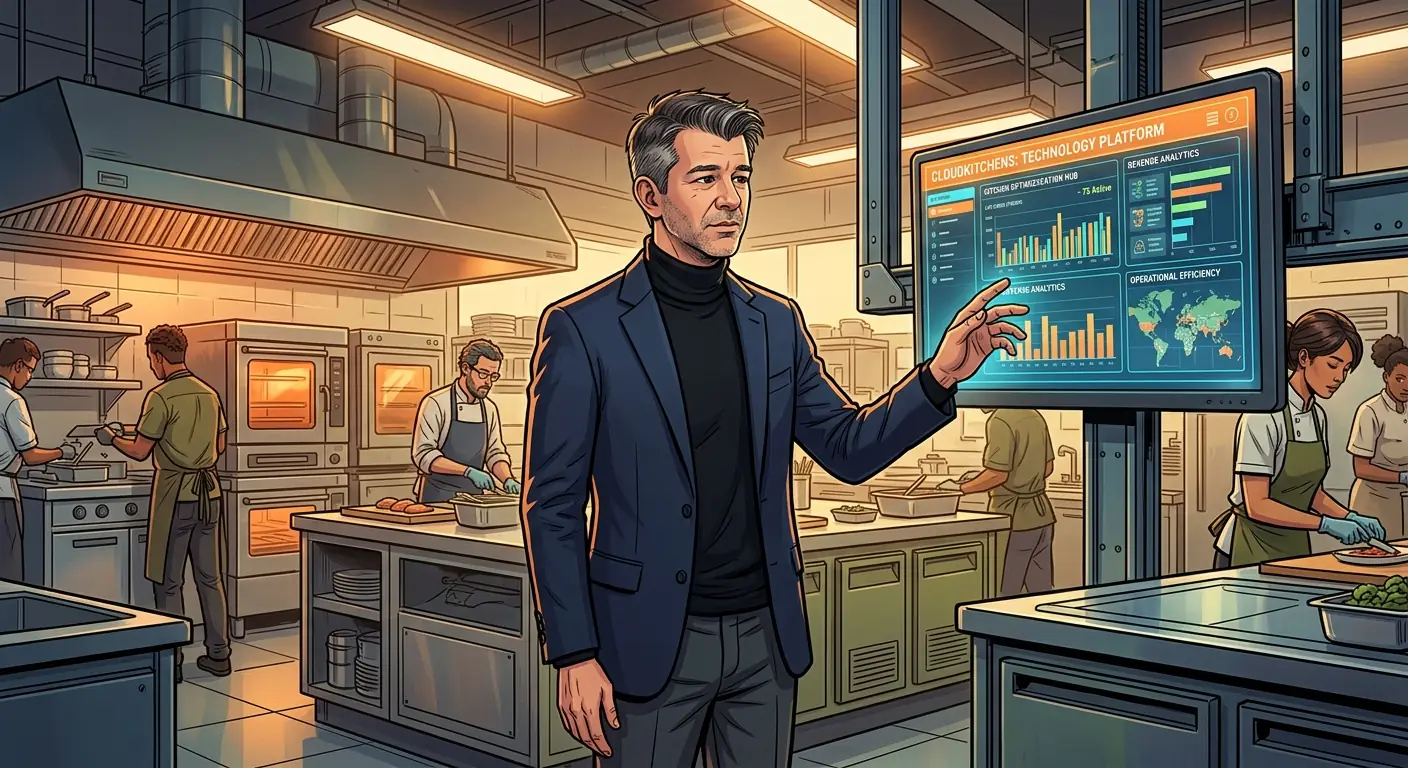
After being unceremoniously ejected from the driver’s seat of his own company in June 2017, most people would expect Travis Kalanick to either retreat to a private island, write a tell-all memoir, or perhaps fund a small, artisanal kombucha startup. But Travis Kalanick isn’t “most people.” The man who built Uber from a crazy idea into a global behemoth wasn’t about to fade into the background. Instead, he simply switched gears, leveraging his immense personal fortune and hard-earned expertise to build a new empire, albeit one shrouded in considerably more secrecy. He traded ride-sharing for ghost kitchens, and the public spotlight for a more clandestine, but equally ambitious, pursuit.
The Billion-Dollar Ghost Kitchens: CloudKitchens
Kalanick’s primary post-Uber venture is a company called CloudKitchens. What are “ghost kitchens,” you ask? Imagine a giant warehouse filled with dozens, even hundreds, of commercial kitchens, each designed for delivery-only restaurants. They’re essentially real estate plays for the food delivery age, providing infrastructure for virtual brands and existing restaurants to expand their delivery footprint without the overhead of a traditional storefront. It’s Uber Eats, but for the kitchen itself. Kalanick reportedly bought the initial property for CloudKitchens in 2016 while still at Uber, foreshadowing his next move.
He poured $300 million of his own money into CloudKitchens, and the company quickly attracted serious investor attention. In 2020, Saudi Arabia’s Public Investment Fund (the same fund that invested heavily in Uber itself) reportedly injected $400 million, valuing CloudKitchens at around $5 billion. Kalanick’s modus operandi is remarkably similar to early Uber: aggressive land acquisition, rapid expansion into new markets (reportedly over 40 cities globally), and a penchant for operating in the shadows. He’s back to being a founder, but with the added advantage of being a billionaire founder who doesn’t need to answer to a public board or demanding investors quite as directly.
Investment Spree and Quiet Influence
While CloudKitchens is his main focus, Kalanick hasn’t stopped being an active investor and operator. He runs a venture fund called 10100 (pronounced “ten one hundred”), named after his home address where he started Scour. Through this fund, he’s reportedly invested in a diverse portfolio of tech companies, from real estate startups to e-commerce. He also made a tidy sum from selling off his remaining Uber shares, netting around $2.7 billion in total from his various sales.
His post-Uber life isn’t without its ironic twists. Having been ousted from Uber due to a toxic culture, he’s now building a company that, by some accounts, still retains shades of that aggressive, demanding environment. Reports from Business Insider and The New York Times have detailed a high-pressure, secrecy-obsessed culture at CloudKitchens, with Kalanick reportedly still very much the hands-on, demanding CEO. It seems some habits, like a relentless drive and a tendency to push boundaries, are hard to break. The “Uber-morals” might have been purged from Uber, but perhaps they found a new home.
The Shadow of the Founder
Travis Kalanick might no longer be leading one of the world’s most recognizable companies, but his influence continues to ripple through the tech world. He remains a fascinating, polarizing figure — a ruthless genius who revolutionized an industry, then got tripped up by his own creation. His story serves as a potent reminder that success in Silicon Valley isn’t just about groundbreaking ideas and relentless execution; it’s also about building sustainable culture, managing ethical boundaries, and knowing when to adapt.
His new ventures suggest he’s learned some lessons about avoiding the public spotlight, but perhaps fewer about tempering his ambition or his famously aggressive style. He’s building again, still disrupting, still chasing that next impossible dream. Whether CloudKitchens will reach the stratospheric heights of Uber, or if Kalanick will once again find himself caught in the whirlwind of his own creation, remains to be seen. But one thing is for sure: Travis Kalanick is not done building. And knowing him, he’s probably already planning his next move, just out of sight, in the shadows.
💡 Key Insights
- ▸ Uber proved that aggression can build an empire — but it can't sustain one. Kalanick's 'win at all costs' mentality was the perfect tool for disrupting the taxi industry and the worst possible tool for running a mature company. The traits that make someone a great wartime founder often make them a terrible peacetime CEO.
- ▸ Culture isn't a nice-to-have — it's infrastructure. Uber's toxic workplace wasn't a side effect of rapid growth; it was a direct reflection of leadership values. When the CEO publicly brags about the company nickname 'Boober' and argues with drivers on camera, every middle manager gets the message: rules are for other people.
- ▸ The most expensive lesson in Silicon Valley: the board always wins. Kalanick held enormous power — billions in equity, a loyal inner circle, legendary status as a founder. None of it mattered when five investors showed up with a letter. Founders who ignore governance do so at their own peril.
- ▸ Regulatory arbitrage has an expiration date. Uber's strategy of launching illegally in new cities and daring regulators to shut them down worked brilliantly — until it didn't. Greyball crossed the line from aggressive to potentially criminal, and the reputational damage became a permanent tax on the business.
- ▸ Susan Fowler's 2,900-word blog post did more damage to Uber than any competitor, regulator, or lawsuit ever could. In the age of social media, a single credible whistleblower with a well-written account can unravel a $70 billion company faster than any market force. Reputation is the most fragile asset on the balance sheet.
Sources
- Mike Isaac — Super Pumped: The Battle for Uber (Book) ↗
- Susan Fowler — Reflecting on One Very, Very Strange Year at Uber (Blog Post) ↗
- New York Times — Uber's C.E.O. Plays With Fire ↗
- Bloomberg — Uber's Travis Kalanick Resigns as CEO ↗
- The Verge — Uber's Greyball Tool and Regulatory Evasion ↗
- SEC Filings — Uber Technologies S-1 ↗
- Eric Holder — Covington & Burling Report on Uber Workplace Culture ↗