Marc Benioff: How Salesforce Sold the Cloud Before the Cloud Was Obvious
Marc Benioff turned a software delivery model into a movement, using subscriptions, spectacle, acquisitions, and stakeholder rhetoric to build Salesforce.
View all stories about this mogul
Marc Benioff did not invent software over the internet, but he made “no software” one of enterprise technology’s most effective acts of rebellion.
In 1999, large business applications were commonly installed through expensive projects, maintained through upgrades, and sold through licenses that placed much of the operational burden on customers. Salesforce proposed that customer relationship management could live in a browser and arrive as a service.
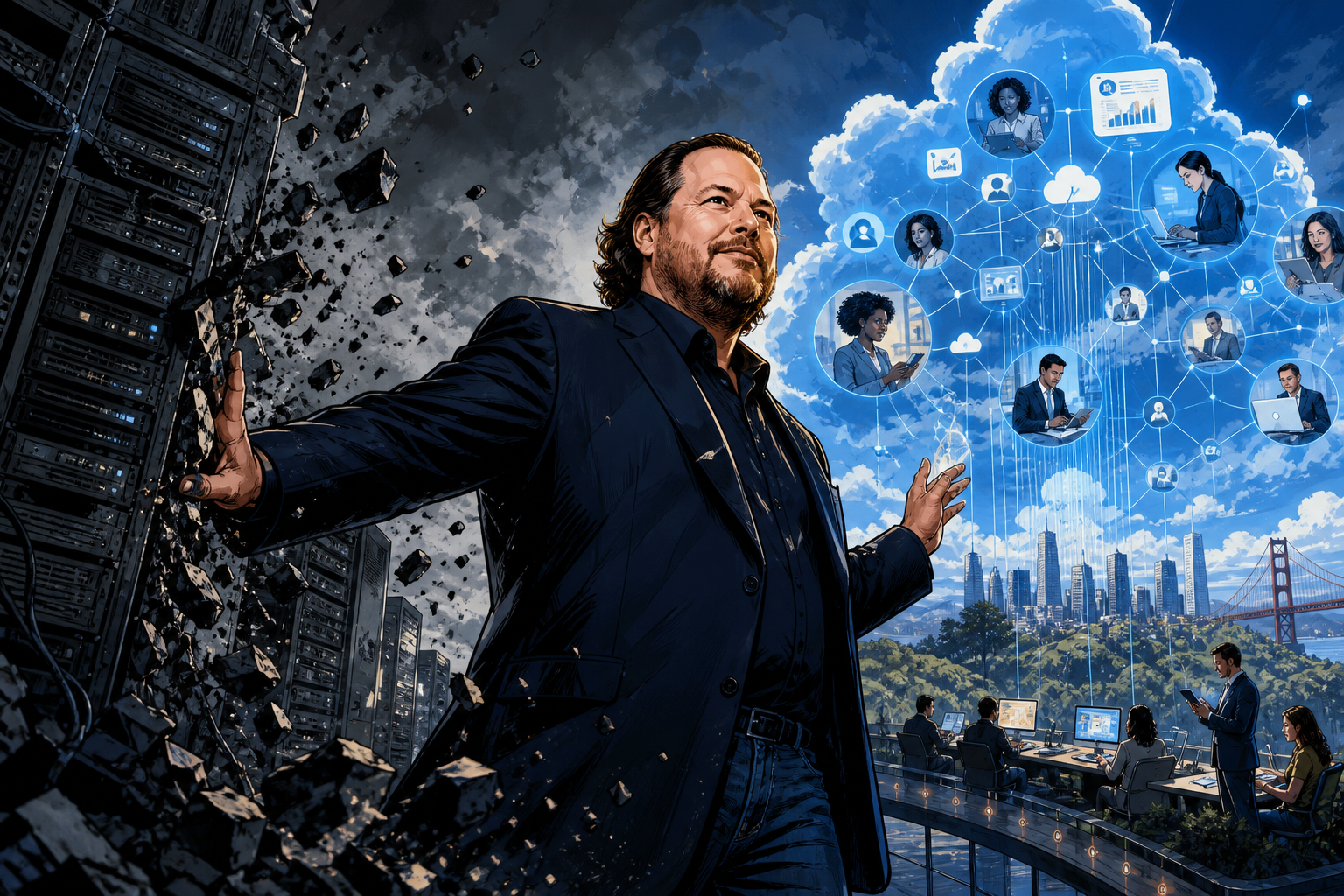
The architecture mattered. So did the showmanship. Benioff turned a technical and financial model into a public identity strong enough to challenge far larger incumbents.
How did Benioff make hosted software feel like a revolution?

Benioff spent years at Oracle, where he learned enterprise sales, product positioning, and the power of a forceful founder. After leaving, he started Salesforce in a San Francisco apartment with Parker Harris, Dave Moellenhoff, and Frank Dominguez.
The initial product addressed a familiar problem—managing customer relationships—but changed delivery. Users could access it through the web, while Salesforce operated the infrastructure and released improvements centrally. Customers avoided some server ownership and upgrade pain, and Salesforce gained a recurring relationship.
Benioff framed the shift with memorable antagonism. The “No Software” logo and staged protests portrayed installed enterprise applications as the old regime. The claim was technically exaggerated; Salesforce obviously wrote software. As category design, it was excellent. It let buyers summarize the difference before they understood every feature.
The subscription model also changed internal discipline. A license vendor could celebrate the contract. A service vendor had to keep the customer using and renewing. Reliability, adoption, and expansion became part of the revenue engine.
How did Salesforce grow from one application into a platform empire?

Salesforce expanded beyond sales automation into service, marketing, commerce, analytics, integration, and application development. Its platform allowed partners and customers to build on shared data and tools, increasing switching costs and ecosystem value.
Dreamforce became more than a user conference. It was a ritual for customers, developers, partners, employees, and the financial community. Benioff used launches, celebrity appearances, and civic messages to make enterprise software culturally louder than its back-office reputation suggested.
Acquisitions accelerated the expansion. MuleSoft strengthened integration, Tableau added analytics, and Slack brought workplace communication. Each deal widened the strategic map but created a harder operating problem: products with different architectures, sales motions, and cultures do not become a unified platform because a slide connects their logos.
Salesforce’s scale produced the pressures faced by mature software empires—margin scrutiny, activist investors, reorganizations, layoffs, and tension between growth and efficiency. The company had to prove that a broad portfolio could deliver operating leverage, not only revenue.
Can stakeholder capitalism survive the demands of scale?

Benioff made philanthropy part of the company’s operating identity through the 1-1-1 model: pledging portions of equity, product, and employee time to communities. He also became an outspoken voice on homelessness, public education, healthcare, and corporate responsibility.
That stance differentiated Salesforce in recruiting and brand terms. It also created a standard against which the company could be judged. Stakeholder language is easiest during fast growth; it becomes more revealing when leaders face layoffs, political controversy, customer conflicts, or investor demands.
Benioff’s career demonstrates both the power and risk of founder-led narrative. A founder can hold a category story through downturns and make decisions professional managers might avoid. The same centrality can blur succession, amplify inconsistency, and make corporate identity dependent on one personality.
Salesforce helped normalize the idea that enterprise software should be continuously delivered, subscribed to, and expanded as a platform. Today’s cloud market makes that seem inevitable. It was not inevitable when Benioff began carrying a “No Software” sign. His central skill was making a new business model emotionally legible—and then building an organization large enough to keep selling the promise after the slogan became ordinary reality.
💡 Key Insights
- ▸ A delivery model becomes a category when customers can repeat its contrast in one sentence.
- ▸ Subscription revenue changes product incentives from closing a sale to earning renewal.
- ▸ Corporate theater can concentrate attention, but integration determines whether acquisitions create value.
- ▸ Values claims become strategy only when they constrain real choices.


