MrBeast: How a Teenager From North Carolina Built the Biggest YouTube Empire on Earth
He spent years studying YouTube's algorithm, gave away millions of dollars on camera, and built a business empire worth billions. MrBeast didn't just play the platform — he became the platform.
View all stories about this mogul
Jimmy Donaldson — known to the world as MrBeast — is the most successful content creator in history, and he built his empire by doing something that sounds insane: giving away money. He gives strangers $10,000 to quit their jobs. He gives away entire houses. He fills swimming pools with cash. He recreates Squid Game with a $456,000 prize. He plants 20 million trees. The videos are watched by hundreds of millions of people, generating tens of millions in ad revenue, which he reinvests into bigger, more expensive videos. It’s a perpetual motion machine powered by generosity and algorithm optimization, and it has made a kid from Greenville, North Carolina, one of the most influential media moguls on the planet.
Chapter 1: The Kid Who Studied the Algorithm (1998–2016)

James Stephen Donaldson was born on May 7, 1998, in Wichita, Kansas, and raised in Greenville, North Carolina. His parents divorced when he was young, and his mother raised him and his brother in modest circumstances. There was nothing about his childhood that predicted extraordinary success — no special connections, no family money, no obvious advantages.
What Donaldson had was an obsession. At age thirteen, he uploaded his first YouTube video. It was terrible. Nobody watched it. He kept uploading. For the next four years — while his classmates were playing sports and going to parties — Donaldson was in his bedroom, making videos and, more importantly, studying YouTube. He watched thousands of hours of content, analyzed what worked and what didn’t, dissected thumbnails, titles, pacing, and audience retention graphs with the intensity of a PhD researcher.
He developed theories about why certain videos went viral and tested them relentlessly. He called other small YouTubers and spent hours on the phone discussing the algorithm. He identified patterns that most creators ignored: the importance of the first three seconds, the optimal video length for different content types, the relationship between thumbnail design and click-through rates. By the time he was eighteen, Donaldson understood YouTube’s mechanics better than most people who worked at YouTube.
Chapter 2: The Video That Changed Everything (2017)

In January 2017, Donaldson uploaded a video called “I Counted to 100,000.” It was exactly what it sounds like — he sat in front of a camera and counted, for over 40 hours, from 1 to 100,000. The video went viral. Not because counting is interesting, but because the sheer absurdity of the commitment was compelling. Who does this? Why? The human fascination with extreme effort — regardless of how pointless — drove millions of views.
The video was a turning point. Donaldson realized that extreme commitment — doing things that normal people would never do, pushing concepts to their logical (or illogical) extreme — was the key to viral content. He followed up with more stunt videos: saying Logan Paul 100,000 times, reading the dictionary, spending 24 hours in various unusual locations. Each video was more ambitious than the last.
His subscriber count began climbing rapidly. By late 2017, he had over a million subscribers. More importantly, he had developed a formula: take a simple concept, push it to an extreme, and document the process. It was a formula that would scale beyond anything the YouTube world had ever seen.
Chapter 3: The Philanthropy Machine (2018–2019)

Donaldson’s next innovation was combining extreme stunts with extreme generosity. He started giving away money — first hundreds, then thousands, then tens of thousands of dollars — in videos that were essentially game shows mixed with philanthropy. “I Gave a Homeless Man $10,000.” “Tipping Waitresses $10,000.” “I Gave My Mom a $100,000 House.”
The formula was brilliant for multiple reasons. The giving created genuinely emotional moments — people crying with joy, lives visibly changed — which drove engagement. The large dollar amounts drove clicks and shares. The unpredictability of the recipients’ reactions kept viewers watching. And the generosity gave MrBeast a moral authority that insulated him from the criticism that other attention-seeking creators attracted.
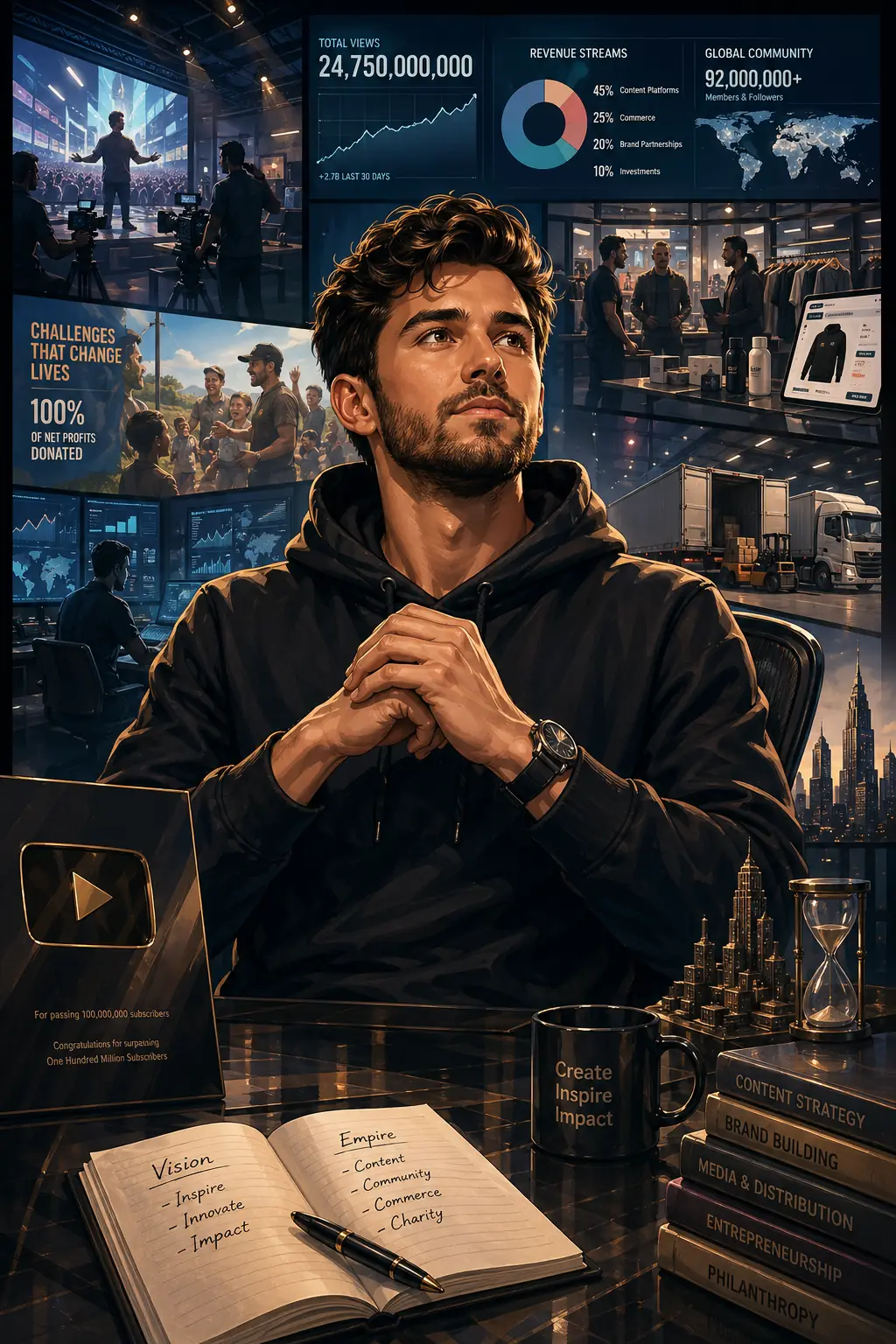
Each video cost more to produce than the last, but the revenue — from YouTube ads, sponsorships, and merchandise — more than covered the costs. Donaldson was reinvesting virtually all of his earnings back into content, a strategy that horrified traditional financial advisors but that was building something far more valuable than a savings account: a media brand with over 100 million subscribers.
Chapter 4: The Production Company — From Creator to Mogul (2019–2021)

MrBeast’s operation evolved from a kid with a camera to a full-scale production company. By 2020, he employed over 60 people — producers, editors, set designers, logistics coordinators, and data analysts. His videos required weeks of planning, custom-built sets, and coordination that rivaled Hollywood productions. The video recreating Squid Game’s challenges, for example, required building full-scale replicas of the show’s sets and managing hundreds of contestants.
Donaldson’s management style was as obsessive as his content creation. He reviewed every edit frame by frame. He A/B tested thumbnails. He analyzed audience retention data to identify exactly where viewers dropped off and restructured future videos to eliminate those weak points. He treated content creation as a science, not an art — an approach that was unusual among creators but common among the most successful tech entrepreneurs.
The operation was based in Greenville, North Carolina — far from Los Angeles or New York. This was partly practical (lower costs) and partly cultural. Donaldson believed that staying in his hometown kept him grounded and kept his team focused on the work rather than the Hollywood social scene. The remoteness also created a kind of creative isolation that fostered intensity and dedication.
Chapter 5: Beast Burger and Feastables — The Business Diversification (2020–2023)

Donaldson understood that YouTube ad revenue, while substantial, was vulnerable. Platform policy changes, algorithm shifts, or advertiser pullbacks could devastate a creator-dependent business. He needed to diversify. His first major move was Beast Burger, a virtual restaurant brand launched in December 2020. Rather than building physical restaurants, Beast Burger operated through existing restaurant kitchens — a “ghost kitchen” model that minimized capital expenditure and allowed rapid nationwide expansion.
Beast Burger launched in 300 locations and was available for delivery across the country within weeks. The marketing was built-in: MrBeast’s audience provided instant awareness that no amount of paid advertising could match. The brand expanded to over 1,700 locations at its peak, though quality control issues emerged as the ghost kitchen model made it difficult to maintain consistent food quality.
In 2022, Donaldson launched Feastables, a chocolate bar brand that he positioned as a premium snack with cleaner ingredients than competitors. Feastables was a more controlled venture than Beast Burger — Donaldson oversaw product development, packaging design, and distribution more directly. The brand launched in Walmart and other major retailers and reportedly generated over $200 million in revenue in its first full year. It was proof that MrBeast’s audience could be converted into mainstream consumer product sales.
Chapter 6: The Most Subscribed Channel on Earth (2022–2024)
In November 2022, MrBeast surpassed PewDiePie to become the most-subscribed individual creator on YouTube. By 2024, his main channel had over 300 million subscribers — more than the population of every country on Earth except China, India, the United States, and Indonesia. He also operated multiple secondary channels: MrBeast Gaming, Beast Reacts, and international dubbed channels that brought his content to non-English-speaking audiences.
The dubbed channels were a strategic masterstroke. Rather than relying on YouTube’s automatic translation, Donaldson invested in professional dubbing for major languages — Spanish, Portuguese, Hindi, Japanese, and others. Each dubbed channel built its own subscriber base, effectively multiplying MrBeast’s global reach. The combined subscriber count across all channels exceeded 500 million.
The scale of MrBeast’s audience gave him leverage that no individual creator had ever possessed. When he posted a new video, it could generate 100 million views within a week. Brands were willing to pay millions for a single sponsorship integration. His negotiating position with YouTube itself was unprecedented — he was arguably the platform’s most valuable creator, and both sides knew it.
Chapter 7: The Amazon Deal and Television Ambitions (2024)

In 2024, MrBeast signed a deal with Amazon to produce “Beast Games,” a competition reality show with a $5 million grand prize — the largest in television history. The show featured 1,000 contestants competing in increasingly difficult challenges, combining MrBeast’s YouTube formula with traditional television production values.
The Amazon deal was significant for several reasons. It validated MrBeast’s content model in the traditional entertainment industry. It gave him access to Amazon’s production resources and global distribution. And it tested whether his YouTube formula — extreme stakes, emotional moments, rapid pacing — could translate to a format with different audience expectations and attention spans.
The show drew massive viewership and cultural attention, though critical reception was mixed. Some reviewers found the format exhausting and the emotional manipulation heavy-handed. Others praised its energy and scale. Regardless of the critical response, the commercial success was undeniable, and it opened the door for MrBeast to become a cross-platform media figure rather than a YouTube-only creator.
Chapter 8: Controversies and Growing Pains (2023–2025)

MrBeast’s rapid growth brought scrutiny and controversy. In 2023, allegations emerged about workplace conditions at his production company — reports of long hours, high-pressure culture, and burnout among employees. Former team members described an environment where the relentless pace of content creation left little room for work-life balance.
More seriously, in 2024, controversy erupted around Ava Kris Tyson, a longtime collaborator and friend who appeared in many MrBeast videos. Allegations of inappropriate online interactions surfaced, and Tyson departed from the team. MrBeast faced criticism for not addressing the situation quickly enough and for the lack of oversight structures within his organization.
The controversies highlighted a tension inherent in creator-led businesses: the same intense, personality-driven culture that enables rapid growth can also create blind spots around governance, human resources, and accountability. MrBeast’s operation had grown from a bedroom hobby to a billion-dollar enterprise, but the management structures hadn’t always kept pace.
Chapter 9: The Valuation — Billions for a YouTuber (2024–2025)
In 2024, reports emerged that MrBeast’s business empire was being valued at approximately $1.5–2 billion in investment discussions. The valuation reflected not just YouTube ad revenue but the combined value of Feastables, the production company, the Amazon deal, and the potential for future brand extensions.
Investors were betting that MrBeast had built something more durable than a typical creator-dependent business. His obsessive attention to data, his diversification into consumer products and television, and his unparalleled audience scale suggested that the MrBeast brand could outlast any single platform. He was, in this view, closer to a Walt Disney or an Oprah Winfrey than to a typical YouTuber.
The comparison to Disney was one that Donaldson himself encouraged. He spoke publicly about wanting to build the “Disney of YouTube” — a media empire that would entertain, inspire, and generate revenue across multiple platforms and product categories for decades. Whether a creator who built his fame on algorithm-optimized stunts could achieve that kind of longevity was the central question facing MrBeast’s business.
Chapter 10: Team Trees, Team Seas, and the Philanthropy Question

MrBeast’s philanthropic initiatives became some of his most viral content. Team Trees, launched in 2019 in collaboration with the Arbor Day Foundation, raised over $23 million to plant 20 million trees. Team Seas, launched in 2021, raised over $30 million to remove 30 million pounds of trash from oceans. A channel dedicated entirely to philanthropy — “Beast Philanthropy” — documented the operations of a food bank and other charitable activities.
The philanthropy raised genuine philosophical questions. Critics argued that philanthropy-as-content commodified generosity — that filming someone’s most vulnerable moment for millions of viewers was exploitative regardless of the financial benefit. Others argued that MrBeast’s model was more effective than traditional charity: by making giving entertaining, he incentivized far more donations and awareness than any traditional nonprofit campaign.
Donaldson’s response was pragmatic: the videos generated revenue that funded more giving. Beast Philanthropy’s food bank served hundreds of thousands of meals. The environmental initiatives removed measurable amounts of pollution. The giving was real even if the presentation was theatrical. Whether you found the model inspiring or uncomfortable depended largely on your tolerance for the intersection of entertainment and altruism.
Chapter 11: The Algorithm Whisperer’s Playbook

MrBeast’s most valuable asset isn’t his subscriber count or his brand deals — it’s his understanding of digital attention. He has spent over a decade studying how to capture and maintain human attention in a world of infinite content choices. The principles he’s developed — many of which he shares publicly — constitute arguably the most sophisticated understanding of digital content strategy possessed by any individual.
His key principles include: every second of a video must be more interesting than the one before it (escalation); the first three seconds determine whether someone watches or scrolls (the hook); thumbnails and titles are more important than content quality (distribution); every video should be rewatchable and shareable (viral mechanics); and production value should increase faster than audience expectations (reinvestment).
These principles sound simple but are extraordinarily difficult to execute consistently. Most creators burn out because the demands of constant escalation are psychologically and financially exhausting. MrBeast has sustained the pace for over a decade by building a team, systematizing his creative process, and treating content creation as an engineering problem rather than an artistic endeavor.
Chapter 12: Legacy — The First True Digital Mogul

MrBeast’s significance extends beyond his personal success. He represents a fundamental shift in how media empires are built. Previous generations of moguls — Murdoch, Disney, Oprah — built their empires through traditional media channels: television networks, movie studios, publishing houses. MrBeast built his entirely through a digital platform, using algorithms and audience data as his primary tools.
His business model — use content to build audience, use audience to launch products, use product revenue to fund bigger content — is a template that thousands of aspiring creators are now trying to replicate. Whether any of them can match his results depends on whether MrBeast’s success is primarily the result of his unique skills and timing, or whether it represents a repeatable formula that others can follow.
At twenty-seven, Donaldson controls a media empire that reaches more people than most television networks. His videos have been watched over 50 billion times. His consumer products are in major retailers nationwide. His production company is creating content for the world’s largest streaming platforms. The kid from Greenville, North Carolina, who spent his teenage years studying YouTube thumbnails has become one of the most influential media figures of his generation. Whether the empire he’s building will endure — whether it can transcend the platform that birthed it and become something permanent — is the question that will define whether MrBeast is a footnote or a founding father of the new media economy.
💡 Key Insights
- ▸ MrBeast proved that YouTube isn't just a platform for content — it's a platform for building businesses. His channel is the top of a funnel that feeds Feastables, Beast Burger, and a production company worth billions.
- ▸ His obsessive study of YouTube's algorithm — literally thousands of hours analyzing what makes videos succeed — is the digital equivalent of Sam Walton visiting competitors' stores. Understanding distribution is as important as creating content.
- ▸ The philanthropy-as-content model raises uncomfortable questions: is giving away money genuinely charitable if it's also generating millions in ad revenue? MrBeast's answer is that the two aren't mutually exclusive — and the numbers support him.