Elizabeth Holmes and Theranos: The Claims, Collapse, Trial, and Conviction
She promised a revolution in blood testing. She delivered fake results, endangered patients, and became the face of Silicon Valley's biggest fraud.

View all stories about this mogul
A 19-year-old Stanford dropout convinced Henry Kissinger, Rupert Murdoch, the Walton family, and the DeVos family to pour nearly a billion dollars into a blood-testing company whose core technology never worked. At its peak, Theranos was valued at $9 billion, making Elizabeth Holmes — on paper — the youngest self-made female billionaire in history. The problem? The finger-prick blood tests she promised would “democratize healthcare” were producing wildly inaccurate results. Some patients received false positives for HIV. Others were told they had cancer when they didn’t. And Holmes knew. This is, in our editorial opinion, the most consequential fraud in Silicon Valley history — not because of the money lost, but because of the lives put at risk.
She wore black turtlenecks like Steve Jobs. She spoke in a manufactured baritone voice that multiple former colleagues have described as fake. She put Henry Kissinger and George Shultz on her board instead of scientists. And for over a decade, she got away with all of it.
This is that story. And it’s worse than you think.
🧬 Chapter 1: The Girl Who Would Change the World (1984–2003)

Elizabeth Anne Holmes was born on February 3, 1984, in Washington, D.C., into a family that practically breathed ambition. Her father, Christian Holmes IV, was a vice president at Enron — yes, that Enron — before moving into government roles at USAID and the EPA. Her mother, Noel, was a Congressional committee staffer. The family had old-money roots: Elizabeth was a direct descendant of Charles Louis Fleischmann, the yeast and whiskey magnate whose fortune had largely evaporated by the time she came along.
A Childhood Obsession
Holmes was, by all accounts, a driven kid. Not in the “straight-A student who colors inside the lines” way, but in the unsettling, single-minded way that makes adults either proud or nervous. According to reporting in Bad Blood and The Dropout podcast, she told her father at age nine or ten that she wanted to be a billionaire. When he suggested she might want to be president instead, she reportedly replied: “No, Dad, I want to be a billionaire.” The specificity was the point. Not “successful.” Not “important.” A billionaire.
She excelled in school and developed an early fascination with technology and medicine. During high school, she attended Stanford’s summer program and studied Mandarin Chinese. By the time she enrolled at Stanford University as a chemical engineering major in 2002, she already had her eyes on something bigger than a degree.
The Stanford Spark
At Stanford, Holmes wormed her way into a position few undergrads ever reach: a research assistant in Professor Channing Robertson’s chemical engineering lab. Robertson would become one of her most important allies — and, critics would later argue, one of her most important enablers. He saw something in her that he described, in later interviews, as genuine brilliance and determination.
During her freshman year, Holmes filed her first patent: a wearable drug-delivery patch that could adjust medication based on real-time blood analysis. It was ambitious. It was visionary. And it planted the seed for what would become Theranos.
By the spring of 2004, Holmes had made her decision. She was dropping out of Stanford. She was 19 years old.
🩸 Chapter 2: Theranos Is Born — The Billion-Dollar Napkin Sketch (2003–2009)

Holmes officially incorporated Real-Time Cures in 2003 — the company that would soon rebrand as Theranos, a portmanteau of “therapy” and “diagnosis.” The pitch was irresistible: what if you could run hundreds of standard blood tests from a single drop of blood, drawn from a tiny finger prick instead of a painful venous draw? Faster. Cheaper. Less invasive. Available at your corner pharmacy.
It would, Holmes told investors, “democratize healthcare.” Those two words became her mantra. She repeated them hundreds of times, in boardrooms, on stages, in magazine profiles. And people believed her — because the idea was genuinely beautiful.
The Money Starts Flowing
Holmes’s first investor was Victor Palmieri, a veteran turnaround artist and family friend. He put in $1 million. Tim Draper — the legendary venture capitalist who also happened to be Holmes’s neighbor growing up — came in next. Then came Don Lucas, the Silicon Valley legend who had backed Oracle in its earliest days. Lucas not only invested; he joined the board and became chairman, lending Theranos the kind of credibility that money alone can’t buy.
By 2004, Theranos had raised approximately $6 million. By 2010, the total was over $92 million. And the technology still didn’t work.
The Culture of Secrecy
From the very beginning, Holmes ran Theranos with a level of secrecy that would make the CIA uncomfortable. Employees were siloed into compartmentalized teams that couldn’t talk to each other. NDAs were extreme and aggressively enforced. According to Bad Blood, Holmes hired David Boies — one of the most feared litigators in America — not as outside counsel for occasional legal matters, but as a permanent enforcer whose primary job was to terrify anyone who might talk.
The secrecy was sold as competitive necessity. “Apple doesn’t show you the iPhone before it’s ready,” was the implicit argument. But Apple’s iPhone actually worked. The secrecy at Theranos served a different purpose entirely: it prevented anyone inside or outside the company from assembling a complete picture of how badly the technology was failing.
🏔️ Chapter 3: Peak Delusion — The $9 Billion Unicorn (2010–2014)

Between 2010 and 2014, Elizabeth Holmes became the most celebrated founder in America. Not just in tech — in America. She was on the cover of Fortune, Forbes, Inc., and T: The New York Times Style Magazine. She did a TED talk. She was named to the Time 100 list of most influential people. Vice President Joe Biden toured her facility in Newark, California, and called it “the laboratory of the future.”
In June 2014, Fortune published a glowing cover story by Roger Parloff titled “This CEO Is Out for Blood.” The article valued Theranos at $9 billion and Holmes’s 50% stake at $4.5 billion, making her — according to Forbes — the youngest self-made female billionaire in history. She was 30 years old.
The Board of Generals and Statesmen
Here’s where the story gets genuinely surreal. Holmes didn’t stack her board with biotech veterans or healthcare executives. She stacked it with former Secretaries of State, former Secretaries of Defense, and military generals. The Theranos board included:
- George Shultz — Former Secretary of State under Ronald Reagan
- Henry Kissinger — Former Secretary of State under Nixon
- William Perry — Former Secretary of Defense under Clinton
- James Mattis — Retired Marine Corps General (later Secretary of Defense under Trump)
- Sam Nunn — Former U.S. Senator
- Gary Roughead — Retired Admiral, former Chief of Naval Operations
- Richard Kovacevich — Former CEO of Wells Fargo
The list reads like a guest list for a state dinner, not a medical technology company. Not a single board member had the expertise to evaluate whether the blood-testing technology actually worked. That was, in our editorial assessment, the point. These weren’t people who would ask hard questions about assay validation or quality control. They were people whose names on a letterhead made other people stop asking questions.
The Walgreens Deal
In 2013, Theranos signed a deal with Walgreens to install “Theranos Wellness Centers” inside their pharmacies. The partnership was supposed to start with locations across California and Arizona and eventually expand nationwide. Walgreens committed an estimated $140 million to the rollout.
Walgreens executives had tried to conduct due diligence. They sent a team to inspect Theranos’s labs. According to Bad Blood, they were rebuffed at nearly every turn — Holmes and her team controlled what the Walgreens representatives could see, who they could talk to, and what data they could review. Walgreens’s own lab consultant, Kevin Hunter, raised red flags, warning that Theranos was being evasive and the technology hadn’t been independently validated. He was reportedly overruled by executives who didn’t want to lose the deal to a competitor.
It was the pattern that defined Theranos: every time someone raised an alarm, someone more powerful — or more invested — shut it down.
⚙️ Chapter 4: The Machine That Couldn’t — Inside the Technology Fraud (2006–2015)

The central promise of Theranos was the “Edison” — a proprietary, miniaturized blood analyzer that could supposedly run a full panel of tests from just a few drops of blood collected via finger prick. Holmes compared it to what the iPhone did for communication: a revolutionary device that would make existing technology obsolete overnight.
There was one problem. The Edison didn’t work. Not reliably. Not consistently. Not even close.
What Was Actually Happening in the Lab
According to extensive reporting by John Carreyrou in the Wall Street Journal and later in Bad Blood, here’s what Theranos was actually doing behind closed doors:
The Edison could only run a small number of tests with any degree of reliability. For the vast majority of the 240+ tests Theranos advertised, the company was secretly running patient samples on commercially available machines made by Siemens and other established manufacturers. The finger-prick blood samples were often too small to produce reliable results, so technicians would sometimes dilute them — introducing errors. In some cases, they ran the samples through a modified Siemens machine they had hacked to work with smaller volumes, a practice that Siemens had not approved and that violated the machines’ validated parameters.
The results were a mess. Internal quality-control data, later revealed during the federal trial, showed alarming rates of inaccuracy. Proficiency testing results — the standardized tests that labs use to verify their accuracy — were, according to government inspectors, manipulated. When the Edison produced results that were clearly wrong, employees were sometimes instructed to void those results and re-run the samples on conventional machines.
The Sunny Balwani Factor
Ramesh “Sunny” Balwani was Holmes’s secret boyfriend and, starting in 2009, Theranos’s president and COO. Balwani, a software executive who had made his fortune during the dot-com era, had zero experience in medical devices or diagnostics. What he brought instead, according to dozens of former employees interviewed by Carreyrou, was a management style built on intimidation, fear, and retaliation.
Employees who raised concerns about test accuracy were, according to multiple accounts in Bad Blood, berated, marginalized, or fired. Balwani reportedly screamed at engineers in meetings, sent threatening emails, and created an atmosphere where challenging the official narrative was career suicide. One former employee described the culture as “the Hunger Games.”
Together, Holmes and Balwani created a closed loop: Holmes sold the vision to the outside world while Balwani made sure nobody inside the company could contradict it.
📰 Chapter 5: The Wall Street Journal and the Unraveling (2015–2016)

The beginning of the end started with a tip. In February 2015, John Carreyrou, a Pulitzer Prize-winning investigative reporter at the Wall Street Journal, received information from a concerned pathologist named Adam Clapper, who ran a medical blog. Clapper had been hearing troubling things about Theranos’s tests. Around the same time, Tyler Shultz — a former Theranos employee and grandson of board member George Shultz — had begun reaching out to regulators and journalists with his own concerns.
Tyler Shultz: The Whistleblower Who Lost His Grandfather
Tyler Shultz’s story is one of the most wrenching subplots in the entire saga. He had joined Theranos in 2013, at age 22, partly because his grandfather George Shultz was so enthusiastic about the company. Within months, Tyler saw enough to realize the technology wasn’t working as advertised. He raised his concerns internally, first to Sunny Balwani and then to Elizabeth Holmes directly. According to his later testimony and interviews, he was dismissed and told he didn’t understand the science.
Tyler quit in April 2014 and began communicating with regulators at the New York State Department of Health. When he eventually spoke to Carreyrou, Theranos responded with overwhelming legal force. David Boies’s law firm sent private investigators to follow Tyler. They threatened to sue him for breach of his NDA. They pressured George Shultz — Tyler’s own grandfather — to convince him to stop talking.
According to Tyler Shultz’s public statements and coverage in Bad Blood, George Shultz sided with Holmes. The elderly statesman, who had served presidents and brokered arms deals, chose to believe the 30-year-old CEO over his own grandson. It ruptured their relationship. Tyler later told ABC News: “She had him wrapped around her finger.”
Tyler Shultz spent over $400,000 on legal fees defending himself against Theranos’s threats. He was 24 years old.
The Article That Changed Everything
On October 15, 2015, the Wall Street Journal published Carreyrou’s first story: “Hot Startup Theranos Has Struggled With Its Blood-Test Technology.” The article reported that Theranos was running the vast majority of its tests on conventional machines, not the proprietary Edison device. It detailed quality-control failures and quoted former employees describing a culture of secrecy and intimidation.
Holmes fought back hard. She went on CNBC, The Today Show, and Jim Cramer’s Mad Money, dismissing the allegations as attacks by competitors and disgruntled employees. “This is what happens when you try to change things,” she told Cramer. “And first they think you’re crazy, then they fight you, and then all of a sudden you change the world.”
It didn’t work. Carreyrou kept publishing. The dominoes started falling.
🔬 Chapter 6: Regulators, Sanctions, and the Collapse (2016–2018)

In January 2016, the Centers for Medicare & Medicaid Services (CMS) released the results of their inspection of Theranos’s Newark, California lab. The findings were devastating. CMS identified deficiencies that posed “immediate jeopardy to patient health and safety.” The lab’s practices were so poor that regulators found Theranos’s testing had the potential to cause “serious injury or harm, or death” to patients.
The Dominoes Fall
The timeline of consequences was swift and brutal:
- January 2016: CMS proposes sanctions against the Newark lab.
- April 2016: Theranos voids two years of Edison test results — tens of thousands of patient tests, gone. Patients and their doctors had been making medical decisions based on data that Theranos itself now admitted was unreliable.
- June 2016: Holmes is banned from owning or operating a lab for two years.
- July 2016: CMS revokes the Newark lab’s CLIA certificate and bans Theranos from the lab business.
- October 2016: Theranos closes its labs and wellness centers, laying off approximately 340 employees — 40% of its workforce.
- 2017: Walgreens terminates its partnership and sues Theranos for breach of contract, eventually settling for an undisclosed amount reported to be less than $100 million.
The SEC Comes Calling
On March 14, 2018, the Securities and Exchange Commission charged Holmes and Balwani with “massive fraud.” The SEC complaint alleged that they had raised more than $700 million from investors “through an elaborate, years-long fraud in which they exaggerated or made false statements about the company’s technology, business, and financial performance.”
Holmes settled with the SEC without admitting or denying the charges. She agreed to pay a $500,000 penalty, return 18.9 million shares of Theranos stock, relinquish voting control of the company, and accept a ten-year ban from serving as an officer or director of a public company. The settlement was widely criticized as a slap on the wrist.
But the criminal case was just getting started.
⚖️ Chapter 7: United States v. Elizabeth Holmes (2018–2022)

On June 15, 2018, a federal grand jury in the Northern District of California indicted Elizabeth Holmes and Ramesh “Sunny” Balwani on nine counts of wire fraud and two counts of conspiracy to commit wire fraud. Each count carried a maximum penalty of 20 years in prison.
The trial was separated — Holmes first, Balwani after — and it became one of the most closely watched white-collar criminal proceedings in recent memory.
The Trial
Holmes’s trial began on August 31, 2021, in San Jose, California, before U.S. District Judge Edward Davila. It lasted nearly four months.
The prosecution’s case was methodical and damning. They presented internal emails showing Holmes had placed fabricated pharmaceutical company logos on validation reports sent to investors and partners. They showed that Theranos had displayed a report to Pfizer’s logo on it, implying Pfizer had validated Theranos’s technology — when Pfizer had done no such thing. A former Pfizer scientist testified that the company’s actual evaluation of Theranos had found the technology unreliable.
Former patients testified about the terror of receiving false test results. One woman described being told she was having a miscarriage based on Theranos’s hCG test — a result that turned out to be wrong. Another received results suggesting she might have HIV.
The Defense: Abuse and Manipulation
Holmes took the stand in her own defense — a risky move that surprised many legal observers. Over seven days of testimony, she presented herself as a well-intentioned founder who had been manipulated and controlled by Sunny Balwani. She testified that Balwani was emotionally and sexually abusive, that he controlled her diet, her sleep, her friendships, and her schedule. She stated that he dictated what she could and couldn’t say to investors and the board.
Balwani’s attorneys denied all abuse allegations. The prosecution argued that whatever happened in Holmes’s personal relationship, it didn’t change the fact that she personally signed off on misleading investor materials, personally presented fabricated reports to partners, and personally made false claims about the technology to the press, to patients, and to Walgreens.
The Verdict
On January 3, 2022, the jury found Elizabeth Holmes guilty on four counts: one count of conspiracy to commit fraud against investors and three counts of wire fraud against specific investors. She was acquitted on four counts related to defrauding patients.
The conviction sent a clear message: you can defraud investors in Silicon Valley, and you will go to prison for it. The acquittal on patient counts was more ambiguous — jurors later said they struggled with proving Holmes’s specific intent to defraud the patients, as opposed to the investors she directly pitched.
🔒 Chapter 8: Sentencing, Prison, and the Final Chapter (2022–Present)

On November 18, 2022, Judge Davila sentenced Elizabeth Holmes to 11 years and 3 months in federal prison — significantly more than the lenient sentence her defense team had requested but less than the 15-year sentence prosecutors sought. She was also ordered to pay $452 million in restitution.
Holmes requested to remain free on bail while she appealed. She was denied. On May 30, 2023, she reported to Federal Prison Camp Bryan in Bryan, Texas — a minimum-security women’s facility. She was 39 years old. She had a one-year-old son and was pregnant with her second child at the time of sentencing, having given birth to her first child in July 2021 — one month before her trial began.
Sunny Balwani’s Trial
Balwani’s trial took place separately in 2022. On July 7, he was found guilty on all twelve counts — all the fraud charges Holmes had faced, including the patient-related counts on which Holmes was acquitted. He was sentenced to 12 years and 11 months in federal prison. The harsher verdict and sentence suggested that jurors in his trial found the evidence of intent more clear-cut.
The Appeal
Holmes appealed her conviction to the Ninth Circuit Court of Appeals. In December 2024, the appeals court upheld her conviction on all counts, rejecting arguments about evidentiary issues and jury instructions. Her legal options have narrowed to a potential Supreme Court petition, which legal experts consider a long shot.
As of 2026, Elizabeth Holmes remains incarcerated at FPC Bryan. She is eligible for release in 2032, assuming good behavior credits. Theranos, the company once valued at $9 billion, formally dissolved in September 2018, with its remaining assets liquidated to partially repay creditors.
💰 Chapter 9: The Money Trail — Who Lost What

Theranos raised approximately $945 million from investors over its lifetime. The investor list reads like a who’s who of American wealth and power:
- Rupert Murdoch — $125 million (the single largest individual investment)
- The Walton family (Walmart heirs) — $150 million
- The DeVos family (Amway) — $100 million
- Cox Enterprises — $100 million
- Partner Fund Management — $96 million
- Various other investors — hundreds of millions more
Murdoch, notably, never pressured the Wall Street Journal — which he owned — to kill Carreyrou’s story, despite his massive investment in Theranos. Whatever else you can say about Murdoch, on this particular point, he let the journalism play out.
The Walton family, the DeVos family, and Partner Fund Management all sued Holmes and Theranos. Most cases settled for pennies on the dollar. The $452 million restitution order that accompanied Holmes’s sentence may never be fully collected.
The employees — the engineers, scientists, and lab technicians who worked brutal hours because they believed they were changing healthcare — got nothing. Many had their careers disrupted. Some faced their own legal threats for cooperating with investigators. Tyler Shultz spent $400,000 defending himself. Erika Cheung, another whistleblower, relocated to Hong Kong partly to escape the company’s legal harassment.
🪞 Chapter 10: What Theranos Tells Us About Silicon Valley

Elizabeth Holmes didn’t build Theranos in a vacuum. She built it inside a system that was practically designed to produce exactly this kind of failure. Silicon Valley’s founding mythology — the dropout in a garage, the visionary who sees what nobody else can see, the founder who bends reality until reality gives in — isn’t just inspirational. It’s a blueprint for fraud.
The Steve Jobs Cosplay
Holmes didn’t just admire Steve Jobs. She performed him. The black turtleneck. The intense, unblinking eye contact. The insistence that she was building something that would “change the world.” According to multiple former employees quoted in Bad Blood, she even deliberately deepened her voice to a baritone register that colleagues found jarring and, eventually, unsettling. Former Stanford Dean of Engineering Phyllis Gardner, who met Holmes in 2002, later said Holmes’s voice was noticeably different — higher, more natural — when they first met.
The Jobs cosplay wasn’t just weird. It was strategic. By wrapping herself in the aesthetics of Silicon Valley’s greatest success story, Holmes made questioning her feel like questioning innovation itself. If you doubted Theranos, you were the person who would have doubted Apple. Nobody wanted to be that person.
The System That Let It Happen
Holmes raised $945 million without a single peer-reviewed publication validating her technology. In pharmaceutical development, that’s not just unusual — it’s unheard of. Drug companies spend billions on clinical trials specifically to prove their products work before they reach patients. Theranos skipped all of that, and nobody with the power to stop it objected.
The investors didn’t demand proper due diligence because the FOMO was too strong. Walgreens didn’t listen to its own consultant because they were terrified CVS would get the deal first. The board didn’t ask hard questions because they weren’t qualified to ask hard questions — and that was by design. The media didn’t dig deeper because the story of a young female founder disrupting a $75 billion industry was too good to scrutinize.
Everyone had a reason to believe. And so everyone did.
Elizabeth Holmes will likely be released from federal prison around 2032. She’ll be 48 years old. Sunny Balwani will be released around the same time. Theranos’s former headquarters in Palo Alto has been occupied by other companies. The Edison devices have been destroyed. The wellness centers are gone.
What remains is a case study that should be taught in every business school, medical school, and journalism school in the country. Not because Elizabeth Holmes was uniquely evil — but because the system that enabled her is still very much intact. The same forces that let Theranos happen — founder worship, FOMO-driven investing, governance theater, media credulity, and the toxic mantra of “fake it till you make it” — are still operating, right now, in thousands of startups across Silicon Valley.
The next Theranos is probably already out there. The only question is whether anyone will ask the right questions before it’s too late.
Or whether, once again, the black turtleneck will be enough.
🐍 Chapter 11: The Inner Circle — Sunny, Secrecy, and the Silicon Valley Cult (2009–2016)
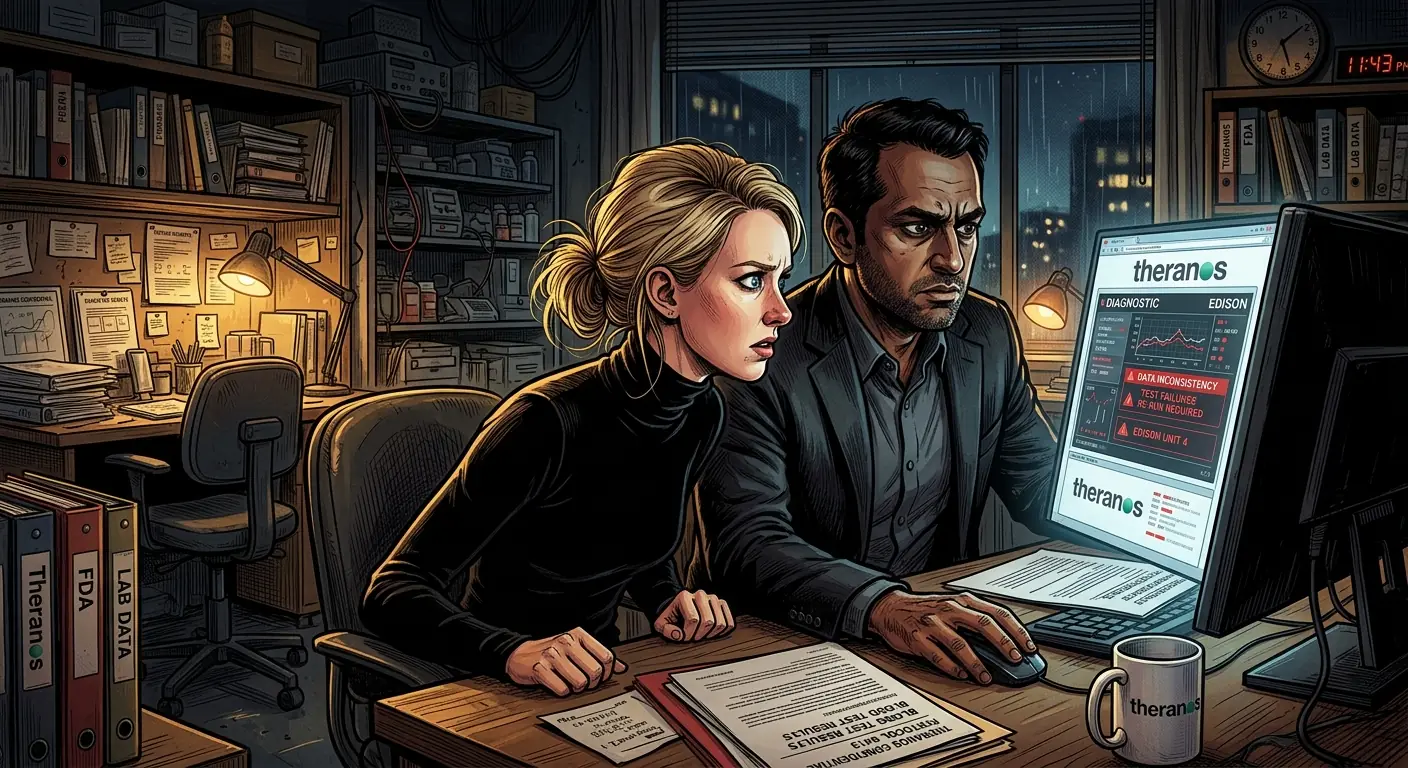
Alright, so we’ve talked about the grand vision, the investors, and the tech that wasn’t. But to truly understand the Theranos implosion, we need to talk about the man often described as Elizabeth Holmes’s enforcer, partner-in-crime, and secret boyfriend: Ramesh “Sunny” Balwani. Their relationship wasn’t just a personal matter; it was the psychological engine that drove much of the company’s internal dysfunction, paranoia, and outright cruelty. Balwani, 19 years Holmes’s senior, met her in 2002 on a trip to Beijing when she was just 18 and he was 37. He invested in her nascent company in 2005, and by 2009, he was officially Theranos’s President and Chief Operating Officer, despite having no formal medical or scientific training. What could possibly go wrong?
The Oracle of Oracle (and Theranos)
Balwani’s background was in software, having sold a company called CommerceFlow for an impressive $225 million during the dot-com boom. He was, by all accounts, a tough, demanding, and often intimidating figure. His arrival at Theranos marked a significant shift in its internal culture. While Holmes projected a visionary, almost messianic aura to the outside world, Balwani was the heavy, the one who would scream at employees, threaten their jobs, and demand impossible results. Witnesses during the trials described an office environment rife with fear. If you questioned the technology, you were out. If you suggested the Edison device wasn’t performing as promised, you were likely to face Balwani’s wrath, often followed by Holmes’s chilling silence or subtle affirmation of his methods. Their relationship, kept secret from most investors and board members, blurred the lines between personal and professional, creating an insular, isolated bubble of control.
A Culture of Fear and Loyalty
The dynamic between Holmes and Balwani fostered a climate where dissent was squashed, and loyalty was paramount. Employees who raised concerns about the accuracy of the blood tests or the functionality of the machines were often fired, marginalized, or subjected to intense verbal abuse. According to reports and trial testimony, Balwani would routinely monitor employee emails and communications, creating an atmosphere of constant surveillance. This wasn’t just “tough management”; it was a deliberate strategy to prevent internal whistleblowers and maintain the illusion that Theranos was on the verge of a breakthrough. It’s a classic playbook for a cult-like environment: isolate, intimidate, and control the narrative. The fear was so pervasive that employees would reportedly walk around the office with USB drives in their pockets, ready to collect evidence if they were suddenly fired, knowing their digital access would be immediately revoked.
The Board’s Blind Eye
Perhaps one of the most baffling aspects of this internal dynamic was how long it went unchecked by Theranos’s star-studded board of directors. With luminaries like George Shultz, Henry Kissinger, and James Mattis, you’d think someone would notice the extreme employee turnover or the whispers of a toxic culture. But Holmes and Balwani were masters of compartmentalization and charm. They presented a unified, confident front to the board, assuring them that any “issues” were simply the growing pains of a revolutionary company facing industry resistance. The board, composed largely of political and military figures rather than scientific or medical experts, seemed more impressed by Holmes’s charisma and the company’s potential valuation than by its actual operational integrity or the well-being of its employees. It was a perfect storm of ambition, secrecy, and unchecked power that allowed the fraud to fester from the inside out.
📸 Chapter 12: The Media Darling — Forbes, Fortune, and the Manufactured Messiah (2013–2015)
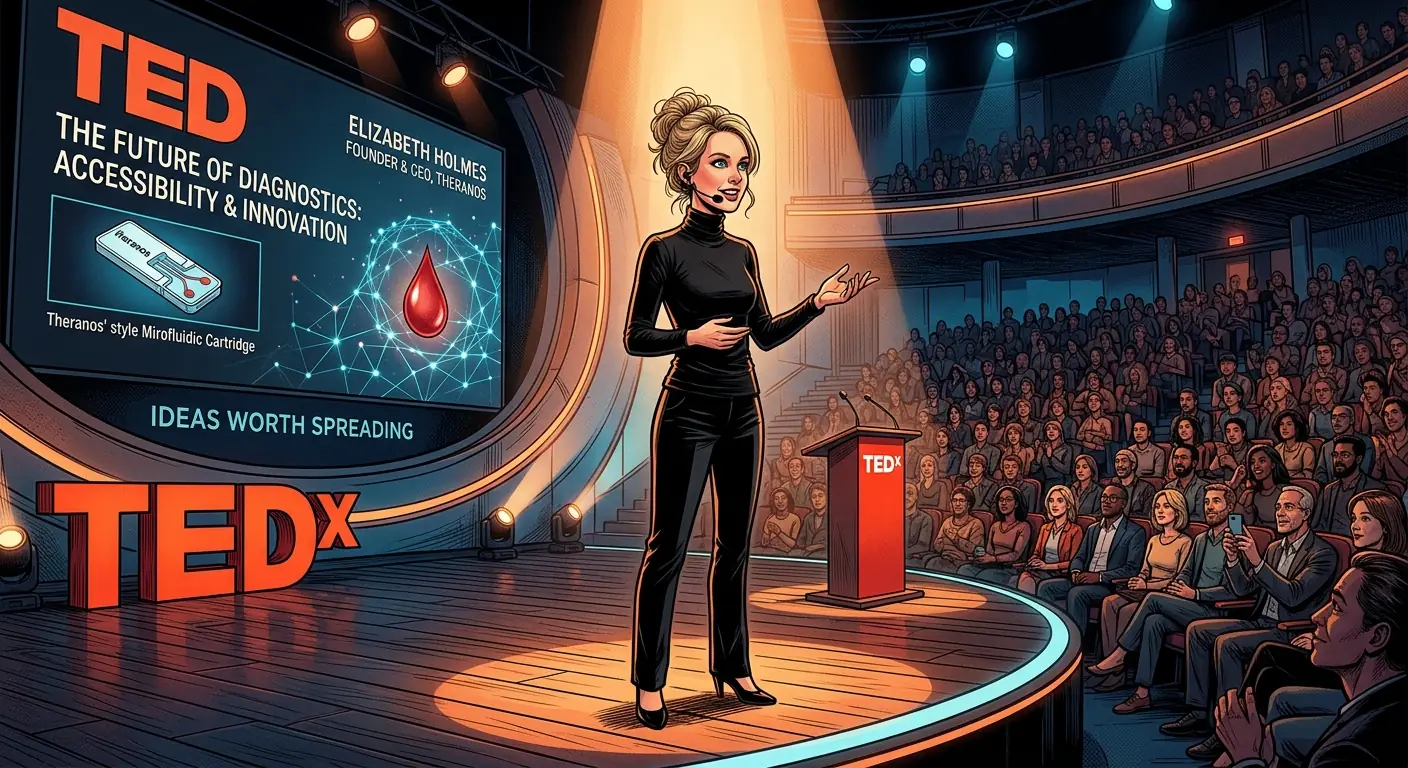
Before the Wall Street Journal exposé ripped the façade apart, Elizabeth Holmes was everywhere. She wasn’t just a CEO; she was a Silicon Valley darling, a media sensation, and a poster child for female entrepreneurship. Her carefully cultivated image played a pivotal role in seducing investors, recruiting top talent (who often had no idea what they were walking into), and charming the public. This wasn’t accidental; it was a meticulously orchestrated media blitz, a masterclass in narrative control that would make even Madison Avenue blush. Her story—the Stanford dropout, the visionary changing healthcare—was simply too good to resist, especially for a media hungry for the next big thing.
The Steve Jobs 2.0 Playbook
Holmes clearly studied the greats, particularly the late Apple founder, Steve Jobs. Her uniform? The now-infamous black turtleneck, a direct nod to Jobs’s iconic look. Her speaking style? A deep, measured baritone, which many who knew her before Theranos claimed was entirely fabricated. She spoke of democratizing healthcare, of empowering individuals with information about their own bodies, echoing the revolutionary rhetoric of tech giants. She even hired Chiat\Day, the advertising agency behind Apple’s legendary “1984” Macintosh commercial. The message was clear: Theranos wasn’t just a company; it was a movement, and Elizabeth Holmes was its messiah. This calculated branding created an impenetrable shield of hype, making it incredibly difficult for anyone to question the substance behind the style. Who would dare challenge a humanitarian visionary?
From Magazine Covers to Conference Stages
The media ate it up. In 2014, Holmes graced the covers of Fortune (with the headline “This CEO’s $9 Billion Blood Test Will Change The World”) and Forbes (dubbing her “The Youngest Self-Made Woman Billionaire In The World”). She was featured in The New Yorker, Inc., and countless other publications. She spoke at prestigious conferences like TEDMED and the Clinton Global Initiative, sharing stages with world leaders and industry titans. Her narrative was compelling: a young woman breaking barriers in a male-dominated tech world, using innovation to solve a critical societal problem—access to affordable, accurate healthcare. The sheer volume and positivity of the media coverage created a powerful echo chamber, reinforcing the belief that Theranos was legitimate and its technology revolutionary. It was a classic case of “fake it till you make it” that spiraled into a “fake it until you’re prosecuted.”
“Every single piece of our work is about making it possible for every person to live their best life,” Holmes told Fortune in 2014. “We think that access to information about your body is a basic human right.”
The Emperor’s New Clothes: A Media Failure?
Looking back, the media’s almost universal praise for Holmes and Theranos raises uncomfortable questions about journalistic due diligence. Few, if any, major outlets pushed past the polished PR machine to ask critical technical questions. Where were the independent scientific reviews? Why weren’t more journalists interviewing disgruntled former employees or scrutinizing the actual lab processes? Part of the problem was Theranos’s legendary secrecy, reinforced by aggressive legal threats and non-disclosure agreements. But part of it was also the allure of the story itself. A charismatic female founder promising to disrupt a staid industry was irresistible. The media, it seems, was just as susceptible to the Silicon Valley hype cycle as the investors, becoming an unwitting accomplice in building the illusion that Theranos was, in fact, real. It wasn’t just a failure of technology; it was, in many ways, a failure of critical inquiry.
🩹 Chapter 13: The Scarred Landscape — Theranos’s Lingering Shadow (2015–Present)
The dust has largely settled on Theranos. Elizabeth Holmes is behind bars, and Sunny Balwani is serving his time. But the legacy of Theranos extends far beyond their individual sentences. This wasn’t just a corporate fraud; it was a seismic event that sent ripples through Silicon Valley, the healthcare industry, and the public’s perception of “disruptive innovation.” It highlighted the inherent dangers when ambition outpaces ethics, and when the pursuit of a “unicorn” valuation blinds everyone to basic scientific reality. The fallout has been multifaceted, touching everything from venture capital due diligence to the very way we talk about medical breakthroughs.
Innovation’s Chilling Effect
One of the most unfortunate consequences of the Theranos scandal is its chilling effect on legitimate innovation, particularly in the diagnostics and biotech space. For years, entrepreneurs with genuinely groundbreaking blood-testing technologies found it harder to secure funding. Investors, burned by Theranos, became understandably more skeptical, demanding far more rigorous scientific validation and regulatory oversight before committing capital. This heightened scrutiny, while necessary, also slowed down the pace for many honest startups trying to solve real problems. The fear of being “another Theranos” became a significant hurdle, potentially delaying life-saving diagnostic tools from reaching patients. It’s a bitter irony that a company promising to revolutionize healthcare ended up making it harder for others to do just that.
The Due Diligence Deficit
The Theranos saga exposed a gaping hole in the due diligence processes of some of the most sophisticated investors in the world. How could seasoned venture capitalists, powerful families, and savvy media moguls pour nearly $1 billion into a company whose core technology they never truly verified? The answer lies in a cocktail of FOMO (Fear Of Missing Out), the allure of a charismatic founder, a board packed with non-scientific heavyweights, and an almost religious belief in Silicon Valley’s “move fast and break things” ethos. Investors were often swayed by Holmes’s vision and the sheer potential for a $9 billion valuation, rather than demanding proof that the Edison device actually worked. The scandal forced a reckoning, prompting many VC firms to strengthen their scientific advisory boards and implement more rigorous technical validation steps before writing those massive checks. It was a hard lesson learned, proving that even in tech, the fundamentals of science and business still matter.
The Unshakeable Myth and the Lessons Learned
Despite the trials and convictions, the story of Elizabeth Holmes continues to captivate. Documentaries, podcasts, and dramatized series like The Dropout keep her narrative alive, raising questions about ambition, gender, and the dark side of startup culture. Her legacy is a complex one: a cautionary tale about hubris, deception, and the dangers of unchecked power. It reminds us that “disruption” isn’t always good, and that charisma can be a powerful, and dangerous, tool. For the rest of us, Theranos serves as a stark reminder to always look beyond the hype, to ask the difficult questions, and to demand transparency, especially when it comes to something as vital as our health. The promise of democratizing healthcare through a single drop of blood still resonates, but now, thanks to Theranos, we approach such claims with a healthy dose of skepticism – and perhaps, a slightly more critical eye on those wearing black turtlenecks.
💡 Key Insights
- ▸ Holmes proved that charisma without substance is just a con with better marketing. She raised $945 million by selling a story so beautiful that some of the most powerful people in America never bothered to verify whether the product actually worked. The lesson: the bigger the vision, the harder people fight against seeing the truth.
- ▸ Theranos had zero peer-reviewed publications supporting its core technology. In an industry where proof is literally life and death, nobody asked for proof. When a founder actively avoids the standard validation process for their industry, that isn't boldness — it's a tell.
- ▸ The board that was supposed to protect investors and patients included Henry Kissinger, George Shultz, and James Mattis — heavy hitters in diplomacy and defense, but not a single person who could evaluate a blood-testing device. Governance theater is worse than no governance at all, because it creates the illusion that someone competent is watching.
- ▸ Holmes surrounded herself with enforcers who silenced dissent — threatening employees with lawsuits, compartmentalizing teams so nobody saw the full picture, and deploying lawyers like weapons. When a company's legal budget dwarfs its R&D results, the product being built isn't technology. It's a cover story.
- ▸ The Theranos fraud didn't just destroy a company — it sent inaccurate medical results to real patients, including false positives for HIV and cancer, and false negatives that delayed treatment. When the stakes are human health, 'fake it till you make it' isn't just unethical. It's dangerous.
Sources
- John Carreyrou — Bad Blood: Secrets and Lies in a Silicon Valley Startup ↗
- Wall Street Journal — Hot Startup Theranos Has Struggled With Its Blood-Test Technology (John Carreyrou, 2015) ↗
- SEC Charges Theranos and CEO Elizabeth Holmes with Massive Fraud (2018) ↗
- United States v. Elizabeth A. Holmes — DOJ Press Release ↗
- Roger Parloff — This CEO Is Out for Blood (Fortune, 2014) ↗
- Hulu — The Dropout (Docudrama Series) ↗
- ABC News — The Dropout Podcast (Rebecca Jarvis) ↗