Jensen Huang: The Leather Jacket Guy Who Bet Everything on AI
For years, Jensen Huang was the CEO of a company that made graphics cards for video games. Wall Street yawned. Then artificial intelligence happened, and NVIDIA became the most important company on Earth. This is the story of the immigrant dishwasher who saw the future before anyone else.

View all stories about this mogul
🌏 Chapter 1: The Boy from Tainan
In 1973, a nine-year-old boy from Tainan, Taiwan arrived in the United States with his older brother. Their parents had sent them to live with an uncle in Tacoma, Washington, believing that American education would give their sons better opportunities.
The uncle enrolled both boys at Oneida Baptist Institute in Oneida, Kentucky. The parents thought it was a prestigious boarding school. It was actually a reform school for troubled youth. The boys — Taiwanese immigrants who spoke limited English — were surrounded by teenage delinquents, some of whom had been convicted of juvenile crimes.
Jensen Huang was nine. His roommate was seventeen, covered in tattoos, and kept a knife under his pillow.
“I didn’t understand what was happening. I just knew I had to survive. So I did the only thing I could: I worked harder than everyone else and tried to be useful.”
This was not a normal childhood. This was trial by fire. And the kid who emerged from Oneida Baptist Institute was not a normal kid.
Jensen figured out the social hierarchy quickly. The bigger kids ran things. If you were small and foreign, you had two options: become a target or become useful. Jensen chose useful. He helped the older kids with homework. He was polite. He was relentless. And — critically — he never complained. Not once.
His parents eventually realized the mistake and moved the boys to Oregon, where Jensen attended Aloha High School in Beaverton. He was a good student — not the best, but consistent. He was an excellent table tennis player — ranked among the best in the Pacific Northwest. And he was, even then, a relentless worker who seemed to have an internal engine that never stopped.
He went to Oregon State University, where he studied electrical engineering. He was a quiet student who spent more time in the lab than in the social scene. After graduating, he went to Stanford for a master’s in electrical engineering.
At Stanford, two things happened that would shape the rest of his life. First, he deepened his understanding of chip design and computer architecture. Second, he met the people who would become his co-founders.
But before NVIDIA, there was another chapter: Jensen Huang got a job as a chip designer at LSI Logic and then at Advanced Micro Devices (AMD). At both companies, he learned how the semiconductor industry worked — the business models, the manufacturing challenges, the competitive dynamics. He was collecting data.
And in 1993, at the age of 30, he had collected enough.
🎮 Chapter 2: The Graphics Gamble

Jensen Huang co-founded NVIDIA on January 22, 1993, with two friends: Chris Malachowsky and Curtis Priem. They started with $40,000 in the bank and an idea that seemed, at the time, ridiculously niche:
Build dedicated hardware for 3D graphics.
In 1993, the personal computer was still primarily a text and 2D machine. Video games were pixelated. 3D graphics existed mainly in research labs and Hollywood studios. The idea that consumers would want — let alone need — a dedicated chip for 3D graphics was considered, at best, premature and, at worst, delusional.
But Huang had done the math. He’d studied the trajectory of Moore’s Law, the growth of the gaming industry, and the evolution of visual computing. His conclusion: within a decade, 3D graphics would be ubiquitous, and the company that built the best graphics chip would own one of computing’s most valuable layers.
“Everyone told me the market didn’t exist yet. I told them the market was coming. I just needed to be there when it arrived.”
The early years were brutal. NVIDIA’s first product, the NV1, was a commercial failure. It used a non-standard rendering approach (quadratic texture mapping) that was incompatible with the emerging industry standard (polygon-based rendering). The NV1 sold poorly, and NVIDIA burned through most of its initial funding.
The company was six months from bankruptcy. Jensen Huang had to lay off half the staff. The surviving employees worked 80-hour weeks for reduced pay. It was the closest NVIDIA would ever come to dying.
But Huang made a critical decision: instead of doubling down on the NV1’s approach, he scrapped it entirely and pivoted to the industry standard. The RIVA 128, launched in 1997, was NVIDIA’s first polygon-based graphics chip. It was fast, it was affordable, and it worked with the software that gamers actually used.
The RIVA 128 sold a million units in four months. NVIDIA was saved.
💻 Chapter 3: The GeForce Era
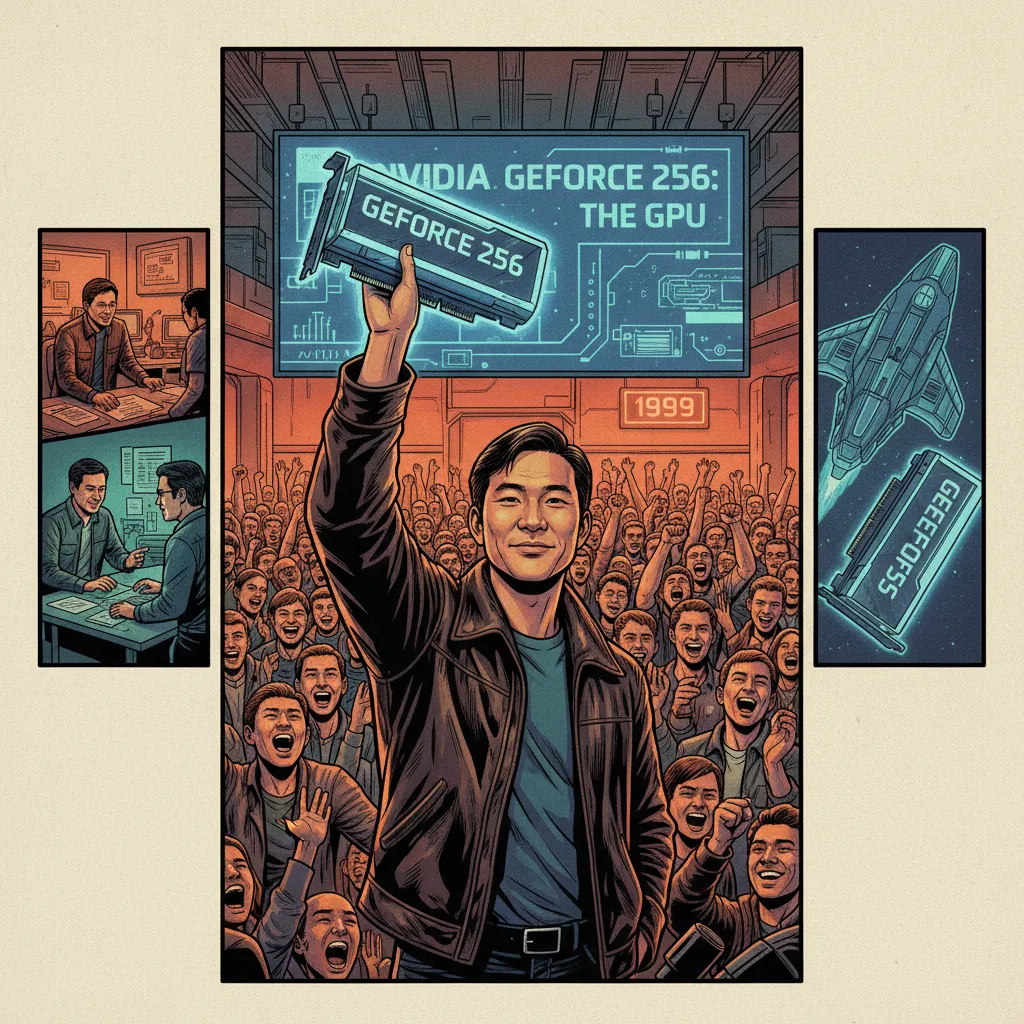
In 1999, NVIDIA launched the product that would define the company for the next decade: the GeForce 256.
NVIDIA called it “the world’s first GPU” — Graphics Processing Unit. The name was brilliant marketing. By coining the term “GPU,” NVIDIA didn’t just launch a product. It created a category. Just as Intel owned “CPU,” NVIDIA now owned “GPU.”
The GeForce 256 was a monster. It could render 10 million polygons per second, transforming PC gaming from a pixelated curiosity into an immersive visual experience. Games like Quake III Arena and Half-Life suddenly looked stunning on GeForce-equipped machines.
Gamers loved it. The gaming industry loved it. NVIDIA’s revenue exploded.
“We didn’t just make a better graphics card. We made a better category. ‘GPU’ didn’t exist before we invented it. We needed a name that was as important-sounding as CPU, because that’s what we were building — something equally essential.”
The GeForce line became NVIDIA’s franchise, with new generations launching every 12-18 months, each one faster and more capable than the last. GeForce 2. GeForce 3. GeForce FX. GeForce 6, 7, 8. Each generation pushed the boundaries of what was visually possible on a personal computer.
NVIDIA went public on January 22, 1999 — the company’s sixth anniversary. The IPO was modestly valued. Wall Street saw NVIDIA as a gaming hardware company — a nice niche, but not transformative.
They had no idea.
Through the 2000s, NVIDIA dominated the discrete GPU market, battling primarily with ATI Technologies (later acquired by AMD). The competition was fierce, and NVIDIA didn’t always win — ATI had periods of technical superiority. But NVIDIA’s pace of innovation and Jensen Huang’s relentless execution kept the company at or near the top.
By 2006, NVIDIA was generating over $3 billion in annual revenue. Jensen Huang was a respected, if somewhat eccentric, tech CEO known for his leather jackets, his intense work ethic, and his unusually clear-eyed vision of computing’s future.
But the gaming GPU business, while profitable, was inherently limited. The total addressable market for discrete gaming GPUs was measured in the low billions. For NVIDIA to become truly great, it needed a bigger stage.
Jensen Huang was about to build one.
🔧 Chapter 4: CUDA — The Quiet Revolution
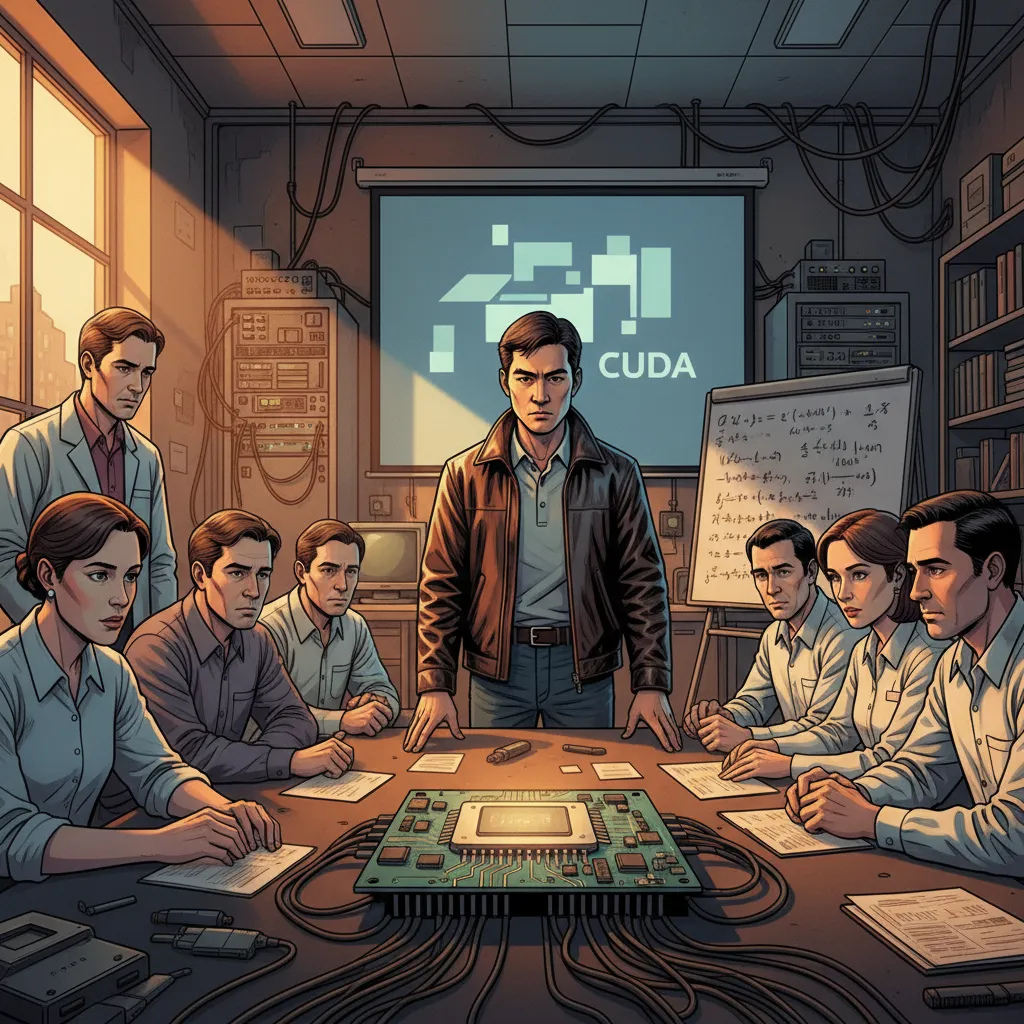
In 2006, NVIDIA launched something that almost nobody outside the computer science world noticed.
It was called CUDA — Compute Unified Device Architecture. In plain English, CUDA was a software platform that allowed programmers to use NVIDIA GPUs for tasks other than graphics rendering.
Why did this matter? Because GPUs were architecturally different from CPUs in a way that turned out to be profoundly important. CPUs were designed to execute complex instructions one at a time, very quickly. GPUs were designed to execute simple instructions thousands at a time, in parallel.
This parallel processing capability was perfect for graphics — rendering millions of pixels simultaneously. But it was also perfect for other massively parallel tasks: scientific simulations, financial modeling, weather forecasting, and — most consequentially — training neural networks.
“CUDA was the most important strategic decision I ever made. We spent billions of dollars over many years building a software ecosystem for GPU computing. Nobody understood why. Then AI happened.”
The CUDA investment was, for years, a money pit. Researchers and scientists loved it — CUDA dramatically accelerated their computations. But the market was tiny. Wall Street analysts questioned why NVIDIA was spending hundreds of millions on a software platform for a handful of academic users when the real money was in gaming.
Jensen Huang didn’t care. He had a thesis: eventually, the world would need massive parallel computing power for tasks that hadn’t been invented yet. When that happened, the company with the best hardware AND the best software platform would own the market.
The thesis required patience. CUDA launched in 2006. The AI revolution wouldn’t arrive for another six years. For six years, NVIDIA invested in CUDA while analysts yawned. For six years, researchers published papers using CUDA-accelerated computing while Wall Street ignored them. For six years, Jensen Huang made a bet that no one else was willing to make.
Then, in 2012, everything changed.
🧠 Chapter 5: The AlexNet Moment

In September 2012, a team of researchers at the University of Toronto entered the ImageNet Large Scale Visual Recognition Challenge — an annual competition where AI systems competed to correctly classify images.
The team, led by Geoffrey Hinton and including Alex Krizhevsky and Ilya Sutskever (who would later co-found OpenAI), submitted a deep neural network they called AlexNet. It used two NVIDIA GTX 580 GPUs to train a convolutional neural network with 60 million parameters.
AlexNet won the competition by a landslide. Its error rate was 15.3%, compared to 26.2% for the second-place entry. It wasn’t just better — it was so much better that it effectively ended the debate about whether deep learning was a viable approach to AI.
And it ran on NVIDIA GPUs.
“When AlexNet happened, I knew. I knew that everything we’d built with CUDA was about to pay off. The world was about to need GPUs in quantities that would have seemed insane a year earlier.”
AlexNet was the Big Bang of the deep learning revolution. Within months, AI researchers around the world were scrambling to get their hands on NVIDIA GPUs. University labs that had been using CPUs for their machine learning experiments discovered that switching to GPUs reduced training times from weeks to hours.
The demand was like nothing NVIDIA had ever experienced. Researchers were buying gaming GPUs — the same GeForce cards that gamers used to play Call of Duty — and repurposing them for AI training. NVIDIA’s data center business, previously a rounding error, began to grow.
And Jensen Huang, who had been preparing for this moment for six years, moved with the speed and decisiveness that would become his hallmark.
NVIDIA launched the Tesla line of data center GPUs (later renamed to avoid confusion with the car company). These weren’t gaming cards repurposed for AI. They were purpose-built AI accelerators — GPUs designed from the ground up for the kind of massively parallel computation that neural network training required.
The Tesla K40, launched in 2013, was NVIDIA’s first serious data center GPU. It was expensive — several thousand dollars per unit. And AI researchers couldn’t buy them fast enough.
🚀 Chapter 6: The AI Gold Rush
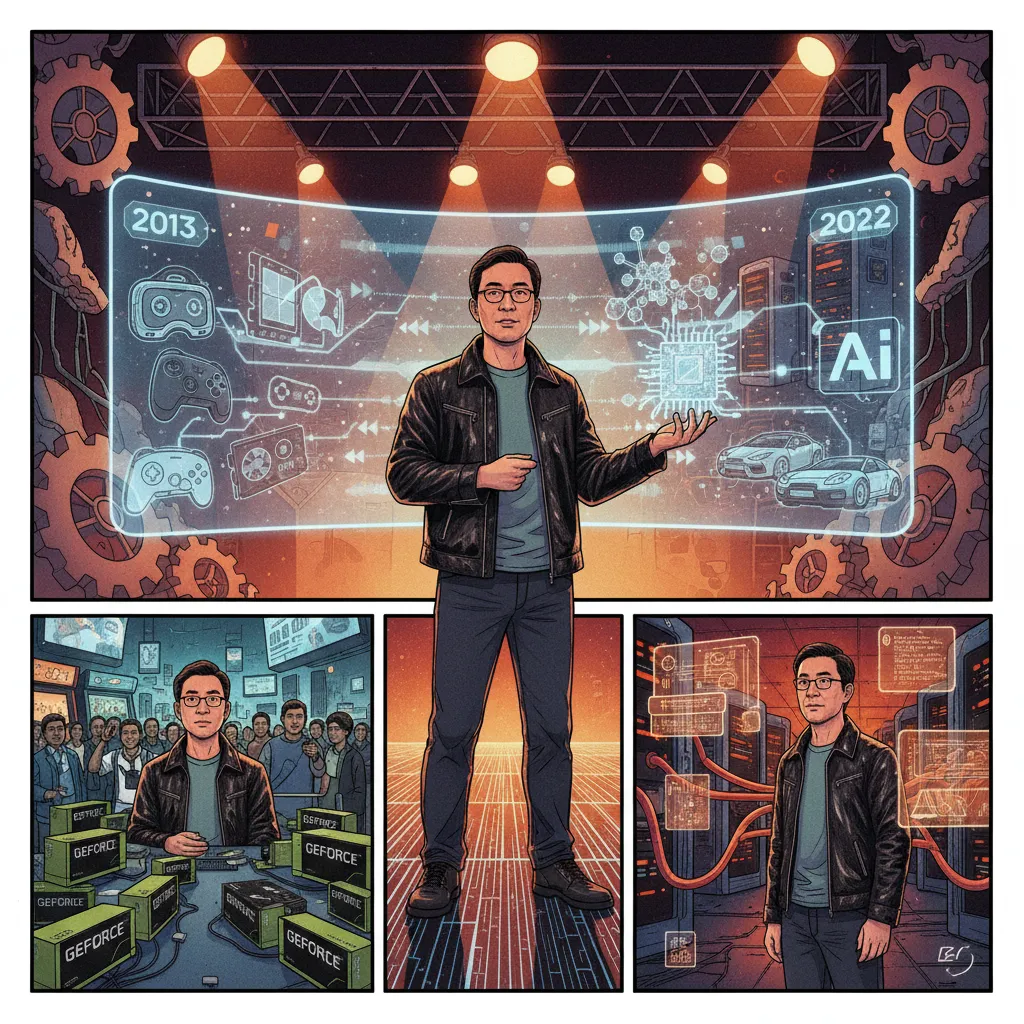
Between 2013 and 2022, NVIDIA’s transformation from gaming company to AI infrastructure company accelerated exponentially.
Each new generation of NVIDIA data center GPUs was dramatically more powerful than the last. The V100, launched in 2017, was the GPU that trained many of the foundational AI models. The A100, launched in 2020, became the de facto standard for AI training in cloud data centers. And the H100, launched in 2022, became the most sought-after piece of hardware on the planet.
The numbers were staggering. An H100 GPU cost approximately $30,000-$40,000. NVIDIA couldn’t manufacture them fast enough. Major cloud providers — Amazon Web Services, Google Cloud, Microsoft Azure — placed orders for tens of thousands of H100s at a time. AI startups raised hundreds of millions of dollars specifically to buy NVIDIA hardware.
“There was a period where getting H100 GPUs was harder than getting concert tickets. Companies were calling us, begging, offering to pay premiums. The demand was unlike anything I’d seen in 30 years in this business.”
By 2023, NVIDIA’s data center business had surpassed its gaming business for the first time. The company that had been built on $300 gaming cards was now making the majority of its revenue from $30,000+ AI accelerators sold to the richest companies on Earth.
And then ChatGPT happened.
OpenAI’s launch of ChatGPT in November 2022 was the iPhone moment for artificial intelligence. Suddenly, AI wasn’t an abstract concept discussed by researchers. It was a product used by hundreds of millions of people. And every company on Earth decided they needed an AI strategy.
Every AI strategy required compute. Every compute strategy required GPUs. Every GPU strategy required NVIDIA.
NVIDIA’s stock price, which had been approximately $15 per share at the start of 2023, began an ascent that would make it one of the most valuable companies in human history.
📈 Chapter 7: The Trillion-Dollar Leather Jacket
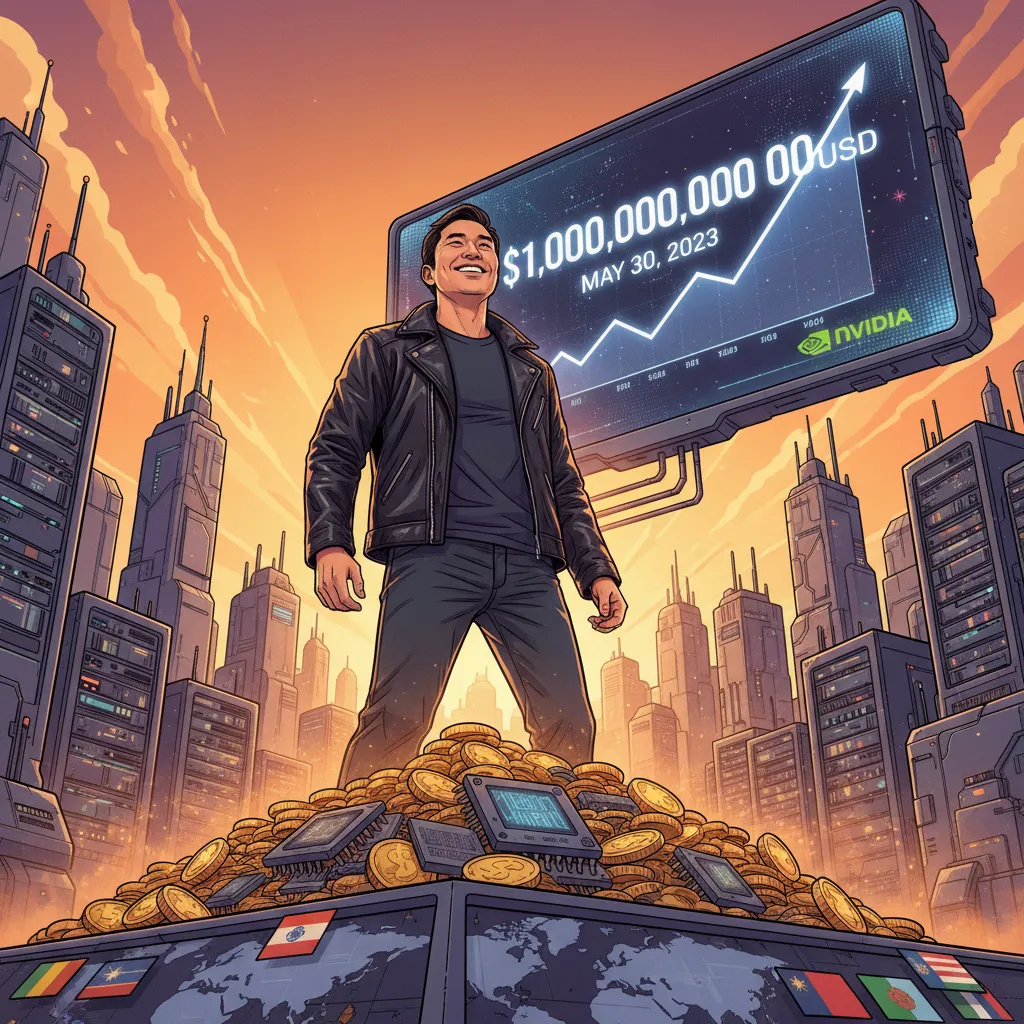
On May 30, 2023, NVIDIA’s market capitalization crossed $1 trillion for the first time. Jensen Huang — still wearing his signature leather jacket — had built a company worth more than most countries’ GDP.
But that was just the beginning.
NVIDIA’s quarterly earnings reports became must-watch events for the entire financial world. Each quarter, revenue came in higher than expected. Each quarter, guidance was raised. Each quarter, analysts scrambled to update their models.
Q1 2024: $26 billion in revenue. Q2 2024: $30 billion. Q3 2024: $35 billion. The numbers were so large, and growing so fast, that they seemed almost fictional.
By June 2024, NVIDIA’s market capitalization briefly surpassed $3 trillion, making it the most valuable company in the world — ahead of Apple and Microsoft. A company that made chips for video games in the 1990s was now worth more than any company that had ever existed.
Jensen Huang’s personal net worth crossed $100 billion. The kid who had washed dishes and survived reform school was now one of the ten richest people on Earth.
“I didn’t start NVIDIA to get rich. I started it because I was fascinated by visual computing. But I’m not going to pretend that becoming one of the most valuable companies in the world isn’t an incredible feeling. It is.”
The leather jacket became iconic. Jensen Huang wore a leather jacket to every keynote, every earnings call, every public appearance. It became his uniform — a visual signature as recognizable as Steve Jobs’ turtleneck. There were memes about it. There were essays about it. There was even a leather jacket tracker on social media.
The jacket was, like everything else about Jensen Huang, deliberate. It signaled that he was different from the suit-and-tie crowd. He was an engineer, a builder, a creator. He wasn’t dressing for Wall Street. He was dressing for himself.
🏗️ Chapter 8: The Full Stack Strategy

NVIDIA’s dominance in AI wasn’t just about making the best chips. It was about building the entire stack.
By the mid-2020s, NVIDIA was selling:
- GPUs (the actual silicon chips that did the computation)
- Systems (complete servers like the DGX series, which bundled multiple GPUs with networking and storage)
- Networking (after acquiring Mellanox in 2020 for $7 billion, NVIDIA owned the high-speed interconnects that linked GPUs together)
- Software (CUDA, cuDNN, TensorRT, and a growing portfolio of AI frameworks and libraries)
- Cloud services (DGX Cloud, which let customers rent NVIDIA infrastructure without buying it)
- Enterprise AI platforms (NVIDIA AI Enterprise, a suite of tools for deploying AI in business)
This full-stack approach was Jensen Huang’s master strategy. By controlling hardware, networking, software, and cloud, NVIDIA made it extremely difficult for competitors to challenge any single layer. A customer who bought NVIDIA GPUs also needed NVIDIA networking to connect them, NVIDIA software to program them, and NVIDIA systems to house them.
“We don’t sell chips. We sell accelerated computing. The chip is just one piece of a much larger system. And we optimize the entire system — hardware, networking, software, cloud — so that our customers get results that no one else can match.”
The ecosystem lock-in was extraordinary. Developers who learned CUDA couldn’t easily switch to competing platforms. Companies that built their AI pipelines on NVIDIA’s software stack faced enormous switching costs. Cloud providers who invested in NVIDIA infrastructure had committed billions of dollars to a specific hardware architecture.
This was the CUDA bet of 2006 paying off at a trillion-dollar scale. The software ecosystem that NVIDIA had built over nearly two decades — while analysts questioned the investment — had become the most powerful moat in the technology industry.
⚔️ Chapter 9: The Rivals Circling

NVIDIA’s dominance inevitably attracted competition. By the mid-2020s, several major players were investing billions to challenge NVIDIA’s AI chip monopoly.
AMD launched its MI300 series of AI accelerators, targeting NVIDIA’s data center business directly. AMD’s chips were competitive on paper and significantly cheaper. Several cloud providers, including Microsoft and Meta, adopted MI300 chips alongside their NVIDIA fleets.
Google developed its own AI chips — the Tensor Processing Unit (TPU) — for use in its data centers and available through Google Cloud. Google’s TPUs were purpose-built for machine learning and offered strong performance on specific workloads.
Amazon developed its own Trainium and Inferentia chips for AI training and inference within AWS. Microsoft was developing its own custom AI chips. Intel was attempting a comeback with its Gaudi AI accelerators.
And dozens of startups — Cerebras, Groq, SambaNova, Graphcore — were building novel AI chip architectures that promised better performance, lower cost, or more efficiency than NVIDIA’s GPUs.
“Competition is good. It validates the market we created. But I’ll tell you this: we’re not going to let anyone catch us. We’re accelerating, not decelerating.”
Despite the mounting competition, NVIDIA maintained an estimated 80-90% market share in AI training chips through 2025. The reasons were both technical and ecosystem-related. NVIDIA’s chips were consistently the fastest. NVIDIA’s CUDA ecosystem was the most mature. And NVIDIA’s pace of innovation — launching a new GPU architecture every two years, each roughly doubling the performance of its predecessor — made it difficult for competitors to close the gap.
But the risks were real. If any competitor could break the CUDA lock-in, if custom chips could match NVIDIA’s performance at lower cost, if the AI market commoditized — NVIDIA’s extraordinary margins could compress rapidly.
Jensen Huang addressed this by doing what he’d always done: investing aggressively in the future. NVIDIA’s R&D spending exceeded $10 billion per year by the mid-2020s. The company was simultaneously developing new GPU architectures, new networking technologies, new software frameworks, and new markets (robotics, autonomous vehicles, digital twins, drug discovery).
🌐 Chapter 10: The Geopolitics of Chips
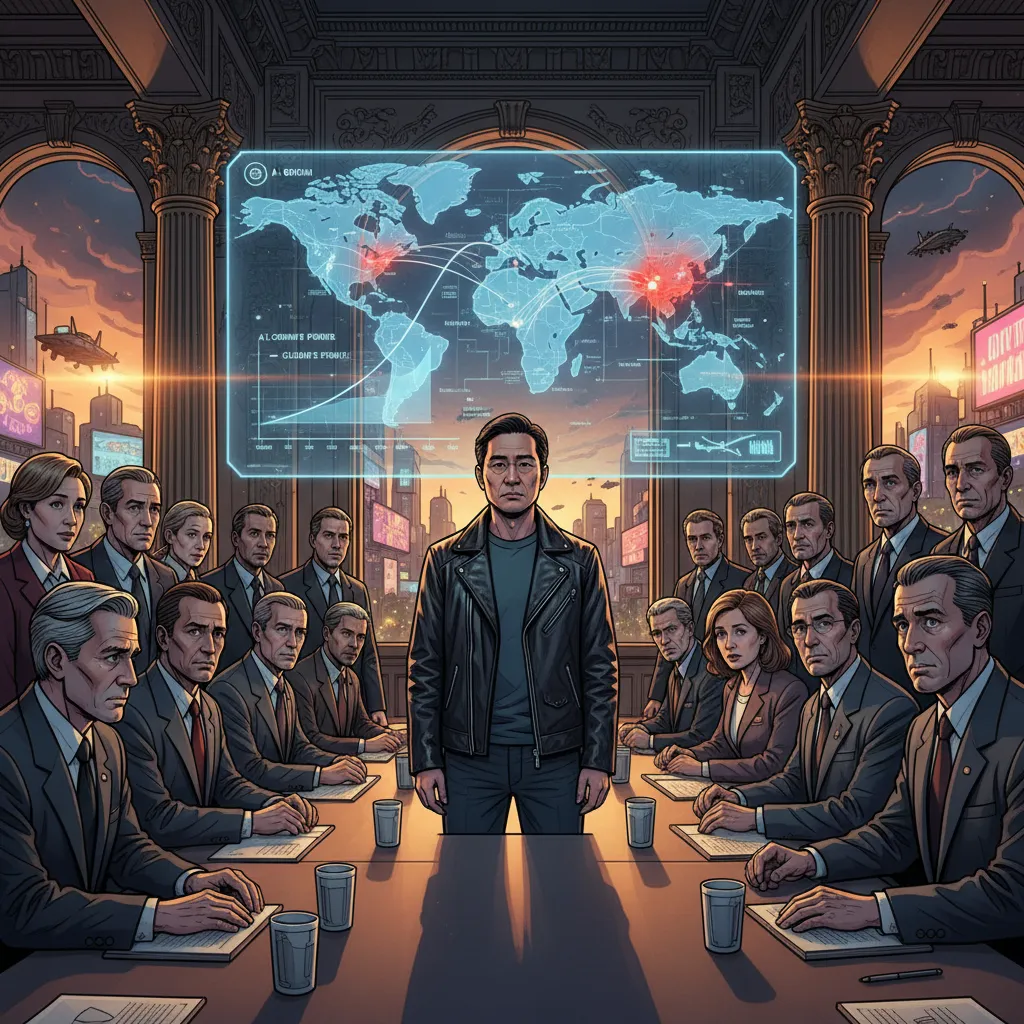
NVIDIA’s AI dominance created a geopolitical problem of enormous proportions.
The U.S. government, concerned about China’s AI capabilities, imposed export controls on advanced AI chips starting in October 2022. NVIDIA’s most powerful data center GPUs — the A100 and H100 — were restricted from sale to Chinese customers.
NVIDIA initially responded by creating China-specific versions of its chips (the A800 and H800) that complied with the export controls while still serving the Chinese market. But the U.S. government tightened the controls further in October 2023, restricting even these modified chips.
The impact was significant. China was one of NVIDIA’s largest markets, representing an estimated $10-15 billion in annual revenue. The export controls effectively closed this market overnight.
“We’re caught between two superpowers. We’re an American company that makes the most advanced chips in the world, and we’re not allowed to sell them to the second-largest economy in the world. It’s a challenging position.”
The export controls also accelerated China’s efforts to develop indigenous AI chip capabilities. Huawei’s Ascend 910B chip emerged as a competitive alternative for Chinese AI companies that could no longer buy NVIDIA’s products. Other Chinese chipmakers invested heavily in catching up.
Jensen Huang navigated this minefield with characteristic pragmatism. He lobbied against the export controls (arguing they would harm NVIDIA without effectively slowing China’s AI development) while simultaneously redirecting investment toward markets that weren’t affected.
The geopolitical dimension added a new layer of complexity to NVIDIA’s story. The company was no longer just a technology business. It was a strategic national asset, its products treated with the same sensitivity as advanced weapons systems.
🔮 Chapter 11: The Huang Doctrine

Jensen Huang turned 63 in 2026. He had been CEO of NVIDIA for 33 years — one of the longest tenures in technology history. Under his leadership, the company had gone from a $40,000 startup to one of the most valuable companies ever created.
His net worth exceeded $100 billion. His company’s market capitalization exceeded $3 trillion. His GPUs powered the AI systems that were reshaping every industry on Earth.
And he still wore the leather jacket.
“People ask me when I’m going to retire. I tell them I’m not going to retire. I’m going to die in this leather jacket, probably on stage at a keynote.”
What makes Jensen Huang’s story remarkable isn’t just the financial outcome — it’s the strategic patience. He invested in CUDA in 2006 when nobody cared about GPU computing. He invested in AI chips in 2012 when AI was an academic curiosity. He invested in data center infrastructure in 2016 when gaming was still NVIDIA’s primary business.
Every bet paid off. Not because Huang was lucky, but because he had a thesis about the future of computing that was extraordinarily clear and extraordinarily right.
The Huang Doctrine can be summarized in five principles:
-
Accelerated computing is inevitable. CPUs are general-purpose and therefore suboptimal for any specific task. The future belongs to specialized processors — GPUs, AI accelerators, domain-specific chips — that do specific things thousands of times faster.
-
Software is the moat. Hardware can be copied. An ecosystem of millions of developers, thousands of libraries, and decades of accumulated code cannot be.
-
Go where the puck is going. Don’t optimize for today’s market. Build for the market that will exist in 5-10 years. If you’re right, you’ll have no competition when you get there.
-
Own the full stack. Selling components makes you a supplier. Selling complete solutions makes you indispensable.
-
Never slow down. NVIDIA’s pace of innovation is its primary defense against competition. The moment you slow down, competitors catch up. So never slow down.
The leather jacket guy from Tainan didn’t just bet on AI. He built the infrastructure that made AI possible. And in doing so, he created one of the most remarkable business stories of the 21st century.
From reform school dishwasher to $100 billion man. Not bad for a kid who started by washing dishes and dodging knives.
NVIDIA’s market capitalization fluctuates but has exceeded $3 trillion. Jensen Huang’s net worth is estimated at over $100 billion as of 2026. NVIDIA is publicly traded on the NASDAQ under the ticker symbol NVDA.
📉 Chapter 12: The Unsung Grind (2007-2015)
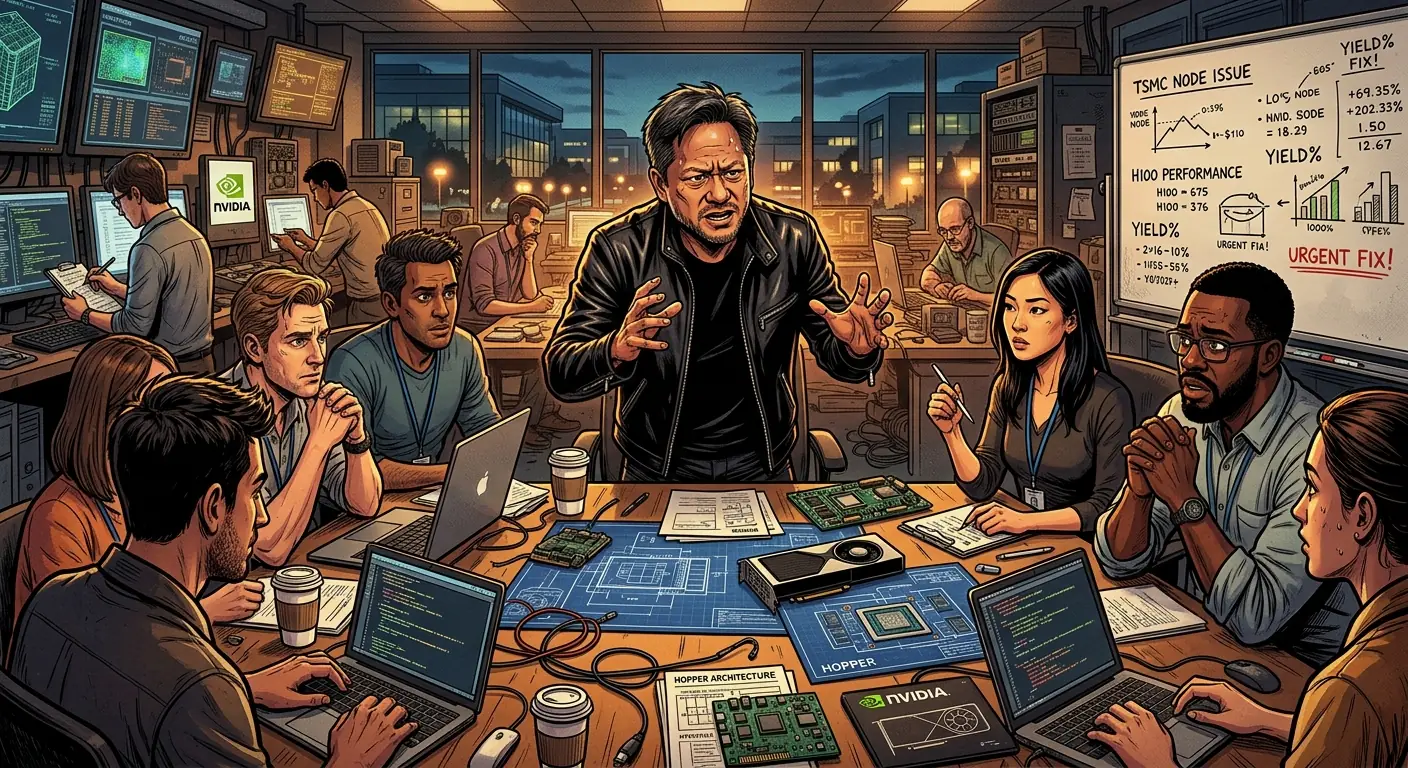
While NVIDIA’s story often feels like a relentless ascent, peppered with brilliant gambles and visionary pivots, it wasn’t all sunshine and GeForce glory. There were years of brutal, unglamorous slogging, times when the company faced existential threats that had little to do with revolutionary new tech and everything to do with corporate power plays and the sheer grind of execution. These were the years when Jensen Huang’s infamous tenacity and long-term conviction were truly forged and tested. It’s easy to focus on the trillion-dollar valuation, but how they survived the lean times, the betrayals, and the sheer competitive nastiness is just as defining.
The Intel Threat and the CPU Gambit
Remember when NVIDIA made chipsets for motherboards? Yeah, a lot of people don’t. But for a good chunk of the 2000s, NVIDIA was a dominant player in this space, providing the glue that connected Intel and AMD CPUs to the rest of the PC. Then, around 2008, Intel dropped a bombshell. They decided that their new Nehalem-based Core i-series processors (the ones that would define a decade of computing) would integrate the memory controller directly onto the CPU. This was a technical masterstroke, but for NVIDIA, it was a gut punch. Suddenly, Intel declared that NVIDIA’s licenses didn’t cover these new integrated chipsets. Essentially, Intel wanted NVIDIA out of the chipset business entirely, cutting off a significant revenue stream and a critical strategic foothold.
NVIDIA, under Huang’s leadership, didn’t just roll over. They sued Intel in 2009, claiming breach of contract. It was a messy, public, and expensive legal battle. Jensen Huang, ever the pragmatist, knew that even if they won, the writing was on the wall. The future was about specialized processors, not general-purpose CPU chipsets. So, while the lawyers duked it out (the dispute was eventually settled in 2011 with Intel paying NVIDIA $1.5 billion over six years for patent cross-licensing, but NVIDIA still exited the CPU chipset market), Huang was already pulling NVIDIA’s resources away from chipsets and pouring them into two areas: GPUs (obviously), and a wild, audacious, some might say insane bet on building their own ARM-based CPU, Project Denver, for mobile and embedded devices. This was a direct challenge to Intel, but it also showed Huang’s willingness to walk away from a dying business and swing for the fences, even when facing down a giant. It was a painful, yet ultimately formative, pivot that underscored his conviction in the GPU’s destiny.
The Huang Way: Culture and Conviction
Jensen Huang isn’t just a CEO; he’s the embodiment of NVIDIA’s culture. His leadership style is legendary, a mix of intense directness, unwavering long-term vision, and a surprising personal touch. He’s known for his “no bad news by surprise” philosophy, encouraging brutal honesty and direct communication, even if it means telling him something he doesn’t want to hear. This fosters a culture where problems are tackled head-on, not swept under the rug. He famously reads every long-range plan from every one of his 50-odd direct reports, providing feedback that can stretch for pages. It’s a demanding environment, for sure, but one that values deep thought and genuine conviction.
His famous leather jacket isn’t just a fashion statement; it’s a symbol of his consistent, almost ritualistic approach to leadership. He wants to be memorable, yes, but also approachable and consistent. He often compares NVIDIA to a “learning machine,” constantly adapting and evolving. This isn’t just corporate jargon; it’s an operational philosophy. When the company makes a mistake (and they’ve made plenty, like the ill-fated Tegra mobile chip efforts), they dissect it, learn from it, and move on with remarkable speed. This ability to iterate, to absorb failure as data, and to maintain a singular focus on the long-term vision, even through challenging periods like the Intel dispute or the early struggles of CUDA adoption, is a hallmark of “The Huang Way.” It’s a testament to a leader who understands that sometimes, the greatest victories are won not by grand gestures, but by the relentless, unsung grind of conviction.
💰 Chapter 13: The Future Architect (2020s & Beyond)
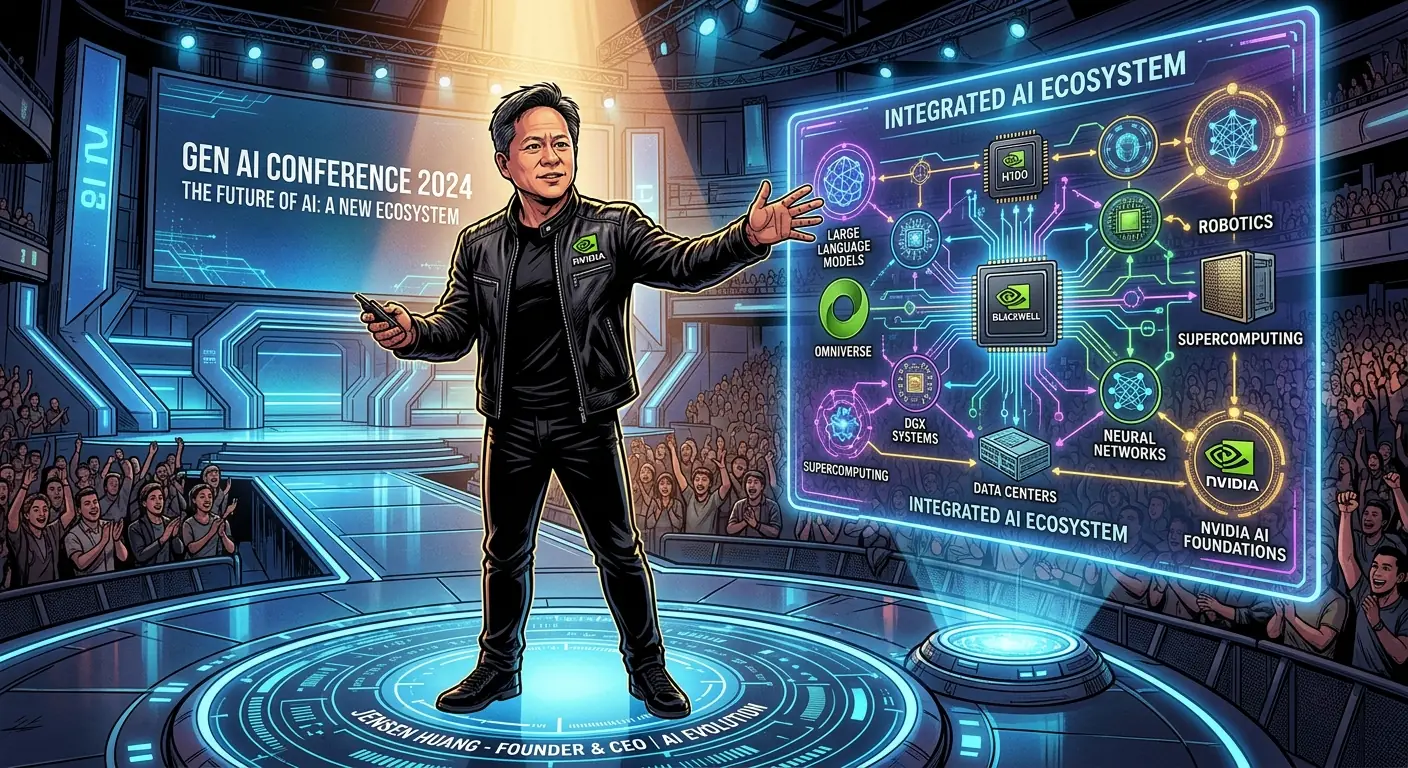
Jensen Huang’s journey from a reform school in Kentucky to the helm of a trillion-dollar company is an epic tale of foresight and grit. But his story isn’t just about the past; it’s about a relentless drive to architect the future. As NVIDIA rocketed past the $1 trillion market cap in June 2023, it wasn’t just a celebration of financial success; it was a validation of a decades-long bet on a future powered by accelerated computing and AI. Yet, Huang isn’t content to simply sell chips. His vision extends far beyond silicon, aiming to build the entire foundational infrastructure for the next industrial revolution, transforming NVIDIA into something much grander than a mere hardware vendor.
Beyond the Chip: Software, Services, and Ecosystems
If you think NVIDIA just makes GPUs, you’re missing the forest for the incredibly powerful trees. Huang has spent years meticulously building out NVIDIA’s “full stack” strategy, and in the 2020s, it’s truly coming to fruition. They’re not just selling you a graphics card; they’re selling you an entire ecosystem. Take Omniverse, launched in 2020, an open, extensible platform for 3D design collaboration and simulation that’s basically a metaverse for engineers and designers. It’s NVIDIA’s operating system for industrial digitalization, allowing companies to create digital twins of factories, cities, and even entire biological systems. This is a massive play into software and services, aiming to capture value at every layer of the AI stack.
Then there’s their deep dive into specific verticals: NVIDIA DRIVE for autonomous vehicles, Clara for healthcare and life sciences, and Isaac for robotics. Each is a comprehensive platform, blending hardware (like the Drive Orin chip), software development kits (SDKs), and AI models. And let’s not forget the Mellanox acquisition for $6.9 billion in 2020, which gave NVIDIA a commanding lead in high-speed networking, absolutely critical for connecting thousands of GPUs in massive AI data centers. This isn’t just about selling a physical product; it’s about selling solutions, subscriptions, and the very infrastructure of the future. Huang is transforming NVIDIA into a full-service AI utility, where you can buy their chips, rent their cloud computing power (DGX Cloud), or use their platforms to build your own AI applications. It’s a strategic expansion designed to make NVIDIA indispensable, no matter how AI evolves.
The Philanthropic Whisper and Enduring Legacy
While Jensen Huang isn’t one for splashy public philanthropy (at least not in the vein of some other tech titans), his impact through giving is quietly significant. In 2022, he and his wife, Lori, donated $50 million to their alma mater, Oregon State University, to establish the Jensen and Lori Huang Engineering Center. This follows a $30 million gift to Stanford University in 2008 for the Huang Engineering Center, aimed at fostering interdisciplinary research. These donations aren’t just about buildings; they’re investments in the very engineering talent and research that will drive the next wave of innovation, mirroring his own belief in foundational technological advancement. It’s a classic “put your money where your future is” move, nurturing the academic roots that feed the tech industry.
Huang’s legacy is still being written, but a few things are already clear. He didn’t just build a successful company; he created the “accelerated computing” paradigm, fundamentally shifting how we approach the hardest computational problems. He saw the potential of parallel processing in GPUs long before anyone else connected it to AI. He made painful, often lonely bets, like CUDA, that paid off spectacularly years later. His relentless focus on the future, his willingness to pivot, and his unwavering conviction in the power of visual computing and AI have not only built NVIDIA into a global powerhouse but have also laid the digital infrastructure for the coming age of artificial intelligence. He’s not just a CEO; he’s a true architect of the future, a visionary who, quite literally, helped humanity see what was coming, and then built the tools for us to build it ourselves.
💡 Key Insights
- ▸ Jensen Huang's key strategic insight was that GPUs — originally designed for rendering video game graphics — could be repurposed for parallel computing tasks like AI training. He invested billions in CUDA (a software platform for GPU computing) years before AI became mainstream, creating a software ecosystem that locked in developers and researchers. When the AI revolution arrived, NVIDIA was the only company with the hardware AND the software stack to serve it.
- ▸ NVIDIA's business model evolution from selling $300 gaming cards to $40,000 data center GPUs to complete AI infrastructure systems is a masterclass in moving upmarket. Most companies try to go downmarket for volume. NVIDIA went upmarket for margins, ultimately capturing the most valuable segment of the AI value chain: the compute layer.