Andrew Carnegie: The Steel King Who Gave It All Away
He built the largest steel empire in history, crushed his workers at Homestead, then gave away 90% of his fortune. The paradox of America's first great philanthropist.

View all stories about this mogul
Andrew Carnegie: The Steel King Who Gave It All Away
He arrived in America as a penniless 12-year-old Scottish immigrant, barely able to speak English. By 65, he had built the largest steel company the world had ever seen and sold it for $480 million — equivalent to roughly $17 billion today. Then he did something no tycoon of his era had ever done: he gave almost all of it away. Andrew Carnegie’s life is the original American mogul story — a tale of staggering ambition, brutal labor practices, and a final act of philanthropy that reshaped the world. The question that still haunts his legacy: can you atone for how you made your money by giving it away?
🚢 Chapter 1: The Boy from Dunfermline
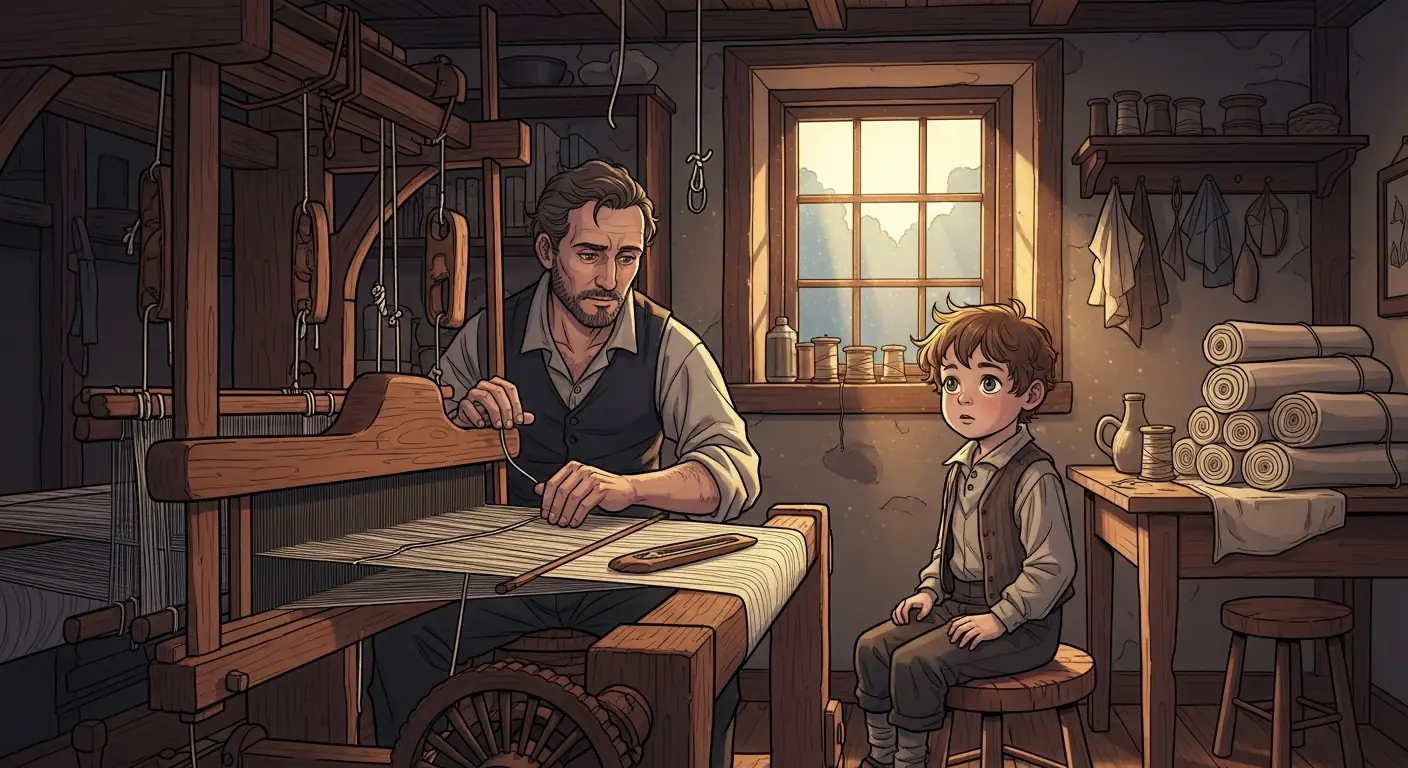
Andrew Carnegie was born on November 25, 1835, in Dunfermline, Scotland, a small town famous for its linen weaving. His father, William Carnegie, was a handloom weaver — a skilled craftsman in an industry that was being obliterated by the Industrial Revolution’s power looms.
By the mid-1840s, William Carnegie could no longer find work. The family was destitute. Andrew’s mother, Margaret Morrison Carnegie — a fierce, resourceful woman who would influence Andrew profoundly — made the decision that would change everything: they would emigrate to America.
In May 1848, the Carnegie family — William, Margaret, 12-year-old Andrew, and his younger brother Tom — boarded a sailing ship bound for New York. They had borrowed money for the passage. They arrived with almost nothing and settled in Allegheny City, Pennsylvania (now part of Pittsburgh), where Margaret’s sisters had already established themselves.
Andrew went to work immediately. His first job was as a bobbin boy in a cotton mill, earning $1.20 per week — roughly $42 in today’s money. He was 13 years old, working 12-hour days, six days a week, in a dark, lint-filled factory.
But young Andrew Carnegie had two qualities that would separate him from millions of other immigrant children toiling in America’s factories: an insatiable hunger for knowledge and an almost supernatural ability to charm powerful men.
In 1849, he took a job as a telegraph messenger boy, earning $2.50 per week. He memorized the locations of every business in Pittsburgh. He taught himself to decode telegraph messages by ear — a rare skill that caught the attention of Thomas A. Scott, the superintendent of the Pennsylvania Railroad’s Western Division.
Scott hired Carnegie as his personal telegraph operator and secretary in 1853. Carnegie was 17 years old, and he had just found his first patron — the man who would open the door to wealth beyond anything a weaver’s son from Dunfermline could have imagined.
🚂 Chapter 2: Railroads, War, and the Art of Investment
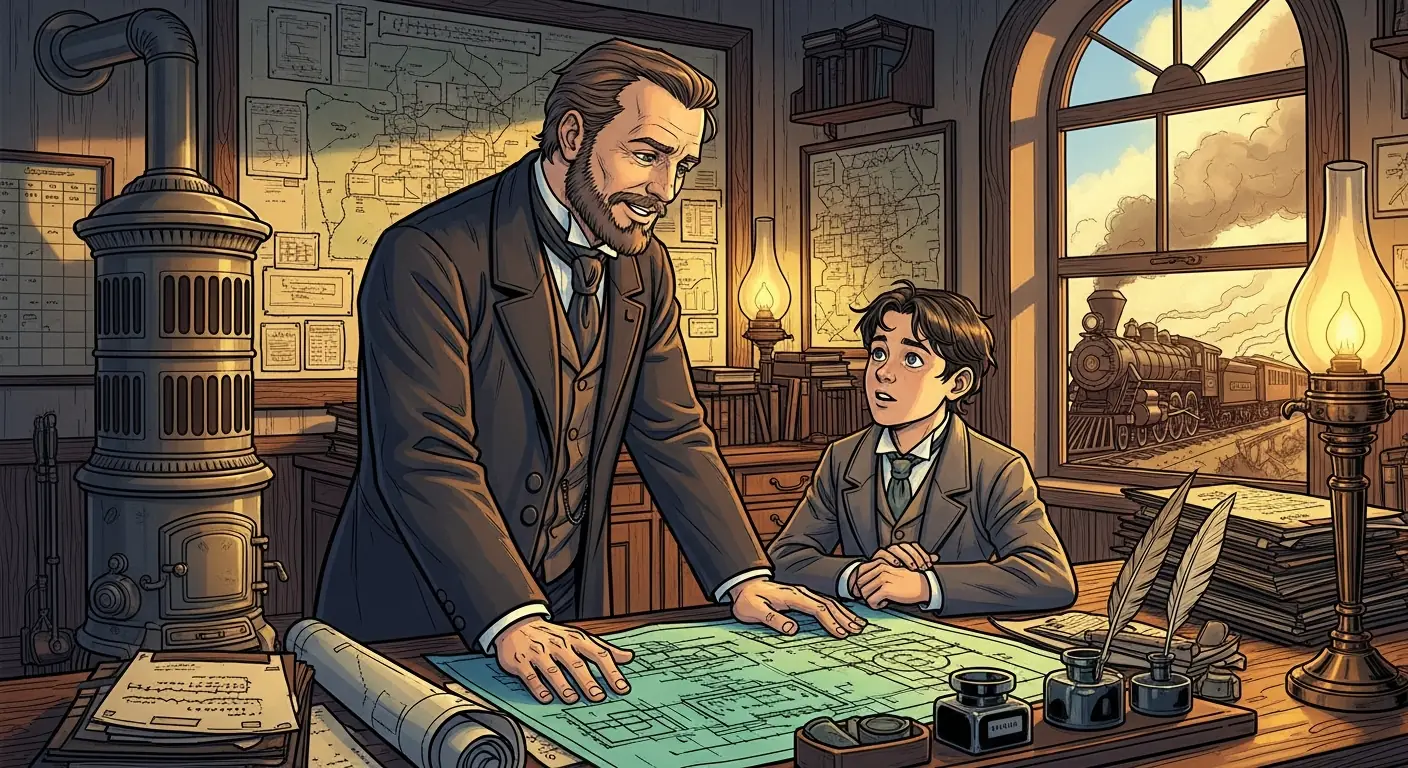
Thomas Scott became Carnegie’s mentor, business partner, and surrogate father. Through Scott, Carnegie learned the inner workings of the Pennsylvania Railroad — then the largest corporation in America and a masterclass in management, logistics, and capital allocation.
Carnegie rose rapidly. By 1859, at just 24, he was appointed superintendent of the railroad’s Western Division. He was managing hundreds of employees, millions of dollars in assets, and the critical supply line that connected Pittsburgh to the rest of the country.
But Carnegie’s real education was in investing. Scott introduced him to the world of business deals, and Carnegie proved to be a natural. His first major investment was $500 (borrowed from his mother, who mortgaged their house) in the Adams Express Company, which paid dividends carried by the railroad. When his first dividend check arrived — $10 — Carnegie later wrote that it was like “a return from the clouds.”
During the Civil War (1861-1865), Carnegie served in Washington helping organize the Union’s military telegraph system and railroad transportation. He witnessed firsthand how infrastructure won wars — and how government contracts made men rich.
After the war, Carnegie plunged into a dizzying series of investments: oil wells in Titusville, iron bridges to replace wooden ones destroyed in the war, bond-selling trips to Europe, and the Keystone Bridge Company. By his early 30s, he was earning over $50,000 per year from investments alone — a fortune at the time.
In 1868, at age 33, Carnegie wrote a remarkable memo to himself at the St. Nicholas Hotel in New York:
“Thirty-three and an income of $50,000 per annum! Beyond this never earn — make no effort to increase fortune, but spend the surplus each year for benevolent purposes… Man must have an idol — the amassing of wealth is one of the worst species of idolatry.”
It would take him another 33 years to honor that promise. But he never forgot it.
🔥 Chapter 3: The Steel Empire
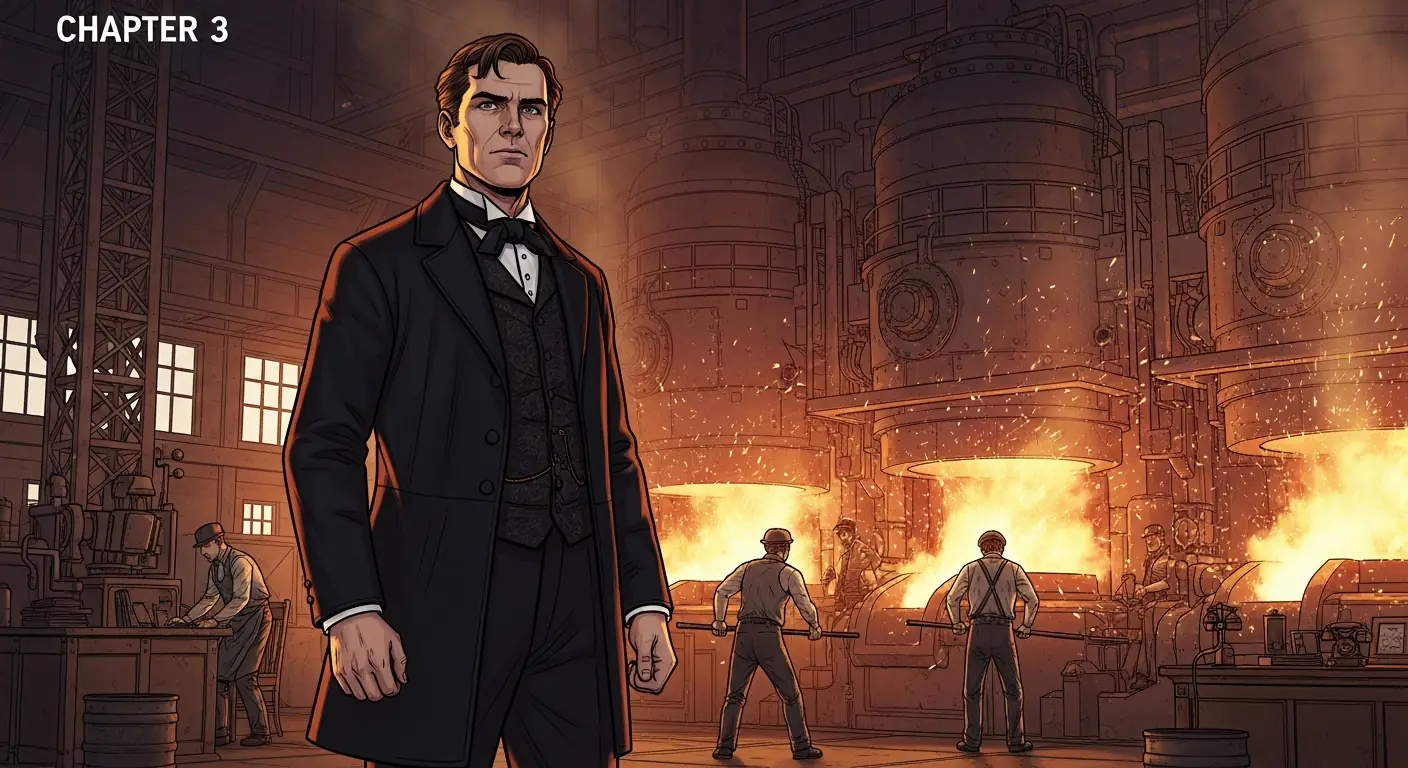
In the early 1870s, Andrew Carnegie made the pivotal decision of his career: he would focus all of his energy on steel.
The timing was impeccable. America was building — railroads, bridges, buildings, ships — and everything required steel. The Bessemer process, which converted molten pig iron into steel by blowing air through it, had dramatically reduced the cost of steel production. Carnegie saw that whoever could produce steel cheapest and fastest would control the most important material of the Industrial Age.
In 1875, Carnegie opened the Edgar Thomson Steel Works in Braddock, Pennsylvania, named after the president of the Pennsylvania Railroad (his biggest potential customer). The plant was state-of-the-art, designed to produce steel rails at unprecedented speed and scale.
Carnegie’s competitive strategy was ruthlessly simple: cut costs relentlessly, reinvest every penny of profit into better technology, and drive competitors out of business through lower prices.
He hired a brilliant but brutal manager named Henry Clay Frick to oversee operations. Frick shared Carnegie’s obsession with efficiency but had none of his charm. Together, they built a vertically integrated empire: Carnegie Steel owned its own iron ore mines in the Mesabi Range of Minnesota, its own coke ovens (Frick’s specialty), its own railroads to transport raw materials, and its own steel mills to produce the finished product.
By controlling every step of the supply chain, Carnegie could produce steel at costs his competitors couldn’t match. When the price of steel rails fell from $160 per ton in 1875 to $17 per ton by the late 1890s, Carnegie was still making a profit while his competitors were going bankrupt.
By 1900, Carnegie Steel produced more steel than all of Great Britain combined. It generated $40 million in annual profit — approximately $1.4 billion in today’s money. Andrew Carnegie was the richest man in America.
⚒️ Chapter 4: Blood at Homestead
The cost of Carnegie’s empire was paid, in significant part, by his workers. And nowhere was that cost more visible — or more violent — than at the Homestead Steel Works in 1892.
Carnegie’s workers labored 12-hour shifts, seven days a week, in conditions that were dangerous, exhausting, and often deadly. Steel mills were infernos of molten metal, flying sparks, and deafening noise. Injuries were common. Deaths were not unusual. The average steelworker earned between $1.50 and $2.00 per day.
In 1892, the contract between Carnegie Steel and the Amalgamated Association of Iron and Steel Workers — the union representing skilled workers at the Homestead mill — was up for renegotiation. Carnegie, who publicly professed sympathy for labor unions, left for a vacation at his castle in Scotland and handed negotiations to Henry Clay Frick.
Frick’s approach was straightforward: crush the union.
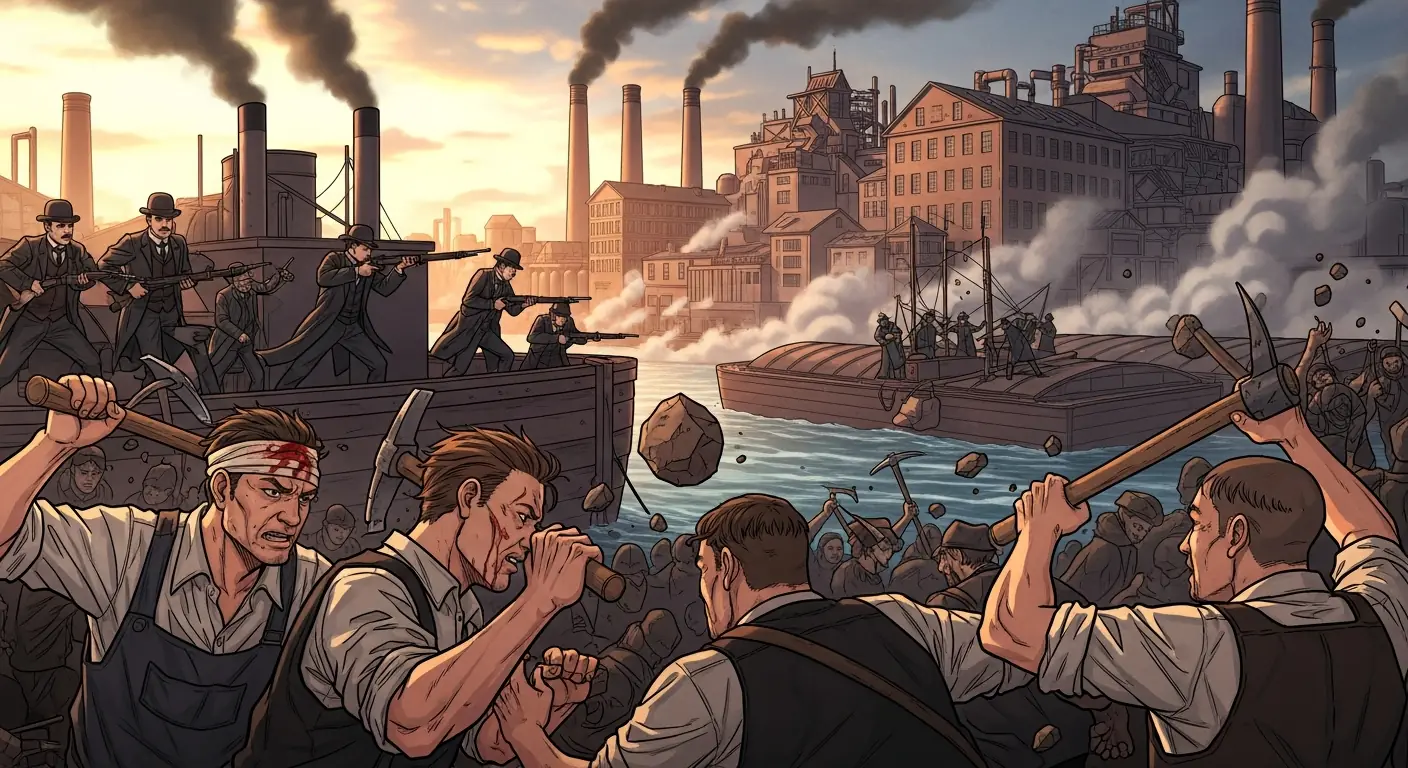
He demanded deep wage cuts and refused to negotiate. When the union rejected his terms, Frick locked out the workers on June 30, 1892. He then built a 12-foot fence topped with barbed wire around the Homestead plant and hired 300 armed Pinkerton agents to break the strike.
On July 6, 1892, the Pinkertons arrived by barge on the Monongahela River at 4:00 AM. The workers were waiting. A battle erupted that lasted 14 hours. When it was over, seven workers and three Pinkertons were dead. Dozens more were wounded.
Pennsylvania’s governor sent 8,500 National Guard troops to Homestead. The strike was broken. The union was destroyed at Carnegie’s mills and would not return for more than 40 years.
Carnegie claimed to be horrified by the violence. He wrote letters expressing regret. But he never overruled Frick, never reinstated the workers, and never changed the conditions that had led to the strike. As the writer Hamlin Garland described conditions at Homestead after visiting: “The streets were horrible; the buildings were poor; the sidewalks were sunken, swaying, and full of holes… Everywhere the yellow smoke of the mills.”
The Homestead Strike became the defining stain on Carnegie’s reputation. It exposed the contradiction at the heart of his philosophy: he preached the dignity of labor while profiting from its exploitation.
💰 Chapter 5: The Deal of the Century
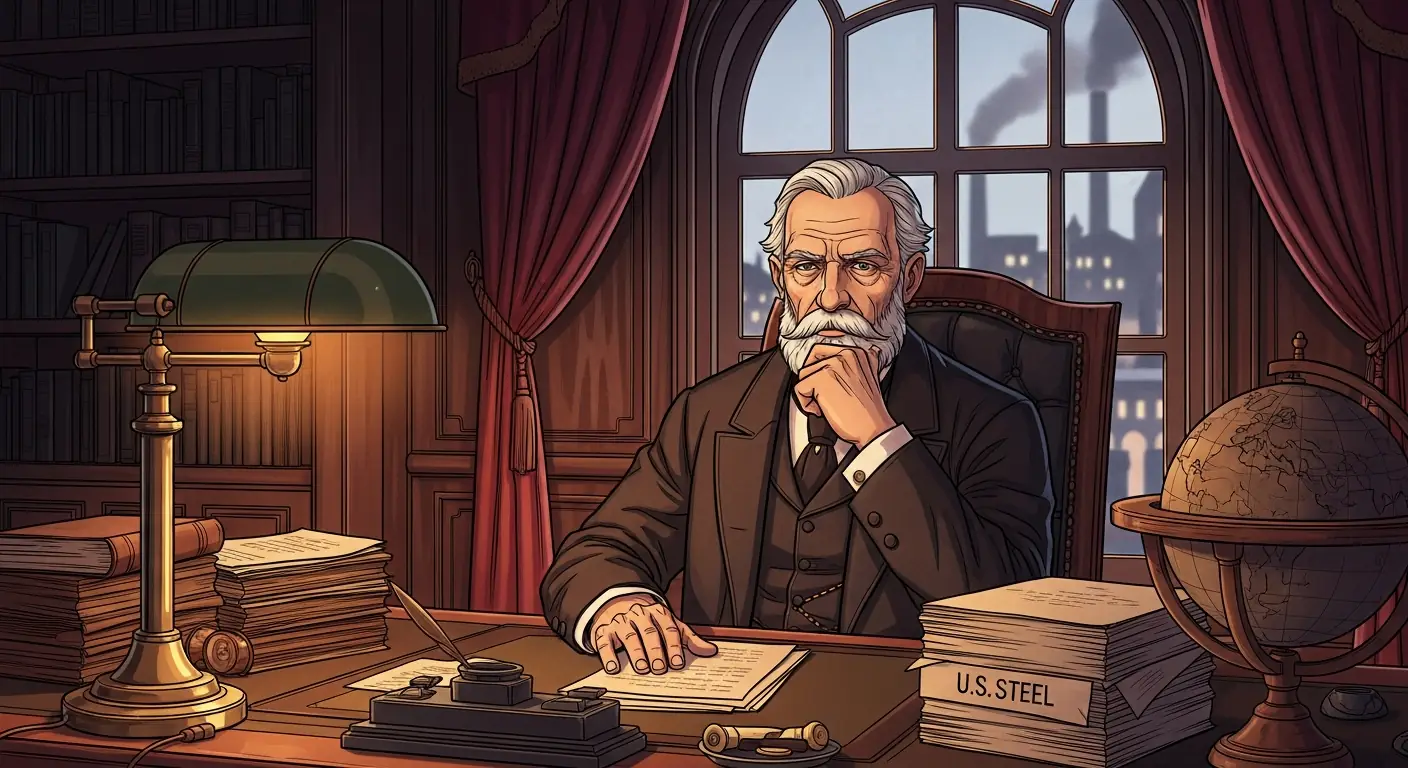
By the late 1890s, Andrew Carnegie was 65 years old, the undisputed king of American steel, and restless.
He had been thinking increasingly about his 1868 memo — the one where he promised to stop accumulating wealth and start giving it away. His wife, Louise Whitfield Carnegie, whom he had married in 1887, encouraged his philanthropic instincts. So did his reading of Herbert Spencer and his own essay, “The Gospel of Wealth,” published in 1889.
In that essay, Carnegie laid out a revolutionary argument: the rich had a moral obligation to distribute their wealth during their lifetimes. “The man who dies thus rich dies disgraced,” he wrote. Inherited wealth, Carnegie argued, was a curse that destroyed the character of the next generation. The rich should live modestly, provide moderately for their families, and use the rest of their fortune to benefit society.
It was a radical idea in the Gilded Age, and it set the stage for what was coming.
In 1900, a young banker named Charles M. Schwab (not to be confused with the modern brokerage founder) gave a legendary speech at a dinner at the University Club in New York. In the audience was J.P. Morgan, the most powerful financier in America. Schwab outlined a vision for consolidating the American steel industry into a single giant corporation.
Morgan was intrigued. He approached Carnegie with an offer to buy Carnegie Steel.
Carnegie wrote his price on a slip of paper and handed it to Schwab to deliver to Morgan: $480 million (approximately $17 billion in today’s dollars).
Morgan looked at the number and said: “I accept this price.”
The deal closed on March 2, 1901. Carnegie Steel was merged with Federal Steel and several other companies to form the United States Steel Corporation — the first billion-dollar company in history, capitalized at $1.4 billion.
When Morgan and Carnegie met shortly after the deal, Morgan reportedly said: “Congratulations, Mr. Carnegie. You are now the richest man in the world.”
Carnegie is said to have later told friends that he should have asked for $100 million more.
📚 Chapter 6: The Gospel of Giving
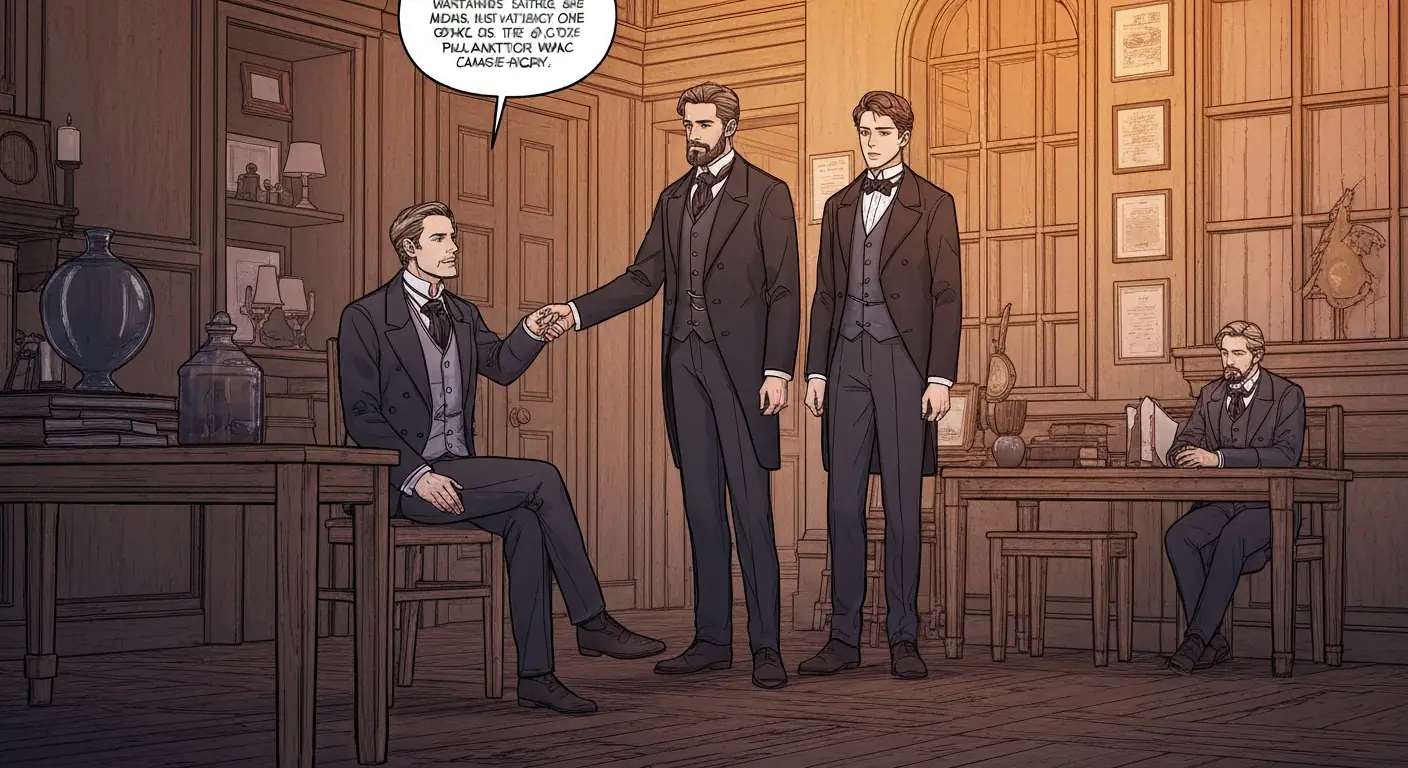
With $480 million in hand and the moral weight of his “Gospel of Wealth” essay on his conscience, Andrew Carnegie embarked on one of the most extraordinary philanthropic campaigns in history.
His giving was not random. It was systematic, strategic, and guided by a clear philosophy: invest in institutions that would help people help themselves. Carnegie didn’t believe in handouts. He believed in opportunity.
Libraries: Carnegie’s most visible legacy. Between 1883 and 1929, Carnegie funded the construction of 2,509 public libraries across the English-speaking world — 1,689 in the United States alone. The deal was always the same: Carnegie would pay for the building if the local community agreed to fund the ongoing operations. He spent approximately $55 million on libraries (over $2 billion today).
Education: Carnegie founded the Carnegie Institute of Technology in Pittsburgh (now Carnegie Mellon University), donated $10 million to establish the Carnegie Institution for Science in Washington, D.C., funded the Carnegie Foundation for the Advancement of Teaching, and created the Carnegie Endowment for International Peace.
Music: He built Carnegie Hall in New York City in 1891, giving the city one of the world’s great concert venues.
Peace: Carnegie was a passionate anti-imperialist and pacifist. He funded the Palace of Peace at The Hague (home of the International Court of Justice) and spent millions promoting international arbitration as an alternative to war. The outbreak of World War I in 1914 devastated him personally — he had genuinely believed that war between civilized nations had become impossible.
Pensions: He established the Carnegie Hero Fund Commission to recognize and reward acts of civilian heroism, and created pension funds for university professors through the Carnegie Foundation.
In total, Carnegie gave away approximately $350 million during his lifetime — roughly $5.5 billion in today’s money. This represented about 90% of his fortune at the time of the U.S. Steel sale.
The scale of his giving was unprecedented. No individual in history had given away so much, so systematically, with such clear intent.
⚖️ Chapter 7: The Paradox of Carnegie
Andrew Carnegie died on August 11, 1919, at his summer estate in Lenox, Massachusetts. He was 83 years old. The remaining $30 million of his fortune was distributed to foundations and charities in his will.
He left behind a legacy that remains profoundly debated more than a century later.
On one hand, Carnegie’s philanthropy was genuinely transformative. The 2,509 libraries he funded democratized access to knowledge in an era before public education was universal. Carnegie Mellon University became one of the world’s leading research institutions. The Carnegie Endowment for International Peace continues its work today. The Carnegie Corporation of New York remains one of America’s largest foundations, with an endowment exceeding $4 billion.
On the other hand, Carnegie’s wealth was built on the backs of workers who labored in horrific conditions for subsistence wages. The Homestead Strike wasn’t an aberration — it was the logical consequence of a business model that treated labor as a cost to be minimized rather than people to be respected.
This paradox — the mogul who crushed his workers and then gave away his fortune to benefit humanity — remains the central question of Carnegie’s legacy. Was his philanthropy genuine atonement? Or was it an elaborate exercise in reputation laundering?
The answer, as with most things about Carnegie, is probably both.
Carnegie genuinely believed in the “Gospel of Wealth.” His essays on the subject were written decades before he sold his company, and they reflected a sincere intellectual conviction that concentrated wealth carried moral obligations. He wasn’t performing generosity — he was living out a philosophy he had articulated when he was still accumulating his fortune.
But it’s equally true that Carnegie’s philanthropy allowed him to shape his own narrative. By giving away libraries and concert halls and universities, he ensured that his name would be associated with enlightenment rather than exploitation. Every Carnegie Library in every American town is, in a sense, a monument to successful reputation management.
The historian David Nasaw, author of the definitive Carnegie biography, put it this way: “Carnegie was not a hypocrite. He was something more complex — a man who held contradictory beliefs simultaneously and acted on all of them.”
🏛️ Chapter 8: The Blueprint for Modern Philanthropy
Andrew Carnegie’s influence extends far beyond steel and libraries. He essentially invented modern philanthropy — the idea that the wealthy should give away their fortunes systematically during their lifetimes, through dedicated institutions, with measurable goals.
When Bill Gates and Warren Buffett launched the Giving Pledge in 2010 — a commitment by billionaires to give away at least half their wealth — they were explicitly following Carnegie’s playbook. Gates has cited Carnegie’s “Gospel of Wealth” as a direct inspiration.
The parallels between Carnegie and today’s tech billionaires are striking:
- Like Carnegie, they built their fortunes in transformative industries
- Like Carnegie, they are accused of monopolistic practices and worker exploitation
- Like Carnegie, they argue that their philanthropy benefits society more than government redistribution would
- Like Carnegie, they face questions about whether giving away money excuses how it was made
The Carnegie model of philanthropy — large foundations run by professional staff, focused on systemic change rather than individual charity — became the template for the Rockefeller Foundation, the Ford Foundation, the Gates Foundation, and hundreds of others.
But Carnegie’s legacy also raises uncomfortable questions that remain unanswered. If a society produces billionaires who then decide how to spend their fortunes for the public good, who elected them to make those decisions? Carnegie chose libraries. He might have chosen something else — or nothing at all. The fact that his choices happened to be beneficial doesn’t validate the system that gave one man such power.
As of 2026, the institutions Carnegie created continue to shape American life. Carnegie Hall hosts 200+ concerts per year. Carnegie Mellon is a top-10 computer science university. The Carnegie libraries that survived urban renewal and budget cuts still serve their communities.
And the question Carnegie posed in 1889 — what should the rich do with their money? — burns as urgently today as it did in the Gilded Age.
Andrew Carnegie came to America with nothing and left it with the blueprint for billionaire philanthropy. He built an empire on steel and sweat, crushed those who stood in his way, and then spent his final decades trying to give it all back. Whether that ledger balances is a question each generation must answer for itself.
🌉 Chapter 9: The Bridge Builder (1860s-1870s)
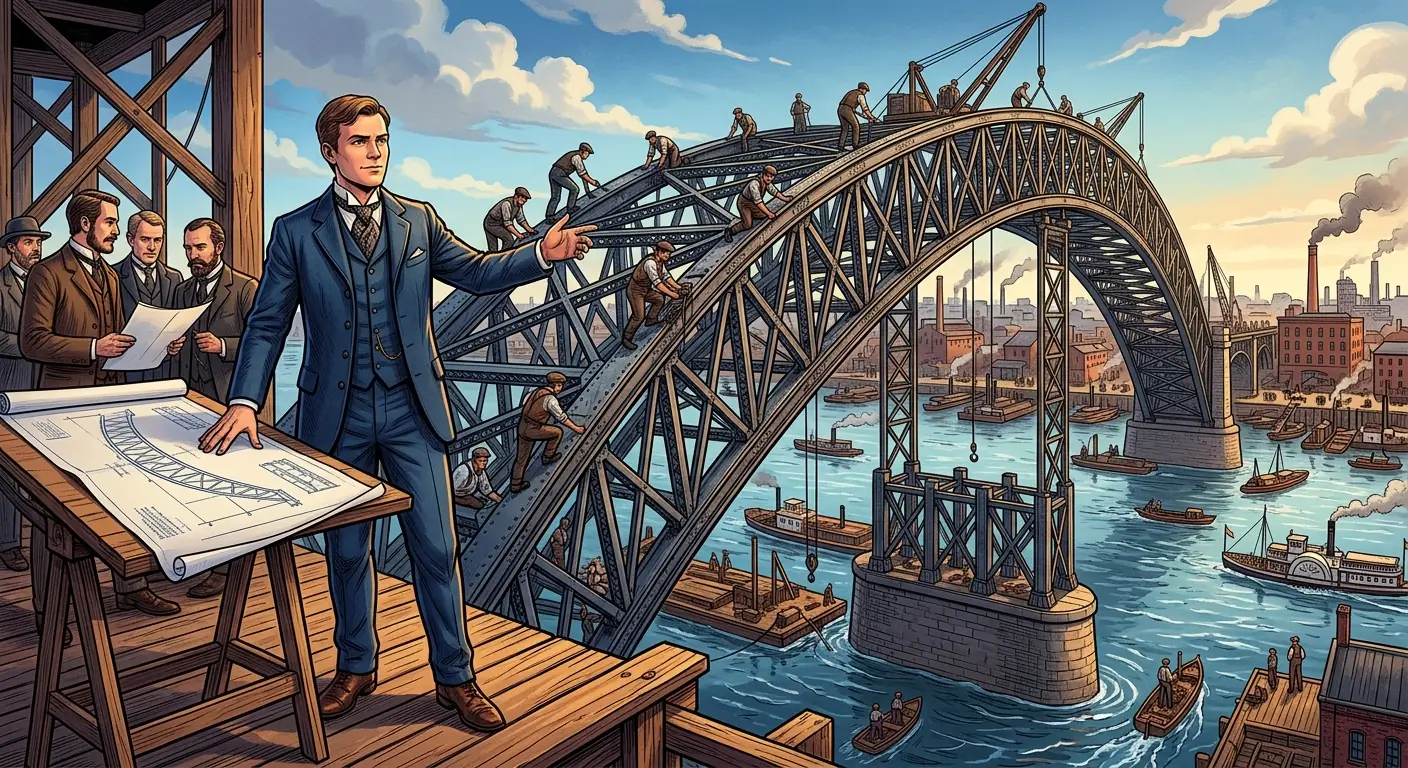
You know, before Andrew Carnegie was “The Steel King,” he was more like “The Iron Prince” – specifically, the prince of bridges. After making a tidy sum in railroad investments and oil (thanks, Thomas Scott!), Carnegie wasn’t content to just sit back and clip coupons. Oh no. The man had an insatiable itch to build things, to get his hands dirty, metaphorically speaking, in the nuts and bolts of industrial might. And what better way to connect a rapidly expanding nation than with monumental bridges?
From Railroads to Rivets: Keystone Bridge Company
Carnegie’s first major foray into heavy manufacturing came in 1865 with the establishment of the Keystone Bridge Company. This wasn’t just some casual investment; Carnegie saw a massive opportunity. The nation’s railroads were booming, but crossing rivers and ravines was still a logistical nightmare, often involving ferries or rickety wooden structures. Iron bridges were the future, offering strength and durability that timber couldn’t match. Keystone quickly became a leader in the field, constructing some of America’s most impressive spans. One of their crown jewels? The Eads Bridge over the Mississippi River in St. Louis, completed in 1874. This was an engineering marvel of its time, using innovative steel (though mostly wrought iron) arches and pneumatic caissons. Carnegie’s involvement here wasn’t just as an investor; he was actively learning the ins and outs of large-scale construction, metallurgy, and project management – skills that would become absolutely critical when he pivoted to steel.
The Material Question: Iron vs. Steel
The bridge business wasn’t just about building; it was about the materials. For years, iron was king, but Carnegie, ever the forward-thinker, was already peeking over the fence at its shinier, stronger cousin: steel. He was obsessed with efficiency and cost-cutting, and he knew that while steel was more expensive to produce initially, its superior strength meant lighter, more durable structures. This realization was a slow burn, not an overnight epiphany. He observed the structural integrity challenges with iron, especially under the increasing loads of heavier trains. He saw the potential for steel to revolutionize not just bridges, but everything. This period, from the mid-1860s through the early 1870s, was Carnegie’s industrial apprenticeship. He wasn’t just making money; he was gaining invaluable experience in every aspect of heavy industry, from sourcing raw materials to managing massive workforces and navigating complex engineering challenges. It was the perfect, albeit unintentional, training ground for the steel empire that was just around the corner. He once famously quipped about his early business strategy:
“The way to make money is to get in on the ground floor, and then, by standing on the shoulders of giants, see further than anyone else.”
And for Carnegie, the giants were the engineers and innovators showing him the way to steel.
😈 Chapter 10: The Frick Factor (1880s-1890s)
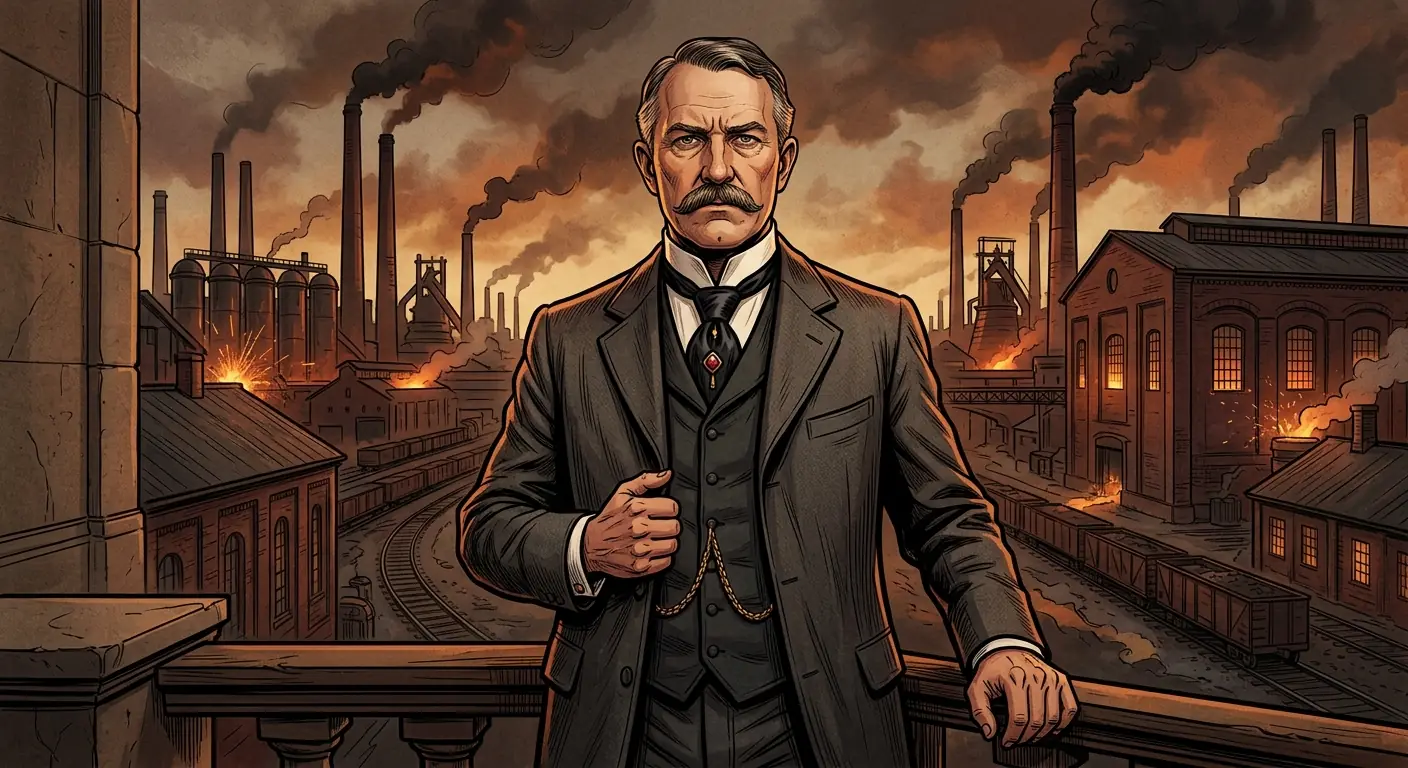
Ah, Henry Clay Frick. If Andrew Carnegie was the visionary, the charming strategist, then Frick was the ruthless enforcer, the man who got things done, no matter the cost. Their partnership was, for a time, a match made in industrial heaven – or perhaps, industrial purgatory, depending on your perspective. Carnegie recognized Frick’s unparalleled talent for cost-cutting and aggressive management, a talent that perfectly complemented his own grand ambitions. It was a bromance built on ambition and profit, destined for a spectacularly bitter end.
The Rise of a Ruthless Lieutenant
Carnegie first got wind of Frick, a young coke magnate, in the late 1870s. Frick had built a massive fortune by cornering the market on Connellsville coke, the high-quality fuel essential for steel production. In 1882, Carnegie brought Frick into his steel operations, acquiring a controlling interest in Frick’s coke company. It was a stroke of genius, securing a vital raw material and bringing a formidable talent into the fold. Frick soon became chairman of Carnegie Bros. & Co., and later the overall chairman of the Carnegie Steel Company. He was a man of iron will, famously saying:
“I will not compromise. I will not be dictated to. And I will not tolerate insubordination.”
Frick streamlined operations, squeezed every last penny out of production, and pushed his workers to the absolute limit. He was the perfect foil for Carnegie, who preferred to be the “big picture” guy, often retreating to his Scottish castles, while Frick handled the grimy realities of industrial management back in Pittsburgh. This division of labor worked wonders for a decade, propelling Carnegie Steel to unprecedented dominance.
The Bitter End: A Partnership Soured
The partnership, however, was fundamentally unstable. Carnegie, for all his ruthlessness, often tried to present himself as a benevolent capitalist, particularly through his “Gospel of Wealth.” Frick, on the other hand, was unapologetically hard-nosed, with little patience for sentiment. The infamous Homestead Strike of 1892 (which, yes, we’ve touched on, but bears revisiting from the Frick angle) was the ultimate breaking point. While Carnegie was conveniently (or cowardly, depending on who you ask) in Scotland, Frick took the full brunt of the confrontation, employing Pinkerton agents and crushing the strike with brutal efficiency. Carnegie later publicly criticized Frick’s handling of the strike, attempting to distance himself from the bloodshed, which Frick considered a profound betrayal.
The final straw came in 1899. Carnegie, ever the clever strategist, decided to buy out his partners to consolidate control before his eventual retirement. Frick, believing Carnegie was trying to lowball him on his shares, refused to sell at the offered price. What followed was a nasty, protracted legal battle, a public airing of dirty laundry that shocked the business world. Carnegie, with his typical cunning, eventually forced Frick out, saying he wanted “no more partners.” The partnership that built an empire ended in a bitter, personal feud, leaving a permanent scar on both men. It’s a classic tale of power, money, and the corrosive nature of unchecked ambition.
⚙️ Chapter 11: The Empire’s Inner Workings: Vertical Integration and Ruthless Efficiency (1870s-1890s)
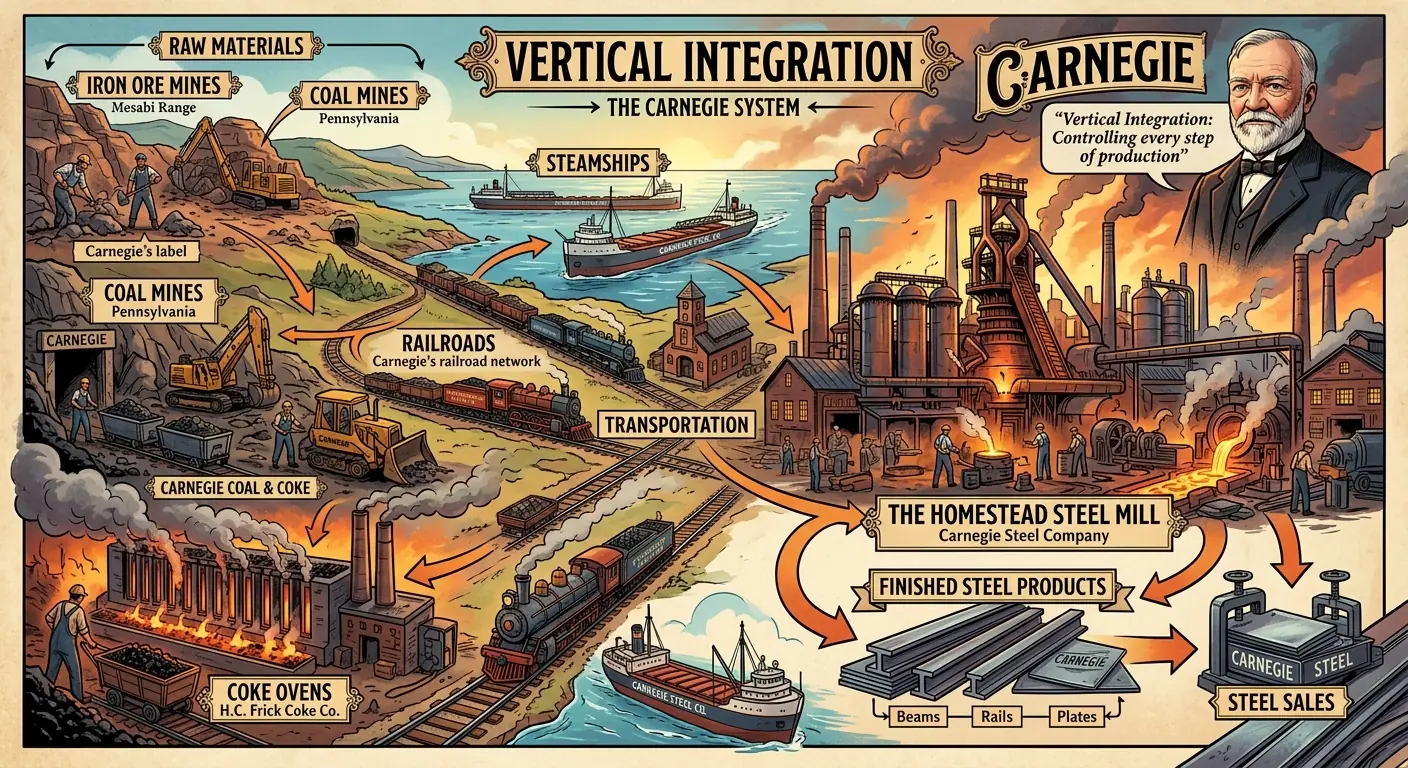
So, we know Carnegie built a steel empire, but how exactly did he do it? It wasn’t just about having the biggest furnaces or the most workers. Carnegie’s genius lay in his relentless pursuit of efficiency and his pioneering adoption of business strategies that were revolutionary for their time. He didn’t just make steel; he optimized every single step of making steel, turning it into a lean, mean, profit-generating machine. Think of him as the original supply chain guru, but with more mustaches and less yoga.
The Vertical Juggernaut: Owning It All
One of Carnegie’s most impactful strategies was vertical integration. While others focused on just one part of the steel-making process, Carnegie sought to own everything from the ground up. This meant acquiring iron ore mines in Michigan and Minnesota (specifically the vast deposits of the Mesabi Range), owning the coalfields that supplied his coke ovens, and even controlling the railroads and steamships that transported these raw materials to his mills. He literally owned the means of production, distribution, and the raw materials. This gave him an unparalleled advantage: he could control costs at every stage, cutting out middlemen and ensuring a steady, reliable supply chain, even when competitors faced shortages or price hikes. He even had his own fleet of barges and tugboats on the Monongahela River! This comprehensive ownership allowed him to deliver steel cheaper and faster than anyone else, practically guaranteeing his dominance. As he once declared, with characteristic bravado:
“Pioneering don’t pay. The man who puts his money into a new invention is a fool. The man who comes along after him and buys his rights for a song is a genius.”
And by owning the entire process, he effectively owned the “rights” to the cheapest steel.
Cost Accounting: The Devil in the Details
Beyond owning the entire chain, Carnegie was fanatical about cost accounting. This might sound boring, but it was anything but. In an era where many businesses simply tracked overall profits and losses, Carnegie drilled down to the penny. He knew the precise cost of every ton of iron ore, every pound of coal, every hour of labor, and every finished beam of steel. He installed sophisticated accounting systems (for the time) that tracked production metrics religiously. Foremen and managers were given daily reports on their departments’ efficiency, creating intense internal competition. If one department could make a product cheaper than another, that method became the new standard. He famously had massive blackboards erected in his mills, displaying the daily output and costs of each furnace, spurring fierce rivalry among his managers. This relentless focus on minute details allowed him to identify inefficiencies, eliminate waste, and constantly drive down production costs. It was a brutal, Darwinian approach to management, but it worked. Carnegie didn’t just make steel; he made cheap steel, and in the burgeoning industrial age, cheap steel conquered the world.
🏡 Chapter 12: Home and Hearth: The Man Behind the Money (1880s-1900s)
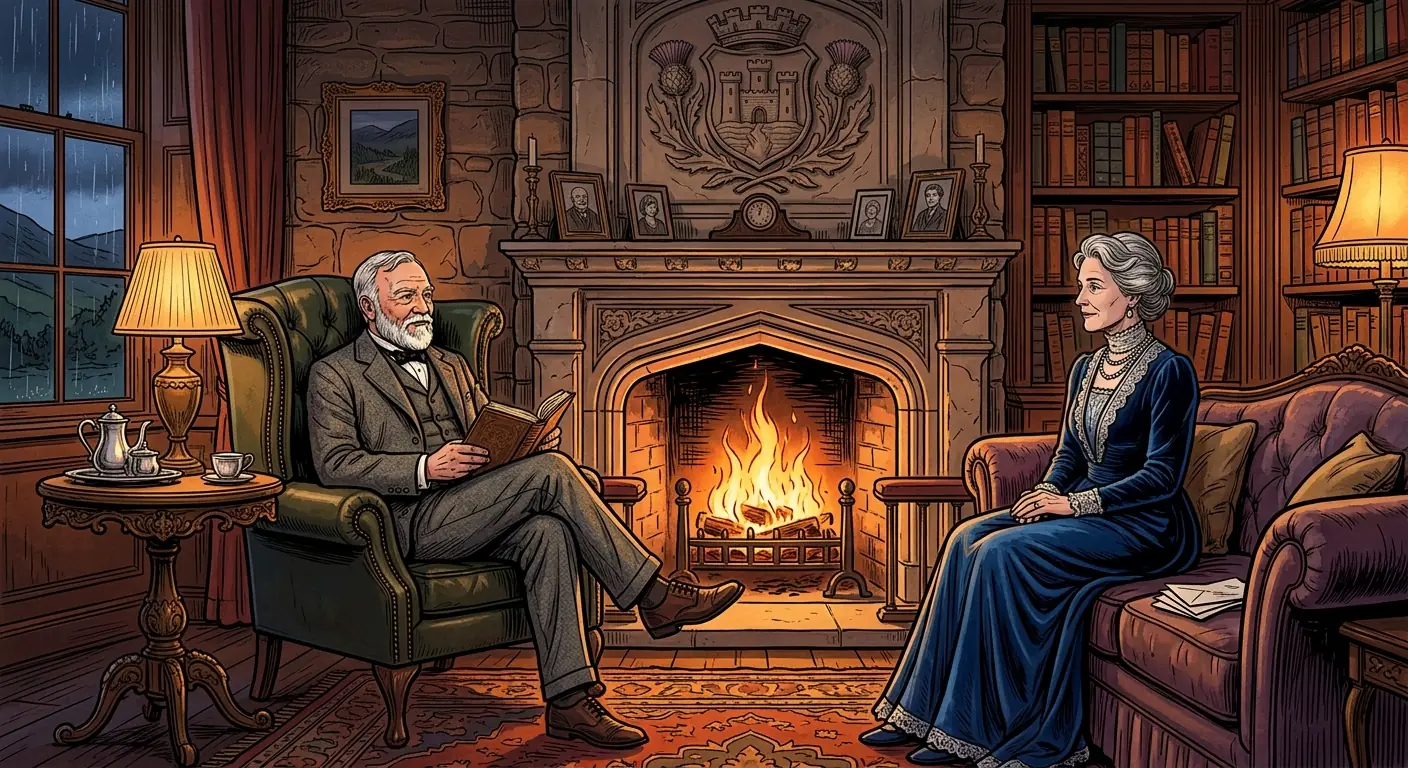
For a man who spent his life accumulating one of the world’s greatest fortunes, Andrew Carnegie’s personal life was surprisingly quiet, almost conventional, especially in his later years. He wasn’t the flamboyant, scandal-ridden millionaire often seen in Gilded Age society. Instead, he cultivated a domestic sphere that reflected his deep-seated values (and perhaps some of his contradictions). While his public persona was all about steel and philanthropy, at home, he was a husband, a son, and eventually, a father.
The Indispensable Mother and the Patient Wife
Carnegie’s mother, Margaret Morrison Carnegie, was arguably the most influential woman in his life. Fiercely independent and resourceful, she was his confidante, his moral compass, and a constant presence until her death in 1886. Carnegie was notoriously devoted to her, even making a pact with her that he wouldn’t marry while she was alive. Some historians suggest this was less a vow of eternal devotion and more a convenient excuse, as marriage would have complicated his relentless pursuit of wealth. Regardless, his bond with his mother was profound.
Just a year after his mother’s passing, at the ripe old age of 51, Carnegie finally married Louise Whitfield, a woman 21 years his junior who had been his personal secretary. Louise was intelligent, cultured, and incredibly patient. She understood Carnegie’s demanding schedule, his intense focus on business, and later, his obsession with philanthropy. Their marriage, which lasted until his death, was by all accounts a happy and supportive one. Louise often accompanied him on his travels, managed their homes, and became an active partner in his philanthropic endeavors, particularly after the sale of Carnegie Steel. She provided a stable, loving environment that Carnegie, for all his public bluster, deeply cherished.
Skibo Castle and the Joy of Fatherhood
While Pittsburgh was the crucible of his fortune, Carnegie found solace and joy in his homes, particularly Skibo Castle in the Scottish Highlands, which he purchased in 1898. He spent significant portions of his later life there, a poetic return to his Scottish roots. Skibo became his personal retreat, a place where he could entertain dignitaries, philosophers, and industrial titans, all while indulging his love for golf and the tranquil Scottish landscape. It was at Skibo that he truly began to shed the relentless businessman persona and embrace the role of the global philanthropist.
Perhaps the greatest personal joy came late in life. In 1897, when Carnegie was 62 years old, Louise gave birth to their only child, a daughter named Margaret Carnegie. The steel magnate, who had forged an empire with an iron will, found himself utterly smitten and softened by fatherhood. He adored Margaret, doting on her and ensuring she had a childhood far removed from his own impoverished beginnings. This late-in-life fatherhood, coming after decades of single-minded focus on wealth, offered a profound shift in his priorities, underscoring the universal human desire for family and connection, even for the most ambitious of moguls. He once wrote to his nephew about Margaret:
“I sometimes think I care more for my dear little baby than for all the libraries and institutions I have founded.”
It seems even the hardest steel can melt under the warmth of a child’s love.
🕊️ Chapter 13: The Peacemaker and the Patron: Carnegie’s Global Ambitions (1900s-1919)
After selling Carnegie Steel to J.P. Morgan in 1901 for that eye-watering $480 million, Andrew Carnegie was, by all accounts, the richest man in the world and, more importantly, a free man. Free from the daily grind of industrial warfare, he could now fully dedicate himself to his “Gospel of Wealth” – the belief that the wealthy had a moral obligation to use their fortunes for the public good. But his philanthropy wasn’t just about libraries and universities; it evolved into a grand, almost quixotic, ambition to bring about world peace. The man who had fueled industrial wars with his steel now sought to end all wars.
Funding the Future: Beyond Libraries
While his 2,500+ libraries are his most visible legacy, Carnegie’s philanthropy extended far beyond books. He established a constellation of foundations, each designed to address a critical societal need. The Carnegie Institute of Washington (1902) was founded with $10 million to support scientific research and discovery. The Carnegie Foundation for the Advancement of Teaching (1905), endowed with $10 million, revolutionized American higher education by establishing a pension system for professors, effectively creating the concept of academic tenure. He founded the Carnegie Hero Fund Commission (1904) to recognize and reward acts of civilian heroism, starting with $5 million. These were not mere handouts; they were strategic investments designed to create lasting institutions that would improve society long after he was gone. He believed in providing “ladders upon which the aspiring can rise,” not “crutches to help the fallen.”
The Dream of World Peace: The Hague and Beyond
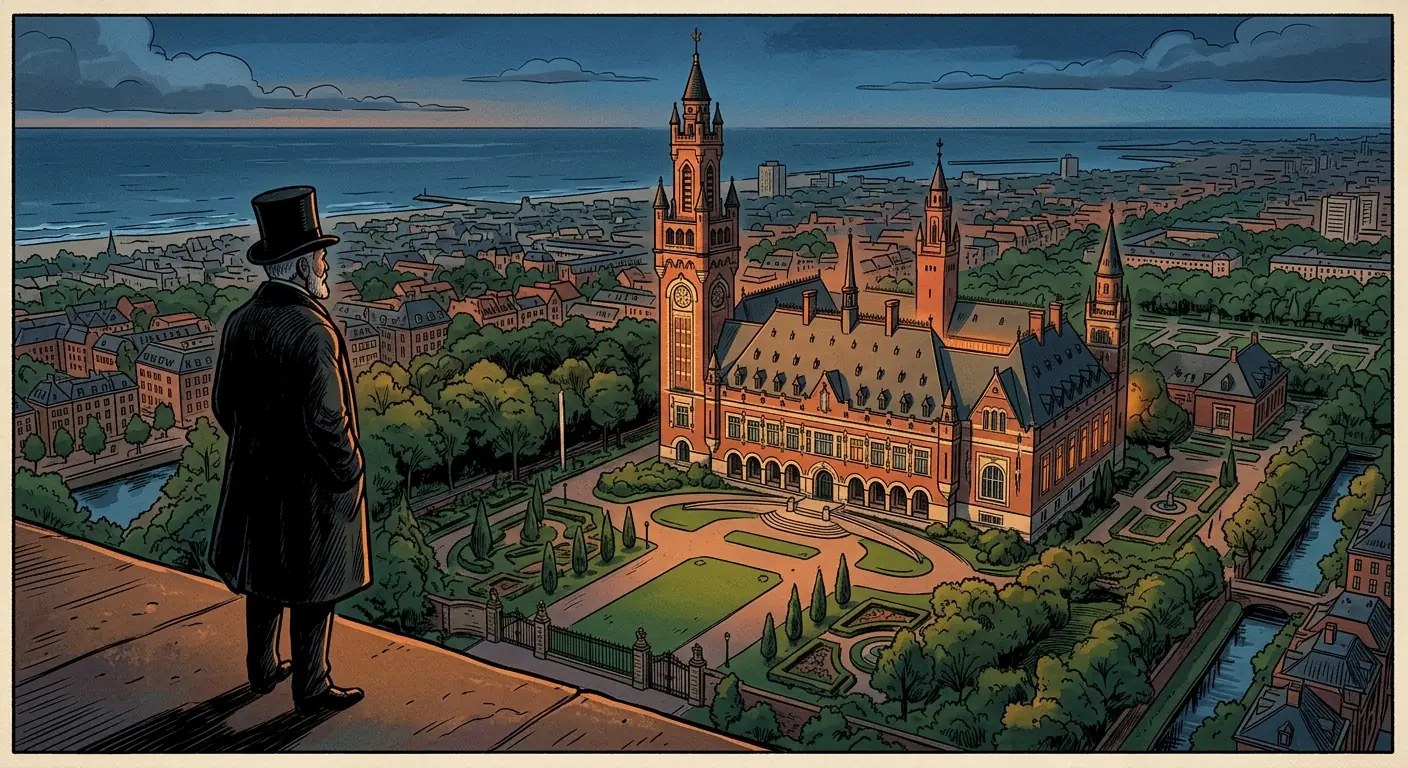
Perhaps his most ambitious and ultimately tragic endeavor was his tireless pursuit of international peace. The thought of war, especially after the horrors of the American Civil War and the brutality of industrial strife, deeply troubled him. He poured millions into peace initiatives, believing that education, international law, and arbitration could prevent future conflicts. His most iconic contribution to this cause was the funding of the Peace Palace in The Hague, Netherlands. Donating $1.5 million in 1903, he envisioned it as a permanent home for international justice, housing the Permanent Court of Arbitration and later the International Court of Justice. He believed that if nations had a forum for dialogue and legal recourse, they would choose reason over war.
Carnegie also established the Carnegie Endowment for International Peace (1910) with an astounding $10 million, specifically tasked with finding ways to abolish war. He personally lobbied world leaders, wrote countless articles, and funded conferences, all driven by the fervent hope that humanity could evolve beyond armed conflict. Tragically, his grand dream was shattered by the outbreak of World War I in 1914. The “War to End All Wars” deeply saddened and disillusioned him, undermining his optimistic view of human progress. He reportedly told a friend:
“All my hopes of organized peace are gone. I have failed.”
He continued to give, but the shadow of the Great War loomed large over his final years. Andrew Carnegie died on August 11, 1919, just months after the Treaty of Versailles was signed, ending the war that had broken his spirit. He had given away an estimated $350 million (equivalent to over $50 billion today), leaving a mere $30 million to his wife and daughter. His legacy remains a complex tapestry: a titan of industry who built an empire with ruthless efficiency, yet dedicated his later life to promoting knowledge, science, and a world free from war, leaving behind a blueprint for modern philanthropy that continues to shape our world.
💡 Key Insights
- ▸ Vertical integration — controlling every step from raw materials to finished product — was Carnegie's key competitive advantage.
- ▸ The 'Gospel of Wealth' philosophy argues that the rich have a moral duty to redistribute their fortune during their lifetime.
- ▸ Reputation damage from labor conflicts can haunt a legacy forever — Homestead still defines Carnegie for many historians.
- ▸ Systematic philanthropy, not random charity, creates lasting impact — Carnegie's 2,509 libraries still serve communities today.
- ▸ The tension between how wealth is made and how it is given away remains the central question of billionaire philanthropy.