Sara Blakely: From Fax Machines to Spanx Billionaire
She had no fashion experience, no business degree, and no connections. What Sara Blakely did have was $5,000 in savings, a pair of scissors, and the kind of shameless determination that makes legends. This is how a door-to-door fax machine saleswoman built the most iconic undergarment brand in history.

View all stories about this mogul
🌅 Chapter 1: The Girl Who Embraced Failure
Sara Blakely’s father did something unusual at the dinner table.
Every night, while most parents asked their kids “What did you learn today?” or “How was school?”, Bob Blakely asked his children a different question:
“What did you fail at today?”
Not what they accomplished. Not what they succeeded at. What they failed at.
If Sara or her brother couldn’t name a failure, their father was disappointed. Not because he wanted his children to fail. Because he wanted them to try things that were hard enough to risk failure. In the Blakely household, the only real failure was not trying.
“My dad reframed failure for me at an early age. Failure wasn’t the outcome. Failure was not trying. That mindset is the single most important thing that made Spanx possible.”
Sara Tricia Blakely was born on February 27, 1971, in Clearwater, Florida. Her childhood was normal in most ways — middle-class family, public schools, summer vacations — but marked by two unusual influences.
The first was her father’s failure philosophy. The second was a set of self-help tapes by Wayne Dyer that her father gave her when she was 16. Sara listened to those tapes so many times she could recite them from memory. They planted an idea that would take root and grow for the next decade: you can visualize the life you want and then build it.
Most people hear self-help messages and feel inspired for about 72 hours. Sara Blakely heard them and actually believed them. For the rest of her life.
She went to Florida State University, where she studied communications and joined the debate team. She wanted to be a lawyer. She took the LSAT. Twice. Her scores were… not good. Law school was not going to happen.
“The universe was telling me that being a lawyer wasn’t my path,” she later said. “At the time, I didn’t know what my path was. I just knew it wasn’t that.”
After college, with no law school acceptance and no clear plan, Sara Blakely took a job at Walt Disney World. She spent three months as a ride greeter, standing in the Florida heat in a brown polyester uniform, welcoming tourists to rides.
It was soul-crushing. And it was temporary. After Disney, she answered a classified ad and got a job selling fax machines door to door for Danka, an office supply company.
This is where the Sara Blakely story really begins.
📠 Chapter 2: The Fax Machine Years
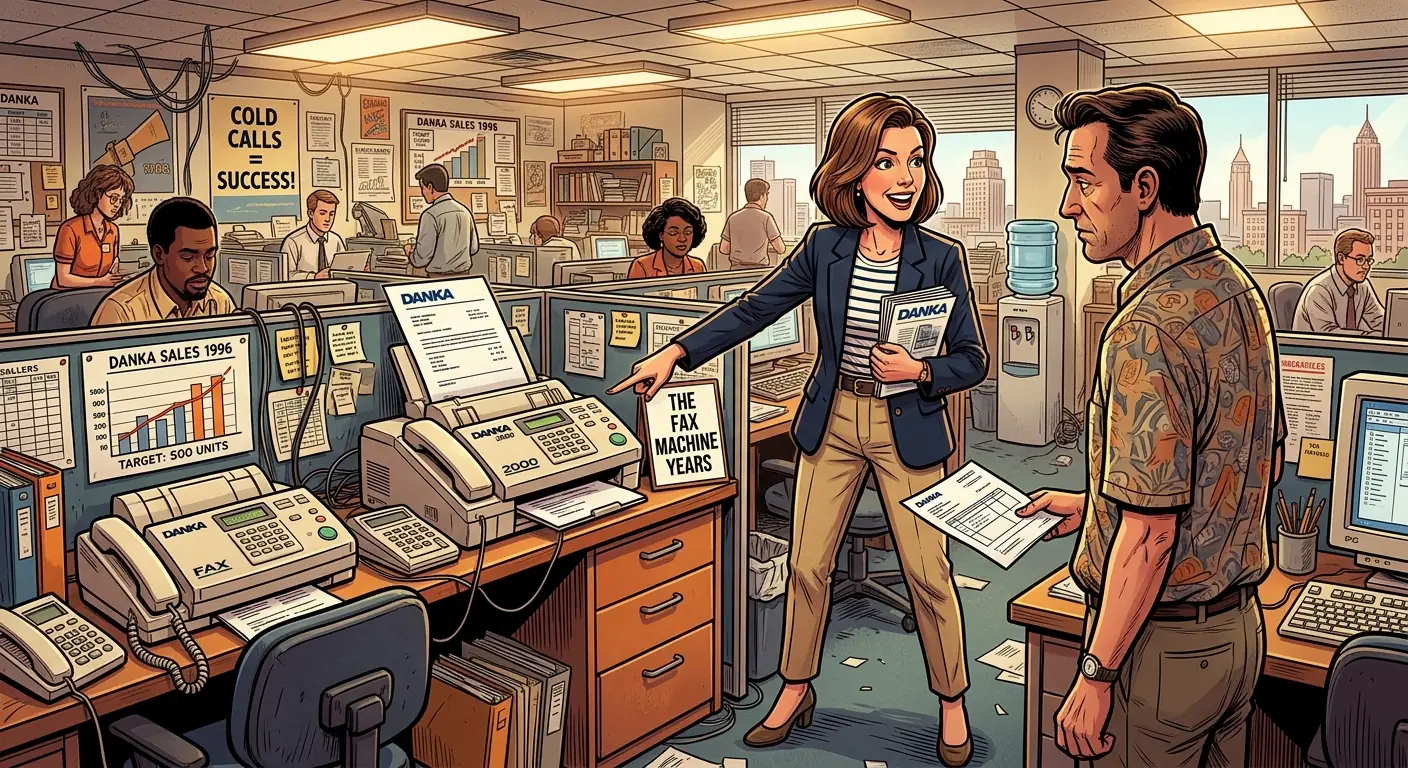
Selling fax machines door to door in the mid-1990s was about as glamorous as it sounds.
Sara Blakely drove around Clearwater and Tampa, walking into businesses cold, asking to speak to whoever made purchasing decisions, and pitching them on why they needed a fax machine. She was 22 years old, had no sales training, and was earning a base salary of $1,500 per month.
She was terrible at it. For the first few months, she couldn’t sell anything. Doors were slammed in her face. Secretaries told her the boss was busy. Business owners told her to get lost.
She cried in her car. A lot.
“I would sit in my car after getting rejected and cry. And then I would wipe my face, look in the mirror, and go to the next door. Because my dad had taught me that the failure wasn’t getting rejected. The failure would be not going to the next door.”
Something started to shift. Blakely realized that the key to selling wasn’t the product — it was the connection. She stopped leading with features and specifications. She started leading with problems. “What frustrates you about your current communication process?” “What would you do with an extra hour a day?”
She got better. Then she got good. Then she got really good. Within two years, Blakely was one of Danka’s top salespeople. She was promoted to national sales trainer. She was making decent money.
And she was completely miserable.
“I knew this wasn’t my thing,” she later recalled. “I’d drive around all day and think, ‘There has to be more than this. I have an idea inside me. I just haven’t found it yet.’”
For two years, she kept a journal where she wrote down ideas. Most were terrible. She knew they were terrible. She wrote them down anyway, because she was waiting for the one that wasn’t.
Then, one night in 1998, getting ready for a party, Sara Blakely found her idea at the bottom of her dresser drawer.
✂️ Chapter 3: The Scissors Moment
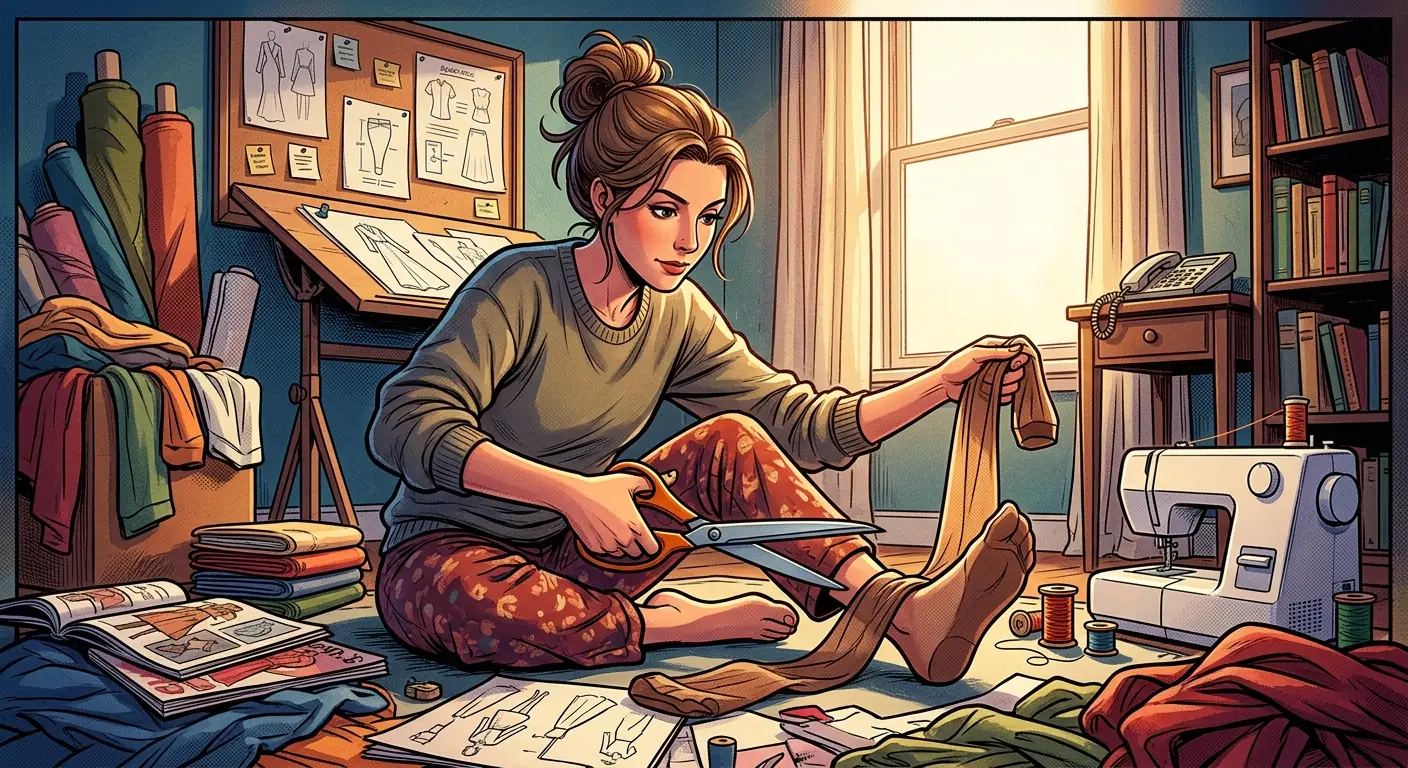
The party required cream-colored pants. The cream-colored pants required smooth lines underneath. Sara Blakely’s undergarments were not cooperating.
She tried pantyhose, but the seamed foot created a visible line in her open-toed shoes. She tried going without, but the pants showed every bump and line. She tried control-top pantyhose and cut the feet off with scissors.
It worked. The control top smoothed everything out. The cut-off feet meant she could wear open-toed shoes. She looked great.
And standing in her bathroom, holding scissors and the severed feet of a pair of pantyhose, Sara Blakely had the thought that would change her life:
Why doesn’t this product already exist?
“I remember looking at the cut pantyhose and thinking: this is my idea. This is the one I’ve been waiting for. I don’t know anything about fashion or manufacturing or retail, but I know this product needs to exist.”
She spent the next two years researching the hosiery industry while continuing to sell fax machines. What she found was remarkable: the entire hosiery industry was run by men. Men were designing women’s undergarments. Men were deciding what women needed. And they had decided, collectively, that the existing product line — pantyhose, stockings, and control-top hose — was sufficient.
No one was innovating. No one was asking women what they actually wanted. No one was making a product that solved the specific, daily, universally experienced problem that Sara Blakely had solved with a pair of scissors.
Blakely had $5,000 in savings. She used it all.
She wrote her own patent (she couldn’t afford a lawyer, so she bought a textbook on patent law and wrote it herself). She cold-called hosiery manufacturers in North Carolina — the hosiery capital of America — and pitched them on her idea.
Every single one of them hung up on her.
“They thought I was insane,” Blakely recalled. “A girl from Florida with no experience calling to pitch a new kind of pantyhose with the feet cut off? They literally laughed at me.”
She kept calling. For months. One manufacturer, Highland Mills in Asheboro, North Carolina, finally agreed to a meeting — not because the owner believed in the product, but because he had two daughters who told him the idea actually made sense.
That meeting changed everything.
🏭 Chapter 4: Building Spanx with $5,000
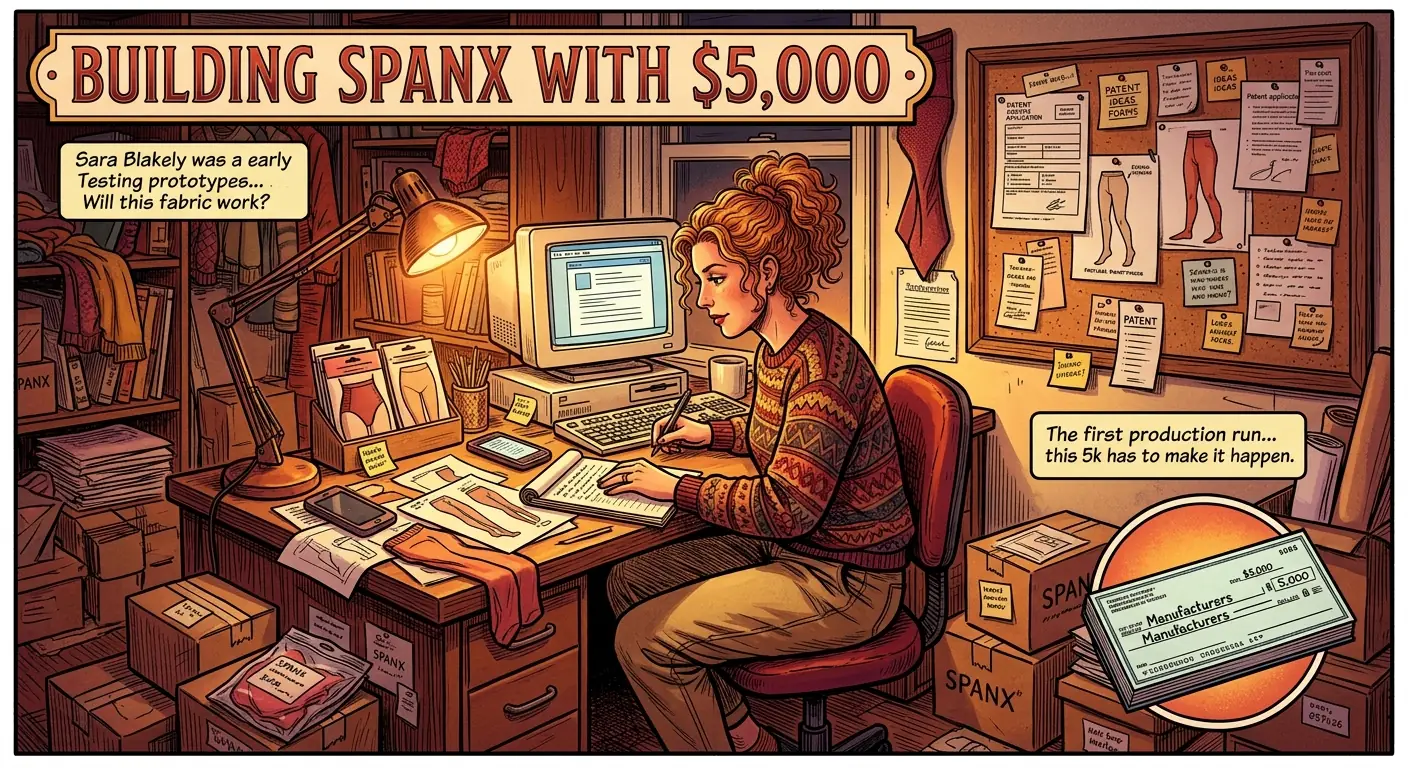
The name came to her while driving. Spanx. (Originally Spanks, but she changed the “ks” to an “x” because she’d read that made-up words with the “k” sound performed better in branding.)
With Highland Mills agreeing to produce a prototype, Blakely threw herself into building a company with the same shameless energy she’d used selling fax machines.
She designed the packaging herself. She chose red — bold, impossible to miss — in an aisle dominated by beige and nude tones. She wrote the copy herself. She modeled the product herself (she couldn’t afford a model). She created the logo herself using a cartoonish illustration of three women’s silhouettes.
“I did everything myself because I had to. I had $5,000 and a credit card. There was no marketing budget. There was no design team. There was just me and a very strong opinion about how this product should be presented to the world.”
The name. The packaging. The messaging. Every choice Blakely made was instinctive, unorthodox, and, as it turned out, brilliant. The red packaging popped on shelves. The friendly, irreverent tone (the back of the package featured cartoons and jokes) made a product category that was traditionally boring feel fun and approachable. The branding said: this is made by a woman who gets it.
Blakely’s first big break came through sheer audacity. She cold-called a buyer at Neiman Marcus and somehow talked her way into a 10-minute meeting. When the buyer seemed skeptical, Blakely dragged her into the bathroom and did a live before-and-after demonstration, pulling on the cream pants with and without Spanx.
The buyer placed an order for seven stores.
Then Blakely cold-called Oprah’s producers. She sent a gift basket with Spanx samples and a handwritten note. Months later, Oprah named Spanx one of her “Favorite Things” for 2000.
The phone started ringing. And it didn’t stop for the next twenty years.
🚀 Chapter 5: The Rocket Ship Takes Off
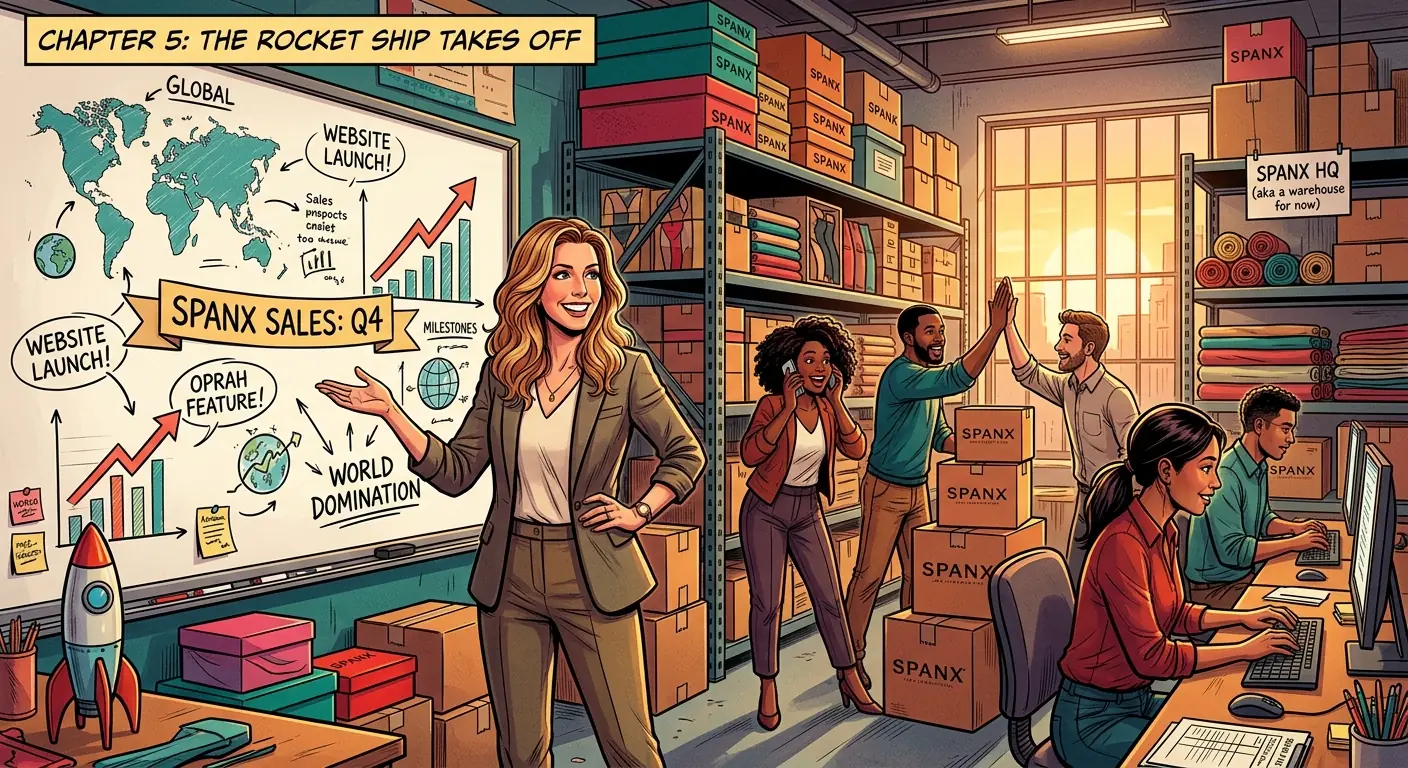
Oprah’s endorsement was the ignition, but the fuel was the product itself. Women tried Spanx. Women loved Spanx. Women told their friends about Spanx. Their friends told their friends.
In its first year, Spanx generated $4 million in revenue. Without advertising. Without a marketing department. Without a sales team. Just word of mouth and one Oprah appearance.
By the end of the second year, revenue had doubled. By year three, it had doubled again. Spanx was being sold at Neiman Marcus, Nordstrom, Saks Fifth Avenue, Bloomingdale’s, and Target. The product line expanded from the original footless pantyhose to include bras, leggings, shapewear shorts, maternity wear, and eventually menswear.
“I didn’t spend a dollar on advertising for the first sixteen years. Not one dollar. The product sold itself because it solved a real problem that every woman understood.”
This is one of the most remarkable facts in modern business history. Spanx grew to become a billion-dollar brand with zero traditional advertising. No TV commercials. No magazine ads. No billboards. Every dollar of growth was driven by product quality, word of mouth, celebrity endorsements (which came organically because celebrities actually used the product), and Blakely’s genius for PR.
She appeared on QVC and sold 8,000 units in six minutes. She talked about Spanx in every interview, at every party, to every stranger on every airplane. She was the product’s walking billboard — enthusiastic, relatable, and completely unfiltered.
The company was also staggeringly profitable. With no advertising costs, no venture capital to service, no debt to repay, and relatively simple manufacturing, Spanx’s margins were extraordinary. Industry analysts estimated gross margins of 50-60% — putting Spanx in the same territory as luxury brands, but with mass-market volume.
And Sara Blakely owned 100% of it. Every share. Every dollar of profit. Every decision.
👑 Chapter 6: The Youngest Self-Made Female Billionaire
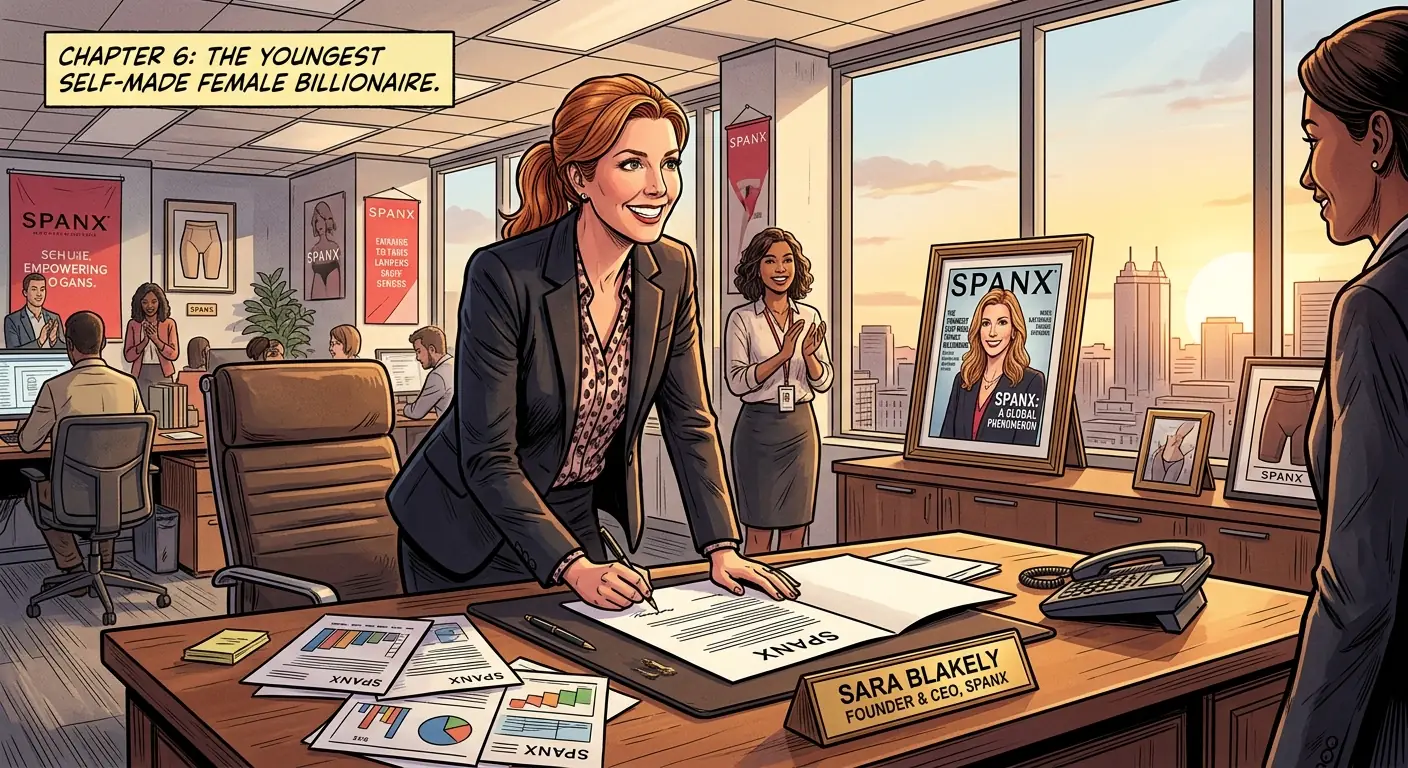
In March 2012, Forbes published its annual billionaires list. For the first time, it included Sara Blakely, with a net worth of approximately $1 billion. She was 41 years old.
More significantly, she was the youngest self-made female billionaire in the world.
The distinction — self-made — was important. There were female billionaires who had inherited their wealth, or who had become billionaires through divorce settlements. But Blakely had built her fortune from scratch, starting with $5,000 and a pair of scissors.
The media loved the story. A fax machine saleswoman from Florida who became a billionaire selling shapewear? It was a perfect narrative — the American Dream in Lycra.
“When Forbes called to tell me I’d made the billionaires list, I was sitting in my car in the parking lot of a Walgreens. That felt appropriate.”
Blakely handled the attention with the same natural charm that had made her a great saleswoman. She was funny, self-deprecating, and honest about the unglamorous parts of her journey. She talked openly about the years of rejection, the tears in the car, the fear of failure.
She also began using her platform for philanthropy. She signed the Giving Pledge in 2013, committing to donate at least half her wealth to charity. She founded the Sara Blakely Foundation, focused on supporting women entrepreneurs through education and mentorship. She provided funding for female-led startups and organizations.
But perhaps her most powerful contribution was her visibility. In a world where most business role models were men, Blakely’s success — built without investors, without an MBA, without connections — proved that the barriers to entry were often imaginary.
“If I can do it,” she told audiences repeatedly, “anyone can do it. And I mean that literally. I had no advantages. I had no special skills. I just refused to quit.”
🏗️ Chapter 7: Scaling Without Selling Your Soul
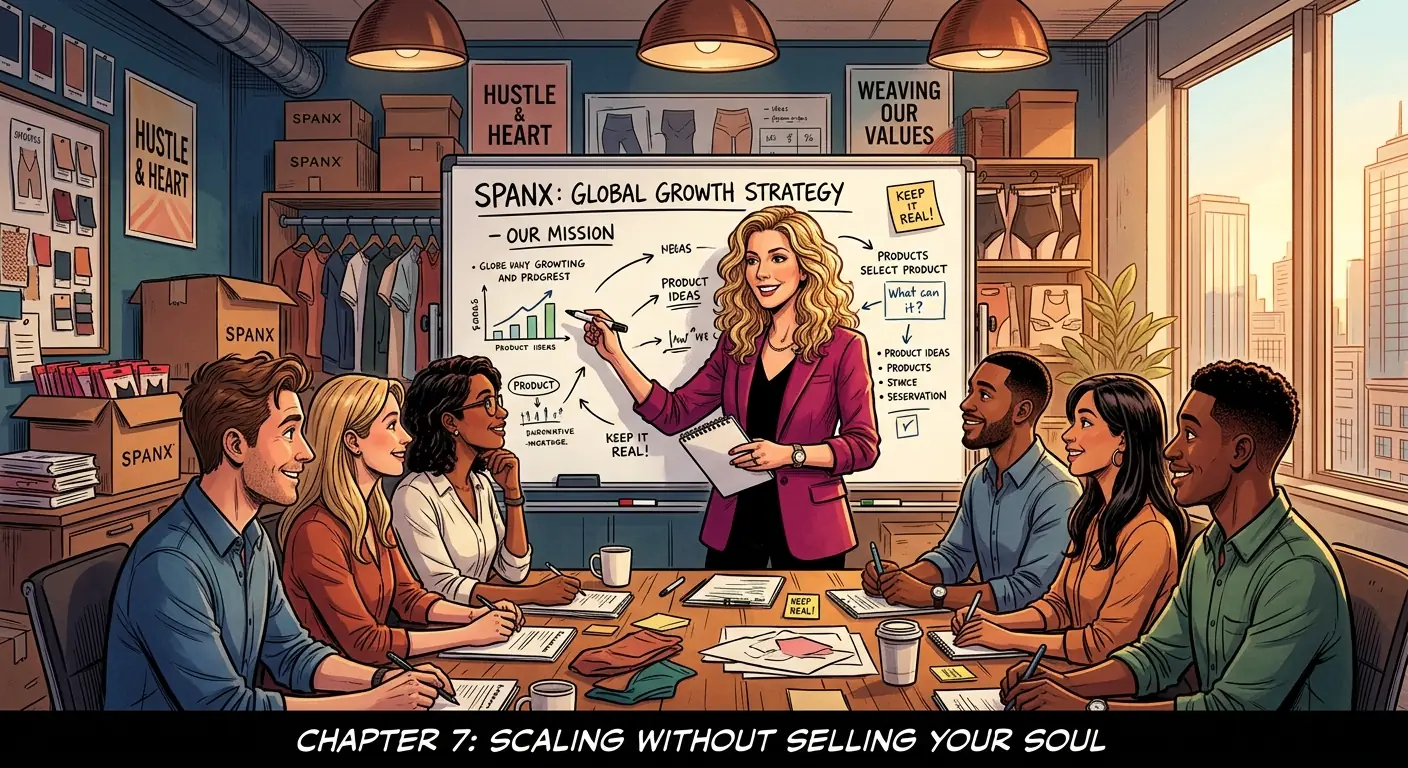
One of the most impressive aspects of the Spanx story is what Blakely didn’t do.
She didn’t take the company public. She didn’t take venture capital. She didn’t bring in a private equity firm. She didn’t hire a celebrity CEO to replace herself. She didn’t franchise. She didn’t license. She didn’t sell out.
For two decades, Sara Blakely ran Spanx as a privately held, founder-controlled, bootstrapped company. In an era where every successful startup was pressured to raise money, scale aggressively, and IPO as fast as possible, Blakely’s approach was radically old-fashioned.
And it worked.
By 2020, Spanx was generating estimated annual revenues of $400-500 million. The brand had expanded from its original shapewear category into activewear, denim, swimwear, and everyday clothing. There were Spanx retail stores in major cities. The brand was sold in over 50 countries.
“Everyone told me I needed outside money. ‘You’re leaving money on the table,’ they said. ‘You need to scale faster.’ But I didn’t want to scale faster. I wanted to scale right. And scaling right meant maintaining control.”
Blakely’s approach to business was deeply personal. She approved every product. She reviewed every ad (when Spanx finally started advertising). She personally tested every garment. The company’s culture reflected her personality: informal, optimistic, fiercely protective of the customer experience.
This isn’t to say the company didn’t face challenges. Competition intensified throughout the 2010s as dozens of shapewear brands entered the market, including Kim Kardashian’s SKIMS, which launched in 2019 and quickly became a major competitor. Fast-fashion brands began offering cheap shapewear knockoffs. The market that Blakely had essentially created was now crowded.
But Spanx’s brand power — built over two decades of product quality and authentic marketing — proved durable. In an age of manufactured authenticity, Blakely’s genuineness was a competitive advantage that no amount of marketing spend could replicate.
💰 Chapter 8: The Blackstone Deal
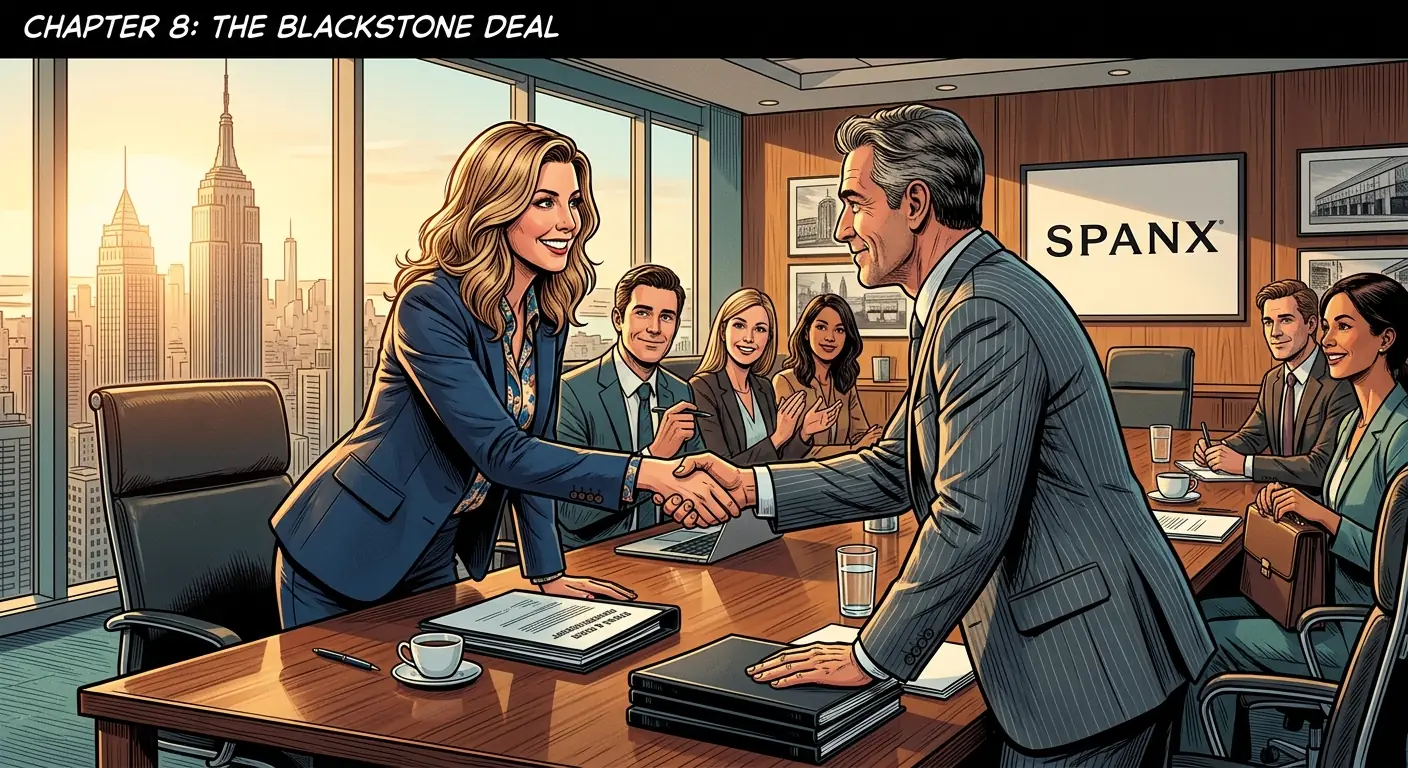
In October 2021, private equity giant Blackstone acquired a majority stake in Spanx at a valuation of $1.2 billion.
The deal made Sara Blakely a billionaire multiple times over (she had already been a billionaire on paper, but the Blackstone deal converted much of that value into liquid cash). Blakely retained a significant minority stake and continued to serve as executive chairwoman.
To celebrate the deal, Blakely did something extraordinary: she gave every one of Spanx’s approximately 500 employees two first-class plane tickets to anywhere in the world and $10,000 in spending money.
“When I got the call that the deal had closed, the first thing I thought about was the people who built this company alongside me. They deserved to celebrate too.”
The total cost of the employee gifts was reportedly around $10 million — a rounding error on the deal value, but a gesture that generated more positive press coverage than any advertising campaign could have achieved.
The Blackstone deal represented a new chapter for Spanx. With Blackstone’s resources and operational expertise, the company could invest in international expansion, digital commerce, new product categories, and the kind of marketing that Blakely had never needed but that a larger company required.
It was also, for Blakely, a partial exit. After 21 years of building Spanx as a solo act, she was sharing control for the first time. The question was whether Spanx’s magic — which was so deeply intertwined with Blakely’s personal touch — could survive institutional ownership.
Early indications were mixed. Revenue grew, but so did competition. SKIMS, in particular, had captured a younger demographic with Kardashian’s social media reach and a more inclusive sizing and marketing approach. The shapewear market was no longer Spanx’s alone.
💔 Chapter 9: The Personal Price
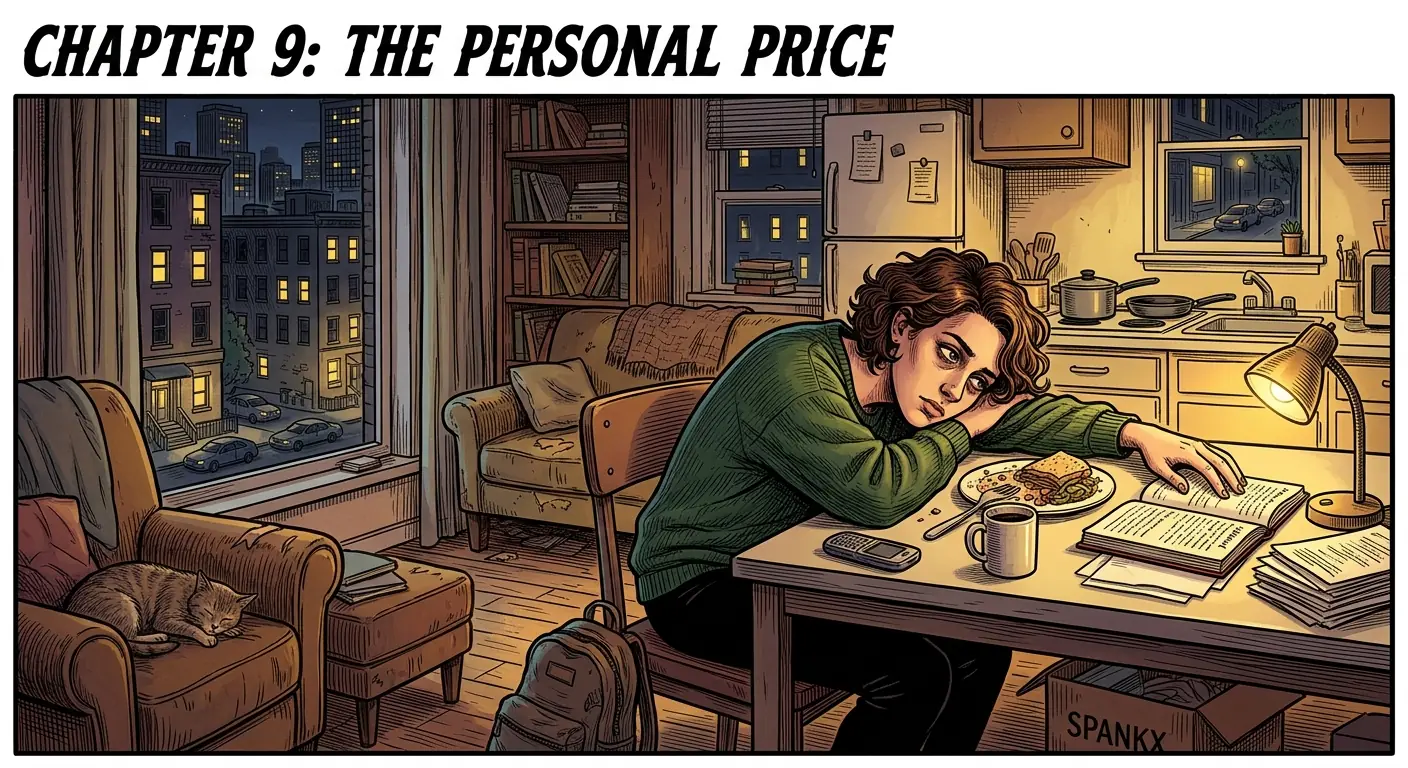
Success stories rarely include the cost. Sara Blakely’s does.
In 2022, Blakely and her husband, Jesse Itzler (entrepreneur, author, and co-owner of the Atlanta Hawks), publicly separated after 14 years of marriage. The separation was amicable, by all accounts, but it underscored a reality that the Instagram version of entrepreneurial success often obscures: building a billion-dollar company while raising four children exacts a toll that no amount of money can fully compensate.
Blakely has been honest about this in interviews. She’s talked about the guilt of missing school events, the stress of running a company while managing a household, and the impossibility of “having it all” as traditionally defined.
“You can have it all, but not all at the same time. Some seasons are about the business. Some seasons are about the family. The trick is being honest about which season you’re in.”
This honesty is part of what makes Blakely’s story resonate more deeply than the typical billionaire narrative. She doesn’t pretend that success came without sacrifice. She doesn’t present a sanitized version of entrepreneurship where hard work leads smoothly to happiness. She acknowledges the trade-offs, the pain, and the moments when she wondered if it was all worth it.
The answer, she insists, is yes. But it’s a qualified yes — a yes that includes sleepless nights, strained relationships, and the constant anxiety of being solely responsible for hundreds of employees’ livelihoods.
🌟 Chapter 10: The Blakely Playbook
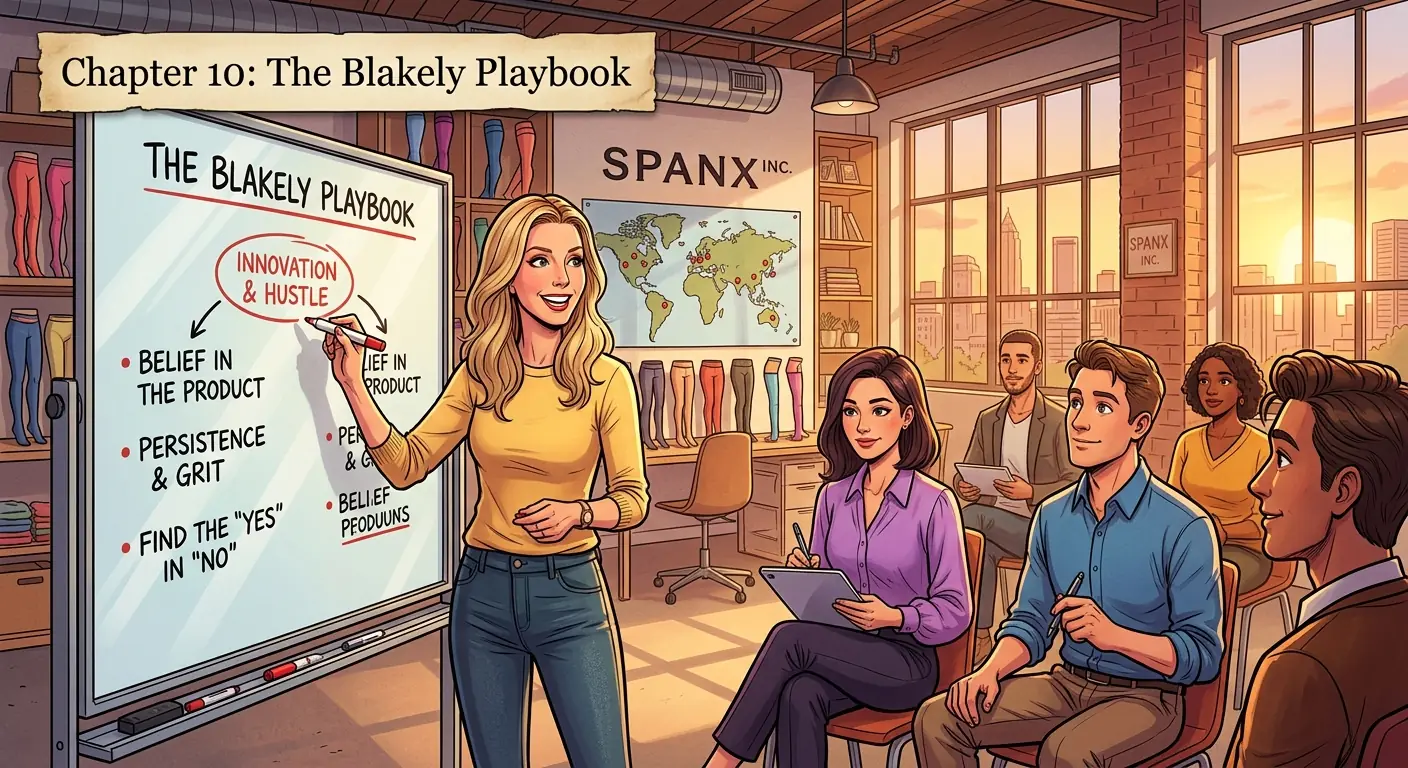
So what can aspiring entrepreneurs learn from Sara Blakely?
Lesson 1: Solve your own problem.
Blakely didn’t conduct market research. She didn’t hire a consulting firm. She experienced a problem firsthand — uncomfortable, unattractive undergarments — and built a solution. The best products come from genuine frustration, not theoretical analysis.
Lesson 2: Ignorance can be an advantage.
Blakely knew nothing about fashion, manufacturing, or retail. This meant she didn’t know what was “impossible.” She didn’t know that hosiery manufacturers would refuse to work with unknown inventors. She didn’t know that major retailers wouldn’t take meetings with unknown brands. So she kept trying until they did.
Lesson 3: Bootstrap if you can.
By not taking outside money, Blakely maintained 100% control and 100% of the economics for 21 years. When she finally sold a stake, she did it on her terms, at a valuation that reflected two decades of profitable growth. Most founders who take VC money early end up with a small slice of a big pie. Blakely kept the whole pie and then sold half of it for a fortune.
Lesson 4: Your story is your marketing.
Spanx spent zero dollars on advertising for 16 years. Instead, Blakely used her personal story — the fax machines, the scissors, the $5,000 — as the brand’s marketing. People didn’t just buy Spanx. They bought into Sara Blakely’s journey. Authentic founder stories are the most powerful marketing tool in the world.
Lesson 5: Celebrate failure.
Blakely’s father’s dinner-table question — “What did you fail at today?” — is the most underrated business strategy in this entire article. The willingness to fail, and to see failure as evidence of effort rather than evidence of inadequacy, is what separates entrepreneurs who quit from entrepreneurs who succeed.
“The secret to Spanx isn’t the fabric or the design. It’s the fact that I was willing to be embarrassed, rejected, and laughed at, over and over again, for years. Most people stop after the first rejection. I just kept going.”
🏆 Chapter 11: The Legacy of the Fax Machine Girl

Sara Blakely’s story is, in many ways, the most improbable billionaire story of the 21st century.
No tech background. No finance background. No family connections. No Ivy League degree. No venture capital. No industry experience. Just $5,000, a pair of scissors, and the emotional resilience that comes from growing up in a household where failure was celebrated.
By 2026, Spanx remained one of the most recognized shapewear brands in the world, even as competition intensified. Blakely continued to serve as executive chairwoman, though her day-to-day involvement had shifted from product development to brand stewardship and mentorship.
Her philanthropic work expanded significantly. The Sara Blakely Foundation had invested millions in women’s entrepreneurship programs. She’d become one of the most sought-after speakers in the business world, commanding fees that would have required years of fax machine commissions.
But perhaps her most lasting legacy isn’t Spanx itself. It’s the proof of concept. Sara Blakely proved that you don’t need Silicon Valley’s playbook to build a billion-dollar company. You don’t need algorithms, platforms, or network effects. You just need a product that people love, the discipline to grow profitably, and the patience to build something lasting.
In a world obsessed with unicorns and disruption, Blakely built something far rarer: a company that grew steadily, profitably, and sustainably for two decades before ever taking outside money.
“I’m not a tech mogul or a financial wizard. I’m a girl from Florida who cut the feet off her pantyhose. And somehow, that turned out to be enough.”
Yeah. Somehow, that was more than enough.
Spanx was valued at approximately $1.2 billion during the Blackstone acquisition in 2021. Sara Blakely’s personal net worth is estimated at over $1 billion. She continues to serve as executive chairwoman of Spanx and is active in philanthropic work through the Sara Blakely Foundation.
👗 Chapter 12: The Spanx Effect: Reshaping an Industry (and Women’s Expectations) (2000s-2010s)
So, Sara Blakely had successfully launched a product that solved a very specific problem: pesky panty lines under white pants. But here’s the kicker – that humble footless tight wasn’t just a garment; it was a Trojan horse for a revolution. Spanx didn’t just sell shapewear; it sold confidence, comfort, and the revolutionary idea that you could smooth things out without feeling like a sausage in a casing. It wasn’t about hiding; it was about enhancing. And that, my friends, was a seismic shift in an industry that desperately needed a good shake-up.
Beyond the Pantyhose: Product Innovation
Once the initial buzz settled, Blakely knew one product, no matter how genius, wouldn’t sustain an empire. The true test of a visionary is not just creating a hit, but knowing how to iterate, innovate, and anticipate what people want next. Spanx quickly diversified, listening intently to customer feedback (a Blakely hallmark, naturally). Women loved the smoothing, but they also had other “pain points.” Enter the parade of Spanx innovations: high-waisted shaper shorts, camisoles, leggings, bras, and even swimwear. By 2009, the brand had expanded into men’s shapewear, a move that raised eyebrows but proved Blakely’s uncanny ability to spot an untapped market. “Men wear suits, too, and they want to look good,” she’d quip, ever the pragmatist.
The sheer breadth of the Spanx product line became staggering. They moved beyond just compression to offer different levels of “squeeze” – from “smooth” to “sculpt” to “shape.” They introduced breathable fabrics, seamless designs, and a rainbow of colors. It wasn’t just about functionality; it was about comfort and variety. Blakely, who famously tested every single product herself, insisted that if it wasn’t comfortable enough to wear all day, it wasn’t going into production. This commitment to user experience, combined with an almost obsessive attention to detail, kept Spanx at the forefront. They weren’t just selling undergarments; they were selling solutions, one perfectly engineered stitch at a time.
The Shapewear Wars: Fending off Copycats
Naturally, success breeds imitation. And boy, did Spanx have imitators. The market was soon flooded with “me-too” brands, from established hosiery giants to nimble startups, all trying to grab a piece of the burgeoning shapewear pie that Sara had baked. It was the Wild West of waist-cinchers. How did Spanx not just survive, but thrive amidst this onslaught? A few key factors: brand loyalty, continuous innovation, and Sara’s unwavering commitment to quality and her core mission.
While competitors often focused on cheaper alternatives or aggressive marketing, Spanx maintained its premium position. They owned the “original” narrative, something incredibly powerful in consumer goods. Furthermore, Blakely had built a cult-like following long before “influencers” were a thing, largely through word-of-mouth and Oprah’s golden endorsement. When a competitor launched a product that looked suspiciously similar, Spanx’s response wasn’t always a lawsuit (though they had their share); it was often to launch something better. They invested heavily in R&D, constantly refining fabrics and designs. Blakely understood that while others could copy the product, they couldn’t copy the soul of the brand, which was deeply intertwined with her personal story and mission to make women feel great. It was a masterclass in staying ahead by simply being them, only more so.
Redefining “Foundation”: From Functional to Fashionable
Before Spanx, “foundation garments” were often associated with grandmothers, girdles, and a general sense of mild torture. They were hidden, functional, and frankly, a bit of a fashion faux pas. Spanx utterly demolished this perception. Blakely’s genius lay in marketing shapewear not as a punitive measure, but as an empowering tool. It wasn’t about squeezing yourself into an unrealistic ideal; it was about smoothing, supporting, and feeling more confident in your clothes.
Suddenly, shapewear wasn’t something to be ashamed of. Celebrities openly touted their love for Spanx on red carpets, acknowledging its role in achieving that flawless silhouette. Oprah’s public endorsement wasn’t just a sales booster; it was a cultural validator. Shapewear became a topic of casual conversation, a “secret weapon” shared between friends. Spanx didn’t just create a product category; it normalized and even glamorized it. It went from being a necessary evil to a fashionable secret, a subtle enhancement that made women feel like the best version of themselves. It was the ultimate undercover agent of confidence, and Sara Blakely was its brilliant, witty commander-in-chief.
💖 Chapter 13: Giving Back and Looking Forward: The Blakely Blueprint for Impact (2006-Present)
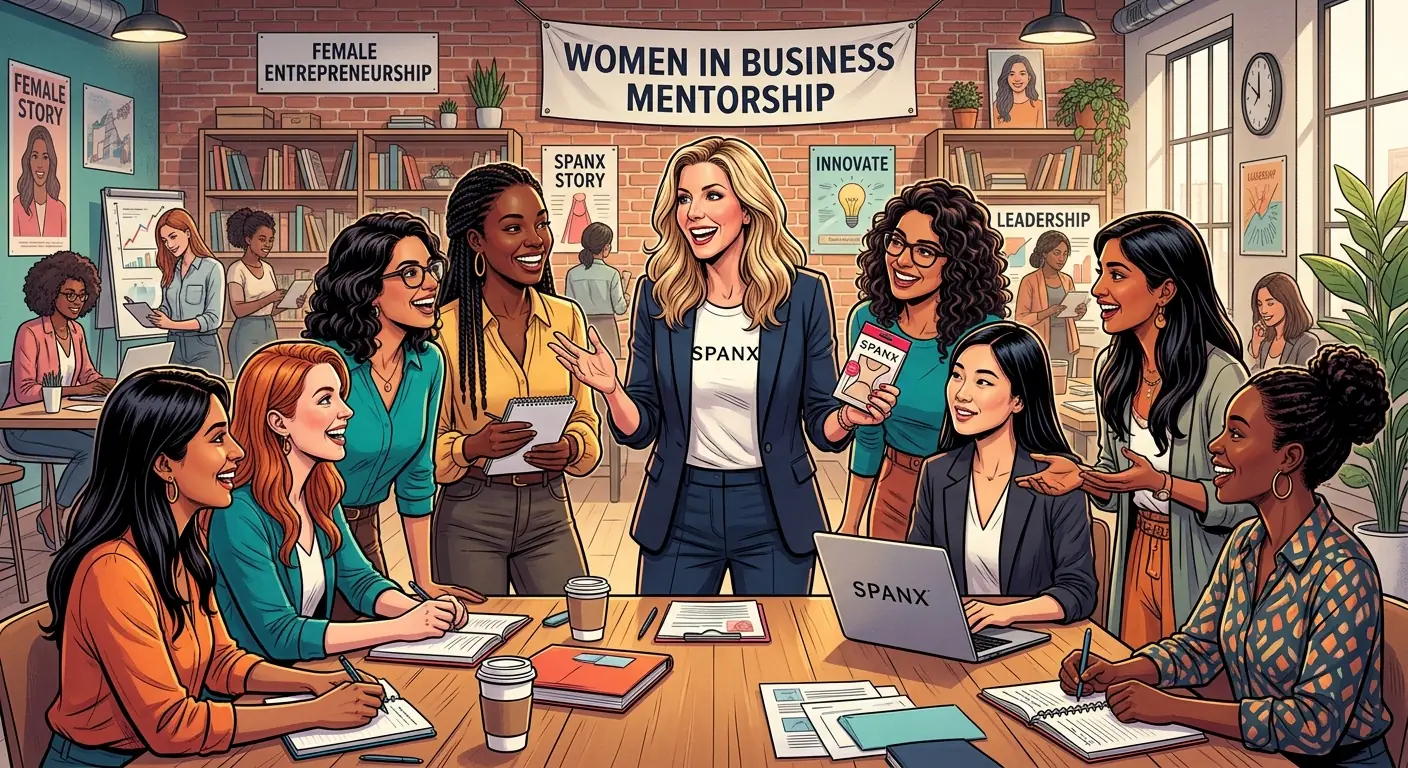
You’d think after building a billion-dollar empire from a pair of cut-up pantyhose, Sara Blakely would be content to kick back on a beach somewhere, sipping margaritas and counting her blessings (and her cash). But if you know anything about Blakely, you know that’s just not her style. From the outset, her vision for Spanx wasn’t just about making money; it was about making a difference, particularly for women. And true to form, she didn’t just talk the talk; she started writing checks. Big ones.
The Foundation: Investing in Women
Sara Blakely’s philanthropic journey is as inspiring as her entrepreneurial one. In 2006, she established the Sara Blakely Foundation, years before she officially became a billionaire. Her mission was clear and focused: to support women through education and entrepreneurship. This wasn’t some vague, feel-good endeavor; it was a direct extension of her own journey. She knew firsthand the power of an idea, the struggle of starting small, and the systemic barriers women often face.
The Foundation has since invested tens of millions of dollars in initiatives across the globe. It’s funded scholarships for women at universities, provided microloans to female entrepreneurs in developing countries, and supported organizations dedicated to empowering women and girls. One notable example includes a $1 million donation to Oprah Winfrey’s Leadership Academy for Girls in South Africa in 2006 – a full-circle moment given Oprah’s pivotal role in Spanx’s early success. Blakely didn’t just want to empower women to look good; she wanted them to feel good, to do good, and to build good. As she often says, “When you empower a woman, you empower her whole family and her entire community.” It’s a pretty powerful ripple effect, originating from a pair of scissors and a dream.
A Family Affair: Balancing Billionaire Life
While building a global brand, Sara also built a family. In 2008, she married Jesse Itzler, an entrepreneur known for co-founding Marquis Jet and being a general force of nature himself. Together, they have four children: Lazer, Maraton, Lincoln, and Tille. Yes, her kids have names that sound like they were destined for greatness, or at least a really interesting memoir. Juggling the demands of a rapidly expanding business and a bustling household of four young kids is no small feat, even for a billionaire. Blakely has often spoken candidly about the myth of “having it all” and the constant juggle.
“I didn’t want to choose between having a family and having a career. I wanted both, and I figured it out. It’s not easy, and it’s messy, but it’s incredibly rewarding.”
She’s been a vocal advocate for integrating work and life, famously bringing her kids to the Spanx office and designing a “mom’s room” there. She embraced the chaos, finding humor in the everyday struggles of balancing board meetings with school pickups. Her approach to motherhood, much like her approach to business, is characterized by authenticity, resilience, and a healthy dose of “I’ll figure it out.” It’s a refreshing take from someone who could easily afford to outsource every aspect of her life, proving that even at the pinnacle of success, some things are just universally human.
The Next Act: What’s Blakely Building Now?
After the monumental 2021 deal where Blackstone acquired a majority stake in Spanx, valuing the company at a staggering $1.2 billion, many wondered what Sara Blakely’s next move would be. While she stepped down as CEO in 2020, she remains the Executive Chairwoman, deeply involved in the brand’s vision and strategy. But her influence extends far beyond Spanx. She continues her work through the Foundation, actively mentoring other female entrepreneurs, and sharing her unique “Blakely Playbook” with aspiring innovators.
She’s a frequent speaker, a mentor, and a consistent voice for female empowerment in business. Her story, from fax machine sales to fashion mogul, is a beacon for anyone who dares to dream differently. She’s not just a businesswoman; she’s a storyteller, a cheerleader, and a living testament to the power of a single idea, executed with grit, humor, and an unshakeable belief in oneself. The fax machine girl’s legacy isn’t just about comfortable undergarments; it’s about making the world a more comfortable, confident, and equitable place for women, one ingenious solution at a time. And frankly, we can’t wait to see what she “fails” at next.
💡 Key Insights
- ▸ Blakely's biggest advantage was being an outsider. She had no fashion industry experience, which meant she had no preconceptions about what was possible or impossible. She didn't know that hosiery manufacturers wouldn't want to work with her, so she kept calling until one said yes. Ignorance of industry norms can be a powerful competitive advantage when those norms are the reason the industry is stale.
- ▸ Spanx's growth was almost entirely organic for the first 16 years — no external funding, no debt, no venture capital. Blakely maintained 100% ownership until the Blackstone deal in 2021. This patience allowed her to build the brand on her terms without pressure to scale prematurely or dilute the product quality. The lesson: not every business needs VC money, and the ones that don't often create more value for their founders.