Sheila Johnson: From BET Co-Founder to a Luxury Hospitality Portfolio
Sheila Johnson helped build a pioneering media company, then created a second act across luxury hospitality, sports ownership, arts, and community investment.

View all stories about this mogul
Sheila Johnson’s career could have ended as a footnote to a historic media exit. Instead, she used the end of one empire to begin the slower work of building another in her own operating image.
Johnson co-founded Black Entertainment Television with her then-husband, Robert Johnson. The network created national distribution for Black music, news, culture, and entertainment when mainstream television offered far less space. After BET’s sale to Viacom, Johnson moved into hospitality, sports, film, education, and the arts—fields connected by experience and place rather than by a single technology.
Her story is compelling because the second act was not a passive investment portfolio. Luxury resorts and professional sports teams require capital, but they also expose owners to operating detail, public scrutiny, and the emotions of customers and communities.
What did building BET teach about owning distribution?

Before BET, Johnson trained and worked as a musician and educator. That background was not the conventional résumé for a cable entrepreneur, but it brought sensitivity to talent, audience, and cultural presentation. BET began in 1980, initially with limited programming time, and grew alongside the expansion of cable distribution.
The strategic gap was obvious but not easy to serve. Black audiences were economically important yet underrepresented in national television. Advertisers needed a way to reach them; artists and producers needed distribution; cable operators needed differentiated programming. BET sat between those groups.
Owning the network mattered. A performer can appear on a program, but the distributor decides which programs exist, when they air, how advertising is sold, and which audience data becomes visible. BET helped demonstrate that representation could be an economic market rather than a charitable exception.
Media scale also brings tension. A network must balance cultural mission, ratings, advertising, costs, and the diversity within any audience. Critics may want more news, more art, or fewer commercial formulas. Those debates are evidence of the power distribution carries: once a platform becomes important, people contest how it uses that importance.
Viacom’s acquisition of BET produced a landmark exit. Yet an exit can create an identity vacuum for a founder—especially when public narratives compress a joint creation into one person’s story. Johnson’s next chapter required choosing what she wanted to own directly.
How did Salamander turn reinvention into an operating company?

Johnson founded Salamander Hospitality and developed what became Salamander Middleburg in Virginia horse country. Resort development is a long-duration bet: acquire or control land, navigate approvals, finance construction, define a guest promise, recruit leaders, and then deliver thousands of details every day.
The choice fit Johnson personally—music, equestrian interests, food, design, and gathering spaces could converge—but personal taste was not enough. Luxury guests notice the gap between a beautiful property and a well-operated one. Housekeeping, kitchens, maintenance, reservations, spas, events, and staff training must perform as one system.
Hospitality also differs sharply from licensing a name to a building. A hotel owner carries real-estate exposure and must keep reinvesting in the property. Demand can collapse during recessions, pandemics, or travel disruptions while fixed costs continue. The asset is tangible; the experience is perishable every night.
Salamander expanded into a collection associated with distinctive properties and management. The strategic logic is not maximum uniformity. A collection can share operating expertise, distribution, procurement, and service standards while allowing each destination to retain a sense of place.
Johnson’s role as a Black woman owner is significant in an industry where guests and frontline workers are diverse but ownership has historically been less so. The distinction affects procurement, leadership pipelines, design choices, and which communities participate in the economics of development.
What connects hospitality, sports, and the arts in Johnson’s portfolio?
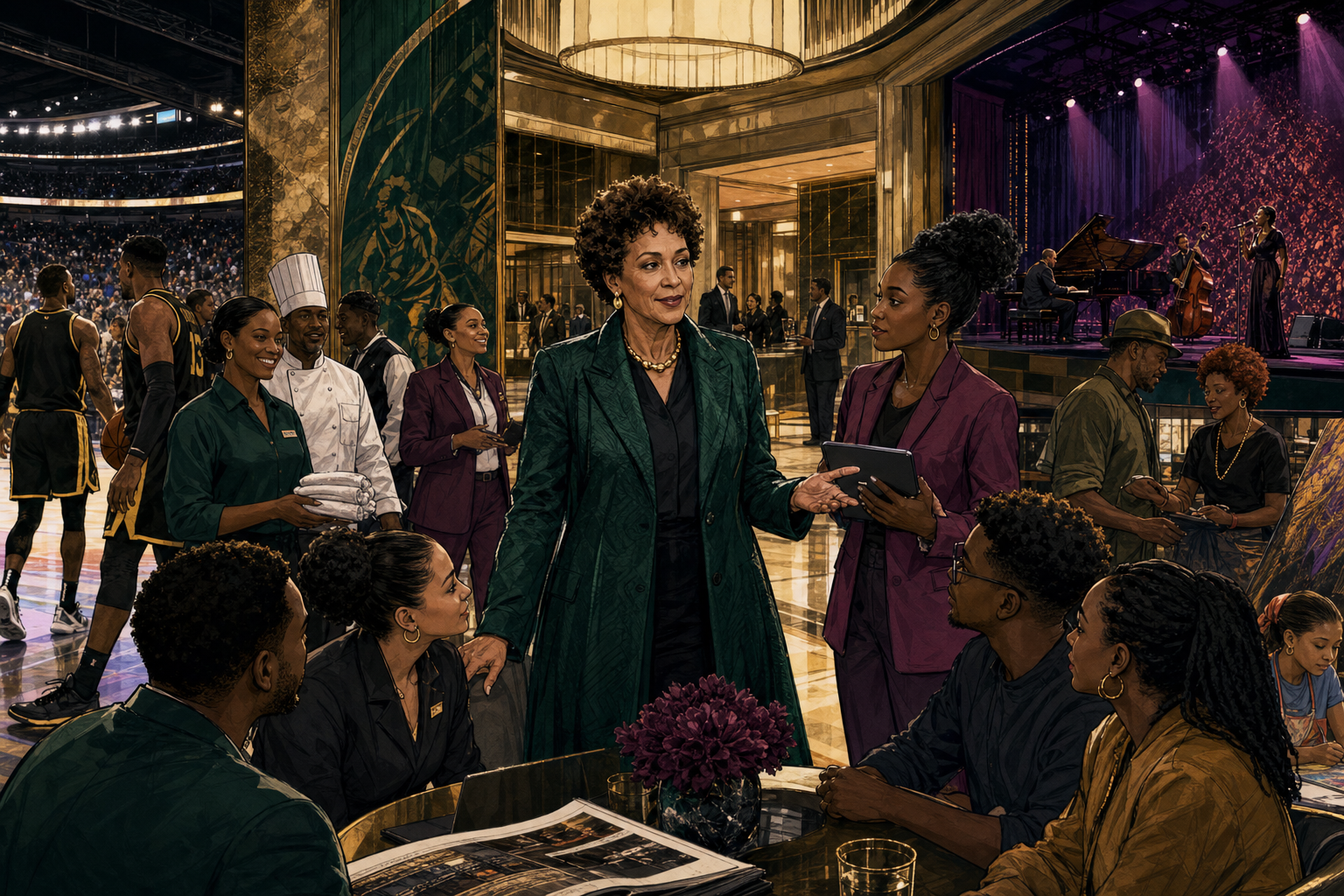
Johnson has held ownership interests connected to Washington professional sports, including the Mystics, Capitals, and Wizards, and has supported film, arts, education, and community initiatives. These may look like unrelated passions. Economically, they share several features: live experience, storytelling, place, talent, and community loyalty.
Sports ownership combines scarcity with civic responsibility. A franchise is a valuable asset partly because leagues tightly limit supply, but its meaning comes from fans, athletes, staff, and a home market. Hospitality similarly monetizes an experience that cannot be separated from how people feel while receiving it.
There are portfolio benefits. Resorts can host events; sports and arts relationships expand networks; storytelling can differentiate a destination. But cross-industry prestige can also distract from unit economics. Each property and team still needs competent management, capital discipline, and a reason to belong in the portfolio.
Johnson’s second act therefore offers a deeper lesson than diversification. She moved from owning a channel that represented an audience to owning places and institutions where people gather. In both cases, the business depends on who feels seen, welcomed, and valued—but inclusion must coexist with operational excellence.
The real lesson is that a successful exit does not automatically create a legacy. Johnson built hers by accepting the risk of becoming an operator again, this time across physical places where the quality of ownership can be experienced directly.
💡 Key Insights
- ▸ A major exit creates optionality, but a second operating career requires rebuilding identity and capabilities.
- ▸ Luxury hospitality is real estate wrapped in thousands of service details; ownership alone does not create experience.
- ▸ Cross-industry portfolios can share place-making, entertainment, and community relationships even when operations differ.
- ▸ Representation becomes more powerful when it includes equity and control, not only visibility.