The Walton Family: How Sam Walton's $5,000 Store Became a $500 Billion Empire That Swallowed America
A small-town merchant with a borrowed $5,000 built the largest company on Earth — then his heirs became the richest family in human history.

View all stories about this mogul
In 1945, a 27-year-old Army veteran named Sam Walton borrowed $5,000 from his father-in-law, added $20,000 of his own savings, and bought a tiny Ben Franklin variety store in Newport, Arkansas — population 7,000. The store was failing. The lease was terrible. The location was nothing special. But Walton didn’t care. He had a theory: if you could sell things cheaper than the guy down the street, people would walk past that guy’s store and come to yours. Every single time.
That bone-simple insight — cheaper, always — would grow into the largest company in the history of the world. Walmart today generates over $600 billion in annual revenue. It employs 2.1 million people, making it the largest private employer on Earth. And the family Sam Walton left behind controls a combined fortune exceeding $250 billion, making the Waltons the wealthiest dynasty in human history.
But here’s the thing nobody tells you about the Walton story: Sam Walton didn’t invent anything. Not a single thing. He just did everything better, faster, and cheaper than everyone else — and he never, ever stopped.
🛒 Chapter 1: The Five-and-Dime Apprenticeship (1918–1962)

Samuel Moore Walton was born on March 29, 1918, in Kingfisher, Oklahoma. His father, Thomas, was a farm mortgage agent — a man who spent the Depression repossessing farms from people who couldn’t pay. His mother, Nan, supplemented the family income by milking cows and selling the milk. Money was tight. Always.
The Kid Who Won Everything
Sam was one of those maddening people who was good at basically everything. Eagle Scout at age 13 — the youngest in Missouri’s history at the time. Quarterback of the football team. Student body president. He had the kind of aggressive, competitive energy that made him impossible to ignore and probably exhausting to be around.
He enrolled at the University of Missouri in 1936, graduated in 1940 with an economics degree, and immediately took a job at J.C. Penney in Des Moines, Iowa. Starting salary: $75 a month. It was at Penney’s that Walton learned the fundamentals of retail — how to manage inventory, how to deal with customers, how to display merchandise. But the most important thing he learned was from a Penney’s manager named Duncan Majors, who taught him to call every customer by name. Sam never forgot this. Decades later, running the biggest retailer on the planet, he’d still walk into stores and address employees and customers by their first names.
World War II interrupted everything. Walton served in the Army Intelligence Corps, supervising security at aircraft plants and prisoner-of-war camps. He reached the rank of captain. Then, in 1945, the war ended and Sam Walton — 27 years old, newly married to Helen Robson, and burning with ambition — went looking for a store to buy.
The Newport Experiment
Helen’s father, L.S. Robson, was a prosperous banker and rancher in Claremore, Oklahoma. He lent Sam $20,000 (Sam had saved $5,000 from his Army service). With $25,000 total, Walton bought a Ben Franklin franchise in Newport, Arkansas.
The store was mediocre. But Walton attacked it like a man possessed. He studied everything. He drove to competing stores in neighboring towns — sometimes driving hundreds of miles — to see how they displayed merchandise, what they charged, what they did differently. He’d walk through a competitor’s store with a notepad, literally writing down their prices. No shame. No pretense. Pure intelligence-gathering.
Within three years, that Newport store was the number-one Ben Franklin franchise in its six-state region, generating $250,000 in annual sales. Walton had figured out the formula: buy goods as cheaply as humanly possible, mark them up as little as possible, and make your money on volume. Sell more stuff at lower margins. Sounds obvious. Almost nobody actually did it.
Then disaster struck. Walton’s landlord, a man named P.K. Holmes, saw how well the store was doing and refused to renew the lease. Holmes wanted the store for his own son. There was no renewal clause — Sam’s father-in-law’s lawyer had missed it. Walton lost everything. He had to sell the business, the inventory, all of it.
He was devastated. In his autobiography Made in America, Walton wrote: “It was the low point of my business life. I felt sick to my stomach. I couldn’t believe it was happening to me. It really was like a nightmare.”
But here’s what makes Sam Walton different from most people: he didn’t mope. He didn’t sue. He packed up his family, moved to Bentonville, Arkansas — a town of barely 3,000 people — and opened a new store. Then another. Then another. He kept going.
🏪 Chapter 2: The Birth of Walmart (1962–1970)

By 1962, Walton owned 15 Ben Franklin variety stores across Arkansas, Missouri, and Oklahoma. He was doing well. But he’d been watching something happening in the retail world that made him restless: discount stores.
Stealing the Idea
Discount retailing was the hot concept of the early 1960s. Stores like Kmart (founded 1962), Target (also 1962), and Woolco were opening in cities across America, offering brand-name goods at steep discounts in big, no-frills buildings. The idea was simple: forget the fancy department store experience. Strip out the carpeting, the chandeliers, the attentive salespeople. Stack the merchandise high, price it low, and let customers serve themselves.
Sam Walton saw this happening and immediately understood it was the future. He went to the Ben Franklin headquarters in Chicago and pitched the idea of launching a discount chain under the Ben Franklin name. They turned him down flat. Too risky, they said. Discount stores were vulgar.
So Walton did it himself. On July 2, 1962, he opened the first Wal-Mart Discount City in Rogers, Arkansas — population 5,700. The name came from Bob Bogle, Walton’s first store manager, who suggested “Wal-Mart” because it had fewer letters and would cost less for the sign. Walton loved that kind of thinking.
The first Walmart was not glamorous. The building was only 16,000 square feet — roughly the size of a modern dollar store. The floors were bare concrete. The merchandise was piled on folding tables. A donkey stood in the parking lot as a promotion for kids. It looked, frankly, like a rummage sale with a roof.
But the prices were insane. Walton had driven all over the region, buying closeouts, overstock, and manufacturer deals directly. He priced everything as low as he possibly could — sometimes making only a few cents per item. “I learned a lesson which has stuck with me all through the years,” he wrote. “Say I bought an item for 80 cents. I found that by pricing it at $1.00 I could sell three times more of it than by pricing it at $1.20. I might make only half the profit per item, but because I was selling three times as many, the overall profit was much greater.”
That single insight — volume beats margins — is the entire Walmart business model. Everything else is execution.
The Small-Town Strategy Nobody Saw Coming
Here’s where Sam Walton outmaneuvered every major competitor in American retail, and he did it with geography.
Kmart, Target, and other discounters opened in cities and suburbs — places with big populations and established shopping corridors. They ignored small towns. Who would build a 50,000-square-foot discount store in a town of 10,000 people? The math didn’t work. There wasn’t enough population to support it.
Sam Walton thought different. He knew small towns. He’d grown up in them, built his business in them, and understood something the MBAs in Detroit and Minneapolis didn’t: people in small towns drove to larger cities to shop because they had no choice. If you gave them a discount store in their town, they’d never leave.
“Our key strategy was to put good-sized stores into little one-horse towns which everybody else was ignoring,” Walton wrote in Made in America. “When people want to simplify the Walmart story, that’s usually how they sum up the secret of our success. And they’re not wrong.”
Walton opened Walmart after Walmart in towns across Arkansas, Missouri, Oklahoma, Kansas, and Louisiana. Towns of 5,000. Towns of 8,000. Places where the nearest competition was a Sears catalog and a general store. In each of these communities, Walmart became the only game in town — literally. By the time Kmart noticed what was happening in these rural markets, Walmart had already locked them down.
Between 1962 and 1970, Walton opened 38 Walmart stores, generating $44 million in annual sales. Not bad for a guy who started with a donkey in a parking lot.
📈 Chapter 3: Going Public and Going Nuclear (1970–1985)

By 1970, Walmart needed capital to keep expanding. Sam Walton had been financing growth with bank loans and personal debt, but the pace of expansion was outstripping his ability to borrow. There was only one option: take Walmart public.
The IPO That Changed Everything
On October 1, 1970, Wal-Mart Stores, Inc. went public on the New York Stock Exchange at $16.50 per share. The IPO raised $3.3 million — a modest amount even by 1970 standards. Nobody on Wall Street took much notice. It was a small-town discount chain from Arkansas. Who cared?
Anyone who bought $1,000 of Walmart stock at the IPO and held it (with stock splits reinvested) would be sitting on roughly $20 million by 2025. It became one of the greatest investments in the history of the American stock market.
With public capital flowing in, Walton hit the accelerator. The expansion was breathtaking:
- 1970: 38 stores, $44 million in sales
- 1975: 125 stores, $340 million in sales
- 1980: 276 stores, $1.2 billion in sales
- 1985: 882 stores, $8.4 billion in sales
That’s a revenue growth from $44 million to $8.4 billion in fifteen years. A 190x increase. In retail. Where margins are razor-thin. It shouldn’t be mathematically possible. But Sam Walton made it work because of one thing nobody talks about enough: the distribution system.
The Logistics Revolution
Sam Walton’s real genius wasn’t picking store locations or negotiating with suppliers — though he was brilliant at both. His master stroke was building a distribution network that was, by a wide margin, the most efficient in retail history.
Walton’s system worked like this: instead of having suppliers ship directly to individual stores (the standard model), Walmart built massive distribution centers positioned within a day’s drive of clusters of stores. Suppliers shipped to the distribution center. Walmart’s own fleet of trucks then delivered goods to every store in the region on a strict schedule.
This did three things simultaneously. First, it gave Walmart enormous purchasing power — they were buying in gigantic quantities for the distribution center, which meant lower prices from suppliers. Second, it eliminated middlemen and reduced shipping costs. Third, it meant Walmart stores could restock faster than any competitor. When a shelf went empty, it got refilled within 48 hours. Kmart, by comparison, often took weeks.
By 1985, Walmart operated its own fleet of more than 2,000 trucks and was investing in satellite technology — literal communication satellites — to track inventory in real time across hundreds of stores. In 1987, Walmart completed its private satellite network, the largest in the private sector, linking every store, distribution center, and the Bentonville headquarters into one system. Sam Walton, a country boy from Oklahoma, was using space technology to track how many tubes of toothpaste were on the shelf in store #247 in Paragould, Arkansas.
David Glass, who served as Walmart’s CEO from 1988 to 2000, put it bluntly: “People think we got big by putting big stores in small towns. The truth is we got big because of distribution. If we had not been ahead of everyone else in distribution, we never could have grown the way we did.”
🤠 Chapter 4: The Billionaire in a Pickup Truck (1985–1992)

In 1985, Forbes magazine named Sam Walton the richest man in America, with a fortune estimated at $2.8 billion. Walton was horrified. Not because it was wrong — but because he hated the attention.
The Richest Man Who Didn’t Act Like It
Sam Walton’s personal lifestyle was a genuine oddity among the ultra-wealthy. He drove a 1979 Ford F-150 pickup truck with cages in the back for his bird dogs. He got his hair cut at the local barbershop in Bentonville for $5. He wore Walmart clothes — khakis and a baseball cap, usually. He ate at the local diner. When journalists came to profile the richest man in America, they expected a mansion. They found a nice but unremarkable house on a quiet street.
This wasn’t an act. People who knew Walton consistently described a man who genuinely didn’t care about luxury. “I have concentrated all along on building the finest retailing company that we possibly could,” he wrote. “Period. Creating a huge personal fortune was never particularly a goal of mine.”
Whether you believe that or not — and critics argue that Walton’s folksy frugality was itself a carefully cultivated brand — the contrast with other billionaires of the era was striking. While Donald Trump was gilding everything in sight and Lee Iacocca was doing Chrysler commercials, Sam Walton was wandering through his own stores at 4 AM, checking shelf prices and talking to stock clerks.
The Saturday Morning Meeting
Walton created a company culture that was part revival meeting, part boot camp. The centerpiece was the Saturday Morning Meeting at Bentonville headquarters — a weekly gathering that began at 7 AM sharp and included hundreds of managers, executives, and visiting store employees. There were cheers. There were chants. There was the Walmart Cheer: “Give me a W! Give me an A! Give me an L!” All the way through, with a squiggly for the hyphen. Grown adults. In a conference room. At seven in the morning on a Saturday.
It was corny. It was cultish. And it worked. Walton used these meetings to review store performance in granular detail, recognize top-performing employees, share ideas, and keep everyone aligned on the mission of low prices. The meetings continued long after his death and still take place today.
Walton also pioneered what he called “profit sharing” — giving hourly employees a share of store profits and access to company stock through a purchase plan. Associates, as Walmart called all employees, could buy stock at a 15% discount. Those who participated early and held on became genuinely wealthy. Walton loved telling these stories — the truck driver who retired with $700,000, the cashier who put three kids through college on stock gains.
Critics would later point out that profit sharing and stock purchase plans are a very different thing from paying people well. But in the 1980s, it was revolutionary for a retail company. It made employees feel like owners — which was exactly what Walton wanted.
⚰️ Chapter 5: The Death of the King and the Rise of the Dynasty (1992–2010)

On March 17, 1992, President George H.W. Bush awarded Sam Walton the Presidential Medal of Freedom in a ceremony at Walmart headquarters in Bentonville. Walton was too ill to travel to Washington. He had been diagnosed with multiple myeloma — a blood cancer — and he was dying.
Walton received the medal in a wheelchair. He passed away on April 5, 1992, at age 74. At the time of his death, Walmart had 1,928 stores and annual sales of $55 billion. It was already the largest retailer in America. But the real explosion was still to come.
The Heirs
Sam and Helen Walton had four children: Rob (born 1944), Jim (born 1948), Alice (born 1949), and John (born 1946). Sam had divided his Walmart shares among the family early — a brilliant estate-planning move that distributed the wealth before it became enormous, dramatically reducing the tax burden on the next generation.
When Sam died, the family owned approximately 38% of Walmart stock. As the company continued its relentless expansion through the 1990s and 2000s — adding supercenters, expanding internationally, launching grocery operations — that 38% became worth staggering sums.
Rob Walton served as chairman of Walmart’s board from 1992 to 2015. Quiet, methodical, and deeply private, Rob oversaw the company’s transformation from a domestic retail chain into a global behemoth. Under his chairmanship, Walmart expanded into Mexico, Canada, China, the United Kingdom, Brazil, and dozens of other countries. By 2005, Walmart had become the first company in history to exceed $300 billion in annual revenue. Rob’s personal fortune as of 2026 is estimated at approximately $77 billion.
Jim Walton ran Arvest Bank Group, the family’s regional banking empire based in Bentonville, and served on Walmart’s board. He kept the lowest profile of any Walton, rarely giving interviews and avoiding the spotlight entirely. His net worth is estimated at approximately $72 billion.
Alice Walton became the most publicly visible Walton — not through retail, but through art. In 2011, she opened Crystal Bridges Museum of American Art in Bentonville, a $200 million museum designed by Moshe Safdie and housing works by Andy Warhol, Norman Rockwell, Georgia O’Keeffe, and other American masters. Alice spent decades and hundreds of millions assembling the collection. She also became deeply involved in education reform, pouring money into charter school initiatives. Her net worth is approximately $72 billion.
John Walton served in Vietnam as a Green Beret medic, became a crop duster pilot, and later focused on education and philanthropy. He was killed on June 27, 2005, when the ultralight aircraft he was flying crashed near Jackson Hole, Wyoming. He was 58 years old. His wealth passed to his son, Lukas Walton, who as of 2026 controls a fortune of approximately $30 billion and has become an active impact investor focused on sustainability and environmental causes.
Helen Walton, Sam’s wife and the quiet anchor of the family, died on April 19, 2007, at age 87. Rob’s son-in-law, Steuart Walton, and Jim’s son, Tom Walton, have also become increasingly active in Walmart governance and in reshaping Bentonville into a destination for mountain biking, art, and corporate tourism.
The Combined Fortune
As of 2026, the Walton family’s combined net worth exceeds $250 billion. To put that in perspective: no individual billionaire on Earth — not Elon Musk, not Bernard Arnault, not Jeff Bezos — commands that much wealth alone. The Waltons do it as a family. They are the richest dynasty in human history, and it all traces back to a $5,000 loan and a variety store in Newport, Arkansas.
⚡ Chapter 6: The Machine After Sam — Walmart’s Unstoppable Growth (1992–2026)

After Sam’s death, Walmart didn’t slow down. It accelerated. The company Sam built had become a self-sustaining growth machine — powered by the distribution infrastructure, the supplier relationships, and the relentless cost discipline he had embedded into its DNA.
The Supercenter Revolution
In the mid-1990s, Walmart introduced the Supercenter format — stores of 180,000 square feet or more that combined a full discount store with a complete grocery supermarket. It was a nuclear weapon aimed at the grocery industry. Traditional supermarket chains — Kroger, Safeway, Albertsons — were suddenly competing against a company that could sell groceries at lower prices because it was subsidizing food margins with profits from general merchandise.
The results were devastating. By 2001, Walmart had become the largest grocery seller in America. Thousands of independent grocers and regional chains went under. Entire food deserts emerged in communities where the local grocery store closed after Walmart moved in nearby, only for Walmart to later close its own store in pursuit of a better location.
The Numbers
The scale of Walmart by the 2020s defies easy comprehension:
- Revenue (2025): Over $640 billion — larger than the GDP of most countries
- Employees: 2.1 million worldwide — only the U.S. Department of Defense employs more people
- Stores: More than 10,500 locations in 19 countries
- Weekly customers: Approximately 240 million people visit Walmart stores or websites every week
- Market cap: Over $500 billion
Walmart is not just a company. It is an economic ecosystem. Its purchasing decisions shape global manufacturing. When Walmart tells a supplier to cut prices, that supplier restructures its entire operation to comply — or loses access to the largest retail distribution channel on Earth.
🔥 Chapter 7: The Dark Side — Wages, Unions, and the Walmart Effect

No honest accounting of the Walmart story can ignore the controversies that have shadowed the company for decades. Sam Walton built an empire on low prices. Critics argue he did it by keeping wages even lower.
The Wage Problem
As of 2025, Walmart’s minimum starting wage is $14 per hour. The median full-time Walmart associate earns approximately $28,000 per year. That is below the poverty line for a family of four in most American states.
For decades, studies have shown that a significant percentage of Walmart employees rely on food stamps, Medicaid, and other public assistance programs to survive. A 2020 report by the Government Accountability Office found that Walmart was one of the top employers of SNAP (food stamp) recipients in multiple states. Critics frame this as a hidden subsidy: American taxpayers effectively subsidize Walmart’s labor costs by providing healthcare and food assistance to workers the company doesn’t pay enough.
The Walton family’s response has generally been that Walmart provides opportunity, flexibility, and advancement to millions of people who might otherwise lack employment entirely. The company has raised wages several times since 2015, when it implemented a $9 minimum wage that has since risen to $14. But the gap between the Walton family’s $250 billion fortune and the $28,000 annual earnings of a typical associate remains a lightning rod.
The Anti-Union Machine
Walmart is one of the most aggressively anti-union companies in American history. The company has fought unionization with a sophistication and intensity that is genuinely remarkable. It maintains a “Labor Relations” team that deploys to any store where union activity is detected, sometimes within hours. Managers are trained with videos and manuals on how to identify and discourage union organizing. Employees who have attempted to organize have reported intimidation, schedule reductions, and termination.
The most infamous incident occurred in 2000, when meat cutters at a Walmart in Jacksonville, Texas, voted to join the United Food and Commercial Workers Union. It was the first and only time any group of Walmart employees successfully unionized in the United States. Walmart’s response? It eliminated the meat-cutting department in every single store in the country, switching to pre-packaged meat. Rather than negotiate with a union in one department at one store, the company restructured its entire national meat operation.
Sam Walton addressed unions bluntly in Made in America: “I’ve always said the union is not something management should have to face, provided we do a good job of managing our people.” In practice, “doing a good job” often meant spending enormous resources ensuring no union vote ever succeeded.
The Walmart Effect on Small Towns
Perhaps the most debated legacy of Walmart is its impact on the communities Sam Walton claimed to love. When Walmart opens in a small town, studies consistently show a pattern: local shops close. The downtown hollows out. Jobs shift from multiple small businesses to a single large employer. Prices do drop — that part of Walmart’s promise is real. But the character of the community often changes irrevocably.
Economist Kenneth Stone of Iowa State University documented this phenomenon extensively in the 1990s, finding that within ten years of a Walmart opening, towns within a 20-mile radius lost up to 47% of their retail trade. Main Streets emptied. Hardware stores, pharmacies, clothing shops, sporting goods stores — gone. Replaced by a single building on the edge of town with a parking lot the size of a football field.
Defenders of Walmart argue that this is simply progress — that consumers vote with their wallets and choose lower prices over sentiment. Sam Walton himself seemed genuinely unbothered by it. “If some community, for whatever reason, doesn’t want us in there, we aren’t interested in going in and creating a fuss,” he wrote. But he also acknowledged the basic truth: “There is no question that we have put some small-town merchants out of business.”
🏛️ Chapter 8: The Political Dynasty Nobody Elected

The Walton family doesn’t run for office. They don’t need to. Their wealth gives them political influence that most elected officials can only dream of.
The Education Crusade
The Walton Family Foundation, funded primarily by Jim, Rob, and Alice Walton, has poured more than $1 billion into education reform — specifically, into charter schools and school choice initiatives. The foundation has funded the creation of thousands of charter schools across the United States and has been one of the most powerful forces behind the school privatization movement.
This has made the Waltons heroes to some and villains to others. Supporters argue they are giving low-income families access to better educational options. Critics, including teachers’ unions, argue the Waltons are systematically undermining public education while profiting from the privatization of a public good.
Political Spending
The Walton family and Walmart’s PAC have donated hundreds of millions of dollars to political candidates and causes at the federal, state, and local levels. Their giving has historically skewed Republican, though they’ve donated to Democrats as well. Their lobbying priorities have included lower corporate taxes, reduced business regulation, and — perhaps unsurprisingly — opposition to minimum wage increases at the federal level.
In Bentonville itself, the family has essentially rebuilt the town. Through various family-funded initiatives, Bentonville has gained the Crystal Bridges Museum, a world-class mountain biking trail system, boutique restaurants, and a rapidly growing tech scene. It’s a vision of what unlimited private wealth can do when applied to a single community. Whether it’s a model or an anomaly depends on your perspective.
💡 What the Walton Empire Teaches Us
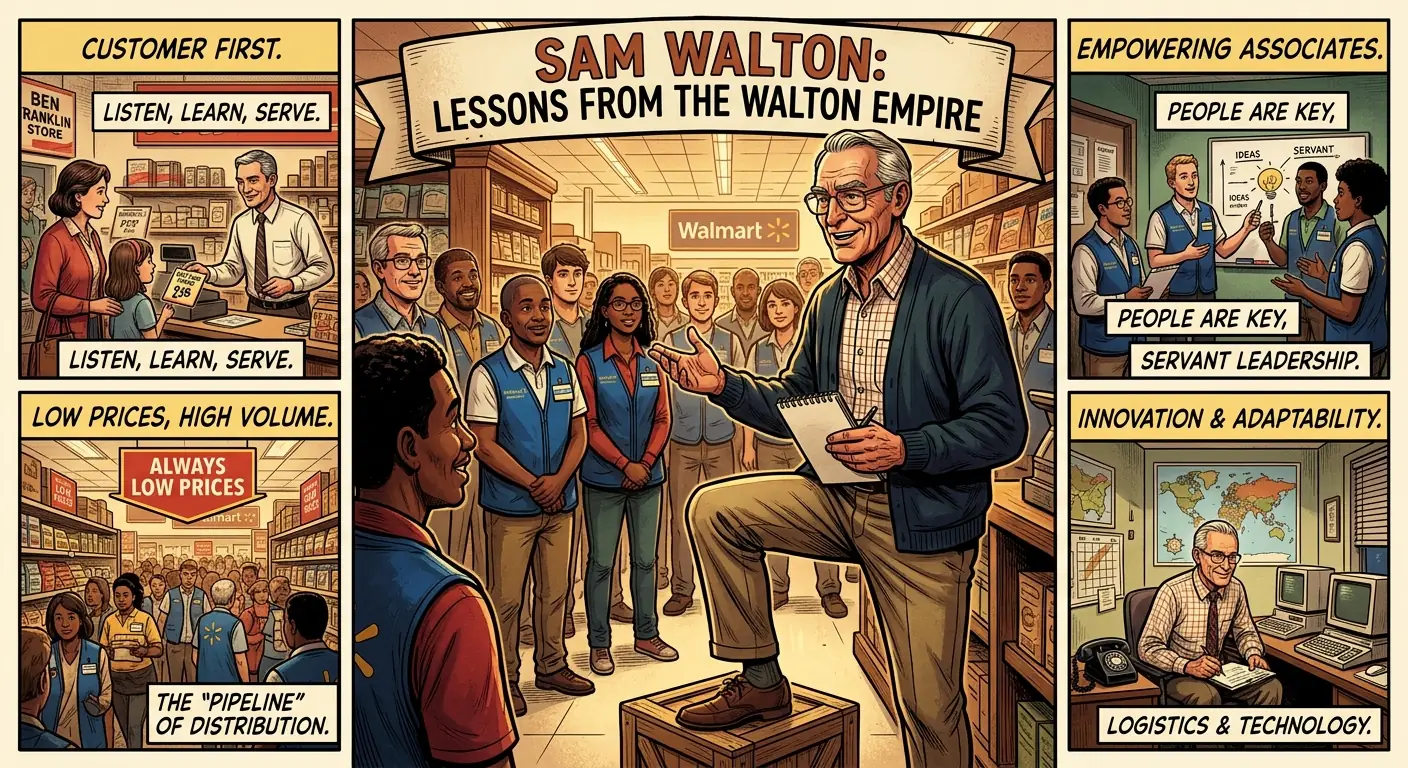
Sam Walton’s story is not a tale of genius invention or technological disruption. He didn’t create a new product. He didn’t discover a scientific breakthrough. He didn’t write code. What Sam Walton did was take an existing idea — selling things for less — and execute it with a ferocity, discipline, and logistical precision that nobody else could match. Then he passed it down to a family that held on tight.
The Walton story raises questions that go far beyond business strategy. When one family controls $250 billion in wealth generated by 2.1 million workers earning a median of $28,000, what does that say about the economy those workers live in? When a single company can reshape the physical and economic landscape of thousands of American communities, who bears responsibility for what’s lost?
Sam Walton answered these questions with cheerful pragmatism. In the final pages of Made in America, written as he was dying of cancer, he reflected: “I had to pick myself up and get on with it, do it all over again, only even better this time.” That was his entire philosophy in eleven words. Fall down. Get up. Do it cheaper. Do it bigger. Never stop.
The Waltons haven’t stopped. And the machine Sam built in a small Arkansas town with a borrowed $5,000 keeps grinding forward — creating wealth at the top, controversy at the bottom, and low prices for everyone in between.
Whether that’s a triumph or a tragedy depends entirely on where you’re standing in the store.
⚙️ Chapter 9: The Invisible Machine: Supply Chain Mastery (1970–1990)
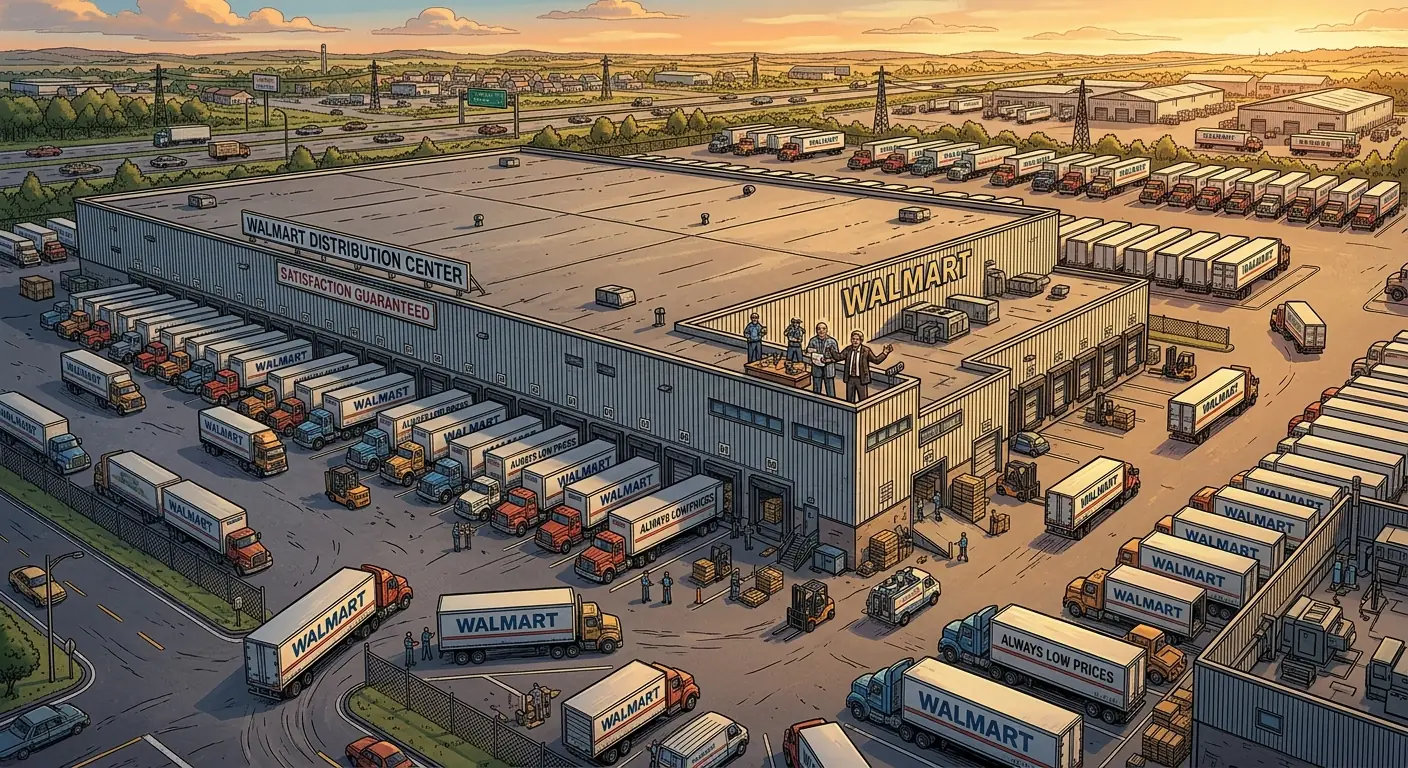
So, Sam Walton had this brilliantly simple idea: sell stuff cheaper. But how do you actually do that when you’re buying from the same manufacturers as everyone else? The secret wasn’t just in Sam’s legendary haggling (though, trust us, he was a master). The real magic, the kind that made competitors tear their hair out, was in the invisible machine that hummed behind every fluorescent-lit aisle: Walmart’s revolutionary supply chain. This wasn’t just about moving boxes; it was about moving them faster, cheaper, and smarter than anyone thought possible. It became their ultimate competitive weapon.
The Distribution Center Revolution
While other retailers relied on manufacturers to ship directly to individual stores (a logistical nightmare for a growing chain), Sam had a different vision. He’d build his own distribution centers. The first one opened in 1970 in Bentonville, a 200,000-square-foot behemoth that served 15 stores. By 1978, Walmart had three such centers, each servicing stores within a day’s drive. This wasn’t just about efficiency; it was about control. Walmart dictated the terms, the timing, the packaging. They cut out middlemen like a surgeon removes a tumor.
This hub-and-spoke model meant that instead of dozens of trucks from different suppliers showing up at each store, a single Walmart truck could deliver everything a store needed, often several times a week. This reduced inventory in stores (saving precious real estate and capital), minimized stockouts, and drastically cut transportation costs. It was the retail equivalent of building your own highway system while everyone else was stuck on dirt roads. They didn’t just sell things; they orchestrated their movement with military precision.
UPC, Satellites, and Cross-Docking: The Tech Edge
Walmart was an early adopter of just about any technology that promised to save a nickel. They were among the first to widely implement UPC bar codes across all their stores by the mid-1980s. This wasn’t just for scanning items at checkout; it allowed them to track every single product, every single sale, in real-time. This data was gold. It told them what was selling, where, and when, allowing them to optimize inventory and ordering with unheard-of precision.
Then came the satellites. Yes, satellites! In 1983, Walmart launched its own private satellite communication system, a $24 million investment that connected all its stores, distribution centers, and headquarters. This wasn’t for watching Netflix; it was for instant communication, sharing sales data, coordinating logistics, and even broadcasting Sam Walton’s folksy pep talks directly to every store. It was like having a corporate brain connected by fiber optics when everyone else was still using snail mail.
But perhaps the most ingenious innovation was cross-docking. Imagine goods arriving at a distribution center, not to be stored, but to be immediately sorted and transferred to an outbound truck heading to a specific store. No warehousing, no long-term storage costs. Products would literally “cross the dock.” This meant goods could move from manufacturer to store shelf in a matter of days, sometimes hours, not weeks. It was a logistical ballet, choreographed for maximum speed and minimal cost, making their “everyday low prices” not just a slogan, but an operational reality. Sam Walton might have been a country boy, but his supply chain was pure rocket science.
🌎 Chapter 10: The World is Not Enough: Global Ambitions and Retail Wars (1980–2000)
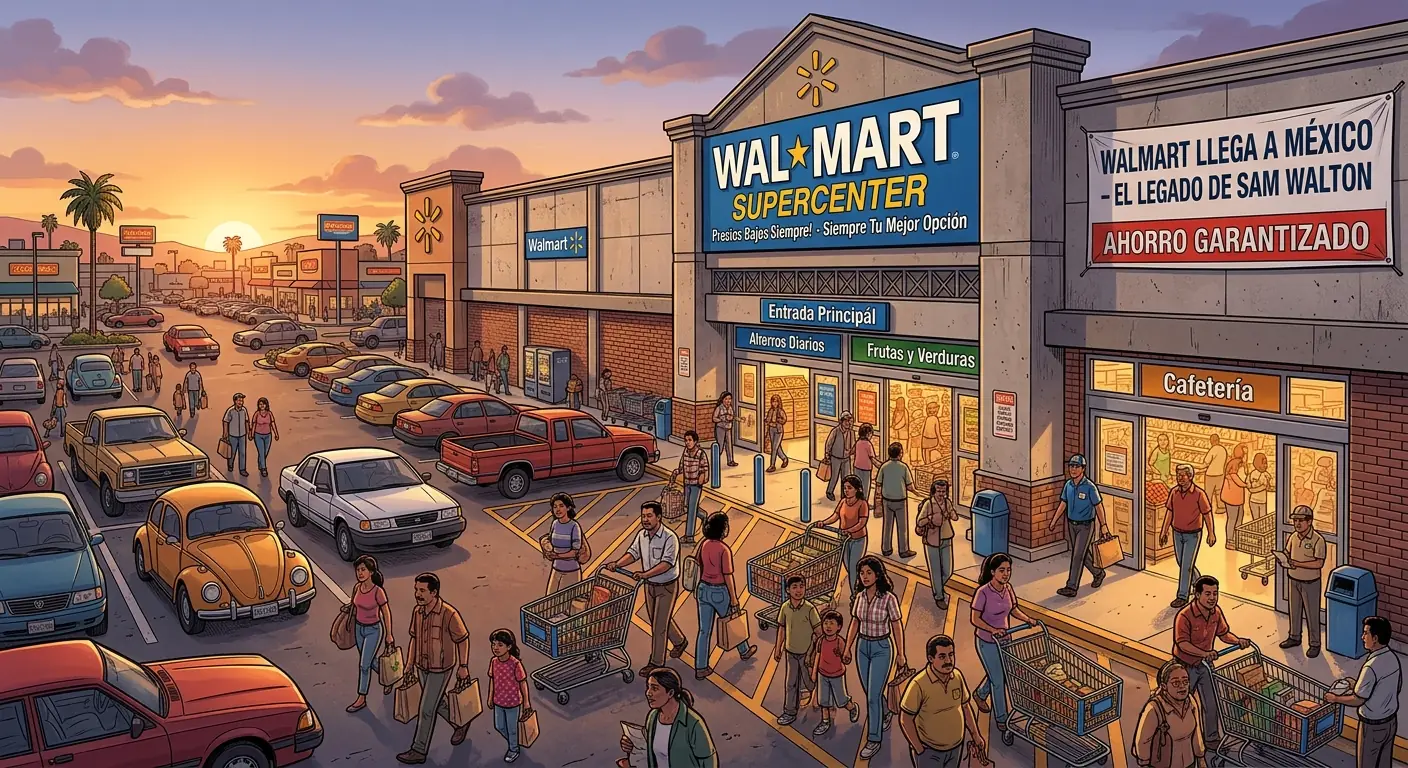
By the 1980s, Walmart was already a titan in the U.S., but Sam Walton’s ambition, much like his personal fortune, knew no bounds. He wanted to take his low-price, high-volume model everywhere. But expanding outside the comfort of rural America meant going head-to-head with established giants and navigating entirely new cultural landscapes. It was a gamble, a test of whether the “Walmart Way” was universally applicable, or if it was just a particularly potent strain of American exceptionalism.
Kmart’s Folly, Walmart’s Triumph
Before Walmart conquered the world, it first had to bury its closest domestic rivals. The 1970s and 80s were the golden age of the discount store, and the fiercest battle was waged against Kmart. Kmart had a significant head start, boasting 2,000 stores by the early 1980s compared to Walmart’s roughly 800. But Kmart made a fatal error: complacency. They focused on promotions and coupons, chasing short-term sales boosts, while Walmart relentlessly focused on everyday low prices, supply chain efficiency, and relentless expansion into smaller towns that Kmart ignored.
Walmart’s strategy was simple: build Supercenters (combining general merchandise with a full grocery store) and cluster them around distribution centers. Kmart, meanwhile, started diversifying into specialty stores and neglected its core discount format. By 1990, Walmart surpassed Kmart in sales. By 1991, it was the largest retailer in the U.S. The difference wasn’t just in strategy; it was in culture. Sam Walton was notorious for visiting stores, quizzing managers, and constantly looking for ways to improve. Kmart’s leadership, by contrast, grew distant and bureaucratic. The result? Kmart declared bankruptcy in 2002, a retail cautionary tale etched in the annals of business history. Walmart didn’t just win; it absorbed its competitor’s market share like a black hole.
The World is Not Enough: International Expansion
Sam Walton himself presided over Walmart’s first international foray, a joint venture with Cifra, a Mexican retail group, leading to the opening of the first Walmex store in 1991. It was a smart move, starting close to home. Then came Canada in 1994, when Walmart acquired 122 Woolco stores, instantly establishing a significant footprint. These were relatively easy wins, culturally and logistically similar to the U.S.
But then came the bigger, bolder, and often bumpier adventures. In 1997, Walmart acquired the German chain Wertkauf, marking its entry into Europe. A year later, they stormed into South Korea and China. The idea was simple: replicate the U.S. model. But the world, it turned out, wasn’t quite ready for a one-size-fits-all approach to discount retail. The company learned, sometimes painfully, that “everyday low prices” needed local context. In some markets, they struggled to adapt their supply chain to existing infrastructure, or their product mix clashed with local tastes. While Walmart saw phenomenal success in Mexico and Canada, Europe and South Korea proved to be far tougher nuts to crack, highlighting that even the mightiest empire can find its limits.
Culture Clash: Lessons from Abroad
Walmart’s international expansion wasn’t a uniformly triumphant march. In Germany, for example, they struggled immensely. German shoppers valued quality and service over rock-bottom prices, and Walmart’s aggressive pricing tactics and corporate culture clashed with local labor laws and consumer expectations. They famously tried to implement “greeters” and employee cheers, which were met with bewilderment and even ridicule. After nearly a decade of losses and an estimated $1 billion in write-offs, Walmart finally pulled out of Germany in 2006, selling its 85 stores.
Similarly, South Korea proved challenging, where local competitors like E-Mart were better attuned to consumer preferences, offering fresher produce and a more localized shopping experience. Walmart exited South Korea in 2006 as well. These failures weren’t just financial setbacks; they were humbling lessons that even a company as dominant as Walmart couldn’t simply transplant its model without deep cultural understanding and flexibility. It forced the company to become more agile, more willing to localize its approach, and acknowledge that sometimes, the “Walmart Way” needed a bit of local flavor.
🎨 Chapter 11: Beyond the Big Box: Family Values and Philanthropic Power (1992–Present)

Sam Walton’s passing in 1992 left a void at the helm of Walmart, but it also cemented the legacy of a family that, for better or worse, would forever be intertwined with the identity of America itself. While the company continued its relentless march, the Walton family members, now among the wealthiest people on Earth, began to carve out their own distinct paths, moving beyond the discount aisles into the realms of art, education, and environmental conservation. Their collective influence, channeled through various foundations and personal projects, became a force just as potent, if less visible, than the retail behemoth itself.
Beyond the Big Box: Helen’s Legacy and Family Values
While Sam was the public face of Walmart, his wife, Helen Robson Walton, was the quiet anchor of the family. A formidable woman in her own right, she instilled a strong sense of community and frugality in her children, even as their wealth skyrocketed. Helen was a fervent advocate for education and the arts in Arkansas long before the family’s major philanthropic endeavors began. Her death in 2007 marked the end of an era, but her values continued to shape the family’s approach to wealth and giving.
The Walton children — Rob, John (who passed away in 2005), Jim, and Alice — inherited not just a vast fortune but also a sense of responsibility, however interpreted, to use that wealth. Rob Walton stepped in as chairman of Walmart’s board after his father’s death, guiding the company through its next phase of growth until 2015. Jim Walton focused on the family’s banking interests (Arvest Bank, where he is chairman and CEO) and media holdings, becoming a significant figure in Arkansas business. Their collective decisions, from corporate strategy to philanthropic giving, continued to reflect a blend of shrewd business acumen and a deeply ingrained, if sometimes controversial, commitment to their home state.
A Billionaire’s Brushstroke: Alice and Crystal Bridges
Perhaps the most visible and surprising venture from a Walton is Alice Walton’s creation of the Crystal Bridges Museum of American Art in Bentonville, Arkansas. Opened in 2011, the museum is a stunning architectural achievement, housing a world-class collection of American art, much of it acquired by Alice herself. She reportedly spent hundreds of millions of dollars, acquiring masterpieces by artists like Norman Rockwell, Andy Warhol, and Georgia O’Keeffe.
Crystal Bridges wasn’t just a passion project; it was a deliberate attempt to transform Bentonville into a cultural destination and improve the quality of life in Northwest Arkansas. The museum offers free general admission, an explicit nod to the democratic spirit of Sam Walton’s “everyday low prices” philosophy. This bold move by Alice, a woman who had a sometimes tumultuous personal life but a clear vision for art’s accessibility, demonstrated that the Walton family’s impact could extend far beyond retail, shaping cultural landscapes with the same scale and ambition that built Walmart itself. It was an audacious, sometimes criticized, but undeniably transformative act of philanthropy.
Education, Environment, and Arkansas: The Walton Foundation
The primary vehicle for the family’s collective philanthropy is the Walton Family Foundation, established by Sam and Helen in 1987. While their initial giving was modest compared to their later scale, it exploded after Sam’s death. By the 2000s, the foundation became one of the largest philanthropic organizations in the world, with assets exceeding $5 billion and annual disbursements often topping $500 million.
The foundation focuses on three key areas: K-12 education reform (primarily supporting charter schools and school choice initiatives), environmental conservation (especially in the Mississippi River Basin and marine conservation), and supporting the quality of life in Northwest Arkansas. Their education reform efforts have been particularly influential and, at times, controversial, drawing criticism from public school advocates who argue their funding undermines traditional public education. Regardless of the debate, the scale of their giving has undeniably reshaped policy and practice in their chosen fields. From funding bike trails in Bentonville to advocating for sustainable fishing practices globally, the Walton Family Foundation ensures that the family’s influence extends far beyond the price tag on a can of beans, touching millions of lives in deeply impactful, and often debated, ways.
📲 Chapter 12: The Digital Goliath: Walmart’s Battle for the Future (2000–Present)
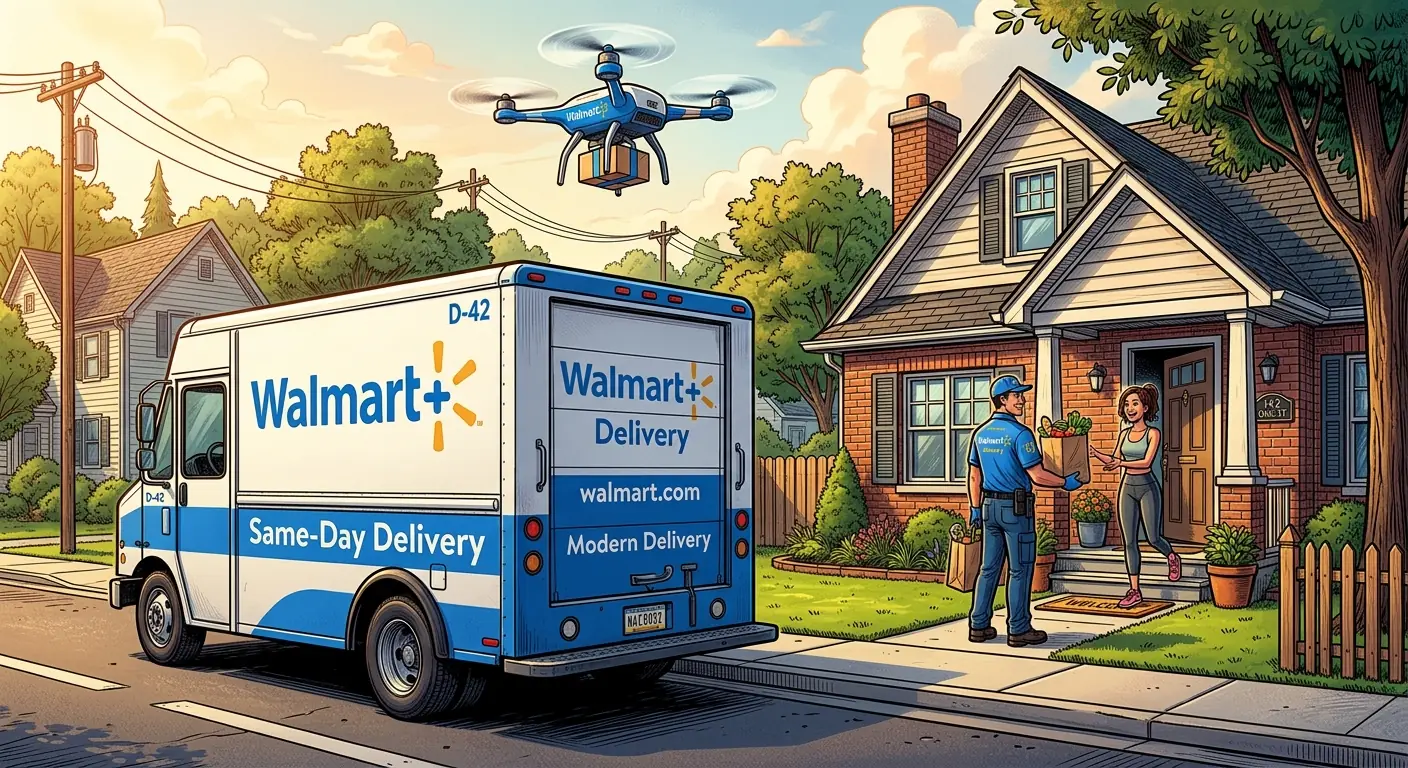
For decades, Walmart perfected physical retail, building an empire on bricks, mortar, and brilliant logistics. But then came the internet, and with it, a new kind of behemoth: Amazon. Suddenly, Walmart’s sprawling network of stores and efficient supply chain felt like a relic in a world shifting to clicks and doorsteps. The early 2000s saw Walmart stumble, struggling to translate its physical dominance into digital success. This chapter isn’t just about adapting; it’s about a multi-billion-dollar fight for relevance, a frantic scramble to pivot from the undisputed king of discount stores to a serious contender in the digital age.
The Internet Strikes Back: Walmart’s Early Stumbles
Walmart was, let’s be frank, late to the internet party. While Amazon was perfecting its online shopping experience in the late 1990s and early 2000s, Walmart’s initial e-commerce efforts were disjointed and uninspired. They had a website, sure, but it felt like an afterthought, a pale imitation of their in-store experience. The company’s culture, so focused on physical operations and cost-cutting, struggled to embrace the agility and customer-centricity required for online retail. They were too big, too slow, and frankly, a bit too arrogant to fully grasp the seismic shift happening.
Their early attempts to compete felt clunky. Shipping was slow, product selection was limited compared to Amazon’s “everything store,” and the user experience left much to be desired. While Amazon was building its Prime membership program and refining its logistics for direct-to-consumer shipping, Walmart was still trying to figure out how to integrate its vast store inventory with online orders. It was a classic innovator’s dilemma: the very strengths that made Walmart dominant in one era became obstacles in the next. They were selling cheap goods, but Amazon was selling convenience, speed, and an endless aisle, and for a long time, Walmart just couldn’t catch up.
Buying Their Way In: Acquisitions and Reinvention
Realizing they couldn’t just build it from scratch fast enough, Walmart started buying expertise. In 2016, they made a splash by acquiring Jet.com for a whopping $3.3 billion. This wasn’t just about getting a website; it was about acquiring Marc Lore, Jet.com’s founder, and his team, who brought fresh thinking and an aggressive approach to e-commerce. Lore was tasked with revitalizing Walmart’s entire online operation, and he immediately pushed for a more premium experience, expanded product categories, and faster shipping. It was a clear signal: Walmart was finally taking the internet seriously.
This acquisition spree continued globally. In 2018, Walmart made its largest-ever acquisition, buying a 77% stake in Indian e-commerce giant Flipkart for an astonishing $16 billion. This move instantly gave Walmart a massive foothold in one of the world’s fastest-growing retail markets, a market where Amazon was also aggressively expanding. These weren’t small bets; these were multi-billion-dollar declarations of war in the digital retail landscape, demonstrating a newfound willingness to spend big to secure their future.
The Omnichannel Gambit: Groceries and the Next Frontier
Today, Walmart’s strategy is clear: leverage its massive physical footprint (over 4,700 stores in the U.S. alone) to win the omnichannel game. While Amazon builds warehouses, Walmart already has distribution centers in every town. The focus has shifted to making their stores a competitive advantage for online orders, offering services like curbside grocery pickup (which exploded during the pandemic) and same-day delivery. They’ve invested heavily in automation within their stores and distribution centers, using AI and robotics to pick and pack orders more efficiently.
The battleground is increasingly groceries. Walmart is the undisputed king of physical grocery sales, and they’re determined to maintain that lead online. Their Walmart+ membership program, launched in 2020, is a direct shot at Amazon Prime, offering free grocery delivery, fuel discounts, and other perks. While Amazon still holds a significant lead in overall e-commerce market share, Walmart’s aggressive push into digital, particularly with groceries, shows they’re not just fighting to survive; they’re fighting to dominate. The future of retail will likely be a hybrid model, and Walmart, the ultimate brick-and-mortar giant, is now proving it can be a digital force to be reckoned with too, demonstrating that even a 60-year-old empire can learn new tricks… or buy them.
💡 Key Insights
- ▸ Sam Walton didn't invent discount retail — he stole the idea openly and executed it better than anyone else. His genius wasn't originality. It was relentless, shameless iteration. He visited competitors' stores obsessively, took notes, and implemented their best ideas faster than they could.
- ▸ The Walton family fortune — over $250 billion combined — makes them richer than any individual billionaire on Earth. Yet they pay their median worker around $28,000 a year. The gap between the family's wealth and the wages of the people who generate it is one of the defining economic contradictions of modern America.
- ▸ Walmart's real competitive advantage was never low prices. It was logistics. Sam Walton built a distribution system so efficient that Walmart could deliver goods to rural stores cheaper and faster than anyone else. He won the retail war in warehouses and on trucking routes, not on the sales floor.
- ▸ Sam Walton's deliberate strategy of opening stores in small towns that competitors ignored gave Walmart a near-monopoly in thousands of communities before Kmart and Sears even noticed. By the time they woke up, Walmart had locked down rural America.
- ▸ The Waltons have quietly become one of the most powerful political families in America — not through holding office, but through hundreds of millions in political donations, lobbying, and funding school privatization movements. They reshaped American education policy without most people realizing it.
Sources
- Sam Walton with John Huey — Sam Walton: Made in America (1992) ↗
- Bob Ortega — In Sam We Trust: The Untold Story of Sam Walton and Walmart ↗
- Forbes — The Walton Family Wealth Tracker ↗
- Bloomberg Billionaires Index — Walton Family ↗
- The New York Times — Walmart's Labor Practices Coverage ↗
- Bethany Moreton — To Serve God and Wal-Mart (Harvard University Press) ↗
- Nelson Lichtenstein — The Retail Revolution: How Wal-Mart Created a Brave New World of Business ↗