WeWork's Comeback: Can the Zombie Startup Rise From the Dead?
Valued at $47 billion, then bankrupt at zero. Now WeWork is trying the impossible: a second life. Can the most spectacular failure in startup history actually pull it off?

View all stories about this mogul
WeWork’s Comeback: Can the Zombie Startup Rise From the Dead?
In November 2023, WeWork filed for Chapter 11 bankruptcy. It was the final chapter of what had been the most spectacular startup implosion in Silicon Valley history — a company once valued at $47 billion reduced to effectively zero. Adam Neumann was long gone. SoftBank had written off billions. The media had written the obituary. But here’s the thing about WeWork: the company refused to die. In early 2024, it emerged from bankruptcy with slashed costs, terminated leases, and new management. Now, in 2026, it’s attempting something almost no failed startup has ever pulled off — a genuine second act. The question haunting every investor, landlord, and employee: is this a real comeback, or just the last twitch of a zombie?
💀 Chapter 1: How We Got Here — A Brief History of the Disaster
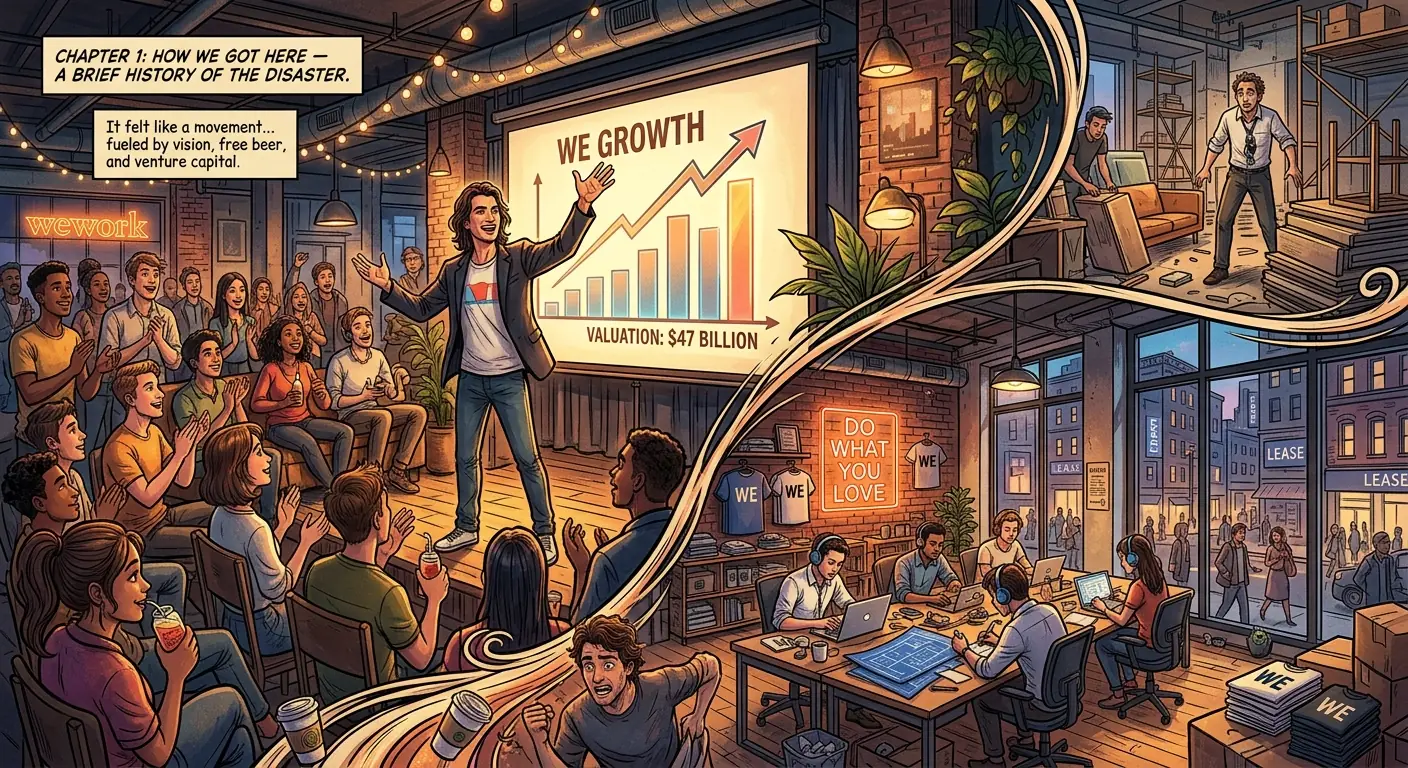
To understand WeWork’s potential comeback, you have to understand the depth of the hole it crawled out of.
WeWork was founded in 2010 by Adam Neumann, an Israeli-born entrepreneur, and Miguel McKelvey, an architect, in New York City. The concept was simple: lease office space, redesign it into stylish co-working environments, and rent desks and offices to freelancers, startups, and small businesses on flexible terms.
The business was not revolutionary. Co-working spaces had existed for years. What was revolutionary was the scale of Neumann’s ambition — and the scale of the money that funded it.
Between 2010 and 2019, WeWork raised approximately $22 billion in funding, including over $10 billion from SoftBank’s Vision Fund. Masayoshi Son personally valued the company at $47 billion after a brief meeting with Neumann. The money poured in faster than any real estate company had ever seen.
Neumann spent it with abandon. WeWork expanded to 800+ locations across 120 cities in 40 countries. It acquired companies ranging from a coding bootcamp (Flatiron School) to a wave pool company (Wavegarden). It launched WeLive (co-living), WeGrow (a school for children), and Rise by We (a gym). The company’s headquarters featured beer taps, surfboards, and a culture that mixed Silicon Valley startup energy with Wall Street excess.
The S-1 prospectus filed in August 2019 revealed the extent of the dysfunction:
- Revenue: $1.8 billion (2018)
- Net loss: $1.9 billion (2018) — the company lost more money than it earned
- CEO compensation: Neumann had taken out $700 million in personal loans secured by WeWork stock
- Self-dealing: Neumann owned buildings that he leased back to WeWork
- Governance: Neumann controlled a majority of voting shares despite owning a minority of economic shares
- “We” trademark: Neumann had personally trademarked the word “We” and charged WeWork $5.9 million for the rights (later reversed)
The IPO was pulled. Neumann was forced out. SoftBank injected an additional $5 billion to keep the company alive. WeWork staggered on as a private company, bleeding money every quarter.
Then COVID-19 hit.
The pandemic emptied offices worldwide. WeWork’s model — densely packed shared workspaces — was the exact opposite of what the world needed during a respiratory pandemic. Occupancy rates plummeted. Revenue collapsed. The company burned through its remaining cash reserves.
WeWork went public through a SPAC merger in October 2021 at a valuation of approximately $9 billion — a fraction of its former $47 billion. The stock immediately began falling. By mid-2023, WeWork’s market capitalization had dropped below $500 million. The company was running out of cash.
On November 6, 2023, WeWork filed for Chapter 11 bankruptcy protection. The $47 billion startup was officially worth nothing.
🏗️ Chapter 2: Surgery in Bankruptcy Court
Chapter 11 bankruptcy is not the end. It’s a restructuring tool — a legal process that allows a company to shed unsustainable obligations while continuing to operate. For WeWork, it was the surgery the patient desperately needed.
The core problem with WeWork was never the concept. Flexible office space is genuinely valuable. The problem was WeWork’s lease structure: the company had committed to long-term leases (10-15 years) at above-market rates during its hyper-growth phase, while renting to tenants on short-term agreements (month-to-month or 1-2 years).
This mismatch — long-term liabilities with short-term revenue — meant that WeWork was locked into paying for space whether it was occupied or not. When occupancy dropped, the company still owed billions in lease obligations.
Bankruptcy allowed WeWork to do what it couldn’t do outside of court: reject unprofitable leases.
Between November 2023 and June 2024, WeWork:
- Rejected over 170 leases in underperforming locations, representing approximately 30% of its global portfolio
- Renegotiated terms on hundreds of remaining leases, securing rent reductions averaging 40-50%
- Eliminated approximately $12 billion in long-term lease obligations
- Reduced corporate overhead by laying off approximately 40% of its corporate staff
- Closed or consolidated offices in markets where supply exceeded demand
- Eliminated non-core businesses including all remaining side ventures
The restructuring plan was approved by the bankruptcy court in May 2024. WeWork emerged from Chapter 11 in June 2024 as a privately held company (the SPAC-era public shares were wiped out). Its new owners were primarily its former creditors — the banks and bondholders who had lent WeWork money and now converted their debt into equity.
The new WeWork had dramatically different economics:
| Metric | Pre-Bankruptcy (2023) | Post-Bankruptcy (2024) |
|---|---|---|
| Locations | 800+ | ~500 |
| Lease obligations | ~$18 billion | ~$6 billion |
| Corporate employees | ~2,500 | ~1,500 |
| Average lease cost | Market or above | 40-50% below market |
| Annual cash burn | ~$1.5 billion | ~$200 million |
The surgery was brutal. Landlords lost billions. Former shareholders got nothing. Employees lost their jobs. But the patient survived.
👔 Chapter 3: New Management, New Playbook
The post-bankruptcy WeWork is run by a new leadership team with a fundamentally different philosophy than Adam Neumann’s “grow at all costs” approach.
The new management’s priorities were starkly simple:
- Profitability over growth: No new locations unless they could demonstrate a path to profitability within 12 months
- Occupancy over expansion: Fill existing spaces before opening new ones
- Enterprise over freelancers: Shift the customer mix toward larger companies on longer-term agreements
- Technology over tequila: Invest in the operational technology platform, not the party culture
The enterprise pivot was particularly significant. In WeWork’s early days, its typical customer was a freelancer or 5-person startup renting a handful of desks. These customers were charming but unpredictable — they churned frequently, paid relatively little, and required significant amenity spending to attract.
Post-bankruptcy WeWork aggressively pursued enterprise clients — companies with 50-500+ employees who wanted flexible office space without the commitment of a traditional long-term lease. These clients paid more per desk, signed longer agreements (1-3 years), and had lower churn rates.
By the end of 2025, enterprise clients represented over 60% of WeWork’s revenue, up from roughly 40% pre-bankruptcy. Average contract length had increased from 7 months to approximately 18 months. These longer, more predictable revenue streams made the business fundamentally more stable.
The company also invested heavily in its technology platform — the software that manages space booking, access control, billing, and community features. This technology, initially built to manage WeWork’s own locations, was being licensed to other building owners and operators who wanted to offer flexible workspace without building the technology themselves.
🌍 Chapter 4: The Market That Came to WeWork
Here is the irony that haunts the WeWork story: the market conditions that WeWork always predicted would arrive — a world where flexible office space was the norm rather than the exception — actually materialized. Just not in time to save the original company.
The COVID-19 pandemic fundamentally and permanently changed how companies think about office space:
Before COVID (2019):
- Most companies leased office space on 5-10 year terms
- Remote work was a perk, not a standard practice
- Flexible office space represented less than 5% of total office inventory in most markets
After COVID (2025):
- Hybrid work (3 days in office, 2 days remote) has become the dominant model for knowledge workers
- Companies are reluctant to commit to long-term leases when they don’t know how much space they’ll need in 3 years
- Flexible office space represents 10-15% of total office inventory in major markets, growing at 15-20% annually
This shift created exactly the demand that WeWork had always predicted. Companies that once would have signed a 10-year lease for 50,000 square feet now wanted the ability to scale up or down with short-term commitments. They wanted furnished, move-in-ready spaces. They wanted someone else to manage the coffee, the cleaning, the internet, and the building maintenance.
That’s exactly what WeWork offers.
The competitive landscape also shifted in WeWork’s favor during bankruptcy. Several smaller co-working operators shut down during the pandemic. Others scaled back. WeWork, despite its troubles, remained the largest flexible office provider in the world, with brand recognition that no competitor could match.
Competitors exist — IWG/Regus (the largest by number of locations), Industrious, Spaces (owned by IWG), and various local operators — but none have WeWork’s combination of global scale, brand recognition, and technology platform.
📊 Chapter 5: The Numbers — Is It Actually Working?
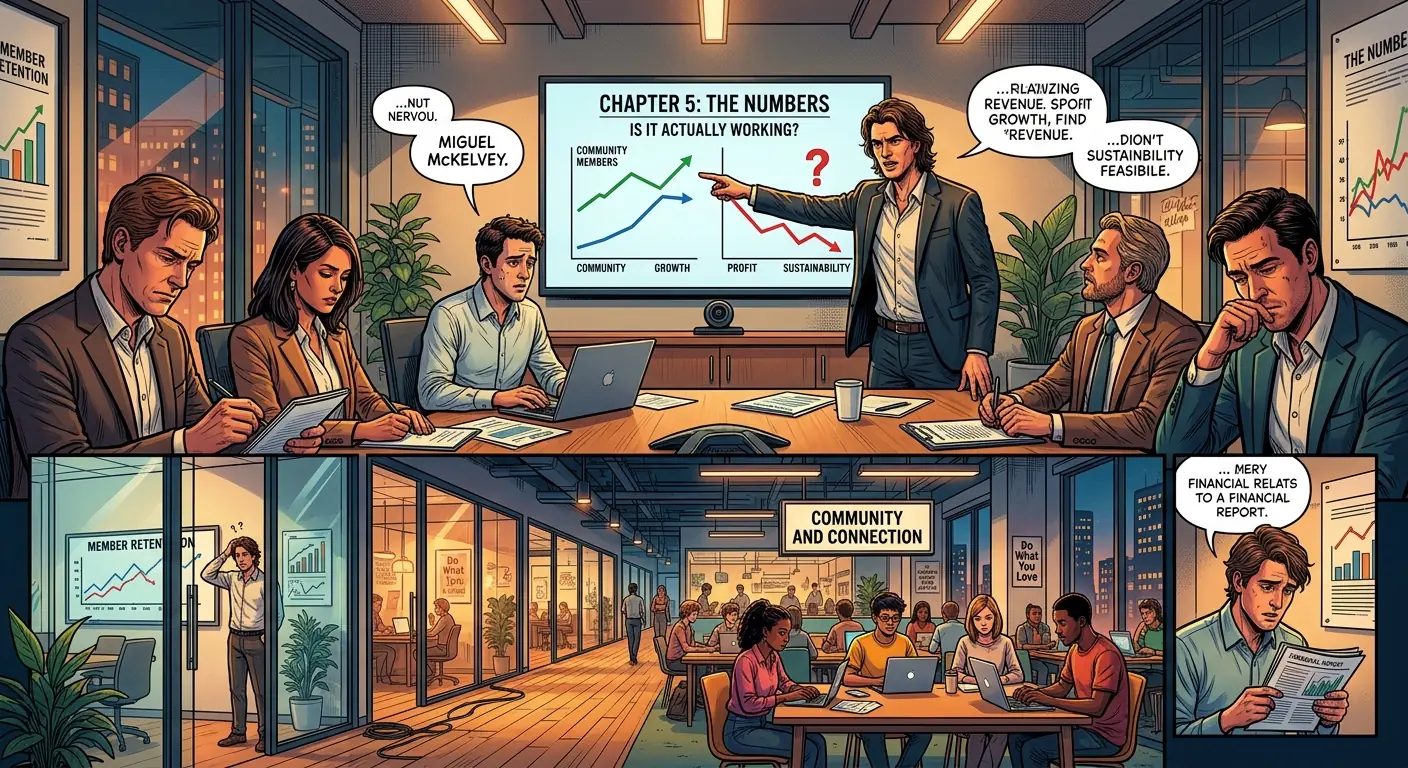
The critical question: is post-bankruptcy WeWork actually making money?
The data through early 2026 is cautiously encouraging:
Occupancy: WeWork’s global occupancy rate has recovered to approximately 75-80%, up from a low of approximately 46% during the pandemic. The company’s target is 85%, which management has described as the break-even point for most locations.
Revenue: Annual revenue has stabilized at approximately $3.5-4 billion, down from the peak of $4.4 billion in 2022 but generated from a much smaller (and more efficient) portfolio.
Cash flow: WeWork achieved positive EBITDA (earnings before interest, taxes, depreciation, and amortization) in several quarters of 2025 — the first time in the company’s history. Free cash flow remained negative but was approaching break-even.
Debt: Total debt was reduced from approximately $18 billion pre-bankruptcy to roughly $4 billion, with most remaining obligations tied to lease commitments at renegotiated rates.
The trajectory is positive but fragile. WeWork is not yet consistently profitable on a free cash flow basis. The company’s margins are thin, and any significant economic downturn that reduced office demand could push it back into the red.
Management has discussed the possibility of returning to public markets through an IPO in 2027 or 2028, assuming the financial trajectory continues to improve. The potential valuation would likely be in the $5-8 billion range — a fraction of the original $47 billion but a remarkable achievement for a company that was worth zero 18 months earlier.
🏢 Chapter 6: The Office Market in 2026
WeWork’s fate is inseparable from the broader office real estate market, which remains in a state of historic transition.
The numbers paint a complex picture:
U.S. office vacancy rates hit approximately 20% nationally in 2025, the highest level since the savings and loan crisis of the early 1990s. Major cities like San Francisco (33% vacancy), New York (22%), and Chicago (25%) have been particularly hard hit.
But within this bleak landscape, a clear divergence has emerged:
- Class A buildings (new, well-located, amenity-rich) have vacancy rates of 10-15% and are commanding premium rents
- Class B and C buildings (older, less desirable) have vacancy rates of 25-40% and are facing existential threats, with many being converted to residential or demolished
WeWork’s portfolio is concentrated in Class A and A- buildings in prime urban locations. This positioning has helped the company maintain occupancy even as the broader market struggles.
The shift toward hybrid work has also created what industry analysts call the “flight to flex” — companies that previously signed long-term leases are increasingly allocating a portion of their office portfolio to flexible space. A company that needs 100 desks might sign a 5-year lease for 70 and use flexible space for the remaining 30, adjusting up or down as needs change.
This trend is structural, not cyclical. It represents a permanent change in how companies consume office space. And WeWork, as the largest and most recognized flexible office provider, is positioned to capture a significant share of this shift.
🎭 Chapter 7: The Ghost of Adam Neumann
No discussion of WeWork’s comeback is complete without addressing the elephant in the room: Adam Neumann.
Neumann was ousted from WeWork in September 2019. He received a severance package worth approximately $1.7 billion from SoftBank, including consulting fees, stock buybacks, and a credit line. The package was widely criticized as a reward for failure — the man who had driven WeWork to the brink of ruin walking away with a billion-dollar golden parachute.
Since his departure, Neumann has been remarkably active. In 2022, he founded Flow, a residential real estate company focused on branded apartment buildings. The concept — applying the WeWork model of community and technology to residential living — attracted a $350 million investment from Andreessen Horowitz at a $1 billion valuation.
The fact that Neumann could raise $350 million for a real estate venture just three years after nearly destroying a real estate company said something about Silicon Valley’s capacity for forgiveness — or its short memory.
Flow has expanded to several properties across the United States, though it remains far smaller and more conservatively managed than WeWork ever was. Whether it succeeds or fails, its existence is a reminder that in the startup world, founders get second chances that their employees, investors, and landlords rarely do.
For current WeWork, Neumann’s legacy is both a burden and a benefit. The burden: the WeWork brand is still associated with excess, fraud, and corporate dysfunction. The Hulu documentary, the Apple TV+ series WeCrashed, and the best-selling book The Cult of We have cemented the Neumann-era narrative in popular culture.
The benefit: everyone knows what WeWork is. Brand recognition, even when associated with controversy, has value. The challenge for new management is converting that recognition from a punchline to a proposition.
🔮 Chapter 8: The Verdict — Zombie or Phoenix?

So: is WeWork’s comeback real?
The bull case:
- The flexible office market is growing 15-20% annually and is a structural, permanent shift
- WeWork has shed $12 billion in bad leases and is operating with dramatically lower costs
- Enterprise clients provide more stable, higher-margin revenue
- Post-pandemic work patterns have validated the original thesis
- The technology platform creates value beyond physical space
- WeWork has the strongest brand in the category
- Management is focused on profitability, not growth-at-all-costs
The bear case:
- WeWork has never been consistently profitable on a free cash flow basis
- The office market remains in a historic downturn with 20%+ vacancy rates
- Competition from IWG/Regus and new entrants is intensifying
- The brand is still associated with the Neumann-era disaster
- Any economic recession could push occupancy below break-even levels
- The company’s debt, while reduced, remains significant
- Landlords in WeWork locations have been burned before and may not cooperate if times get tough
The honest assessment, as of March 2026: WeWork is somewhere between zombie and phoenix. It has survived — which is more than anyone expected 18 months ago. It has a viable business model in a growing market. But it has not yet proven that it can generate consistent profits over a full economic cycle.
The next 18-24 months will be decisive. If occupancy continues to climb toward 85%, if enterprise clients continue to grow, and if the economy avoids a severe recession, WeWork could be the rarest thing in the startup world: a company that failed spectacularly, went to zero, and came back.
If the recovery stalls — if a recession hits, if occupancy plateaus, if the technology platform fails to differentiate — then WeWork will have been exactly what the skeptics always said it was: a real estate company with delusions of grandeur.
The ultimate lesson of WeWork isn’t about office space. It’s about the difference between an idea and a business. The idea — that the future of work is flexible — was right. The business — sign long-term leases, spend lavishly on amenities, grow at all costs, and hope the math works out later — was catastrophically wrong.
WeWork 2.0 is trying to keep the idea while fixing the business. Whether it succeeds will determine if this is the greatest comeback story in startup history — or just the longest death scene.
WeWork was valued at $47 billion. Then it was valued at zero. Now it’s trying to find its real value — somewhere in between. The answer matters not just for WeWork but for the future of how we work. In a world where the office is optional, the company that makes it desirable might be worth more than anyone expects. Or it might be worth nothing at all. Again.
👑 Chapter 9: The Cult of We (2010-2019)
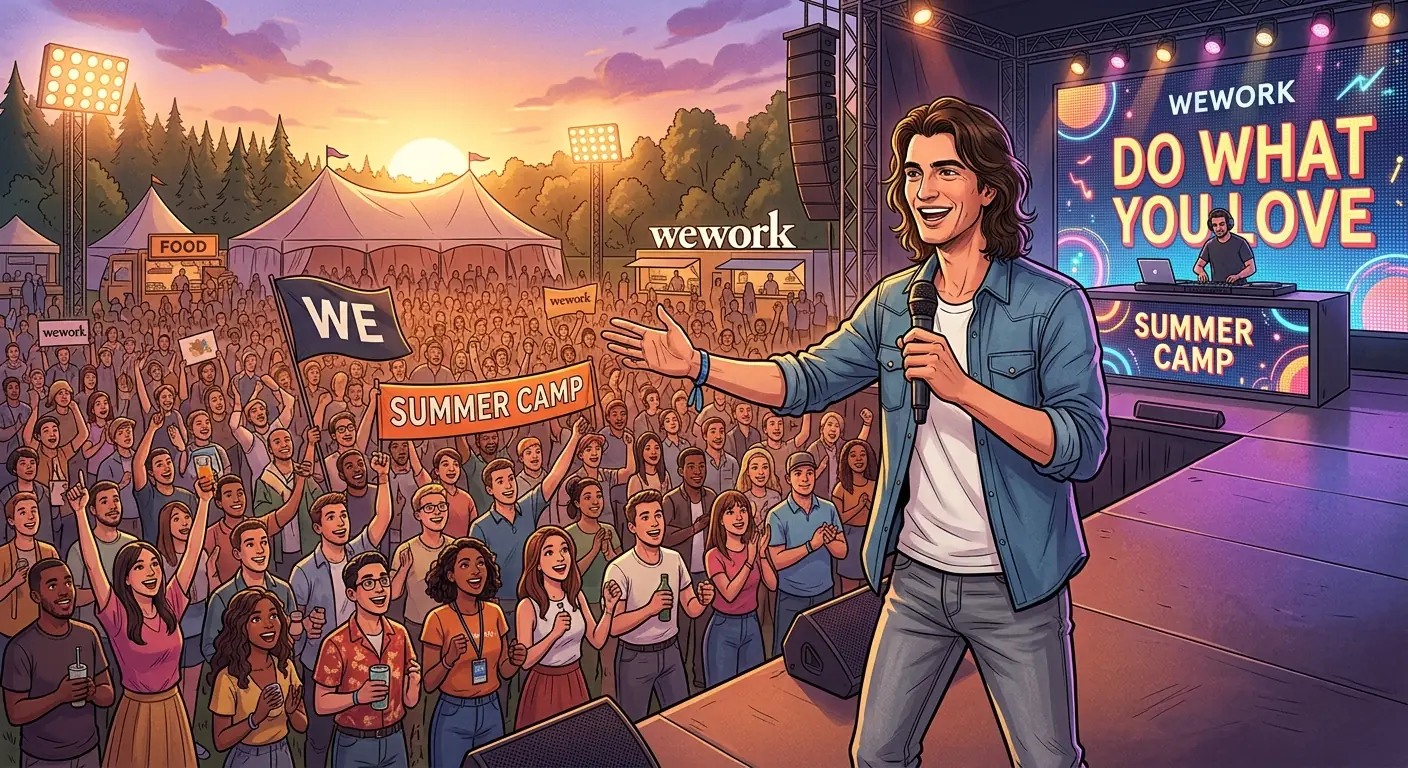
Before WeWork became a cautionary tale in corporate governance and valuation, it was, for many, a movement. And at the heart of that movement was Adam Neumann, a man whose charisma was as boundless as his ambition. He wasn’t just selling desks; he was selling a lifestyle, a community, a mission. And boy, did people buy into it.
The Visionary and the Guru
Adam Neumann wasn’t your typical CEO. Tall, disheveled, often barefoot, and perpetually brimming with an almost messianic energy, he cultivated an image somewhere between a startup visionary and a spiritual guru. He spoke of “elevating the world’s consciousness” and creating a “physical social network.” His pitch wasn’t about square footage, but about belonging. He famously told investors that WeWork’s valuation wasn’t based on real estate, but on its “energy and spirituality.” (Spoiler alert: the market eventually disagreed.)
He had an uncanny ability to connect with people, making them feel like they were part of something truly special. Early employees and members often spoke of the electric atmosphere, the free-flowing beer, the communal breakfasts, and the sense of shared purpose. He held company-wide “Summer Camps” – mandatory, alcohol-fueled extravaganzas where employees would bond, often hear Adam speak of the future of humanity, and participate in team-building exercises that bordered on the cultish. One former employee recounted to Vanity Fair that Neumann once gathered staff to tell them they were “changing the world,” an experience that felt “like a religious revival.” It was a powerful cocktail of aspiration and intoxication, and it made people incredibly loyal, for a time.
Party Hard, Work Harder
The WeWork culture was legendary, for better or worse. It was a place where “work-life balance” was a foreign concept, replaced by “work-life integration” – where the lines blurred between your colleagues and your best friends, your office and your social life. The company hosted lavish parties, often with celebrity DJs and open bars, reinforcing the image of a place where innovation and fun went hand-in-hand. This wasn’t just perks; it was a carefully constructed identity designed to attract and retain top talent, especially millennials looking for more than just a paycheck.
But beneath the veneer of communal bliss, cracks began to show. The “work hard, party harder” ethos often meant incredibly long hours and immense pressure. Neumann himself was known for his demanding and sometimes erratic behavior, including firing people on a whim or changing strategic directions overnight. The boundary-less culture that fostered camaraderie could also lead to burnout and a lack of professional boundaries. For every story of inspirational leadership, there were whispers of a toxic environment, especially as the company scaled. The early magic was hard to maintain when you had thousands of employees and a global footprint.
The “We” Philosophy and Its Dark Side
Neumann’s “We” philosophy permeated everything, from the company’s name to its various ventures: WeLive, WeGrow, WeWork. He genuinely believed in the power of community and shared experience, perhaps stemming from his own background in a kibbutz. But this noble ideal became intertwined with his personal brand and, ultimately, his personal enrichment. The infamous $5.9 million that WeWork paid him for the “We” trademark (before public backlash forced him to return it) was a glaring example of how the “We” became “Adam.”
The very culture that attracted so many also enabled some of the worst excesses. Employees, swept up in the mission, often overlooked questionable business practices or internal inconsistencies because “Adam said so.” This created an echo chamber where dissent was rare, and critical self-reflection was even rarer. The cult of personality, while initially a powerful engine for growth and belief, ultimately blinded the company to its own unsustainable trajectory, setting the stage for the dramatic fall that would follow. It turns out, you can’t pay rent with “energy and spirituality,” no matter how charismatic your CEO.
🥊 Chapter 10: The Empire Strikes Back… with Legal Letters (2015-2020)
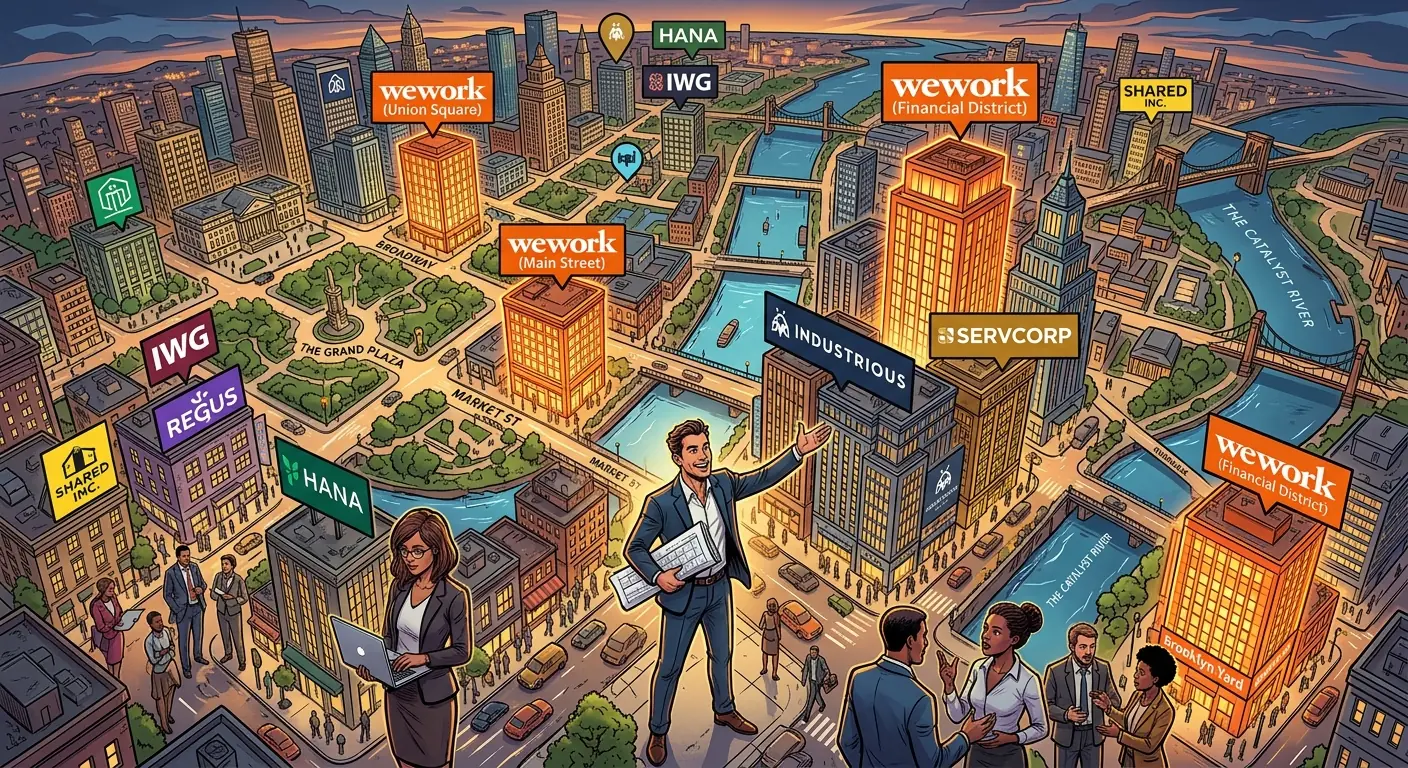
While Adam Neumann was busy “elevating the world’s consciousness,” WeWork was also engaged in a decidedly more earthly battle: the war for dominance in the flexible office space market. And like any rapidly expanding empire, WeWork wasn’t afraid to throw its weight around, often quite literally. Their strategy wasn’t just about out-innovating rivals; it was about out-spending, out-maneuvering, and occasionally, out-litigating them.
Flex Space Wars: The Race to Dominate
In the mid-2010s, as WeWork’s valuation soared, so did the competition. Companies like Regus (now IWG), a long-established player, and newer, more design-focused startups like Knotel and Spaces (an IWG brand) were vying for market share. WeWork’s approach was aggressive: secure prime real estate, often paying above market rates, and expand at a breakneck pace. They wanted to be everywhere, making it difficult for smaller competitors to find attractive locations.
WeWork’s sheer funding power, courtesy of SoftBank, allowed them to subsidize rents and offer amenities that others couldn’t match. They’d often sign massive master leases, sometimes for entire buildings, effectively squeezing out other flexible office providers or even traditional tenants. This “growth at all costs” mentality meant that while they were burning cash, they were also establishing an undeniable physical presence that dwarfed most competitors. Their valuation, inflated by venture capital, gave them an unfair advantage in a very traditional real estate market – they could simply outbid anyone.
The Art of the Deal… and the Lawsuit
WeWork wasn’t shy about using legal tactics to protect its turf. They were known to be litigious, sometimes against former employees, sometimes against landlords, and definitely against competitors. One particularly infamous incident involved Knotel, a rival flexible office provider. In 2018, Knotel’s CEO, Amol Sarva, publicly claimed WeWork was engaged in anti-competitive practices, even accusing them of trying to sabotage their relationships with landlords. WeWork, in turn, sued Knotel for trademark infringement over the “We” in “Knotel”. Yes, really. The irony of WeWork, a company that had to pay its founder $5.9 million for the “We” trademark, suing someone else for using “We” was not lost on industry observers.
“WeWork’s lawsuit against Knotel for trademark infringement was a classic example of a cash-rich behemoth trying to bully a smaller competitor,” commented one real estate analyst at the time. “It showed how far they were willing to go to maintain their perceived dominance, even if it meant stretching legal arguments to their breaking point.”
These legal skirmishes, while sometimes petty, signaled a clear message: WeWork was playing hardball. They were not just building offices; they were building a fortress, legally and physically, to protect their perceived empire.
A Shifting Landscape: From Competitors to Copycats
Ultimately, WeWork’s impact on its rivals was a mixed bag. On one hand, their massive scale and aggressive pricing undoubtedly put immense pressure on smaller players, forcing some out of business or into acquisition. On the other hand, WeWork validated the flexible office concept on a global scale. It showed traditional landlords and developers that there was a massive, untapped market for co-working and flexible leases. This led many to launch their own flexible offerings, essentially becoming WeWork copycats or partners.
Even IWG (Regus), the veteran in the space, had to adapt, launching their more design-forward “Spaces” brand to compete directly with WeWork’s aesthetic. The competition forced innovation across the industry, proving that while WeWork might have burned billions, it undeniably accelerated the evolution of commercial real estate. The lawsuits and aggressive tactics were just part of the collateral damage in a race to redefine how and where we work.
💰 Chapter 11: Masayoshi Son’s Billion-Dollar Bet (2017-2023)
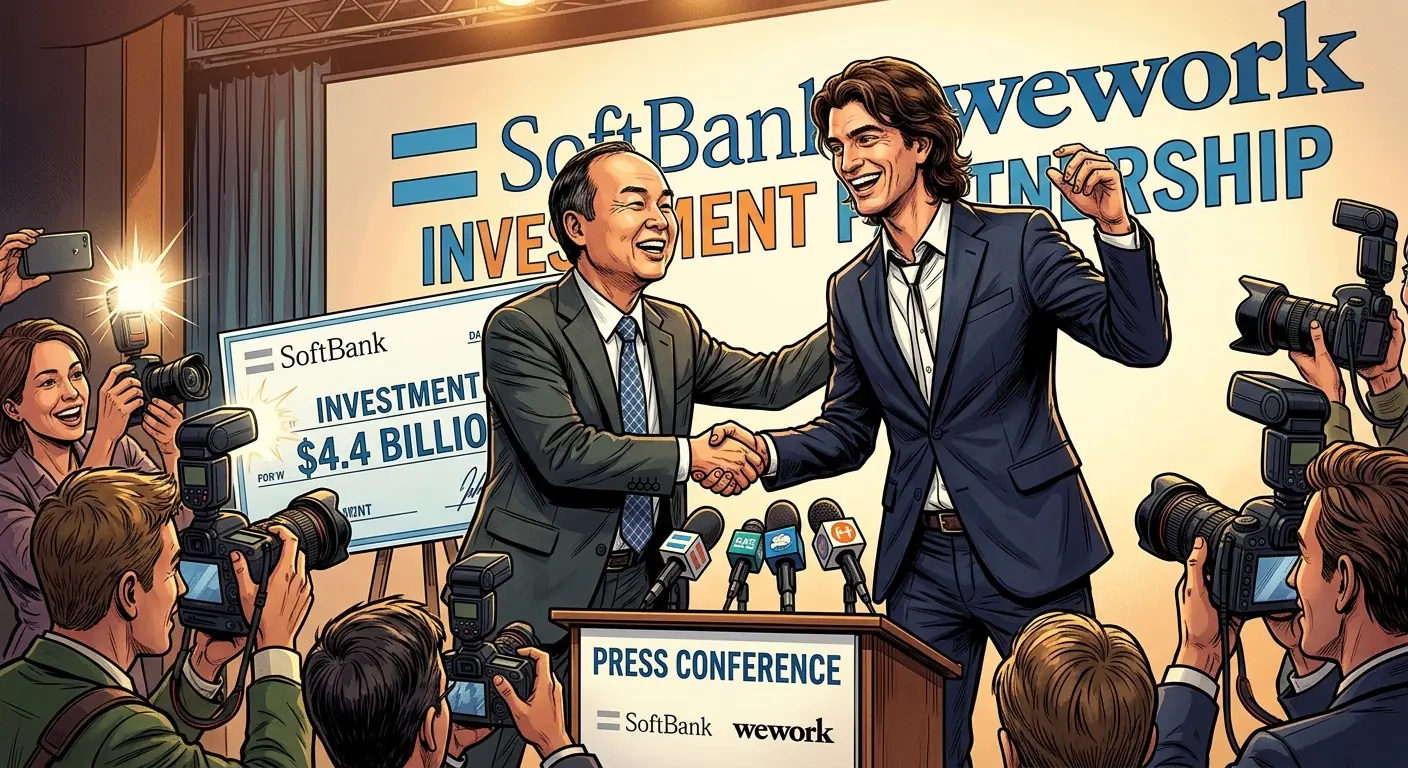
If Adam Neumann was the charismatic frontman, Masayoshi Son, the CEO of SoftBank, was the enabler, the deep-pocketed believer who poured more money into WeWork than almost any other investor in startup history. Their relationship was a fascinating, often bewildering, blend of mutual admiration, outsized ambition, and ultimately, profound financial regret.
The “Unicorn Hunter” and the Prophet
Masa Son, a legendary investor known for his early bet on Alibaba, had launched the $100 billion Vision Fund in 2017, explicitly to find and supercharge “unicorns” – startups valued at over $1 billion. He saw himself as a visionary, identifying the next generation of global champions. When he met Adam Neumann in late 2016, it was, by all accounts, an electric encounter. Son, known for his “gut feelings,” was instantly captivated by Neumann’s grand vision for WeWork.
Their infamous 28-minute meeting, during which Son reportedly scrawled “most of your ideas are crazy, but you’re not crazy enough” on an iPad, culminated in a $4.4 billion investment in 2017. Son didn’t just invest; he became Neumann’s mentor, urging him to “think bigger” and expand faster. He encouraged Neumann to reject a lower valuation from JPMorgan, telling him: “Adam, a little more crazy is good. Only a crazy person can change the world.” This encouragement, while perhaps well-intentioned, fueled Neumann’s already boundless ego and accelerated WeWork’s unsustainable growth trajectory.
The Vision Fund’s Blank Check
SoftBank’s investment in WeWork wasn’t just large; it was relentless. Over several rounds, SoftBank and its Vision Fund poured an estimated $18.5 billion into WeWork. To put that in perspective, that’s more than the entire GDP of some small countries. This wasn’t just about funding growth; it was about strategic control. SoftBank eventually became the majority owner, making its fortunes inextricably linked to WeWork’s.
Why such a massive bet? Son believed WeWork wasn’t just a real estate company; it was a tech company, a data company, an AI company, a community company. He saw it as the future of work, a platform that would integrate physical and digital spaces globally. He famously compared it to the early days of Alibaba, believing WeWork had the potential for similar exponential returns. This belief allowed him to overlook WeWork’s mounting losses and Neumann’s increasingly erratic behavior, often overruling more cautious SoftBank executives who questioned the fundamentals. It was an investment driven by vision, ego, and a serious case of FOMO (Fear Of Missing Out) on what Son perceived as the next world-changing enterprise.
Regret, Resignation, and a $18.5 Billion Write-off
The chickens, as they always do, eventually came home to roost. The disastrous S-1 filing in August 2019 exposed WeWork’s financial fragility and governance issues, leading to the pulled IPO and Neumann’s ouster. SoftBank, having invested so heavily, was left holding the bag. They orchestrated Neumann’s exit, providing him with a $1.7 billion payout (later reduced) while simultaneously injecting billions more to keep the company from immediate collapse. It was an astonishing turn of events: the investor who had pushed for more “crazy” was now paying a fortune to clean up the mess created by that very craziness.
By 2020, SoftBank had written off billions of dollars on its WeWork investment – an estimated $18.5 billion in total. Son publicly admitted that his judgment had been “poor” and that he had been “fooled” by Neumann. This wasn’t just a financial hit; it was a blow to Son’s reputation as a visionary investor. The WeWork saga became a stark lesson for the entire venture capital world: even the biggest funds, with the grandest visions, can get caught up in the hype, proving that sometimes, a little less crazy is a lot more sustainable.
💡 Chapter 12: The WeWork Effect: Legacy & Lessons (2010-Present)
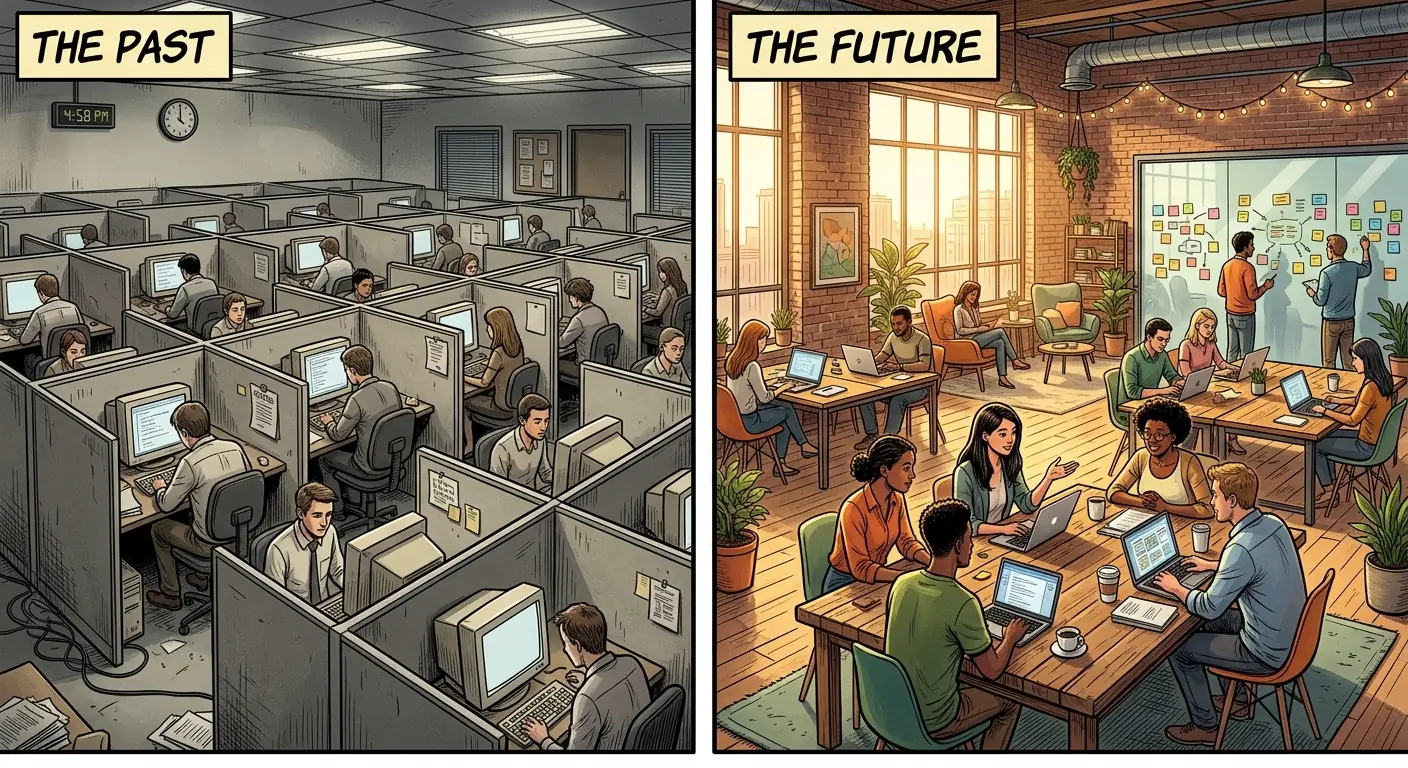
WeWork’s journey from a $47 billion titan to bankruptcy was a spectacular implosion, but its legacy isn’t simply one of failure. Like a meteor crashing to Earth, it left an undeniable crater, forever changing the landscape of commercial real estate and venture capital. Even if the company itself ultimately fades, “the WeWork effect” will be felt for decades.
Redefining the Office Experience
Before WeWork, flexible offices were largely seen as temporary solutions for startups or satellite teams, often synonymous with bland, sterile environments like those offered by traditional players such as Regus. WeWork changed that perception entirely. They didn’t just offer desks; they offered an experience. With their signature exposed brick, glass walls, artisanal coffee, beer taps, and vibrant community events, they made shared workspaces cool, aspirational, and even luxurious.
They popularized the “plug-and-play” office, where businesses, from solo freelancers to Fortune 500 companies, could scale up or down with unprecedented agility. WeWork demonstrated a massive demand for flexibility, community, and well-designed spaces, forcing traditional landlords and developers to rethink their offerings. Now, “flex space” is a standard component of many commercial real estate portfolios, and amenities like communal lounges, event spaces, and high-quality coffee are expected, not just perks. WeWork’s model, even if economically flawed for them, proved that the market craved a more dynamic, less rigid approach to work environments. They dragged a historically slow-moving industry into the 21st century, whether it wanted to go or not.
The Valuation Bubble & Investor Reckoning
Perhaps WeWork’s most profound lesson was for the venture capital world. Its stratospheric $47 billion valuation in 2019, despite never turning a profit and bleeding billions annually, became the poster child for the “growth at all costs” mentality run amok. Investors, desperate not to miss out on the “next big thing,” threw money at WeWork based on a vague promise of “community” and “technology” rather than sound financial fundamentals. The S-1 filing, which revealed the shocking losses and governance issues, triggered a massive reckoning.
As venture capitalist Bill Gurley famously warned about tech valuations: “We’re in a bubble. And it’s not just tech, it’s all private markets… WeWork is the poster child for this.”
The WeWork implosion, alongside similar struggles at Uber and other heavily funded “unicorns,” forced investors to scrutinize business models more carefully, to demand paths to profitability, and to question whether a company selling real estate could truly be valued like a software company. It led to a more cautious investment environment, particularly for capital-intensive businesses. The era of blindly chasing growth metrics without regard for unit economics or governance suddenly felt very, very over.
The Blueprint for Modern Flexible Work
Despite its spectacular flameout, WeWork undeniably laid a blueprint for the modern flexible workspace. Its influence is evident in every boutique co-working space, every landlord now offering “managed solutions,” and every company considering a hybrid work model. They proved that people crave human connection and a sense of purpose in their work environment, even if they sometimes prefer to work from home.
The pandemic, ironically, underscored the value of flexibility that WeWork championed. Companies, facing uncertain futures, realized the burden of long-term, fixed leases. WeWork, even in bankruptcy, emerged as a potential solution, offering the very flexibility the market now desperately needs. Its legacy is a paradox: a colossal financial failure that simultaneously pioneered and validated a fundamental shift in how we think about work, office space, and community. The zombie might be rising, but the lessons it taught us about ambition, valuation, and the true cost of “crazy” are indelible.
🚀 Chapter 13: Beyond the Desks: WeWork’s Unfinished Story (2024-Present)
So, WeWork has emerged from bankruptcy, shorn of its most burdensome leases and its most flamboyant founder. It’s a leaner, humbler beast, but what’s next? Is it destined to be a ghost of its former self, rattling chains in the corporate graveyard, or can it truly carve out a sustainable future beyond the hype and hubris? The answer lies in its ability to adapt, not just to the market, but to its own tarnished legacy.
The Post-Bankruptcy Pivot: Beyond the Hype
The “new” WeWork, under its current leadership, is a stark contrast to the Neumann-era spectacle. Gone are the grandiose pronouncements about changing the world (at least for now). The focus is squarely on profitability, efficiency, and core business. This means a dramatic reduction in its physical footprint – shedding over 250 unprofitable locations during bankruptcy, a move that would have been unthinkable in its expansionist heyday. They’re no longer aiming to be the biggest; they’re aiming to be the smartest.
The strategy now revolves around catering to a more diverse clientele, including larger enterprises seeking flexible solutions for their hybrid workforces. They’re emphasizing their technology platform, allowing companies to manage their remote and in-office teams more seamlessly. It’s less about creating a “cult” and more about providing a reliable, cost-effective service. The goal isn’t to revolutionize consciousness, but to provide functional, well-managed office space with flexible terms. It’s a return to the basics, stripped of the “We” trademark drama and the Kombucha on tap (though I’m sure there’s still good coffee).
Who’s Using WeWork Now?
The customer base has also evolved. While still attracting startups and freelancers, a significant portion of WeWork’s current revenue comes from larger, established companies. Post-pandemic, many corporations are hesitant to commit to long-term, traditional leases, especially with the uncertainty surrounding remote and hybrid work models. WeWork, with its array of private offices, meeting rooms, and on-demand spaces, offers an attractive solution. Companies can expand or contract their physical footprint as needed, without the immense capital outlay or commitment of a traditional office.
This shift means WeWork is now competing more directly with traditional landlords who are increasingly offering their own flexible options, as well as established players like IWG. The challenge is differentiating itself in a market it helped create, but which is now far more crowded. The “community” aspect, while still present, is less about shared surfboards and more about professional networking and efficient resource sharing. It’s less a party, more a well-organized business mixer. They still have a recognizable brand, but now it’s associated with both spectacular failure and potential redemption – a double-edged sword.
The Long Road to Redemption (or Oblivion)
WeWork’s story is far from over. It’s now operating in a world that, ironically, has embraced the very flexibility it pioneered. The question remains whether it can leverage its brand recognition and streamlined operations to achieve sustained profitability. Its debt load is significantly reduced, its lease obligations are manageable, and its management is focused. But the scars of its past run deep.
The company will always carry the baggage of Adam Neumann’s excesses and SoftBank’s overspending. Every earnings report, every new lease, every strategic decision will be scrutinized through the lens of its dramatic fall. Its current status is that of a company fighting for relevance in a market it once dominated through sheer force of will and capital. It’s a sober, serious comeback attempt, devoid of the earlier extravagance. WeWork isn’t just selling desks anymore; it’s selling its own resilience. The ghost of Adam Neumann might still lurk in the hallways, but the new WeWork is trying to build a future by focusing on what it should have been all along: a fundamentally sound real estate business that offers a valuable service. Only time will tell if this zombie truly has a phoenix hidden within.
💡 Key Insights
- ▸ Bankruptcy isn't always death — it can be the surgery that removes the tumor of bad leases and unsustainable costs.
- ▸ The underlying demand for flexible office space was always real — it was WeWork's economics that were broken, not the concept.
- ▸ Post-pandemic work patterns have validated WeWork's original thesis, even as they destroyed WeWork's original business.
- ▸ New management that prioritizes profitability over growth can transform a money-burning startup into a viable business.
- ▸ The biggest lesson from WeWork's saga: valuation is not value, and growth is not a business model.
Sources
- The Wall Street Journal - WeWork Bankruptcy and Restructuring ↗
- The Cult of We by Eliot Brown and Maureen Farrell ↗
- Bloomberg - WeWork's Post-Bankruptcy Strategy ↗
- Financial Times - Flexible Office Market Recovery ↗
- Reuters - WeWork Emerges from Bankruptcy ↗
- CNBC - WeWork's New Management Team ↗
- Forbes - The Future of Flexible Office Space ↗