Charles Schwab: How Discount Brokerage Turned Wall Street Into a Retail Platform
Charles Schwab used deregulation, transparent pricing, branches, phones, and software to separate financial guidance from expensive stock commissions and scale self-directed investing.
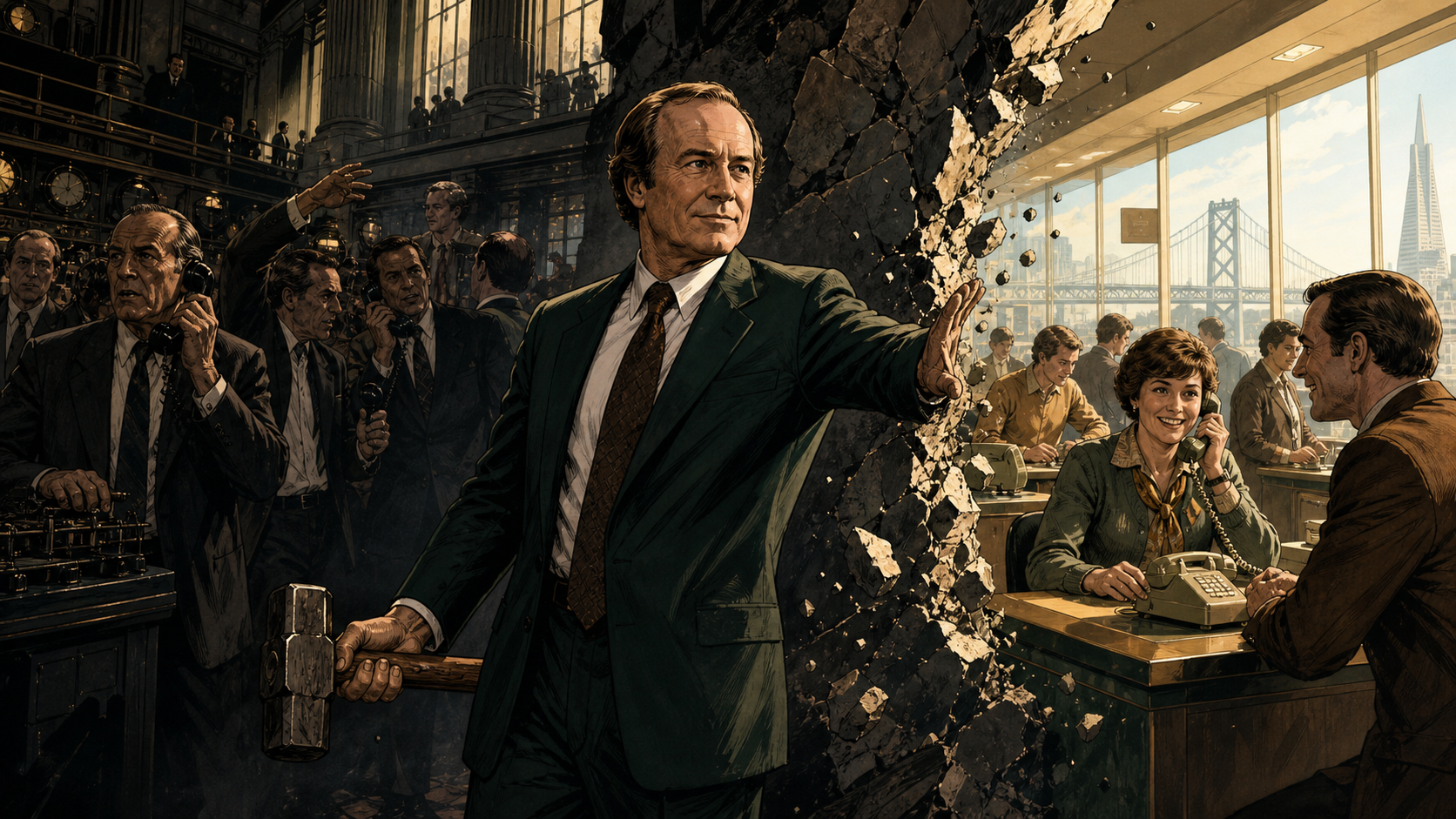
View all stories about this mogul
Charles Schwab built a financial giant by attacking a fee that Wall Street had treated as permanent. When fixed brokerage commissions ended in the United States, he offered investors a simpler proposition: execute the trade reliably and charge less.
Discounting was the entry point, not the complete business. Schwab surrounded low-cost transactions with branches, telephone access, custody, research tools, mutual-fund access, and eventually digital platforms. The company evolved from a cheaper broker into infrastructure for individual investors and advisers.
The journey included cash shortages, a sale to Bank of America, and an audacious buyback. Its central strategic lesson is that a regulatory opening becomes valuable only when a company reorganizes the customer experience around it.
How did May Day turn a small brokerage into a challenger?

Schwab founded the predecessor to his brokerage in the early 1970s after working in investment publishing. The young firm entered a market in which stock-trading commissions were fixed, limiting price competition and supporting a service bundle designed around affluent clients and commissioned salespeople.
On May 1, 1975—remembered as “May Day” on Wall Street—fixed commissions ended. Brokers could set their own rates. Schwab moved aggressively into discounted execution, separating the cost of placing a trade from traditional advice and sales structures.
The change appealed to self-directed investors, but low price alone raised a trust problem. Customers were sending money and securities to a relatively unfamiliar firm. Schwab built physical branches and emphasized service so investors could reach a person, deliver certificates, and resolve problems.
This combination mattered. The firm did not ask customers to accept worse execution in exchange for a bargain. It sought to remove a cross-subsidy: investors who wanted transactions without a broker’s recommendations no longer had to pay the full bundled commission.
Volume became an advantage. More accounts supported better systems and broader access; better service attracted more accounts. But rapid growth also required capital, technology spending, and operational control in a business where errors directly affect client assets.
Why did Schwab sell the company—and then buy it back?

In 1983, Schwab sold the company to Bank of America. The combination promised capital, distribution, and the backing of a large financial institution. For an expanding brokerage, those resources could solve real constraints.
Ownership also created friction. A discount broker built around speed, customer choice, and focused economics did not fit neatly inside a diversified bank with different priorities and bureaucracy. Scale from a parent is useful only when the parent preserves the operating model that customers value.
Schwab led a management buyback in 1987, borrowing heavily to regain independence. The decision concentrated risk around the founder and the company’s future cash flow. It also restored strategic control at a moment when technology and consumer participation were reshaping brokerage.
The company went public later that year. Public capital helped fund growth, while independence let management decide which channels, products, and systems deserved investment.
The sequence—sell, experience the mismatch, buy back—shows that a high valuation or prestigious parent does not settle the question of ownership. The relevant test is whether control rights and incentives support the customer’s proposition over the next phase of the market.
How did a discount broker become a financial platform?

Schwab repeatedly adopted channels that reduced investor effort. Telephone services expanded access beyond branch hours. Personal-computer and online trading moved quotes, account information, and orders closer to the customer. Each shift threatened transaction revenue while making the relationship more convenient.
The company expanded mutual-fund access, banking services, retirement accounts, research, and support for registered investment advisers. Custody became especially strategic: advisers could maintain independent client relationships while Schwab provided account infrastructure, trading, reporting, and asset safekeeping.
As commissions approached zero across the industry, the original product became a commodity. Schwab’s durability depended on assets held on the platform, client cash, service, scale economics, and the switching costs of an integrated financial relationship.
That evolution also brought new responsibilities. A platform serving millions of investors must manage outages, conflicts, disclosures, cybersecurity, execution quality, and the danger of making investing appear effortless or insulated from loss.
Charles Schwab did not democratize markets by inventing stock ownership. He changed the access layer: price, channel, tools, and the institutional assumption that every investor needed a commissioned gatekeeper.
The deeper playbook is to cannibalize the fee before competitors do, then earn the broader relationship through trust and infrastructure. The cheap trade opened the door; the platform gave customers reasons to stay.
💡 Key Insights
- ▸ Deregulation creates an opening, but an operating model is required to turn a legal change into a durable market.
- ▸ Low price can be a wedge; trust, service, custody, and useful tools determine whether customers consolidate assets.
- ▸ A founder may need to reverse a seemingly successful sale when a parent company's incentives conflict with the product mission.
- ▸ Technology compounds a platform advantage when it lowers customer effort rather than merely lowering internal cost.