Coco Chanel in Wartime: Collaboration Allegations and a Contested Legacy
A review of documented reporting and historical allegations concerning Coco Chanel's wartime relationships, business interests, and disputed role in German intelligence activity.
View all stories about this mogul
💎 Chapter 1: The Icon, The Myth, The Shadowy Whisper
Alright, grab a seat. Pull up close. Because what I’m about to tell you isn’t the glossy, pearl-draped fairy tale you think you know. Forget the little black dress. Forget the effortless chic. Forget the perfume that practically built an empire. We’re about to peel back the layers of Gabrielle ‘Coco’ Chanel, and trust me, it’s not going to smell like Chanel No. 5.
This isn’t a story of genius alone; it’s a raw, brutal saga of ambition so fierce it burned through every moral boundary. It’s about a woman who clawed her way out of destitution, redefined an entire industry, and then, when the world fractured under the boots of the Third Reich, made choices so dark, so audacious, they would make even the most hardened moguls blanch. We’re talking Nazi collaboration. Espionage. A secret history buried so deep, it took decades, and a damn good historian, to even glimpse the truth.
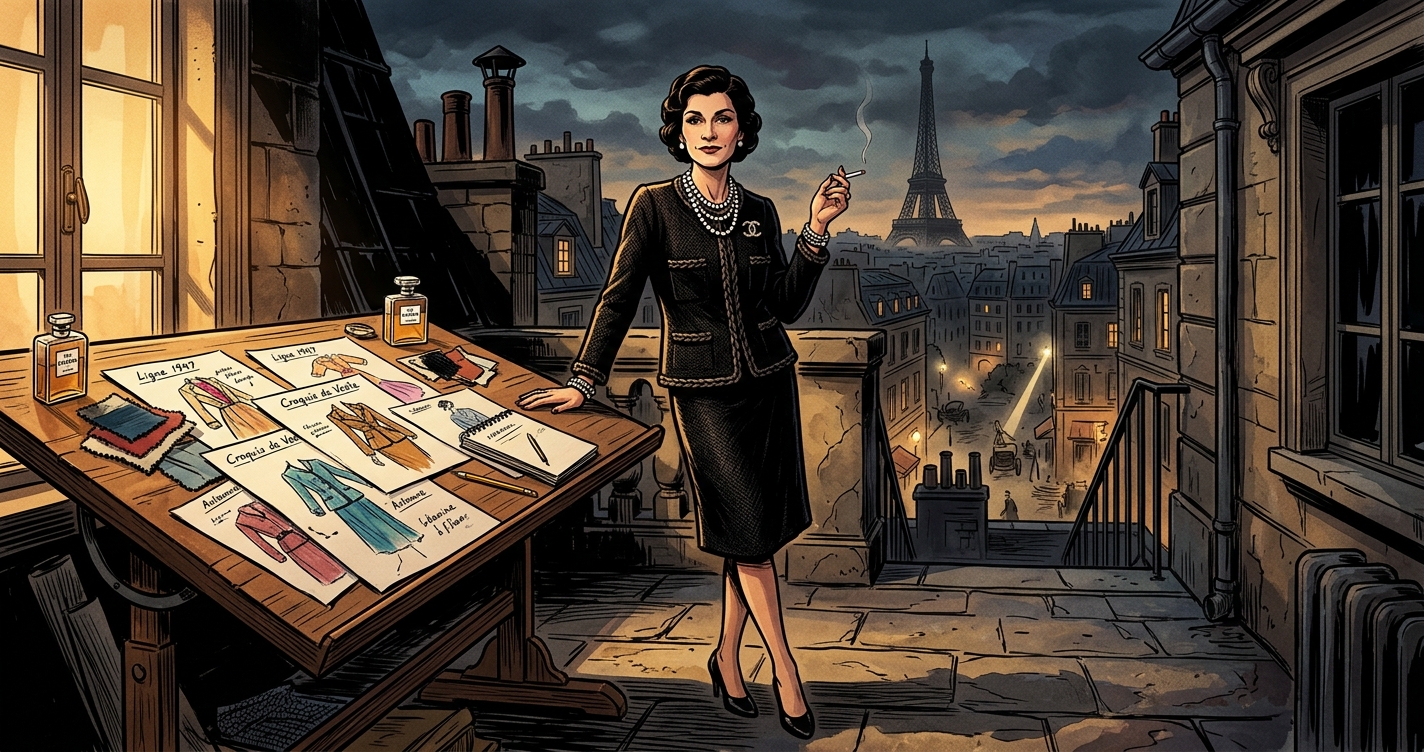
Picture this: Paris, the undeniable heart of fashion, glittering under the pre-war sun. And at its very center, a woman, petite but formidable, whose vision had liberated women from corsets and frippery, dressing them in comfort, elegance, and an air of untouchable sophistication. Coco Chanel wasn’t just a designer; she was a force of nature, a brand before brands were even a thing. She didn’t just sell clothes; she sold an identity, a lifestyle, a dream. Her name was synonymous with modern femininity, independence, and impeccable taste.
But beneath that perfectly coiffed bob and that unshakeable gaze lay a past she meticulously scrubbed clean, and a wartime present she desperately tried to erase. This isn’t just about a historical figure making bad choices; it’s about the ultimate business mogul, the ultimate survivor, leveraging every connection, every ounce of charisma, every ruthless instinct to navigate the most treacherous geopolitical landscape in human history. And in doing so, she crossed lines that most wouldn’t even dare to approach, leaving a trail of complicity and secrets that would haunt her legacy, even if the world was slow to catch on.
We’re going to talk about how she survived, how she thrived, and how she orchestrated perhaps the greatest brand reputation management coup of the 20th century. Because while the bombs fell and the world burned, Coco Chanel was playing a far more dangerous game than anyone knew, a game for survival, for power, and for the very soul of her empire. And the stakes? They were nothing less than her name, her legacy, and her freedom.
🇫🇷 Chapter 2: Paris Under the Swastika – The Stage is Set
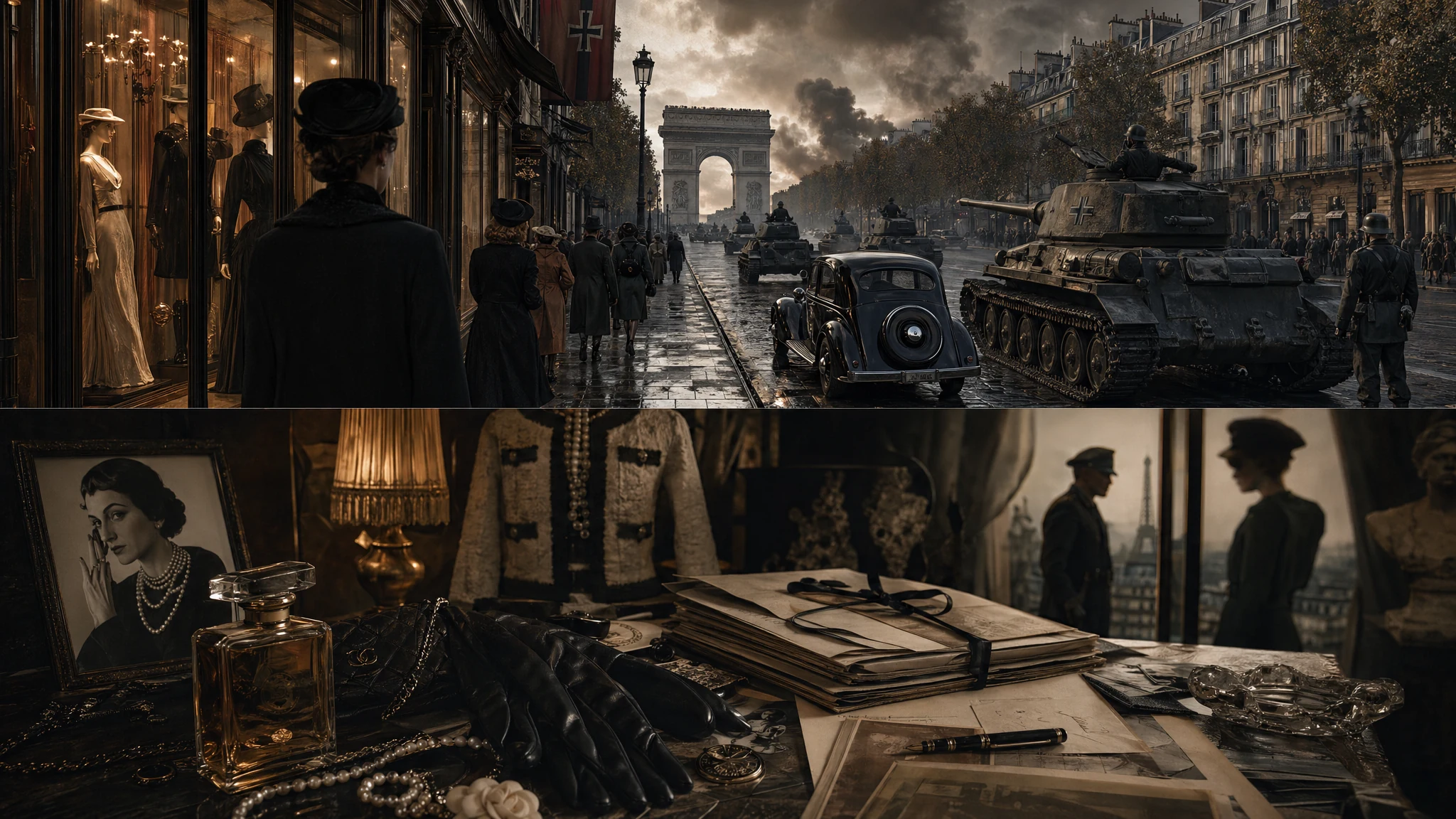
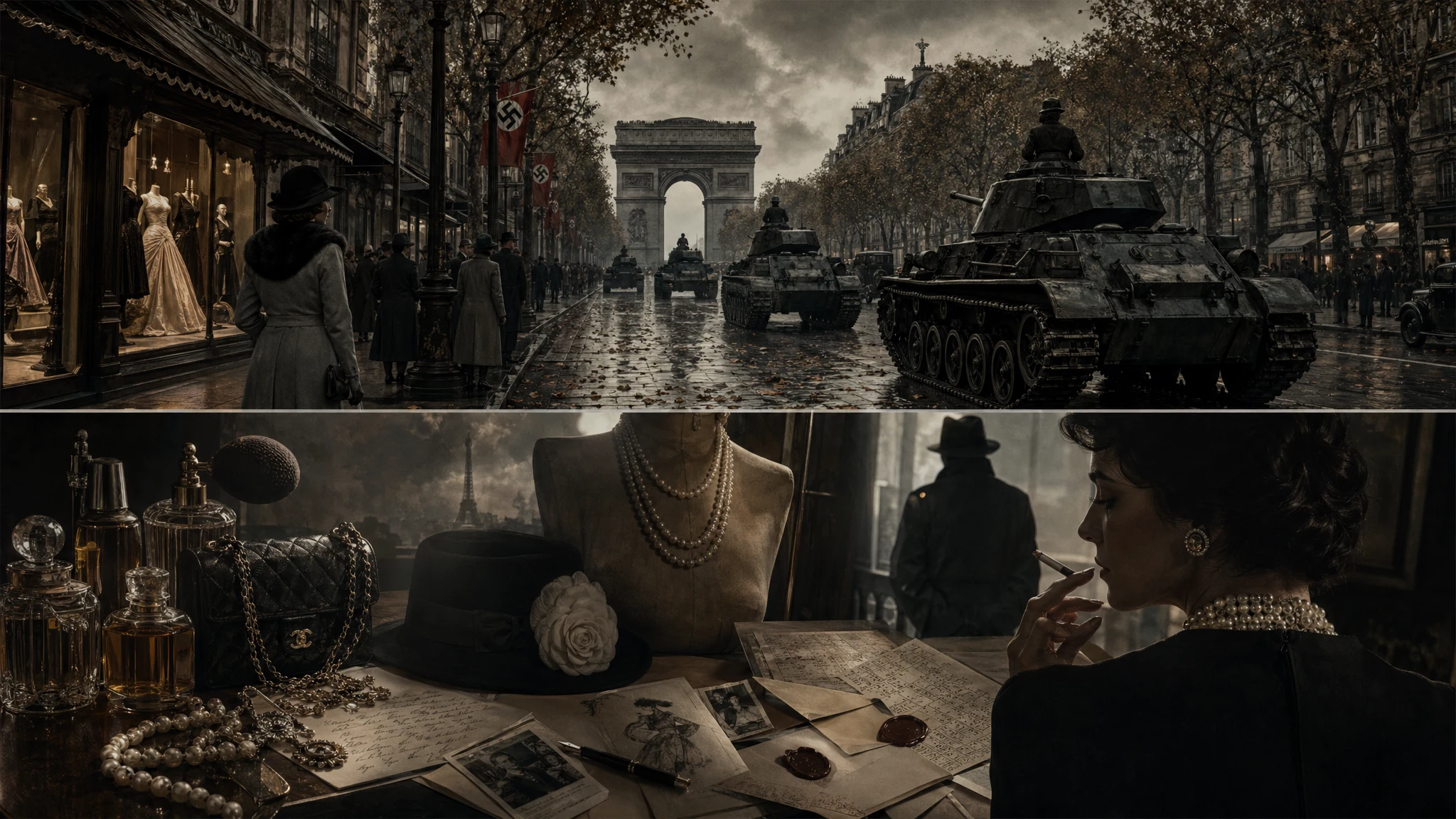
The year is 1940. The champagne flutes are shattered. The glittering lights of the City of Love are dimmed, replaced by the ominous, flickering glow of fear. German tanks roll down the Champs-Élysées. Swastikas unfurl from public buildings. Paris, the proud, beating heart of European culture, falls silent, suffocated under the weight of Nazi occupation.
For the French elite, for the business titans, for the artists and the socialites, this wasn’t just a war; it was an earthquake that shifted every foundation. The moral compass spun wildly, often landing on the most pragmatic, self-serving point. Survival became the ultimate currency. Collaboration, in its myriad forms, became a grim reality for many. And Coco Chanel, a woman who had always understood power, leverage, and the art of the deal, was no exception. In fact, she excelled at it.
Her apartment at the Ritz, a bastion of luxury even amidst the encroaching gloom, became her fortress, her command center. It wasn’t just a place to weather the storm; it was a strategic position. The Ritz, you see, was no ordinary hotel during the occupation. It was the chosen residence of the highest-ranking German officers, the crème de la crème of the Nazi regime in Paris. To live there, to rub shoulders with the enemy, suggested a certain… accommodation. A quiet understanding. A tacit approval.
This wasn’t a random happenstance. Chanel had options. She could have fled, like many of her contemporaries. She could have retreated to her country estate. But she chose the Ritz. Why? Because Coco Chanel was never one to retreat. She was always on the offensive, always calculating, always looking for an angle. And in the occupied capital, surrounded by the enemy, she saw not just danger, but opportunity.
This was the ultimate high-stakes poker game. The French economy was ravaged, Jewish businesses were being “Aryanized” (stolen), and a new, brutal order was being imposed. For someone like Chanel, with her keen business mind and her almost feral instinct for survival, this was a landscape ripe for exploitation. She had a network of contacts, immense personal wealth, and a brand that transcended borders, even if those borders were now guarded by armed Nazis.
Her decision to stay, and more importantly, to embed herself within the very heart of the occupation, was the first, chilling clue that Coco Chanel was not merely a victim of circumstance. She was a player. A ruthless, calculating player in a game where the rules were being rewritten daily, and the consequences for losing were often death. The stage was set for a drama far more intricate, and far more disturbing, than any fashion show she had ever conceived.
🇩🇪 Chapter 3: The German Lover and Operation Modellhut
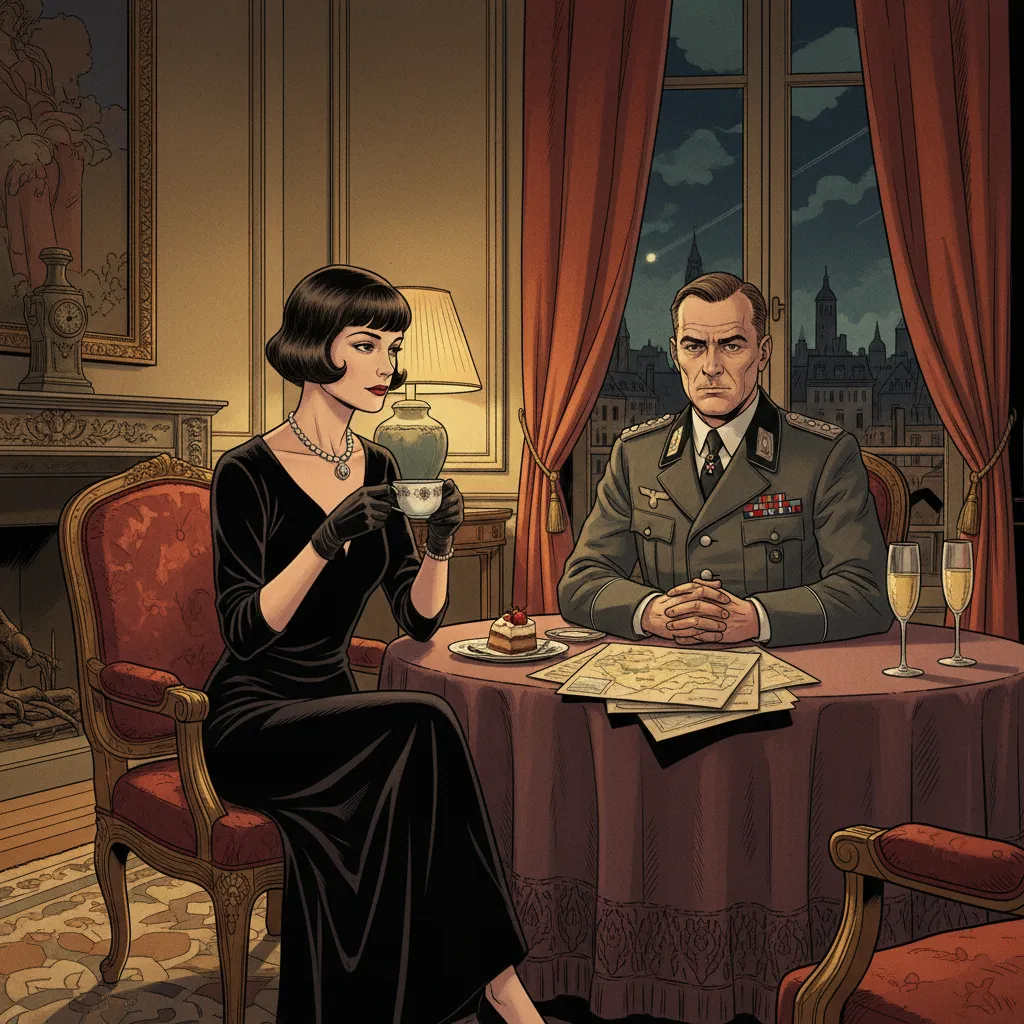
The plot thickens, my friends. Because living at the Ritz wasn’t just about strategic positioning. It was about a man. A German man. And not just any German man, but a high-ranking intelligence officer, a spy, an Abwehr agent named Baron Hans Günther von Dincklage.
Picture this: Coco Chanel, in her late 50s, still radiating that fierce, magnetic energy, finds herself in the arms of a man significantly younger, sophisticated, well-connected, and deeply entrenched in the Nazi apparatus. This wasn’t some fleeting wartime romance; this was a relationship of convenience, certainly, but also one that provided immense protection and unprecedented access. Dincklage wasn’t just a lover; he was her shield, her guide, and eventually, her handler.
Their relationship wasn’t a secret within the walls of the Ritz. It was an open, if unspoken, truth. And it provided Chanel with an unparalleled bubble of immunity in a city where mere suspicion could lead to arrest, torture, or worse. She moved freely, while others starved. She maintained her luxuries, while others lost everything. This wasn’t just about love; it was about power, influence, and the ultimate insurance policy against the chaos outside.
But the relationship went deeper than personal protection. Much deeper. As the war raged, and the Nazi regime grew desperate, they began to leverage their assets, their contacts, their intelligence. And Coco Chanel, with her international renown, her access to Allied circles (she had, after all, been friends with Winston Churchill), and her undeniable charm, was seen as a valuable asset.
Enter Operation Modellhut – “Operation Fashion Hat.” Sounds innocuous, right? Like a new line of accessories. But this was no fashion venture. This was a top-secret Nazi intelligence mission, and Coco Chanel was its unwitting, or perhaps entirely willing, central figure. Her code name was Westminster, a nod to her past romance with the Duke of Westminster, a man closely connected to the British elite, including Churchill himself.
The objective? To use Chanel’s connections to open a back channel to Winston Churchill, then Prime Minister of the United Kingdom, in an attempt to broker a separate peace treaty between Germany and Britain. The Nazis, facing a two-front war, were desperate to avoid a protracted conflict with the Western Allies so they could focus their full might on the Eastern Front against the Soviet Union.
“Chanel was not just sleeping with the enemy; she was working for the enemy. Her relationship with Dincklage wasn’t a romantic dalliance; it was a strategic alliance that placed her at the heart of Nazi intelligence operations.”
This wasn’t some fleeting indiscretion. This was active collaboration with a regime responsible for unimaginable atrocities. It wasn’t about survival anymore; it was about playing a high-stakes geopolitical game, with Chanel at the table, dealing cards for the Nazis. The woman who dressed the world in elegance was now engaged in the dirtiest of trades: espionage.
✡️ Chapter 4: The Jewish Question and the Battle for Chanel No. 5
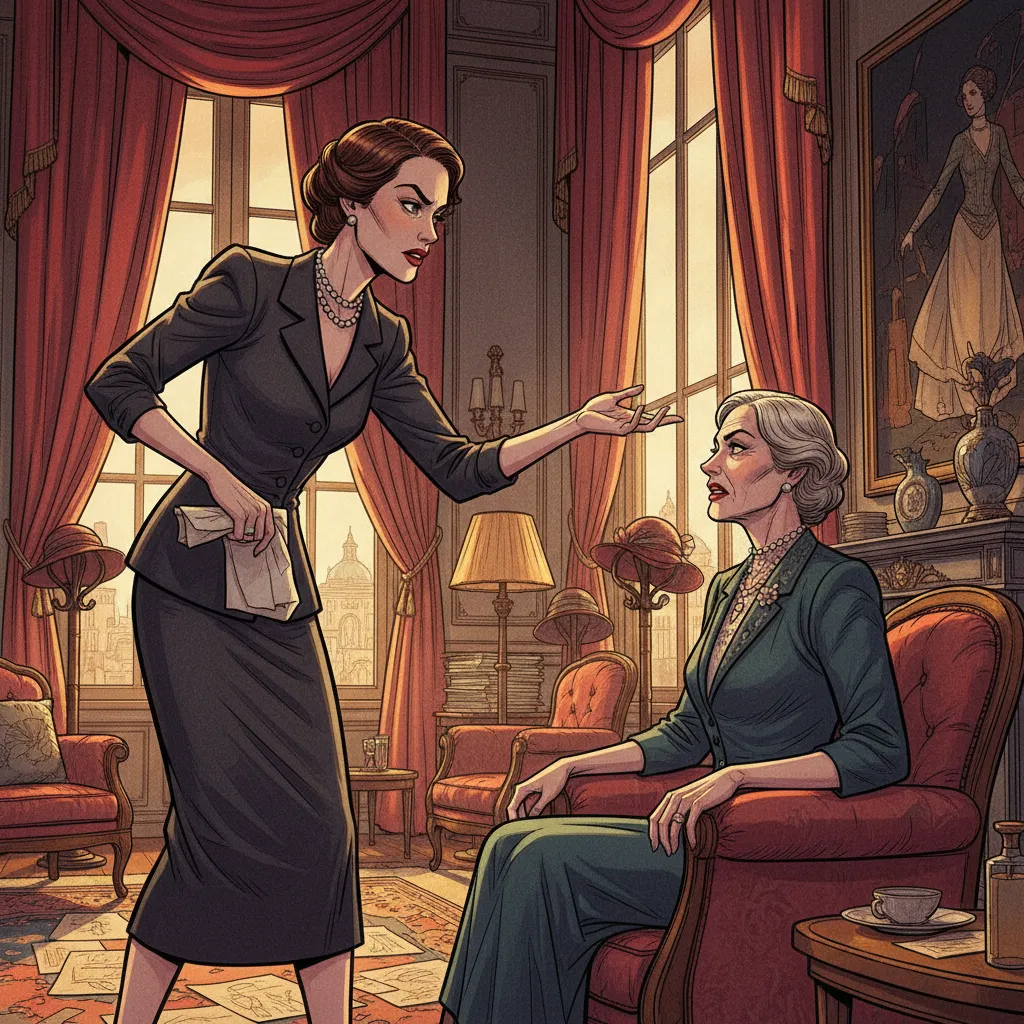
While Operation Modellhut was playing out on the grand stage of international espionage, Coco Chanel was also engaged in a far more personal, yet equally ruthless, battle. This was a battle for control, for profit, and it laid bare the chilling opportunism that lurked beneath her carefully constructed facade. The target? Her own perfume empire, Parfums Chanel, and the Jewish family who owned the majority stake: the Wertheimers.
The story of Chanel No. 5 is iconic. Chanel created the fragrance, but she lacked the business acumen and capital to mass-produce and distribute it globally. In 1924, she struck a deal with Pierre Wertheimer, a shrewd businessman who, along with his brother Paul, owned the Bourjois cosmetics company. The deal was classic Chanel: she got 10% of the company, a small percentage but a significant annual income, and they got 90% and all the headaches of manufacturing, marketing, and distribution. It made them both incredibly rich.
Fast forward to occupied Paris. The Nazis had implemented strict “Aryanization” laws, designed to confiscate Jewish-owned property and transfer it to “Aryan” ownership. For Chanel, this wasn’t just a moral outrage; it was a golden ticket. She saw a chance to reclaim 100% ownership of Parfums Chanel, a business that, by 1941, was raking in unimaginable profits, particularly from its flagship perfume, Chanel No. 5.
Her logic, as presented in her official request to German authorities, was chillingly simple: she was the undisputed “Aryan” owner of the brand, and the Wertheimers were Jewish. Therefore, under Nazi law, the company should be hers. She explicitly stated that Parfums Chanel was “Jewish property” and had been “legally abandoned” by its owners.
“Her attempt to seize Parfums Chanel was not born of patriotic duty, but of naked greed. She weaponized anti-Semitism, using the very laws designed to persecute Jews to enrich herself.”
But the Wertheimers were not easily defeated. Pierre Wertheimer was a master of anticipating threats. Long before the Nazis marched into Paris, he had shrewdly transferred legal ownership of Parfums Chanel to a non-Jewish French businessman, a Christian named Felix Amiot. This was a pre-emptive strike, a clever legal maneuver to protect his assets from confiscation. He then fled France with his family, eventually making his way to the United States.
So, when Chanel made her official claim, the German authorities found themselves in a bureaucratic tangle. The company appeared to be Aryan-owned. The legal labyrinth protected the Wertheimers’ interests, at least on paper. Despite Chanel’s fervent appeals and her powerful German connections (including Dincklage), she was unable to fully wrest control of her perfume empire.
This chapter of her life reveals a disturbing facet of her character: an almost pathological drive for control and accumulation, even at the expense of human decency. It wasn’t enough to be rich and famous; she wanted everything. And she was willing to exploit the darkest currents of wartime prejudice to get it. This wasn’t just bad business; it was a moral bankruptcy that no amount of haute couture could ever truly cover up.
🕵️♀️ Chapter 5: Agent F-7124 – The Spy’s Game Unfolds

The attempt to seize Parfums Chanel from the Wertheimers was a side hustle, a personal vendetta wrapped in opportunistic greed. But the real game, the one that put Coco Chanel firmly in the crosshairs of history’s judgment, was Operation Modellhut. And in this game, she wasn’t just a bystander; she was an active participant, an agent designated F-7124, codenamed Westminster, working for the Abwehr, the Nazi military intelligence service.
This wasn’t a matter of coercion. While under the protection of Hans Günther von Dincklage, Chanel was certainly in a compromised position, but the evidence suggests a level of engagement that goes beyond mere survival. She was, by all accounts, a willing instrument in the Nazi scheme to sow division and seek a separate peace with Britain.
The plan was audacious, even for the Nazis. The core idea was to leverage Chanel’s personal relationship with Winston Churchill, dating back to her affair with the Duke of Westminster in the 1920s, a relationship that had brought her into Churchill’s intimate circle. The Nazis believed that if anyone could open a back channel, it was the iconic Coco Chanel, a woman known for her persuasive charm and her ability to navigate the highest echelons of European society.
The specifics of Operation Modellhut involved Chanel traveling to Madrid, a neutral country, where she would meet with a British diplomat or intelligence officer. Her mission was to convey the message that certain high-ranking Nazi officials were interested in negotiating a peace treaty with Britain, separate from the conflict with the Soviet Union. The hope was that Churchill, a pragmatist, might be swayed by the prospect of ending the Western front and focusing on the Communist threat.
Imagine the scene: Coco Chanel, the epitome of French elegance, stepping into the shadowy world of wartime espionage. Her meetings, her movements, her communications – all orchestrated by the Abwehr. She wasn’t just a messenger; she was a critical piece of a complex intelligence puzzle, her celebrity status providing the perfect cover for her clandestine activities. Who would suspect the legendary fashion designer of being a Nazi agent? It was, in its own twisted way, brilliant.
“Chanel’s involvement in Operation Modellhut wasn’t a passive act of self-preservation. It was a calculated collaboration, a willingness to lend her formidable influence and access to the enemy in exchange for personal advantage and protection.”
The implications of this are staggering. This wasn’t just about profiting from anti-Semitic laws; this was about actively aiding a regime responsible for genocide and global conflict. Her actions could have shifted the course of the war, potentially prolonging it or altering its outcome in ways that are chilling to contemplate.
For the Abwehr, Chanel represented a unique opportunity. Her celebrity, her seemingly apolitical nature, and her genuine past connections made her an ideal, if improbable, asset. She could move in circles closed off to traditional spies. She could whisper in ears that would never listen to a German official. And she did. The evidence, painstakingly uncovered by historians like Hal Vaughan, paints a damning picture of a woman deeply enmeshed in the Nazi intelligence apparatus. The legend of Coco Chanel suddenly takes on a far more sinister hue, revealing a side of her ambition that transcended even the cutthroat world of fashion.
🇪🇸 Chapter 6: Madrid and the Churchill Connection – The Mission Unravels

So, Agent F-7124, aka Coco Chanel, found herself in Madrid, Spain, in the autumn of 1943. This was the culmination of Operation Modellhut. Spain, officially neutral, was a hotbed of spies, diplomats, and clandestine meetings. It was the perfect stage for a delicate, desperate negotiation.
Chanel didn’t travel alone. She was accompanied by Baron Hans Günther von Dincklage, her German lover and handler, and Walter Schellenberg, a high-ranking SS intelligence officer, one of the most ruthless and cunning men in the Nazi regime. This wasn’t a casual trip; this was a meticulously planned mission with incredibly high stakes.
Her objective: to meet with Sir Samuel Hoare, the British Ambassador to Spain, and deliver the message to Winston Churchill. The Nazis, particularly Schellenberg, believed that Churchill, a staunch anti-communist, might be receptive to a peace deal that would allow Germany to focus its war efforts against the Soviet Union. They thought Chanel, with her personal history with Churchill and his inner circle, could be the key to unlocking this possibility.
Imagine the scene: the elegant, impeccably dressed Coco Chanel, walking into the British Embassy, ostensibly for a social call, but carrying a message that could alter the course of history. Her celebrity was her camouflage. Her charm, her weapon. She was to suggest that certain elements within the SS were willing to negotiate a separate peace, bypassing Hitler. This was a desperate gambit, a sign of the increasing pressure the Nazis felt as the tide of war began to turn against them.
But the mission, despite its elaborate planning, was a spectacular failure. The British were far too savvy to fall for such an obvious trap. They had their own intelligence networks, and they were well aware of the nature of Chanel’s relationship with Dincklage and her presence in Madrid with Schellenberg. Churchill himself, a man of unwavering resolve, would never have entertained such a proposition, especially not from a known associate of the enemy.
“The Madrid mission was a testament to the Nazis’ desperation and Chanel’s hubris. They underestimated Churchill’s resolve and the sophistication of Allied intelligence, and Chanel overestimated her own ability to manipulate the grand chessboard of global politics.”
Sir Samuel Hoare reportedly listened politely, but essentially dismissed the overture. The message, if it even reached Churchill in any serious capacity, was almost certainly ignored. The British were committed to unconditional surrender from Germany, not a negotiated peace that would allow the Nazi regime to survive and regroup.
Chanel returned to Paris, her mission a bust. But the attempt itself, the fact that she was willing to undertake such a dangerous and morally compromising task for the Nazi regime, speaks volumes. It wasn’t just about being a “socialite” caught up in wartime romance; it was about active participation in enemy intelligence operations.
This episode is a stark reminder of the moral quagmire of war, and how individuals, even those of immense public stature, can be drawn into its darkest corners. For Coco Chanel, the Madrid debacle was a near miss, a secret that, if exposed, would have utterly destroyed her reputation and likely led to severe consequences. But for now, the secret remained buried, a ticking time bomb beneath the glittering facade of her legend.
🤫 Chapter 7: The Cover-Up Begins – Escape from Justice
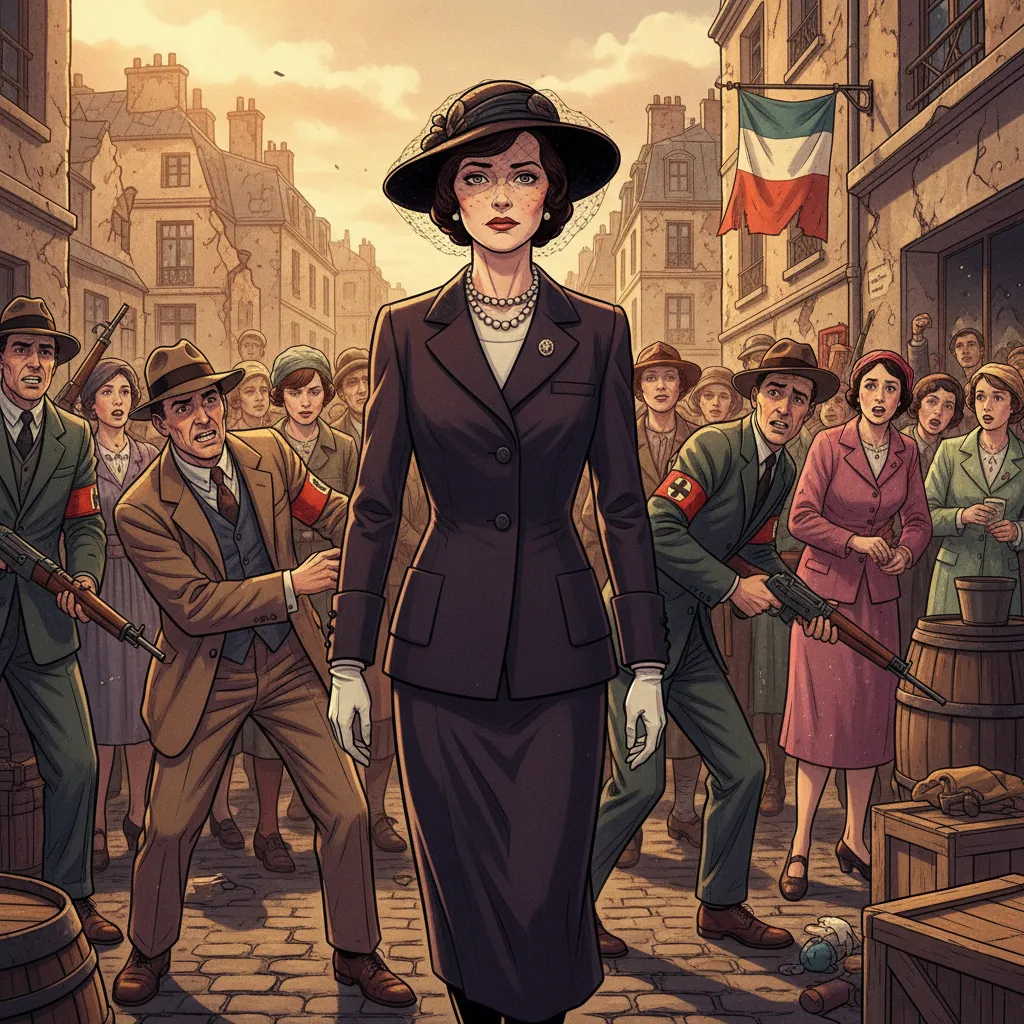
The war ended in 1945. The euphoria of liberation swept through Paris, quickly followed by a brutal reckoning. The “épuration” – the purge – began. Collaborators, both prominent and obscure, were rounded up, publicly shamed, tried, and often executed. Women who had slept with German soldiers had their heads shaved and were paraded through the streets. The price for aiding the enemy was severe.
And Coco Chanel? The woman who lived at the Ritz with a high-ranking Nazi, who tried to steal a Jewish-owned business, who served as an Abwehr agent in Operation Modellhut? She walked free. Unscathed. Unpunished.
How? How did she, of all people, escape the wrath of the French Resistance and the Allied forces? This, my friends, is where the true genius of Coco Chanel – her ruthless pragmatism, her unparalleled networking skills, and the sheer power of her connections – truly shines, albeit in a morally ambiguous light.
The most commonly cited reason for her swift release after a brief interrogation (some accounts suggest she was detained for only a few hours) is her direct appeal to Winston Churchill. Yes, the same Churchill she had tried to contact on behalf of the Nazis. It is believed that upon her arrest, Chanel immediately invoked Churchill’s name. The story goes that Churchill, perhaps out of a sense of past loyalty, or more likely, a desire to avoid an embarrassing public scandal involving a figure so close to the British establishment, intervened.
“Chanel’s escape from post-war justice was a testament to the immense, almost untouchable power of her connections. When the reckoning came, she pulled a card so high-value, it trumped all the evidence of her complicity.”
Churchill’s intervention, if true, would have been a quiet, discreet affair, a whisper in the right ears to make the problem disappear. A public trial of Coco Chanel for collaboration would have been a media circus, potentially revealing uncomfortable truths about other high-ranking figures, both French and Allied, who might have associated with her or had their own less-than-stellar wartime records. Better to sweep it under the rug.
But it wasn’t just Churchill. Chanel had cultivated a lifetime of powerful friendships and relationships. She had dressed the wives of politicians, entertained royalty, and charmed industrialists. These were the kind of people who could make problems vanish. Her wealth, too, played a role. Money can buy silence, influence, and even selective amnesia.
Furthermore, her role in Operation Modellhut remained largely unknown to the general public and even to many intelligence agencies at the time. The Abwehr’s records were scattered, destroyed, or kept highly secret. The full extent of her espionage activities wouldn’t come to light for decades. Without concrete, publicly available evidence, it was easier for the authorities to let her go, especially with powerful figures advocating on her behalf.
So, while others faced firing squads, Coco Chanel merely packed her bags. She retreated. Not to prison, but to Switzerland, a neutral haven where she would live in comfortable exile for nearly a decade. The cover-up had begun. The legend was being protected, even as the truth festered beneath the surface, waiting for its eventual, dramatic reveal. This wasn’t justice; it was a masterful exercise in power and privilege, silencing the past to protect a future.
🇨🇭 Chapter 8: The Swiss Exile and the Improbable Comeback

After her miraculous escape from the post-war purges, Coco Chanel didn’t face the guillotine or public humiliation. Instead, she retreated to the serene anonymity of Lausanne, Switzerland. For nearly a decade, from 1945 to 1954, the undisputed queen of fashion lived in self-imposed exile, a ghost in the machine of her own empire.
But don’t mistake this exile for penance. This wasn’t a woman wracked with guilt. This was a strategic retreat. A time to let the dust settle, for memories to fade, for the collective French consciousness to forgive, or at least forget, the wartime transgressions of its most famous fashionista. While in Switzerland, she maintained her luxurious lifestyle, thanks to the continued income from Parfums Chanel. And this is where the story takes another fascinating, almost unbelievable turn, involving the very family she tried to ruin.
Remember the Wertheimers, the Jewish family she tried to dispossess of their stake in Chanel No. 5? While she was in exile, Pierre Wertheimer not only continued to manage Parfums Chanel with immense success, but he also provided her with a generous income, ensuring her financial stability. Why? It was a pragmatic, almost cynical, business decision. Chanel’s name was still gold. To cut her off entirely would risk her trying to create a competing perfume, or worse, publicly airing her grievances and potentially damaging the brand. It was a Faustian bargain: the Wertheimers would continue to pay their tormentor, in exchange for her silence and the continued use of her iconic name.
“Chanel’s Swiss exile wasn’t a fall from grace, but a strategic hibernation. And her relationship with the Wertheimers during this period was a masterclass in pragmatic business, a truce with the very people she tried to destroy, all to protect the golden goose of her brand.”
But Coco Chanel was not a woman content with quiet retirement. The fashion world was changing. Christian Dior had emerged with his “New Look,” a romantic, extravagant style that was everything Chanel had rebelled against. She saw it as a betrayal of her vision, a return to the very corsetry and fussiness she had liberated women from. The fire, the ambition, the ruthless drive that had defined her, began to simmer once more.
In 1954, at the age of 71, Coco Chanel made one of the most audacious comebacks in business history. She decided to return to Paris, to reopen her haute couture house, and to reclaim her throne. The fashion establishment was skeptical, even hostile. Many remembered her wartime activities, or at least the whispers of them. The press, particularly the French press, was initially scathing. Her first collection was met with derision, dismissed as old-fashioned.
But Chanel was a survivor. She was stubborn. And she had an ace up her sleeve: the American market. While the French might have been unforgiving, the Americans adored her. Her simple, elegant designs resonated with American women who valued practicality and sophistication. With the support and shrewd business backing of the Wertheimers (yes, still them!), who saw the potential for her fashion line to bolster the perfume sales, she persevered.
Her comeback was slow, deliberate, and ultimately, triumphant. The Chanel suit became a global phenomenon once more. The pearls, the quilted bags, the two-tone shoes – they all returned, cementing her status as an enduring icon. She didn’t just return to fashion; she redefined it again, proving that true genius, however tarnished, can always find a way back to the spotlight, especially when backed by strategic financial muscle and a meticulously managed narrative. The public, it seemed, was ready to forget, or simply didn’t know, the darker chapters of her past.
🤫 Chapter 9: The Silence and the Storytellers – Burying the Bones

With her triumphant comeback, the narrative surrounding Coco Chanel was meticulously rewritten. The wartime years, her dalliance with a Nazi officer, her espionage activities, her attempt to seize Parfums Chanel from the Wertheimers – all of it was swept under the plush carpet of her legend. The silence was deafening, and it was deliberately cultivated.
Who benefited from this silence? First and foremost, Chanel herself. To acknowledge her collaboration would have been to destroy her reborn empire and her carefully constructed image. She was a master manipulator of her own story, a woman who understood that perception was reality. She spun tales of hardship, of artistic integrity, of a lone genius battling against the odds. The past was simply too inconvenient, too dangerous, to confront.
Secondly, the Wertheimer family played a crucial, if morally complex, role in maintaining this silence. As owners of Parfums Chanel, they had a vested interest in protecting the brand’s image. While they had been victims of her wartime greed, they also understood that the name “Chanel” was a multi-million-dollar asset. A public scandal about Coco’s Nazi past would have severely damaged the brand, impacting their profits. So, they continued to support her, even fund her, ensuring her silence and the brand’s pristine facade. It was a cold, hard business decision: protect the asset, even if it meant protecting the woman who tried to steal it.
“The legend of Coco Chanel was meticulously curated, a pristine facade built over a foundation of wartime secrets. The silence surrounding her darkest years was a joint venture, a strategic pact between the mogul herself and the business empire that bore her name.”
The fashion industry, too, was complicit. The allure of Coco Chanel was too powerful, her designs too iconic, to allow a messy past to tarnish the industry’s crown jewel. There was a collective desire to move forward, to celebrate beauty and creativity, and to conveniently forget the ugliness of the war. Fashion, after all, thrives on glamour, not gritty historical truth.
For decades, the official biographies, the magazine features, the documentaries – they all painted a picture of an indomitable, independent woman, a visionary who revolutionized style. Her humble origins were celebrated, her romances romanticized, her genius lionized. The brief “retirement” in Switzerland was framed as an artistic sabbatical, a period of quiet reflection before her glorious return. The whispers of collaboration were dismissed as rumor, jealousy, or the inevitable fallout of wartime chaos.
The sheer power of the Chanel brand became a shield. It was so globally recognized, so deeply embedded in the cultural consciousness, that it developed an almost impenetrable aura. To question Coco was to question the very fabric of modern elegance. And few dared. The narrative was set, the history whitewashed, and the dark bones of her wartime secrets were buried deep, protected by a vast, unspoken conspiracy of silence, all in the service of an empire built on perfume and tweed.
📜 Chapter 10: Unearthing the Truth – The Cracks in the Facade
For decades, the official narrative held firm. The legend of Coco Chanel remained largely untarnished, her wartime activities relegated to the realm of dismissed rumor or carefully controlled biography. But history, like a persistent current, eventually erodes even the most solid facades. The truth, however inconvenient, has a way of finding its light.
The first significant cracks began to appear in the late 20th and early 21st centuries, as historians gained access to previously sealed archives, declassified intelligence documents, and personal testimonies. The gradual unveiling of Chanel’s darker past was not a single dramatic reveal, but a slow, uncomfortable process of piecing together fragments of evidence.
The most comprehensive and damning exposé came with the publication of Hal Vaughan’s 2011 book, “Sleeping with the Enemy: Coco Chanel’s Secret War.” Vaughan, an American historian, spent years poring over French, British, German, and American archives. What he uncovered was explosive: irrefutable evidence of Chanel’s direct involvement with the Abwehr, her codename F-7124 (Westminster), her mission to Madrid, and the specific details of her relationship with Hans Günther von Dincklage.
Vaughan’s research brought to light the official German documents, including a 1942 Abwehr report confirming her recruitment and her role in Operation Modellhut. He also detailed her explicit appeal to Nazi authorities to seize control of Parfums Chanel under “Aryanization” laws, complete with her signature on the request. These weren’t whispers anymore; these were documented facts, chillingly direct from the source.
“Hal Vaughan didn’t just write a book; he detonated a historical bomb. He meticulously pieced together the fragments of evidence, exposing a truth so uncomfortable it shattered the carefully constructed myth of Coco Chanel, revealing her not just as a collaborator, but as an active agent of the Nazi regime.”
The reaction was immediate and intense. The world, which had long embraced Chanel as an icon of liberation and style, was forced to confront a far more sinister reality. Major publications like The New York Times, The BBC, and The Guardian covered the revelations extensively, challenging the carefully curated image that had persisted for so long.
The House of Chanel, the luxury brand she founded, responded cautiously. While they acknowledged her relationship with Dincklage, they maintained that she was merely a “friend” of German officers and that the archives “attest to her resistance.” This was a clear attempt at damage control, to distance the brand from the damning personal actions of its founder, highlighting the ongoing tension between a legacy and its uncomfortable truths.
But the cat was out of the bag. The carefully constructed myth had been pierced. The story of Coco Chanel could no longer be told without acknowledging the gaping, ugly chasm of her wartime past. It forced a re-evaluation of her genius, her ambition, and the ethical compromises she was willing to make for survival and power. The truth, once buried, had finally clawed its way to the surface, forever changing how we perceive one of the 20th century’s most influential figures.
📈 Chapter 11: The Mogul’s Gambit – Business Lessons from the Abyss
So, what do we, the savvy entrepreneurs and investors of today, take away from this wild, dark ride through Coco Chanel’s secret war? This isn’t just a historical scandal; it’s a brutal case study in extreme business strategy, reputation management, and the often-uncomfortable intersection of personal ethics and corporate survival.
First, let’s talk about Brand Resilience vs. Founder Flaws. Chanel’s brand, against all odds, survived its founder’s morally bankrupt actions. This tells you something profound about the power of an established brand. Once a brand reaches a certain level of cultural penetration and desirability, it can develop an almost independent life force. The name, the aesthetic, the aspiration – these can become stronger than the personal character of the individual who created them. For investors, this means understanding that brand equity is a tangible asset, often insulated from founder controversies if managed correctly (or ruthlessly). For entrepreneurs, it’s a stark reminder that while your personal integrity is crucial, the long-term strength of your brand might ultimately transcend your individual failings, provided the right mechanisms are in place for protection.
Second, consider The Art of Strategic Reinvention and Narrative Control. Chanel’s post-war comeback was nothing short of miraculous. She didn’t just disappear; she strategically hibernated. She allowed the storm to pass, then re-emerged, skillfully leveraging her existing network, her creative genius, and, critically, the financial backing of the Wertheimers (her former adversaries!) to stage a global triumph. Her story was meticulously rewritten, with the dark parts conveniently omitted. This is a masterclass in crisis management and narrative control. She understood that in the absence of truth, a compelling story can prevail. For any business leader, this highlights the immense power of public relations, strategic communications, and the ability to shape your own narrative. It’s a sobering lesson on how effectively history can be whitewashed to protect a commercial empire.
“Chanel’s story is a chilling masterclass in brand protection at any cost. She proved that with enough power, enough money, and enough ruthlessness, you can bury the darkest truths and still emerge a legend, leaving a wake of moral questions in your perfectly tailored path.”
Third, there’s the harsh reality of Opportunism in Crisis and the Moral Grey Zones of Business. Wartime presented extreme, often grotesque, opportunities. Chanel’s attempt to use “Aryanization” laws to seize Parfums Chanel from the Wertheimers is a chilling example of leveraging a societal crisis for personal financial gain. Her espionage activities, while perhaps framed by her as survival, were ultimately a strategic play for protection and influence. This isn’t a lesson to emulate, but a lesson to understand. In times of upheaval, ethical boundaries blur, and some individuals will seize any advantage, no matter how morally reprehensible. For entrepreneurs and investors, it’s a reminder that market dynamics during crises can be profoundly distorted, revealing the darkest aspects of human ambition and the complex interplay between law, ethics, and profit. It forces us to ask: What lines are truly inviolable when the stakes are existential?
Finally, her story underscores the Power of Connections and Privilege. Chanel’s escape from post-war justice was largely due to her powerful network, including Winston Churchill. This reveals the uncomfortable truth that privilege and influence can often circumvent accountability. In business, who you know, who owes you favors, and who you’ve cultivated relationships with can be as critical as your product or service, especially when facing existential threats.
The hidden dark side of Coco Chanel isn’t just a tale of betrayal; it’s a stark, unvarnished look at the extremes of human ambition, the ruthless pursuit of power, and the terrifying effectiveness of a meticulously orchestrated cover-up. It reminds us that behind every gleaming facade, there might be secrets buried so deep, they could shatter the very foundations of a legend.
🖤 Chapter 12: The Stain That Lingers – A Legacy Divided
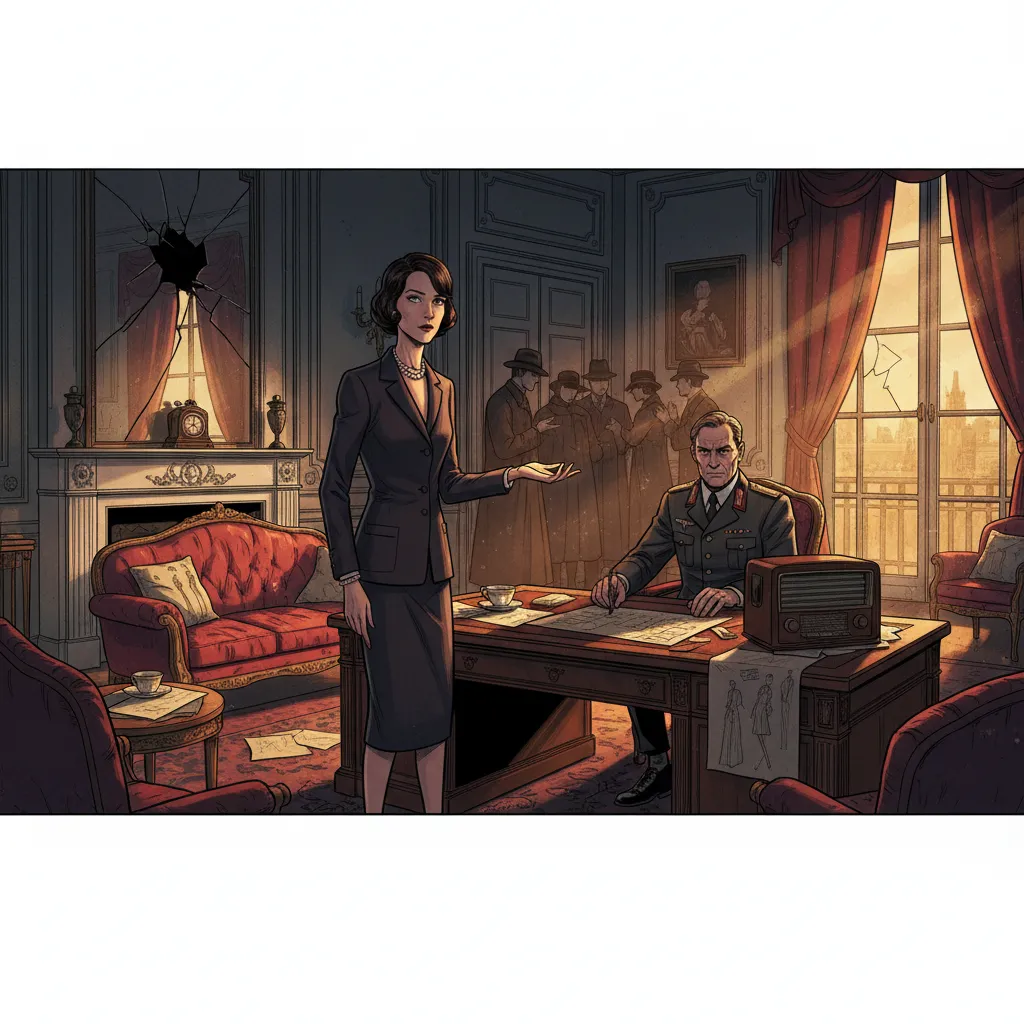
We’ve journeyed through the glittering salons and the shadowed backrooms of occupied Paris, through the audacious plots and the shrewd maneuvers that defined Coco Chanel’s wartime years. We’ve seen the icon, the spy, the opportunist, the survivor. And now, we stand at the precipice of her legacy, forced to reconcile the conflicting truths of a woman who was both a revolutionary genius and a documented collaborator.
The little black dress, the tweed suit, the pearls, Chanel No. 5 – these enduring symbols of elegance and female empowerment are interwoven with a narrative of Nazi complicity, espionage, and cold-hearted greed. Can we separate the art from the artist? Can we admire the genius while condemning the person? This is the uncomfortable question that Coco Chanel’s story forces us to confront, a question that continues to echo through the halls of history and the boardrooms of luxury empires.
Her life is a testament to the idea that genius, ambition, and a relentless will to power can exist alongside profound moral failings. She built an empire, redefined an era, and then, when the world descended into chaos, she made choices that were not merely pragmatic, but deeply compromising and actively harmful. And then, with an almost unbelievable audacity, she orchestrated one of history’s greatest disappearing acts, burying her secrets for decades, allowing the legend to eclipse the truth.
“The legacy of Coco Chanel is a tapestry woven with threads of brilliance and betrayal. It challenges us to look beyond the surface, to question the curated narratives, and to acknowledge that even the most celebrated moguls can harbor the darkest of secrets.”
The stain of her wartime activities, once hidden, now lingers. It’s a shadow that falls across every iconic design, every bottle of perfume. It forces us to re-evaluate the very concept of a “legend.” Is a legend truly deserving of uncritical adoration when its foundations are built, in part, on such morally reprehensible actions?
Perhaps the most potent lesson from Coco Chanel’s dark side is not just about her, but about us. It’s about our willingness to believe the myth, to embrace the glamour, and to overlook the inconvenient truths that challenge our comfortable perceptions. It’s about the power of narrative, the allure of success, and how easily we can be swayed by a captivating story, even when the facts tell a far more disturbing tale.
Coco Chanel was a mogul of unparalleled vision and ruthless ambition. She played a dangerous game and won, at least in the short term, ensuring her survival and the enduring power of her brand. But the truth, however long it takes, always finds a way out. And in the harsh light of that truth, the dazzling image of the fashion icon is forever altered, forever shadowed by the chilling reality of Agent F-7124, Westminster, the Nazi collaborator who got away with it. Her legacy is not just one of style, but one of secrets, survival, and the enduring, uncomfortable questions about the cost of power. And that, my friends, is a story that will never truly be out of fashion.
💡 Key Insights
- ▸ Brand Resilience vs. Personal Ethics: Coco Chanel's story is a stark reminder that a powerful, well-established brand can possess an almost unimaginable resilience, capable of surviving and even thriving despite the morally compromised actions of its founder. It highlights the complex separation that can exist between personal reputation and corporate identity, demonstrating how market perception can be engineered and how brand equity can, in certain circumstances, overshadow deeply troubling founder controversies. For entrepreneurs and investors, this underscores the dual nature of brand value – it's both a reflection of its origins and a separate entity that can be strategically managed and protected, sometimes at great ethical cost.
- ▸ The Art of Strategic Reinvention and Narrative Control: Chanel's masterful ability to disappear from the public eye during her most controversial period, then reappear and meticulously craft a triumphant post-war narrative of artistic genius, is a masterclass in reputation management and strategic comebacks. She understood the power of controlling her story, leveraging powerful connections and financial muscle to silence critics and rewrite history. This offers a potent, albeit ethically challenging, lesson for entrepreneurs and investors on the critical importance of narrative control, crisis management, and the lengths some individuals and organizations will go to protect a legacy, proving that perception can often be more potent than reality in the long run.
- ▸ Opportunism in Crisis and the Moral Grey Zones of Business: The chaotic, morally ambiguous environment of World War II presented extreme opportunities, and Chanel's actions reveal how some individuals ruthlessly leverage crises for personal and business gain. Her attempts to use anti-Semitic laws to seize control of her perfume empire, alongside her espionage activities, blur the lines between survival, patriotism, and pure self-interest. This serves as a broader industry and market lesson: crises expose character and create unique market dynamics where ethical considerations can be severely tested or entirely sidelined by the pursuit of profit or power, with long-term reputational consequences often deferred or deliberately obscured.