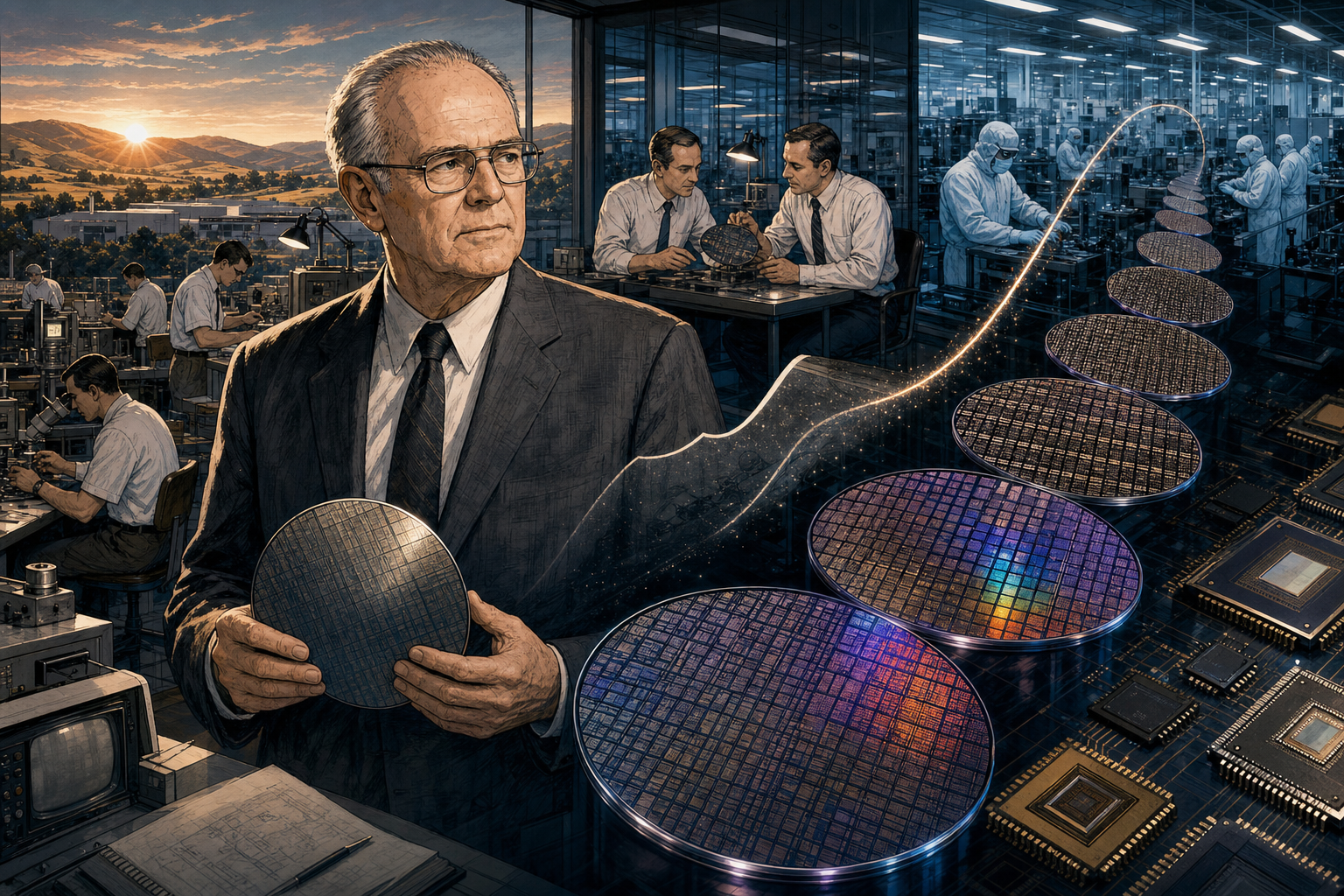
Gordon Moore: The Quiet Strategist Behind Intel and Moore's Law
Gordon Moore turned a technical observation about chip density into an industry clock, then helped Intel survive the strategic exit that defined its future.
View all stories about this mogul
Gordon Moore became famous for predicting the future of semiconductors, but his larger achievement was helping build an organization that repeatedly manufactured that future.
Moore’s Law is often quoted as though it were a natural law guaranteeing faster computers. It began as an observation about the economics and density of integrated circuits. Over time, it became a target shared by chip designers, equipment makers, materials suppliers, software companies, and investors.
Behind the slogan stood a reserved chemist who co-founded Fairchild Semiconductor and Intel, worked beside Robert Noyce and Andy Grove, and helped make one of the most consequential strategic exits in business history. Moore’s career is a lesson in how technical judgment, capital intensity, and organizational partnership create compounding advantage.
How did Gordon Moore turn an observation into an industry clock?

Moore was born in San Francisco in 1929 and trained as a chemist, earning a doctorate from Caltech. He joined William Shockley’s semiconductor laboratory, then left with seven colleagues after conflict over management. The group—later labeled the “traitorous eight”—formed Fairchild Semiconductor in 1957.
Fairchild became a foundation of Silicon Valley. Its engineers advanced silicon transistors and integrated circuits while creating a generation of future founders. Moore led research and development, gaining a close view of how rapidly manufacturers were placing more components onto chips.
In a 1965 article for Electronics, Moore observed that the number of components on an integrated circuit had been increasing rapidly and projected continued growth. He later revised the cadence. The exact formulation changed, but the strategic meaning endured: integration would make computing dramatically more capable and economical.
The prediction mattered because semiconductor production is coordinated investment. A chip company needs lithography tools, chemicals, design software, packaging, factories, and customers planning products years ahead. Once the industry treated a scaling cadence as credible, suppliers could align road maps and capital around it.
Moore’s Law was therefore partly descriptive and partly self-reinforcing. Engineers still had to solve new physical problems at every generation. The “law” did not do the work; it justified the belief that solving the next constraint would create an enormous market.
Why did Intel abandon memory to become a processor company?

Moore and Robert Noyce founded Intel in 1968. The company initially focused on semiconductor memory, an expanding market that fit its technical capabilities. Intel also developed microprocessors, including products born from custom-chip work, but memory defined its early identity.
By the 1980s, Japanese competitors had become formidable in memory. Price pressure, quality competition, and overcapacity damaged Intel’s position. The company faced the classic innovator’s trap: the business that had built its skills and identity was no longer the best place to deploy them.
Andy Grove later described a pivotal question posed with Moore: if a new management team replaced them, what would it do? The answer was to get out of memory. Grove’s response—then why should they not do it themselves?—helped clarify the decision.
Intel shifted resources toward microprocessors, where its position in personal computers offered different economics and strategic leverage. The transition was painful. It involved closing activities, reallocating people and capital, and admitting that technical pride could not reverse industry structure.
Moore’s role is important precisely because it was not theatrical. Noyce was the charismatic institution builder. Grove was the intense operator and strategist. Moore brought technical depth, calm judgment, and credibility with engineers and the board. Their differences created a stronger leadership system than any one style alone.
The processor focus later produced extraordinary market power, though Intel’s history also shows that no advantage is permanent. Manufacturing delays, architectural shifts, mobile computing, and new competitors would challenge the company in later decades. Moore’s Law remained an aspiration even as the economics and physics behind it grew more complex.
What did Gordon Moore do with the wealth created by silicon?

Moore served as Intel’s chief executive and chairman before stepping back from active leadership. With his wife, Betty, he established the Gordon and Betty Moore Foundation in 2000. The foundation has directed substantial resources toward scientific discovery, environmental conservation, patient care, and the San Francisco Bay Area.
The philanthropy reflected the same comfort with long horizons seen in semiconductors. Fundamental science may take years before its value becomes obvious. Conservation requires sustained work across land, water, institutions, and communities. These are areas where quarterly incentives are often poorly matched to the problem.
Moore was also known for personal understatement relative to the scale of the industry he helped create. That temperament can obscure the ambition of his decisions. Projecting exponential integration, financing new fabrication, leaving Fairchild, founding Intel, and exiting memory were not cautious moves. They were high-conviction bets expressed without performance.
He died in 2023 at age 94. By then, the phrase attached to his name had shaped expectations for nearly six decades. Transistor scaling has become harder and more expensive, while progress increasingly comes from specialized architectures, advanced packaging, parallelism, and system design. The simple curve no longer explains every gain.
Its managerial lesson remains. A useful forecast does more than predict. It gives a network of people a pace, encourages investment before demand is fully visible, and exposes organizations that stop learning. The danger is confusing the road map with inevitability.
Gordon Moore did not decree that computing would improve. He helped create the companies, partnerships, capital commitments, and engineering culture that made repeated improvement plausible. The quiet strategist’s real law was organizational: progress compounds when an ecosystem agrees on the next impossible target and then takes responsibility for reaching it.
💡 Key Insights
- ▸ A forecast can become a coordination mechanism when an ecosystem invests as if it must come true.
- ▸ Technology companies need the courage to leave the business that created them when industry economics move.
- ▸ Complementary founders can be more powerful than one charismatic center.
- ▸ Patient scientific philanthropy applies long time horizons where markets and politics often cannot.