Indra Nooyi: The CEO Who Rewired PepsiCo Before the Market Caught Up
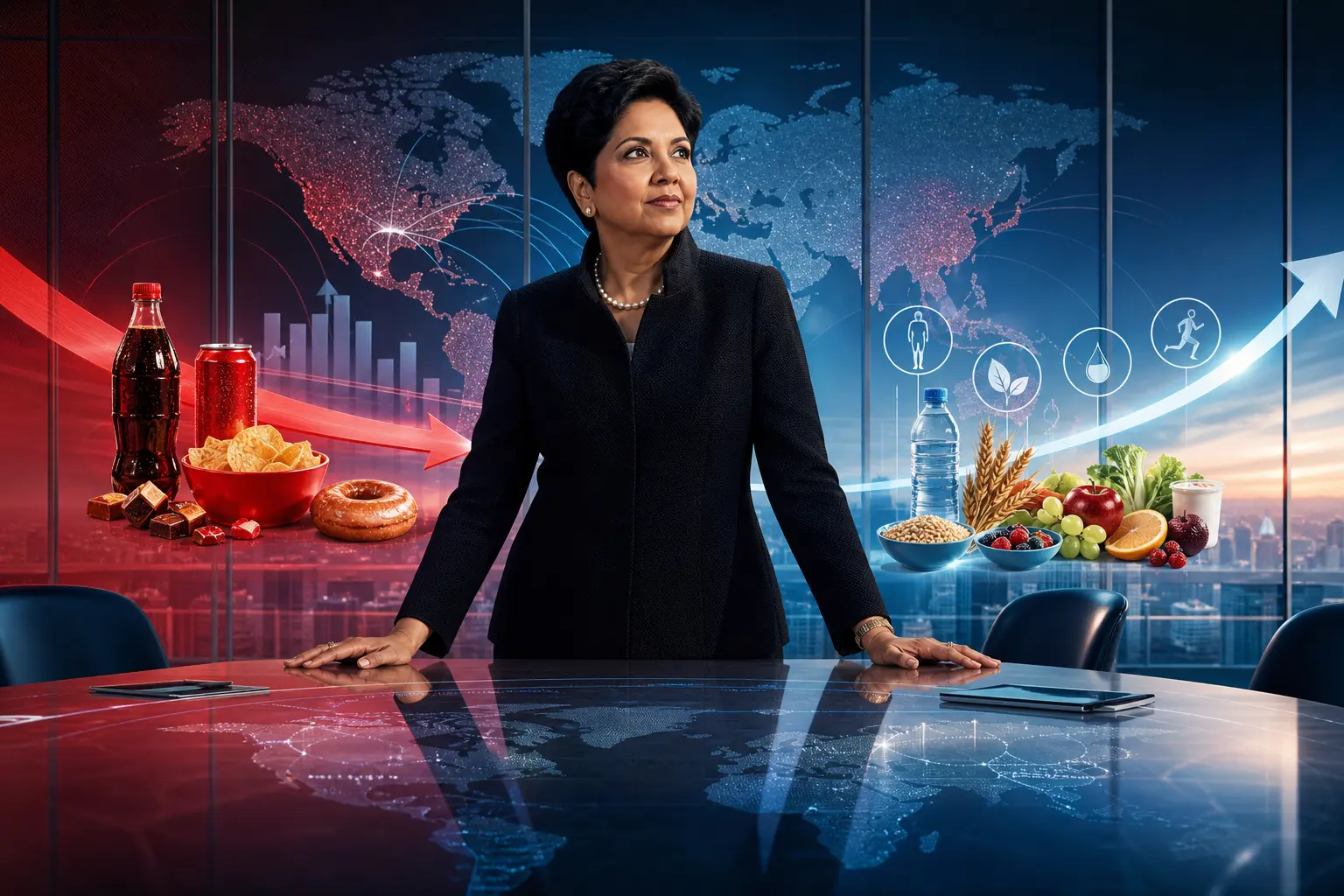
Indra Nooyi led PepsiCo through a strategic shift bigger than quarterly snacks and soda numbers: she pushed the company toward a broader future where performance and health pressures had to be managed together.
View all stories about this mogul
Indra Nooyi inherited neither a founder myth nor an easy operating environment. What she built at PepsiCo was something more subtle and, in some ways, more difficult: a strategic redirection inside a massive incumbent before the full force of consumer change had arrived.
This is why she belongs in Legacy. Nooyi was not simply managing a global snack-and-beverage giant. She was trying to reposition it for a world that was beginning to ask harder questions about health, sustainability, regulation, and the social meaning of consumer packaged goods.
That kind of leadership rarely looks dramatic in real time. It looks like slow rewiring.
Chapter 1: She Entered as a Strategist, Not Just an Operator

One reason Indra Nooyi matters is that she did not rise through PepsiCo as a narrow caretaker. Forbes notes that she joined the company in 1994 as chief strategist, and that background shaped the way she later governed it.
Strategists inside large companies often get caricatured as presentation people. Nooyi’s case was different. She seemed to understand that the real danger for a consumer giant is not immediate collapse. It is delayed irrelevance. When a company is already enormous, the threat comes from being structurally misaligned with where the world is going.
Her job, eventually, was to reduce that misalignment.
Chapter 2: PepsiCo Was Bigger Than Soda, but the Market Still Read It Through Soda

That framing problem sat at the heart of the challenge.
PepsiCo had a much broader business than a simple cola rivalry, yet the public conversation around the company often pulled it back toward sugary drinks, marketing battles, and legacy brand warfare. Nooyi had to lead a portfolio company while being judged through a narrower and older narrative.
That is strategically inconvenient. It can trap management inside a reputation the business is already trying to evolve beyond.
Nooyi’s answer was not to deny PepsiCo’s legacy categories. It was to widen the company’s future so that its identity became less dependent on them.
Chapter 3: Performance With Purpose Was Not Just Slogan Work

Critics often treat executive catchphrases as polished vapor. Sometimes they are. But PepsiCo’s own materials around Performance with Purpose make clear that Nooyi was trying to encode a broader operating philosophy: business success tied to sustainability, product evolution, and long-term societal fit.
That idea was easy to mock if viewed only as branding language. It looks more serious when seen as institutional positioning.
Nooyi seemed to grasp that health pressure, environmental expectations, and changing consumer preferences were not side issues. They were future P&L issues. If PepsiCo waited for perfect market clarity, it would be reacting too late.
So she moved before full consensus arrived.
That is often what leadership looks like inside a giant public company.
Chapter 4: Rewiring an Incumbent Is Harder Than Launching a Challenger

Startups get praise for disruption because they are supposed to move fast. Large incumbents almost never get equal credit for changing themselves, even though the internal difficulty can be much greater.
A company like PepsiCo has layers: supply chains, legacy brands, channel relationships, investor expectations, global complexity, internal politics, and massive organizational inertia. Changing direction inside that machine is less like steering a speedboat and more like rerouting a continent.
That is why Nooyi’s story deserves serious treatment. She was not building from zero. She was trying to alter the posture of an empire that already worked well enough to resist change.
That may be the hardest kind of business leadership there is.
Chapter 5: She Understood That Consumer Backlash Would Eventually Become Structural

For years, many consumer companies treated health criticism as an external annoyance to be managed through messaging. Nooyi’s better instinct was to assume the pressure would deepen and eventually reshape capital allocation, innovation, and public legitimacy.
That assumption proved smart.
Whether the market rewarded each move immediately is beside the point. Strategy at that scale is not about winning one quarter’s argument. It is about preventing tomorrow’s reality from arriving as a surprise.
Nooyi tried to put PepsiCo in position for a world where better-for-you products, sustainability language, and broader stakeholder scrutiny would matter more, not less.
In hindsight, that looks less like idealism and more like anticipation.
Chapter 6: Her Legacy Includes the Discipline of Expanding the Time Horizon

One of the hardest executive tasks in public markets is stretching the organization’s time horizon without losing the market’s confidence. Nooyi had to communicate near-term results while asking the company to think in longer arcs.
That takes unusual political skill. Investors want growth. Employees want clarity. Consumers want relevance. Activists want accountability. Legacy brands want protection. Future categories want investment.
The CEO has to hold all of those clocks at once.
Nooyi’s legacy is partly that she treated long-term adaptation as an executive duty, not a luxury add-on.
Chapter 7: Representation Mattered, but It Was Not the Whole Story

Indra Nooyi’s prominence as an Indian-born female CEO of one of the world’s most visible corporations mattered and still matters. Representation changes who people imagine leadership is for.
But stopping there would undersell her. Symbolic importance is not the same as strategic importance. Nooyi deserves attention not only because of who she was in the chair, but because of what she tried to do with the chair.
She used the role to widen the company’s concept of success.
That is a more demanding legacy than visibility alone.
Chapter 8: The Best Way to Read Her Tenure Is as Early Adaptation
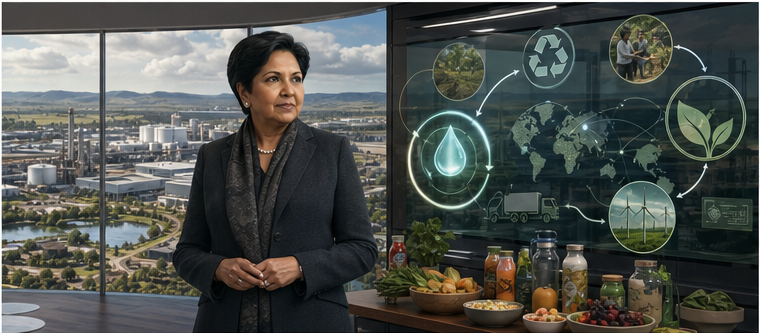
PepsiCo’s 2018 and 2019 statements about leadership transition highlighted strong shareholder returns during Nooyi’s era. Those numbers matter, but they are not the most interesting part of the story.
The more interesting part is that she used a period of corporate strength to begin changing the business before it was forced into change by full crisis. That is a mark of stronger leadership than emergency reaction.
Emergency leaders get more cinematic credit. Early adapters often build the conditions that let successors inherit a more resilient company.
Nooyi belongs in that category.
Chapter 9: Why Indra Nooyi Still Matters

Indra Nooyi matters because she demonstrated that scale does not have to mean strategic passivity.
A giant company can look at public-health pressure, sustainability demands, and shifting consumer preferences and decide those are not public-relations distractions but design constraints for the future business. That is the move she tried to institutionalize.
Whether every initiative worked perfectly is not the point. The point is that she pushed the company to ask better future-facing questions while it still had the power to act on them.
That is legacy-level leadership.
Final Take: She Rewired the Debate Before the Market Fully Rewarded It
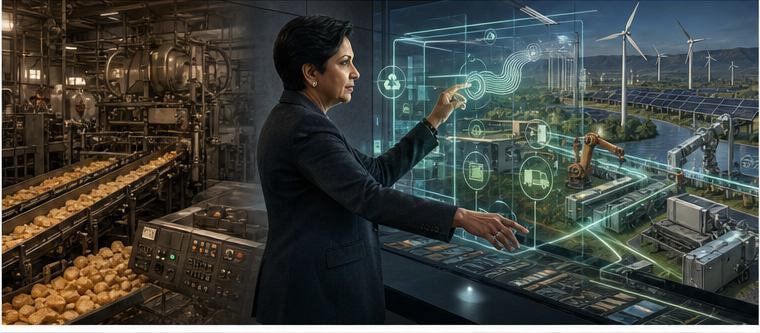
Indra Nooyi’s achievement was not that she made PepsiCo unrecognizable. It was that she made a legacy consumer empire more self-aware, more adaptive, and less trapped by its oldest story.
That is what reinvention usually looks like in real business life.
Not a dramatic pivot.
A disciplined reorientation before the world forces your hand.
💡 Key Insights
- ▸ Nooyi's signature move was strategic reframing: treating health pressure, sustainability, and long-term consumer shifts as core business design problems rather than external PR annoyances.
- ▸ She tried to make PepsiCo less dependent on a single historical identity and more resilient across changing tastes.
- ▸ Her legacy matters because she proved that a giant consumer company can start retooling before the market fully rewards the move.
Sources
- PepsiCo — Ramon Laguarta Elected Chief Executive Officer of PepsiCo ↗
- PepsiCo — PepsiCo Elects CEO Ramon Laguarta as Chairman of the Board ↗
- PepsiCo — 2025 Sustainability Agenda Designed to Meet Changing Consumer and Societal Needs ↗
- Forbes — Indra Nooyi's Passions: People, Performance & Purpose At PepsiCo And Beyond ↗
- National Women's History Museum — Biography: Indra Nooyi ↗