Jim Simons: The Mathematician Who Cracked Wall Street's Code
He was a Cold War codebreaker and award-winning mathematician who built the most successful hedge fund in history. Renaissance Technologies returned 66% annually for three decades. Nobody else has come close.
View all stories about this mogul
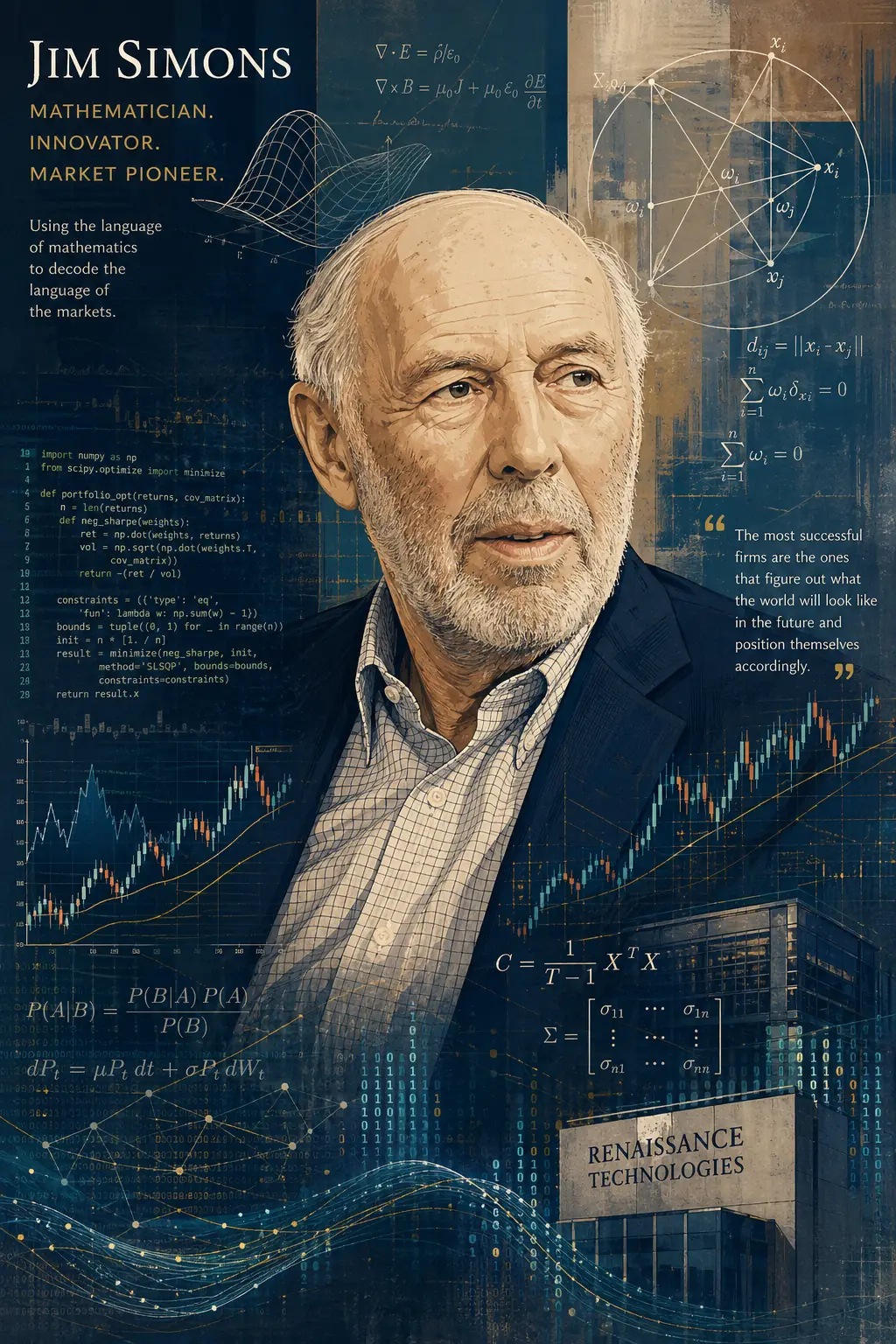
Jim Simons was a mathematician who decided to treat financial markets as a puzzle, and then solved it. His hedge fund, Renaissance Technologies, generated returns so extraordinary that they defy belief: the Medallion Fund returned approximately 66% annually before fees — and 39% after fees — over a period of more than thirty years. No other fund has come close. Warren Buffett, George Soros, Ray Dalio — the greatest investors in history — don’t approach Simons’ numbers. He didn’t do it through brilliance in finance. He did it through brilliance in mathematics, hiring scientists instead of traders, and building algorithms that found patterns in market data that no human could see. He was the most successful investor who ever lived, and he barely talked about money.
Chapter 1: The Numbers Kid From Boston (1938–1961)

James Harris Simons was born on April 25, 1938, in Brookline, Massachusetts. His father ran a shoe factory. His mother was a homemaker. From an early age, Simons showed extraordinary mathematical ability — not the kind of precocious genius that makes newspaper headlines, but a deep, intuitive feel for numbers and patterns that his teachers recognized immediately.
He enrolled at MIT at seventeen and completed his bachelor’s degree in mathematics in three years. He then moved to the University of California, Berkeley for his PhD, which he completed at age twenty-three. His doctoral thesis was on the geometry of multi-dimensional curved spaces — abstract, beautiful mathematics that had no obvious practical application. Simons didn’t care about applications. He cared about the elegance of the mathematics itself.
His early academic career was brilliant. He co-developed the Chern-Simons theory — a mathematical framework in differential geometry that became fundamental to theoretical physics, contributing to our understanding of quantum field theory and string theory. The work won him the Oswald Veblen Prize, one of the highest honors in geometry. He was, by any measure, a world-class mathematician.
Chapter 2: The Codebreaker (1964–1968)

During the Vietnam War era, Simons worked for the Institute for Defense Analyses (IDA), a think tank that did classified work for the National Security Agency. His job was codebreaking — using mathematical techniques to crack enemy communications. It was intellectually stimulating work that combined his love of mathematics with a practical purpose.
Simons was good at it. His ability to find patterns in seemingly random data — a skill that would later make him billions — was perfectly suited to cryptanalysis. But his time at the IDA ended abruptly when he publicly criticized the Vietnam War. He was fired. It was a rare moment of political engagement for a man who would later become one of the largest political donors in America.
The IDA experience was crucial to his later career in ways that weren’t immediately obvious. Codebreaking and quantitative trading share a fundamental challenge: extracting meaningful signal from enormous amounts of noisy data. The mathematical tools are similar — statistical analysis, pattern recognition, machine learning. Simons had been training for quantitative finance without knowing it.
Chapter 3: Stony Brook and the Academic Life (1968–1978)

After the IDA, Simons became chairman of the mathematics department at Stony Brook University on Long Island. He built the department into one of the best in the country, recruiting top mathematicians and creating an environment of intellectual freedom that attracted talent from around the world.
But Simons was restless. Mathematics was intellectually satisfying but financially modest. He had a family, a lifestyle he wanted to maintain, and a competitive streak that academic salaries couldn’t satisfy. He started dabbling in financial markets, making investments and trading currencies with mixed results. The trading was amateurish by his later standards, but it planted a seed: financial markets contained patterns, and those patterns could be found with the right mathematical tools.
In 1978, Simons left academia to focus on investing full-time. His colleagues thought he was crazy — a world-class mathematician abandoning the pursuit of pure knowledge for the pursuit of money. Simons saw it differently. Financial markets were the most complex, data-rich system on Earth. Finding patterns in that data was a mathematical challenge worthy of the best minds. He just needed to assemble those minds.
Chapter 4: The Founding of Renaissance Technologies (1982)

Simons founded Renaissance Technologies in 1982 in a nondescript office in East Setauket, Long Island — about as far from Wall Street as you could get while still being in New York. The location was deliberate. Simons didn’t want his firm contaminated by Wall Street culture. He wanted scientists, not traders.
The early years were difficult. Simons and his small team — mostly mathematicians and physicists — developed trading models that sometimes worked and sometimes didn’t. The challenge was enormous: financial data is noisy, patterns are subtle, and overfitting (finding patterns in historical data that don’t persist in the future) is a constant danger. For every genuine signal they found, they were tempted by dozens of false signals.
Simons’ key insight was that the solution required better data, better models, and better people — in that order. He invested heavily in collecting and cleaning financial data going back decades, creating datasets of unprecedented quality. He recruited brilliant scientists and gave them the freedom to experiment. And he built a culture where ideas were tested rigorously and failures were analyzed rather than punished.
Chapter 5: The Medallion Fund — The Greatest Trade in History (1988–2000)

In 1988, Renaissance launched the Medallion Fund, named after the math awards that Simons and his co-founder had won. The fund used quantitative models — algorithms that analyzed vast amounts of historical data to identify short-term patterns in securities prices — to generate trading signals. The models considered everything from price movements and trading volumes to weather patterns, news sentiment, and economic data.
The results were otherworldly. In its first full decade, Medallion returned approximately 66% per year before fees (roughly 40% after the fund’s hefty management and performance fees). These returns were so extraordinary that many in the financial industry didn’t believe them. They assumed the numbers were fabricated, or that Simons was taking risks that would eventually blow up.
But the returns continued. Year after year, decade after decade, Medallion delivered. The fund had only one losing year in its history (1989), and that loss was recovered within months. By 2000, Renaissance’s track record was so anomalous that it had become a genuine scientific mystery: how was this possible? The efficient market hypothesis — the academic theory that financial markets incorporate all available information and therefore can’t be consistently beaten — said it shouldn’t be.
Chapter 6: The Scientists — Hiring PhDs, Not MBAs (1990–2010)

Renaissance’s hiring strategy was unlike anything on Wall Street. Simons didn’t hire MBAs, CFA charterholders, or experienced traders. He hired mathematicians, physicists, statisticians, computer scientists, and speech recognition experts. Many of his recruits had never bought a stock in their lives. That was a feature, not a bug.
Key hires included Robert Mercer and Peter Brown, computational linguists from IBM who had developed speech recognition algorithms. Their experience with extracting patterns from noisy data — making sense of human speech from audio signals — turned out to be directly applicable to extracting patterns from noisy market data. Mercer and Brown would eventually become co-CEOs of Renaissance.
The scientific culture was reinforced by strict secrecy. Renaissance employees signed non-compete and non-disclosure agreements. The firm’s models and data were considered trade secrets of the highest order. Employees who left were legally prohibited from working in quantitative finance for years. The secrecy was extreme even by hedge fund standards and contributed to Renaissance’s mystique.
Chapter 7: Closing Medallion — Too Good to Share (2005)

In 1993, Simons made a decision that revealed the true value of Medallion’s strategy: he closed the fund to outside investors, returning their money and restricting the fund to Renaissance employees and their families. The move was unprecedented. Most hedge fund managers spend their careers trying to attract more capital. Simons was sending it away.
The logic was simple but counterintuitive: Medallion’s strategies had limited capacity. The patterns the fund exploited existed in specific markets at specific scales. Deploying too much capital would overwhelm those patterns — buying or selling large enough to move prices and eliminate the very inefficiencies the fund was profiting from. By keeping the fund small (approximately $10 billion), Simons could maximize returns per dollar invested.
The decision also meant that Medallion’s returns were essentially a private wealth machine for Renaissance employees. The fund’s cumulative returns since inception have generated over $100 billion in profits — more than any other fund in history. Almost all of that profit went to the few hundred people who worked at the firm. It was the most exclusive money-making club on Earth.
Chapter 8: The Tax Controversy (2014–2021)

Renaissance’s extraordinary returns attracted IRS scrutiny. In 2014, the Senate Permanent Subcommittee on Investigations held hearings examining Renaissance’s use of basket options — a complex financial instrument that, critics argued, allowed the firm to convert short-term trading gains (taxed at up to 39.6%) into long-term capital gains (taxed at 20%). The tax savings were estimated at approximately $6.8 billion over a fourteen-year period.
The Senate committee described the basket option strategy as a tax avoidance scheme. Renaissance argued that the structures were legal and had been approved by the banks that sold them (Deutsche Bank and Barclays). The IRS challenged Renaissance’s tax treatment, and the firm eventually settled, reportedly paying billions in back taxes and penalties.
The controversy was one of the few public glimpses into Renaissance’s operations. The hearings revealed details about the firm’s trading strategies, its use of leverage, and its financial performance that had never been publicly disclosed. For a firm that prized secrecy above almost everything, the exposure was deeply uncomfortable.
Chapter 9: The Mercer Problem — Politics and Hedge Funds (2016–2017)

Robert Mercer, Renaissance’s co-CEO, became a major force in conservative politics, providing substantial funding to Breitbart News, the Cambridge Analytica data firm, and Donald Trump’s 2016 presidential campaign. Mercer’s political activities created a public relations crisis for Renaissance, whose other employees spanned the political spectrum and whose client base (through its public funds) included institutions with no desire to be associated with far-right politics.
Simons, a major Democratic donor, was reportedly uncomfortable with the situation. In 2017, Mercer stepped down as co-CEO, and Renaissance issued a rare public statement distancing the firm from Mercer’s personal political activities. Peter Brown became the sole CEO.
The episode highlighted the tensions that arise when a firm’s wealth is concentrated among a small number of employees whose personal political activities can create reputational risk for the institution. It also demonstrated that even the most secretive firms on Wall Street cannot fully insulate themselves from the political environment.
Chapter 10: The Philanthropy and the Flatiron Institute (2010–2024)

Simons channeled much of his wealth into philanthropy, with a focus on mathematics, science, and education. The Simons Foundation, established with his wife Marilyn, donated billions to research institutions, universities, and educational programs. The foundation’s most ambitious project was the Flatiron Institute, a research center in Manhattan dedicated to computational science.
The Flatiron Institute employed hundreds of researchers working on computational problems in astrophysics, biology, neuroscience, mathematics, and quantum physics. It was, in essence, a private research university without students — a place where the best computational scientists could work on the hardest problems without the constraints of grant funding or teaching obligations.
Simons also funded Math for America, a program that provided additional compensation and professional development to math and science teachers in New York City. The program reflected Simons’ belief that the quality of mathematics education in the United States was inadequate and that the solution was to attract and retain talented teachers through better compensation and support.
Chapter 11: Death and the Legacy Question (2024)

James Simons died on May 10, 2024, at the age of eighty-six. His death prompted a reassessment of his contributions to both mathematics and finance. In mathematics, the Chern-Simons theory remained one of the most important contributions to differential geometry and theoretical physics. In finance, Renaissance Technologies’ track record remained unmatched — a permanent challenge to the efficient market hypothesis.
Simons’ net worth at death was estimated at approximately $31.4 billion, making him one of the thirty wealthiest people in the world. The wealth came almost entirely from Medallion’s returns — decades of compounding at rates that no other fund had achieved. He had donated over $6 billion to philanthropic causes during his lifetime, and his foundation continued his work after his death.
The succession at Renaissance was orderly — Peter Brown continued as CEO, and the firm’s scientific culture and quantitative methods persisted. But the question of whether Medallion’s returns would continue without its founder remained open. Simons had created the culture, recruited the talent, and set the intellectual direction. Whether the machine could run without its creator was the ultimate test of whether his genius was personal or institutional.
Chapter 12: Legacy — The Man Who Proved the Market Wrong

Jim Simons’ legacy is a number: 66% annual returns, for over thirty years. That number challenged the most fundamental assumption in academic finance — that markets are efficient and cannot be consistently beaten. Simons didn’t just beat the market; he demolished it, year after year, by a margin that should have been mathematically impossible.
He did it by treating finance as science rather than art. While other investors traded on intuition, relationships, and gut feelings, Simons traded on data, algorithms, and statistical patterns. He proved that the scientific method — hypothesis, experiment, analysis, iteration — could be applied to financial markets with extraordinary effectiveness. The entire quantitative hedge fund industry — now managing trillions of dollars — traces its intellectual lineage to Simons.
But perhaps his most important legacy is what he did with the money. Over $6 billion in philanthropic donations funded research in mathematics, science, education, and healthcare. The Flatiron Institute, Math for America, and dozens of other initiatives reflected Simons’ conviction that the most important thing about money is what it enables. The man who solved the market used the solution to fund the pursuit of knowledge — the same pursuit that had driven him since he was a numbers kid from Boston, fascinated by the patterns hidden in the world around him.
💡 Key Insights
- ▸ The Medallion Fund's returns — 66% annually before fees over three decades — are the most extraordinary track record in financial history. The fund is closed to outside investors and manages only employee money, which tells you everything about how valuable the strategy is.
- ▸ Simons proved that markets are not fully efficient — that mathematical patterns exist in market data that can be exploited by those with the tools to find them. This insight challenged the dominant academic theory of finance and created an entirely new industry.
- ▸ Renaissance's hiring strategy — mathematicians, physicists, and computer scientists rather than MBAs and traders — was revolutionary. Simons understood that the skills needed to extract patterns from noisy data are scientific, not financial.