Martha Stewart: How a Stockbroker-Turned-Caterer Built a Lifestyle Empire, Went to Prison, and Came Back Stronger
She turned homemaking into a billion-dollar brand, survived an insider trading conviction and five months in prison, and emerged as an even bigger cultural icon. Martha Stewart doesn't just come back — she upgrades.
View all stories about this mogul
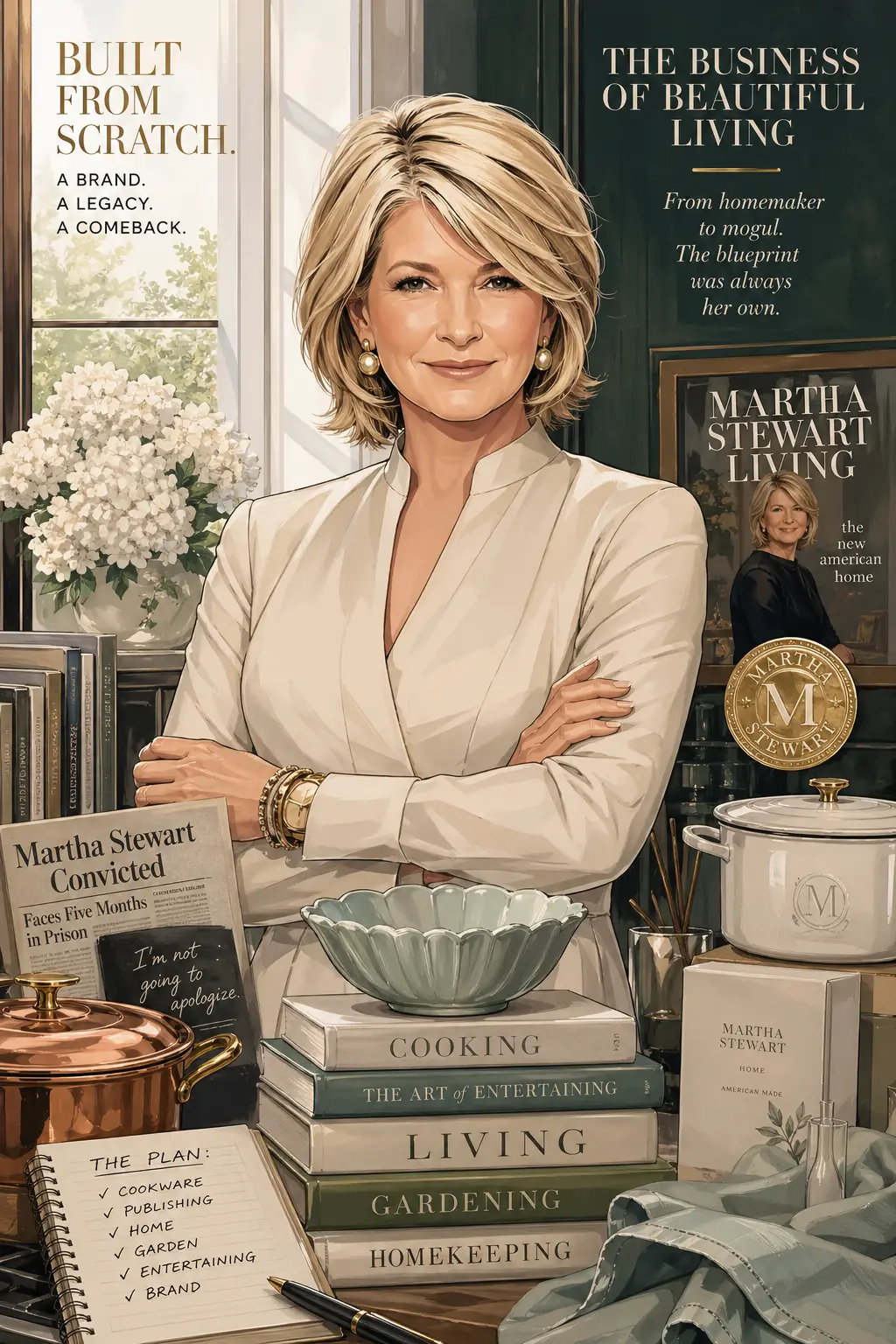
Martha Stewart went to federal prison for five months, emerged with an ankle monitor, and within a decade was more famous, more wealthy, and more culturally relevant than she had ever been. She had built the world’s first lifestyle media empire — turning cooking, gardening, and tablescaping into a publicly traded company — and then watched it nearly collapse when she was convicted of lying to federal investigators about a stock sale. The conviction should have ended her career. Instead, it became the setup for the greatest comeback in media history. At eighty-three, she was posing for Sports Illustrated’s swimsuit issue, producing shows with Snoop Dogg, and launching a new wave of product partnerships. Martha Stewart doesn’t just survive scandal — she metabolizes it.
Chapter 1: Nutley, New Jersey — The Perfectionist Is Born (1941–1962)

Martha Helen Kostyra was born on August 3, 1941, in Jersey City, New Jersey, and raised in Nutley, a working-class suburb. Her father, Edward Kostyra, was a pharmaceutical salesman and an avid gardener. Her mother, Martha Ruszkowski Kostyra, was a teacher and homemaker who instilled in her daughter an obsessive attention to detail in everything domestic — cooking, sewing, cleaning, gardening.
The Kostyra household was not wealthy, but it was immaculate. Martha learned to cook, bake, can preserves, and arrange flowers at an early age. She was a perfectionist from childhood — the kind of student who not only got straight A’s but rewrote her notes until they were flawless. This trait, which would later make her fabulously wealthy, also made her difficult to work for and, by some accounts, difficult to live with.
She was beautiful and knew it. She modeled in high school and college, appearing in advertisements for Chanel and other brands. She attended Barnard College in New York, where she studied art history and chemistry — an unusual combination that reflected her twin interests in aesthetics and precision. She married Andrew Stewart, a Yale Law student, in 1961, and the couple moved to New York City.
Chapter 2: From Wall Street to Westport (1962–1976)

After Barnard, Stewart became a stockbroker at a small Wall Street firm. She was one of the few women on the trading floor in the mid-1960s, and she was good at it — aggressive, detail-oriented, and comfortable with numbers. She made significant money and developed a network of wealthy clients who would later become the core audience for her lifestyle empire.
But Wall Street didn’t satisfy her creative ambitions. In 1973, the Stewarts moved to a historic farmhouse in Westport, Connecticut, which Martha began restoring with the same obsessive attention to detail she had applied to everything else. She renovated the kitchen, planted gardens, raised chickens, and turned the property into a showcase of domestic perfection.
The renovation of the Westport house was, in retrospect, the prototype for everything that followed. Stewart was creating a lifestyle — a vision of domestic life that was beautiful, ordered, and aspirational. She didn’t just cook dinner; she grew the herbs, arranged the table, and photographed the result. She was, without knowing it yet, developing a brand.
Chapter 3: The Catering Business and the First Book (1976–1990)

In 1976, Stewart started a catering business from her Westport home. Her food was exceptional, her presentation was stunning, and her client list grew quickly — wealthy Fairfield County families who wanted their dinner parties to look like magazine spreads. Stewart’s catering was as much about aesthetics as flavor. Every plate was a composition. Every table was a set piece.
The catering business led to connections in publishing. In 1982, Stewart published her first book, “Entertaining,” a lavishly photographed guide to hosting that was part cookbook, part design manual, and part lifestyle manifesto. The book was a bestseller and established Stewart as an authority on domestic arts. More importantly, it established the template for the Martha Stewart brand: aspirational domesticity, presented with professional-grade production values.
Over the next decade, Stewart published a series of books — “Martha Stewart’s Quick Cook,” “Weddings,” “The Martha Stewart Cookbook” — each one expanding her reach and reinforcing her position as America’s domestic authority. She appeared on television, wrote magazine columns, and developed a public persona that was simultaneously warm and intimidating. She made everything look easy, which inspired some people and infuriated others.
Chapter 4: Martha Stewart Living — The Media Empire (1990–1999)
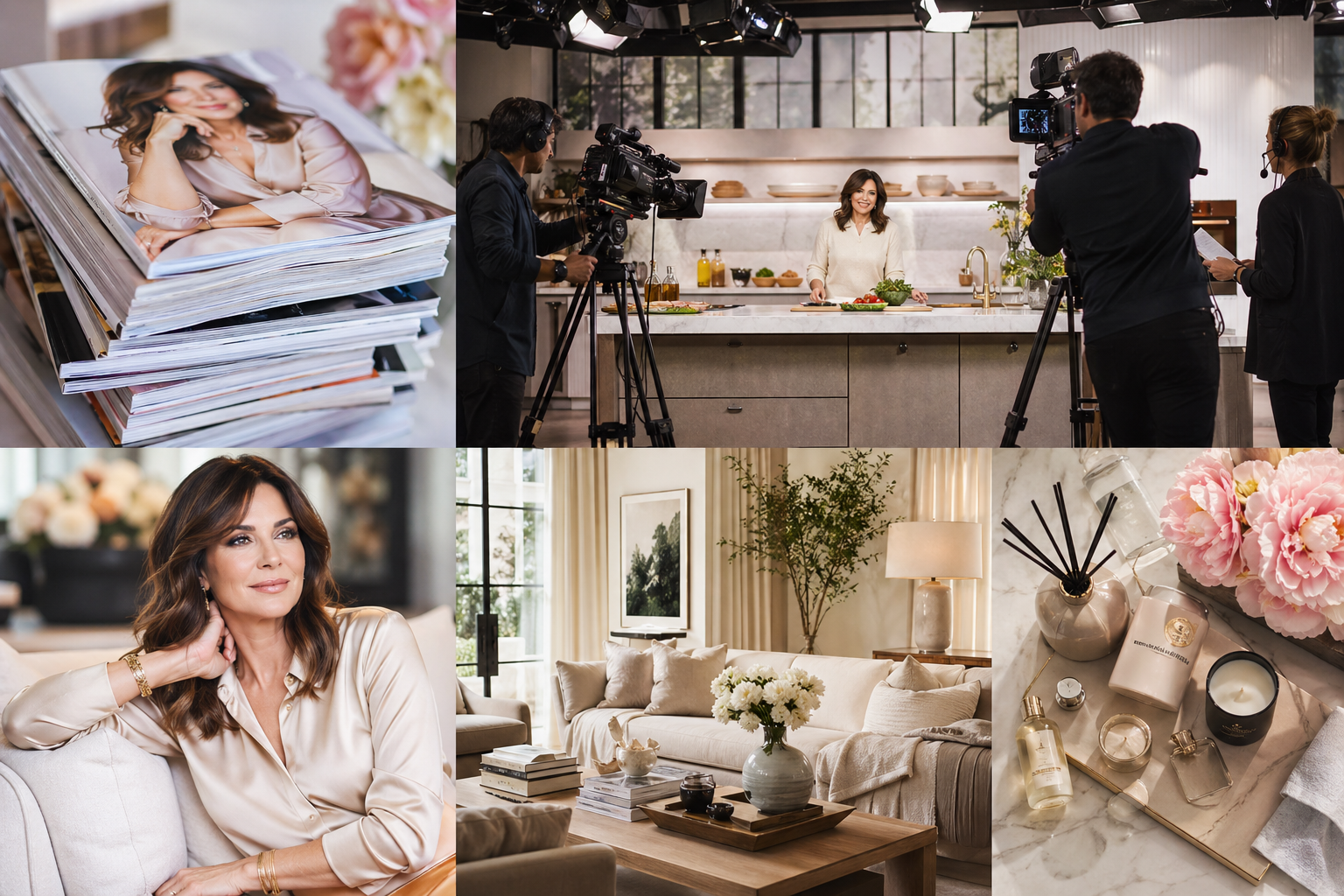
In 1990, Stewart launched Martha Stewart Living, a magazine published in partnership with Time Inc. The magazine was an immediate success, combining practical advice with aspirational photography and Stewart’s personal authority. Within a few years, it had a circulation of over two million and was generating substantial advertising revenue.
In 1993, Stewart launched a television show — also called Martha Stewart Living — that became one of the most popular daytime programs in America. The show featured Stewart cooking, gardening, crafting, and decorating, all with the calm, authoritative demeanor that had become her trademark. She made elaborate projects look achievable and expensive results look affordable.
In 1997, Stewart made her boldest business move: she purchased the Martha Stewart Living brand from Time Inc. and created Martha Stewart Living Omnimedia (MSLO), a company that consolidated all of her media properties, product lines, and licensing deals under one roof. MSLO went public in 1999, and the stock price nearly tripled on its first day of trading. Stewart’s stake was worth approximately $1.2 billion. The catering lady from Westport was now a billionaire.
Chapter 5: The ImClone Trade — A Fateful Phone Call (2001)

On December 27, 2001, Martha Stewart sold 3,928 shares of ImClone Systems, a biotechnology company, for approximately $228,000. The sale occurred one day before the FDA announced it would not review ImClone’s cancer drug application — news that caused the stock price to plummet. The timing was suspicious.
The SEC investigated, and the story that emerged was damaging. Stewart’s broker at Merrill Lynch, Peter Bacanovic, had allegedly tipped her that Sam Waksal — ImClone’s CEO and a friend of Stewart’s — was selling his shares. Stewart sold hers the same day. The amount of money involved was trivial relative to Stewart’s net worth — saving approximately $45,000 by selling before the FDA announcement. But the investigation wasn’t about the trade. It was about what Stewart said when investigators asked her about it.
Stewart told investigators that she had a pre-existing order to sell ImClone if it fell below $60 per share. Investigators found evidence that this order didn’t exist — that Stewart and Bacanovic had fabricated the explanation after the fact. The cover-up, as is often the case, became worse than the crime.
Chapter 6: The Trial and Conviction (2003–2004)

Martha Stewart was indicted in June 2003 on charges of conspiracy, obstruction of justice, and making false statements to federal investigators. Notably, she was not charged with insider trading — the evidence for that charge was apparently insufficient. She was charged with lying about why she sold the stock.
The trial, in January 2004, was a media circus. Stewart arrived at the courthouse every day carrying a designer handbag, dressed impeccably, and projecting an image of serene confidence. The prosecution presented evidence that Stewart and Bacanovic had coordinated their stories. The defense argued that Stewart had no motive to lie about such a small trade and that the investigation was driven by her celebrity status rather than the merits of the case.
On March 5, 2004, the jury found Stewart guilty on all four counts. She was sentenced to five months in federal prison, five months of home confinement, and two years of supervised release. The sentence was at the lower end of the guidelines, reflecting the relatively minor nature of the underlying conduct. Stewart announced she would begin serving immediately to “put this nightmare behind me.”
Chapter 7: Alderson Federal Prison Camp (2004–2005)

Stewart reported to the Federal Prison Camp at Alderson, West Virginia — a minimum-security facility known as “Camp Cupcake” — in October 2004. She was Federal Inmate Number 55170-054. The prison housed approximately 1,000 women in conditions that were spartan but not harsh — dormitory-style housing, outdoor recreation, and work assignments.
Stewart adapted to prison with the same efficiency she had applied to everything else. She reportedly organized a microwave cooking class for fellow inmates, helped redesign the prison’s landscaping, and maintained a rigorous daily routine. She wrote letters to friends and family but was forbidden from conducting business.
The public reaction to her imprisonment was revealing. Instead of the schadenfreude that many expected, public sympathy for Stewart grew during her incarceration. Many people — particularly women — felt the sentence was disproportionate for lying about a trade that saved her $45,000. The same qualities that had made Stewart polarizing before prison — her perfectionism, her competitiveness, her refusal to show weakness — became admirable when she displayed them under duress.
Chapter 8: The Comeback (2005–2010)

Stewart was released from Alderson in March 2005 and began five months of home confinement at her Bedford, New York estate, wearing an ankle monitor. Her return to public life was immediate and aggressive. She launched “The Martha Stewart Show” on daytime television. She launched a line of products at Macy’s. She published new books. She appeared on The Apprentice: Martha Stewart, a reality show that was cancelled after one season but generated enormous publicity.
The comeback was driven by a simple insight: Stewart’s brand was ultimately about competence, and nothing demonstrates competence like overcoming adversity. The prison experience, rather than destroying her brand, had added a dimension of toughness and resilience that made her more relatable. She was no longer just the unattainable domestic goddess — she was a woman who had been knocked down and gotten back up.
MSLO’s stock price, which had cratered during the investigation and trial, began recovering. New licensing deals were signed. Revenue grew. The company wasn’t yet back to its pre-scandal highs, but the trajectory was unmistakably upward. Martha Stewart was back.
Chapter 9: Snoop Dogg and the Cultural Reinvention (2015–2023)

The most improbable chapter of Stewart’s career began in 2015 when she appeared on Comedy Central’s roast of Justin Bieber. Her deadpan delivery of raunchy jokes delighted audiences and revealed a side of Stewart that her previous persona had concealed: she was funny, self-aware, and willing to be provocative.
This led to “Martha & Snoop’s Potluck Dinner Party,” a VH1 show featuring Stewart and rapper Snoop Dogg cooking, entertaining, and bantering. The show was a critical and commercial hit. The chemistry between the Waspy domestic queen and the gangsta rap legend was irresistible. More importantly, the show introduced Stewart to a younger, more diverse audience that had never watched her daytime television show or read her magazine.
Stewart leaned into the reinvention. She became a social media personality, posting thirst traps on Instagram that went viral. She endorsed cannabis products. She posed for Sports Illustrated’s swimsuit issue at eighty-one. Each move expanded her cultural reach and proved that brands — like people — can evolve far beyond their original identity.
Chapter 10: The Sequential Brands Deal and Beyond (2015–2025)

In 2015, Sequential Brands Group acquired Martha Stewart Living Omnimedia for approximately $353 million. The deal provided Stewart with financial liquidity and a licensing structure that allowed her brand to be applied to a wide range of products — furniture, cookware, home décor, food products — through partnerships with major retailers.
When Sequential Brands filed for bankruptcy in 2021, the Martha Stewart brand was acquired by Marquee Brands, which continued to expand the licensing portfolio. Stewart herself remained actively involved in product development and brand direction, ensuring that the quality standards she had established decades earlier were maintained.
By 2025, the Martha Stewart brand generated over $1 billion in retail sales annually through licensing deals with companies including Walmart, Wayfair, and Amazon. Stewart’s personal net worth was estimated at approximately $400 million. The financial recovery from the ImClone scandal was complete, but more importantly, the brand had achieved something rare: cultural longevity across multiple generations.
Chapter 11: The Partnership with Canopy Growth and CBD

Stewart’s partnership with Canopy Growth Corporation — one of the world’s largest cannabis companies — to develop a line of CBD products was among her most surprising moves. Launched in 2020, the Martha Stewart CBD line included gummies, oils, and softgels, all marketed with Stewart’s signature attention to quality and aesthetics.
The cannabis partnership was both a business opportunity and a cultural statement. Stewart — a convicted felon — endorsing cannabis products created an ironic parallel that she openly embraced. The products were positioned as wellness-oriented rather than recreational, reflecting Stewart’s understanding that her core audience (affluent women over forty) would be more comfortable with a health-focused framing.
The partnership also deepened her relationship with Snoop Dogg, who was an early investor in Canopy Growth. The Stewart-Snoop alliance, which had begun as an improbable television pairing, had evolved into a genuine business relationship and friendship that both parties leveraged across multiple ventures.
Chapter 12: Legacy — The Woman Who Made Lifestyle a Business
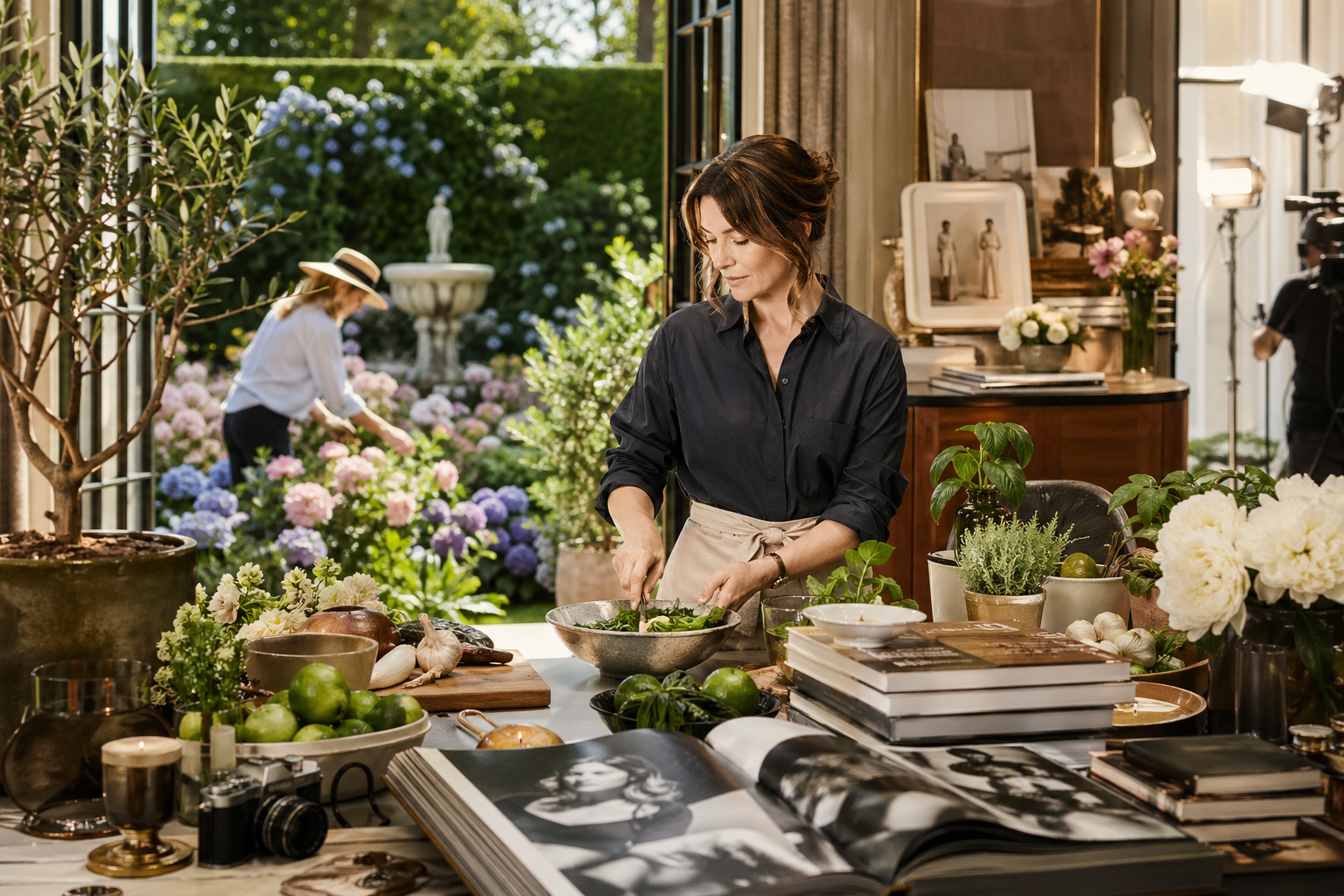
Martha Stewart’s legacy is the invention of a category. Before her, “lifestyle” wasn’t a business — it was a description. She turned cooking, gardening, decorating, and entertaining into an integrated media and product empire that generated billions in revenue and spawned an entire industry of imitators. Gwyneth Paltrow’s Goop, Joanna Gaines’ Magnolia, and every other celebrity lifestyle brand owes a debt to Stewart’s template.
Her career arc — from caterer to billionaire to convicted felon to comeback queen to cultural icon — is one of the most remarkable in American business. She survived a scandal that would have permanently destroyed most careers, not by hiding or apologizing, but by demonstrating that the qualities that made her successful in the first place — competence, perfectionism, resilience — were still intact.
At eighty-four, Martha Stewart remains active, relevant, and evolving. She has transcended the domestic goddess persona that made her famous and become something rarer: a genuine cultural institution. The girl from Nutley, New Jersey, who learned to can preserves from her mother turned homemaking into an empire, lost it all, rebuilt it, and then reinvented herself so completely that her audience now includes people who have never baked a cake in their lives. That’s not just a business achievement — it’s a testament to the power of refusing to be defined by anyone else’s expectations, including your own.
💡 Key Insights
- ▸ Stewart invented the lifestyle brand. Before her, nobody had packaged homemaking as aspirational content. She turned cooking, gardening, and decorating into media properties, product lines, and an entire industry.
- ▸ Her prison sentence — for lying to investigators, not for insider trading — destroyed lesser careers but amplified hers. She emerged as a sympathetic figure who had been punished disproportionately, and the comeback story made her more famous than ever.
- ▸ Stewart's late-career reinvention as a meme-friendly, cannabis-endorsing, Snoop Dogg-collaborating cultural icon proves that brand evolution isn't about staying the same — it's about staying relevant.