Ray Kroc: The Man Who Stole McDonald's and Built a $200 Billion Empire
At 52, he was a struggling milkshake machine salesman. By 70, he owned the most valuable restaurant brand on Earth. The real story of McDonald's isn't about hamburgers.

View all stories about this mogul
Ray Kroc: The Man Who Stole McDonald’s and Built a $200 Billion Empire
Here is a story about theft dressed up as genius. In 1954, a 52-year-old milkshake machine salesman named Ray Kroc walked into a hamburger stand in San Bernardino, California, and saw two brothers who had perfected the fast-food system. He didn’t invent McDonald’s. He took it. And then he built it into the most successful restaurant operation in human history — a $200 billion empire serving 69 million customers every single day. The McDonald brothers got a handshake deal and a broken heart. Ray Kroc got everything else.
🥤 Chapter 1: The Salesman Who Couldn’t Quit
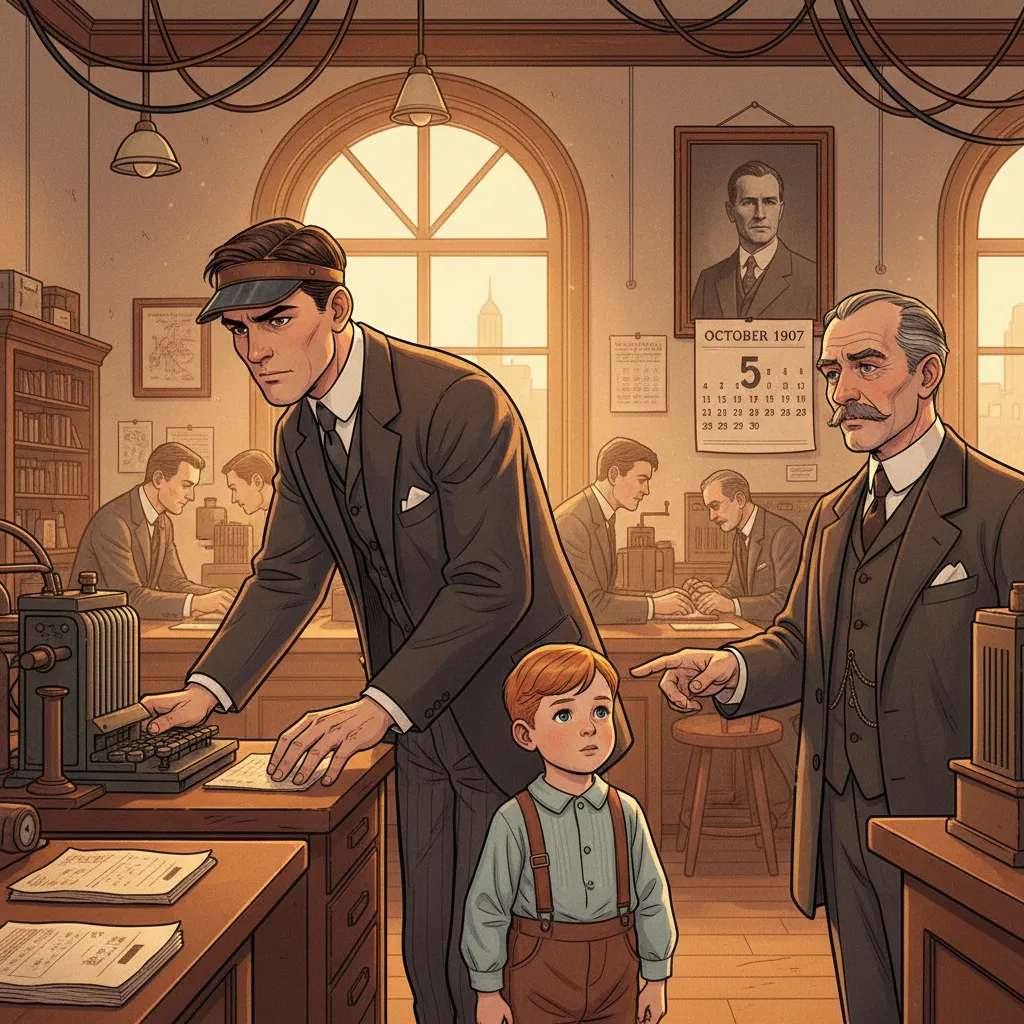
Raymond Albert Kroc was born on October 5, 1902, in Oak Park, Illinois — the same suburb that produced Ernest Hemingway. His father, Louis Kroc, was a Czech immigrant who worked for Western Union. His mother, Rose, gave piano lessons.
From an early age, Ray Kroc was a hustler. During World War I, the 15-year-old lied about his age and enlisted as a Red Cross ambulance driver. He was shipped to Connecticut for training but the war ended before he saw action. Among his fellow ambulance trainees: a young man named Walt Disney.
After the war, Kroc bounced between jobs with the restless energy that would define his entire life. He sold paper cups for the Lily-Tulip Cup Company. He played piano at restaurants and on the radio. He sold real estate in Florida during the land boom of the 1920s.
Nothing stuck. By his early 30s, Kroc was a journeyman salesman with a wife (Ethel Fleming, married in 1922), a daughter (Marilyn), and no clear path to the success he craved. He was competent but not exceptional. Persistent but not prosperous.
In 1939, Kroc discovered a product that would occupy the next 15 years of his life: the Multimixer, a milkshake mixing machine that could make five shakes simultaneously. He became the exclusive distributor for the Multimixer and spent the next decade and a half crisscrossing the country, selling the machines to restaurants and soda fountains.
It was honest work, but it wasn’t making Kroc rich. By 1954, he was 52 years old — an age when most men of his era were thinking about retirement. His marriage was strained. His savings were modest. His arthritic hands ached from years of hauling heavy machines. He had diabetes.
Then he got a strange order from San Bernardino, California. A single hamburger restaurant wanted to buy eight Multimixers — enough to make 40 milkshakes at once. What kind of restaurant needed to make 40 milkshakes simultaneously?
Ray Kroc had to see this place for himself.
🍔 Chapter 2: The Brothers Who Invented Fast Food
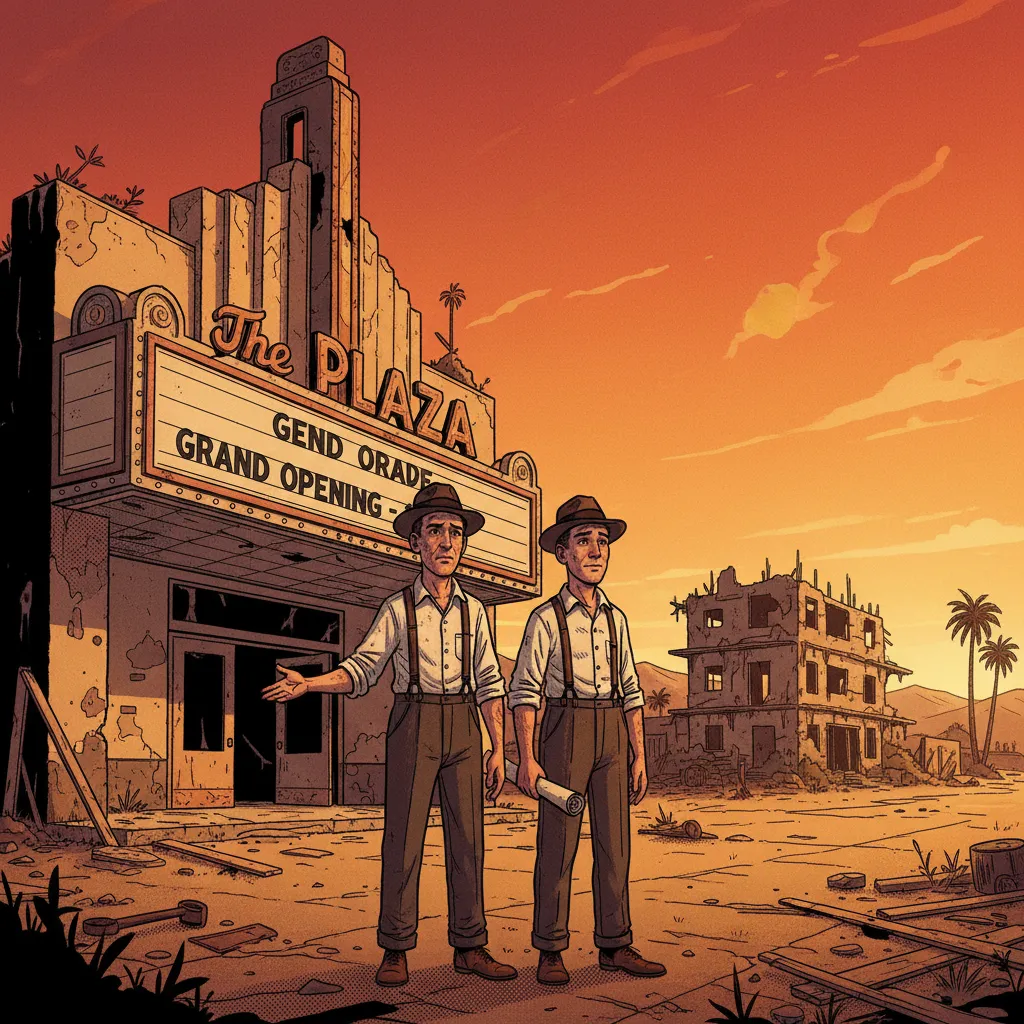
Richard “Dick” McDonald and Maurice “Mac” McDonald were two brothers from New Hampshire who had moved to California in the late 1920s. After various failed ventures, including a movie theater and a hot dog stand, they opened a drive-in restaurant called “McDonald’s Famous Barbecue” in San Bernardino in 1940.
The drive-in was successful but chaotic. Carhops took orders. Customers waited in their cars. The menu was extensive. Labor costs were high. Teenage loiterers caused trouble. The McDonald brothers were making money, but they sensed they could do better.
In 1948, Dick and Mac closed the restaurant for three months and reinvented it. What they created was nothing less than the blueprint for modern fast food:
The Speedee Service System:
- A radically simplified menu: hamburgers, cheeseburgers, fries, shakes, and drinks. That’s it.
- An assembly-line kitchen designed like a factory floor, where each worker performed one specific task
- Self-service: customers walked to the counter and ordered. No carhops, no tipping.
- Disposable packaging: paper bags and cups instead of plates and glasses. No dishwashers needed.
- Low prices: 15 cents for a hamburger (competitors charged 30 cents)
- Speed: food delivered in 30 seconds or less
The brothers literally mapped out the kitchen on a tennis court, choreographing the movement of workers to eliminate wasted motion. They custom-designed the equipment. They perfected the french fry, discovering that storing the potatoes in a specific way (allowing them to dry out before frying) produced a crispier result.
The result was revolutionary. McDonald’s could serve more customers, faster, with fewer employees, at lower prices than any competitor. Lines formed around the block. By 1954, the San Bernardino location was grossing $350,000 per year — over $3.8 million in today’s money — from a hamburger stand.
The brothers had also dabbled in franchising, licensing their system to a handful of operators. But Dick and Mac were small-town guys who liked their comfortable life. They didn’t want to build an empire. They just wanted a good restaurant.
Enter Ray Kroc.
🤝 Chapter 3: The Handshake That Changed Everything
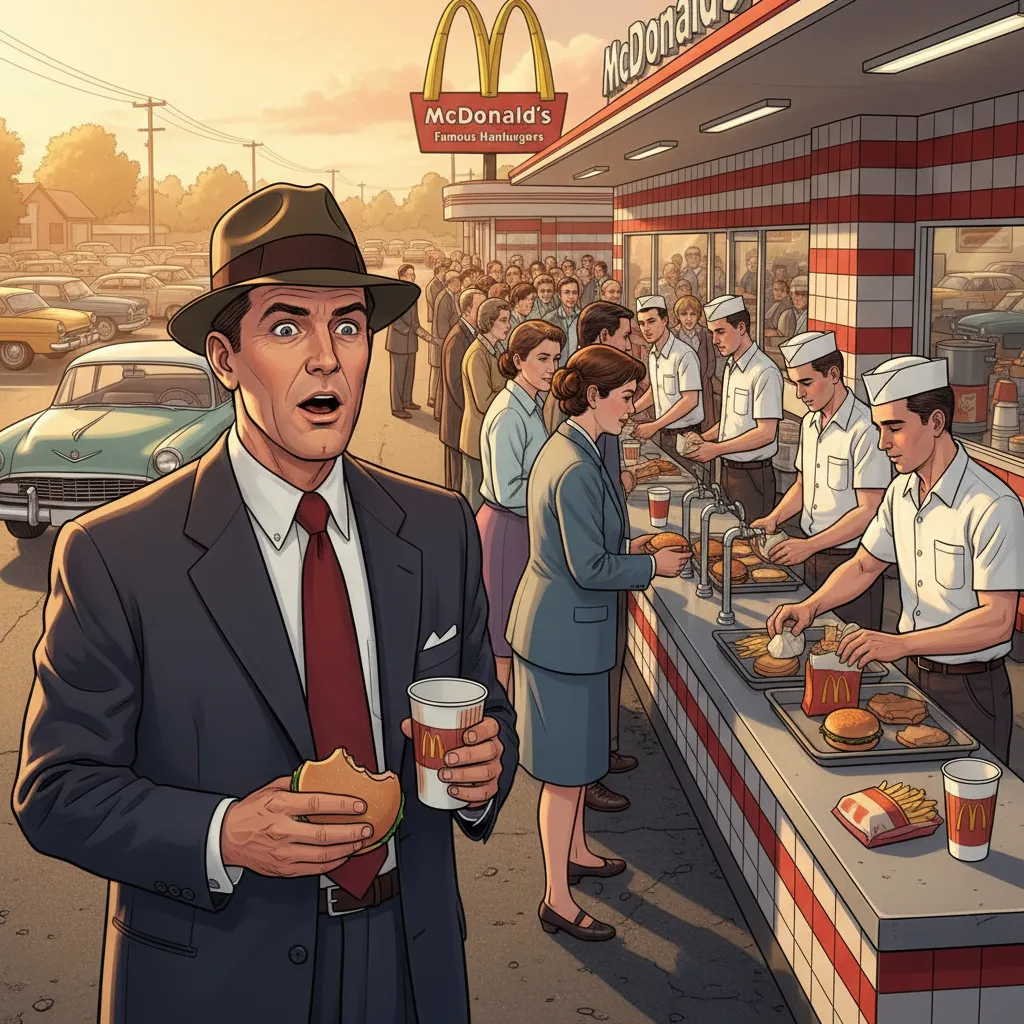
Ray Kroc arrived at the San Bernardino McDonald’s in 1954 and was immediately electrified. He watched the lunch rush — hundreds of customers served with assembly-line precision. He tasted the food: consistent, hot, cheap. He studied the operation: clean, efficient, systematized.
“I felt like some latter-day Newton who’d just had an apple drop on his head,” Kroc later wrote in his autobiography. “This was the most amazing thing I’d ever seen.”
Kroc saw what the McDonald brothers couldn’t — or wouldn’t. He didn’t see a great hamburger stand. He saw a system that could be replicated ten thousand times across America. Every small town, every highway exit, every suburb needed a McDonald’s.
On April 2, 1955, Kroc incorporated McDonald’s System, Inc. (later renamed McDonald’s Corporation). He had negotiated a franchise agreement with the McDonald brothers that gave him the right to license their system nationwide. The terms:
- Kroc would recruit and manage franchisees
- Each franchise would pay 1.9% of gross sales as a franchise fee
- The McDonald brothers would receive 0.5% of that (effectively 0.5% of all franchise revenue)
- The brothers retained control of their original San Bernardino restaurant
- Any changes to the operating system required the brothers’ written approval
The last clause would become a source of endless friction. As Kroc expanded, he wanted to make changes — add new menu items, modify the building design, adjust operations. Every change required the brothers’ permission, which they sometimes withheld.
Kroc opened his first McDonald’s franchise in Des Plaines, Illinois, on April 15, 1955. Opening day revenue: $366.12.
🏗️ Chapter 4: “You’re Not in the Hamburger Business”
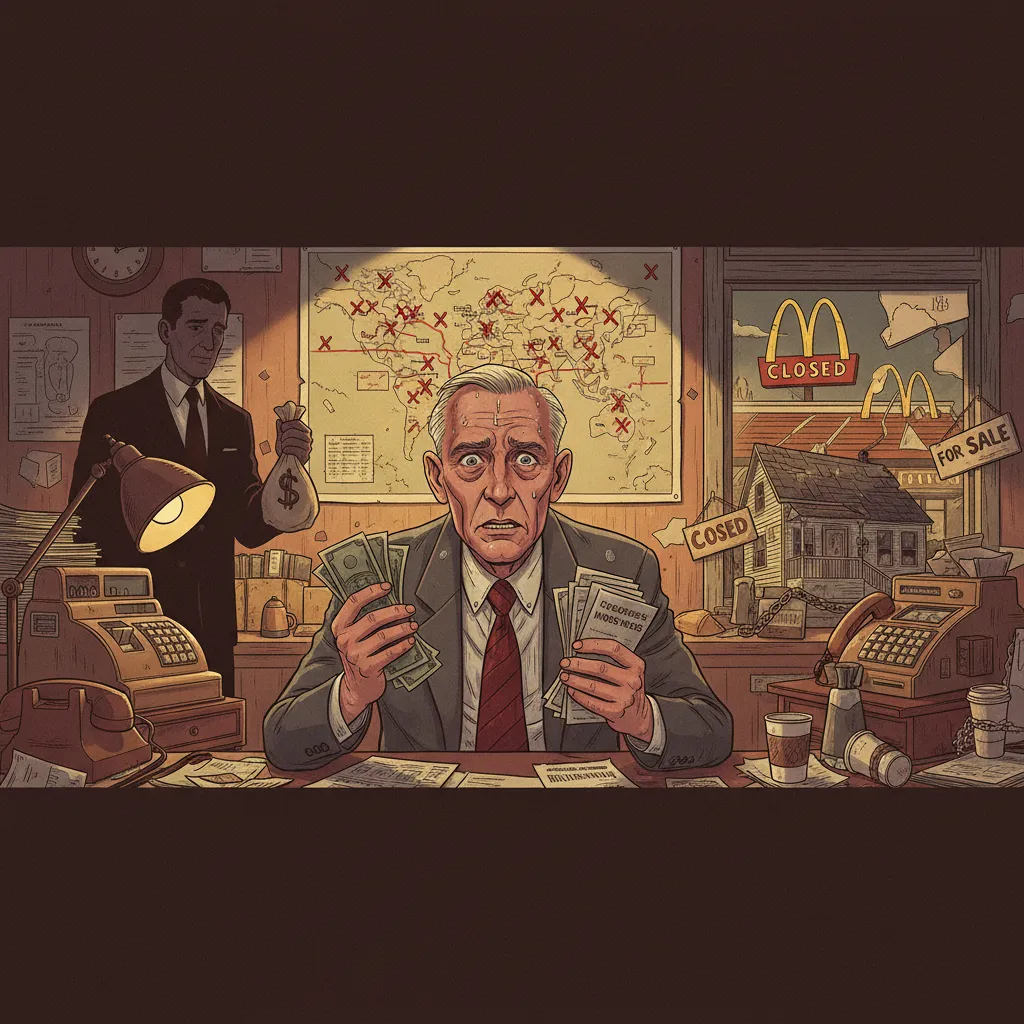
The early years of McDonald’s expansion were brutally difficult. Kroc was burning through money — his personal savings, loans from friends, mortgages on his home — to keep the franchise operation running. The 1.9% franchise fee barely covered his operating costs, let alone generated profit.
The breakthrough came from an unlikely source: Harry Sonneborn, a financial wizard who joined McDonald’s in 1956.
Sonneborn told Kroc something that changed the trajectory of the entire company: “You’re not in the hamburger business. You’re in the real estate business.”
Sonneborn’s insight was this: instead of just collecting franchise fees, McDonald’s Corporation should lease or purchase the land and buildings for each franchise location, then sublease them to franchisees at a markup. This would give McDonald’s:
- A reliable, high-margin revenue stream from real estate (lease income), not just the thin-margin franchise fee
- Control over franchisees — if a franchisee didn’t comply with standards, McDonald’s could terminate the lease
- Appreciation of real estate assets as McDonald’s locations drove up surrounding property values
In 1956, Kroc formed the Franchise Realty Corporation to execute this strategy. McDonald’s would identify promising locations, secure the real estate (through leases or purchases), build the restaurant, and then sublease it to the franchisee.
The economics were transformative. McDonald’s franchisees paid not just the 1.9% franchise fee but also rent — typically 8.5% of sales or a minimum monthly rent, whichever was higher. This made McDonald’s Corporation one of the largest commercial landlords in the world.
As of 2025, McDonald’s Corporation owns or holds long-term leases on approximately 55% of its restaurant locations worldwide. The company’s real estate portfolio is estimated to be worth over $40 billion. The rent income from franchisees generates far more profit than the franchise fees.
Ray Kroc, the milkshake machine salesman, had become one of the largest real estate operators in America — and he’d done it by selling 15-cent hamburgers.
💔 Chapter 5: The Betrayal of the McDonald Brothers
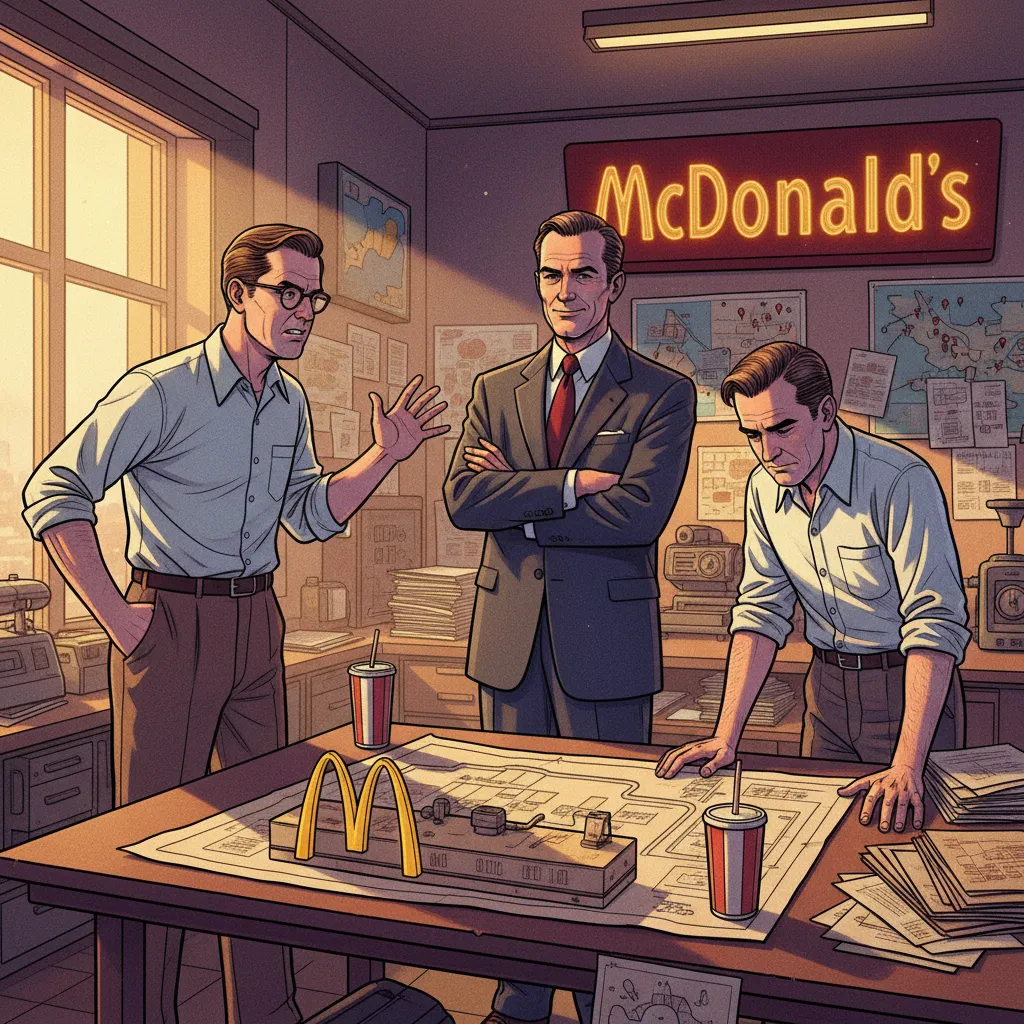
As McDonald’s grew, the relationship between Ray Kroc and the McDonald brothers deteriorated steadily.
The brothers were frustrated that Kroc was making changes without their approval. Kroc was frustrated that the brothers’ veto power was slowing his expansion. The 0.5% royalty the brothers received felt like a leash to Kroc — a constant reminder that the McDonald’s name belonged to someone else.
In 1961, Kroc made his move. He offered to buy the McDonald brothers out completely — their name, their system, their restaurant, everything.
The brothers’ asking price: $2.7 million.
Kroc didn’t have that kind of money. He was deeply in debt from the expansion. But he found a group of investors willing to finance the deal, and in 1961, McDonald’s Corporation acquired all rights to the McDonald’s name and system from the brothers for $2.7 million.
There was, however, one catch — and it became the cruelest twist in the story.
The brothers asked for an additional provision: a continuing royalty of 0.5% of McDonald’s revenues in perpetuity. This was the brothers’ insurance policy — their way of participating in the empire’s future growth.
According to the McDonald brothers, Kroc agreed to the royalty verbally but refused to include it in the written contract. He told them that the royalty would be handled as a “handshake agreement” because including it in the contract would complicate the financing.
The brothers trusted him. They signed the contract without the royalty clause.
Kroc never paid the royalty.
Had the handshake agreement been honored, the 0.5% royalty would have been worth over $100 million per year by the 2020s — and the brothers or their heirs would have become billionaires.
The betrayal went further. The original San Bernardino McDonald’s was not included in the sale — the brothers had retained it. But Kroc, out of what can only be described as spite, opened a new McDonald’s franchise directly across the street from the brothers’ original restaurant. The brothers couldn’t compete with their own creation. Their original restaurant eventually closed.
Dick McDonald died in 1998 at age 89. Mac McDonald died in 1971. Neither became wealthy from the company they created. The $2.7 million sale price, after taxes and legal fees, left each brother with approximately $1 million.
When asked about the brothers in later interviews, Kroc was dismissive: “They were not in a position to operate the business the way I wanted to operate it.”
🌍 Chapter 6: The Machine That Ate the World
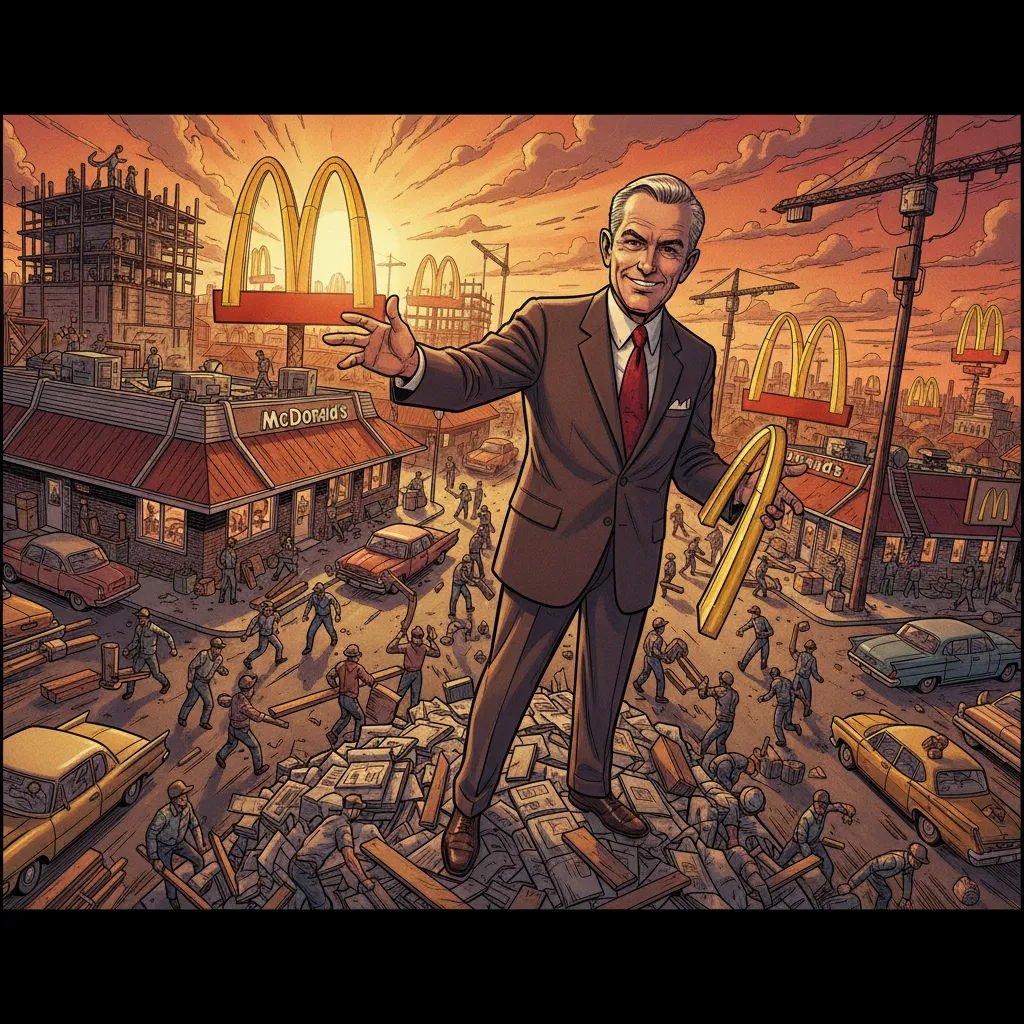
With full ownership of the McDonald’s brand and system, Kroc accelerated expansion to a staggering pace.
The numbers tell the story:
- 1960: 228 restaurants
- 1965: 738 restaurants
- 1970: 1,592 restaurants
- 1975: 3,076 restaurants (international expansion begins)
- 1980: 6,263 restaurants
- 1990: 11,803 restaurants
- 2000: 28,707 restaurants
- 2025: approximately 41,000 restaurants in over 100 countries
McDonald’s opened its first international restaurant in Richmond, British Columbia, Canada, in 1967. Japan followed in 1971 (the Ginza location in Tokyo became one of the highest-grossing McDonald’s in the world). Australia, Germany, France, and the UK followed quickly.
Each international expansion required adaptation — menu items were modified for local tastes (the Teriyaki McBurger in Japan, the McAloo Tikki in India, the Croque McDo in France) — but the core system remained the same. The assembly-line kitchen, the standardized procedures, the obsessive quality control, the real estate model — all of it was transplanted to every corner of the globe.
The cultural impact was as significant as the business impact. McDonald’s became a symbol of American capitalism — beloved by some, reviled by others. Economist Thomas Friedman famously proposed the “Golden Arches Theory of Conflict Prevention,” arguing that no two countries with McDonald’s had ever gone to war with each other (a theory later disproven).
Kroc’s other key innovation was Hamburger University, founded in 1961 in the basement of a McDonald’s restaurant in Elk Grove Village, Illinois. The institution trained franchise operators in every aspect of McDonald’s operations — from cooking procedures to customer service to financial management. By 2025, Hamburger University had graduated over 400,000 people, making it one of the largest corporate training programs in the world.
👑 Chapter 7: The Later Years and the Joan Crawford of It All

Ray Kroc’s personal life was as turbulent as his business life was disciplined.
He divorced his first wife, Ethel, in 1961 — the same year he bought out the McDonald brothers. He married his second wife, Jane Dobbins Green, in 1963. That marriage lasted six years.
In 1969, Kroc married Joan Beverly Mansfield Smith, a woman he had first met in 1957 when she was playing the organ at a restaurant in St. Paul, Minnesota. Their connection was instant — and complicated. Both were married to other people at the time. Kroc later said he told Joan during their first meeting: “Someday I’m going to marry you.” It took 12 years, two other marriages (for both of them), and considerable heartbreak, but he kept his word.
Joan Kroc would become almost as significant a figure as Ray himself. After Ray’s death, she became one of the most generous philanthropists in American history, giving away billions to causes including National Public Radio ($200 million), the Salvation Army ($1.6 billion), and various peace initiatives.
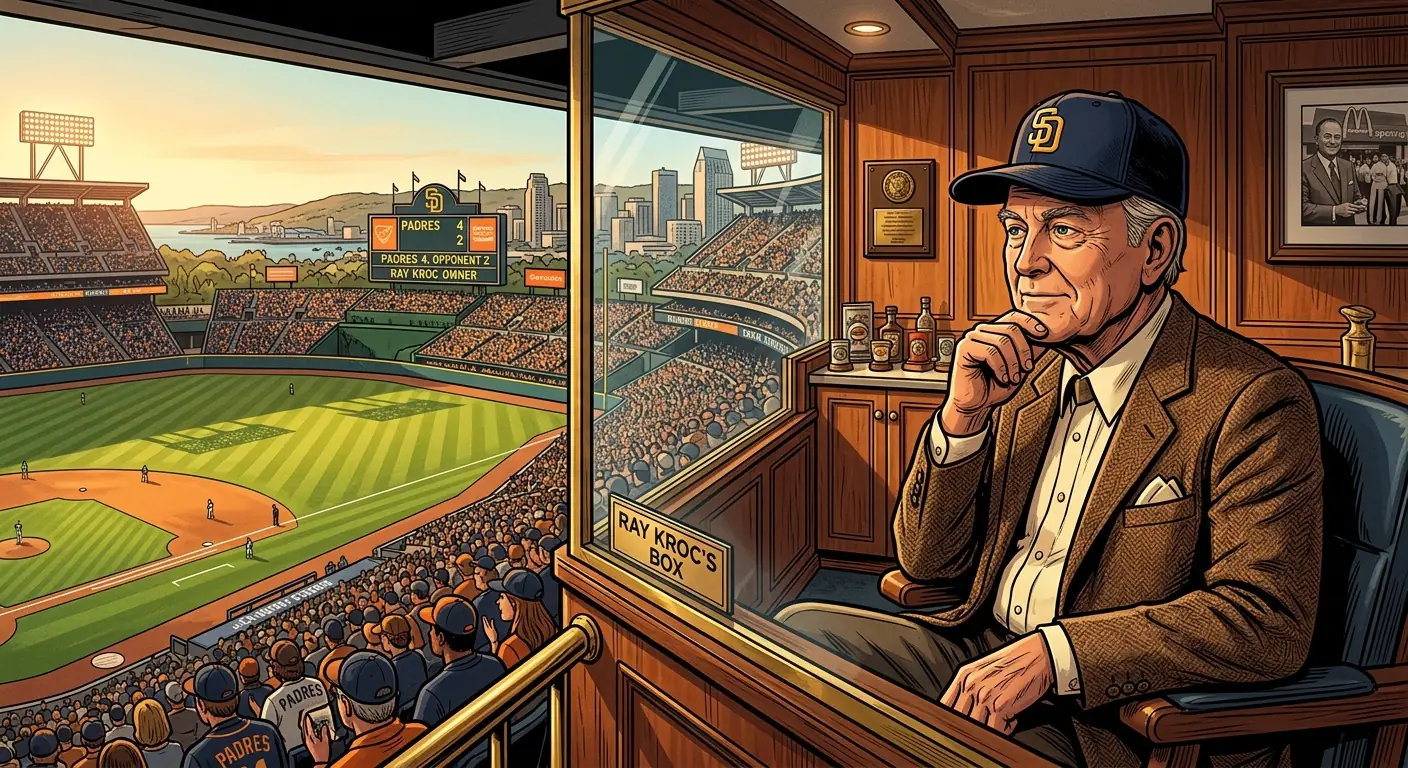
Ray Kroc also bought the San Diego Padres baseball team in 1974 for $12 million. He was a passionate but impatient owner who once grabbed the public address microphone during a game to apologize to fans for the team’s terrible play: “I’ve never seen such stupid ball playing in my life!”
By the late 1970s, Kroc’s health was declining. He had diabetes, alcoholism, and arthritis. He continued working — visiting restaurants, berating managers who didn’t meet his standards, obsessing over the quality of the french fries — until the very end.
Ray Kroc died on January 14, 1984, at age 81. His net worth at death was estimated at $600 million (approximately $1.7 billion today). McDonald’s Corporation, the company he had built from a single franchise in Des Plaines, Illinois, was serving 22 million customers daily at over 7,500 locations worldwide.
⚖️ Chapter 8: The Legacy — Genius or Thief?
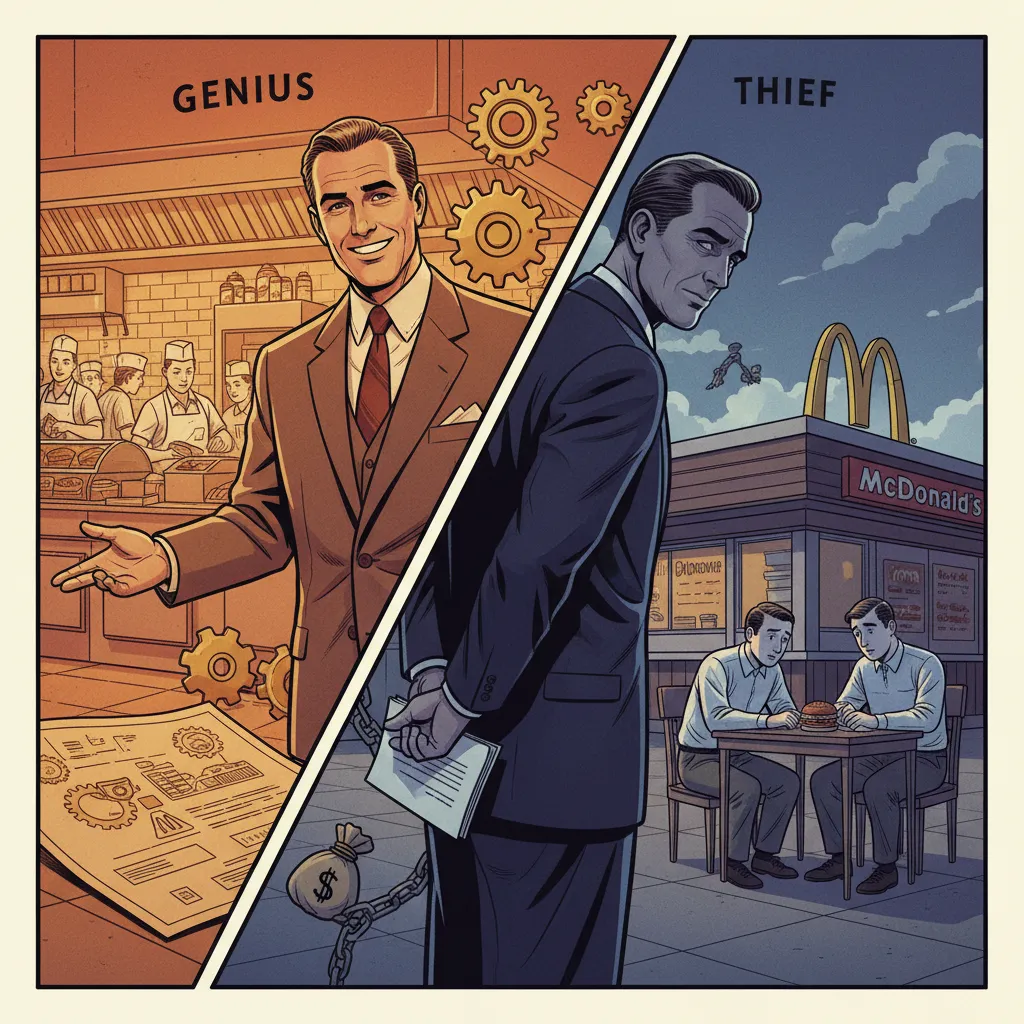
The debate over Ray Kroc’s legacy comes down to a single question: Was he a genius or a thief?
The case for genius is strong. The McDonald brothers had created a great restaurant. Kroc created a global system. The brothers had no interest in expansion. Kroc had nothing but interest in expansion. Without Kroc, McDonald’s would likely have remained a single restaurant in San Bernardino, California — eventually forgotten, like thousands of other drive-ins of the 1950s.
Kroc’s real estate insight, his franchise management system, his relentless standardization, and his marketing genius (the Ronald McDonald character, the Happy Meal, the “You Deserve a Break Today” campaign) transformed a hamburger stand into the most recognizable brand on Earth.
The case for thief is equally compelling. Kroc didn’t invent the McDonald’s system — the brothers did. He didn’t create the name — they did. He took their life’s work, bought it for a fraction of its value, reneged on the handshake royalty agreement, and then drove their original restaurant out of business by opening a competitor across the street. That’s not business genius. That’s cruelty.
The truth, perhaps, is that Ray Kroc was both — a visionary operator who was also capable of profound callousness. He saw something others couldn’t see, and he was willing to do things others wouldn’t do to seize it.
As of March 2026, McDonald’s Corporation has a market capitalization of approximately $200 billion. It serves approximately 69 million customers daily across 41,000 locations in over 100 countries. It is the world’s largest restaurant company by revenue and one of the largest private employers on Earth.
Every one of those 41,000 restaurants traces its lineage back to a single hamburger stand in San Bernardino, run by two brothers who just wanted to make a good burger. They succeeded beyond their dreams — and lost it all to a 52-year-old salesman who wanted more.
Ray Kroc’s own words serve as both his epitaph and his confession: “If any of my competitors were drowning, I’d stick a hose in their mouth and turn on the water.”
The McDonald brothers weren’t his competitors. But he stuck the hose in anyway.
McDonald’s is the story of American capitalism in its purest form: someone builds something beautiful, someone else takes it and makes it enormous, and the historians argue about who deserves the credit. Ray Kroc didn’t invent the hamburger. He didn’t invent fast food. But he built the machine that ate the world — and he did it starting at age 52. It’s never too late to take someone else’s dream and make it your own.
📈 Chapter 9: The Public Offering and the Power Grab (1965)
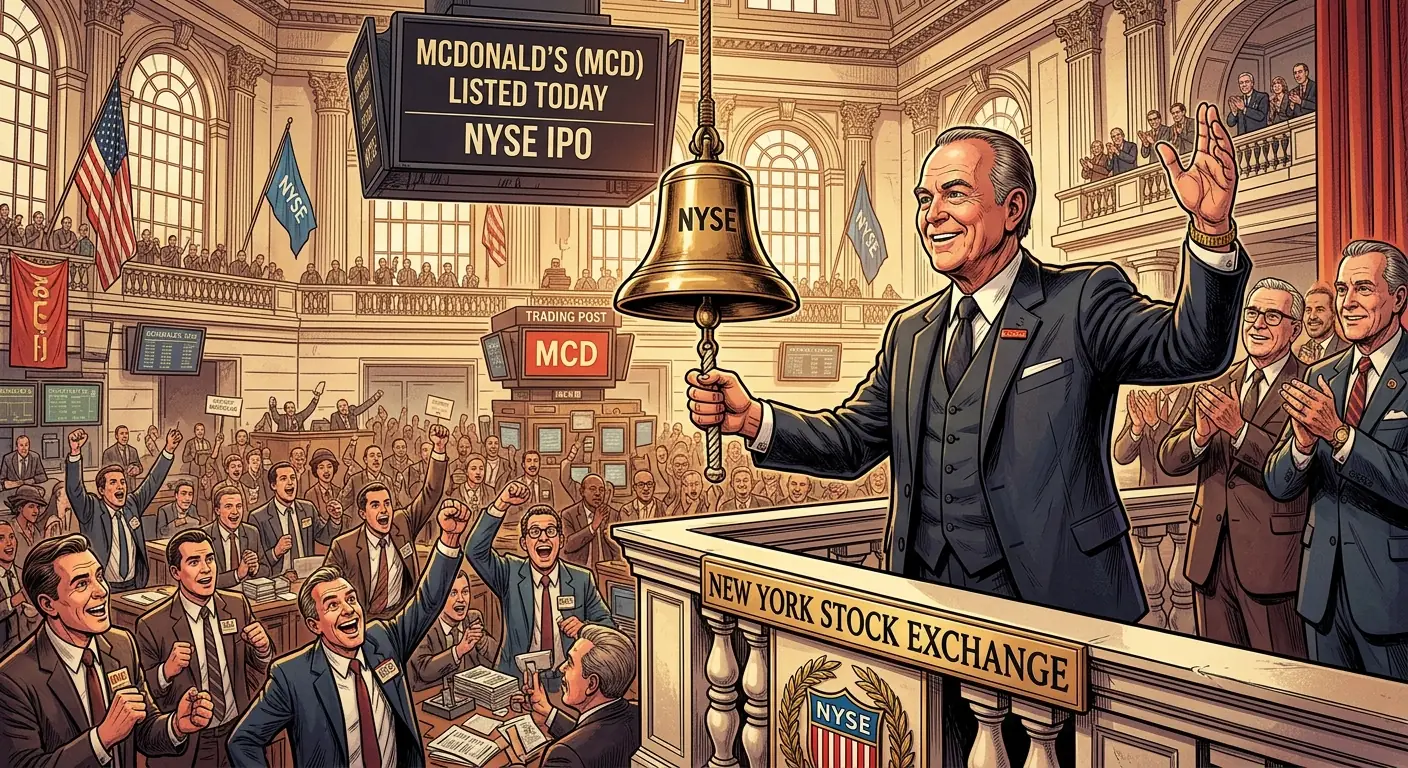
Alright, so Ray Kroc had bought out the McDonald brothers for a cool $2.7 million in 1961 (a deal that, as we know, came with a bitter aftertaste). He now owned the whole darn shebang, free to steer his golden ship wherever he pleased. But steering a ship this size, especially one growing at the breakneck speed of McDonald’s, requires serious fuel – and by fuel, I mean capital. Lots and lots of capital. Kroc, ever the visionary (or perhaps just a man who knew how to leverage other people’s money), knew exactly how to get it: take the company public.
From Private Enterprise to Public Spectacle
The year is 1965. McDonald’s has grown from that single Des Plaines, Illinois, store in 1955 to 700 restaurants across the U.S. That’s a staggering growth rate, folks. Kroc and his financial guru, Harry Sonneborn (whose earlier strategic genius in real estate had saved Kroc’s bacon), decided it was time to let the public in on the action. On April 21, 1965, McDonald’s Corporation stock went live on the New York Stock Exchange. The initial offering price? A humble $22.50 per share.
And let me tell you, it was a smash hit. The stock practically exploded. By the end of the first day, it had soared to $30. Within weeks, it hit $49. Suddenly, paper millionaires were popping up faster than McDonald’s could flip burgers. Kroc himself, who owned a significant chunk, became unbelievably wealthy overnight. This wasn’t just about money; it was about legitimizing McDonald’s as a serious, blue-chip enterprise, not just a glorified hamburger stand. It was a declaration to the world: “We’re here, we’re growing, and we’re just getting started.”
Shaking Up the Boardroom
With the IPO, Kroc’s power became absolute, and his vision was the only one that mattered. He had already navigated the tricky waters of buying out the brothers, but there were other early investors and partners who, while instrumental in the early days, didn’t quite share Kroc’s relentless, almost tyrannical drive for expansion and standardization. The public offering provided the perfect opportunity to consolidate control.
Kroc had a knack for identifying talent, but he also had a low tolerance for dissent or anyone who might slow down his express train. He wanted a company that moved at his speed. Early investors, some of whom had been friends or colleagues, found themselves gradually eased out or sidelined. It was a ruthless move, perhaps, but Kroc believed it was necessary. He wasn’t building a family business; he was building an empire, and empires require singular, unwavering leadership. He famously declared, “I believe in God, family, and McDonald’s — and in the office, that order is reversed.” No kidding, Ray.
The Golden Age of Expansion Begins
The influx of capital from the IPO was a major change. It allowed McDonald’s to accelerate its expansion like never before, funding new restaurant openings, improving infrastructure, and investing in nationwide marketing campaigns. This was the era where the Golden Arches truly began their march across America, cementing their place in the suburban landscape. Kroc wasn’t just selling hamburgers; he was selling a dream of consistency, speed, and affordability.
He was also selling a dream to franchisees – the chance to own a piece of this rapidly growing phenomenon. But with that opportunity came strict adherence to the McDonald’s system. Kroc was obsessive about uniformity, from the precise temperature of the fries to the exact width of the pickle slice. He’d famously visit stores unannounced, sometimes even cleaning toilets himself if he found them unsatisfactory. For Kroc, the IPO wasn’t just a financial transaction; it was a launchpad for total domination, ensuring every single McDonald’s, no matter where it was, delivered the exact same, predictable experience. And the public, it seemed, couldn’t get enough of it.
🍔 Chapter 10: The Burger Wars and Menu Magic (1960s-1970s)
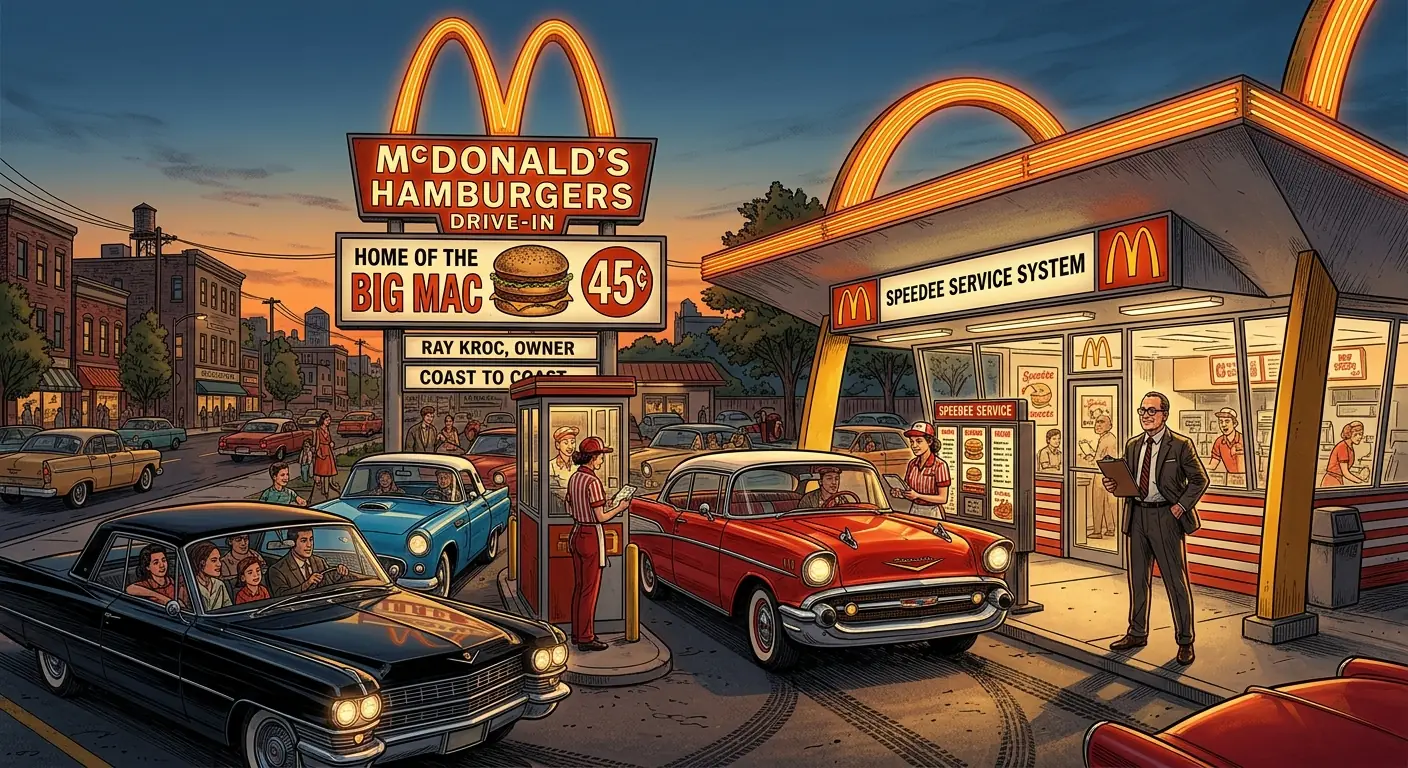
With McDonald’s now a publicly traded behemoth, Kroc wasn’t just competing with local diners anymore. The success of the Golden Arches had spawned a whole new industry, and suddenly, everyone wanted a piece of the fast-food pie. The 1960s and 70s saw the rise of what would become known as the “Burger Wars,” a fierce, delicious battle for America’s stomachs. Kroc, naturally, was ready for a fight, and he wasn’t afraid to innovate, even if it meant reluctantly straying from the original, minimalist menu.
The Battle for Burger Supremacy
McDonald’s wasn’t the only player in town. Burger King, founded in 1953, was growing, touting its flame-broiled burgers as a superior alternative. Then came Wendy’s in 1969, promising “old-fashioned hamburgers” and a drive-thru menu that was a bit more customizable. Kroc, a man who believed in relentless improvement and crushing the competition, knew he couldn’t stand still. While he was a purist at heart, devoted to the simple 15-cent hamburger, he also understood the market was evolving.
His response? Innovation, marketing, and sheer scale. McDonald’s wasn’t just bigger; it was smarter. They listened to their franchisees and customers, even if Kroc sometimes had to be dragged kicking and screaming into new menu items. The pressure from rivals, combined with the expanding tastes of the American public, pushed McDonald’s beyond its original, Spartan offerings. It was a turning point for the company, proving that even a tightly controlled system could adapt.
A Menu of Legends
It’s hard to imagine McDonald’s without the Big Mac, isn’t it? Well, it wasn’t Kroc’s idea. It was invented by Jim Delligatti, a franchisee in Pittsburgh, Pennsylvania, in 1967. Kroc initially resisted, fearing it would complicate the Speedee Service System. But Delligatti’s customers loved it. It was a bigger, more complex burger, designed to compete with the Whopper. Kroc eventually relented, and the Big Mac, with its “two all-beef patties, special sauce, lettuce, cheese, pickles, onions on a sesame seed bun,” became a global icon, pulling in customers looking for something more substantial.
Then there was the Filet-O-Fish, introduced in 1962. This was another franchisee idea, from Lou Groen in Cincinnati, who noticed a slump in sales on Fridays due to the Catholic tradition of abstaining from meat. Kroc, a man of strong opinions, apparently favored a “Hula Burger” (pineapple and cheese on a bun – seriously, Ray?), but Groen’s fish sandwich won out in a sales contest. Thank goodness. The Filet-O-Fish became a permanent fixture, proving McDonald’s could cater to specific market needs. And let’s not forget the Egg McMuffin, invented by Herb Peterson in Santa Barbara in 1971, which revolutionized breakfast and eventually became a huge profit driver for the company, much to Kroc’s initial skepticism. These items weren’t just new; they fundamentally changed the fast-food landscape.
Marketing the Dream
Beyond the menu, McDonald’s truly mastered marketing during this era. They weren’t just selling food; they were selling an experience, a sense of community, and a break from the everyday. Ronald McDonald, first appearing in 1963, became a beloved mascot, a friendly face for families and children. The “You Deserve a Break Today” campaign, launched in 1971, was an absolute stroke of genius, resonating with busy families and tired workers.
These weren’t just jingles; they were cultural touchstones. McDonald’s became synonymous with consistency, value, and family fun. Kroc understood that branding was everything. He might have been a gruff salesman, but he knew how to hire brilliant marketers who could capture the imagination of millions. The Burger Wars pushed McDonald’s to be more creative, more adaptable, and ultimately, even more dominant. They didn’t just win the war; they redefined the battlefield.
💍 Chapter 11: Wives, Wealth, and the Weight of Empire (1960s-1970s)
Building a multi-billion dollar empire from scratch isn’t just a business story; it’s a deeply personal one. And for Ray Kroc, a man utterly consumed by his work, his personal life often felt like collateral damage. While his professional life soared to dizzying heights, his relationships with his wives were, shall we say, a bit more grounded in reality – a reality often overshadowed by the golden arches.
The Personal Toll of Ambition
Ray Kroc was married three times. His first marriage to Ethel Fleming lasted over 39 years, from 1922 to 1961. Think about that: nearly four decades of marriage, much of it spent with Ray struggling as a paper cup salesman, then a Multimixer salesman, always chasing the next big thing. Ethel was a quiet, supportive woman who endured his endless travels, his relentless ambition, and the financial struggles that came with it. She raised their daughter, Marilyn. But as McDonald’s took off, and Kroc’s wealth exploded, their paths diverged.
Ethel simply wasn’t built for the high-flying, cutthroat world Kroc now inhabited. She preferred a simpler life, far from the corporate boardrooms and public eye. Kroc, on the other hand, was energized by the spotlight, by the constant grind. The gap between them widened until it became a chasm. When Kroc finally filed for divorce in 1961, citing “extreme mental cruelty” (a common, albeit often hollow, legal phrase of the time), it was clear that his loyalty to McDonald’s superseded all else. Ethel reportedly received a settlement of around $300,000 and a pension, which, while a substantial sum for the time, was a mere pittance compared to the fortune Kroc was rapidly accumulating. It was a stark example of the personal sacrifices Kroc made, or demanded, in his pursuit of greatness.
The Millionaire and the Music Lady
Not long after divorcing Ethel, Kroc married Jane Dobbins Green in 1963. Jane was a bit more sophisticated, someone Kroc thought could fit into his new, opulent lifestyle. He bought her a sprawling estate in Florida, complete with a nine-hole golf course. But even with all the trappings of wealth, this marriage, too, was short-lived, ending in divorce in 1968. Kroc was a workaholic, a man who lived and breathed McDonald’s. He expected his partners to understand, if not share, that same all-consuming passion.
Then came Joan Beverly Smith. Their story is quite the Hollywood romance, or perhaps, a cautionary tale. Kroc first met Joan in 1957 at a McDonald’s opening in St. Paul, Minnesota. She was married to a McDonald’s franchisee, Rollie Smith, and was a talented musician, playing the organ. Kroc was immediately smitten. They had an undeniable connection, an almost magnetic attraction. Despite both being married, they began a clandestine affair that simmered for years, a testament to Kroc’s relentless pursuit, not just in business, but in his personal life too. He divorced Jane in 1968, and Joan divorced Rollie in 1968. Finally, in 1969, Ray and Joan were married. This would be his last marriage, and arguably, his most significant personal relationship.
A Fortune Forged in Fries
By the time Kroc married Joan, his personal fortune was astronomical. The 1965 IPO had made him a multi-millionaire, and McDonald’s continued to grow at an unprecedented pace. He was living a life of unimaginable luxury – private jets, sprawling estates, and enough money to buy whatever, and whoever, he wanted. Yet, for all his wealth, Kroc remained fundamentally the same driven, demanding, and often gruff individual. He was still the first one in the office, still obsessed with the smallest details of his restaurants.
His health, however, was starting to show the strain of decades of relentless work. He had diabetes and arthritis, and his blood pressure was a constant concern. But even these physical ailments couldn’t stop him. The weight of building and maintaining such a vast empire was immense, and while he reveled in the power and the wealth, it’s clear his personal life often paid a heavy price. Joan, a woman as strong-willed and independent as Kroc himself, would become his partner in a different kind of empire in his later years: philanthropy, but that’s a story for another time.
🌍 Chapter 12: The Golden Arches Go Global (1970s-1980s)
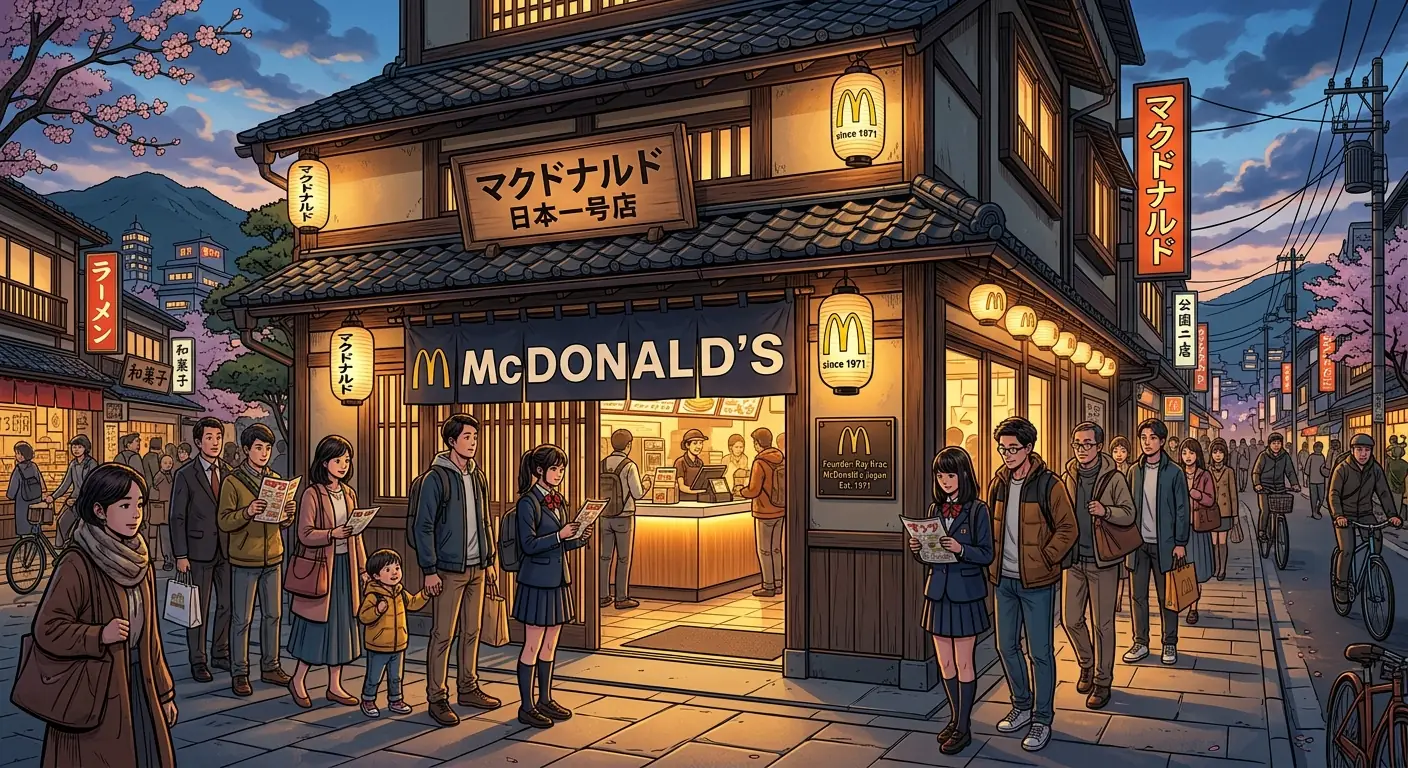
Ray Kroc had conquered America. From coast to coast, the Golden Arches were as ubiquitous as gas stations. But for a man of Kroc’s ambition, the borders of the United States were just arbitrary lines on a map. His vision was truly global, long before “globalization” became a buzzword. The 1970s and early 80s saw McDonald’s embark on an unprecedented international expansion, planting its flag in countries that had never even heard of a quarter-pounder.
Conquering Continents, One Burger at a Time
The first international McDonald’s restaurant opened in Canada in 1967, followed swiftly by Puerto Rico in the same year. But the real push into diverse cultures began in the early 1970s. In 1971, McDonald’s simultaneously opened its doors in Japan, Germany, and Australia. Imagine the logistical nightmare! Japan, in particular, was a bold move, requiring not just cultural adaptation but also a complete overhaul of supply chains. The first Japanese McDonald’s opened in Tokyo’s upscale Ginza district, a strategic decision to position it as a modern, desirable dining option.
Kroc’s philosophy for international expansion was simple yet brilliant: standardize the system, localize the flavor. The core menu and operating procedures remained sacrosanct – the Speedee Service System was universal. But McDonald’s was smart enough to understand that a one-size-fits-all menu wouldn’t work everywhere. In Germany, they offered beer (initially, at least). In Japan, they adapted sizes and introduced menu items that resonated with local tastes over time, though the initial menu was very American. This flexibility, combined with Kroc’s relentless pursuit of efficiency and quality control, allowed McDonald’s to rapidly embed itself into diverse societies.
The Challenges of Cross-Cultural Capitalism
This global march wasn’t without its headaches, of course. Everything from sourcing local beef that met McDonald’s rigorous standards to navigating complex labor laws and cultural nuances proved challenging. Kroc, ever the pragmatist, understood that certain adaptations were necessary, but he drew a hard line at anything that compromised the core McDonald’s experience. He famously insisted on the highest standards of hygiene and customer service, believing these were universal values.
One of the biggest hurdles was simply getting the ingredients. Establishing a reliable supply chain for beef, potatoes, and dairy in countries where such infrastructure didn’t exist for fast food was a massive undertaking. McDonald’s often had to invest in developing these local industries, essentially creating its own ecosystem of suppliers. This meant long-term commitment and significant capital investment, but it also ensured the quality and consistency Kroc demanded. It was a testament to the company’s deep pockets and Kroc’s unwavering belief in the McDonald’s model.
The World, According to McDonald’s
By the time Kroc passed away in 1984, McDonald’s had expanded into 32 countries and operated over 8,000 restaurants. It was an astonishing achievement, transforming a regional hamburger stand into a truly global phenomenon. The Golden Arches became a symbol, not just of American capitalism, but of modernity, convenience, and a certain kind of predictable comfort. Whether you were in Paris, Tokyo, or Sydney, you knew what you were getting when you walked into a McDonald’s.
Kroc’s legacy in this regard is immense. He didn’t just expand a business; he helped pioneer the concept of global fast food. He proved that a meticulously engineered system, combined with smart localization, could transcend cultural barriers. He taught the world how to “eat American,” laying the groundwork for countless other brands to follow. For better or worse, Kroc’s vision ensured that the smell of fries and the sight of those iconic arches would greet travelers in nearly every corner of the earth.
⚾ Chapter 13: Kroc’s Last Stand & Enduring Influence (1980s & Beyond)
By the early 1980s, Ray Kroc was in his late 70s and early 80s. The relentless drive that had fueled his life for so long was still there, but his body was increasingly failing him. Yet, even as his health declined, Kroc found new outlets for his boundless energy and immense wealth, leaving behind a legacy that stretched far beyond just hamburgers.
From Hamburgers to Home Runs
One of Kroc’s more surprising ventures in his later years was his foray into professional sports. In 1974, the struggling San Diego Padres baseball team was on the verge of being sold and moved to Washington D.C. Kroc, a longtime baseball fan, stepped in and bought the team for $12 million. It was a move driven by a mix of civic pride and a desire to keep the team in San Diego, where he spent much of his later life.
His ownership was, predictably, colorful. Kroc brought his characteristic passion and bluntness to the ballpark. Famously, during a game in 1974, exasperated by the Padres’ poor play, he grabbed the public address microphone and declared, “I’ve never seen such stupid ballplaying in my life!” He even suggested putting a public address system in the dugout so he could yell at the players directly. While he didn’t turn the Padres into a dynasty overnight (they did make it to the World Series in 1984, the year he died), his involvement saved the team for the city and showed a different, perhaps more human, side of the ruthless businessman. It was a passion project, a way to connect with a community and indulge a lifelong love, albeit with his signature Kroc-ian intensity.
The Philanthropist’s Pitch
Beyond baseball, Kroc, along with his third wife Joan, became increasingly involved in philanthropy. While Kroc was alive, their charitable efforts were significant, though they truly blossomed after his passing under Joan’s leadership. However, it was during Kroc’s lifetime that the seeds were sown for what would become one of McDonald’s most enduring and impactful contributions: Ronald McDonald House Charities. The first Ronald McDonald House opened in Philadelphia in 1974, providing a “home away from home” for families of seriously ill children receiving treatment.
This initiative, driven by the desire to give back and supported by McDonald’s franchisees, embodied a different kind of empire-building – one focused on compassion. It allowed McDonald’s to leverage its vast network and resources for a social good, creating a lasting positive impact that continues to this day. Kroc, the man often depicted as solely driven by profit, also had a hand in establishing a charitable foundation that has provided comfort and support to millions of families worldwide.
A Legacy Cast in Gold (and Greed?)
Ray Kroc passed away on January 14, 1984, at the age of 81, due to heart failure. At the time of his death, his personal net worth was estimated at $500 million, a staggering sum for the era. McDonald’s, the company he built from a small hamburger stand, had grown into a global behemoth with thousands of restaurants and billions in annual sales. His death marked the end of an era, but not the end of his influence.
His legacy remains complex and fiercely debated. Was he a genius who saw potential where others didn’t, a relentless visionary who built an unparalleled business model? Or was he a thief, as the McDonald brothers bitterly contended, who leveraged their innovation for his own gain, pushing them aside with calculated ruthlessness? The truth, as always, is likely somewhere in the nuanced middle. He didn’t invent fast food, and he didn’t invent McDonald’s. But he systematized it, scaled it, and globalized it with an almost terrifying efficiency.
Kroc’s impact on business, franchising, and the global food industry is undeniable. He perfected the “system,” creating a blueprint for consistency, efficiency, and brand recognition that is still studied today. He transformed a simple hamburger into a global cultural phenomenon. The lessons from his life are many: the power of persistence, the importance of vision, the ruthlessness required to build an empire, and the often-unseen personal costs of such ambition. Ray Kroc may be gone, but the Golden Arches, his enduring monument, continue to shine around the world.
💡 Key Insights
- ▸ Starting late doesn't mean finishing last — Kroc didn't begin his life's work until 52, proving that age is irrelevant to ambition.
- ▸ Understanding what business you're REALLY in is the key insight — McDonald's was a real estate company disguised as a restaurant.
- ▸ Systemization beats innovation — McDonald's didn't make the best burger, it made the most consistent one.
- ▸ The ethics of 'business genius' are always complicated — Kroc's success came at the direct expense of the brothers who invented the concept.
- ▸ Franchise models create wealth through leverage — one person's system multiplied across thousands of operators.
Sources
- Grinding It Out: The Making of McDonald's by Ray Kroc ↗
- Ray & Joan: The Man Who Made the McDonald's Fortune and the Woman Who Gave It All Away by Lisa Napoli ↗
- The Founder (2016 Film) - Historical Research Materials ↗
- McDonald's Corporation - Company History ↗
- Bloomberg Businessweek - McDonald's Real Estate Strategy ↗
- The Wall Street Journal - McDonald's Franchise Model ↗
- Forbes - History of McDonald's Growth ↗