Samsung: How the Lee Family Built a $500B Empire from a Noodle Shop
From trading dried fish in 1938 to dominating global tech — the three-generation dynasty behind Samsung, South Korea's most powerful chaebol.
View all stories about this mogul
In South Korea, you can be born in a Samsung hospital, go to a Samsung-affiliated school, live in a Samsung-built apartment, work at Samsung, buy your groceries at a Samsung department store, and when you finally keel over, Samsung Life Insurance will handle the payout. Samsung isn’t a company. It’s 20% of an entire country’s GDP. It’s a shadow government run by one family for nearly ninety years — and that family has been to prison, been pardoned, and gone right back to running everything.
This is the story of how a dried-fish trader in a war-wrecked country built the most dominant technology conglomerate on Earth, and how his children and grandchildren held onto it through scandals, explosions, and at least one presidential impeachment they helped cause.
Buckle up. This one’s wild.
🇰🇷 Chapter 1: The Noodle Trader — Lee Byung-chul and the Birth of Samsung (1910–1960)
To understand Samsung, you first need to understand Korea in the 1930s. And understanding Korea in the 1930s means understanding what it felt like to live under the boot of the Japanese empire — a foreign power that controlled your economy, your schools, and your future.
Lee Byung-chul was born on February 12, 1910, in Uiryeong, a rural town in the southern Korean province of Gyeongsang. His family were wealthy landowners — minor aristocrats in the old Joseon class system. But aristocrat or not, you were still Korean under Japanese occupation, which meant you were still second-class in your own country.
The Unlikely Entrepreneur
Lee was the youngest son, which in Korean Confucian tradition meant he was basically the backup quarterback nobody expected to play. He got shipped off to Waseda University in Tokyo to study, dropped out, and came home. His family was not thrilled.
But Lee had been paying attention to something his family missed. He’d been watching the Japanese zaibatsu — those enormous industrial conglomerates like Mitsubishi, Mitsui, and Sumitomo that had their tentacles in every sector of the Japanese economy. One family. Dozens of industries. Absolute power. He took notes. Very detailed notes.
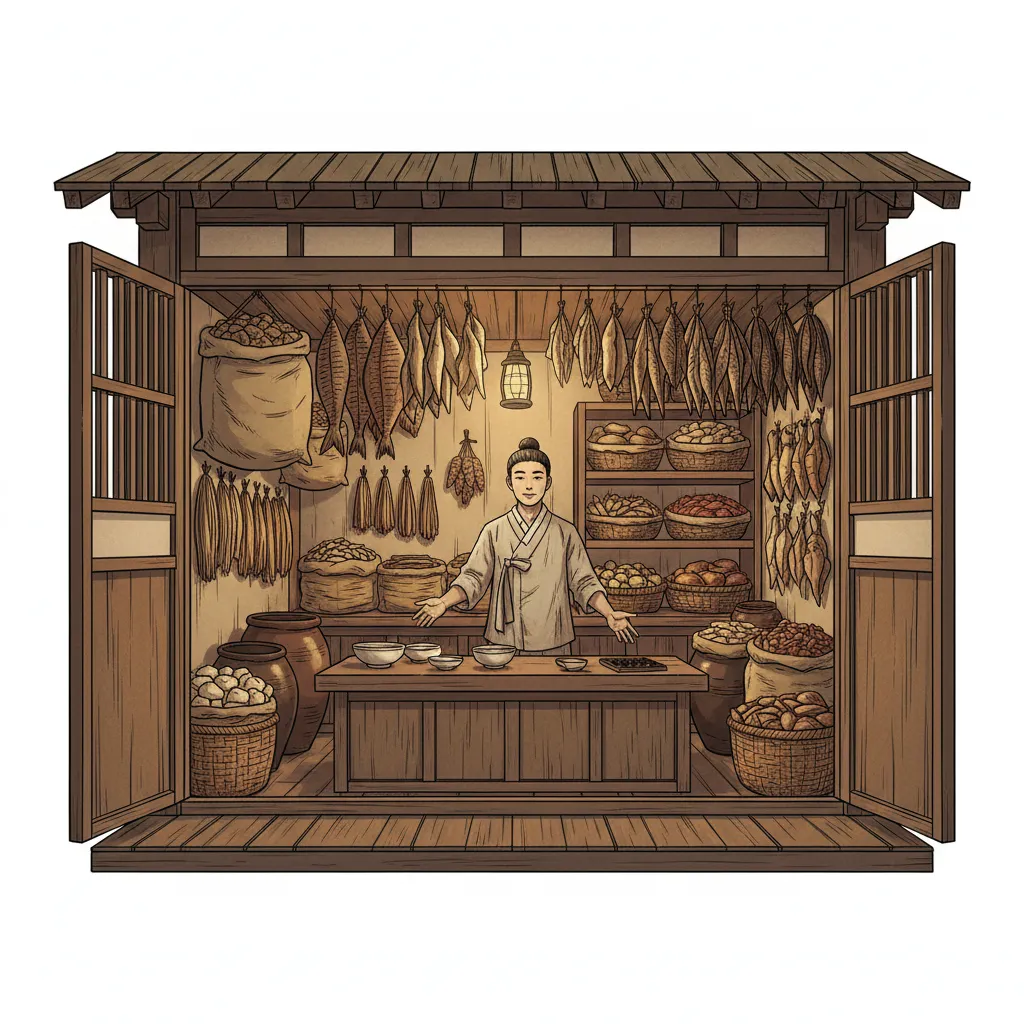
On March 1, 1938, in the southern city of Daegu, Lee Byung-chul opened a small trading company with 30,000 won — roughly $50,000 in today’s money — and forty employees. He traded dried fish, vegetables, and noodles, exporting them to Manchuria and Beijing. His grand empire started with the Korean equivalent of a seafood and pasta side hustle.
He called the company Samsung, which translates to “Three Stars.” Big, eternal, cosmic — like the stars themselves.
Wildly ambitious name for a noodle exporter. But the man was not joking.
Surviving the Storm
The next two decades were an absolute nightmare for Korea. World War II ended Japanese colonial rule in 1945, but the country immediately got ripped in half. The Korean War (1950-1953) killed millions and turned most cities into rubble. Seoul changed hands four times during the fighting. Four times.

Lee lost nearly everything. His businesses in Seoul were destroyed. But the man had a gift that would define the Lee family for three generations: the ability to look at absolute chaos and see a business opportunity.
As South Korea began to rebuild, the government — first under President Syngman Rhee, then under the military dictator Park Chung-hee — needed companies big enough to execute massive reconstruction projects. The deal was simple and borderline feudal: the government would hand out cheap loans, tax breaks, and import licenses, and in exchange, companies would industrialize the country at warp speed.
This was the birth of the chaebol system. And Samsung rode it like a wave.
The Chaebol System Explained
The word “chaebol” literally means “wealth clan.” Let that sink in. Not “corporation.” Not “enterprise.” Wealth. Clan. It’s a family-run corporate empire, and the Korean government essentially created them on purpose.
The chaebols — Samsung, Hyundai, LG, SK, Lotte — were the Korean answer to Japan’s zaibatsu. The government gave them sweetheart conditions, and they industrialized the country at breakneck speed. South Korea went from a per-capita GDP lower than Ghana’s in 1960 to joining the OECD by 1996. That is genuinely insane economic growth.
But it also created a class of family dynasties with enormous political influence, opaque governance, and a sense of entitlement that would eventually produce scandal after scandal after scandal. The chaebols built modern Korea. They also kind of own it. Whether that’s a success story or a cautionary tale depends on who you ask and how recently a chaebol leader went to prison.
Samsung was the biggest, the most successful, and — as we’ll see — the most dramatically scandal-prone of them all.
🏭 Chapter 2: From Textiles to Technology — Building the Conglomerate (1960–1987)
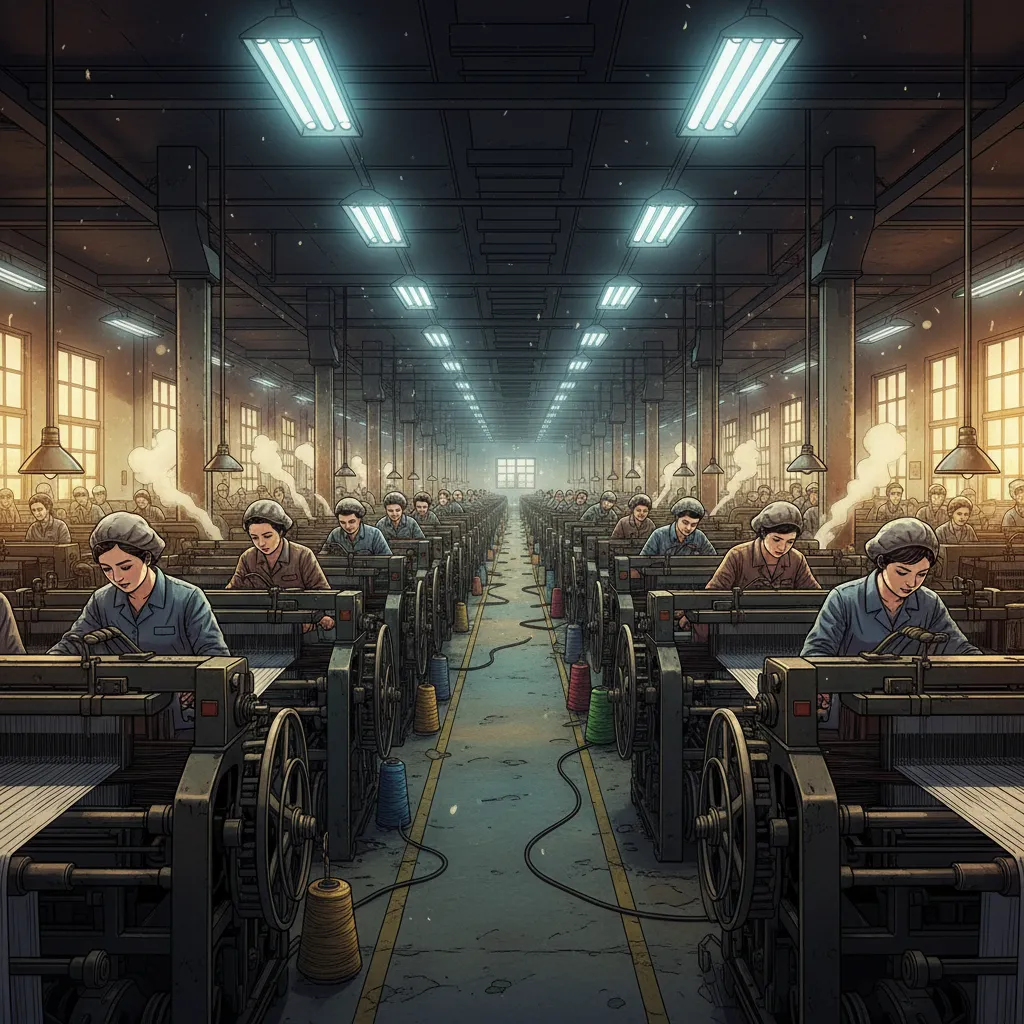
Through the 1950s and 1960s, Lee Byung-chul expanded Samsung into textiles, sugar refining, insurance, and construction. Each move was calculated. Textiles provided steady cash flow. Insurance gave Samsung access to capital. Construction positioned the company for fat government infrastructure contracts. The man was playing corporate chess while everyone else was playing checkers.
But Lee had his eye on something bigger. Way bigger.
The Pivotal Decision of 1969
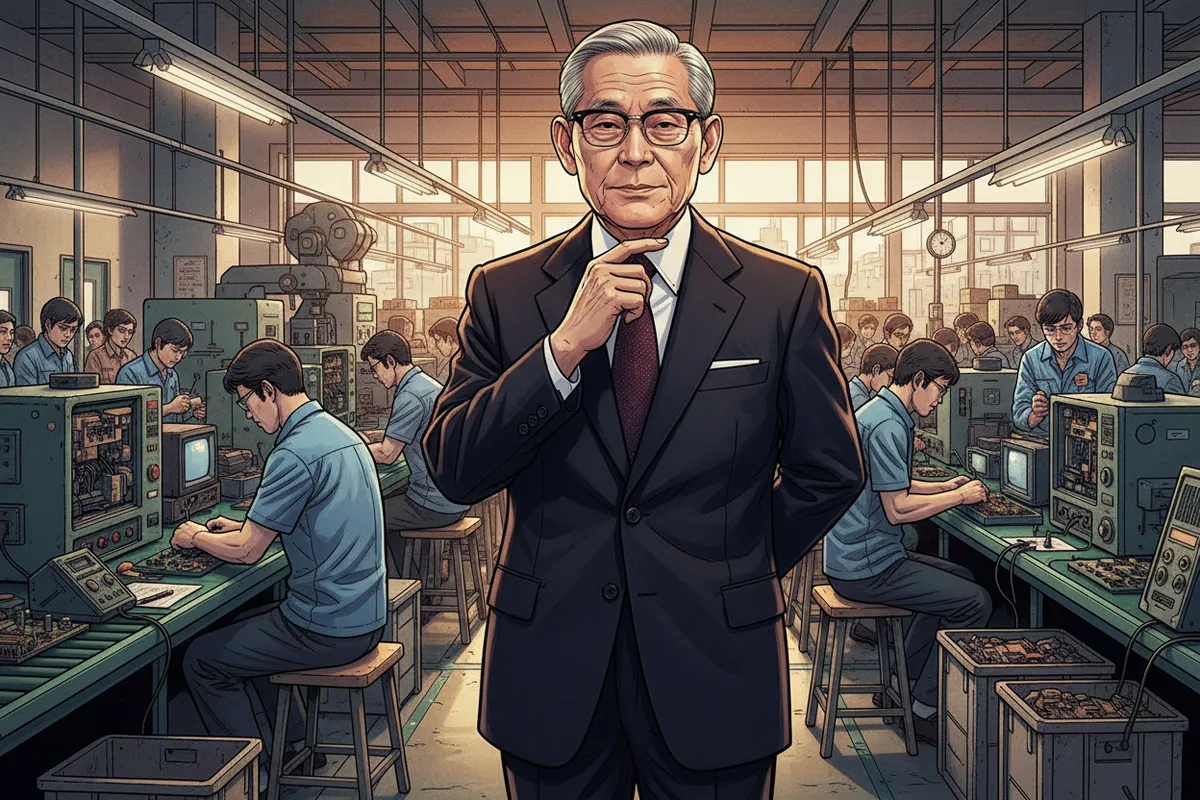
In 1969, Lee founded Samsung Electronics. Think about the timing. South Korea was still a developing nation. Per-capita income was about $250. The idea that a Korean company could go toe-to-toe with Japanese electronics giants like Sony, Panasonic, and Toshiba was laughable. People literally laughed.
Lee wasn’t bothered. He sent teams to Japan to walk through factories, analyze production methods, and reverse-engineer products. Samsung’s early electronics were, let’s be honest, knockoffs. The first product was a black-and-white television built largely from Japanese components. But originality was never the point. The point was: learn, improve, outproduce. Get into the ring, take the punches, and figure out how to punch harder.
Lee’s Management Philosophy
Lee Byung-chul ran Samsung on three principles that were radical for Korean business at the time:
- Invest in people first. Samsung was one of the first Korean companies to recruit based on open examinations rather than family connections. Revolutionary concept in a country where “who’s your father” was basically a job interview.
- Technology is the future. Even when Samsung was primarily a sugar and textile company, Lee funneled resources into technology research. Sugar money funding semiconductor dreams.
- Think in decades, not quarters. Lee was willing to bleed money for years in a new industry if he believed it would eventually dominate. This patience would be inherited by his son and grandson — and it became Samsung’s secret weapon.
The Semiconductor Bet
In 1974, Lee made his first move into semiconductors by acquiring a 50% stake in Korea Semiconductor. But the real gamble — the bet-the-farm, this-is-either-genius-or-insanity gamble — came in 1983, when Samsung announced it would enter the DRAM memory chip business.
Every advisor told him it was suicide. Intel and Japanese firms like NEC, Toshiba, and Hitachi had decades of head start. The technology was staggeringly complex. Samsung had zero experience in chip fabrication. Zero.
Lee didn’t care. He’d studied the semiconductor industry and spotted something everyone else missed: it was cyclical. Prices rose and fell in predictable waves. His strategy was breathtakingly simple and brutally hard to execute — invest massively during downturns when competitors were cutting back. Build the newest, most advanced factories when land and equipment were cheap. Then, when the market recovered, Samsung would have the best tech and the lowest costs.
The industry called this the “Samsung Paradox” — counter-cyclical investment. It sounded insane. It was genius.
Samsung poured in billions. For years, the chip division hemorrhaged cash. Engineers worked around the clock in fabrication plants. There’s a famous story from this era: Samsung engineers kept sleeping bags under their desks. When one shift ended, the next shift literally stepped over the unconscious bodies of their colleagues to take their positions. Korean work culture, ladies and gentlemen.
By 1992, Samsung had become the world’s largest producer of DRAM memory chips, overtaking the Japanese companies that had seemed invincible a decade earlier. As of 2026, Samsung is still the largest memory chip manufacturer on Earth.
The Founder’s Final Years
Lee Byung-chul died on November 19, 1987, at 77. He’d taken a noodle-trading company and turned it into South Korea’s largest conglomerate, spanning electronics, heavy industry, chemicals, construction, and financial services.
But he left behind a mess. Eight children from two wives. And the question of who would lead Samsung created family rifts that persist to this day. Dynasties: great for building empires, terrible for Thanksgiving dinner.
🔥 Chapter 3: Lee Kun-hee and the “New Management” Revolution (1987–2000)
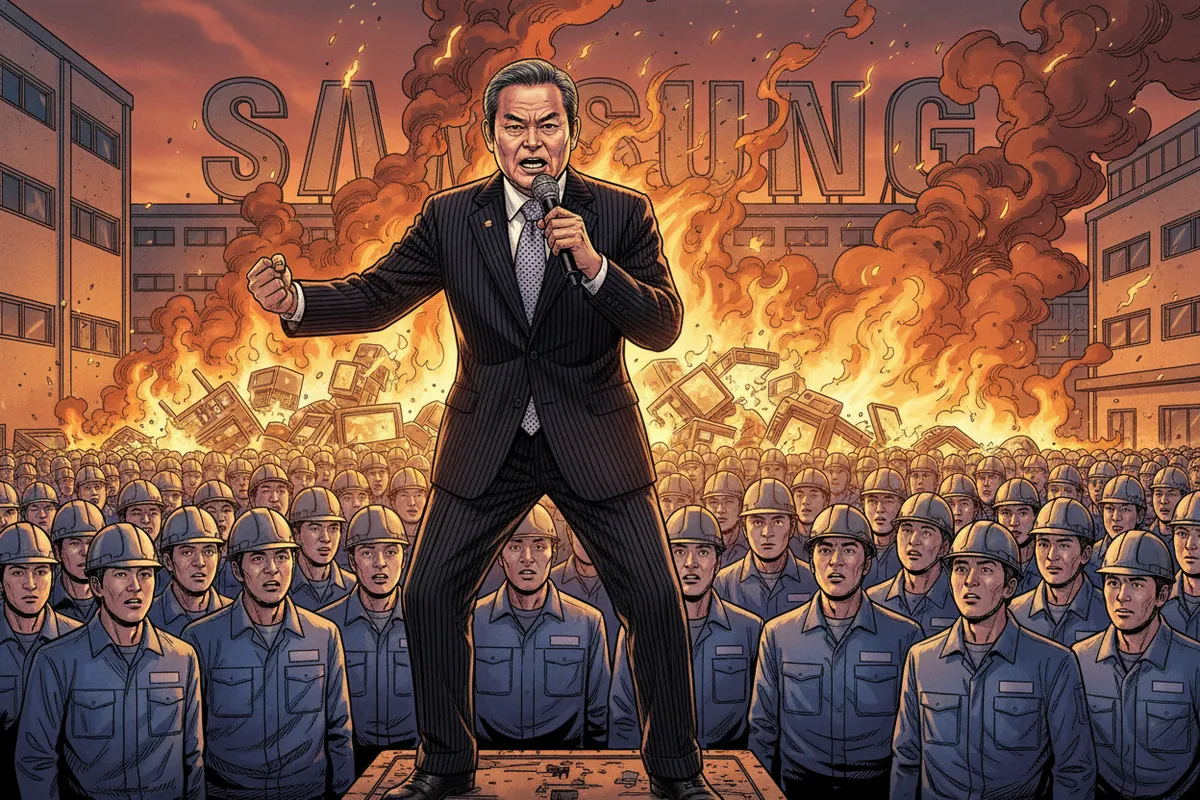
Lee Kun-hee, the third son of Lee Byung-chul, took over as chairman of Samsung Group in 1987. He was 45, quiet, somewhat reclusive, and widely underestimated. The business press wondered aloud whether this shy, soft-spoken heir had the spine to lead Samsung into the big leagues.
They were about to find out.
”Change Everything Except Your Wife and Children”
In 1993, Lee Kun-hee gathered Samsung’s top executives at a hotel in Frankfurt, Germany. What was supposed to be a routine overseas meeting turned into the most famous tirade in Korean business history.
Here’s what set him off. Lee had been touring electronics stores across Europe and America. What he found made his blood boil. Samsung products were gathering dust on bottom shelves while customers walked right past them to grab Sony and Panasonic. In some stores, Samsung televisions were being given away as freebies — buy a real TV and get a Samsung for free. Their products were the participation trophy of consumer electronics.
Lee started talking. He didn’t stop for three days.
Over the course of what became known as the “Frankfurt Declaration,” he delivered an impassioned, sometimes furious, occasionally unhinged demand for total transformation. His most famous line became Samsung’s internal war cry:
“Change everything except your wife and children.”
This was not a suggestion. This was not a TED talk. This was an order from a man who controlled one of the most powerful companies in Asia, and he meant every syllable.
The Phone-Burning Incident
Now here’s where it gets really good. Lee Kun-hee didn’t just want to talk about quality. He wanted to make a point nobody would ever forget.
In 1995, Samsung shipped a batch of mobile phones that turned out to be defective. When Lee found out, he ordered every Samsung phone in the Gumi factory complex — roughly 150,000 units worth an estimated $50 million — to be hauled outside and piled in a massive heap in front of the factory.
Then he made 2,000 Samsung employees stand there and watch as every single phone was set on fire and bulldozed into the dirt.
Fifty million dollars. Up in smoke. While two thousand people watched in stunned silence.
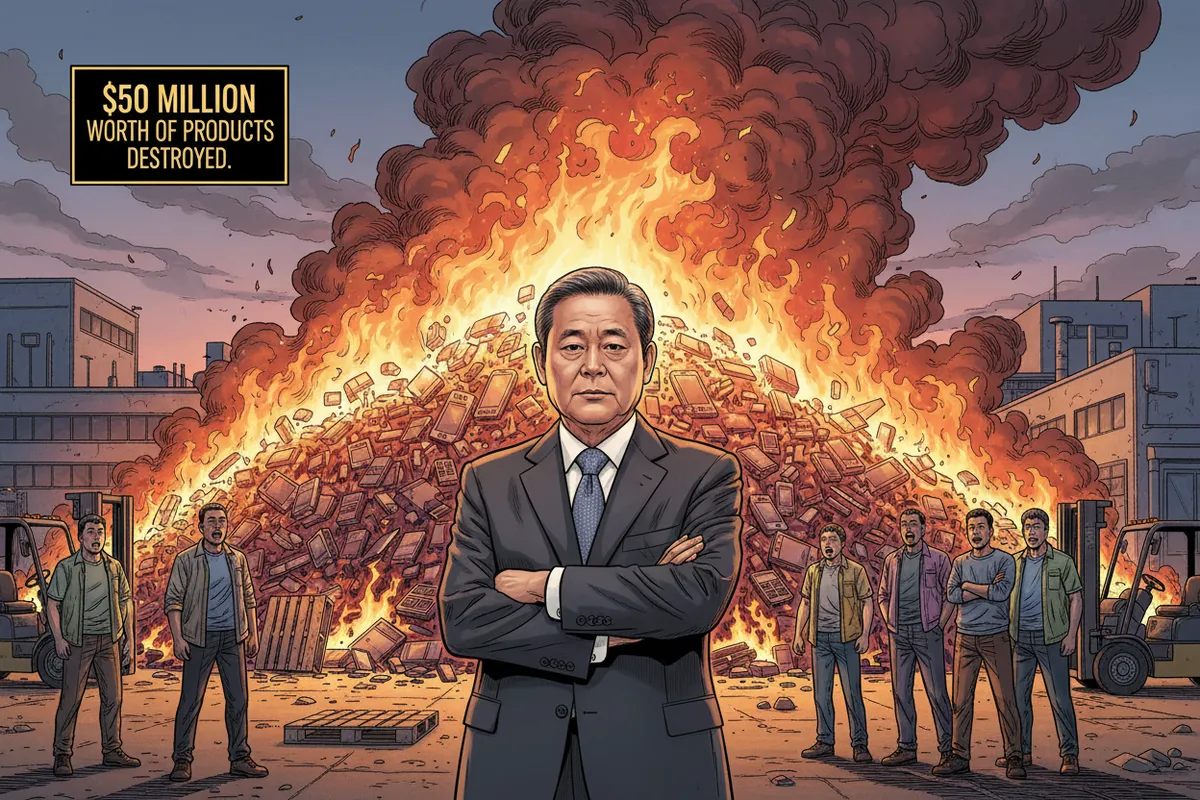
The message was not subtle. Samsung would rather torch $50 million in product than ship a single unit that wasn’t perfect. You want to cut corners? Here’s what corners look like — burning in a parking lot. Employees who were there described it as equal parts traumatic and electrifying. Nobody shipped a defective product out of that factory again. Probably because they were still having nightmares about the bonfire.
That single act transformed Samsung’s culture more effectively than any PowerPoint, any memo, any corporate retreat with trust falls could have. Sometimes you just have to set things on fire.
The “New Management” Initiative
Lee Kun-hee’s transformation program — branded “New Management” — tore into every aspect of how Samsung operated:
Design. Samsung hired designers from around the world, set up design centers in San Francisco, London, Tokyo, and Shanghai, and elevated design from an afterthought to a core function. Products went from ugly utilitarian boxes to sleek objects you actually wanted to own.
Quality. Samsung implemented Six Sigma quality control across all divisions. Defect rates cratered. Within five years, Samsung’s quality ratings matched or beat the Japanese competition. Remember — these were the guys who were literally being given away as freebies five years earlier.
Speed. Samsung restructured its product pipeline to move faster than anyone. Concept to mass production in months, not years. This speed would later prove absolutely decisive in the smartphone wars.
Culture. Lee broke with Korean corporate tradition by promoting based on merit rather than seniority — which, in Korean business culture, was roughly equivalent to setting another bonfire. He recruited aggressively from abroad, paying salaries that made domestic competitors weep.
The Asian Financial Crisis
In 1997, the Asian financial crisis hit South Korea like a freight train. The Korean won lost half its value overnight. Major chaebols — Daewoo, Ssangyong, Halla — went belly-up. The government had to crawl to the IMF for a humiliating $57 billion bailout. Koreans still call it the “IMF Crisis,” and it’s a national trauma.
Samsung was drowning in debt. Several subsidiaries were circling the drain. Lee Kun-hee made brutal calls: he killed unprofitable divisions, sold off non-core businesses, and laid off tens of thousands. Samsung Motors — his personal baby, his prestige project — was sold to Renault at a massive loss. That had to sting.
But here’s the Lee family playbook, passed down from father to son: never waste a crisis. While competitors were retrenching and licking their wounds, Samsung doubled down on display and semiconductor investments. When the recovery came, Samsung was positioned to eat everyone’s lunch. Again.
📱 Chapter 4: The Rise to Global Dominance — Displays, Phones, and the Apple Wars (2000–2014)
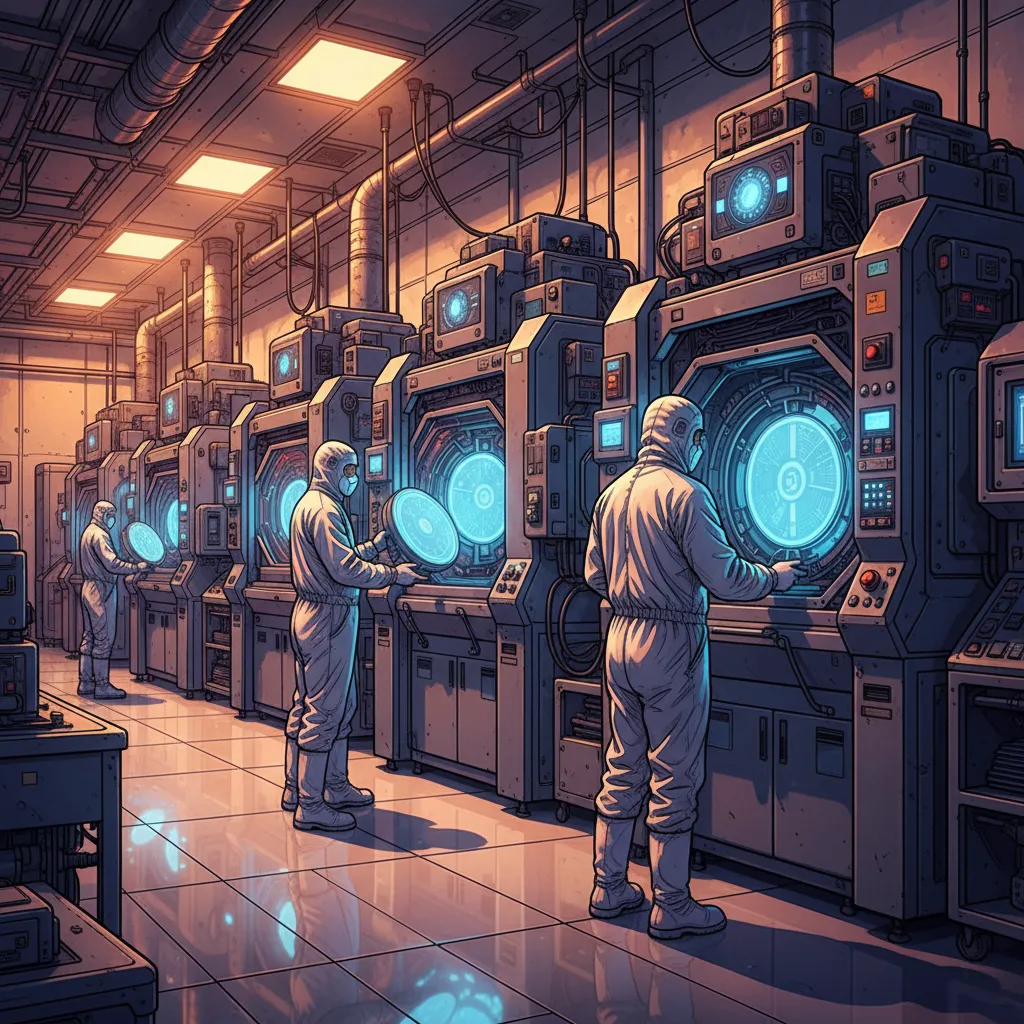
The 2000s were the decade Samsung went from “respected Asian conglomerate” to “global technology behemoth that your daily life literally cannot function without.” Three product categories drove the transformation: flat-panel displays, memory chips, and mobile phones.
The Display Revolution
In the late 1990s, Samsung made a monster bet on flat-panel display technology — LCD first, then OLED. Billions poured into fabrication plants while CRT televisions still dominated. Classic Samsung move: bet huge on the future while everyone else is comfortable in the present.
The bet paid off obscenely well. By the mid-2000s, flat panels had replaced CRTs worldwide, and Samsung was the biggest manufacturer on the planet. Even better — Samsung supplied display panels not just for its own products but for competitors. Including, crucially, Apple.
This created one of the most deliciously bizarre relationships in tech history. Apple and Samsung were simultaneously each other’s biggest customer and fiercest competitor. Apple needed Samsung’s OLED screens for the iPhone because they were simply the best on Earth. Meanwhile, Samsung was building phones to destroy the iPhone. It’s like if Pepsi was secretly manufacturing Coca-Cola’s bottles.
The Smartphone Wars
When Apple dropped the iPhone in 2007, it detonated the entire mobile phone industry. Samsung, like everybody else, got caught flat-footed. But Samsung’s response was faster and more aggressive than anyone expected — because that’s what three decades of “fast follower” DNA will do.
In 2009, Samsung launched the Galaxy S line of Android smartphones. Were they good? Yes. Were they original? Let’s be generous and say “inspired by.” Apple certainly thought “inspired by” was a polite way of saying “copied,” and in April 2011, Apple sued Samsung for patent infringement.
What followed was one of the most epic legal cage matches in corporate history.
Apple vs. Samsung: The Patent War
The battle spanned multiple countries and dragged on for years. In the U.S., Apple won a jury verdict of over $1 billion in 2012 — one of the largest patent verdicts ever. Samsung appealed. The case went to the Supreme Court, which in 2016 sided with Samsung on how design patent damages should be calculated. The final settlement in 2018 was reportedly around $539 million — still a monster number, but less than half the original hit.

The trial was brutal. Internal Samsung documents showed executives explicitly comparing their phones to the iPhone and listing features to copy. Apple’s lawyers presented side-by-side comparisons that were, frankly, devastating. Samsung’s lawyers countered that Apple didn’t invent the rectangular touchscreen phone, which is technically true but also kind of like saying Henry Ford didn’t invent the wheel.
Here’s the beautiful irony, though: the patent war barely slowed Samsung down. While lawyers were billing millions arguing about rounded corners, Samsung’s engineers kept shipping phones. The Galaxy S series improved dramatically with each generation. The Galaxy Note, launched in 2011 with its massive screen and S Pen stylus, created an entirely new product category — the “phablet.” Critics mocked the Note’s ridiculous size. Within two years, every phone manufacturer on Earth was making bigger phones. Samsung had the last laugh.
By 2012, Samsung had overtaken Apple as the world’s largest smartphone manufacturer by volume. The company that had been giving away free TVs in the ’90s was now outselling the iPhone.
The Samsung Ecosystem
Samsung’s real competitive edge wasn’t any single product — it was the fact that Samsung made almost everything inside the product. The company manufactured its own processors (Exynos), its own memory chips, its own display panels, its own camera sensors, and its own batteries. When you bought a Samsung phone, you were basically buying a product that Samsung had built from the silicon up.
This vertical integration meant Samsung could control costs, iterate at terrifying speed, and guarantee supply in ways that competitors relying on third-party suppliers could only dream about. It’s hard to have a supply chain crisis when you are the supply chain.

Samsung’s City: Suwon
Samsung’s scale inside South Korea is almost impossible for outsiders to comprehend. The company’s main campus in Suwon — about 30 kilometers south of Seoul — is essentially its own city. Samsung Digital City houses tens of thousands of employees across massive R&D buildings, manufacturing facilities, and office towers.
But Samsung’s presence in Suwon extends far beyond the campus gates. Samsung-built apartments house employees. Samsung-affiliated hospitals provide healthcare. Samsung-run schools educate employees’ kids. The local economy basically is Samsung.
This pattern repeats across the entire country. Samsung Group employs over 300,000 people in a nation of 52 million. Koreans joke — with a cocktail of pride and existential dread — that you can be born in a Samsung hospital, attend a Samsung school, live in a Samsung apartment, work for Samsung, shop at a Samsung department store, and when you finally die, Samsung Life Insurance handles the paperwork.
It’s not really a joke, though. It’s basically accurate. And that should probably concern someone.
💥 Chapter 5: The Galaxy Note 7 Disaster and the Fall of Lee Kun-hee (2016–2020)

On August 19, 2016, Samsung launched the Galaxy Note 7 to absolutely glowing reviews. Tech reviewers called it the best Android phone ever made — gorgeous design, stunning display, killer camera, beloved S Pen. It was Samsung’s finest hour.
Two weeks later, the phones started exploding.
The Battery Crisis
Reports flooded in from everywhere. Galaxy Note 7 phones were catching fire while charging. In people’s pockets. In their cars. On airplanes. Videos of charred, melted phones went viral. Airlines started banning the Note 7 from flights. Not banning them from use — banning them from being on the plane at all. Flight attendants were making announcements about the Samsung Galaxy Note 7 the way they used to announce emergency exits. The U.S. Federal Aviation Administration issued an emergency order prohibiting passengers from even turning the thing on aboard an aircraft.
Your phone was literally too dangerous to bring on a plane. Try explaining that brand image to the marketing department.
Samsung initially blamed one battery supplier and issued a recall on September 2, 2016, offering to replace all 2.5 million units with phones containing batteries from a different supplier. Problem solved, right?
The replacement phones started exploding too.
On October 11, 2016 — less than two months after launch — Samsung killed the Galaxy Note 7 entirely and recalled every single unit worldwide. It was the most catastrophic product failure in consumer electronics history. A phone so good it might literally set your house on fire.
The financial damage was staggering — Samsung estimated the total cost at approximately $5.3 billion, including recalls, lost sales, and a cratering stock price. But the reputational damage was worse. Samsung’s brand — the brand Lee Kun-hee had spent decades building from bottom-shelf joke to premium global name — was suddenly synonymous with “the phone that explodes.”
The Root Cause
Samsung’s internal investigation revealed something deeply ironic. The problem wasn’t a random defect. It was Samsung’s own relentless drive to be the best. Samsung had been pushing battery suppliers to maximize energy density — cramming more power into a thinner space — to make the Note 7 slimmer than the competition. The batteries were compressed so tightly that the positive and negative electrodes could touch, causing a short circuit and thermal runaway.
In plain English: Samsung made the batteries too big for their casing because they were obsessed with making the phone thinner. The same “change everything” culture Lee Kun-hee had instilled — the culture of pushing past every limit — had pushed past the limit of physics. The Note 7 was the best phone Samsung had ever built, right up until the moment it became an incendiary device.
The Redemption
Credit where it’s due: Samsung’s crisis response was textbook. Full recall, no hedging, no blaming customers for holding it wrong. They established an eight-point battery safety check for all future products and created an independent advisory board. The Galaxy S8, launched in April 2017, was a hit. The Galaxy Note 8 later that year came with aggressive reassurances about battery safety that basically screamed “WE PROMISE THIS ONE WON’T EXPLODE.”

Within 18 months of the worst product disaster in tech history, Samsung was back on top as the world’s leading smartphone maker. That’s either a testament to the quality of their subsequent products or a terrifying commentary on how short our collective memory is. Probably both.
Lee Kun-hee’s Final Years
Lee Kun-hee had been largely absent from Samsung since May 2014, when he suffered a massive heart attack that left him incapacitated. He spent the last six years of his life in a hospital room at Samsung Medical Center — yes, his own company’s hospital — reportedly in a persistent vegetative state.
Despite being essentially unconscious, Lee remained Samsung’s chairman and largest individual shareholder. His son, Lee Jae-yong, gradually assumed control, but formal succession was complicated by the kind of legal issues that only chaebol families seem to generate.
Lee Kun-hee died on October 25, 2020, at 78. His estate was valued at approximately $21 billion, making it the largest inheritance in South Korean history. The inheritance tax bill alone was over $10 billion. Ten billion dollars in taxes. The Lee family had to sell shares and take out loans just to pay the government. Even in death, a Lee makes headlines with the size of the numbers involved.
⚖️ Chapter 6: Lee Jae-yong — The Heir, the Prisoner, and the Pardon (2014–Present)
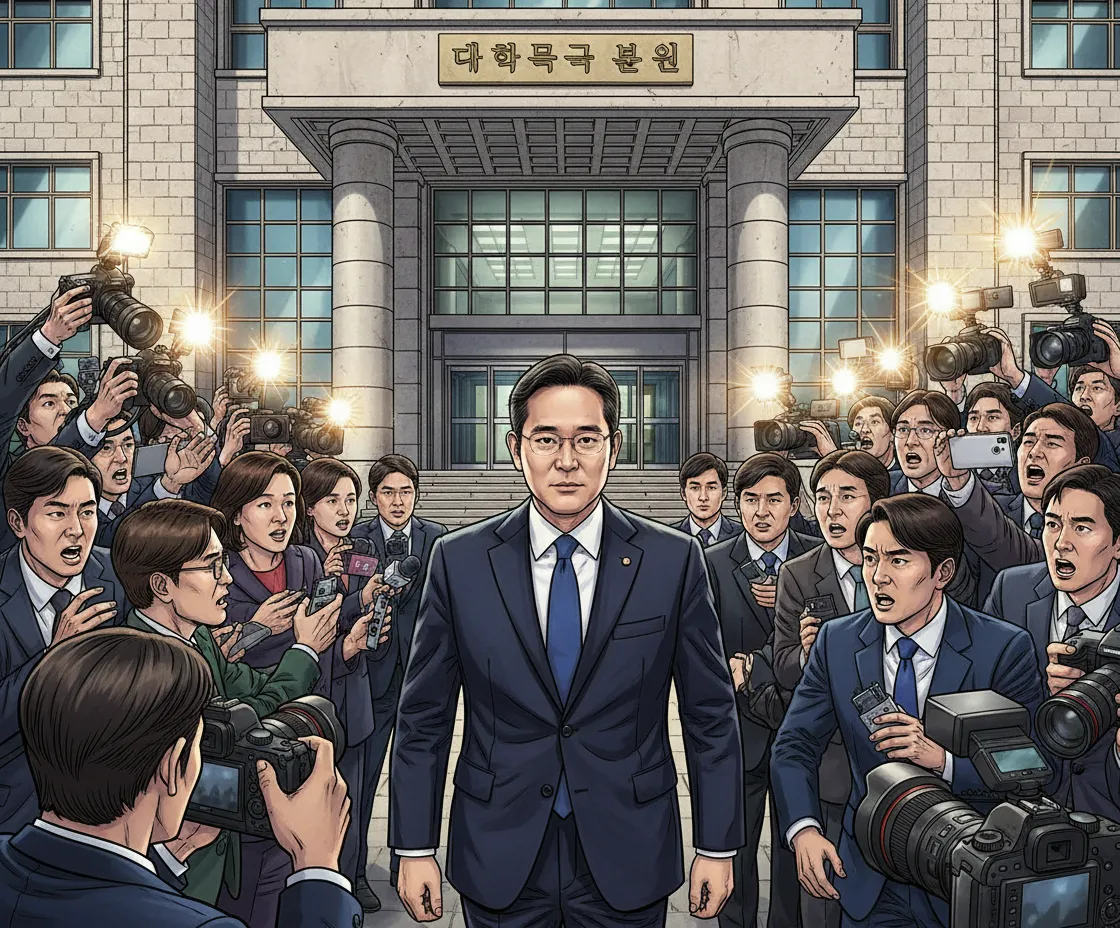
Lee Jae-yong — known internationally as Jay Y. Lee — was born on June 23, 1968. Only son of Lee Kun-hee. Educated at Seoul National University, Keio University in Tokyo, and Harvard Business School. Groomed from birth to lead Samsung. The plan was straightforward: grow up, learn the business, take the throne.
Nobody planned for the “go to prison” part.
The Samsung-Park Geun-hye Scandal
In 2016, South Korea was rocked by the biggest political scandal in its democratic history. President Park Geun-hye was discovered to have allowed a personal confidante — a woman named Choi Soon-sil who held no government position whatsoever — to extort donations from major corporations, influence government policy, and even edit presidential speeches. It was like finding out the president’s psychic was secretly running the country. Because Choi was, in fact, the daughter of a cult leader. You cannot make this stuff up.
Samsung was the biggest donor. According to prosecutors and subsequent court findings, Lee Jae-yong had authorized payments of approximately $36 million to entities linked to Choi Soon-sil, allegedly in exchange for government support for a merger that would tighten the Lee family’s grip on Samsung. Lee was ultimately convicted of bribery — corporate governance repackaged as criminal conduct, in the court’s view.
The scandal brought millions of protesters into the streets of Seoul — the largest demonstrations since the pro-democracy movement of the 1980s. Candlelight vigils. Weeks of massive protests. President Park was impeached and removed from office. And Lee Jae-yong, heir to the Samsung throne, was arrested and charged with bribery, embezzlement, and perjury.
The Trial and Imprisonment
In August 2017, Lee Jae-yong was sentenced to five years in prison. The image of Samsung’s crown prince — immaculately dressed, completely expressionless — being led away in handcuffs became one of the most iconic photographs in Korean history. The man who controlled 20% of the national economy, in handcuffs, heading to a cell.
The sentence was reduced on appeal to two and a half years, then suspended — meaning Lee walked free in February 2018 after serving about a year. But South Korean justice wasn’t done with him. He was re-tried. Re-convicted. Re-sentenced to two and a half years in January 2021. Back to prison. He served 18 months total before being released on parole in August 2021.
The revolving door between the Samsung boardroom and Korean prison started to feel less like justice and more like a particularly dramatic commute.
The Presidential Pardon
On August 15, 2022, South Korean President Yoon Suk-yeol granted Lee Jae-yong a formal presidential pardon. Full civil rights restored, including the right to manage a business — crucial, since Korean law prohibits convicted felons from serving as executives for five years after sentencing.
Critics went ballistic. The pardon demonstrated, they argued, that chaebols are effectively above the law in South Korea. You can bribe a president, go to prison, and get pardoned because the economy needs you too badly. The government’s official justification? Samsung needed “strong leadership” to navigate global semiconductor competition. Translation: we can’t afford to keep our biggest company’s boss in jail.
And you know what? They had a point. When Samsung sneezes, South Korea catches pneumonia. That’s not a defense of corruption — it’s a description of a structural problem nobody knows how to fix.
Here’s the kicker: Lee Jae-yong’s father was also convicted of crimes, also received a presidential pardon, and that pardon was partly so he could serve on the committee organizing the 2018 Winter Olympics. Getting convicted and then pardoned is apparently a Lee family tradition, like a really expensive, really legally complicated bar mitzvah.

Lee Jae-yong’s Samsung
Since his pardon, Lee has moved aggressively to position Samsung for the next era. While observers have noted he may lack his grandfather’s patience and his father’s theatrical charisma, the man does not lack ambition.
Advanced Semiconductors. In 2022, Samsung announced a $200 billion investment plan through 2042 to build new fabrication plants in South Korea and the United States. The centerpiece is a massive new fab in Taylor, Texas. Samsung is locked in a death match with TSMC for dominance in cutting-edge chip manufacturing — particularly the advanced 3-nanometer and 2-nanometer nodes that power the latest AI chips. The stakes are existential.
Artificial Intelligence. Samsung has poured money into AI across its product line, from camera processing on Galaxy phones to smart home integration. More importantly, Samsung’s semiconductor division is a major supplier of high-bandwidth memory chips used in AI training data centers. Doesn’t matter which AI company wins the software wars — they all need Samsung’s chips.
Foldable Phones. Samsung pioneered the foldable smartphone with the Galaxy Fold in 2019 and has iterated aggressively with the Z Flip and Z Fold series. It’s Samsung’s bet that the future of smartphones involves bending in half — a technology Samsung’s display division has been quietly developing for over a decade. Classic Samsung: build the component technology, then build the product around it.
👨👩👧👦 Chapter 7: The Lee Family Dynasty — Power, Wealth, and Succession
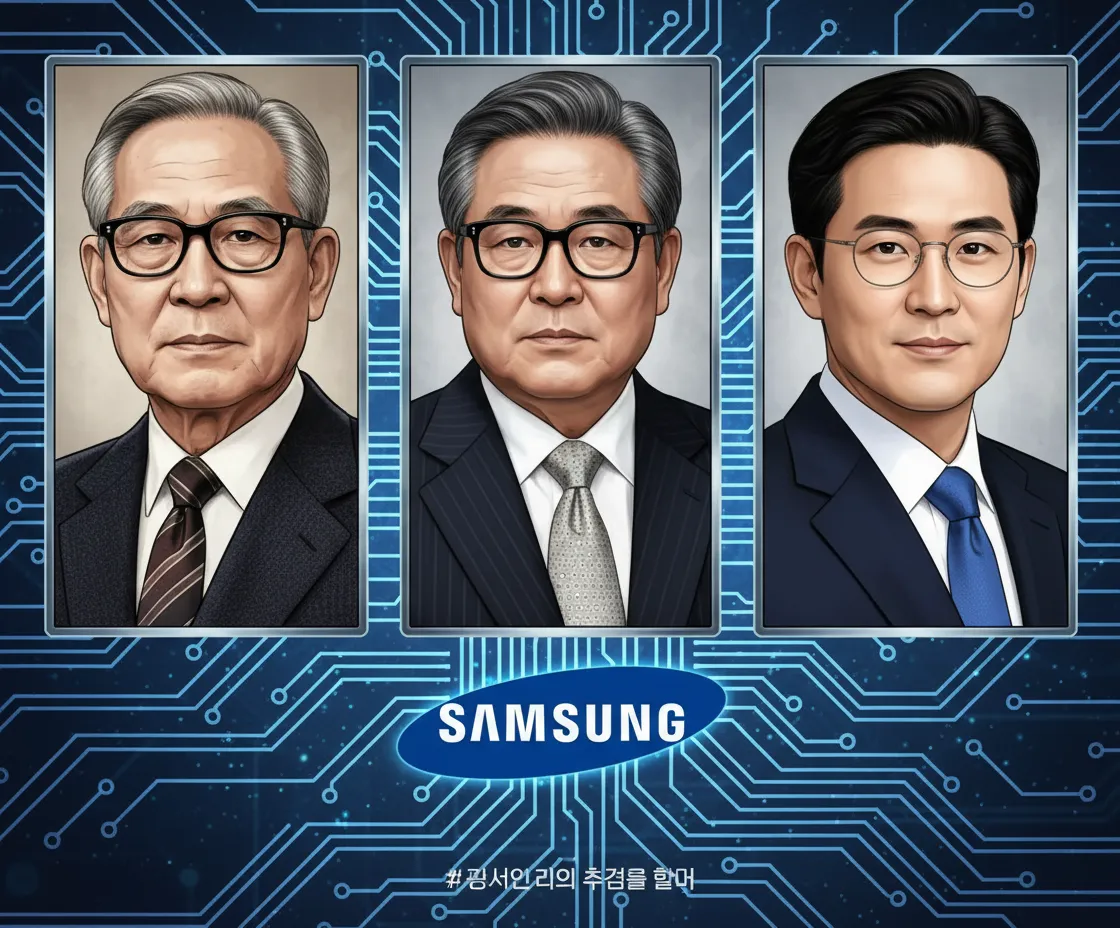
The Lee family’s control of Samsung is one of the most remarkable — and, depending on your perspective, troubling — stories of dynastic power in modern capitalism. Three generations. Nearly ninety years. One family. One empire.
First Generation: Lee Byung-chul (Founder)
Built Samsung from a noodle shop into South Korea’s largest conglomerate. Reserved, methodical, thought in decades. His genius was the semiconductor bet — entering an industry where Samsung had zero experience and turning it into global domination through sheer willpower and counter-cyclical investing.
Also a complicated family man, which is a polite way of saying succession was a bloodbath. Eight children from two marriages. His eldest son, Lee Maeng-hee, was passed over. His second son, Lee Chang-hee, was also passed over — he’d been involved in a saccharin-smuggling scandal in Japan, which is simultaneously a very serious crime and a very funny sentence. The chairmanship went to the third son, Lee Kun-hee.
The siblings who got passed over never forgave, never forgot. The Lee family has been filing lawsuits against each other over shares, inheritance, and influence for decades. Billion-dollar family feuds make regular family feuds look quaint.
Second Generation: Lee Kun-hee (The Transformer)
Took a major Korean conglomerate and turned it into a global technology superpower. Burned $50 million in phones to make a point. Talked for three days straight in Frankfurt. Transformed Samsung’s culture from bargain-bin knockoffs to premium global brand.
His personal life was complicated. In 2008, he was charged with tax evasion and maintaining slush funds. He was convicted and sentenced to a suspended term, then pardoned by President Lee Myung-bak in 2009 — partly so he could sit on the committee organizing South Korea’s Winter Olympics bid. Tax evasion to Olympic committee: the most chaebol career trajectory imaginable.
He was also a world-class art collector. After his death, the family donated roughly 23,000 artworks — Monet, Picasso, Dali, Korean masters — to national museums. Estimated value: over $2 billion. Was this cultural generosity or an inheritance tax play? Yes. It was both. And nobody pretended otherwise.
Third Generation: Lee Jae-yong (The Survivor)
Lee Jae-yong’s leadership has been defined by surviving things that would have destroyed most executives: criminal conviction, prison, public humiliation, and the awkwardness of being pardoned by a president because your company is too big to fail.
He has one older sister, Lee Boo-jin, who runs Hotel Shilla (Samsung’s luxury hotel chain) and has weathered her own messy public divorce scandal. His younger sister, Lee Seo-hyun, heads the Samsung Welfare Foundation. The family presents a united front in public. Media reports and industry insiders have described a different picture — ongoing tensions over money, influence, and who really calls the shots. Standard dynasty stuff. Just with a lot more zeros.
The Ownership Puzzle
How do you control a $500 billion empire with only 1.5% direct ownership? With the most Byzantine corporate structure this side of a Russian nesting doll.
The structure works like this: Lee Jae-yong owns a stake in Samsung C&T (construction and trading), which owns a stake in Samsung Life Insurance, which owns a stake in Samsung Electronics, which owns stakes in other Samsung affiliates. Through this chain of cross-shareholdings — over 60 subsidiaries linked in a web that requires a flowchart and an advanced degree to understand — the Lee family controls the entire conglomerate with a tiny direct equity stake.
Corporate governance advocates have been screaming about this for decades. It lets the family exercise control wildly disproportionate to their actual ownership. Activist investors have tried to break it — most notably Elliott Management, which in 2015 tried to block a merger designed to tighten the Lee family’s grip. Elliott lost, partly because the Korean National Pension Service voted in favor of the merger. That vote was later alleged in court proceedings to have been influenced by President Park Geun-hye’s administration — as part of the bribery scandal that led to Lee Jae-yong’s conviction and imprisonment.
It’s a governance structure that critics describe as ripe for abuse at every level. And somehow the empire keeps growing.
🌏 Chapter 8: Samsung’s Impact on South Korea and the World

Samsung’s influence goes so far beyond consumer electronics that calling it a “tech company” is like calling the Roman Empire “a local government.”
The 20% Economy
Samsung Group’s combined revenue routinely exceeds $230 billion annually — roughly 20% of South Korea’s entire GDP. To put that in perspective, imagine if a single American company generated $5 trillion in revenue. That’s how dominant Samsung is in the Korean context.
Koreans call their country the “Republic of Samsung.” Sometimes it’s said with pride. Sometimes with something closer to horror. Samsung’s success lifted millions of Koreans into the middle class, funded world-class universities, and turned South Korea into a technology superpower. But it also created an economy dangerously dependent on a single family-controlled conglomerate. When Samsung’s stock drops, the Korean won weakens. When Samsung announces layoffs, the national mood darkens. That’s not a healthy relationship. That’s codependency.
Samsung’s Secret Weapon: The “Fast Follower” Strategy
Samsung has almost never been first to market with anything. Apple invented the modern smartphone. Sony pioneered consumer electronics. Intel created the microprocessor architecture. Samsung didn’t invent any of those things. What Samsung did was enter the market second and then systematically obliterate the first movers through superior manufacturing, relentless iteration, and massive scale.
This “fast follower” strategy works because Samsung controls so much of the supply chain. When a new technology emerges, Samsung can manufacture the components, build the final product, and scale production faster and cheaper than competitors who depend on third-party suppliers. It’s not sexy. There’s no famous keynote. No turtleneck. But it works.
The result: Samsung became the default manufacturer for much of the tech industry. Even companies that compete with Samsung’s consumer products — Apple, Google, Qualcomm — depend on Samsung’s foundry, display, and memory divisions. Your iPhone runs on Samsung memory. Let that irony marinate.
Beyond Electronics
Most people know Samsung for phones and TVs. They have no idea how deep the rabbit hole goes.
Samsung Heavy Industries is one of the world’s largest shipbuilders. Container ships, offshore drilling platforms — if it floats and it’s enormous, Samsung might have built it.
Samsung Engineering builds petrochemical plants, power stations, and infrastructure across the Middle East, Southeast Asia, and Africa. Samsung C&T constructed the Burj Khalifa in Dubai. Yes. The tallest building on Earth. Samsung built it.
Samsung Life Insurance is the largest life insurer in South Korea.
Samsung Medical Center is one of the top-ranked hospitals in Asia. It’s where Lee Kun-hee spent his final six years. Born in Samsung, die in Samsung.
Samsung Everland (now Everland Resort) is South Korea’s largest theme park. Because apparently they also want to compete with Disney.
Samsung SDI manufactures electric vehicle batteries for BMW, Ford, and other automakers.
The breadth is almost absurd. The Lee family’s decisions ripple through global construction, shipping, healthcare, finance, energy, and entertainment. It’s not a company. It’s a civilization.
🔮 Chapter 9: The Future — AI, Chips, and the Next Frontier
Samsung faces its most brutal competitive landscape in decades. The semiconductor industry is being reshaped by AI demand and geopolitics. The smartphone market is maturing. Chinese competitors are gaining ground fast. And for the first time in a long time, Samsung’s dominance isn’t guaranteed.
The TSMC Challenge
Samsung’s most dangerous rival is TSMC — Taiwan Semiconductor Manufacturing Company. In the foundry business — manufacturing chips designed by other companies — TSMC has pulled ahead in both technology and market share. Apple, Qualcomm, Nvidia, and most other major chip designers use TSMC for their most advanced chips. Samsung’s foundry division has been plagued by yield problems (the percentage of chips that actually work off the production line), and key customers have defected.
Lee Jae-yong has made closing the gap with TSMC a top priority, throwing hundreds of billions at new fab technology. But catching TSMC is like chasing a car that’s accelerating — you have to run faster just to not fall further behind. Some analysts question whether Samsung can do it.
The AI Opportunity
The explosive growth of artificial intelligence has created monstrous demand for Samsung’s memory chips. Training large language models and running AI inference requires vast amounts of high-bandwidth memory, and Samsung is one of only three companies on Earth (alongside SK Hynix and Micron) capable of manufacturing it at scale.
Samsung has also bet big on on-device AI — processing AI tasks directly on your phone instead of in the cloud. Galaxy AI features represent Samsung’s wager that AI will be the next major differentiator in consumer electronics. Whether consumers actually care about AI on their phone or just want better battery life remains an open question.
Looking Ahead
Samsung’s history says it will adapt. This is a company that has survived Japanese colonialism, the Korean War, military dictatorships, financial crises, a president it helped bribe getting impeached, phones that literally exploded, and the imprisonment of its leader. Each time, it came back stronger. The cockroach of conglomerates. You cannot kill this thing.
But the next decade will test whether the Samsung model — family-controlled, vertically integrated, aggressive fast-follower — still works in an era of rapid technological disruption, geopolitical fragmentation, and intensifying competition from both Western and Chinese rivals. The model has worked for nearly ninety years. Whether it works for ninety more is the billion-dollar question. Well. The five-hundred-billion-dollar question.
📖 Chapter 10: The Lesson

Samsung’s story blows up several things conventional business wisdom holds sacred.
You don’t need to be first. Samsung entered memory chips decades after Intel. Smartphones years after Apple. Flat-panel displays after Japanese pioneers. In every case, it won — not by being first, but by being better at manufacturing and scaling than everyone else in the room. First-mover advantage is overrated. Last-mover dominance is underrated.
Culture change requires spectacle. Lee Kun-hee didn’t transform Samsung with an all-hands email. He burned $50 million worth of phones in front of 2,000 employees. He screamed for three days in a Frankfurt hotel. He fired anyone who resisted. Transformation doesn’t happen through memos. It happens through acts so dramatic that nobody can pretend they didn’t see them.
Dynasties are cockroaches. The Lee family has controlled Samsung across three generations, through wars, financial crises, and criminal convictions. Family-controlled businesses get dismissed as primitive or corrupt. Samsung’s history suggests they can also be extraordinarily durable — because a family that owns the company can think in decades, absorb the hit of a prison sentence, get pardoned, and keep going. Try doing that as a hired CEO.
Empires aren’t built on genius alone — they’re built on execution and endurance. Samsung has never had a Steve Jobs or an Elon Musk — a singular visionary who captures the public imagination. What it’s had is three generations of disciplined, strategic, sometimes ruthless, occasionally imprisoned leaders who understood that the real competition isn’t about who has the best idea. It’s about who can build the best factory, hire the best engineers, survive the worst crisis, and outlast everyone else.
From dried fish and noodles in 1938 to $500 billion in revenue, the most advanced semiconductor fabs on Earth, and a family dynasty that treats prison sentences like speed bumps — that’s the Samsung story. And the Lees are still writing it.
That’s an empire.
📅 Timeline
| Year | Event |
|---|---|
| 1910 | Lee Byung-chul born in Uiryeong, Korea |
| 1938 | Samsung founded as a trading company in Daegu |
| 1950-53 | Korean War devastates the peninsula; Samsung rebuilds |
| 1953 | Samsung enters sugar refining and textiles |
| 1969 | Samsung Electronics founded |
| 1974 | Samsung acquires Korea Semiconductor (50% stake) |
| 1983 | Samsung enters the DRAM memory chip business |
| 1987 | Lee Byung-chul dies; Lee Kun-hee becomes chairman |
| 1992 | Samsung becomes world’s largest DRAM manufacturer |
| 1993 | Lee Kun-hee delivers the “Frankfurt Declaration” — “Change everything” |
| 1995 | The phone-burning incident — $50M in defective phones destroyed |
| 1997 | Asian Financial Crisis; Samsung restructures brutally |
| 2007 | Apple launches iPhone; smartphone era begins |
| 2009 | Samsung launches Galaxy S line of Android smartphones |
| 2010 | Samsung becomes world’s largest technology company by revenue |
| 2011 | Apple sues Samsung for patent infringement |
| 2012 | Samsung overtakes Apple as world’s largest smartphone maker |
| 2014 | Lee Kun-hee suffers heart attack; Lee Jae-yong assumes de facto control |
| 2016 | Galaxy Note 7 battery explosion crisis; full product recall |
| 2016 | Samsung-Park Geun-hye bribery scandal breaks |
| 2017 | Lee Jae-yong arrested and sentenced to prison |
| 2019 | Samsung launches first foldable phone (Galaxy Fold) |
| 2020 | Lee Kun-hee dies at age 78; $10B+ inheritance tax bill |
| 2022 | Lee Jae-yong receives presidential pardon |
| 2022 | Samsung announces $200B semiconductor investment plan |
| 2024 | Samsung Taylor, Texas fab begins operations |
| 2026 | Samsung remains world’s largest memory chip and smartphone maker |
💡 Key Insights
- ▸ Samsung's secret: they didn't invent — they perfected. They entered every market second and beat the first movers through relentless execution. The DRAM chips, the flat-panel displays, the smartphones — Samsung was never first. They were just better at scaling.
- ▸ The Lee family controlled Samsung through a complex web of cross-shareholdings, proving that power structures matter as much as products. With only about 1.5% direct ownership of Samsung Electronics, the Lee family wielded near-total control through a labyrinth of 60+ subsidiaries.
- ▸ Samsung survived a financial crisis, a presidential scandal, family succession battles, and a literal exploding phone crisis. Resilience is the ultimate competitive advantage — but in Samsung's case, so is being too big for South Korea to let fail.
- ▸ The chaebol system is a double-edged sword. It gave South Korea the fastest industrialization in human history, lifting the country from African-level poverty to G20 status in one generation. But it also created family empires with near-feudal power over the national economy.
- ▸ Lee Kun-hee's 'New Management' philosophy proved that culture change must start with destruction. By literally burning defective products and tearing apart Samsung's internal hierarchy, he demonstrated that transformation requires visible, dramatic acts — not just memos.