Sundar Pichai: From Product Leader to CEO of Google and Alphabet
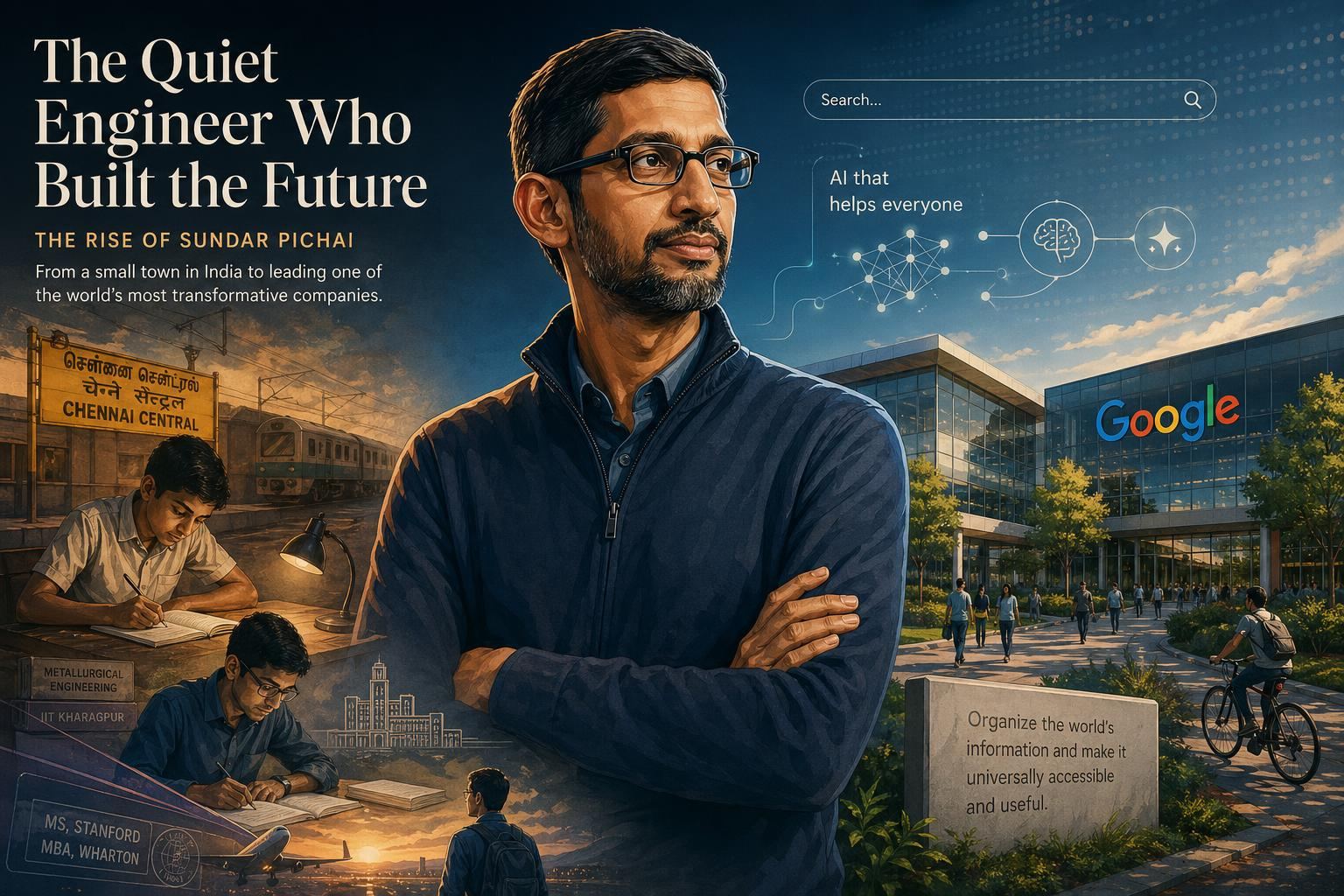
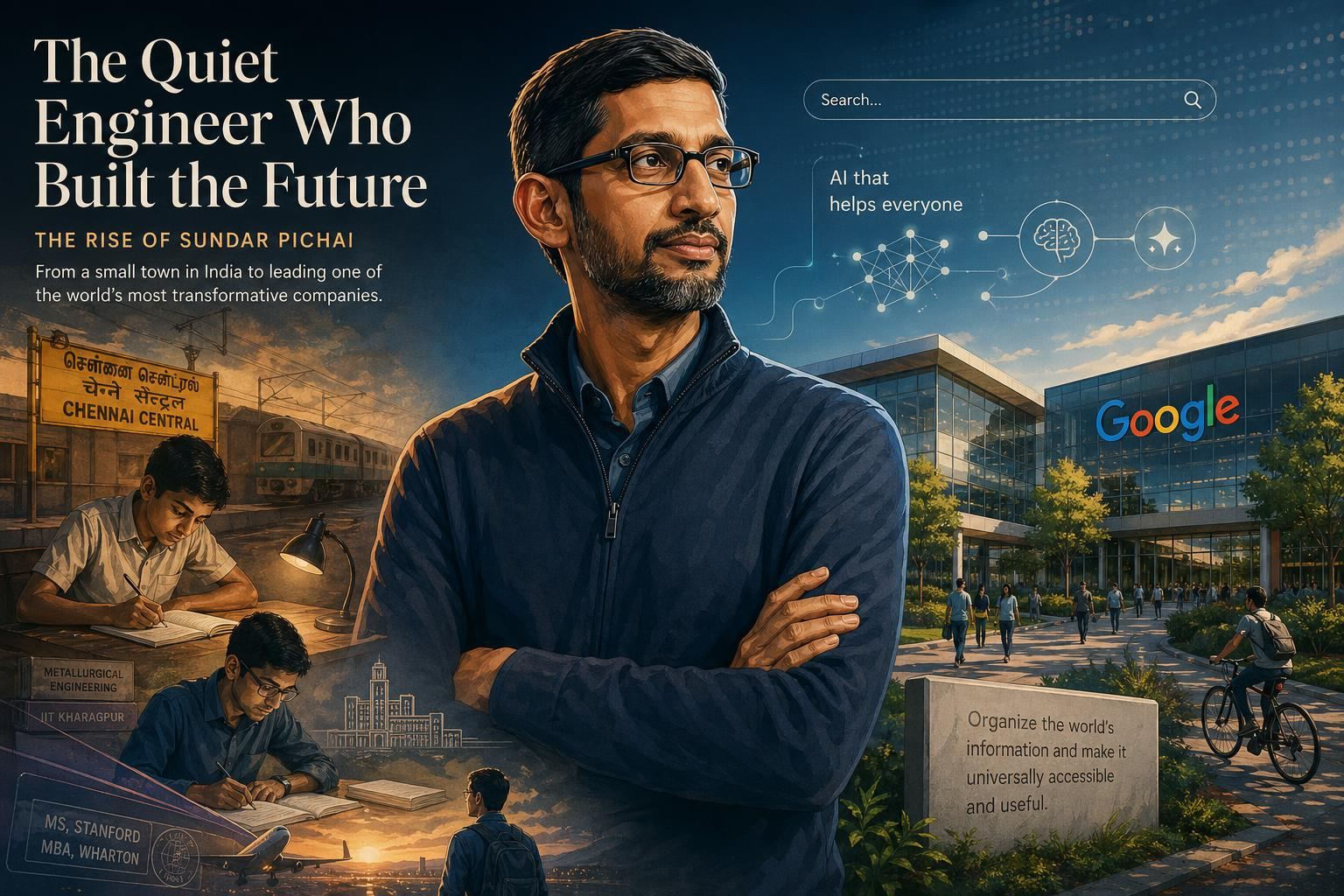
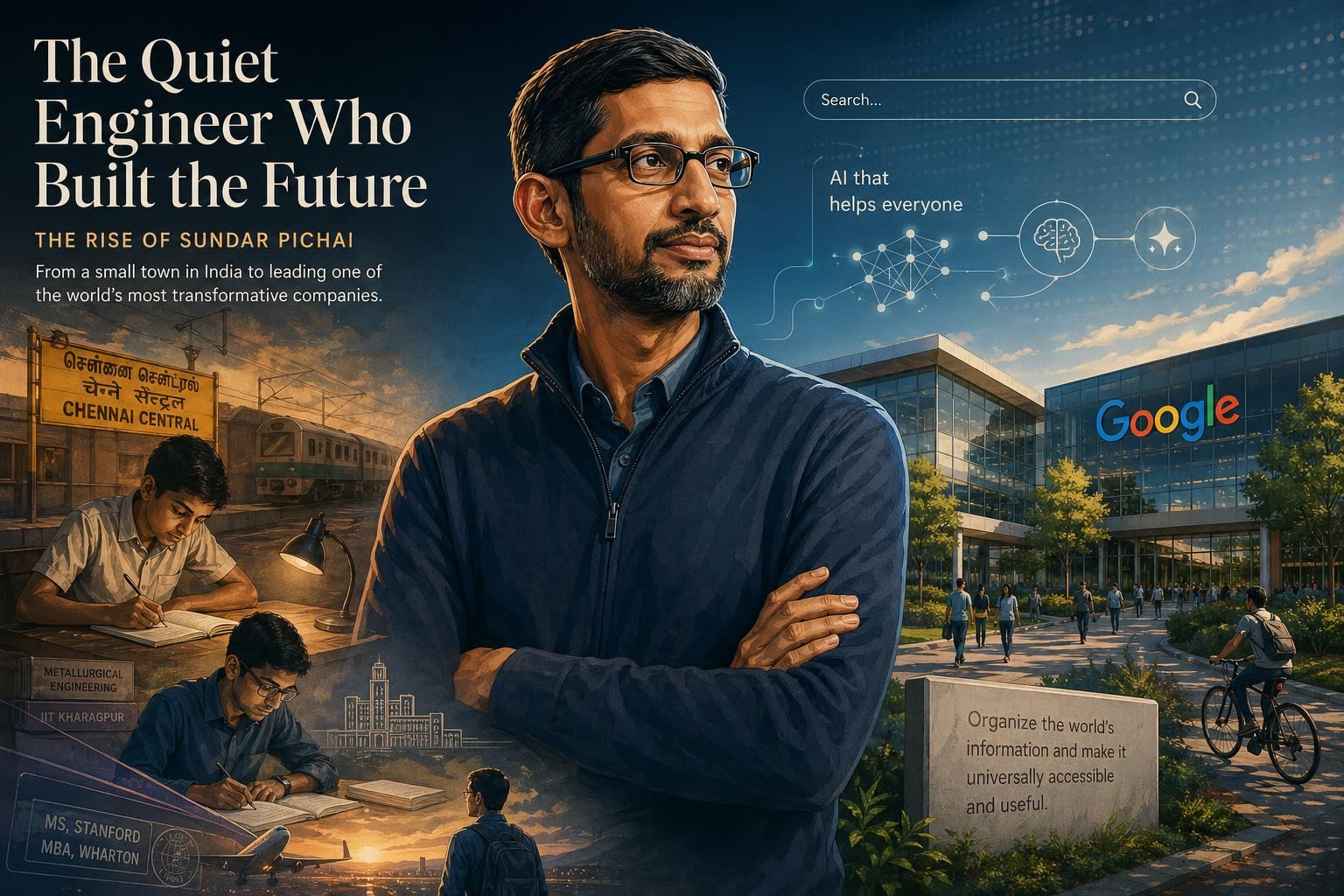
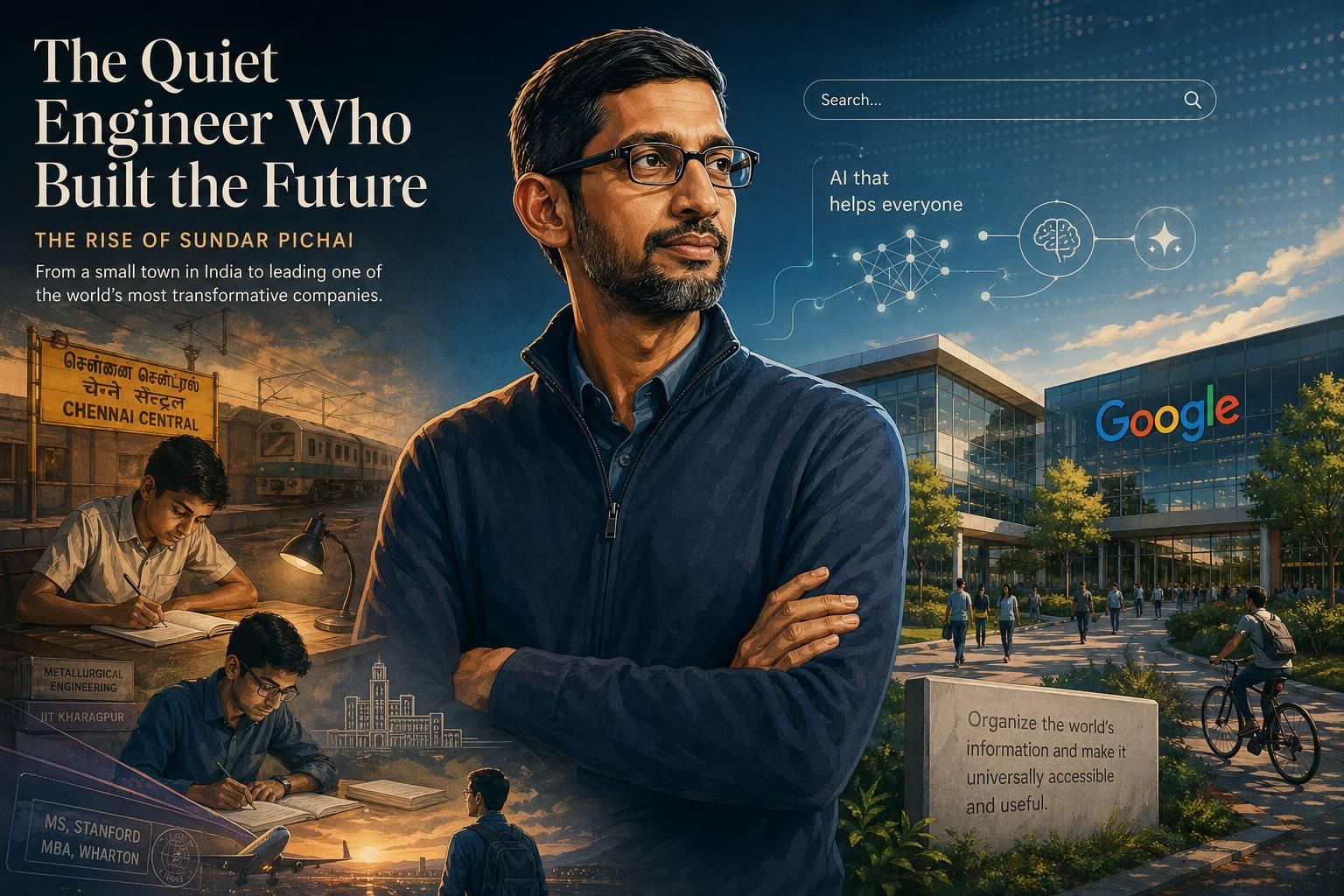
He grew up sleeping on the living room floor in Chennai, memorizing phone numbers because his family couldn't afford a phonebook. Thirty years later, he runs the company that organizes the world's information.

View all stories about this mogul
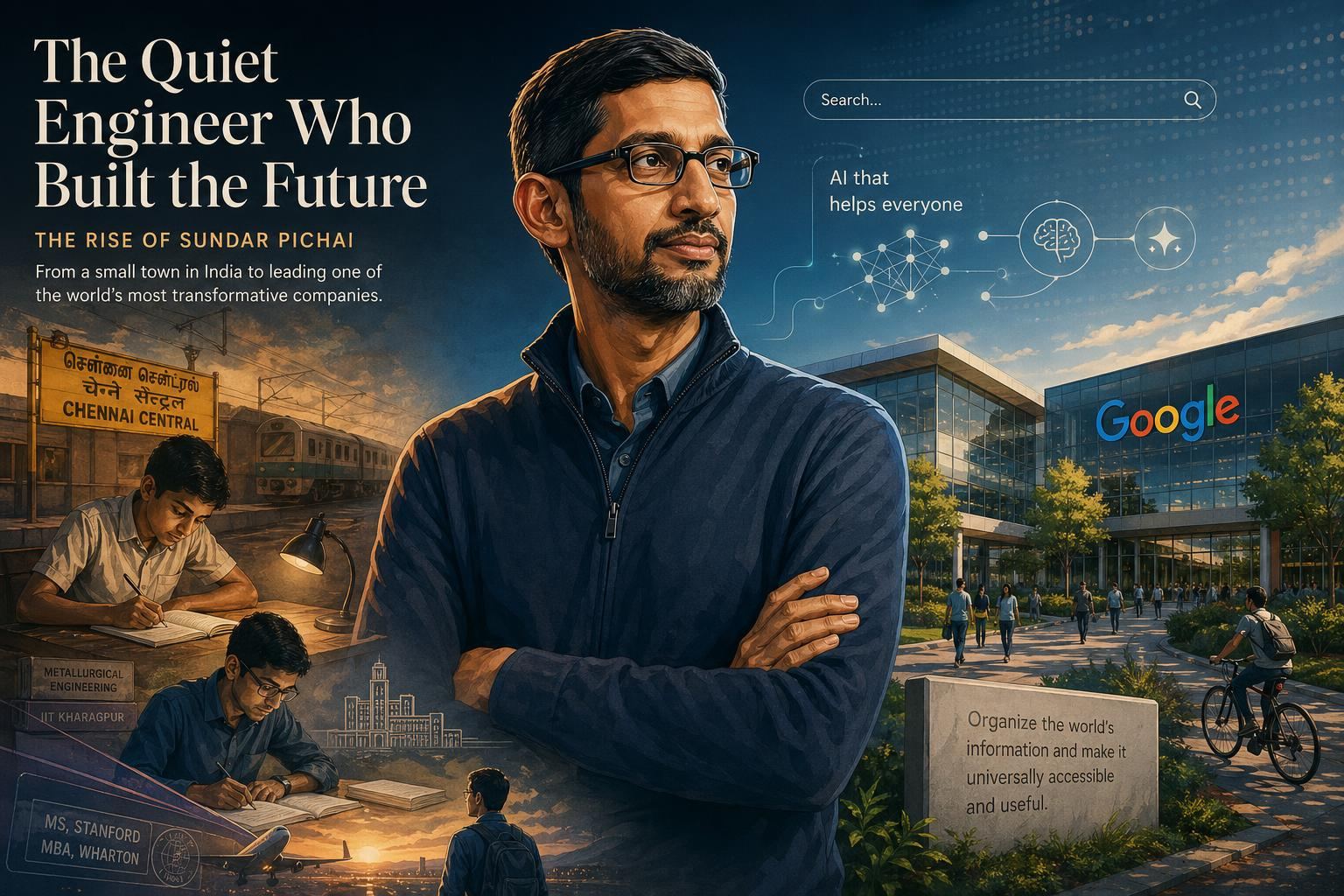
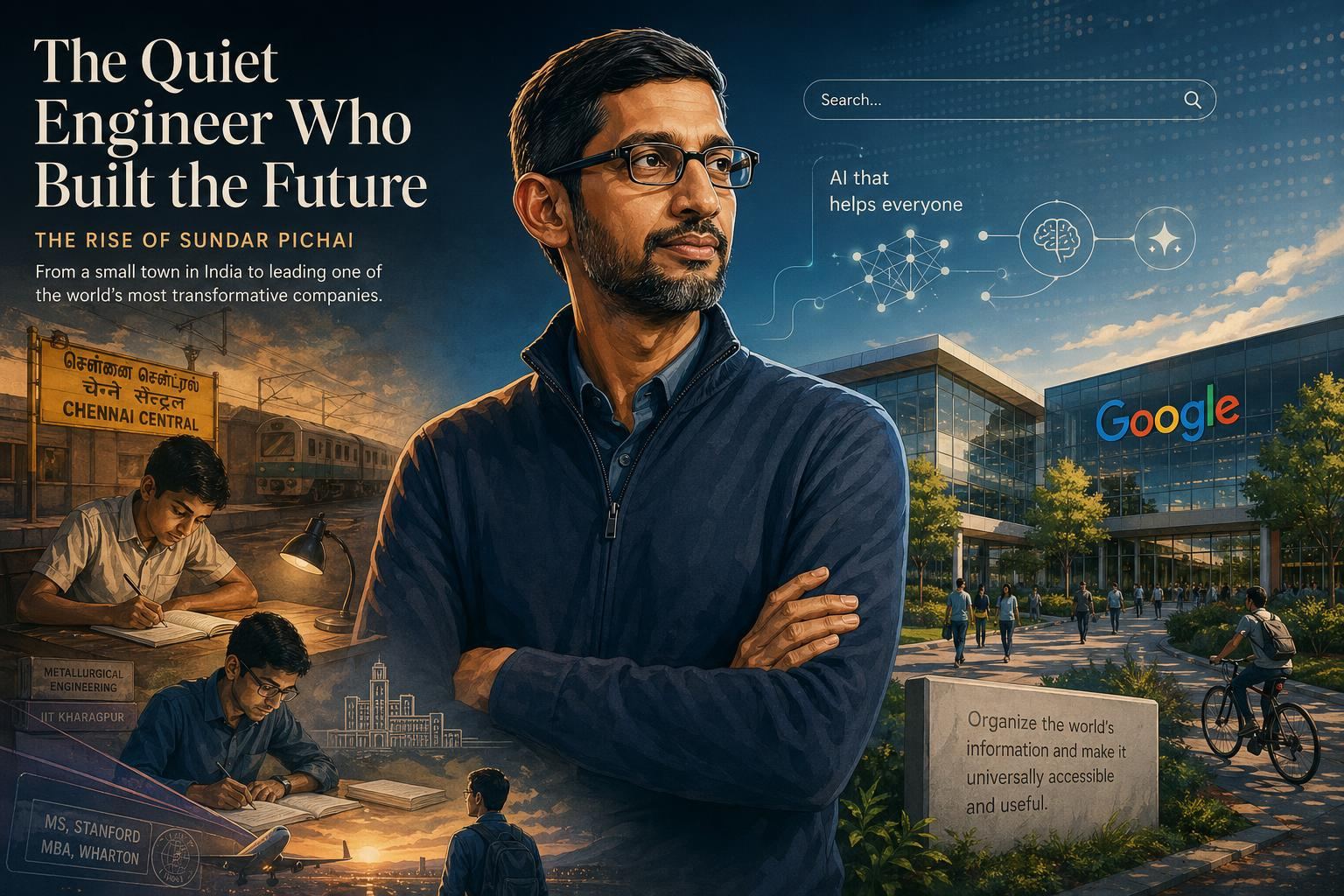
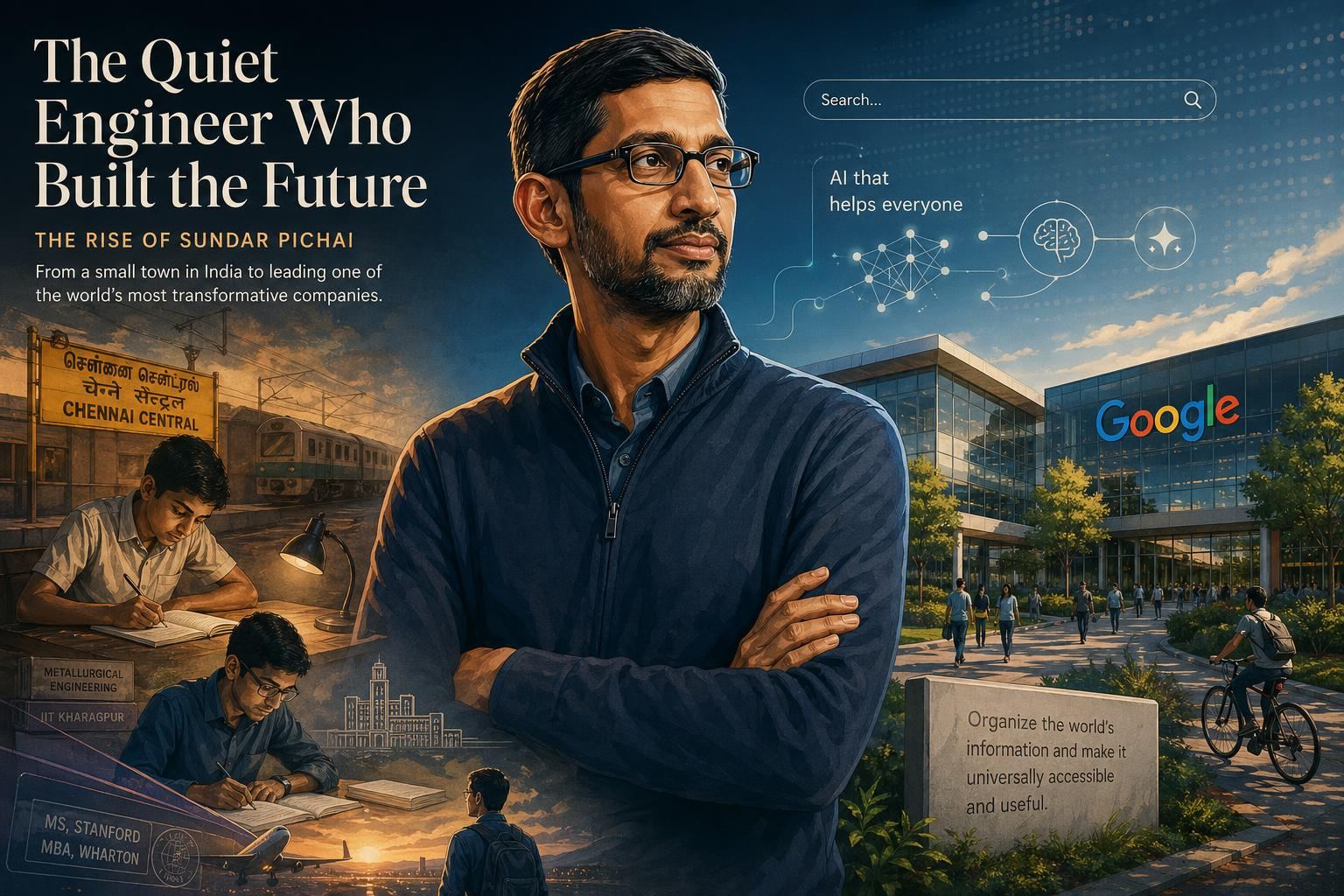
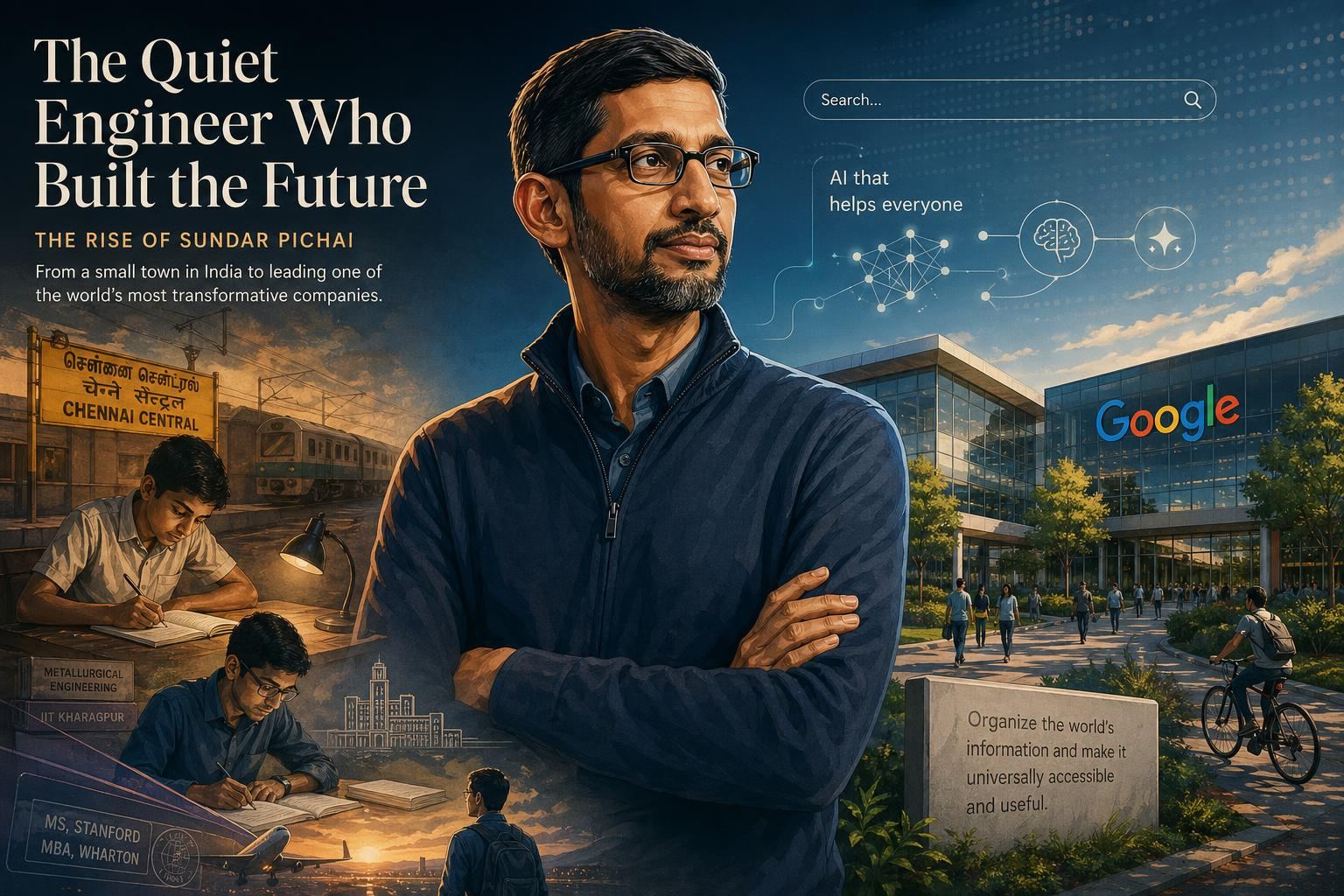
In a two-room apartment in Chennai in the 1970s, a quiet boy named Pichai Sundararajan slept on the living room floor. His family didn’t own a refrigerator until he was twelve. They didn’t own a telephone until he was in high school. When the rotary phone finally arrived, Sundar discovered a strange talent: he could memorize every number anyone ever dialed in his presence and recall them years later.
It was an unremarkable superpower in a city of millions. But it hinted at something his teachers and later his colleagues would all notice — an almost inhuman capacity to absorb information, organize it, and retrieve it without friction. It was, in retrospect, the perfect biological operating system for someone who would one day run the largest information-retrieval company on Earth.
Three decades later, that boy would sit in a glass conference room in Mountain View and become CEO of Google — and then, CEO of Alphabet, a trillion-dollar holding company controlling search, YouTube, Android, Chrome, Waymo, DeepMind, and a dozen other businesses that shape how humans experience the internet. He got there without burning anyone, without tweeting recklessly, and without ever raising his voice in a meeting.
This is the story of how the quietest man in Silicon Valley became its most powerful executive.
📱 Chapter 1: A Boy Who Memorized Phone Numbers
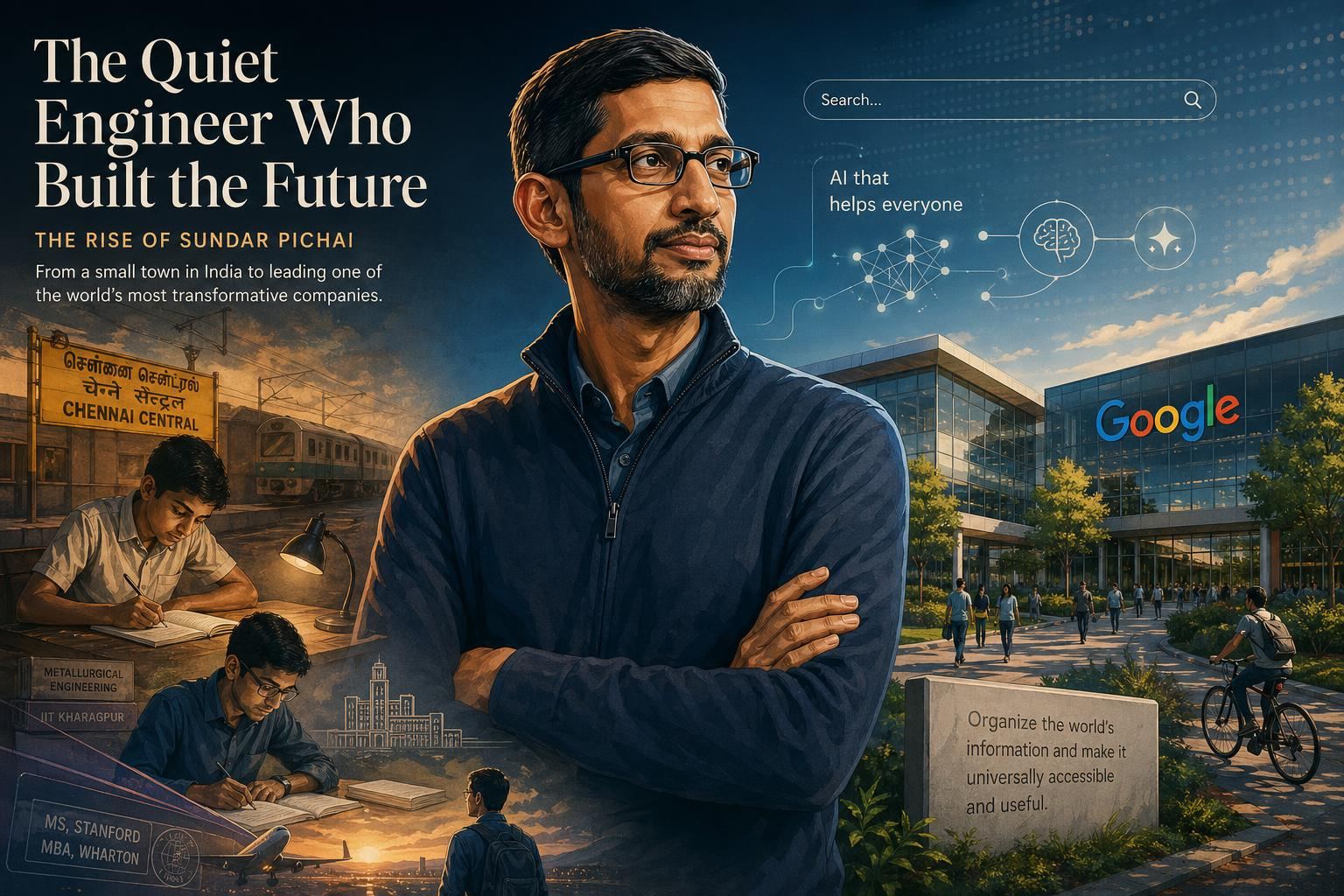
Sundar Pichai was born on June 10, 1972, in Madurai, Tamil Nadu, and raised in Chennai. His father, Regunatha Pichai, was an electrical engineer at the British conglomerate GEC; his mother, Lakshmi, was a stenographer before becoming a full-time parent. Money was tight. The family shared a small apartment with Sundar’s younger brother, and the kitchen doubled as a study room.
When the family finally saved enough to install a landline, Sundar was already a teenager. Relatives would call the apartment and recite phone numbers they needed. Sundar would listen once and remember them forever. Friends tested him with dozens of numbers at a time. He never missed one.
His father often brought home stories from work about circuit boards, failure rates, and the logic of engineering systems. Sundar listened carefully. Years later, he would tell interviewers that his earliest memory of “technology” wasn’t a gadget — it was the week his father explained how a rotary phone worked by drawing diagrams on the back of a newspaper.
That quiet curiosity, combined with an extraordinary memory and a family culture of grinding effort, would carry him out of Chennai and into the world.
🎓 Chapter 2: IIT, Stanford, and a Plane Ticket He Couldn’t Afford
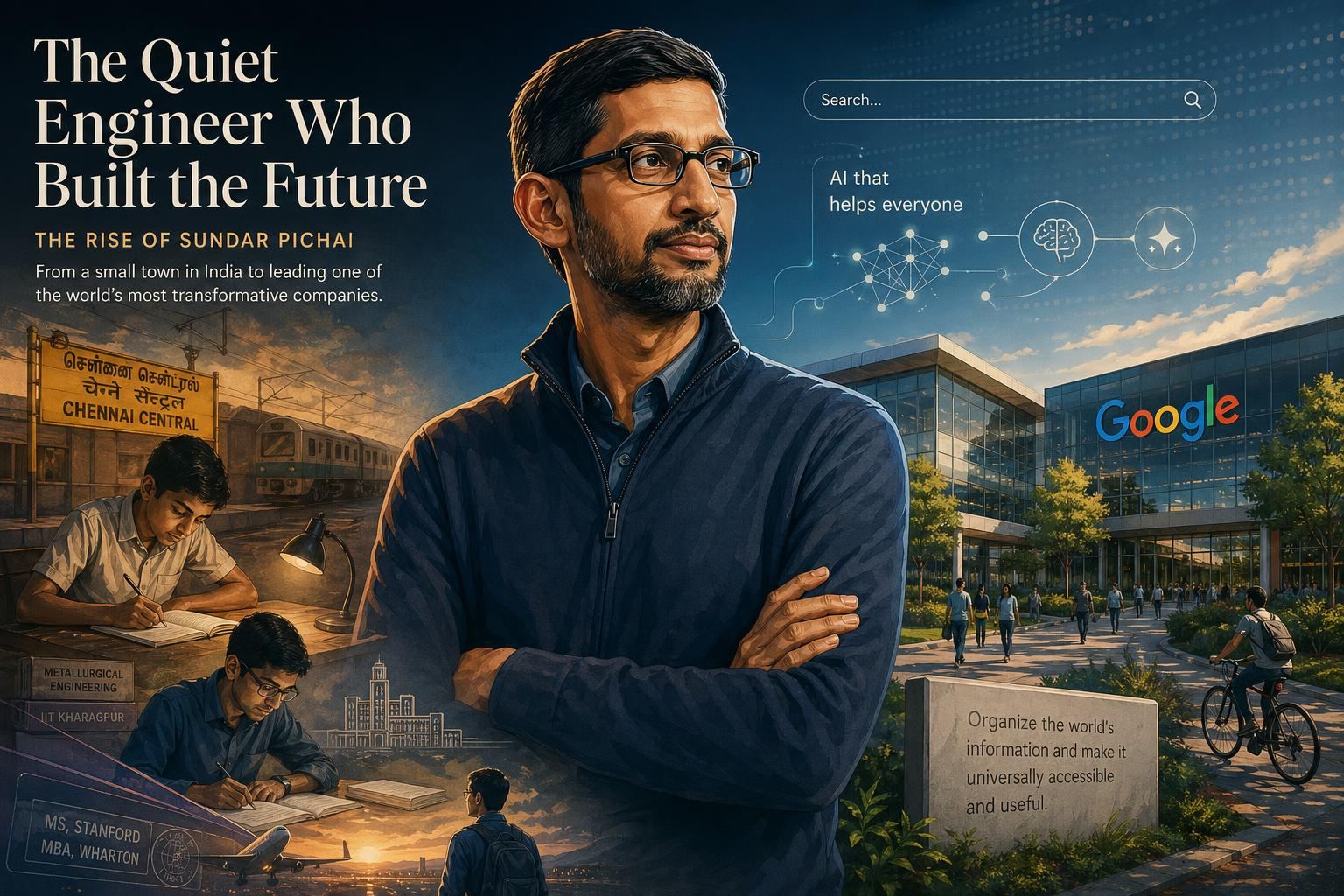
Pichai earned a place at the Indian Institute of Technology, Kharagpur — one of the most competitive engineering programs in the world — where he studied metallurgical engineering. He graduated at the top of his class and won a silver medal.
Then Stanford University offered him a scholarship for a master’s degree in materials science. It was the opportunity of a lifetime. But the plane ticket to California cost more than his father’s annual salary. Regunatha Pichai took out a loan, emptied the family’s savings, and put his son on the plane.
Sundar arrived at Stanford in 1993 with a single suitcase. The first thing he noticed was the price of a backpack at the campus bookstore: sixty dollars. “I thought it was crazy,” he later recalled. “Back home, that was more than my father made in a week.”
He finished his master’s at Stanford, then enrolled at the Wharton School for an MBA, graduating as a Siebel Scholar and Palmer Scholar. After a brief stint at McKinsey and before that at Applied Materials, he joined Google in April 2004 — the same month Gmail launched — as a product manager. He was 31 years old.
He would not leave.
🧭 Chapter 3: The Toolbar That Nobody Wanted
Pichai’s first major assignment at Google was one of the least glamorous projects in the company: the Google Toolbar. It was a small plug-in that sat inside Internet Explorer and Firefox, giving users a quicker way to search Google without typing a URL.
Most Googlers considered it a dead-end product. Who wanted to install yet another browser add-on? But Pichai saw something his peers missed. Microsoft, he warned, could at any moment flip a switch in Internet Explorer and redirect default searches away from Google — and billions of dollars in ad revenue would evaporate overnight.
He fought to make the Toolbar get pre-installed on computers sold with other software. He negotiated distribution deals with OEMs. He pushed engineers to ship faster. The Toolbar became the first line of defense for Google’s search monopoly against Microsoft’s attacks.
Larry Page and Sergey Brin noticed. The quiet product manager who had inherited an unloved project had turned it into a strategic moat. It was the first time anyone at Google whispered the word “CEO material” next to Sundar Pichai’s name.
🌐 Chapter 4: Chrome Against the World
In 2006, Pichai began championing an idea most Google executives initially rejected: Google should build its own web browser. Sergey Brin and Eric Schmidt worried it was a distraction. Microsoft had 80% market share with Internet Explorer. Firefox was growing. The browser wars seemed settled.
Pichai disagreed. He argued that the browser was the most strategic piece of software in the world — the layer between Google and every user. If Microsoft ever decided to cripple Google on IE, the company was finished. Google needed its own browser, and it needed to be so fast and simple that people would download it voluntarily.
He assembled a small team. He recruited engineers from Firefox. He insisted on a minimalist design — no toolbars, no clutter, nothing between the user and the web. On September 2, 2008, Google Chrome launched.
Within four years, Chrome overtook Internet Explorer to become the world’s most popular browser. By 2020, it held over 65% global market share. Every click on Chrome was a click inside Google’s ecosystem. Pichai had built the single most important defensive moat in the company’s history.
He was no longer a quiet product manager. He was the man who won the browser war.
📱 Chapter 5: Inheriting Android
In March 2013, Andy Rubin — the mercurial creator of Android — stepped down from running the mobile operating system. Larry Page handed Android to Sundar Pichai.
It was a poisoned chalice. Android was growing explosively but was plagued by fragmentation, carrier disputes, and tensions with device makers like Samsung. Rubin’s combative style had burned bridges across the industry.
Pichai approached it the opposite way. He flew to Seoul to meet Samsung executives personally. He negotiated. He listened. He smoothed over years of grievances. He slowed down risky bets and focused on stabilizing the platform.
Under his watch, Android’s global market share climbed above 80%. Google Play became one of the largest software distribution businesses in history. The fragmentation complaints quieted down. The relationship with Samsung — Android’s largest OEM by far — shifted from adversarial to cooperative.
By the end of 2014, Pichai effectively controlled Search, Chrome, Android, Gmail, Google Maps, Google Play, and the commercial products used by billions of people. No executive at Google — including the co-founders — had more operational responsibility. The question inside the company was no longer whether he would become CEO, but when.
🏛️ Chapter 6: The Alphabet Restructuring
On August 10, 2015, Larry Page published a blog post that stunned the technology industry. Google was being reorganized under a new parent holding company called Alphabet. Page would become CEO of Alphabet. Brin would become President. And the operating entity called Google — the core ad business, Search, YouTube, Chrome, Android, Maps — would be led by a new CEO: Sundar Pichai.
It was the biggest corporate restructuring in Silicon Valley history. The founders were stepping back from day-to-day operations of the cash cow to focus on “moonshots” like self-driving cars, life sciences, and internet balloons. Pichai would run the business that made the money.
The announcement was characteristically Pichai-shaped: no press tour, no magazine cover, no victory lap. He tweeted a short note of thanks. He went back to work. He held his next product meeting that afternoon.
For the first time, a non-founder was running Google. The boy from Chennai who had arrived at Stanford with a single suitcase was now in charge of one of the most valuable companies on Earth.
⚔️ Chapter 7: Employee Revolts and the Walkout
The easy years didn’t last. Starting in 2018, Pichai faced a wave of employee activism that threatened to redefine Google’s internal culture.
First came Project Maven — a Pentagon contract to build AI tools for drone video analysis. Thousands of employees signed a letter demanding Google cancel the project. Pichai complied. Then came the James Damore memo, a controversial document about gender in tech that split the company. Then came a walkout on November 1, 2018, when 20,000 Google employees in offices around the world marched out to protest the company’s handling of sexual harassment allegations — particularly the revelation that Andy Rubin had been given a $90 million exit package after credible misconduct claims.
Pichai stood in front of the company the next day and apologized. He implemented new policies ending forced arbitration for harassment claims. He committed to greater transparency. Critics said it wasn’t enough. Loyalists said no CEO had ever been asked to manage such a public, internet-connected workforce.
Through it all, Pichai refused to pick fights. He didn’t fire ringleaders. He didn’t tweet. He absorbed the pain in person, in meetings, in careful written responses. It was a new model of CEO leadership — slower, more emotionally attuned, and deeply unfamiliar to an industry shaped by founders who screamed.
🤖 Chapter 8: The ChatGPT Earthquake
On November 30, 2022, OpenAI released ChatGPT. Within five days, it had a million users. Within two months, it had a hundred million. Inside Google, panic set in.
For years, Google had been the undisputed leader in artificial intelligence research. DeepMind, acquired in 2014, had beaten the world champion at Go. Google Brain had published the 2017 “Attention Is All You Need” paper — the foundational research behind the transformer architecture that powered ChatGPT. Google had the talent, the data, the compute, and the head start.
But it had been cautious. Too cautious. Pichai had insisted on safety reviews, red-teaming, and slow rollouts. OpenAI had shipped. The market rewarded shipping.
Pichai declared a “code red” inside Google in late 2022. He personally reviewed AI product roadmaps. He reorganized DeepMind and Google Brain into a single unit under Demis Hassabis. He accelerated the release of Bard, which launched messily in early 2023, then iterated rapidly into Gemini, which by 2024 matched or exceeded GPT-4 on most benchmarks.
The early narrative was brutal: Google was losing the AI race to a startup with a fraction of its resources. The later narrative was quieter and more accurate: Google had caught up, integrated AI across every product, and was using its search and cloud distribution to reach more AI users than any competitor.
⚖️ Chapter 9: The Antitrust Storm
Running Google in the 2020s meant running a company constantly under legal attack. The U.S. Department of Justice filed a landmark antitrust lawsuit against Google in October 2020, alleging the company had illegally maintained its search monopoly through exclusive deals with Apple, Samsung, and other distributors.
In August 2024, a federal judge ruled against Google, declaring the company a monopolist. Remedies were debated for months. Some proposed breaking up Chrome or Android from Google. Others proposed forcing Google to share its search index with competitors.
Pichai testified in Washington repeatedly. He sat through hostile Senate hearings. He answered questions about China, about Russia, about Project Dragonfly, about AI bias, about privacy, about advertising. He never once raised his voice. He corrected inaccuracies politely. He apologized when he was wrong. He refused to take the bait when senators tried to trap him.
Colleagues described his testimony strategy in a single word: patience. Pichai believed that Google’s long-term survival depended on not becoming the villain of every news cycle. The patient, diplomatic, almost boring CEO was exactly the armor Google needed in an era when every other tech founder had become a political flashpoint.
💰 Chapter 10: The Trillion-Dollar Operator
Under Pichai’s leadership, Alphabet’s revenue grew from $75 billion in 2015 to over $330 billion by 2024. Market capitalization crossed $2 trillion. Google Cloud, once a distant third behind AWS and Azure, became profitable and grew rapidly. YouTube became the second-largest television network on Earth by watch time.
He expanded Google’s physical presence dramatically — new campuses in New York, Dublin, Hyderabad, and Zurich. He pushed the company into hardware with the Pixel phone line, Nest smart home devices, and the Tensor chip. He centralized AI research. He professionalized operations in ways the founders had always resisted.
His compensation reflected the scale of what he was managing. In 2022, he received a package valued at roughly $226 million — mostly in performance stock units that vested based on Alphabet’s share price. Critics called it obscene. The board called it the going rate for running one of the three or four most valuable companies on the planet.
Through it all, Pichai reportedly continued to sign off on final product decisions personally, to respond to employee emails at 2am, and to live in the same modest house he had bought years earlier in Los Altos Hills.
🧠 Chapter 11: The Philosophy of Patience
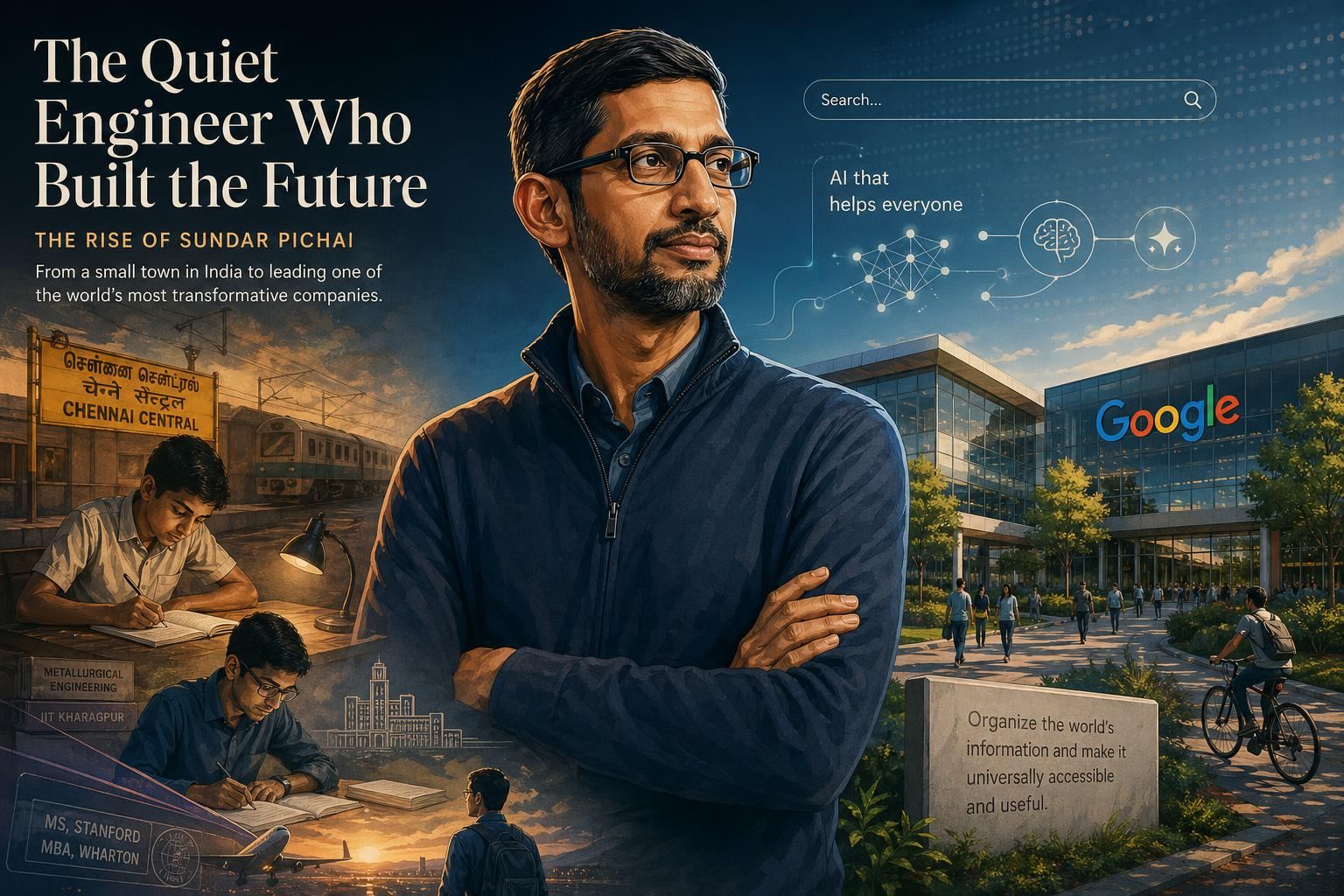
Colleagues who have worked closely with Pichai describe a near-identical leadership style across a decade of interviews. He listens longer than he speaks. He asks questions before giving answers. He writes decisions down in short, precise memos. He never publicly humiliates a subordinate. He rarely interrupts.
In a Silicon Valley culture built around loud founders — Steve Jobs throwing tantrums, Elon Musk firing people on Twitter, Travis Kalanick screaming at drivers — Pichai’s style felt almost revolutionary. “He leads by asking what you think,” one former VP told the press. “And then he tells you what he thinks. And then you realize he’s already decided, but he wanted to make sure he wasn’t missing anything.”
This quiet style is not weakness. Colleagues describe Pichai as capable of making brutal decisions — layoffs, project cancellations, organizational shake-ups — but doing them without drama. When Google laid off 12,000 employees in January 2023, Pichai personally took responsibility in a public blog post. He did not blame the market, inflation, or his board. He said the decisions had been his.
In an era when tech CEOs are performers, Pichai is an operator. The difference may be the most important variable in the next decade of Silicon Valley leadership.
🌅 Chapter 12: The Long Game
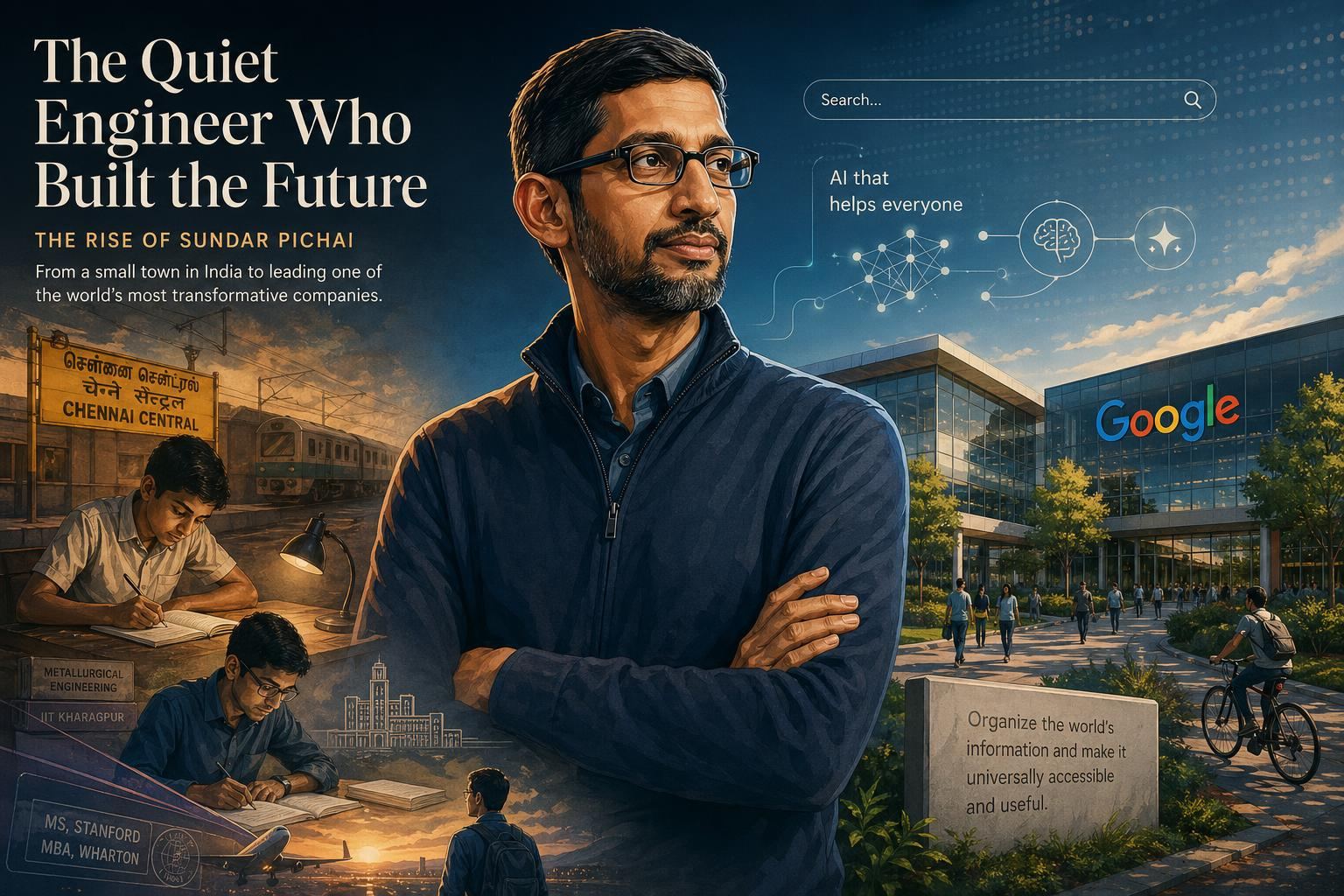
Today, Sundar Pichai runs a company that touches nearly every person on Earth with an internet connection. Search answers over 8 billion queries per day. YouTube streams over a billion hours of video daily. Android powers over 3 billion active devices. Gmail holds the correspondence of 1.8 billion users. Google Maps directs a large fraction of global navigation. Google Cloud runs critical infrastructure for governments, hospitals, and Fortune 500 companies.
And all of this sits under the operational control of a man who once slept on a living room floor in Chennai, whose family couldn’t afford a telephone, whose superpower was memorizing numbers nobody else bothered to remember.
He has not announced retirement plans. He has not floated successors. He has said, repeatedly, that he plans to keep running Google “for as long as the board wants me to.” In a world of volatile founders and turbulent tech politics, that quiet commitment may be the most valuable asset Alphabet has.
The loud era of Silicon Valley built the industry. The patient era — the Pichai era — will decide what it becomes. And somewhere in Chennai, an electrical engineer named Regunatha Pichai can say, without exaggeration, that the plane ticket he bought for his son in 1993 turned out to be the best investment anyone in his family had ever made.
💡 Key Insights
- ▸ Pichai's ascent proves that technical credibility plus diplomatic patience can outcompete charisma in modern tech leadership. He didn't win Google by out-shouting rivals — he won by building products nobody could argue with and managing egos nobody else could handle.
- ▸ Chrome, Android, and Gmail leadership gave Pichai the rarest resume in tech: product wins at scale across three of the most valuable platforms in history. Founders who want C-suite power should study how he layered adjacent product wins rather than chasing a single moonshot.
- ▸ The 2015 Alphabet restructuring was engineered partly to give Pichai operational control of Google while Page and Brin took moonshots. The lesson: sometimes the best way to become CEO is to make the founders want to leave the operational seat.
- ▸ Pichai's handling of the AI race — losing the early ChatGPT narrative, then catching up with Gemini — shows how a patient operator can turn an embarrassing lag into a measured comeback when the underlying research advantage is real.
- ▸ His management style — listening longer than he speaks, never publicly humiliating a lieutenant, making decisions in writing — is the opposite of founder-CEO folklore. In a post-founder era, this quiet style may be the new template.