Zhang Yiming: The Introvert Who Built TikTok and Conquered the World
He didn't drink, didn't smoke, didn't do small talk. Zhang Yiming was the quietest person in every room — and he built the most addictive app on Earth. The story of how a socially awkward engineer from a small Chinese city created ByteDance, TikTok, and a $220 billion empire that terrified governments.

View all stories about this mogul
🌾 Chapter 1: The Quiet Kid from Longyan
Zhang Yiming was not the kind of person you’d pick out of a crowd.
Born in 1983 in Longyan, a small city in Fujian province in southeastern China, he was the son of civil servants. His father worked at a local science commission. His mother worked for a local state-owned enterprise. They were educated, stable, unremarkable — the Chinese middle class in its most distilled form.
Young Yiming was quiet. Not shy — quiet. There’s a difference. Shy people want to speak but can’t. Quiet people simply don’t see the point. Zhang Yiming, even as a child, was calculating the return on investment of every social interaction, and most of them came up negative.
“I don’t like small talk. It’s inefficient. If you have something to say, say it. If you don’t, silence is fine.”
He was good at math. He was good at science. He was exceptionally good at pattern recognition — the ability to look at a system and understand its underlying logic. These weren’t talents that made you popular in school. They were talents that would eventually make you worth $50 billion.
Zhang Yiming tested into Nankai University in Tianjin — one of China’s top universities — and initially enrolled in microelectronics. Within a year, he transferred to software engineering. The reason was pure Zhang Yiming: he decided that software was more scalable than hardware. You could build a chip that served one function. Or you could write code that could do anything.
He chose anything.
At Nankai, Zhang Yiming was the student who spent more time in the computer lab than in the classroom. He read voraciously — not novels, but technical documentation, business biographies, and anything related to information theory. He was particularly obsessed with a question that would define his career:
How do you get the right information to the right person at the right time?
It seemed like a simple question. The answer would be worth hundreds of billions of dollars.
💻 Chapter 2: The Serial Starter
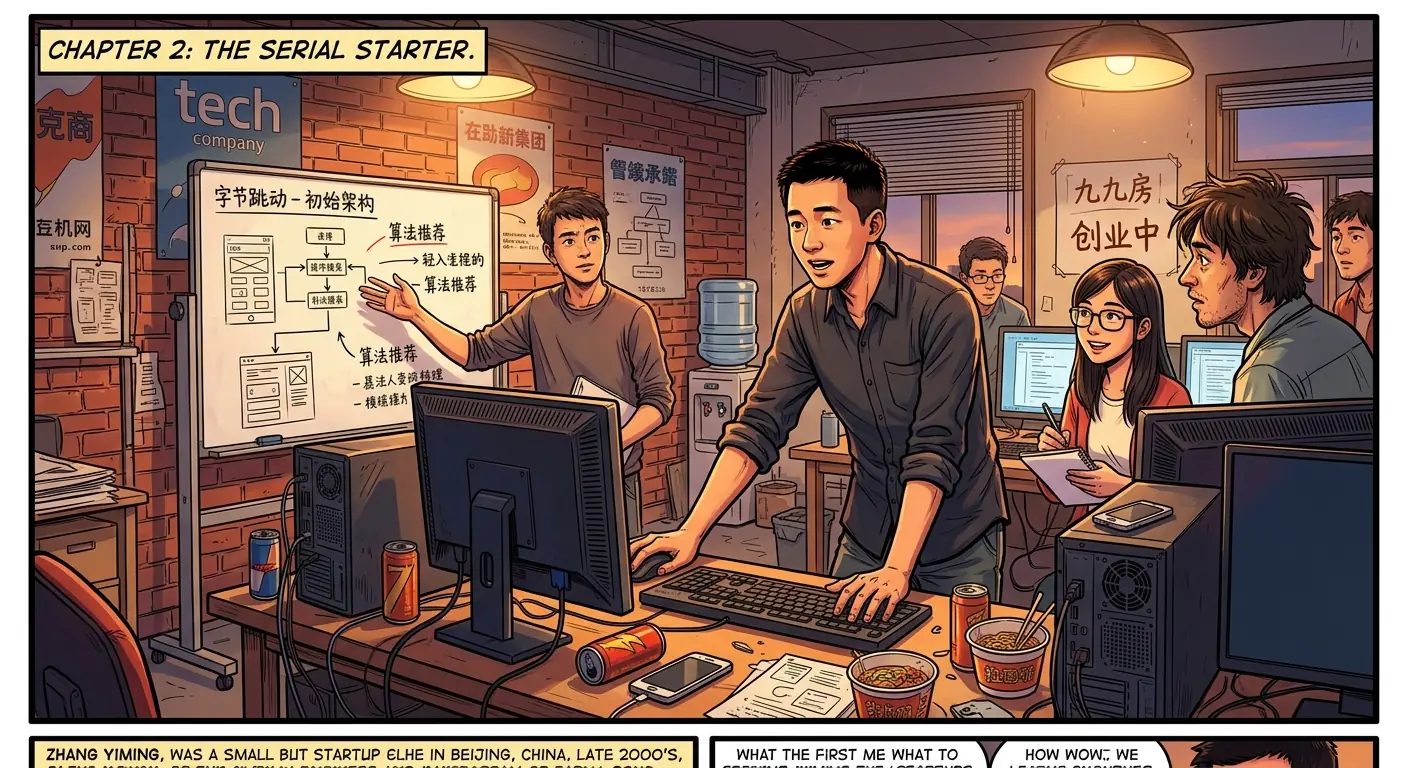
After graduating from Nankai in 2005, Zhang Yiming didn’t join a big tech company. He didn’t go to grad school. He did something far more interesting: he started joining startups.
His first job was at Kuxun, a travel search company (later acquired by TripAdvisor). He was one of the first engineers. He built systems, learned how search algorithms worked, and observed how people interacted with information online. Within a year, he’d been promoted to technical director.
But Zhang Yiming wasn’t building a career. He was conducting research.
He left Kuxun and joined Microsoft — briefly. Very briefly. The bureaucracy suffocated him. Microsoft in the mid-2000s was a massive corporation where decisions moved at the speed of committee meetings. Zhang Yiming lasted less than a year before fleeing to another startup.
Then he co-founded Fanfou, a Twitter-like microblogging platform. It gained traction quickly — too quickly. Chinese authorities shut it down in 2009 during politically sensitive events. The experience taught Zhang Yiming two lessons: (1) content platforms could grow explosively, and (2) the Chinese government was a force you had to work with, not against.
He filed these lessons away. They would prove critical.
In 2009, he founded 99fang.com, a real estate search platform. It was moderately successful — functional, profitable, boring. Zhang Yiming ran it for three years while his mind churned on something bigger.
“I started four companies before ByteDance. Each one taught me something. Kuxun taught me search. Fanfou taught me virality. 99fang taught me patience. But none of them solved the problem I really cared about.”
The problem he really cared about was information distribution. How do you take the infinite ocean of content being created every second and surface exactly what each individual person wants to see, before they even know they want to see it?
In 2012, at the age of 29, Zhang Yiming quit everything else to answer that question.
He founded ByteDance.
📱 Chapter 3: Toutiao — The Algorithm Awakens
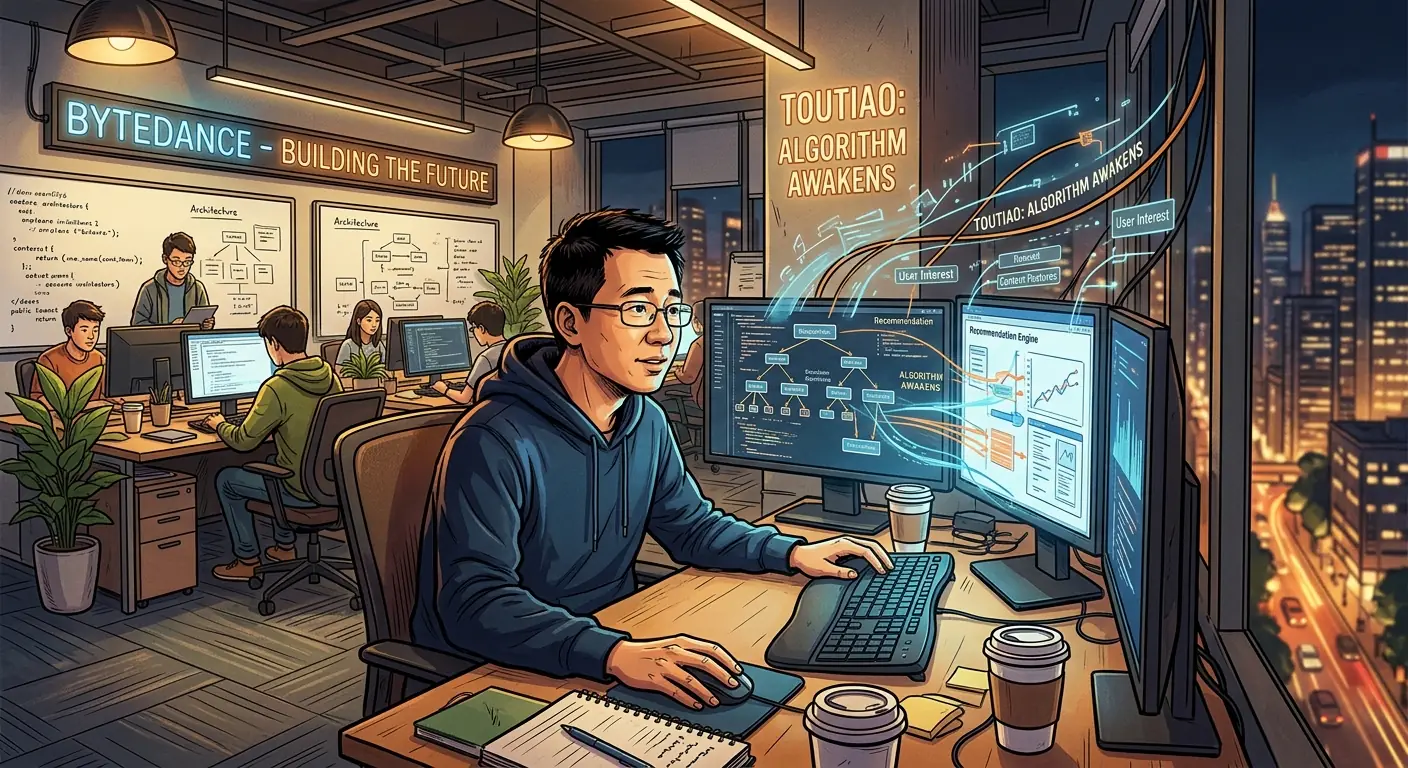
ByteDance’s first product wasn’t TikTok. It wasn’t even a video app. It was a news aggregator called Toutiao (meaning “Headlines” in Chinese).
Toutiao launched in August 2012, and it looked, at first glance, like dozens of other news apps. You opened it. You saw headlines. You tapped to read. What was the big deal?
The big deal was invisible. It was the algorithm.
Most news apps at the time used editors to curate content. Human beings decided what was important, what was trending, what should be on the front page. Toutiao used no editors at all. Zero. The entire content feed was generated by machine learning algorithms that analyzed each user’s behavior — what they clicked, how long they read, what they shared, what they scrolled past — and built an increasingly precise model of their interests.
The more you used Toutiao, the better it knew you. After a few days, the app was showing you exactly the kind of content that would keep you scrolling. After a few weeks, it was practically reading your mind.
“We don’t create content. We don’t edit content. We connect content with people. The algorithm is the editor.”
This was radical in 2012. The idea that a machine could replace human editorial judgment seemed either utopian or dystopian, depending on your perspective. Zhang Yiming didn’t care about the philosophy. He cared about the data. And the data was unambiguous: Toutiao’s AI-driven feed was addictive in a way that human-curated news feeds simply weren’t.
Toutiao exploded. Within a year, it had 10 million daily active users. Within two years, 40 million. By 2015, it was one of the most popular apps in China, with over 100 million daily active users spending an average of 76 minutes per day on the platform.
Seventy-six minutes. Per day. On a news app.
The advertising industry took notice. Here was an app that knew exactly what each user cared about, kept them engaged for over an hour a day, and could serve precisely targeted ads. Toutiao’s ad revenue rocketed upward.
ByteDance was profitable by 2014, just two years after launch. Zhang Yiming — the quiet, socially awkward engineer from Longyan — was running one of the fastest-growing tech companies in China.
But he was already thinking about what came next.
🎵 Chapter 4: The Birth of Douyin
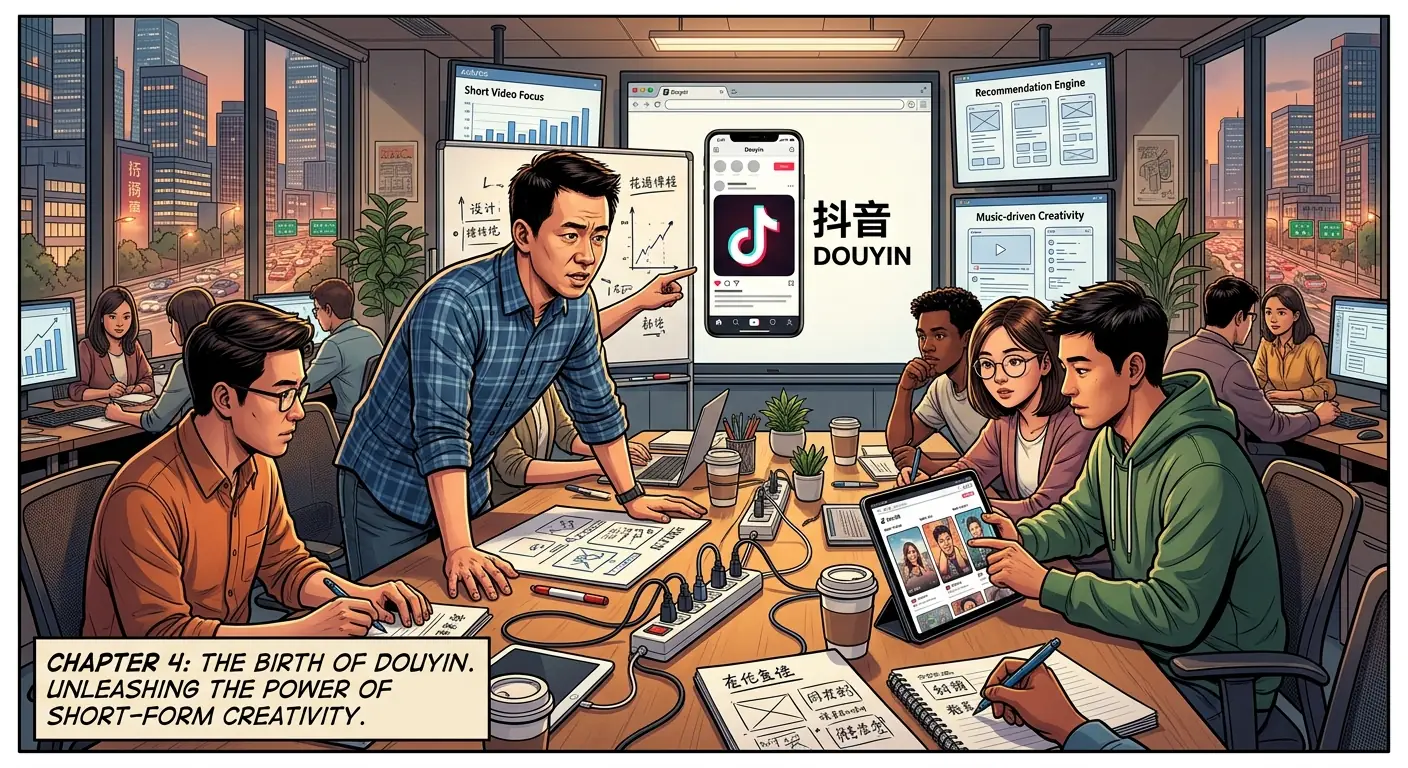
In 2016, Zhang Yiming looked at the data and saw something that everyone else was missing: short-form video was about to eat the internet.
Smartphone cameras were getting better. Mobile internet was getting faster. People’s attention spans were getting shorter. The logical endpoint was obvious: the dominant content format of the future would be short videos — 15 to 60 seconds — delivered by an algorithm that learned what you wanted to watch.
Zhang Yiming assembled a team and gave them a mandate: build the most addictive short video app in the world. They had the algorithm from Toutiao. They had the data science expertise. They just needed the product.
In September 2016, ByteDance launched Douyin in China. The concept was simple: open the app, and you’re immediately watching a full-screen short video. Swipe up, and the next one plays. No menus. No feeds. No decisions. Just an infinite scroll of algorithmically optimized dopamine hits.
The design was deliberately frictionless. There was no home screen, no menu to navigate, no decisions to make. You opened the app and content was already playing. Every UX choice was designed to reduce the gap between “I’m bored” and “I’ve been watching for an hour.”
“We studied human attention the way a physicist studies gravity. We didn’t judge it. We measured it. And then we built a product that worked with it, not against it.”
Douyin’s algorithm was Toutiao’s algorithm on steroids. It didn’t just learn what topics you liked — it learned what sounds, visual styles, pacing, faces, and even colors kept you watching. A user who consistently watched videos of dogs would see more dogs. A user who watched cooking videos at night but travel videos in the morning would get different feeds at different times of day.
The granularity was almost creepy. And it worked phenomenally.
Douyin hit 100 million users in China within a year. By 2018, it had 300 million. It was, by every metric, the fastest-growing app in Chinese history.
And Zhang Yiming wasn’t even warmed up.
🌏 Chapter 5: TikTok Goes Global
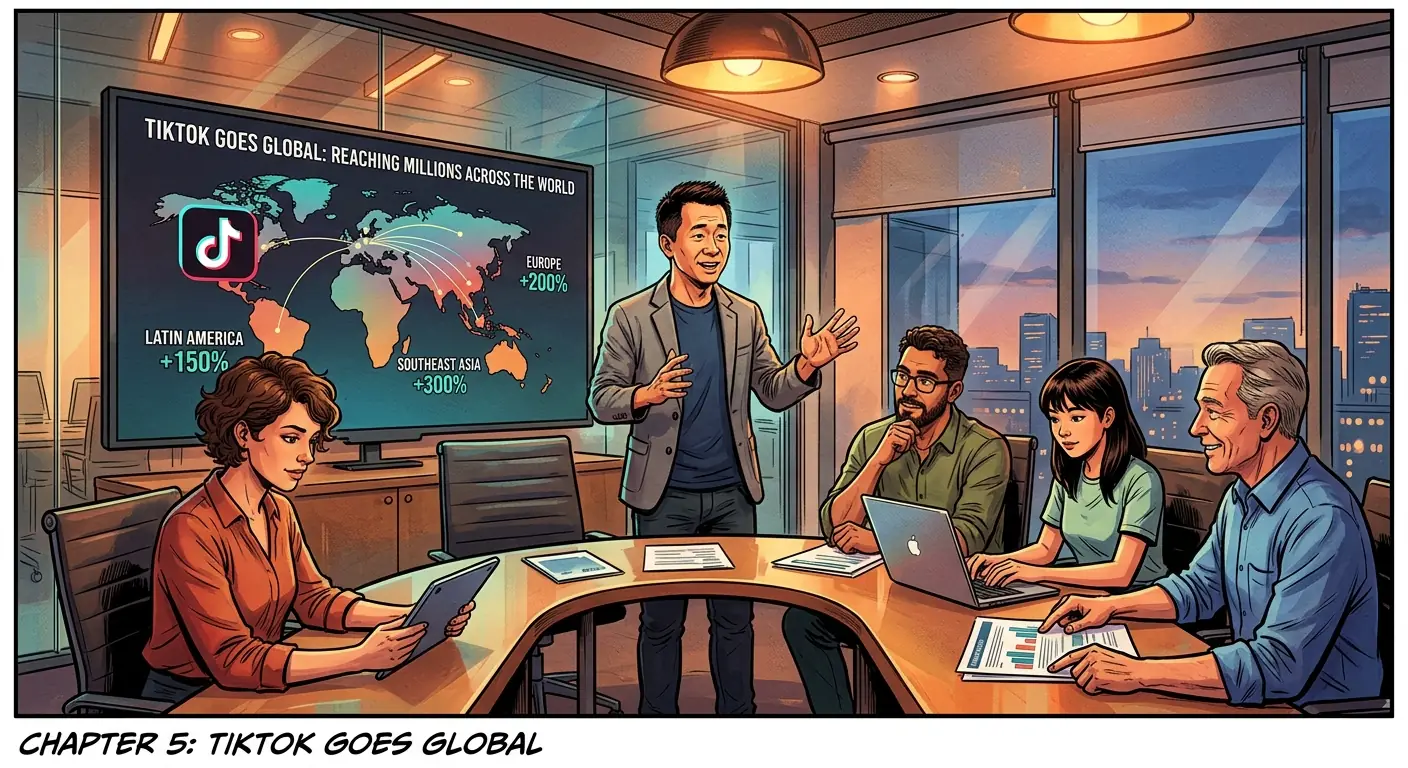
In 2017, ByteDance acquired Musical.ly, a short-video app that had gained significant traction in the United States and Europe. Musical.ly had roughly 100 million users, mostly teenagers who used it to make lip-sync videos.
The acquisition cost approximately $1 billion. It seemed like a lot for an app that mostly featured teenagers mouthing along to pop songs. But Zhang Yiming wasn’t buying the app. He was buying the user base. And the distribution.
In August 2018, ByteDance merged Musical.ly into a new global app: TikTok.
TikTok was essentially Douyin with a different name, designed for markets outside China. Same algorithm. Same interface. Same addictive, full-screen, infinite-scroll design. But with content and moderation adapted for Western audiences.
The result was the most explosive app launch in internet history.
TikTok hit 500 million monthly active users by mid-2018. One billion by 2021. By 2024, it had surpassed 1.5 billion monthly active users, making it the most downloaded app in the world — ahead of Instagram, YouTube, Facebook, and everything else.
“People say we got lucky with TikTok. We didn’t get lucky. We spent six years perfecting an algorithm on Toutiao, tested it on 300 million users with Douyin, and then deployed it globally. That’s not luck. That’s engineering.”
The impact on global culture was seismic. TikTok didn’t just change social media — it changed music, fashion, politics, news, commerce, and the very concept of fame. A teenager in a small town could post a video at noon and be famous by dinner. Songs went from obscure to number-one hits because they went viral on TikTok. Political movements organized on the platform. Businesses rose and fell based on TikTok virality.
For better or worse, TikTok had become the attention layer of human civilization.
🏛️ Chapter 6: The Geopolitical Storm
Success on TikTok’s scale created enemies on a corresponding scale.
The biggest enemy was the United States government. Starting in 2020, American politicians from both parties began raising alarms about TikTok’s Chinese ownership. The concerns were straightforward: ByteDance was a Chinese company. Chinese law required companies to share data with the government upon request. TikTok had data on over 150 million Americans. The national security implications were obvious.
President Trump issued an executive order in 2020 attempting to ban TikTok unless it was sold to an American company. The order triggered months of chaotic negotiations involving Microsoft, Oracle, Walmart, and the Chinese government. The deal fell apart.
President Biden signed the Protecting Americans from Foreign Adversary Controlled Applications Act in April 2024, which gave ByteDance approximately nine months to divest TikTok’s U.S. operations or face a ban.
ByteDance fought back with an army of lawyers, lobbyists, and the most powerful weapon of all: 170 million American TikTok users who really, really didn’t want to lose their app.
“We built something that hundreds of millions of people love. And now governments want to take it away. That’s not a technology problem. That’s a political problem.”
The TikTok saga became one of the most complex geopolitical technology disputes in history. It involved questions about data privacy, national security, free speech, economic competition, and the fundamental tension between a globalized internet and a world of sovereign nations with different values and different definitions of acceptable surveillance.
Zhang Yiming, characteristically, said very little publicly. He had stepped down as ByteDance CEO in May 2021, citing a desire to focus on long-term strategy and personal interests. The timing was suspicious — it came just as TikTok’s political problems were intensifying.
His successor, Liang Rubo, a college roommate and co-founder, took over the day-to-day management of the geopolitical firestorm. But everyone understood that Zhang Yiming was still the shadow power behind ByteDance.
🧠 Chapter 7: The Algorithm Is the Product
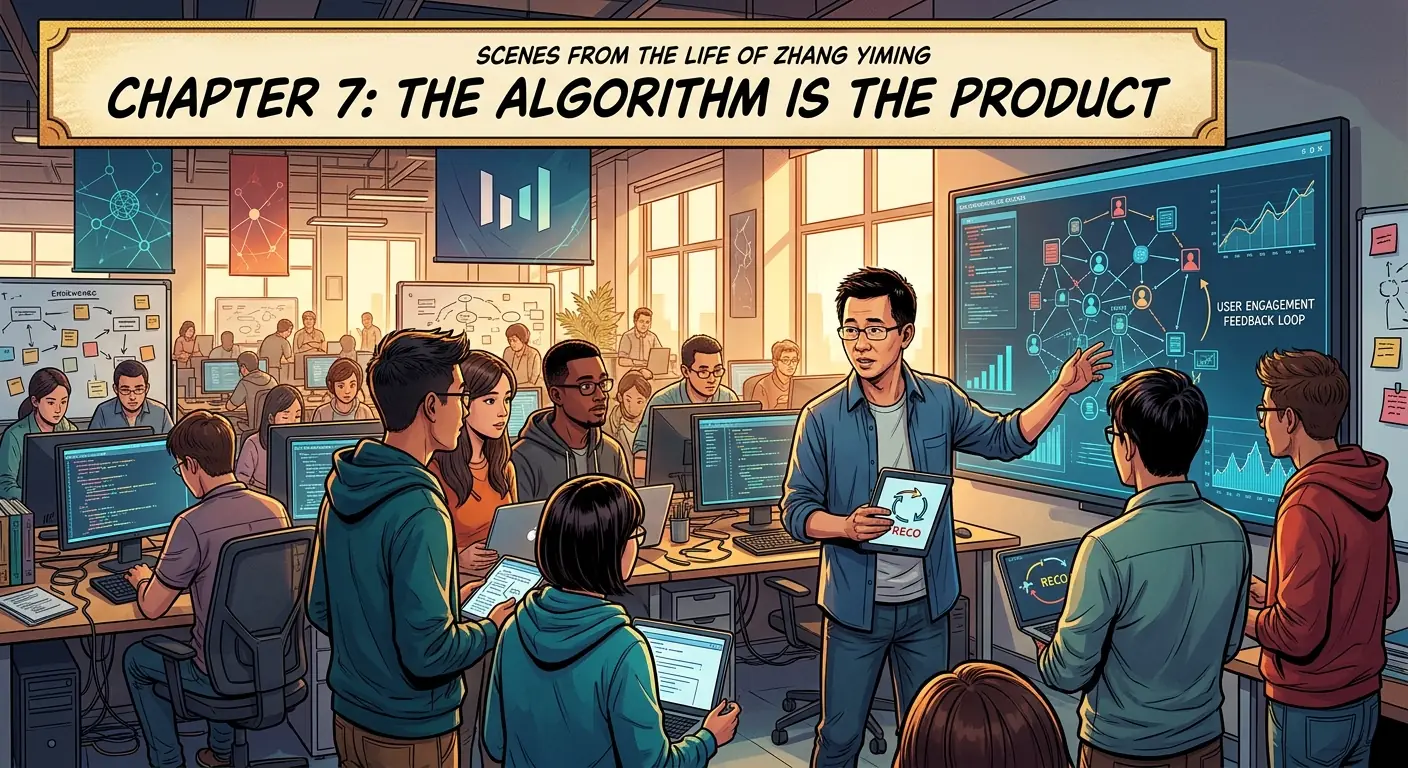
To understand ByteDance’s dominance, you have to understand one thing: the algorithm isn’t a feature of the product. The algorithm IS the product.
ByteDance’s recommendation engine is, by most accounts, the most sophisticated content-matching AI system ever built. It processes billions of signals — watch time, replays, shares, comments, follows, skips, time of day, device type, location, audio preferences, visual preferences — and constructs a multidimensional model of each user’s attention patterns.
The system doesn’t just learn what you like. It learns what keeps you watching. These are different things. You might like educational content about climate change. But you watch cooking videos and cat compilations. TikTok’s algorithm doesn’t care about your aspirational self. It caters to your actual self.
This is what makes the algorithm both incredibly effective and deeply controversial. Critics argue that it creates filter bubbles, promotes addictive behavior, and optimizes for engagement at the expense of well-being. Supporters argue that it’s the most democratic content distribution system ever created — anyone can go viral, regardless of their follower count or social connections.
Zhang Yiming’s philosophy was clear: the algorithm is neutral. It reflects human behavior. If you don’t like what the algorithm shows you, the problem isn’t the algorithm — it’s you.
This philosophy was elegant, intellectually consistent, and almost certainly wrong. Or at least incomplete. Because an algorithm that optimizes for engagement will inevitably promote content that triggers strong emotional reactions — outrage, fear, desire, schadenfreude — and suppress content that is important but boring.
“The algorithm gives people what they want. Whether that’s good for them is a question for philosophers, not engineers.”
But ByteDance didn’t build the algorithm just for TikTok. They deployed it across a dozen products: Toutiao for news, Douyin for Chinese short video, TikTok for global short video, CapCut for video editing, Lemon8 for lifestyle content, and several others.
Each app was a different surface for the same underlying intelligence. The algorithm learned from all of them simultaneously, getting smarter with every interaction across every platform. It was a flywheel of artificial intelligence, and no competitor could match it because no competitor had the same breadth and depth of data.
🚀 Chapter 8: ByteDance’s War Chest

By 2025, ByteDance had become one of the most valuable private companies in history.
Internal valuations pegged the company at approximately $220 billion. Annual revenue exceeded $120 billion — putting it in the same league as Meta and Alphabet in terms of advertising revenue. The company employed over 150,000 people globally, with offices in Beijing, Shanghai, Singapore, London, Dublin, New York, Los Angeles, and dozens of other cities.
The financial engine was almost entirely advertising-driven. TikTok’s ad business alone generated estimated revenues of over $30 billion per year outside China. Douyin’s ad business generated even more inside China. Combined with e-commerce revenue (Douyin had built a massive live-shopping platform in China), ByteDance was printing money at a rate that made even Meta jealous.
And Zhang Yiming’s personal wealth? Despite stepping back from the CEO role, he remained ByteDance’s largest individual shareholder. His net worth was estimated at approximately $50 billion, making him one of the wealthiest people in Asia.
But Zhang Yiming showed almost zero interest in the trappings of wealth. He didn’t buy yachts. He didn’t collect art. He didn’t throw parties. He lived relatively modestly and spent his time reading, thinking about technology, and — reportedly — exploring AI research and longevity science.
“Money is a measurement, not a goal. I never built ByteDance to get rich. I built it to solve an information problem. The money was a side effect.”
This was either genuine humility or the most effective personal branding in tech history. Probably a bit of both.
💣 Chapter 9: The Costs of Attention
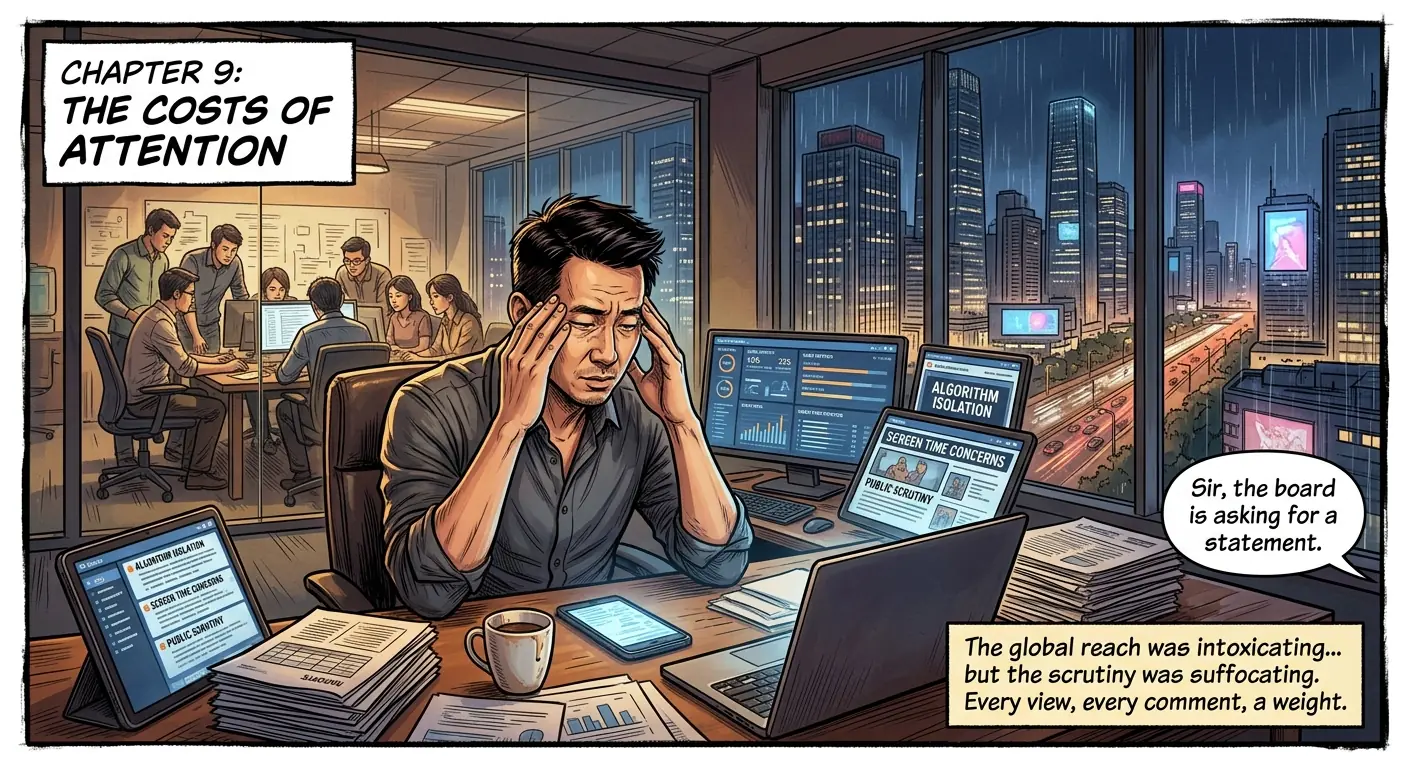
For all its success, ByteDance’s story has a darker dimension that deserves honest examination.
TikTok has been linked to significant mental health concerns, particularly among teenagers. Studies have shown correlations between heavy TikTok use and increased rates of anxiety, depression, and body image issues. The app’s algorithm, designed to maximize engagement, has been shown to push vulnerable users toward increasingly extreme content — including content related to eating disorders, self-harm, and suicide.
In 2023, the U.S. Surgeon General issued an advisory about social media’s impact on youth mental health, with TikTok prominently mentioned. Multiple states filed lawsuits against TikTok, alleging that the platform was designed to be addictive to children.
TikTok responded with features like screen time limits, restricted mode for younger users, and content warnings. But critics argued these measures were superficial — the equivalent of a tobacco company putting “smoking may be harmful” on a cigarette pack while spending billions to make the cigarettes more addictive.
There was also the content creator economy to consider. TikTok had created a new class of internet celebrity — people who built massive followings and, in some cases, lucrative careers through short videos. But the platform’s algorithm was brutally capricious. A creator could have millions of followers one month and zero views the next, entirely at the mercy of algorithmic changes they couldn’t see or understand.
“The algorithm giveth and the algorithm taketh away. If your entire livelihood depends on an algorithm you don’t control, you don’t have a business. You have a lottery ticket.”
Zhang Yiming rarely addressed these criticisms directly. His worldview — that the algorithm was a neutral mirror of human behavior — provided a convenient philosophical shield against accountability. If the algorithm showed teenagers harmful content, it was because teenagers sought out harmful content. The platform was just the messenger.
This argument had the appeal of logic and the deficiency of empathy. Algorithms aren’t mirrors. They’re amplifiers. And an amplifier has a choice about what frequency to boost.
🔮 Chapter 10: The Retirement That Isn’t
In May 2021, Zhang Yiming announced that he was stepping down as CEO of ByteDance. He was 38 years old.
The announcement shocked the tech world. Here was a founder at the peak of his power, running one of the most valuable and influential companies on Earth, and he was… quitting?
Zhang Yiming’s stated reasons were characteristically analytical. He said he wasn’t good at managing people. He said he wanted to focus on long-term research. He said he wanted to read more and think more.
“I’m not a very social person,” he wrote in an internal letter to employees. “I lack the skills to manage a large organization. The company will be better served by someone who is better at those things.”
But the real reasons were likely more complex. The geopolitical pressure on ByteDance was intensifying. The Chinese government had begun cracking down on tech companies, with Alibaba, Tencent, and Didi all facing regulatory actions. Zhang Yiming may have calculated that a lower profile was strategically advantageous.
Whatever the reasons, Zhang Yiming’s “retirement” looked nothing like retirement. He remained ByteDance’s controlling shareholder and continued to influence the company’s strategic direction. He reportedly spent his time exploring artificial general intelligence, reading scientific papers, and quietly investing in biotech startups.
The quiet kid from Longyan had become a quiet billionaire from everywhere and nowhere. He maintained almost zero public presence. No social media accounts. No interviews. No conference appearances. He was a ghost with $50 billion.
“The best founders know when to step back. Zhang Yiming built the machine, optimized it, and then trusted it to run without him. That takes a different kind of confidence than building it in the first place.”
🏆 Chapter 11: The Algorithm Age
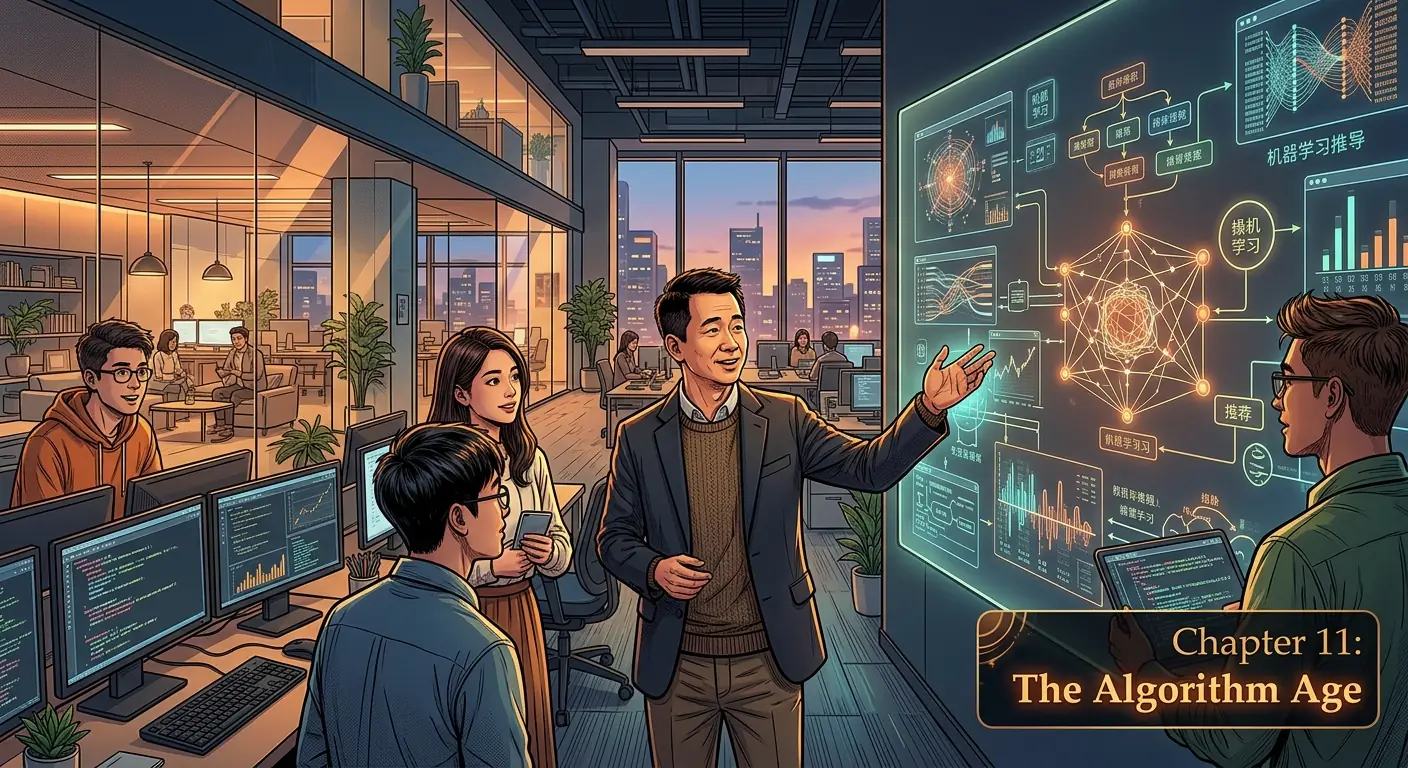
Zhang Yiming’s legacy extends far beyond TikTok. He proved something that will reshape business, media, and society for decades to come:
Algorithms can know what you want better than you know yourself.
This insight — simple to state, terrifying to internalize — is the foundation of the attention economy’s next phase. Before TikTok, social media was organized around identity: who you were, who you knew, what groups you belonged to. After TikTok, social media is organized around desire: what captures your attention, regardless of who you are or who you know.
The shift is subtle but profound. Identity-based platforms (Facebook, LinkedIn) create echo chambers around existing social structures. Desire-based platforms (TikTok) create echo chambers around individual psychological profiles. One reinforces your social world. The other reinforces your inner world.
Zhang Yiming didn’t necessarily intend to build the most powerful attention-manipulation engine in human history. He intended to solve an information problem: how do you get the right content to the right person? But in solving that problem, he created something that governments fear, parents worry about, and two billion people can’t stop using.
Business Lessons from the ByteDance Playbook:
-
The algorithm is the moat. Features can be copied. Content can be duplicated. An algorithm trained on billions of user interactions cannot be replicated without billions of user interactions.
-
Launch many products, let the algorithm decide. ByteDance launched dozens of apps. Most failed. The ones that succeeded did so because the algorithm found product-market fit faster than any human could.
-
Go global early. ByteDance’s decision to launch TikTok as a global product — not just a Chinese one — was the key strategic decision that separated it from every other Chinese tech company.
-
The founder doesn’t have to be the face. Zhang Yiming built a $220 billion company while being virtually unknown to the public. In an age of celebrity CEOs, his invisibility was a competitive advantage.
-
Solve the distribution problem, and the content will come. ByteDance never created content. It built the world’s best distribution system and let billions of users supply the content for free.
The quiet kid from Longyan didn’t just build an app. He built the infrastructure for how humanity consumes information in the 21st century.
Whether that’s a triumph or a tragedy depends on who’s asking.
ByteDance’s valuation is estimated at approximately $220 billion as of early 2026. The company remains private and does not publicly disclose its financials. TikTok’s regulatory status in the United States and other countries continues to evolve.
⚔️ Chapter 12: The Regulatory Gauntlet (2018-2020)
So, you’ve built a global sensation. You’ve conquered hearts, minds, and smartphone screens in over 150 countries. You’ve got teenagers doing dances, grandmas sharing recipes, and everyone in between endlessly scrolling. What could possibly go wrong? Oh, just a minor thing: the combined might of the US government, intelligence agencies, and a handful of other nations suddenly deciding your brilliant, addictive algorithm is a national security threat. Just another Tuesday for Zhang Yiming, right?
### The Scrutiny Begins: Data, Spies, and “The CCP”
By 2018, TikTok wasn’t just big; it was everywhere. And when something out of China gets that big, that fast, in the West, alarm bells start ringing louder than a K-Pop concert. The whispers began: “Is TikTok sending user data back to Beijing?” “Is the Chinese Communist Party (CCP) using it for propaganda?” “Are our kids’ dance moves being weaponized?” It sounds like the plot of a bad spy movie, but for ByteDance, it was very real.
The core issue was simple, yet incredibly complex: TikTok was owned by a Chinese company. In China, national security laws dictate that companies must assist intelligence agencies when requested. This meant, theoretically, that the CCP could demand access to TikTok’s vast trove of user data – everything from location and browsing history to biometric data. ByteDance vehemently denied ever sharing data, and Zhang Yiming was quick to point out that TikTok’s US user data was stored in the US (and later Singapore). But try telling that to a politician looking for an easy headline.
US lawmakers, particularly those wary of China’s growing tech influence, started raising hell. Senators Marco Rubio and Tom Cotton were among the earliest and loudest critics, pushing for investigations into TikTok’s data practices and potential censorship of content deemed sensitive by Beijing. This wasn’t just about data privacy; it was about the growing tech cold war, and TikTok was suddenly caught squarely in the crosshairs. The company found itself in a constant PR battle, trying to explain to a skeptical public and even more skeptical politicians that no, their teens weren’t being spied on by foreign agents while attempting the “Renegade” dance.
### Trump’s Hammer: Executive Orders and Forced Sales
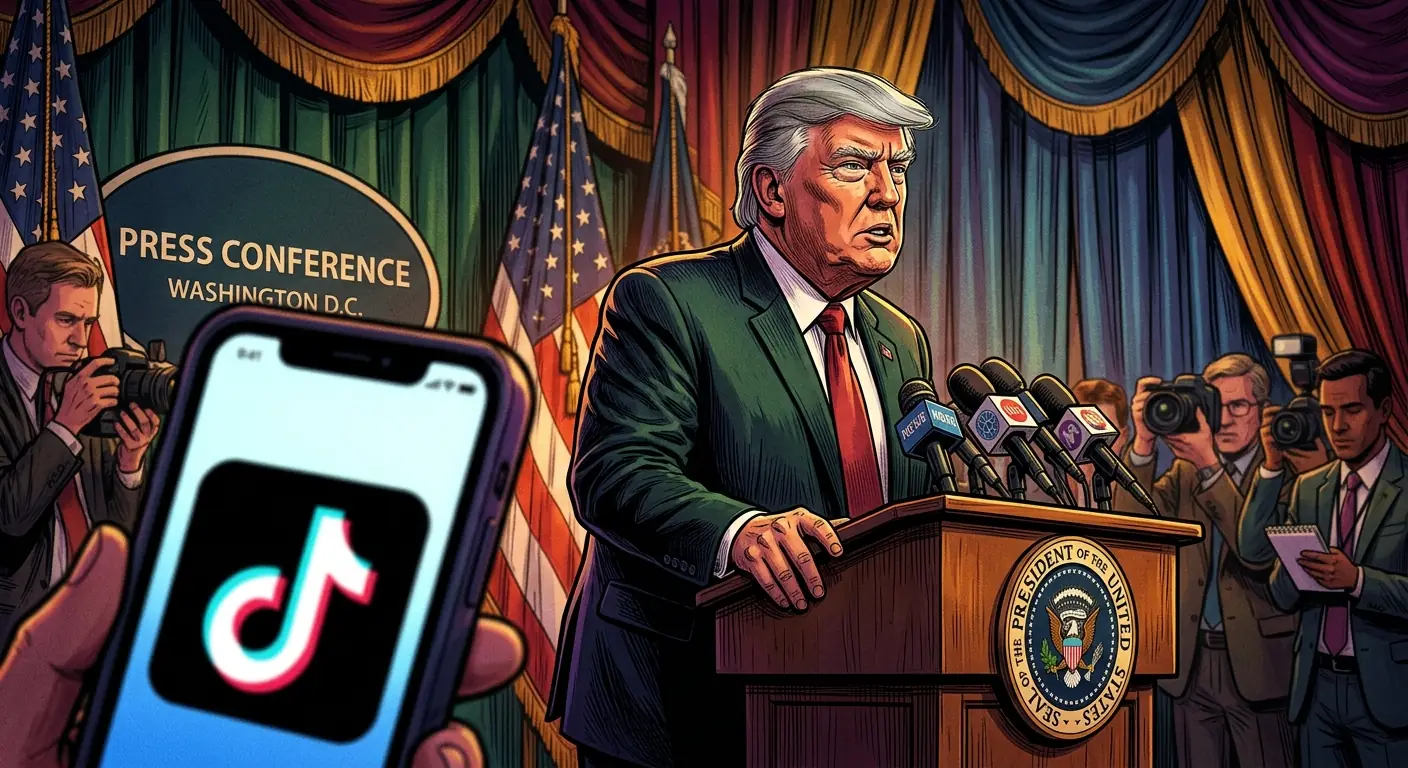
The rhetorical storm truly escalated into a Category 5 hurricane in mid-2020. President Donald Trump, never one to shy away from a direct confrontation (or a dramatic flourish), declared TikTok a national security threat. On August 6, 2020, he issued an executive order prohibiting transactions with ByteDance, effectively aiming to ban TikTok in the US unless it was sold to an American company.
“We’re going to ban TikTok,” Trump declared. “As far as TikTok is concerned, we’re banning them from the United States.”
Zhang Yiming and ByteDance were plunged into a geopolitical nightmare. Imagine building an app from scratch, making it a global phenomenon, and then being told by the leader of the free world that you have to sell it, or it dies. The company fought back with lawsuits, arguing the ban was unconstitutional and lacked due process. Meanwhile, a frantic scramble ensued to find a US buyer. Microsoft, Oracle, and Walmart all entered the fray, sniffing around for a piece of the hottest social media pie. It was a bizarre, high-stakes game of corporate poker, played out in public, with billions of dollars and the future of a cultural touchstone on the line. At one point, it seemed like a deal with Oracle and Walmart was imminent, but the complexities of a three-way deal under such duress proved almost insurmountable. The whole saga was a stark reminder that even the most innovative tech companies operate at the mercy of political winds.
### Navigating the Dragon’s Den: China’s Unseen Hand
While battling the US, Zhang Yiming also had to contend with Beijing. The Chinese government, initially quiet, became increasingly vocal as the forced sale loomed. After all, if TikTok was sold, it would mean a major Chinese tech success story—and its powerful algorithm—would fall into American hands. This was a non-starter for Beijing.
In late August 2020, China updated its export control rules, specifically adding “AI interface technologies” and “personalized information push services” to a list requiring government review for export. This was widely seen as a direct move to block the sale of TikTok’s core algorithm – its secret sauce – to US companies. Suddenly, ByteDance was caught between a rock and a hard place: sell TikTok without its algorithm, making it far less attractive to buyers, or refuse to sell and face the US ban. It was a classic “damned if you do, damned if you don’t” scenario.
Zhang Yiming, the quiet strategist, found himself at the epicenter of a global power struggle. He had built an empire on the simple premise of giving people what they want to see, but the world had decided that how he did it, and who he was, mattered more. The planned sale ultimately fizzled out as the Trump administration left office, but the regulatory gauntlet had been run, leaving an indelible mark on ByteDance and forever changing how the world viewed a Chinese tech giant. The message was clear: building a global empire meant navigating political minefields, not just technological ones.
🚀 Chapter 13: The Algorithm’s Enduring Legacy (2021-Present)
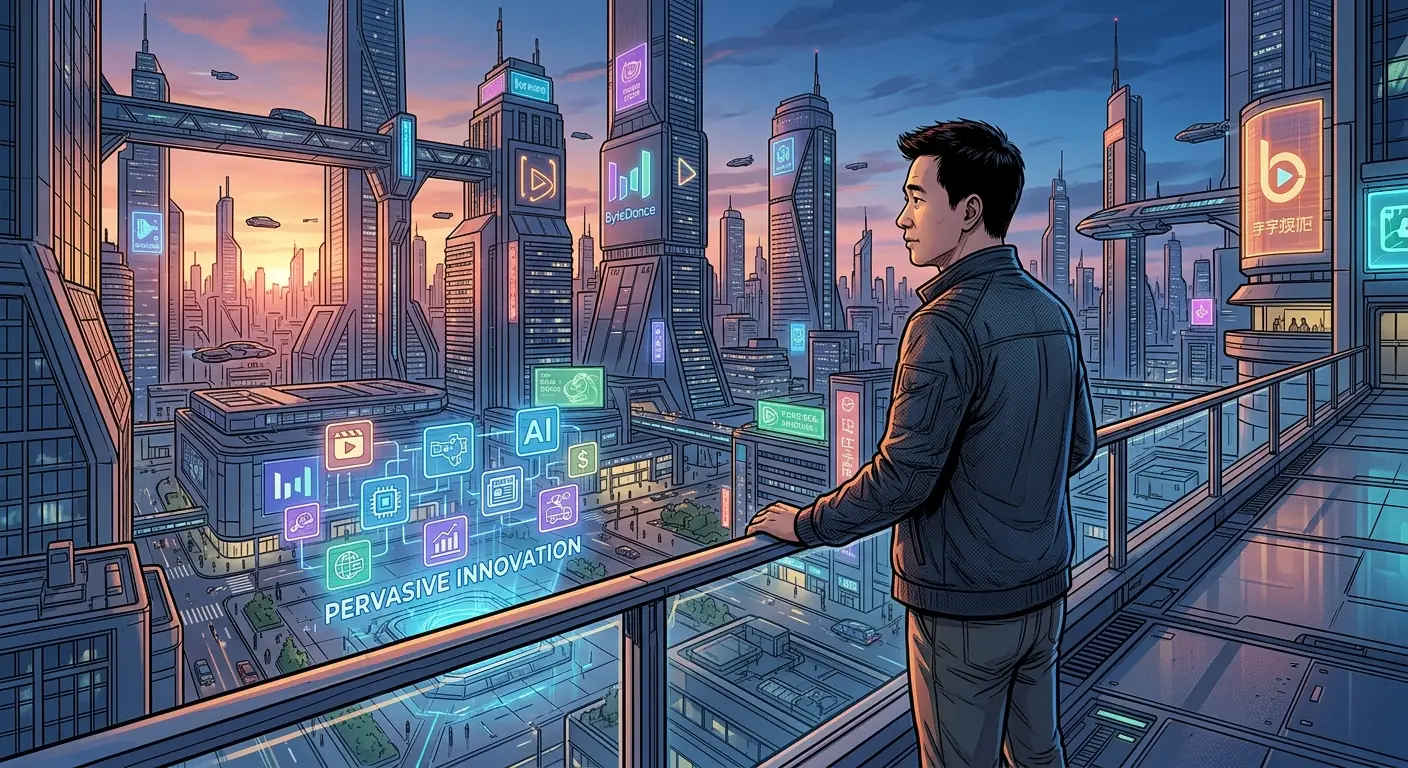
So, after surviving regulatory firestorms and building an empire that redefined digital content, what does an introvert do for an encore? If you’re Zhang Yiming, you step back. Or at least, you appear to. The story of ByteDance isn’t just about TikTok anymore; it’s about the relentless expansion of an algorithm-driven philosophy into every corner of the digital world, and the quiet architect who keeps pulling the strings, even from the shadows.
### From CEO to Strategist: Zhang’s Evolving Role
In May 2021, Zhang Yiming announced he would step down as CEO of ByteDance, handing the reins to his long-time co-founder and HR chief, Liang Rubo. Then, in November 2021, he resigned from the board of directors as well. On the surface, it looked like a classic founder’s exit – a move to “spend more time thinking about long-term strategy, corporate culture, and social responsibility,” as he put it in an internal memo. But let’s be real, this is Zhang Yiming we’re talking about. The man who rarely does anything without a calculated reason.
This wasn’t a retirement in the traditional sense; it was a strategic repositioning. Zhang Yiming, the ultimate quiet strategist, was moving from the operational hot seat to a more powerful, less exposed role. He remains ByteDance’s largest individual shareholder, reportedly holding around 20% of the company and maintaining significant voting power. He’s still the visionary, the quiet force guiding the ship, just from the captain’s quarters rather than the deck. It allowed him to escape the intense public scrutiny that comes with being the face of a company like ByteDance, particularly one constantly battling geopolitical headwinds. It’s a savvy move: let others manage the day-to-day chaos while you focus on the next big thing, the truly disruptive ideas. He’s still the “Chief Algorithm Officer,” just without the official title.
### The ByteDance Juggernaut Expands: Beyond the Feed
While TikTok captures global headlines, ByteDance has been quietly, and aggressively, diversifying. The company’s revenue isn’t just from short-form videos anymore. It’s a sprawling digital conglomerate with its fingers in an astonishing number of pies, all powered by its core strength: intelligent recommendation algorithms.
Take e-commerce. Douyin (China’s TikTok) is a massive force in live-stream shopping, generating billions in sales. ByteDance has launched its own dedicated e-commerce platforms like Fyllo in Indonesia and Shop in the US, directly challenging Amazon and Shopify. Then there’s gaming. ByteDance acquired gaming studios like Moonton Technology for an estimated $4 billion in 2021, aiming to carve out a significant slice of the global gaming market. They’re also heavily invested in education (though this sector faced severe crackdowns in China), enterprise software with Lark (their answer to Slack/Microsoft Teams), and even AI hardware and VR/AR with Pico, which they acquired in 2021.
The company’s estimated revenue for 2023 was reportedly over $110 billion, a staggering figure that underscores its relentless expansion. Zhang Yiming’s vision was never just about one app; it was about building a machine that could deliver any digital content, any product, any service, precisely tailored to the individual. It’s an information distribution engine perfected, and it’s being applied everywhere.
### The Algorithm Age: A Lasting Legacy
Zhang Yiming’s most profound legacy isn’t just TikTok; it’s the popularization and perfection of the “algorithm-as-product” philosophy. Before ByteDance, social media was largely about social graphs – you saw content from your friends, or people you followed. Zhang flipped that on its head. With Toutiao and then TikTok, it was about interest graphs – what the algorithm thinks you’ll like, regardless of who created it or if you follow them. This has fundamentally changed how we consume information and entertainment online, making every platform from Instagram Reels to YouTube Shorts scramble to copy ByteDance’s infinitely scrolling, hyper-personalized feed.
His silent revolution has created a new paradigm where the content itself is secondary to the delivery mechanism. The algorithm isn’t just a feature; it’s the experience. It’s a powerful, often unsettling, testament to the idea that if you can understand human preferences at scale, you can build an empire.
The man who preferred to code in solitude has, ironically, created one of the most socially impactful technologies of our time. He showed the world that an introverted engineer, armed with an obsession for efficient information distribution and a profound understanding of human psychology (or at least, algorithmic psychology), could build a global behemoth that reshapes industries, challenges governments, and ultimately, changes how billions of people spend their attention. The algorithm age is here, and Zhang Yiming is its quiet, formidable architect.
💡 Key Insights
- ▸ Zhang Yiming's core insight was that algorithms should decide what people see, not editors or social graphs. While Facebook showed you content from people you knew, TikTok showed you content you'd love from people you'd never heard of. This fundamental difference — recommendation over social graph — turned out to be the more powerful model for capturing attention at scale.
- ▸ ByteDance's strategy of launching multiple apps simultaneously (Toutiao, Douyin, TikTok, CapCut, Lemon8) and letting algorithms optimize each one independently created a portfolio approach to consumer attention. Most companies bet on one product. ByteDance bet on the algorithm itself, then deployed it across dozens of surfaces.